Components of

Working Capital
The main items of WC are:


            Cash
         Receivables

          Inventory
CASH MANAGEMENT
 Cash is the most important component of
  current assets
 It is the most liquid current asset
 It includes bank
 Other current assets such as receivables and
  inventory are converted into cash in the ordinary
  course of business operation
 Cash means, in a narrow sense, currency,
  cheques, drafts and demand drafts in banks, but
  in broader sense, it includes near-cash assets
  such as marketable securities, short term
  deposits also.
 Cash management means management of both
  cash and non-cash assets
Motives of holding cash:
The cash, though a barren asset, is held by the
  firms for the following motives:
 Transaction motive: Transaction motive
  refers to the holding of cash to meet routine
  cash requirements. The business
  transactions result in both inflows and
  outflows of cash, which do not perfectly
  match. To meet a situation where the
  payment exceeds inflows, the firm should
  keep cash balance by arranging for cash.
 Precautionary  motive: A firm has to keep cash
  balance to meet unexpected cash needs at short
  notice as a result of flood, strike, increase in cost
  of raw material, slow in collection, cancellation of
  orders etc. the precautionary motive implies the
  need to hold cash to meet unpredictable
  situations.
 Speculative motive: A firm keeps cash balance
  to take advantage of unexpected opportunities
  such as decline in the price of raw materials,
  discount in the purchase etc. The speculative
  motive helps to take advantage of the
  opportunities, which are outside the normal
  course of the business.
Objectives of cash management:
 The objective is to keep optimal cash
  balance at all times.
 To meet the payment schedule a firm
  should keep sufficient cash.
 Keeping adequate cash prevents
  insolvency, develops good relation with
  lenders and suppliers, help to take
  advantage of business opportunities and
  enable a firm to meet the contingencies
 At the same time, a higher level of cash
  balance means high cost to the firm.
Cash management strategies:
The cash management strategies can be
  examined under four heads-
 To keep the minimum level of cash
 Controlling inflow of cash
 Controlling outflow of cash
 Optimal investment of surplus cash

To keep the minimum level of cash:
 To keep the minimum level of cash the
  following aspects are to be examined-
1. Preparation of cash budget:
 The prime objective of preparing cash
  budget is to know whether there is excess
  of cash flow in a period. The following two
  elements are to be taken into
  consideration for preparing cash budget.
a. The first element is the selection of a
  period. The cash flow should be projected
  for the given period. Such period should
  not be too short or too long.
b. The second element is the selection of
  factors for cash flow. Non-cash items
  should be carefully excluded.

2. Unpredictable discrepancies:
 A certain portion of cash balance is to be
  kept to meet unpredictable discrepancies
  such as strikes, riots, floods etc.
3. Short cost:
 The cash budget reveals periods of cash
  shortages. In addition, there may be unexpected
  short falls. The cost incurred as a result of
  shortage of cash is called the short cost . This
  includes, brokerage to raise cash, commitment
  charges to loan, higher bank charges, penal
  rates by banks, etc.
4. Availability of other sources of funds:
 The availability of external sources to obtain
  funds on short notice enables a firm to maintain
  smaller amount of cash balance. Further, the
  level of cash balance is determined by the
  relationship of a company with its banks.
To control inflow of cash:
To control the inflow of cash the following points are
  worth to be noted:
 Preventing fraudulent diversion of cash receipts
 Speed-up the collection
 Proper internal system to prevent defalcations of cash
 The following techniques may be adopted for speedier
  collection of cash:
 Concentration banking – have a number of collection
  centres and open bank accounts in each collection
  centre and direct the bank to transfer the proceeds to
  HO
 Lock box system – hire a post office box and direct the
  local bank to collect the cheques and transfer the
  proceeds to HO
Control over cash outflows:
 The control over cash inflows aims at maximum
  acceleration of collections whereas the control
  over cash outflows tries to slow down the
  disbursement as much as possible without
  affecting the credit standing of the firm. The
  combination of these two result in maximum
  availability of funds
 Methods:
 Do not make the payments early i.e. before the
  due date
 All payments should be made by the HO from a
  centralised disbursement
 Float – means the amount of money tied up in
  cheques that have been written but not
  presented for payment
 Methods of float:
 The firm may issue a cheque away from the
  creditor’s bank
 Analyse the time lag in issue and encashment
  and arrange fund accordingly
 But, playing float involves high amount of risk
Investing surplus cash:
Surplus cash is the amount in excess of the
  firm’s normal cash requirement. This
  involves –
 Determination of the amount of surplus cash
  and
 Determination of the channels of investment
 Keep the safety level of cash and go for
  investment of the balance amount
 While make the investment keep always in
  mind the security, liquidity, yield and maturity
Cash management models:
Baumol Model:
 Suggested by William J Baumol, similar to the EOQ in
  inventory control.
 According to this model, optimum cash level is that
  level of cash where the carrying costs and
  transactions costs are minimum.
 Carrying costs – refers to the cost of holding cash –
  i.e. the opportunity cost
 Transaction costs – refers to the cost involved in
  getting the marketable securities converted into cash
  such as clerical, brokerage, registration etc
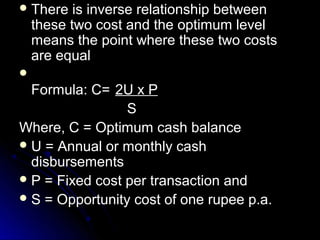
 There    is inverse relationship between
    these two cost and the optimum level
    means the point where these two costs
    are equal

  Formula: C= 2U x P
                 S
Where, C = Optimum cash balance
 U = Annual or monthly cash
  disbursements
 P = Fixed cost per transaction and
 S = Opportunity cost of one rupee p.a.
Miller Orr model:
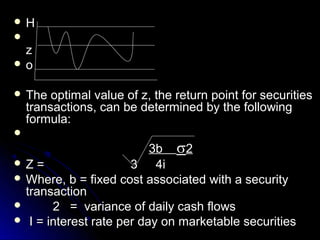
 According to this model, the net cash flow is
  completely stochastic or random.
 This model lays down three control limits,
1.An upper limit (h)
2.A lower limit (o) and
3.A return point (z)
   When    cash balance reaches the upper limit ‘h’, a transfer of
    ‘h – z’ is effected to marketable securities and
   When cash balance reaches the lower limit ‘o’, a transfer
    equal ‘z-o’ from marketable securities to cash is made.
   When cash balance stays between the upper limit and lower
    limit, no transfer is effected
 Both the limits are fixed based on opportunity cost of
  holding cash, degree of fluctuation in cash balance
  and fixed cost associated with security transactions
H

 z
o


 The    optimal value of z, the return point for securities
    transactions, can be determined by the following
    formula:

                          3b 2
Z=                   3 4i
 Where, b = fixed cost associated with a security
  transaction
      2 = variance of daily cash flows
 I = interest rate per day on marketable securities
Management of inventories
 Inventories are goods held for eventual sale by a firm.
  Inventories are thus one of the major elements, which help
  the firm in obtaining the desired level of sales.
Kinds of inventories:
 Raw materials: goods not yet been committed to production
  in a manufacturing firm consists of basic raw materials or
  finished components.
 Work-in-progress: This includes those materials which have
  been committed to production process but not yet been
  completed
 Finished goods: These are completely produced products
  awaiting for sale. They are the final output of the production
  process after inspection in a manufacturing firm and in retail
  and wholesale merchandise, it is referred to as merchandise
  inventory.
 The level of inventory differ depending upon the nature of
  business, time, type of inventory, availability of facilities etc.
Benefits of holding inventories:
 Avoiding losses of sales
 Availing quantity discounts
 Reducing ordering cost
 Achieving efficient production runs,
  thereby reducing the set up costs
 Risks and costs associated with
  inventories such as
   Pricedecline
   Product deterioration
   Obsolescence
Management of inventory
 Good inventory management is good financial
  management
 Inventories constitute a major element of total
  WC hence inventory involve costs
Inventory management covers:-
 Fixation of minimum and maximum levels
 Determining the size of inventory to be carried
 Deciding about the issue price policy
 Setting up receipt and inspection procedure
 Determining the EOQ
 Providing proper storage facilities
 Keeping check on obsolescence and setting up
  effective information system with regard to
  inventories
However, management of inventories from the finance
  manager point of view involves two basic problems:
1.Maintaining a sufficient large size of inventory for
  efficient and smooth production and sales operation
2.Maintaining a minimum investment in inventories to
  minimise the direct/indirect costs associated with
  holding inventories to maximise profitability
 High inventory means high interest cost and high
  storage costs
 Low inventory means interruption in production
  schedule resulting in underutilization of capacity and
  lower sales
So, the objective is to hold optimum
  inventory to ensure:-
 Continuous sufficient stock of raw
  materials in periods of short supply
 Sufficient stock of raw materials in periods
  of short supply
 Sufficient stock of finished goods for
  smooth sales
 Minimum carrying costs
 Investment in inventories at the optimum
  level
Techniques of inventory management
Economic Order quantity
 EOQ refers to the size of the order which gives
  maximum economy in purchasing any item of raw
  material or finished product after taking into
  consideration of the following costs
 Ordering cost – It is the cost of placing an order
  and securing supplies. It varies from time to time
  depending upon the orders placed and the number
  of items ordered. The more frequent the placing of
  orders and few the quantity in each order, greater
  the ordering cost and v.v.
 Inventory carrying cost – It is the cost of keeping
  items in stock, includes interest on investment,
  obsolescence losses, store-keeping cost, insurance
  premium etc. The larger the volume of inventory,
  higher the ICC
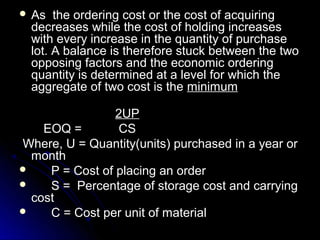
 As   the ordering cost or the cost of acquiring
  decreases while the cost of holding increases
  with every increase in the quantity of purchase
  lot. A balance is therefore stuck between the two
  opposing factors and the economic ordering
  quantity is determined at a level for which the
  aggregate of two cost is the minimum

                 2UP
    EOQ =         CS
Where, U = Quantity(units) purchased in a year or
  month
    P = Cost of placing an order
    S = Percentage of storage cost and carrying
  cost
    C = Cost per unit of material
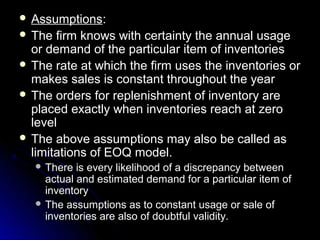
 Assumptions:
 The  firm knows with certainty the annual usage
  or demand of the particular item of inventories
 The rate at which the firm uses the inventories or
  makes sales is constant throughout the year
 The orders for replenishment of inventory are
  placed exactly when inventories reach at zero
  level
 The above assumptions may also be called as
  limitations of EOQ model.
   There  is every likelihood of a discrepancy between
    actual and estimated demand for a particular item of
    inventory
   The assumptions as to constant usage or sale of
    inventories are also of doubtful validity.
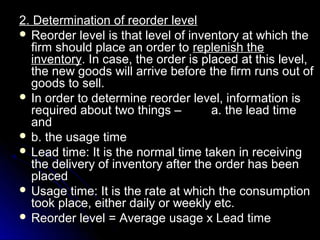
2. Determination of reorder level
 Reorder level is that level of inventory at which the
  firm should place an order to replenish the
  inventory. In case, the order is placed at this level,
  the new goods will arrive before the firm runs out of
  goods to sell.
 In order to determine reorder level, information is
  required about two things –        a. the lead time
  and
 b. the usage time
 Lead time: It is the normal time taken in receiving
  the delivery of inventory after the order has been
  placed
 Usage time: It is the rate at which the consumption
  took place, either daily or weekly etc.
 Reorder level = Average usage x Lead time
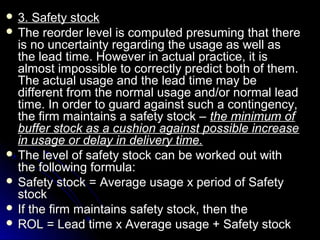
 3.  Safety stock
 The reorder level is computed presuming that there
  is no uncertainty regarding the usage as well as
  the lead time. However in actual practice, it is
  almost impossible to correctly predict both of them.
  The actual usage and the lead time may be
  different from the normal usage and/or normal lead
  time. In order to guard against such a contingency,
  the firm maintains a safety stock – the minimum of
  buffer stock as a cushion against possible increase
  in usage or delay in delivery time.
 The level of safety stock can be worked out with
  the following formula:
 Safety stock = Average usage x period of Safety
  stock
 If the firm maintains safety stock, then the
 ROL = Lead time x Average usage + Safety stock
Accounts receivable management
 Accounts   receivable (also popularly known as
  receivables) constitute a significant portion of the
  total current assets of the business next after
  inventories. They are a direct consequence of ‘trade
  credit’ which has become an essential marketing tool
  in modern business.
 Receivables created in books when goods or
  services are sold on credit.
 Usually, the credit sales are made on open account
  which means that no formal acknowledgements of
  debt obligations are taken from the buyer except the
  PO, shipping documents, despatch statement etc.
 Meaning:   Receivables are asset accounts
  representing amounts owned to the firm as a result of
  sale of goods/services in the ordinary course of
  business.
 The objective of such a facility is to allow the customer
  a reasonable period of time in which they can pay for
  the goods purchased by them.
 Meaning of receivable management
 Receivables as a result of - trade credit – push up
  sales – to push up profit.
 Credit sales leads to blocking of funds – therefore
  additional funds are required for the operating needs
  resulting in additional costs in the form of interest.
 Increase  in trade credits results in bad debts.
 Management of accounts receivables, therefore, is
  defined as the process of making decisions relating
  to the investment of funds in this asset, which will
  result in maximising the overall return on the
  investment of the firm.
Therefore, the objective of receivable management is
  to promote sales and profits until that point is
  reached where the return on investment in further
  funding of receivables is less than the cost of the
  funds raised to finance that additional credit. i.e.
  the cost of capital.
 Purpose of receivables:
 Achieving growth in sales
 Increasing profits
 Meeting competition
Cost of maintaining receivables:
 Capital costs – when funds blocked in
  receivables means raising of additional funds to
  meet other cash out flows, resulting in additional
  capital costs
 Administrative costs
 Collection costs – a. additional operating costs
  for maintaining records etc and b. credit
  information about debtors
 Defaulting costs – bad debts
 Delinquency costs – costs due to non-payment
  in time – sending remainders, getting legal
  opinion etc
Receivable management policies:
 The receivable management has three
  areas:
 Credit policies
 Credit terms
 Collection policies

Credit policies:
The credit policy is based on:
 Credit standards and
 Credit analysis
 Credit standards: Refers to the basic
  consideration for the extension of credit facilities
  to the customers.     If the standards are high,
  the sales and receivables are less and v.v.
 The credit standards are fixed by the factors
  such as:
    Collection  costs such as operating costs such as
     maintaining records, staffing, bad debts, legal
     charges etc – are semi variable – a portion can be
     controlled.
    Average collection period – the time gap between the
     availing of credit and repayment – longer period
     means idle investment.
    Credit ratings – the integrity of the customers
    Financial ratios such as debt collection period, liquid
     and current asset ratios, CA to total assets etc
Credit analysis: The credit analysis is
  usually done in two steps:
 Obtaining credit information – from internal
  or external sources. Usually the internal
  sources are supplemented by the external
  sources of information such as financial
  statements, bank references, trade
  references and specialist credit bureau
  reports.
 Analysis of credit information – by using
  quantitative and qualitative techniques and
  compare with the firm’s credit policies.
 Credit Terms:
     After establishing good credit policy the concern
  should design its credit terms. Credit terms mean the
  principles listed for extending credit facilities to the
  customers. It contains three elements:
 Credit period
 Cash discount
 Cash discount period
 The credit period is highly flexible and vary
  depending upon the nature of business, nature of
  customers, competition, inventory policy etc. Further,
  an earlier period is fixed to avail some concessions
  by the customers in the form of cash discounts vary
  from 1 – 2.5 %. The cash discount is a loss, but
  ensures prompt payments and better turn over of
  cash.
 Collection  policies:
 The collection policies are the procedure to be
  followed in collecting the receivable after the
  expiry of collection period. The collection policy
  can be liberal or strict based on the cost-benefit
  analysis.
 The collection procedure should be fixed, for an
  efficient receivable management.
 The receivable can be collected through,
 Sending reminders
 Personal contacts
 Collection agencies
 Legal action as last resort
Components of working capital

Components of working capital

  • 1.
  • 2.
    The main itemsof WC are: Cash Receivables Inventory
  • 3.
    CASH MANAGEMENT  Cashis the most important component of current assets  It is the most liquid current asset  It includes bank  Other current assets such as receivables and inventory are converted into cash in the ordinary course of business operation  Cash means, in a narrow sense, currency, cheques, drafts and demand drafts in banks, but in broader sense, it includes near-cash assets such as marketable securities, short term deposits also.  Cash management means management of both cash and non-cash assets
  • 4.
    Motives of holdingcash: The cash, though a barren asset, is held by the firms for the following motives:  Transaction motive: Transaction motive refers to the holding of cash to meet routine cash requirements. The business transactions result in both inflows and outflows of cash, which do not perfectly match. To meet a situation where the payment exceeds inflows, the firm should keep cash balance by arranging for cash.
  • 5.
     Precautionary motive: A firm has to keep cash balance to meet unexpected cash needs at short notice as a result of flood, strike, increase in cost of raw material, slow in collection, cancellation of orders etc. the precautionary motive implies the need to hold cash to meet unpredictable situations.  Speculative motive: A firm keeps cash balance to take advantage of unexpected opportunities such as decline in the price of raw materials, discount in the purchase etc. The speculative motive helps to take advantage of the opportunities, which are outside the normal course of the business.
  • 6.
    Objectives of cashmanagement:  The objective is to keep optimal cash balance at all times.  To meet the payment schedule a firm should keep sufficient cash.  Keeping adequate cash prevents insolvency, develops good relation with lenders and suppliers, help to take advantage of business opportunities and enable a firm to meet the contingencies  At the same time, a higher level of cash balance means high cost to the firm.
  • 7.
    Cash management strategies: Thecash management strategies can be examined under four heads-  To keep the minimum level of cash  Controlling inflow of cash  Controlling outflow of cash  Optimal investment of surplus cash To keep the minimum level of cash:  To keep the minimum level of cash the following aspects are to be examined-
  • 8.
    1. Preparation ofcash budget:  The prime objective of preparing cash budget is to know whether there is excess of cash flow in a period. The following two elements are to be taken into consideration for preparing cash budget. a. The first element is the selection of a period. The cash flow should be projected for the given period. Such period should not be too short or too long.
  • 9.
    b. The secondelement is the selection of factors for cash flow. Non-cash items should be carefully excluded. 2. Unpredictable discrepancies:  A certain portion of cash balance is to be kept to meet unpredictable discrepancies such as strikes, riots, floods etc.
  • 10.
    3. Short cost: The cash budget reveals periods of cash shortages. In addition, there may be unexpected short falls. The cost incurred as a result of shortage of cash is called the short cost . This includes, brokerage to raise cash, commitment charges to loan, higher bank charges, penal rates by banks, etc. 4. Availability of other sources of funds:  The availability of external sources to obtain funds on short notice enables a firm to maintain smaller amount of cash balance. Further, the level of cash balance is determined by the relationship of a company with its banks.
  • 11.
    To control inflowof cash: To control the inflow of cash the following points are worth to be noted:  Preventing fraudulent diversion of cash receipts  Speed-up the collection  Proper internal system to prevent defalcations of cash  The following techniques may be adopted for speedier collection of cash:  Concentration banking – have a number of collection centres and open bank accounts in each collection centre and direct the bank to transfer the proceeds to HO  Lock box system – hire a post office box and direct the local bank to collect the cheques and transfer the proceeds to HO
  • 12.
    Control over cashoutflows:  The control over cash inflows aims at maximum acceleration of collections whereas the control over cash outflows tries to slow down the disbursement as much as possible without affecting the credit standing of the firm. The combination of these two result in maximum availability of funds  Methods:  Do not make the payments early i.e. before the due date  All payments should be made by the HO from a centralised disbursement
  • 13.
     Float –means the amount of money tied up in cheques that have been written but not presented for payment  Methods of float:  The firm may issue a cheque away from the creditor’s bank  Analyse the time lag in issue and encashment and arrange fund accordingly  But, playing float involves high amount of risk
  • 14.
    Investing surplus cash: Surpluscash is the amount in excess of the firm’s normal cash requirement. This involves –  Determination of the amount of surplus cash and  Determination of the channels of investment  Keep the safety level of cash and go for investment of the balance amount  While make the investment keep always in mind the security, liquidity, yield and maturity
  • 15.
    Cash management models: BaumolModel:  Suggested by William J Baumol, similar to the EOQ in inventory control.  According to this model, optimum cash level is that level of cash where the carrying costs and transactions costs are minimum.  Carrying costs – refers to the cost of holding cash – i.e. the opportunity cost  Transaction costs – refers to the cost involved in getting the marketable securities converted into cash such as clerical, brokerage, registration etc
  • 16.
     There is inverse relationship between these two cost and the optimum level means the point where these two costs are equal  Formula: C= 2U x P S Where, C = Optimum cash balance  U = Annual or monthly cash disbursements  P = Fixed cost per transaction and  S = Opportunity cost of one rupee p.a.
  • 17.
    Miller Orr model: According to this model, the net cash flow is completely stochastic or random.  This model lays down three control limits, 1.An upper limit (h) 2.A lower limit (o) and 3.A return point (z)  When cash balance reaches the upper limit ‘h’, a transfer of ‘h – z’ is effected to marketable securities and  When cash balance reaches the lower limit ‘o’, a transfer equal ‘z-o’ from marketable securities to cash is made.  When cash balance stays between the upper limit and lower limit, no transfer is effected  Both the limits are fixed based on opportunity cost of holding cash, degree of fluctuation in cash balance and fixed cost associated with security transactions
  • 18.
    H  z o  The optimal value of z, the return point for securities transactions, can be determined by the following formula:  3b 2 Z= 3 4i  Where, b = fixed cost associated with a security transaction  2 = variance of daily cash flows  I = interest rate per day on marketable securities
  • 19.
    Management of inventories Inventories are goods held for eventual sale by a firm. Inventories are thus one of the major elements, which help the firm in obtaining the desired level of sales. Kinds of inventories:  Raw materials: goods not yet been committed to production in a manufacturing firm consists of basic raw materials or finished components.  Work-in-progress: This includes those materials which have been committed to production process but not yet been completed  Finished goods: These are completely produced products awaiting for sale. They are the final output of the production process after inspection in a manufacturing firm and in retail and wholesale merchandise, it is referred to as merchandise inventory.  The level of inventory differ depending upon the nature of business, time, type of inventory, availability of facilities etc.
  • 20.
    Benefits of holdinginventories:  Avoiding losses of sales  Availing quantity discounts  Reducing ordering cost  Achieving efficient production runs, thereby reducing the set up costs  Risks and costs associated with inventories such as  Pricedecline  Product deterioration  Obsolescence
  • 21.
    Management of inventory Good inventory management is good financial management  Inventories constitute a major element of total WC hence inventory involve costs Inventory management covers:-  Fixation of minimum and maximum levels  Determining the size of inventory to be carried  Deciding about the issue price policy  Setting up receipt and inspection procedure  Determining the EOQ  Providing proper storage facilities  Keeping check on obsolescence and setting up effective information system with regard to inventories
  • 22.
    However, management ofinventories from the finance manager point of view involves two basic problems: 1.Maintaining a sufficient large size of inventory for efficient and smooth production and sales operation 2.Maintaining a minimum investment in inventories to minimise the direct/indirect costs associated with holding inventories to maximise profitability  High inventory means high interest cost and high storage costs  Low inventory means interruption in production schedule resulting in underutilization of capacity and lower sales
  • 23.
    So, the objectiveis to hold optimum inventory to ensure:-  Continuous sufficient stock of raw materials in periods of short supply  Sufficient stock of raw materials in periods of short supply  Sufficient stock of finished goods for smooth sales  Minimum carrying costs  Investment in inventories at the optimum level
  • 24.
    Techniques of inventorymanagement Economic Order quantity  EOQ refers to the size of the order which gives maximum economy in purchasing any item of raw material or finished product after taking into consideration of the following costs  Ordering cost – It is the cost of placing an order and securing supplies. It varies from time to time depending upon the orders placed and the number of items ordered. The more frequent the placing of orders and few the quantity in each order, greater the ordering cost and v.v.  Inventory carrying cost – It is the cost of keeping items in stock, includes interest on investment, obsolescence losses, store-keeping cost, insurance premium etc. The larger the volume of inventory, higher the ICC
  • 25.
     As the ordering cost or the cost of acquiring decreases while the cost of holding increases with every increase in the quantity of purchase lot. A balance is therefore stuck between the two opposing factors and the economic ordering quantity is determined at a level for which the aggregate of two cost is the minimum 2UP EOQ = CS Where, U = Quantity(units) purchased in a year or month  P = Cost of placing an order  S = Percentage of storage cost and carrying cost  C = Cost per unit of material
  • 26.
     Assumptions:  The firm knows with certainty the annual usage or demand of the particular item of inventories  The rate at which the firm uses the inventories or makes sales is constant throughout the year  The orders for replenishment of inventory are placed exactly when inventories reach at zero level  The above assumptions may also be called as limitations of EOQ model.  There is every likelihood of a discrepancy between actual and estimated demand for a particular item of inventory  The assumptions as to constant usage or sale of inventories are also of doubtful validity.
  • 27.
    2. Determination ofreorder level  Reorder level is that level of inventory at which the firm should place an order to replenish the inventory. In case, the order is placed at this level, the new goods will arrive before the firm runs out of goods to sell.  In order to determine reorder level, information is required about two things – a. the lead time and  b. the usage time  Lead time: It is the normal time taken in receiving the delivery of inventory after the order has been placed  Usage time: It is the rate at which the consumption took place, either daily or weekly etc.  Reorder level = Average usage x Lead time
  • 28.
     3. Safety stock  The reorder level is computed presuming that there is no uncertainty regarding the usage as well as the lead time. However in actual practice, it is almost impossible to correctly predict both of them. The actual usage and the lead time may be different from the normal usage and/or normal lead time. In order to guard against such a contingency, the firm maintains a safety stock – the minimum of buffer stock as a cushion against possible increase in usage or delay in delivery time.  The level of safety stock can be worked out with the following formula:  Safety stock = Average usage x period of Safety stock  If the firm maintains safety stock, then the  ROL = Lead time x Average usage + Safety stock
  • 29.
    Accounts receivable management Accounts receivable (also popularly known as receivables) constitute a significant portion of the total current assets of the business next after inventories. They are a direct consequence of ‘trade credit’ which has become an essential marketing tool in modern business.  Receivables created in books when goods or services are sold on credit.  Usually, the credit sales are made on open account which means that no formal acknowledgements of debt obligations are taken from the buyer except the PO, shipping documents, despatch statement etc.
  • 30.
     Meaning: Receivables are asset accounts representing amounts owned to the firm as a result of sale of goods/services in the ordinary course of business.  The objective of such a facility is to allow the customer a reasonable period of time in which they can pay for the goods purchased by them.  Meaning of receivable management  Receivables as a result of - trade credit – push up sales – to push up profit.  Credit sales leads to blocking of funds – therefore additional funds are required for the operating needs resulting in additional costs in the form of interest.
  • 31.
     Increase in trade credits results in bad debts.  Management of accounts receivables, therefore, is defined as the process of making decisions relating to the investment of funds in this asset, which will result in maximising the overall return on the investment of the firm. Therefore, the objective of receivable management is to promote sales and profits until that point is reached where the return on investment in further funding of receivables is less than the cost of the funds raised to finance that additional credit. i.e. the cost of capital.  Purpose of receivables:  Achieving growth in sales  Increasing profits  Meeting competition
  • 32.
    Cost of maintainingreceivables:  Capital costs – when funds blocked in receivables means raising of additional funds to meet other cash out flows, resulting in additional capital costs  Administrative costs  Collection costs – a. additional operating costs for maintaining records etc and b. credit information about debtors  Defaulting costs – bad debts  Delinquency costs – costs due to non-payment in time – sending remainders, getting legal opinion etc
  • 33.
    Receivable management policies: The receivable management has three areas:  Credit policies  Credit terms  Collection policies Credit policies: The credit policy is based on:  Credit standards and  Credit analysis
  • 34.
     Credit standards:Refers to the basic consideration for the extension of credit facilities to the customers. If the standards are high, the sales and receivables are less and v.v.  The credit standards are fixed by the factors such as:  Collection costs such as operating costs such as maintaining records, staffing, bad debts, legal charges etc – are semi variable – a portion can be controlled.  Average collection period – the time gap between the availing of credit and repayment – longer period means idle investment.  Credit ratings – the integrity of the customers  Financial ratios such as debt collection period, liquid and current asset ratios, CA to total assets etc
  • 35.
    Credit analysis: Thecredit analysis is usually done in two steps:  Obtaining credit information – from internal or external sources. Usually the internal sources are supplemented by the external sources of information such as financial statements, bank references, trade references and specialist credit bureau reports.  Analysis of credit information – by using quantitative and qualitative techniques and compare with the firm’s credit policies.
  • 36.
     Credit Terms:  After establishing good credit policy the concern should design its credit terms. Credit terms mean the principles listed for extending credit facilities to the customers. It contains three elements:  Credit period  Cash discount  Cash discount period  The credit period is highly flexible and vary depending upon the nature of business, nature of customers, competition, inventory policy etc. Further, an earlier period is fixed to avail some concessions by the customers in the form of cash discounts vary from 1 – 2.5 %. The cash discount is a loss, but ensures prompt payments and better turn over of cash.
  • 37.
     Collection policies:  The collection policies are the procedure to be followed in collecting the receivable after the expiry of collection period. The collection policy can be liberal or strict based on the cost-benefit analysis.  The collection procedure should be fixed, for an efficient receivable management.  The receivable can be collected through,  Sending reminders  Personal contacts  Collection agencies  Legal action as last resort