“
”
Working Capital Financing:-
Tandon Committee
Dr.ANURAG KUMAR ASSOCIATE PROFESSOR DEPTT. OF MBA,
ABES EC GHAZIABAD
Regulation of Bank Finance
in India
• BANK credit has been an important and
inevitable source of short term financing or
working capital finance for most of the
business firms.
• RBI has appointed different study groups from
time to time to suggest ways and means to
make the bank credit as an effective
measurement of industrialization as well as to
ensure equitable distribution of bank
resources.
Committees
• Important recommendations and directives have
stemmed from these groups.
– Tandon committee.
– Daheija committee.
– Chore committee.
– Marathe committee.
Tandon committee
• The Reserve Bank of India appointed in July 1974
a Study Group, under the Chairmanship of Sri P L
Tandon to frame guidelines for the follow-up of
bank credit.
• The practices of most of the banks are still influenced by
tandon committee recommendations though financial
liberalization occurred in 1990s.
• .
Tandon committee
Terms of reference
1. To suggest guidelines for commercial banks to follow up and supervise
credit from the point of view of ensuring proper end-use of funds and keeping
a watch on the safety of advances.
2. To make recommendations for obtaining periodical information that may
be obtained by banks from the borrower.
3. To suggest criteria regarding satisfactory capital structure and sound
financial basis in relation to borrowings.
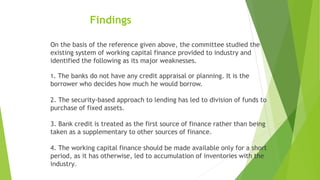
Findings
On the basis of the reference given above, the committee studied the
existing system of working capital finance provided to industry and
identified the following as its major weaknesses.
1. The banks do not have any credit appraisal or planning. It is the
borrower who decides how much he would borrow.
2. The security-based approach to lending has led to division of funds to
purchase of fixed assets.
3. Bank credit is treated as the first source of finance rather than being
taken as a supplementary to other sources of finance.
4. The working capital finance should be made available only for a short
period, as it has otherwise, led to accumulation of inventories with the
industry.
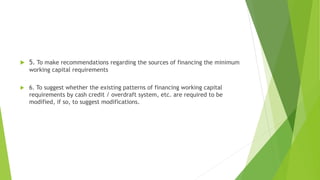
 5. To make recommendations regarding the sources of financing the minimum
working capital requirements
 6. To suggest whether the existing patterns of financing working capital
requirements by cash credit / overdraft system, etc. are required to be
modified, if so, to suggest modifications.
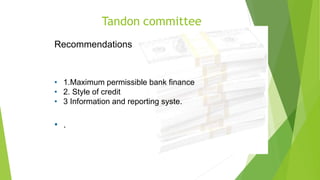
Tandon committee
Recommendations
• 1.Maximum permissible bank finance
• 2. Style of credit
• 3 Information and reporting syste.
• .
Maximum permissible bank
finance (MPBF)
 Tandon Committee introduced the concept of MPBF in the working
capital finance by banker. The Committee suggested that bank should
attempt to supplement the borrowers’ resources in financing the
current assets. It has recommended that the current assets first
should be financed by trade creditors and other current liabilities.
The remaining current assets, which is called working capital gap,
should be financed particularly by bankers in the form of bank credit
and through long-term borrowings or owner’s funds. In the context of
this approach, the committee has suggested three alternative
methods for working out the MPBF. Each successive method reduces
the involvement of short-term bank credit to finance the current
assets.
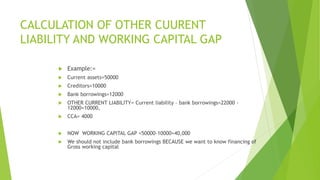
CALCULATION OF OTHER CUURENT
LIABILITY AND WORKING CAPITAL GAP
 Example:=
 Current assets=50000
 Creditors=10000
 Bank borrowings=12000
 OTHER CURRENT LIABILITY= Current liability – bank borrowings=22000 -
12000=10000,
 CCA= 4000
 NOW WORKING CAPITAL GAP =50000-10000=40,000
 We should not include bank borrowings BECAUSE we want to know financing of
Gross working capital.
Tandon committee
Maximum permissible bank finance (MPBF)
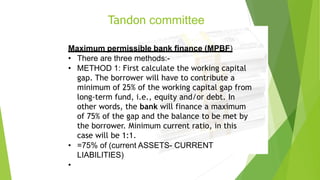
• There are three methods:-
• METHOD 1: First calculate the working capital
gap. The borrower will have to contribute a
minimum of 25% of the working capital gap from
long-term fund, i.e., equity and/or debt. In
other words, the bank will finance a maximum
of 75% of the gap and the balance to be met by
the borrower. Minimum current ratio, in this
case will be 1:1.
• =75% of (current ASSETS- CURRENT
LIABILITIES)
•
METHOD – 2
 ;The borrower will have to provide a minimum of 25% of total current assets
out of long-term funds (i.e., owned funds plus term borrowings), balance will
be financed by other current liabilities (excluding bank borrowings) first and
then by bank credit. Total current liabilities {including bank borrowings) must
not exceed 75% of current assets.
Minimum current ratio, in this case, at least, will be 1.3: 1
 METHOD 2:= ( 75% OFCA)- CL
.
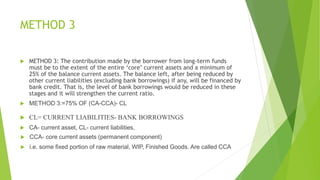
METHOD 3
 METHOD 3: The contribution made by the borrower from long-term funds
must be to the extent of the entire ‘core’ current assets and a minimum of
25% of the balance current assets. The balance left, after being reduced by
other current liabilities (excluding bank borrowings) if any, will be financed by
bank credit. That is, the level of bank borrowings would be reduced in these
stages and it will strengthen the current ratio.
 METHOD 3:=75% OF (CA-CCA)- CL
 CL= CURRENT LIABILITIES- BANK BORROWINGS
 CA- current asset, CL- current liabilities,
 CCA- core current assets (permanent component)
 i.e. some fixed portion of raw material, WIP, Finished Goods. Are called CCA
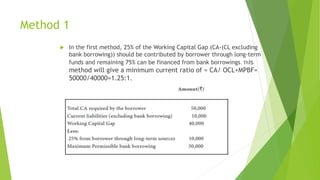
Method 1
 In the first method, 25% of the Working Capital Gap (CA-(CL excluding
bank borrowing)) should be contributed by borrower through long-term
funds and remaining 75% can be financed from bank borrowings. This
method will give a minimum current ratio of = CA/ OCL+MPBF=
50000/40000=1.25:1.
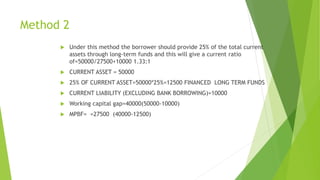
Method 2
 Under this method the borrower should provide 25% of the total current
assets through long-term funds and this will give a current ratio
of=50000/27500+10000 1.33:1
 CURRENT ASSET = 50000
 25% OF CURRENT ASSET=50000*25%=12500 FINANCED LONG TERM FUNDS
 CURRENT LIABILITY (EXCLUDING BANK BORROWING)=10000
 Working capital gap=40000(50000-10000)
 MPBF= =27500 (40000-12500)
Third method
THIRD METHOD

In this method the borrower should contribute from long-term
sources to the extent of core current assets (Fixed Current
assets) and 25% of the balance of the current assets. The
remaining of the working capital gap can be met from bank
borrowings. This method will further strengthen the current
ratio.
 Cuurent ratio = 50000/ 24500+10000=1.44:1

Comparison of MPBF
 Method 1=30000 CR=1.25:1
 Method 2=27500 CR=1.33:1
 Method 3=24500 CR=1.44:1
 MPBF decreases gradually from first method to 2nd and then to 3rd method .
 Method 1 is liberal as compare to Method 2 & 3
 Method 2 & 3 is stringent as compare to method 1.
 2. Style of credit
 3. Information and reporting system
Conclusion:-
 Tandon committee recommended that a beginning should be made by placing
all borrowers on the first method with in ayear and then moving to 2nd & 3rd
method in the light of prevailing circumstances .
 The borrowers in excess of what is permissible under the first method should
be converted into WCTL( working capital term loan ) and should be repaid
over a period of time.

working capital financing:-Tandon committee

  • 1.
    “ ” Working Capital Financing:- TandonCommittee Dr.ANURAG KUMAR ASSOCIATE PROFESSOR DEPTT. OF MBA, ABES EC GHAZIABAD
  • 2.
    Regulation of BankFinance in India • BANK credit has been an important and inevitable source of short term financing or working capital finance for most of the business firms. • RBI has appointed different study groups from time to time to suggest ways and means to make the bank credit as an effective measurement of industrialization as well as to ensure equitable distribution of bank resources.
  • 3.
    Committees • Important recommendationsand directives have stemmed from these groups. – Tandon committee. – Daheija committee. – Chore committee. – Marathe committee.
  • 4.
    Tandon committee • TheReserve Bank of India appointed in July 1974 a Study Group, under the Chairmanship of Sri P L Tandon to frame guidelines for the follow-up of bank credit. • The practices of most of the banks are still influenced by tandon committee recommendations though financial liberalization occurred in 1990s. • .
  • 5.
    Tandon committee Terms ofreference 1. To suggest guidelines for commercial banks to follow up and supervise credit from the point of view of ensuring proper end-use of funds and keeping a watch on the safety of advances. 2. To make recommendations for obtaining periodical information that may be obtained by banks from the borrower. 3. To suggest criteria regarding satisfactory capital structure and sound financial basis in relation to borrowings.
  • 6.
    Findings On the basisof the reference given above, the committee studied the existing system of working capital finance provided to industry and identified the following as its major weaknesses. 1. The banks do not have any credit appraisal or planning. It is the borrower who decides how much he would borrow. 2. The security-based approach to lending has led to division of funds to purchase of fixed assets. 3. Bank credit is treated as the first source of finance rather than being taken as a supplementary to other sources of finance. 4. The working capital finance should be made available only for a short period, as it has otherwise, led to accumulation of inventories with the industry.
  • 7.
     5. Tomake recommendations regarding the sources of financing the minimum working capital requirements  6. To suggest whether the existing patterns of financing working capital requirements by cash credit / overdraft system, etc. are required to be modified, if so, to suggest modifications.
  • 8.
    Tandon committee Recommendations • 1.Maximumpermissible bank finance • 2. Style of credit • 3 Information and reporting syste. • .
  • 9.
    Maximum permissible bank finance(MPBF)  Tandon Committee introduced the concept of MPBF in the working capital finance by banker. The Committee suggested that bank should attempt to supplement the borrowers’ resources in financing the current assets. It has recommended that the current assets first should be financed by trade creditors and other current liabilities. The remaining current assets, which is called working capital gap, should be financed particularly by bankers in the form of bank credit and through long-term borrowings or owner’s funds. In the context of this approach, the committee has suggested three alternative methods for working out the MPBF. Each successive method reduces the involvement of short-term bank credit to finance the current assets.
  • 10.
    CALCULATION OF OTHERCUURENT LIABILITY AND WORKING CAPITAL GAP  Example:=  Current assets=50000  Creditors=10000  Bank borrowings=12000  OTHER CURRENT LIABILITY= Current liability – bank borrowings=22000 - 12000=10000,  CCA= 4000  NOW WORKING CAPITAL GAP =50000-10000=40,000  We should not include bank borrowings BECAUSE we want to know financing of Gross working capital.
  • 11.
    Tandon committee Maximum permissiblebank finance (MPBF) • There are three methods:- • METHOD 1: First calculate the working capital gap. The borrower will have to contribute a minimum of 25% of the working capital gap from long-term fund, i.e., equity and/or debt. In other words, the bank will finance a maximum of 75% of the gap and the balance to be met by the borrower. Minimum current ratio, in this case will be 1:1. • =75% of (current ASSETS- CURRENT LIABILITIES) •
  • 12.
    METHOD – 2 ;The borrower will have to provide a minimum of 25% of total current assets out of long-term funds (i.e., owned funds plus term borrowings), balance will be financed by other current liabilities (excluding bank borrowings) first and then by bank credit. Total current liabilities {including bank borrowings) must not exceed 75% of current assets. Minimum current ratio, in this case, at least, will be 1.3: 1  METHOD 2:= ( 75% OFCA)- CL .
  • 13.
    METHOD 3  METHOD3: The contribution made by the borrower from long-term funds must be to the extent of the entire ‘core’ current assets and a minimum of 25% of the balance current assets. The balance left, after being reduced by other current liabilities (excluding bank borrowings) if any, will be financed by bank credit. That is, the level of bank borrowings would be reduced in these stages and it will strengthen the current ratio.  METHOD 3:=75% OF (CA-CCA)- CL  CL= CURRENT LIABILITIES- BANK BORROWINGS  CA- current asset, CL- current liabilities,  CCA- core current assets (permanent component)  i.e. some fixed portion of raw material, WIP, Finished Goods. Are called CCA
  • 14.
    Method 1  Inthe first method, 25% of the Working Capital Gap (CA-(CL excluding bank borrowing)) should be contributed by borrower through long-term funds and remaining 75% can be financed from bank borrowings. This method will give a minimum current ratio of = CA/ OCL+MPBF= 50000/40000=1.25:1.
  • 15.
    Method 2  Underthis method the borrower should provide 25% of the total current assets through long-term funds and this will give a current ratio of=50000/27500+10000 1.33:1  CURRENT ASSET = 50000  25% OF CURRENT ASSET=50000*25%=12500 FINANCED LONG TERM FUNDS  CURRENT LIABILITY (EXCLUDING BANK BORROWING)=10000  Working capital gap=40000(50000-10000)  MPBF= =27500 (40000-12500)
  • 16.
  • 17.
    THIRD METHOD  In thismethod the borrower should contribute from long-term sources to the extent of core current assets (Fixed Current assets) and 25% of the balance of the current assets. The remaining of the working capital gap can be met from bank borrowings. This method will further strengthen the current ratio.  Cuurent ratio = 50000/ 24500+10000=1.44:1 
  • 18.
    Comparison of MPBF Method 1=30000 CR=1.25:1  Method 2=27500 CR=1.33:1  Method 3=24500 CR=1.44:1  MPBF decreases gradually from first method to 2nd and then to 3rd method .  Method 1 is liberal as compare to Method 2 & 3  Method 2 & 3 is stringent as compare to method 1.
  • 19.
     2. Styleof credit  3. Information and reporting system
  • 20.
    Conclusion:-  Tandon committeerecommended that a beginning should be made by placing all borrowers on the first method with in ayear and then moving to 2nd & 3rd method in the light of prevailing circumstances .  The borrowers in excess of what is permissible under the first method should be converted into WCTL( working capital term loan ) and should be repaid over a period of time.