Cash Management Model


           By
           Godfrey Ouseph
Cash Management Model
• A number of mathematical model have been
  to develop to determined the optimal cash
  balance.
• Two of such model are as follow;
   a) William J. Baumol's inventory model
   b) M. H. Miller and Daniel Orr’s Stochastic
      model
William J. Baumol's Inventory model
Baumol’s model of cash management-
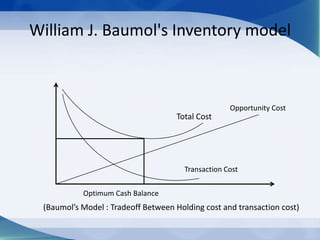
• Trades off between opportunity cost or
  carrying cost or holding cost & the transaction
  cost. As such firm attempts to minimize the
  sum of the holding cash & the cost of
  converting marketable securities in to cash.
• Helps in determining a firm's optimum cash
  balance under certainty
William J. Baumol's Inventory model


                                                    Opportunity Cost
                                    Total Cost


                                       Transaction Cost


           Optimum Cash Balance
 (Baumol’s Model : Tradeoff Between Holding cost and transaction cost)
William J. Baumol's Inventory model

Assumptions
• Cash needs of the firm is known with certainty
• Cash Disbursement over a period of time is
  known with certainty
• Opportunity cost of holding cash is known and
  remains constant
• Transaction cost of converting securities into
  cash is known and remains constant
William J. Baumol's Inventory model
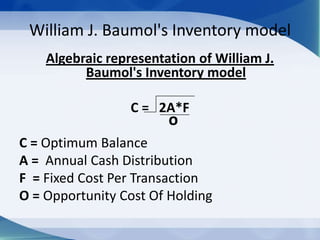
    Algebraic representation of William J.
          Baumol's Inventory model

                  C = 2A*F
                        o
C = Optimum Balance
A = Annual Cash Distribution
F = Fixed Cost Per Transaction
O = Opportunity Cost Of Holding
William J. Baumol's Inventory model
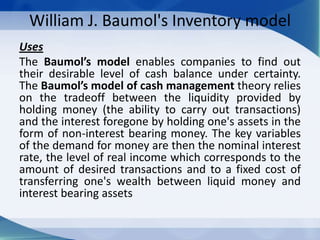
Uses
The Baumol’s model enables companies to find out
their desirable level of cash balance under certainty.
The Baumol’s model of cash management theory relies
on the tradeoff between the liquidity provided by
holding money (the ability to carry out transactions)
and the interest foregone by holding one's assets in the
form of non-interest bearing money. The key variables
of the demand for money are then the nominal interest
rate, the level of real income which corresponds to the
amount of desired transactions and to a fixed cost of
transferring one's wealth between liquid money and
interest bearing assets
William J. Baumol's Inventory model
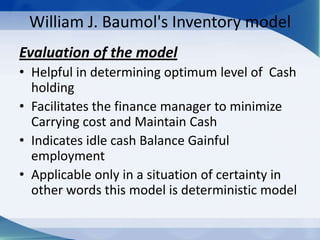
Evaluation of the model
• Helpful in determining optimum level of Cash
  holding
• Facilitates the finance manager to minimize
  Carrying cost and Maintain Cash
• Indicates idle cash Balance Gainful
  employment
• Applicable only in a situation of certainty in
  other words this model is deterministic model
M. H. Miller and Daniel Orr’s
           Stochastic Model
Overview
• The Miller and Orr model of cash
  management is one of the various cash
  management models in operation. It is an
  important cash management model as well. It
  helps the present day companies to manage
  their cash while taking into consideration the
  fluctuations in daily cash flow.
M. H. Miller and Daniel Orr’s
          Stochastic Model
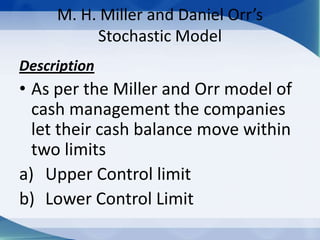
Description
• As per the Miller and Orr model of
  cash management the companies
  let their cash balance move within
  two limits
a) Upper Control limit
b) Lower Control Limit
M. H. Miller and Daniel Orr’s
                    Stochastic Model
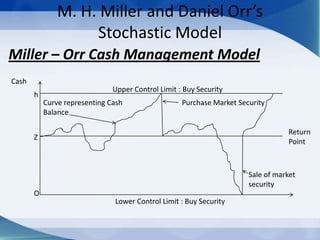
Miller – Orr Cash Management Model
Cash
                               Upper Control Limit : Buy Security
       h
           Curve representing Cash                  Purchase Market Security
           Balance

                                                                                   Return
       Z
                                                                                   Point


                                                                       Sale of market
                                                                       security
       O
                               Lower Control Limit : Buy Security
M. H. Miller and Daniel Orr’s
           Stochastic Model
Explanation For the Diagram
• Along with a return point when the cash
  balance touches the upper Control limit (h),
  the marketable security is purchased to the
  extend till it reaches normal cash balance (Z)
• In the same manner when the cash balance
  touches lower limit (o), the firm Will Sell the
  Marketable security to the extent till it
  reaches normal cash Balance (Z)
M. H. Miller and Daniel Orr’s
              Stochastic Model
       Computation of Miller – Orr Model of Cash
                     Management

                                                                  1/3
Spread (Z)= (3/4 * Transaction cost *Variance of Cash Flow)
                                   Interest Rate
Return Point = Lower limit + Spread (Z)
                                        3
                                                     2        2
Variance of Cash Flow = (Standard Deviation) or (             )
M. H. Miller and Daniel Orr’s
           Stochastic Model
Benefits

• Allows for net cash flow in a random fashion.
• transfer can take place at any time and are
  instantaneous with a fixed transfer cost.
• Produce control limit can be used as basis for
  balance management
M. H. Miller and Daniel Orr’s
          Stochastic Model
Limitations
• May prove difficult to calculate.
• Monitoring needs to be calculated for
  the organizations benefits becomes a
  tedious Work.
M. H. Miller and Daniel Orr’s
           Stochastic Model
Application
• Finding out the approximate prices at which
  the salable securities could be sold or bought
• Deciding the minimum possible levels of
  desired cash balance
• Checking the rate of interest
• Calculating the SD (Standard Deviation) of
  regular cash flows
M. H. Miller and Daniel Orr’s
           Stochastic Model
Evaluation of the Model
• This Stochastic model can be employed even
  in extreme uncertainty
• When the cash flow fluctuate violently in
  short period it will give optimal result
• Finance Manager can apply this model in
  highly unpredictable situation

Cash management model

  • 1.
    Cash Management Model By Godfrey Ouseph
  • 2.
    Cash Management Model •A number of mathematical model have been to develop to determined the optimal cash balance. • Two of such model are as follow; a) William J. Baumol's inventory model b) M. H. Miller and Daniel Orr’s Stochastic model
  • 3.
    William J. Baumol'sInventory model Baumol’s model of cash management- • Trades off between opportunity cost or carrying cost or holding cost & the transaction cost. As such firm attempts to minimize the sum of the holding cash & the cost of converting marketable securities in to cash. • Helps in determining a firm's optimum cash balance under certainty
  • 4.
    William J. Baumol'sInventory model Opportunity Cost Total Cost Transaction Cost Optimum Cash Balance (Baumol’s Model : Tradeoff Between Holding cost and transaction cost)
  • 5.
    William J. Baumol'sInventory model Assumptions • Cash needs of the firm is known with certainty • Cash Disbursement over a period of time is known with certainty • Opportunity cost of holding cash is known and remains constant • Transaction cost of converting securities into cash is known and remains constant
  • 6.
    William J. Baumol'sInventory model Algebraic representation of William J. Baumol's Inventory model C = 2A*F o C = Optimum Balance A = Annual Cash Distribution F = Fixed Cost Per Transaction O = Opportunity Cost Of Holding
  • 7.
    William J. Baumol'sInventory model Uses The Baumol’s model enables companies to find out their desirable level of cash balance under certainty. The Baumol’s model of cash management theory relies on the tradeoff between the liquidity provided by holding money (the ability to carry out transactions) and the interest foregone by holding one's assets in the form of non-interest bearing money. The key variables of the demand for money are then the nominal interest rate, the level of real income which corresponds to the amount of desired transactions and to a fixed cost of transferring one's wealth between liquid money and interest bearing assets
  • 8.
    William J. Baumol'sInventory model Evaluation of the model • Helpful in determining optimum level of Cash holding • Facilitates the finance manager to minimize Carrying cost and Maintain Cash • Indicates idle cash Balance Gainful employment • Applicable only in a situation of certainty in other words this model is deterministic model
  • 9.
    M. H. Millerand Daniel Orr’s Stochastic Model Overview • The Miller and Orr model of cash management is one of the various cash management models in operation. It is an important cash management model as well. It helps the present day companies to manage their cash while taking into consideration the fluctuations in daily cash flow.
  • 10.
    M. H. Millerand Daniel Orr’s Stochastic Model Description • As per the Miller and Orr model of cash management the companies let their cash balance move within two limits a) Upper Control limit b) Lower Control Limit
  • 11.
    M. H. Millerand Daniel Orr’s Stochastic Model Miller – Orr Cash Management Model Cash Upper Control Limit : Buy Security h Curve representing Cash Purchase Market Security Balance Return Z Point Sale of market security O Lower Control Limit : Buy Security
  • 12.
    M. H. Millerand Daniel Orr’s Stochastic Model Explanation For the Diagram • Along with a return point when the cash balance touches the upper Control limit (h), the marketable security is purchased to the extend till it reaches normal cash balance (Z) • In the same manner when the cash balance touches lower limit (o), the firm Will Sell the Marketable security to the extent till it reaches normal cash Balance (Z)
  • 13.
    M. H. Millerand Daniel Orr’s Stochastic Model Computation of Miller – Orr Model of Cash Management 1/3 Spread (Z)= (3/4 * Transaction cost *Variance of Cash Flow) Interest Rate Return Point = Lower limit + Spread (Z) 3 2 2 Variance of Cash Flow = (Standard Deviation) or ( )
  • 14.
    M. H. Millerand Daniel Orr’s Stochastic Model Benefits • Allows for net cash flow in a random fashion. • transfer can take place at any time and are instantaneous with a fixed transfer cost. • Produce control limit can be used as basis for balance management
  • 15.
    M. H. Millerand Daniel Orr’s Stochastic Model Limitations • May prove difficult to calculate. • Monitoring needs to be calculated for the organizations benefits becomes a tedious Work.
  • 16.
    M. H. Millerand Daniel Orr’s Stochastic Model Application • Finding out the approximate prices at which the salable securities could be sold or bought • Deciding the minimum possible levels of desired cash balance • Checking the rate of interest • Calculating the SD (Standard Deviation) of regular cash flows
  • 17.
    M. H. Millerand Daniel Orr’s Stochastic Model Evaluation of the Model • This Stochastic model can be employed even in extreme uncertainty • When the cash flow fluctuate violently in short period it will give optimal result • Finance Manager can apply this model in highly unpredictable situation