DR D DEEPA
Assistant Professor
Department of Management Science – BBA CA
Sri Ramakrishna College of Arts and Science
Coimbatore - 641 006
Tamil Nadu, India
22BMC602 - FINANCIAL MANAGEMENT
CASH MANAGMENT
1
CASH MANAGEMENT
MEANING: Cash is recorded as a current asset on the balance sheet. Even though
cash can be saved for future periods, it is still considered a current asset because it
can because it can be used in one period.
MOTIVES FOR HOLDING CASH:
1. Transaction motive
2. Speculative motive
3. Precautionary motive
4. Compensation motive
FACTORS DETERMINING CASH NEEDS:
5. Credit position of the firm
6. Status of firm’s receivable
7. Status of firm’s inventory account
8. Nature of business enterprise
9. Management’s attitude towards risk
10. Amount of sales in relation to assets
11. Cash inflows and cash outflows
12. Cost of cash balance
CASH MANAGEMENT
Meaning: Cash management refers to
management of cash balance and the bank
balance including the short term deposits.
Objectives of cash management:
1. Meeting the payment schedule
2. Minimizing funds committed to cash balance
CASH MANAGEMENT
Importance of cash management:
Cash management is one of the critical areas of working capital
management and assumes greater significance because it is most liquid asset
used to satisfy the firm’s obligations but it is a sterile asset as it does not
yield anything. Therefore, finance manager has to so manage cash that the
firm maintains its liquidity position without Jeopardizing the profitability.
Problem of prognosticating cash flows accurately and absence of perfect
coincidence between the inflows and outflows of cash add to the
significance of cash management. In view of the above, at one time a firm
may experience dearth of cash because payments of taxes, dividends,
seasonal inventory, etc. build up while at other times, it may have surfeit of
cash stemming out of large cash sales and quick collections of receivables.
It is interesting to observe that in real life, management spends his
considerable time in managing cash which constitutes relatively a small
proportion of a firm’s current assets. This is why in recent years a number of
new techniques have been evolved to minimize cash holding of the firm.
STRATEGIES OF CASH MANAGEMENT
1. Stretching accounts payable
2. Speeding collection of accounts receivable
3. Efficient inventory-production
4. Combined cash management strategies
TECHNIQUES/PROCESS OF CASH MANAGEMENT
1. Cash management planning
2. Determining the optimum cash balance
3. Cash management control
I. ACCELERATING CASH INFLOWS
METHODS OF ACCELERATING CASH INFLOWS:
1. Prompt payment by customers
2. Early conversion of payments into cash
3. Concentrating banking
4. Lock box system
II. CONTROLLING CASH OUTFLOWS
METHODS OF SLOWING DISBURSEMENT
1. Payments through drafts
2. Adjusting payroll funds
3. Inter-bank transfer
4. Avoidance of early payments
5. Centralized disbursements
6. Paying the float
COMPONENTS OF FLOAT
1. Mail time
2. Processing time
3. Collection time
TECHNIQUES/PROCESS OF CASH MANAGEMENT
1. Collection float
2. Payment float
3. Net float
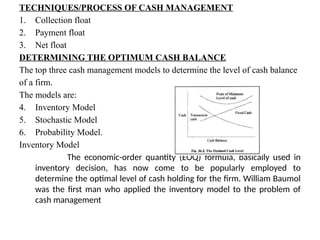
DETERMINING THE OPTIMUM CASH BALANCE
The top three cash management models to determine the level of cash balance
of a firm.
The models are:
4. Inventory Model
5. Stochastic Model
6. Probability Model.
Inventory Model
The economic-order quantity (EOQ) formula, basically used in
inventory decision, has now come to be popularly employed to
determine the optimal level of cash holding for the firm. William Baumol
was the first man who applied the inventory model to the problem of
cash management
DETERMINING THE OPTIMUM CASH BALANCE
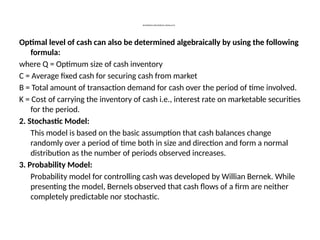
Optimal level of cash can also be determined algebraically by using the following
formula:
where Q = Optimum size of cash inventory
C = Average fixed cash for securing cash from market
B = Total amount of transaction demand for cash over the period of time involved.
K = Cost of carrying the inventory of cash i.e., interest rate on marketable securities
for the period.
2. Stochastic Model:
This model is based on the basic assumption that cash balances change
randomly over a period of time both in size and direction and form a normal
distribution as the number of periods observed increases.
3. Probability Model:
Probability model for controlling cash was developed by Willian Bernek. While
presenting the model, Bernels observed that cash flows of a firm are neither
completely predictable nor stochastic.
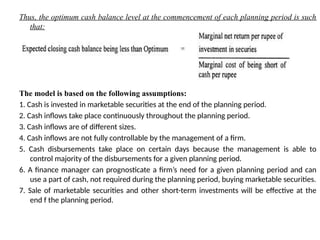
Thus, the optimum cash balance level at the commencement of each planning period is such
that:
The model is based on the following assumptions:
1. Cash is invested in marketable securities at the end of the planning period.
2. Cash inflows take place continuously throughout the planning period.
3. Cash inflows are of different sizes.
4. Cash inflows are not fully controllable by the management of a firm.
5. Cash disbursements take place on certain days because the management is able to
control majority of the disbursements for a given planning period.
6. A finance manager can prognosticate a firm’s need for a given planning period and can
use a part of cash, not required during the planning period, buying marketable securities.
7. Sale of marketable securities and other short-term investments will be effective at the
end f the planning period.
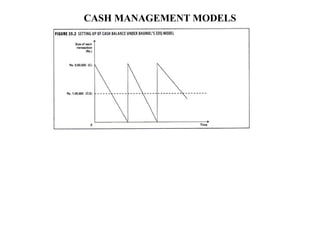
CASH MANAGEMENT MODELS
The following points highlight the top two cash
management models. They are: 1. Baumol’s EOQ
Model of Cash Management 2. Miller-Orr Cash
Management Model.
Baumol’s EOQ Model of Cash Management:
William J. Baumol (1952) suggested that cash may be
managed in the same way as any other inventory and
that the inventory model could reasonably reflect the
cost – volume relationships as well as the cash flows.
In this way, the economic order quantity (EOQ) model
of inventory management could be applied to cash
management. It provides a useful conceptual foundation
for the cash management problem.
CASH MANAGEMENT MODELS
Assumptions:
The Baumol’s model holds good if the following assumptions are fulfilled:
(a) The rate of cash usage is constant and known with certainty. The model has limited use in
times of uncertainty and firms whose cash flows are discontinuous or bumpy.
(b) The surplus cash is invested into marketable securities and those securities are again
disposed of to convert them again into cash. Such purchase and sale transactions involve
certain costs like clerical, brokerage, registration and other costs. The cost to be incurred for
each such transaction is assumed to be constant/fixed. In practice, it would be difficult to
calculate the exact transaction cost.
(c) By holding cash balance, the firm is would incur the opportunity cost of interest forgone by
not investing in marketable securities. Such holding cost per annum is assumed to be
constant.
(d) The short-term marketable securities can be freely bought and sold. Existence of free market
for marketable securities is a prerequisite of the Baumol model.
Limitations:
The important limitations in Baumol’s model are as follows:
(i) The model can be applied only when the payments position can be reasonably assessed.
(ii) Degree of uncertainty is high in predicting the cash flow transactions.
(iii) The model merely suggests only the optimal balance under a set of assumptions. But in
actual situation it may not hold good.
• Nevertheless it does offer a conceptual framework and can be used with caution as a
CASH MANAGEMENT MODELS
Miller-Orr Cash Management Model:
Miller and Orr model (1966) assumes that the cashflow of the
firm is assumed to be stochastic, i.e. different amounts of cash
payments are made on different points of time. It is assumed that
the movements in cash balance occur randomly. Miller and Orr
suggested a model with control limits, which sets control points
for time and size of transfers between an Investment Account
and Cash Account.
The model specifies the following two control limits:
h = Upper control limit, beyond the cash balance should not be
carried.
0 = Lower control limit, sets the lower limit of cash balance, i.e. the
firm should maintain cash resources at least to the extent of
lower limit.
z = Return point for cash balance
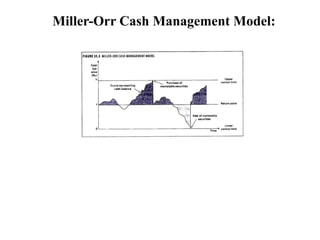
Miller-Orr Cash Management Model:
The Miller-Orr model, will work as follows:
(i) When cash balance touched the upper control limit (h), securities are
bought to the extent of Rs. (h-z).
(ii) Then the new cash balance is z.
(iii) When cash balance touches lower control limit (o), marketable
securities to the extent of Rs. (z-o) will be sold.
(iv) Then the new cash balance again return to point z.
Assumptions:
The basic assumptions of the model are:
(a) The major assumption with this model is that there is no underlying
trend in cash balance over time.
(b) The optimal values of ‘h’ and ‘z’ depend not only on opportunity costs,
but also on the degree of likely fluctuations in cash balances.
The model can be used in times of uncertainty and random cash flows. It
is based on the principle that control limits can be set which when
reached trigger off a transaction. The control limits are based on the day-
to-day variability in cash flows and the fixed costs of buying and selling
government securities.
RECEIVABLES MANAGEMENT
Receivables represent amounts owed to the firm as a result of sale of goods or
services in the ordinary course of business. These are claims of the firm against its
customers and form part of its current assets. Receivables are also known as accounts
receivables, trade receivables, customer receivables or book debts.
Costs of Maintaining Receivables
The allowing of credit to customers means giving funds for the customer’s use. The
concern incurs the following cost on maintaining receivables:
(1) Cost of Financing Receivables: When goods and services are provided on credit
then concern’s capital is allowed to be used by the customers. The receivables are
financed from the funds supplied by shareholders for long term financing and
through retained earnings. The concern incurs some cost for colleting funds which
finance receivables.
(2) Cost of Collection: A proper collection of receivables is essential for receivables
management. The customers who do not pay the money during a stipulated credit
period are sent reminders for early payments. Some persons may have to be sent for
collection these amounts. All these costs are known as collection costs which a
concern is generally required to incur.
(3) Bad Debts : Some customers may fail to pay the amounts due towards them. The
amounts which the customers fail to pay are known as bad debts. Though a concern
may be able to reduced bad debts through efficient collection machinery but one
RECEIVABLES MANAGEMENT
Factors Influencing the Size of Receivables
Besides sales, a number of other factors also influence the size of
receivables. The following factors directly and indirectly affect the size of
receivables.
(1) Size of Credit Sales: The volume of credit sales is the first factor which
increases or decreases the size of receivables. If a concern sells only on
cash basis as in the case of Bata Shoe Company, then there will be no
receivables. The higher the part of credit sales out of total sales, figures of
receivables will also be more or vice versa.
(2) Credit Policies: A firm with conservative credit policy will have a low size of
receivables while a firm with liberal credit policy will be increasing this
figure. If collections are prompt then even if credit is liberally extended the
size of receivables will remain under control. In case receivables remain
outstanding for a longer period, there is always a possibility of bad debts.
(3) Terms of Trade: The size of receivables also depends upon the terms of
trade. The period of credit allowed and rates of discount given are linked
with receivables. If credit period allowed is more then receivables will also
be more. Sometimes trade policies of competitors have to be followed
otherwise it becomes difficult to expand the sales.
(4) Expansion Plans: When a concern wants to expand its activities, it will have to
enter new markets. To attract customers, it will give incentives in the form of
credit facilities. The period of credit can be reduced when the firm is able to get
permanent customers. In the early stages of expansion more credit becomes
essential and size of receivables will be more.
(5) Relation with Profits: The credit policy is followed with a view to increase sales.
When sales increase beyond a certain level the additional costs incurred are
less than the increase in revenues. It will be beneficial to increase sales beyond
the point because it will bring more profits. The increase in profits will be
followed by an increase in the size of receivables or vice-versa.
(6) Credit Collection Efforts: The collection of credit should be streamlined. The
customers should be sent periodical reminders if they fail to pay in time. On the
other hand, if adequate attention is not paid towards credit collection then the
concern can land itself in a serious financial problem. An efficient credit
collection machinery will reduce the size of receivables.
(7) Habits of Customers: The paying habits of customers also have bearing on the
size of receivables. The customers may be in the habit of delaying payments
even though they are financially sound. The concern should remain in touch
with such customers and should make them realise the urgency of their needs.
Meaning and Objectives of Receivables Management
Receivables management is the process of making decisions relating to
investment in trade debtors. We have already stated that certain investment
in receivables is necessary to increase the sales and the profits of a firm.
But at the same time investment in this asset involves cost considerations
also. Further, there is always a risk of bad debts too. Thus, the objective of
receivables management is to take a sound decision as regards investment
in debtors. In the words of Bolton, S.E., the objectives of receivables
management is “to promote sales and profits until that point is reached
where the return on investment in further funding of receivables is less
than the cost of funds raised to finance that additional credit.”
Dimensions of Receivables Management
• Receivables management involves the careful consideration of the
following aspects:
• Forming of credit policy.
• Executing the credit policy.
• Formulating and executing collection policy
1. Forming of Credit Policy
For efficient management of receivables, a concern must adopt a credit
policy. A credit policy is related to decisions such as credit standards, length of
credit period, cash discount and discount period, etc.
(a) Quality of Trade Accounts of Credit Standards: The volume of sales will be
influenced by the credit policy of a concern. By liberalising credit policy the
volume of sales can be increased resulting into increased profits. The increased
volume of sales is associated with certain risks too. It will result in enhanced
costs and risks of bad debts and delayed receipts
(b) Length of Credit Period: Credit terms or length of credit period means the
period allowed to the customers for making the payment. The customers
paying well in time may also be allowed certain cash discount. A concern fixes
its own terms of credit depending upon its customers and the volume of sales.
(c) Cash Discount: Cash discount is allowed to expedite the collection of
receivables. The concern will be able to use the additional funds received from
expedited collections due to cash discount.
(d) Discount Period: The collection of receivables is influenced by the period
allowed for availing the discount. The additional period allowed for this facility
may prompt some more customers to avail discount and make payments.
• 2. Executing Credit Policy
• After formulating the credit policy, its proper execution is very
important. The evaluation of credit applications and finding
out the credit worthiness of customers should be undertaken.
• (a) Collecting Credit information: The first step in
implementing credit policy will be to gather credit information
about the customers. This information should be adequate
enough so that proper analysis about the financial position of
the customers is possible.
• (b) Credit Analysis: The credit analysis will determine the
degree of risk associated with the account, the capacity of the
customer borrow and his ability and willingness to pay.
• (c) Credit Decision: After analysing the credit worthiness of the
customer, the finance manager has to take a decision whether
the credit is to be extended and if yes then up to what level.
He will match the creditworthiness of the customer with the
credit standards of the company.
• (d) Financing Investments in Receivables and
Factoring: Accounts receivables block a part of working
capital. Efforts should be made that funds are not tied up
in receivables for longer periods. The finance manager
should make efforts to get receivables financed so that
working capital needs are met in time.
– The quality of receivables will determine the amount of loan.
The banks will accept receivable of dependable parties only.
Another method of getting funds against receivables is their
outright sale to the bank.
– The bank will credit the amount to the party after deducting
discount and will collect the money from the customers later.
Here too, the bank will insist on quality receivables only. Besides
banks, there may be other agencies which can buy receivables
and pay cash for them. This facility is known as factoring.
• Factoring is collection and finance service designed to improve
the cash flow position of the sellers by converting sales invoices
into ready cash. The procedure of factoring can be explained as
follows:
• Under an agreement between the selling firm and factor firm, the
latter makes an appraisal of the credit worthiness of potential
customers and may also set the credit limit and term of credit for
different customers.
• The sales documents will contain the instructions to make
payment directly to factor who is responsible for collection.
• When the payment is received by the factor on the due date the
factor shall deduct its fees, charges etc and credit the balance to
the firm’s accounts.
• In some cases, if agreed the factor firm may also provide advance
finance to selling firm for which it may charge from selling firm.
Non-Monetary Costs
a) The factor firm doing the evaluation of credit
worthiness of the customer will be primarily
concerned with the minimization of risk of
delays and defaults. In the process it may over
look sales growth aspect.
b) A factor is in fact a third party to the
customer who may not feel comfortable while
dealing with it.
c) The factoring of receivables may be
considered as a symptom of financial weakness.
Benefits and Cost of Factoring
A firm availing factoring services may have the following benefits:
§ Better Cash Flows
§ Better Assets Management
§ Better Working Capital Management
§ Better Administration
§ Better Evaluation
§ Better Risk Management
However, the factoring involves some monetary and non-monetary costs as
follows:
Monetary Costs
a) The factor firm charges substantial fees and commission for collection of
receivables. These charges sometimes may be too much in view of amount
involved.
b) The advance fiancé provided by factor firm would be available at a higher
interest costs than usual rate of interest.
Factoring in India is of recent origin. In order to study the feasibility of
factoring services in India, the Reserve Bank of India constituted a
study group for examining the introduction of factoring services, which
submitted its report in 1988.On the basis of the recommendations of
this study group the RBI has come out with specific guidelines
permitting a banks to start factoring in India through their subsidiaries.
For this country has been divided into four zones. In India the factoring
is still not very common. The first factor i.e. The SBI Factor and
Commercial Services Limited started working in April 1991.
The guidelines for regulation of a factoring are as follows:
(1) A factor firm requires an approval from Reserve Bank of India.
(2) A factor firm may undertake factoring business or other incidental
activities.
(3) A factor firm shall not engage in financing of other firms or firms
engaged in factoring.
3. Formulating and Executing Collection Policy
The collection o f amounts due to the customers is very important. The
collection policy the termed as strict and lenient. A strict policy of
collection will involve more efforts on collection. Such a policy has both
positive and negative effects.
A lenient policy may increase the debt collection period and more bad
debt losses. A customer not clearing the dues for long may not repeat his
order because he will have to pay earlier dues first, thus causing.
The objective is to collect the dues and not to annoy the customer.
The steps should be like
(i) sending a reminder for payments
(ii) Personal request through telephone etc.
(iii) Personal visits to the customers
(iv) Taking help of collecting agencies and lastly
(v) Taking legal action.
The last step should be taken only after exhausting all other means
because it will have a bad impact on relations with customers.
DIMENSIONS OF RECEIVABLES MANAGEMENT
Receivables of management involves the careful consideration of the following
aspects:
1. Credit policy: i. whether or not to extend credit to a customer
ii. How much credit to extend.
2. Credit analysis
1. Obtaining credit information
1. Internal
2. External
1. Financial statements
2. Bank references
3. Trade references
4. Credit bureau reports
2. Analysis of credit information
The well known 5C’s of credit.
1. Character
2. Capacity
3. Capital
4. Collateral
5. Conditions

DR D DEEPA-SRCAS-...CASH MANAGEMENT.pptx

  • 1.
    DR D DEEPA AssistantProfessor Department of Management Science – BBA CA Sri Ramakrishna College of Arts and Science Coimbatore - 641 006 Tamil Nadu, India 22BMC602 - FINANCIAL MANAGEMENT CASH MANAGMENT 1
  • 2.
    CASH MANAGEMENT MEANING: Cashis recorded as a current asset on the balance sheet. Even though cash can be saved for future periods, it is still considered a current asset because it can because it can be used in one period. MOTIVES FOR HOLDING CASH: 1. Transaction motive 2. Speculative motive 3. Precautionary motive 4. Compensation motive FACTORS DETERMINING CASH NEEDS: 5. Credit position of the firm 6. Status of firm’s receivable 7. Status of firm’s inventory account 8. Nature of business enterprise 9. Management’s attitude towards risk 10. Amount of sales in relation to assets 11. Cash inflows and cash outflows 12. Cost of cash balance
  • 3.
    CASH MANAGEMENT Meaning: Cashmanagement refers to management of cash balance and the bank balance including the short term deposits. Objectives of cash management: 1. Meeting the payment schedule 2. Minimizing funds committed to cash balance
  • 4.
    CASH MANAGEMENT Importance ofcash management: Cash management is one of the critical areas of working capital management and assumes greater significance because it is most liquid asset used to satisfy the firm’s obligations but it is a sterile asset as it does not yield anything. Therefore, finance manager has to so manage cash that the firm maintains its liquidity position without Jeopardizing the profitability. Problem of prognosticating cash flows accurately and absence of perfect coincidence between the inflows and outflows of cash add to the significance of cash management. In view of the above, at one time a firm may experience dearth of cash because payments of taxes, dividends, seasonal inventory, etc. build up while at other times, it may have surfeit of cash stemming out of large cash sales and quick collections of receivables. It is interesting to observe that in real life, management spends his considerable time in managing cash which constitutes relatively a small proportion of a firm’s current assets. This is why in recent years a number of new techniques have been evolved to minimize cash holding of the firm.
  • 5.
    STRATEGIES OF CASHMANAGEMENT 1. Stretching accounts payable 2. Speeding collection of accounts receivable 3. Efficient inventory-production 4. Combined cash management strategies
  • 6.
    TECHNIQUES/PROCESS OF CASHMANAGEMENT 1. Cash management planning 2. Determining the optimum cash balance 3. Cash management control I. ACCELERATING CASH INFLOWS METHODS OF ACCELERATING CASH INFLOWS: 1. Prompt payment by customers 2. Early conversion of payments into cash 3. Concentrating banking 4. Lock box system II. CONTROLLING CASH OUTFLOWS METHODS OF SLOWING DISBURSEMENT 1. Payments through drafts 2. Adjusting payroll funds 3. Inter-bank transfer 4. Avoidance of early payments 5. Centralized disbursements 6. Paying the float COMPONENTS OF FLOAT 1. Mail time 2. Processing time 3. Collection time
  • 7.
    TECHNIQUES/PROCESS OF CASHMANAGEMENT 1. Collection float 2. Payment float 3. Net float DETERMINING THE OPTIMUM CASH BALANCE The top three cash management models to determine the level of cash balance of a firm. The models are: 4. Inventory Model 5. Stochastic Model 6. Probability Model. Inventory Model The economic-order quantity (EOQ) formula, basically used in inventory decision, has now come to be popularly employed to determine the optimal level of cash holding for the firm. William Baumol was the first man who applied the inventory model to the problem of cash management
  • 8.
    DETERMINING THE OPTIMUMCASH BALANCE Optimal level of cash can also be determined algebraically by using the following formula: where Q = Optimum size of cash inventory C = Average fixed cash for securing cash from market B = Total amount of transaction demand for cash over the period of time involved. K = Cost of carrying the inventory of cash i.e., interest rate on marketable securities for the period. 2. Stochastic Model: This model is based on the basic assumption that cash balances change randomly over a period of time both in size and direction and form a normal distribution as the number of periods observed increases. 3. Probability Model: Probability model for controlling cash was developed by Willian Bernek. While presenting the model, Bernels observed that cash flows of a firm are neither completely predictable nor stochastic.
  • 9.
    Thus, the optimumcash balance level at the commencement of each planning period is such that: The model is based on the following assumptions: 1. Cash is invested in marketable securities at the end of the planning period. 2. Cash inflows take place continuously throughout the planning period. 3. Cash inflows are of different sizes. 4. Cash inflows are not fully controllable by the management of a firm. 5. Cash disbursements take place on certain days because the management is able to control majority of the disbursements for a given planning period. 6. A finance manager can prognosticate a firm’s need for a given planning period and can use a part of cash, not required during the planning period, buying marketable securities. 7. Sale of marketable securities and other short-term investments will be effective at the end f the planning period.
  • 10.
    CASH MANAGEMENT MODELS Thefollowing points highlight the top two cash management models. They are: 1. Baumol’s EOQ Model of Cash Management 2. Miller-Orr Cash Management Model. Baumol’s EOQ Model of Cash Management: William J. Baumol (1952) suggested that cash may be managed in the same way as any other inventory and that the inventory model could reasonably reflect the cost – volume relationships as well as the cash flows. In this way, the economic order quantity (EOQ) model of inventory management could be applied to cash management. It provides a useful conceptual foundation for the cash management problem.
  • 11.
    CASH MANAGEMENT MODELS Assumptions: TheBaumol’s model holds good if the following assumptions are fulfilled: (a) The rate of cash usage is constant and known with certainty. The model has limited use in times of uncertainty and firms whose cash flows are discontinuous or bumpy. (b) The surplus cash is invested into marketable securities and those securities are again disposed of to convert them again into cash. Such purchase and sale transactions involve certain costs like clerical, brokerage, registration and other costs. The cost to be incurred for each such transaction is assumed to be constant/fixed. In practice, it would be difficult to calculate the exact transaction cost. (c) By holding cash balance, the firm is would incur the opportunity cost of interest forgone by not investing in marketable securities. Such holding cost per annum is assumed to be constant. (d) The short-term marketable securities can be freely bought and sold. Existence of free market for marketable securities is a prerequisite of the Baumol model. Limitations: The important limitations in Baumol’s model are as follows: (i) The model can be applied only when the payments position can be reasonably assessed. (ii) Degree of uncertainty is high in predicting the cash flow transactions. (iii) The model merely suggests only the optimal balance under a set of assumptions. But in actual situation it may not hold good. • Nevertheless it does offer a conceptual framework and can be used with caution as a
  • 12.
  • 13.
    Miller-Orr Cash ManagementModel: Miller and Orr model (1966) assumes that the cashflow of the firm is assumed to be stochastic, i.e. different amounts of cash payments are made on different points of time. It is assumed that the movements in cash balance occur randomly. Miller and Orr suggested a model with control limits, which sets control points for time and size of transfers between an Investment Account and Cash Account. The model specifies the following two control limits: h = Upper control limit, beyond the cash balance should not be carried. 0 = Lower control limit, sets the lower limit of cash balance, i.e. the firm should maintain cash resources at least to the extent of lower limit. z = Return point for cash balance
  • 14.
  • 15.
    The Miller-Orr model,will work as follows: (i) When cash balance touched the upper control limit (h), securities are bought to the extent of Rs. (h-z). (ii) Then the new cash balance is z. (iii) When cash balance touches lower control limit (o), marketable securities to the extent of Rs. (z-o) will be sold. (iv) Then the new cash balance again return to point z. Assumptions: The basic assumptions of the model are: (a) The major assumption with this model is that there is no underlying trend in cash balance over time. (b) The optimal values of ‘h’ and ‘z’ depend not only on opportunity costs, but also on the degree of likely fluctuations in cash balances. The model can be used in times of uncertainty and random cash flows. It is based on the principle that control limits can be set which when reached trigger off a transaction. The control limits are based on the day- to-day variability in cash flows and the fixed costs of buying and selling government securities.
  • 16.
    RECEIVABLES MANAGEMENT Receivables representamounts owed to the firm as a result of sale of goods or services in the ordinary course of business. These are claims of the firm against its customers and form part of its current assets. Receivables are also known as accounts receivables, trade receivables, customer receivables or book debts. Costs of Maintaining Receivables The allowing of credit to customers means giving funds for the customer’s use. The concern incurs the following cost on maintaining receivables: (1) Cost of Financing Receivables: When goods and services are provided on credit then concern’s capital is allowed to be used by the customers. The receivables are financed from the funds supplied by shareholders for long term financing and through retained earnings. The concern incurs some cost for colleting funds which finance receivables. (2) Cost of Collection: A proper collection of receivables is essential for receivables management. The customers who do not pay the money during a stipulated credit period are sent reminders for early payments. Some persons may have to be sent for collection these amounts. All these costs are known as collection costs which a concern is generally required to incur. (3) Bad Debts : Some customers may fail to pay the amounts due towards them. The amounts which the customers fail to pay are known as bad debts. Though a concern may be able to reduced bad debts through efficient collection machinery but one
  • 17.
    RECEIVABLES MANAGEMENT Factors Influencingthe Size of Receivables Besides sales, a number of other factors also influence the size of receivables. The following factors directly and indirectly affect the size of receivables. (1) Size of Credit Sales: The volume of credit sales is the first factor which increases or decreases the size of receivables. If a concern sells only on cash basis as in the case of Bata Shoe Company, then there will be no receivables. The higher the part of credit sales out of total sales, figures of receivables will also be more or vice versa. (2) Credit Policies: A firm with conservative credit policy will have a low size of receivables while a firm with liberal credit policy will be increasing this figure. If collections are prompt then even if credit is liberally extended the size of receivables will remain under control. In case receivables remain outstanding for a longer period, there is always a possibility of bad debts. (3) Terms of Trade: The size of receivables also depends upon the terms of trade. The period of credit allowed and rates of discount given are linked with receivables. If credit period allowed is more then receivables will also be more. Sometimes trade policies of competitors have to be followed otherwise it becomes difficult to expand the sales.
  • 18.
    (4) Expansion Plans:When a concern wants to expand its activities, it will have to enter new markets. To attract customers, it will give incentives in the form of credit facilities. The period of credit can be reduced when the firm is able to get permanent customers. In the early stages of expansion more credit becomes essential and size of receivables will be more. (5) Relation with Profits: The credit policy is followed with a view to increase sales. When sales increase beyond a certain level the additional costs incurred are less than the increase in revenues. It will be beneficial to increase sales beyond the point because it will bring more profits. The increase in profits will be followed by an increase in the size of receivables or vice-versa. (6) Credit Collection Efforts: The collection of credit should be streamlined. The customers should be sent periodical reminders if they fail to pay in time. On the other hand, if adequate attention is not paid towards credit collection then the concern can land itself in a serious financial problem. An efficient credit collection machinery will reduce the size of receivables. (7) Habits of Customers: The paying habits of customers also have bearing on the size of receivables. The customers may be in the habit of delaying payments even though they are financially sound. The concern should remain in touch with such customers and should make them realise the urgency of their needs.
  • 19.
    Meaning and Objectivesof Receivables Management Receivables management is the process of making decisions relating to investment in trade debtors. We have already stated that certain investment in receivables is necessary to increase the sales and the profits of a firm. But at the same time investment in this asset involves cost considerations also. Further, there is always a risk of bad debts too. Thus, the objective of receivables management is to take a sound decision as regards investment in debtors. In the words of Bolton, S.E., the objectives of receivables management is “to promote sales and profits until that point is reached where the return on investment in further funding of receivables is less than the cost of funds raised to finance that additional credit.” Dimensions of Receivables Management • Receivables management involves the careful consideration of the following aspects: • Forming of credit policy. • Executing the credit policy. • Formulating and executing collection policy
  • 20.
    1. Forming ofCredit Policy For efficient management of receivables, a concern must adopt a credit policy. A credit policy is related to decisions such as credit standards, length of credit period, cash discount and discount period, etc. (a) Quality of Trade Accounts of Credit Standards: The volume of sales will be influenced by the credit policy of a concern. By liberalising credit policy the volume of sales can be increased resulting into increased profits. The increased volume of sales is associated with certain risks too. It will result in enhanced costs and risks of bad debts and delayed receipts (b) Length of Credit Period: Credit terms or length of credit period means the period allowed to the customers for making the payment. The customers paying well in time may also be allowed certain cash discount. A concern fixes its own terms of credit depending upon its customers and the volume of sales. (c) Cash Discount: Cash discount is allowed to expedite the collection of receivables. The concern will be able to use the additional funds received from expedited collections due to cash discount. (d) Discount Period: The collection of receivables is influenced by the period allowed for availing the discount. The additional period allowed for this facility may prompt some more customers to avail discount and make payments.
  • 21.
    • 2. ExecutingCredit Policy • After formulating the credit policy, its proper execution is very important. The evaluation of credit applications and finding out the credit worthiness of customers should be undertaken. • (a) Collecting Credit information: The first step in implementing credit policy will be to gather credit information about the customers. This information should be adequate enough so that proper analysis about the financial position of the customers is possible. • (b) Credit Analysis: The credit analysis will determine the degree of risk associated with the account, the capacity of the customer borrow and his ability and willingness to pay. • (c) Credit Decision: After analysing the credit worthiness of the customer, the finance manager has to take a decision whether the credit is to be extended and if yes then up to what level. He will match the creditworthiness of the customer with the credit standards of the company.
  • 22.
    • (d) FinancingInvestments in Receivables and Factoring: Accounts receivables block a part of working capital. Efforts should be made that funds are not tied up in receivables for longer periods. The finance manager should make efforts to get receivables financed so that working capital needs are met in time. – The quality of receivables will determine the amount of loan. The banks will accept receivable of dependable parties only. Another method of getting funds against receivables is their outright sale to the bank. – The bank will credit the amount to the party after deducting discount and will collect the money from the customers later. Here too, the bank will insist on quality receivables only. Besides banks, there may be other agencies which can buy receivables and pay cash for them. This facility is known as factoring.
  • 23.
    • Factoring iscollection and finance service designed to improve the cash flow position of the sellers by converting sales invoices into ready cash. The procedure of factoring can be explained as follows: • Under an agreement between the selling firm and factor firm, the latter makes an appraisal of the credit worthiness of potential customers and may also set the credit limit and term of credit for different customers. • The sales documents will contain the instructions to make payment directly to factor who is responsible for collection. • When the payment is received by the factor on the due date the factor shall deduct its fees, charges etc and credit the balance to the firm’s accounts. • In some cases, if agreed the factor firm may also provide advance finance to selling firm for which it may charge from selling firm.
  • 24.
    Non-Monetary Costs a) Thefactor firm doing the evaluation of credit worthiness of the customer will be primarily concerned with the minimization of risk of delays and defaults. In the process it may over look sales growth aspect. b) A factor is in fact a third party to the customer who may not feel comfortable while dealing with it. c) The factoring of receivables may be considered as a symptom of financial weakness.
  • 25.
    Benefits and Costof Factoring A firm availing factoring services may have the following benefits: § Better Cash Flows § Better Assets Management § Better Working Capital Management § Better Administration § Better Evaluation § Better Risk Management However, the factoring involves some monetary and non-monetary costs as follows: Monetary Costs a) The factor firm charges substantial fees and commission for collection of receivables. These charges sometimes may be too much in view of amount involved. b) The advance fiancé provided by factor firm would be available at a higher interest costs than usual rate of interest.
  • 26.
    Factoring in Indiais of recent origin. In order to study the feasibility of factoring services in India, the Reserve Bank of India constituted a study group for examining the introduction of factoring services, which submitted its report in 1988.On the basis of the recommendations of this study group the RBI has come out with specific guidelines permitting a banks to start factoring in India through their subsidiaries. For this country has been divided into four zones. In India the factoring is still not very common. The first factor i.e. The SBI Factor and Commercial Services Limited started working in April 1991. The guidelines for regulation of a factoring are as follows: (1) A factor firm requires an approval from Reserve Bank of India. (2) A factor firm may undertake factoring business or other incidental activities. (3) A factor firm shall not engage in financing of other firms or firms engaged in factoring.
  • 27.
    3. Formulating andExecuting Collection Policy The collection o f amounts due to the customers is very important. The collection policy the termed as strict and lenient. A strict policy of collection will involve more efforts on collection. Such a policy has both positive and negative effects. A lenient policy may increase the debt collection period and more bad debt losses. A customer not clearing the dues for long may not repeat his order because he will have to pay earlier dues first, thus causing. The objective is to collect the dues and not to annoy the customer. The steps should be like (i) sending a reminder for payments (ii) Personal request through telephone etc. (iii) Personal visits to the customers (iv) Taking help of collecting agencies and lastly (v) Taking legal action. The last step should be taken only after exhausting all other means because it will have a bad impact on relations with customers.
  • 28.
    DIMENSIONS OF RECEIVABLESMANAGEMENT Receivables of management involves the careful consideration of the following aspects: 1. Credit policy: i. whether or not to extend credit to a customer ii. How much credit to extend. 2. Credit analysis 1. Obtaining credit information 1. Internal 2. External 1. Financial statements 2. Bank references 3. Trade references 4. Credit bureau reports 2. Analysis of credit information The well known 5C’s of credit. 1. Character 2. Capacity 3. Capital 4. Collateral 5. Conditions