CASH
      MANAGEMENT
Prabhjot Singh Longia
Prince Kaushal
Puneet Walia
Shubhpreet Kaur

             LMTSOM THAPAR UNIVERSITY
WHAT IS CASH?
• In narrow sense: currency and generally accepted
  equivalents of cash like cheques, drafts etc.
• In broad sense: includes near-cash assets, such as
  marketable securities and time deposits in banks.
   – They can be readily sold and converted into cash.
   – Can serve as a reserve pool of liquidity.
   – Also provide short term investment outlet for excess cash.
Cash management
• Cash management is concerned with the managing
  of:
  – cash flows into and out of the firm,
  – cash flows within the firm, and
  – cash balances held by the firm at a point of time by
    financing deficit or investing surplus cash
Four Facets of Cash Management

•   Cash planning
•   Managing the cash flows
•   Optimum cash level
•   Investing surplus cash
Motives for holding cash
•   Transaction motive
•   Precautionary motive
•   Speculative motive
•   compensating motive
Transaction motive
• Holding of cash to meet routine cash requirements
  to finance the transactions which a firm carries on in
  the ordinary course of business.
Precautionary motive
• The cash balances held in reserve for random and
  unforeseen fluctuations in cash flows.
• A cushion to meet unexpected contingencies.
   – Floods, strikes and failure of imp customers
   – Unexpected slowdown in collection of accounts
     receivable
   – Sharp increase in cost of raw materials
   – Cancellation of some order of goods

• Defensive in nature
Speculative motive
• Is a motive for holding cash/near-cash to quickly take
  advantage of opportunities typically outside the
  normal course of business.
• Positive and aggressive approach
• Helps to take advantage of:
   –   An opportunity to purchase raw materials at reduced price
   –   Make purchase at favorable prices
   –   Delay purchase on anticipation of decline in prices
   –   Buying securities when interest rate is expected to decline
Compensating motive
• Is a motive for holding cash/near-cash to
  compensate banks for providing certain services or
  loans.
• Clients are supposed to maintain a minimum balance
  of cash at the bank which they cannot use
  themselves.
Objectives of cash management
• Meeting payments schedule
   –   It prevents insolvency
   –    relationship with bank is not constrained
   –   Helps in fostering good relationships
   –   Cash discount can be availed
   –   Strong credit rating
   –   Take advantage of business opportunities
   –   Can meet unanticipated cash expenditure with a minimum
       of strain.
• Minimizing funds committed to cash balances
   – High level of cash: large funds remain idle
   – Low level of cash: failure to meet payment schedule
Managing Cash Collections and
      Disbursements

• Accelerating Cash Collections
• Controlling Disbursements
Accelerating Cash Collections

1. Decentralised Collections

         number of collection centres
         Collection centres will collect cheques from customers and
          deposit in their local bank accounts
         They will deposit the funds to a central bank
Accelerating Cash Collections
                 Contd…….
2. Lock-box System
         – Collection centers are established considering the customer locations
           and volume of remittances
         – At each centre the firm hires a post office box
         – Remittances are directly picked from the bank whom the firm gives
           the authority


 Advantages of lock-box system are
         – cheques are deposited immediately upon receipt of remittances
         – Eliminates the period between the time cheques are received by the
           firm and the time they are deposited in the bank for collection
Controlling Disbursements

It means delay the payments as much as possible. Can help
  the firm in conserving cash and reducing the financial
  requirements.

     Disbursement or Payment Float
The size of the minimum cash balance depends on:

• How quickly and cheaply a organization can raise cash when
  needed.

• How accurately managers can predict cash requirements.
  Cash budget helps in this .

• How much precautionary cash the managers need for
  emergencies.
The organization’s maximum cash balance depends on:


• Availability of (short-term) investment opportunities
   – e.g. money market funds, CDs, commercial paper

• Expected return on investment opportunities.
   – e.g. If expected returns are high, organizations should be
     quick to invest excess cash

• Transaction cost of withdrawing cash and making an
  investment

• Demand for Cash for daily transactions
BAUMOL MODEL
Bumol recognized the similarities between cash and
inventory management. He extended the economic
order quantity (EOQ) model to examine its
implications to cash management. The Baumol
model assumes the cash manager invests excess
funds in interest bearing securities and liquidates
them to meet the firm’s demand for cash. As
investment returns increase, the opportunity cost of
holding cash increases and the cash manager
decreases cash balances. As transaction costs (cost
of liquidating short-term investments) increase, the
cash manager decreases the number of times he
liquidates securities, leading to higher cash balances.
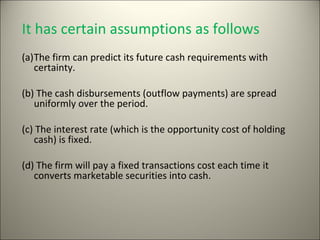
It has certain assumptions as follows
(a)The firm can predict its future cash requirements with
   certainty.

(b) The cash disbursements (outflow payments) are spread
   uniformly over the period.

(c) The interest rate (which is the opportunity cost of holding
   cash) is fixed.

(d) The firm will pay a fixed transactions cost each time it
   converts marketable securities into cash.
Explanation
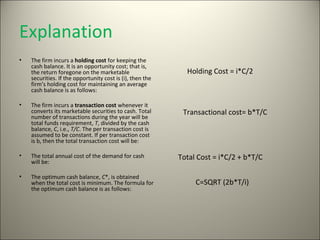
•   The firm incurs a holding cost for keeping the
    cash balance. It is an opportunity cost; that is,
    the return foregone on the marketable                    Holding Cost = i*C/2
    securities. If the opportunity cost is (i), then the
    firm’s holding cost for maintaining an average
    cash balance is as follows:

•   The firm incurs a transaction cost whenever it
    converts its marketable securities to cash. Total       Transactional cost= b*T/C
    number of transactions during the year will be
    total funds requirement, T, divided by the cash
    balance, C, i.e., T/C. The per transaction cost is
    assumed to be constant. If per transaction cost
    is b, then the total transaction cost will be:

•   The total annual cost of the demand for cash           Total Cost = i*C/2 + b*T/C
    will be:

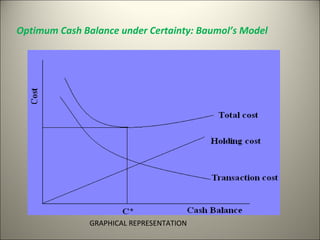
•   The optimum cash balance, C*, is obtained
    when the total cost is minimum. The formula for             C=SQRT (2b*T/i)
    the optimum cash balance is as follows:
Optimum Cash Balance under Certainty: Baumol’s Model


               GRAPHICAL REPRESENTATION
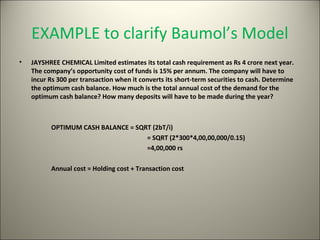
EXAMPLE to clarify Baumol’s Model
•   JAYSHREE CHEMICAL Limited estimates its total cash requirement as Rs 4 crore next year.
    The company’s opportunity cost of funds is 15% per annum. The company will have to
    incur Rs 300 per transaction when it converts its short-term securities to cash. Determine
    the optimum cash balance. How much is the total annual cost of the demand for the
    optimum cash balance? How many deposits will have to be made during the year?


          OPTIMUM CASH BALANCE = SQRT (2bT/i)
                                    = SQRT (2*300*4,00,00,000/0.15)
                                    =4,00,000 rs

          Annual cost = Holding cost + Transaction cost
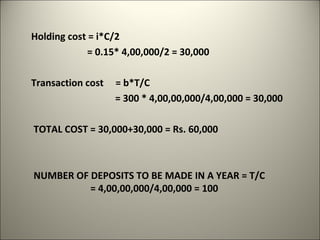
Holding cost = i*C/2
             = 0.15* 4,00,000/2 = 30,000

Transaction cost   = b*T/C
                   = 300 * 4,00,00,000/4,00,000 = 30,000

TOTAL COST = 30,000+30,000 = Rs. 60,000


NUMBER OF DEPOSITS TO BE MADE IN A YEAR = T/C
          = 4,00,00,000/4,00,000 = 100
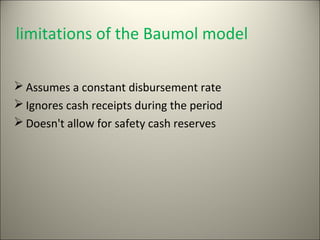
limitations of the Baumol model

 Assumes a constant disbursement rate
 Ignores cash receipts during the period
 Doesn't allow for safety cash reserves
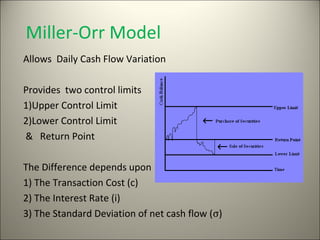
Miller-Orr Model
Allows Daily Cash Flow Variation

Provides two control limits
1)Upper Control Limit
2)Lower Control Limit
& Return Point

The Difference depends upon
1) The Transaction Cost (c)
2) The Interest Rate (i)
3) The Standard Deviation of net cash flow (σ)
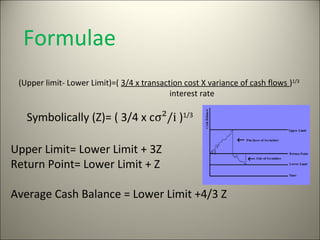
Formulae
 (Upper limit- Lower Limit)=( 3/4 x transaction cost X variance of cash flows )1/3
                                            interest rate

   Symbolically (Z)= ( 3/4 x cσ²/i )1/3

Upper Limit= Lower Limit + 3Z
Return Point= Lower Limit + Z

Average Cash Balance = Lower Limit +4/3 Z
Example
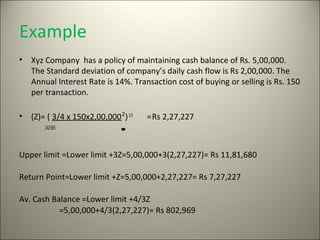
•   Xyz Company has a policy of maintaining cash balance of Rs. 5,00,000.
    The Standard deviation of company’s daily cash flow is Rs 2,00,000. The
    Annual Interest Rate is 14%. Transaction cost of buying or selling is Rs. 150
    per transaction.

•   (Z)= ( 3/4 x 150x2,00,000²) 1/3   = Rs 2,27,227
       .14/365


Upper limit =Lower limit +3Z=5,00,000+3(2,27,227)= Rs 11,81,680

Return Point=Lower limit +Z=5,00,000+2,27,227= Rs 7,27,227

Av. Cash Balance =Lower limit +4/3Z
           =5,00,000+4/3(2,27,227)= Rs 802,969
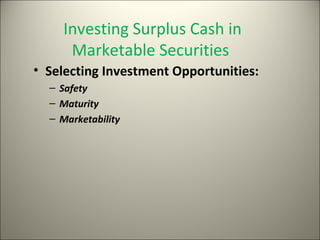
Investing Surplus Cash in
     Marketable Securities
• Selecting Investment Opportunities:
  – Safety
  – Maturity
  – Marketability
Thank You

14685550 cash-management-presentation

  • 1.
    CASH MANAGEMENT Prabhjot Singh Longia Prince Kaushal Puneet Walia Shubhpreet Kaur LMTSOM THAPAR UNIVERSITY
  • 2.
    WHAT IS CASH? •In narrow sense: currency and generally accepted equivalents of cash like cheques, drafts etc. • In broad sense: includes near-cash assets, such as marketable securities and time deposits in banks. – They can be readily sold and converted into cash. – Can serve as a reserve pool of liquidity. – Also provide short term investment outlet for excess cash.
  • 3.
    Cash management • Cashmanagement is concerned with the managing of: – cash flows into and out of the firm, – cash flows within the firm, and – cash balances held by the firm at a point of time by financing deficit or investing surplus cash
  • 4.
    Four Facets ofCash Management • Cash planning • Managing the cash flows • Optimum cash level • Investing surplus cash
  • 5.
    Motives for holdingcash • Transaction motive • Precautionary motive • Speculative motive • compensating motive
  • 6.
    Transaction motive • Holdingof cash to meet routine cash requirements to finance the transactions which a firm carries on in the ordinary course of business.
  • 7.
    Precautionary motive • Thecash balances held in reserve for random and unforeseen fluctuations in cash flows. • A cushion to meet unexpected contingencies. – Floods, strikes and failure of imp customers – Unexpected slowdown in collection of accounts receivable – Sharp increase in cost of raw materials – Cancellation of some order of goods • Defensive in nature
  • 8.
    Speculative motive • Isa motive for holding cash/near-cash to quickly take advantage of opportunities typically outside the normal course of business. • Positive and aggressive approach • Helps to take advantage of: – An opportunity to purchase raw materials at reduced price – Make purchase at favorable prices – Delay purchase on anticipation of decline in prices – Buying securities when interest rate is expected to decline
  • 9.
    Compensating motive • Isa motive for holding cash/near-cash to compensate banks for providing certain services or loans. • Clients are supposed to maintain a minimum balance of cash at the bank which they cannot use themselves.
  • 10.
    Objectives of cashmanagement • Meeting payments schedule – It prevents insolvency – relationship with bank is not constrained – Helps in fostering good relationships – Cash discount can be availed – Strong credit rating – Take advantage of business opportunities – Can meet unanticipated cash expenditure with a minimum of strain. • Minimizing funds committed to cash balances – High level of cash: large funds remain idle – Low level of cash: failure to meet payment schedule
  • 11.
    Managing Cash Collectionsand Disbursements • Accelerating Cash Collections • Controlling Disbursements
  • 12.
    Accelerating Cash Collections 1.Decentralised Collections  number of collection centres  Collection centres will collect cheques from customers and deposit in their local bank accounts  They will deposit the funds to a central bank
  • 13.
    Accelerating Cash Collections Contd……. 2. Lock-box System – Collection centers are established considering the customer locations and volume of remittances – At each centre the firm hires a post office box – Remittances are directly picked from the bank whom the firm gives the authority Advantages of lock-box system are – cheques are deposited immediately upon receipt of remittances – Eliminates the period between the time cheques are received by the firm and the time they are deposited in the bank for collection
  • 14.
    Controlling Disbursements It meansdelay the payments as much as possible. Can help the firm in conserving cash and reducing the financial requirements. Disbursement or Payment Float
  • 15.
    The size ofthe minimum cash balance depends on: • How quickly and cheaply a organization can raise cash when needed. • How accurately managers can predict cash requirements. Cash budget helps in this . • How much precautionary cash the managers need for emergencies.
  • 16.
    The organization’s maximumcash balance depends on: • Availability of (short-term) investment opportunities – e.g. money market funds, CDs, commercial paper • Expected return on investment opportunities. – e.g. If expected returns are high, organizations should be quick to invest excess cash • Transaction cost of withdrawing cash and making an investment • Demand for Cash for daily transactions
  • 17.
    BAUMOL MODEL Bumol recognizedthe similarities between cash and inventory management. He extended the economic order quantity (EOQ) model to examine its implications to cash management. The Baumol model assumes the cash manager invests excess funds in interest bearing securities and liquidates them to meet the firm’s demand for cash. As investment returns increase, the opportunity cost of holding cash increases and the cash manager decreases cash balances. As transaction costs (cost of liquidating short-term investments) increase, the cash manager decreases the number of times he liquidates securities, leading to higher cash balances.
  • 18.
    It has certainassumptions as follows (a)The firm can predict its future cash requirements with certainty. (b) The cash disbursements (outflow payments) are spread uniformly over the period. (c) The interest rate (which is the opportunity cost of holding cash) is fixed. (d) The firm will pay a fixed transactions cost each time it converts marketable securities into cash.
  • 19.
    Explanation • The firm incurs a holding cost for keeping the cash balance. It is an opportunity cost; that is, the return foregone on the marketable Holding Cost = i*C/2 securities. If the opportunity cost is (i), then the firm’s holding cost for maintaining an average cash balance is as follows: • The firm incurs a transaction cost whenever it converts its marketable securities to cash. Total Transactional cost= b*T/C number of transactions during the year will be total funds requirement, T, divided by the cash balance, C, i.e., T/C. The per transaction cost is assumed to be constant. If per transaction cost is b, then the total transaction cost will be: • The total annual cost of the demand for cash Total Cost = i*C/2 + b*T/C will be: • The optimum cash balance, C*, is obtained when the total cost is minimum. The formula for C=SQRT (2b*T/i) the optimum cash balance is as follows:
  • 20.
    Optimum Cash Balanceunder Certainty: Baumol’s Model GRAPHICAL REPRESENTATION
  • 21.
    EXAMPLE to clarifyBaumol’s Model • JAYSHREE CHEMICAL Limited estimates its total cash requirement as Rs 4 crore next year. The company’s opportunity cost of funds is 15% per annum. The company will have to incur Rs 300 per transaction when it converts its short-term securities to cash. Determine the optimum cash balance. How much is the total annual cost of the demand for the optimum cash balance? How many deposits will have to be made during the year? OPTIMUM CASH BALANCE = SQRT (2bT/i) = SQRT (2*300*4,00,00,000/0.15) =4,00,000 rs Annual cost = Holding cost + Transaction cost
  • 22.
    Holding cost =i*C/2 = 0.15* 4,00,000/2 = 30,000 Transaction cost = b*T/C = 300 * 4,00,00,000/4,00,000 = 30,000 TOTAL COST = 30,000+30,000 = Rs. 60,000 NUMBER OF DEPOSITS TO BE MADE IN A YEAR = T/C = 4,00,00,000/4,00,000 = 100
  • 23.
    limitations of theBaumol model  Assumes a constant disbursement rate  Ignores cash receipts during the period  Doesn't allow for safety cash reserves
  • 24.
    Miller-Orr Model Allows DailyCash Flow Variation Provides two control limits 1)Upper Control Limit 2)Lower Control Limit & Return Point The Difference depends upon 1) The Transaction Cost (c) 2) The Interest Rate (i) 3) The Standard Deviation of net cash flow (σ)
  • 25.
    Formulae (Upper limit-Lower Limit)=( 3/4 x transaction cost X variance of cash flows )1/3 interest rate Symbolically (Z)= ( 3/4 x cσ²/i )1/3 Upper Limit= Lower Limit + 3Z Return Point= Lower Limit + Z Average Cash Balance = Lower Limit +4/3 Z
  • 26.
    Example • Xyz Company has a policy of maintaining cash balance of Rs. 5,00,000. The Standard deviation of company’s daily cash flow is Rs 2,00,000. The Annual Interest Rate is 14%. Transaction cost of buying or selling is Rs. 150 per transaction. • (Z)= ( 3/4 x 150x2,00,000²) 1/3 = Rs 2,27,227 .14/365 Upper limit =Lower limit +3Z=5,00,000+3(2,27,227)= Rs 11,81,680 Return Point=Lower limit +Z=5,00,000+2,27,227= Rs 7,27,227 Av. Cash Balance =Lower limit +4/3Z =5,00,000+4/3(2,27,227)= Rs 802,969
  • 27.
    Investing Surplus Cashin Marketable Securities • Selecting Investment Opportunities: – Safety – Maturity – Marketability
  • 28.