Aldehydes and Ketone
Subject Expert
Dr. Tanuja Nautiyal
Sharda Public School, Almora
SHARDA PUBLIC SCHOOL, ALMORA
Carbonyl compounds
Aldehydes
Acid chlorides
Amides
Ketones
Carboxylic acid
Esters
-al
----
-amide
-formyl
-halo
-amino
-one
-oic acid
-oate
-oxo
-carboxy
-alkoxycarbonyl
Carbonyl compounds Suffix name prefix name
SHARDA PUBLIC SCHOOL, ALMORA
 Aldehydes and Ketones both have a carbon-oxygen double
bond called as carbonyl group.
 Both aldehyde and ketones possess the same general formula
Cn(H2O)n.
Aldehydes and Ketones
C H C C
Aldehyde Ketone
SHARDA PUBLIC SCHOOL, ALMORA
 The carbon-oxygen double bond is different than carbon-
carbon double bond. Since, oxygen is more electronegative,
the electrons of the bond are attracted towards oxygen. CO
bond is shorter, stronger and more polar than C=C bond in
alkenes. Consequently, oxygen attains a partial negative
charge and carbon a partial positive charge making the
bond polar, it is proposed that carbonyl group is a resonance
hybrid.
Structure of Carbonyl carbon group
SHARDA PUBLIC SCHOOL, ALMORA
 Carbonyl carbon atom is joined to three atoms by sigma
bonds. Since these bonds utilize sp2 -orbitals, they lie in
the same plane and are 120° apart.
Structure of Carbonyl carbon group
SHARDA PUBLIC SCHOOL, ALMORA
Difference between of Carbonyl carbon C=O bond
and alkene carbon C=C bond
SHARDA PUBLIC SCHOOL, ALMORA
Boiling Points
 Aldehydes and ketones are more polar, so they have a higher
boiling point than comparable alkanes or ethers.
 Aldehydes and ketones can not make hydrogen bond with
each other, so their boiling point is lower than comparable
alcohol.
1- Propanol Boiling point: 970C
Methoxyethane Boiling point: 80C
Propanal Boiling point: 490C
Acetone Boiling point: 560C
Butane Boiling point: 00C
SHARDA PUBLIC SCHOOL, ALMORA
Solubility of Aldehydes and Ketones
Aldehydes and ketones are good solvent for alcohols.
The lone pair of electrons on oxygen of carbonyl can
accept a hydrogen bond from O-H.
Acetaldehyde and Acetone are soluble in water
SHARDA PUBLIC SCHOOL, ALMORA
 Aldehyde has a greater partial positive charge on its
carbonyl carbon than ketone
Relative reactivity of Aldehydes and Ketones
Increasing reactivity
SHARDA PUBLIC SCHOOL, ALMORA
 The carbonyl carbon of an aldehyde is more accessible to
the nucleophile. Ketones have steric hindrance than
aldehydes, greater steric hindrance is responsible for its
less stability.
Relative reactivity of Ketones
Increasing reactivity
SHARDA PUBLIC SCHOOL, ALMORA
Nomenclature of Aldehydes and Ketones
 The aldehyde carbon is 10 carbon. In nomenclature –e
is replaced with –al.
 In nomenclature of ketone –e is replaced with –one.
 In cyclic ketone carbonyl group is assigned the no. 1
SHARDA PUBLIC SCHOOL, ALMORA
Common names
SHARDA PUBLIC SCHOOL, ALMORA
Nomenclature of Aldehydes and Ketones
3-methyl-pentanal-1 3-methyl -2- butanone
3-bromo-cyclohexanone
SHARDA PUBLIC SCHOOL, ALMORA
Preparation of Aldehydes and Ketones
A. Oxidation of Alcohols
B. Oxidation of Alkylbenzene
C. Reduction of Carboxylic acid
D. Reduction of Acid Chlorides(Friedel Crafts Reaction)
E. By using Grignard Reagent
F. Hydration of Alkynes
G. Hydroboration-Oxidation of Alkenes
H. Ozonolysis of Alkenes
SHARDA PUBLIC SCHOOL, ALMORA
10 alcohol Aldehyde
n- Butyl alcohol Butanal
Oxidation of alcohol
20 alcohol
Ketone
SHARDA PUBLIC SCHOOL, ALMORA
Oxidation of primary alcohols to ketone, pyridinium
chlorochromate (PCC) is used as an oxidising agent
Oxidation of alcohols
Oxidation of secondary alcohols by sodium dichromate in
sulphuric acid or by potassium permanganate give ketone.
Cyclohexylmethanol Cyclohexanecarbaldehyde
Borneol CamphorSHARDA PUBLIC SCHOOL, ALMORA
Oxidation of alkyl-benzene
Alkyl benzene Aldehyde
p- Bromotoluene p- Bromobenzaldehyde
SHARDA PUBLIC SCHOOL, ALMORA
Reduction of carboxylic acid by using Lithium Aluminium
Hydride (LiAlH4) gives aldehydes or ketones.
Carboxylic
acid
Aldehyde
SHARDA PUBLIC SCHOOL, ALMORA
Reduction of acid chlorides
Acid chlorides Aldehyde
p- Nitrobenzoyl chloride p- Nitrobenzaldehyde
Lithium aluminium tri (t-butoxy) hydride is a milder reducing
agent that reacts faster with acid chlorides than with
aldehydes
SHARDA PUBLIC SCHOOL, ALMORA
Lithium dialkylcuprate (Gilman reagent) transfer one of its
alkyl group in acid chloride.
Lithium
dialkylcuprate
Acid chloride Ketone
Reduction of Acid chloride
SHARDA PUBLIC SCHOOL, ALMORA
Reaction between an acyl halide and an aromatic ring will
produce a ketone
Friedel- Crafts Reaction
Benzophenone
Acid chloride Ketone
Benzoyl chloride
SHARDA PUBLIC SCHOOL, ALMORA
Preparation of ketone from Grignard reagent
SHARDA PUBLIC SCHOOL, ALMORA
Hydration of Alkynes
Hydration of alkynes gives aldehydes or ketones, the initial
product is an enol, which quickly tautomerizes to its keto
form.
Alkynes Enol Methyl ketone
SHARDA PUBLIC SCHOOL, ALMORA
Hydroboration- Oxidation of Alkynes
Hydroboration- oxidation of an alkyne gives aldehyde,
anti- markovnikov addition of water across the triple
bond.
SHARDA PUBLIC SCHOOL, ALMORA
Ozonolysis of Alkenes
In ozonolysis, the double bond in alkene is cleaved by ozone,
followed by reduction, and the products are aldehydes or
ketones.
SHARDA PUBLIC SCHOOL, ALMORA
If the nucleophile that adds to the aldehyde or ketone is an
Oxygen or Nitrogen, a nucleophilic-elimination reaction will
occur.
Nucleophilic addition reaction: Aldehydes and ketones react
with nucleophiles to form addition products.
Chemical properties of Aldehydes and Ketones
SHARDA PUBLIC SCHOOL, ALMORA
Reduction of Aldehydes or ketones
Addition of hydride ion to an aldehyde or ketone forms
and alkoxide ion, then protonation by an acid produces
an alcohol.
SHARDA PUBLIC SCHOOL, ALMORA
Aldehydes or
ketones
Alcohol
Aldehydes or
ketones
Alcohol
H2+Ni, Pt or Pd
Reduction of aldehydes or ketones
LiAlH4 or NaBH4
SHARDA PUBLIC SCHOOL, ALMORA
Reduction of Aldehydes and Ketones
SHARDA PUBLIC SCHOOL, ALMORA
Reduction of aldehydes and ketones
Aldehydes or
ketones
Alkanes
Aldehydes or
ketones
Alkanes
Zn(Hg), conc.HCl
NH2NH2, base
Clemmensen reduction
Wolff-Kishner reduction
SHARDA PUBLIC SCHOOL, ALMORA
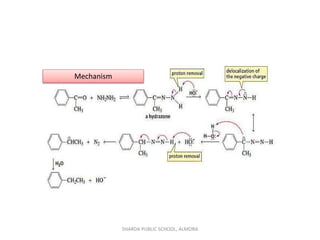
The Wolff-Kishner reduction
When a ketone or an aldehyde in a basic solution of hydrazine,
the carbonyl group is converted into a methylene group.
SHARDA PUBLIC SCHOOL, ALMORA
Mechanism
SHARDA PUBLIC SCHOOL, ALMORA
Mechanism of reduction of Carboxylic acid with LiAlH4
SHARDA PUBLIC SCHOOL, ALMORA
Oxidation of aldehydes and ketones
SHARDA PUBLIC SCHOOL, ALMORA
Tollen’s test (Silver mirror test)
Colourless
solution
Silver- mirror
SHARDA PUBLIC SCHOOL, ALMORA
Haloform reaction
Oxidation of methyl ketone
SHARDA PUBLIC SCHOOL, ALMORA
Mechanism of Haloform reaction:
SHARDA PUBLIC SCHOOL, ALMORA
Reaction with Grignard reagent
Grignard reagents react with aldehydes, ketones and carboxylic
acid derivatives
Propanal Grignard reagent
3-hexanol
SHARDA PUBLIC SCHOOL, ALMORA
Examples: Reaction with Grignard reagent
Butanal 1-phenyl-1-butanol
3-pentanone
3-methyl 3-pentanol
SHARDA PUBLIC SCHOOL, ALMORA
The Witting Reaction
A phosphorus ylide is used as the nucleophile in the
reaction. In this reaction, conversion of carbonyl group into a
new C=C double bond occurs.
Phosphorus ylide Trimethylphosphine
oxide
ketone Alkene
SHARDA PUBLIC SCHOOL, ALMORA
Triphenylphosphine oxide
Ylide Aldehyde or
ketone
Betaine Oxaphosphetane
Oxaphosphetane Alkene
+
Mechanism of Witting reaction
SHARDA PUBLIC SCHOOL, ALMORA
Reaction with Acetylide ions
SHARDA PUBLIC SCHOOL, ALMORA
Reaction with Acetylide ions
Acetylide ions
Acetylide ions Alcohol
SHARDA PUBLIC SCHOOL, ALMORA
Reaction with Hydrogen Cyanide
Acetone Acetone
cyanohydrin
SHARDA PUBLIC SCHOOL, ALMORA
Reaction with Hydrogen Cyanide
SHARDA PUBLIC SCHOOL, ALMORA
Reactions of Aldehydes and Ketones with Nitrogen nucleophile
Aldehydes and Ketones react with amines to form imine and
enamine.
Aldehyde or Ketone Primary amine Imine
Aldehyde or Ketone Secondary amine enamine
SHARDA PUBLIC SCHOOL, ALMORA
Reactions of Aldehydes and Ketones with Nitrogen nucleophile
Benzaldehyde ethylamine Imine
Cyclopentanone diethylamine
enamine
SHARDA PUBLIC SCHOOL, ALMORA
Mechanism
SHARDA PUBLIC SCHOOL, ALMORA
Mechanism
SHARDA PUBLIC SCHOOL, ALMORA
Aldehyde or ketone + Hydroxylamine Oxime
Aldehyde or ketone + Hydrazine Hydrazone
Aldehyde or ketone + phenylhydrazine Phenylhydrazone
Aldehyde or ketone + Semicarbazone Semicarbazone
Addition of derivatives of ammonia
SHARDA PUBLIC SCHOOL, ALMORA
Addition of derivatives of ammonia
SHARDA PUBLIC SCHOOL, ALMORA
Aldehyde
ketone
ketone
Hydroxylamine Oxime
Hydrazine Hydrazone
SemicarbazoneSemicarbazide
Reactions of Aldehydes and Ketones with Nitrogen nucleophile
SHARDA PUBLIC SCHOOL, ALMORA
Reactions of Aldehydes and Ketones with Nitrogen nucleophile
Hydrazine Hydrazone
SemicarbazoneSemicarbazide
SHARDA PUBLIC SCHOOL, ALMORA
Addition of water
Addition of water molecule to an aldehyde or a ketone form
a hydrate (gem-diols), are unstable.
aldehyde
or ketone
water hydrate (gem-diols),
SHARDA PUBLIC SCHOOL, ALMORA
Addition of alcohol
Addition of an alcohol and a ketone produce hemiketal,
after the addition of another alcohol produce ketal.
ketone
hemiketal ketal
SHARDA PUBLIC SCHOOL, ALMORA
Addition of alcohol
Addition of an alcohol and an aldehyde produce hemiacetal,
after the addition of another alcohol produce acetal.
an aldehyde hemiacetal acetal
SHARDA PUBLIC SCHOOL, ALMORA
Cannizzaro rection
Addition of two aldehydes (with no a- hydrogen) in presence
of strong base give one alcohol and one acid salt.
Aldehyde
(no a-Hydrogen)
Acid salt Alcohol
Formaldehydes
(no a-Hydrogen)
Formate ion Methanol
SHARDA PUBLIC SCHOOL, ALMORA
Mechanism of Cannizzaro reaction
SHARDA PUBLIC SCHOOL, ALMORA
Halogenation of aldehydes or ketones
When Cl2, Br2 or I2 is added to the acidic solution of an aldehyde
or a ketone, a halgoen replaces one of the a- hydrogens of the
carbonyl compound.
SHARDA PUBLIC SCHOOL, ALMORA
The carbon adjacent to a carbonyl carbon is called an a- carbon,
the hydrogen bonded to a-carbon is called a-Hydrogen. The a-
hydrogen bonded to a carbon adjacent to a carbonyl carbon is
sufficiently acidic to be removed by a strong base.
An a- hydrogen is more acidic than hydrogen bonded to other
sp3 hybridized carbon, because the base formed when a proton
is removed from other sp3 hybridized carbons, the acid strength
is determined by the stability of the conjugate base that is
formed when the acid gives up a proton.
Acidity of a-hydrogen
SHARDA PUBLIC SCHOOL, ALMORA
Acidity of a-hydrogen
SHARDA PUBLIC SCHOOL, ALMORA
Halogenation of a-Carbon
SHARDA PUBLIC SCHOOL, ALMORA
2-methylcyclohexanone
2-6 dimethylcyclohexanone 2-2 dimethylcyclohexanone
Mechanism of halogenation of a-Carbon
SHARDA PUBLIC SCHOOL, ALMORA
Aldol condensation
Addition of two molecules of aldehydes or two molecules of
ketones (contain a-hydrogen) form aldol (“ald”for aldehyde
and “ol” for alcohol)
SHARDA PUBLIC SCHOOL, ALMORA
Mechanism of Aldol condensation
SHARDA PUBLIC SCHOOL, ALMORA
When two different carbonyl compounds are used in an aldol
condensation, four products are formed, these products have
similar physical properties.
Mixed Aldol or Crossed Aldol Condensation
SHARDA PUBLIC SCHOOL, ALMORA
Carbonyl gps

Carbonyl gps

  • 1.
    Aldehydes and Ketone SubjectExpert Dr. Tanuja Nautiyal Sharda Public School, Almora SHARDA PUBLIC SCHOOL, ALMORA
  • 2.
    Carbonyl compounds Aldehydes Acid chlorides Amides Ketones Carboxylicacid Esters -al ---- -amide -formyl -halo -amino -one -oic acid -oate -oxo -carboxy -alkoxycarbonyl Carbonyl compounds Suffix name prefix name SHARDA PUBLIC SCHOOL, ALMORA
  • 3.
     Aldehydes andKetones both have a carbon-oxygen double bond called as carbonyl group.  Both aldehyde and ketones possess the same general formula Cn(H2O)n. Aldehydes and Ketones C H C C Aldehyde Ketone SHARDA PUBLIC SCHOOL, ALMORA
  • 4.
     The carbon-oxygendouble bond is different than carbon- carbon double bond. Since, oxygen is more electronegative, the electrons of the bond are attracted towards oxygen. CO bond is shorter, stronger and more polar than C=C bond in alkenes. Consequently, oxygen attains a partial negative charge and carbon a partial positive charge making the bond polar, it is proposed that carbonyl group is a resonance hybrid. Structure of Carbonyl carbon group SHARDA PUBLIC SCHOOL, ALMORA
  • 5.
     Carbonyl carbonatom is joined to three atoms by sigma bonds. Since these bonds utilize sp2 -orbitals, they lie in the same plane and are 120° apart. Structure of Carbonyl carbon group SHARDA PUBLIC SCHOOL, ALMORA
  • 6.
    Difference between ofCarbonyl carbon C=O bond and alkene carbon C=C bond SHARDA PUBLIC SCHOOL, ALMORA
  • 7.
    Boiling Points  Aldehydesand ketones are more polar, so they have a higher boiling point than comparable alkanes or ethers.  Aldehydes and ketones can not make hydrogen bond with each other, so their boiling point is lower than comparable alcohol. 1- Propanol Boiling point: 970C Methoxyethane Boiling point: 80C Propanal Boiling point: 490C Acetone Boiling point: 560C Butane Boiling point: 00C SHARDA PUBLIC SCHOOL, ALMORA
  • 8.
    Solubility of Aldehydesand Ketones Aldehydes and ketones are good solvent for alcohols. The lone pair of electrons on oxygen of carbonyl can accept a hydrogen bond from O-H. Acetaldehyde and Acetone are soluble in water SHARDA PUBLIC SCHOOL, ALMORA
  • 9.
     Aldehyde hasa greater partial positive charge on its carbonyl carbon than ketone Relative reactivity of Aldehydes and Ketones Increasing reactivity SHARDA PUBLIC SCHOOL, ALMORA
  • 10.
     The carbonylcarbon of an aldehyde is more accessible to the nucleophile. Ketones have steric hindrance than aldehydes, greater steric hindrance is responsible for its less stability. Relative reactivity of Ketones Increasing reactivity SHARDA PUBLIC SCHOOL, ALMORA
  • 11.
    Nomenclature of Aldehydesand Ketones  The aldehyde carbon is 10 carbon. In nomenclature –e is replaced with –al.  In nomenclature of ketone –e is replaced with –one.  In cyclic ketone carbonyl group is assigned the no. 1 SHARDA PUBLIC SCHOOL, ALMORA
  • 12.
  • 13.
    Nomenclature of Aldehydesand Ketones 3-methyl-pentanal-1 3-methyl -2- butanone 3-bromo-cyclohexanone SHARDA PUBLIC SCHOOL, ALMORA
  • 14.
    Preparation of Aldehydesand Ketones A. Oxidation of Alcohols B. Oxidation of Alkylbenzene C. Reduction of Carboxylic acid D. Reduction of Acid Chlorides(Friedel Crafts Reaction) E. By using Grignard Reagent F. Hydration of Alkynes G. Hydroboration-Oxidation of Alkenes H. Ozonolysis of Alkenes SHARDA PUBLIC SCHOOL, ALMORA
  • 15.
    10 alcohol Aldehyde n-Butyl alcohol Butanal Oxidation of alcohol 20 alcohol Ketone SHARDA PUBLIC SCHOOL, ALMORA
  • 16.
    Oxidation of primaryalcohols to ketone, pyridinium chlorochromate (PCC) is used as an oxidising agent Oxidation of alcohols Oxidation of secondary alcohols by sodium dichromate in sulphuric acid or by potassium permanganate give ketone. Cyclohexylmethanol Cyclohexanecarbaldehyde Borneol CamphorSHARDA PUBLIC SCHOOL, ALMORA
  • 17.
    Oxidation of alkyl-benzene Alkylbenzene Aldehyde p- Bromotoluene p- Bromobenzaldehyde SHARDA PUBLIC SCHOOL, ALMORA
  • 18.
    Reduction of carboxylicacid by using Lithium Aluminium Hydride (LiAlH4) gives aldehydes or ketones. Carboxylic acid Aldehyde SHARDA PUBLIC SCHOOL, ALMORA
  • 19.
    Reduction of acidchlorides Acid chlorides Aldehyde p- Nitrobenzoyl chloride p- Nitrobenzaldehyde Lithium aluminium tri (t-butoxy) hydride is a milder reducing agent that reacts faster with acid chlorides than with aldehydes SHARDA PUBLIC SCHOOL, ALMORA
  • 20.
    Lithium dialkylcuprate (Gilmanreagent) transfer one of its alkyl group in acid chloride. Lithium dialkylcuprate Acid chloride Ketone Reduction of Acid chloride SHARDA PUBLIC SCHOOL, ALMORA
  • 21.
    Reaction between anacyl halide and an aromatic ring will produce a ketone Friedel- Crafts Reaction Benzophenone Acid chloride Ketone Benzoyl chloride SHARDA PUBLIC SCHOOL, ALMORA
  • 22.
    Preparation of ketonefrom Grignard reagent SHARDA PUBLIC SCHOOL, ALMORA
  • 23.
    Hydration of Alkynes Hydrationof alkynes gives aldehydes or ketones, the initial product is an enol, which quickly tautomerizes to its keto form. Alkynes Enol Methyl ketone SHARDA PUBLIC SCHOOL, ALMORA
  • 24.
    Hydroboration- Oxidation ofAlkynes Hydroboration- oxidation of an alkyne gives aldehyde, anti- markovnikov addition of water across the triple bond. SHARDA PUBLIC SCHOOL, ALMORA
  • 25.
    Ozonolysis of Alkenes Inozonolysis, the double bond in alkene is cleaved by ozone, followed by reduction, and the products are aldehydes or ketones. SHARDA PUBLIC SCHOOL, ALMORA
  • 26.
  • 27.
    If the nucleophilethat adds to the aldehyde or ketone is an Oxygen or Nitrogen, a nucleophilic-elimination reaction will occur. Nucleophilic addition reaction: Aldehydes and ketones react with nucleophiles to form addition products. Chemical properties of Aldehydes and Ketones SHARDA PUBLIC SCHOOL, ALMORA
  • 28.
    Reduction of Aldehydesor ketones Addition of hydride ion to an aldehyde or ketone forms and alkoxide ion, then protonation by an acid produces an alcohol. SHARDA PUBLIC SCHOOL, ALMORA
  • 29.
    Aldehydes or ketones Alcohol Aldehydes or ketones Alcohol H2+Ni,Pt or Pd Reduction of aldehydes or ketones LiAlH4 or NaBH4 SHARDA PUBLIC SCHOOL, ALMORA
  • 30.
    Reduction of Aldehydesand Ketones SHARDA PUBLIC SCHOOL, ALMORA
  • 31.
    Reduction of aldehydesand ketones Aldehydes or ketones Alkanes Aldehydes or ketones Alkanes Zn(Hg), conc.HCl NH2NH2, base Clemmensen reduction Wolff-Kishner reduction SHARDA PUBLIC SCHOOL, ALMORA
  • 32.
    The Wolff-Kishner reduction Whena ketone or an aldehyde in a basic solution of hydrazine, the carbonyl group is converted into a methylene group. SHARDA PUBLIC SCHOOL, ALMORA
  • 33.
  • 34.
    Mechanism of reductionof Carboxylic acid with LiAlH4 SHARDA PUBLIC SCHOOL, ALMORA
  • 35.
    Oxidation of aldehydesand ketones SHARDA PUBLIC SCHOOL, ALMORA
  • 36.
    Tollen’s test (Silvermirror test) Colourless solution Silver- mirror SHARDA PUBLIC SCHOOL, ALMORA
  • 37.
    Haloform reaction Oxidation ofmethyl ketone SHARDA PUBLIC SCHOOL, ALMORA
  • 38.
    Mechanism of Haloformreaction: SHARDA PUBLIC SCHOOL, ALMORA
  • 39.
    Reaction with Grignardreagent Grignard reagents react with aldehydes, ketones and carboxylic acid derivatives Propanal Grignard reagent 3-hexanol SHARDA PUBLIC SCHOOL, ALMORA
  • 40.
    Examples: Reaction withGrignard reagent Butanal 1-phenyl-1-butanol 3-pentanone 3-methyl 3-pentanol SHARDA PUBLIC SCHOOL, ALMORA
  • 41.
    The Witting Reaction Aphosphorus ylide is used as the nucleophile in the reaction. In this reaction, conversion of carbonyl group into a new C=C double bond occurs. Phosphorus ylide Trimethylphosphine oxide ketone Alkene SHARDA PUBLIC SCHOOL, ALMORA
  • 42.
    Triphenylphosphine oxide Ylide Aldehydeor ketone Betaine Oxaphosphetane Oxaphosphetane Alkene + Mechanism of Witting reaction SHARDA PUBLIC SCHOOL, ALMORA
  • 43.
    Reaction with Acetylideions SHARDA PUBLIC SCHOOL, ALMORA
  • 44.
    Reaction with Acetylideions Acetylide ions Acetylide ions Alcohol SHARDA PUBLIC SCHOOL, ALMORA
  • 45.
    Reaction with HydrogenCyanide Acetone Acetone cyanohydrin SHARDA PUBLIC SCHOOL, ALMORA
  • 46.
    Reaction with HydrogenCyanide SHARDA PUBLIC SCHOOL, ALMORA
  • 47.
    Reactions of Aldehydesand Ketones with Nitrogen nucleophile Aldehydes and Ketones react with amines to form imine and enamine. Aldehyde or Ketone Primary amine Imine Aldehyde or Ketone Secondary amine enamine SHARDA PUBLIC SCHOOL, ALMORA
  • 48.
    Reactions of Aldehydesand Ketones with Nitrogen nucleophile Benzaldehyde ethylamine Imine Cyclopentanone diethylamine enamine SHARDA PUBLIC SCHOOL, ALMORA
  • 49.
  • 50.
  • 51.
    Aldehyde or ketone+ Hydroxylamine Oxime Aldehyde or ketone + Hydrazine Hydrazone Aldehyde or ketone + phenylhydrazine Phenylhydrazone Aldehyde or ketone + Semicarbazone Semicarbazone Addition of derivatives of ammonia SHARDA PUBLIC SCHOOL, ALMORA
  • 52.
    Addition of derivativesof ammonia SHARDA PUBLIC SCHOOL, ALMORA
  • 53.
    Aldehyde ketone ketone Hydroxylamine Oxime Hydrazine Hydrazone SemicarbazoneSemicarbazide Reactionsof Aldehydes and Ketones with Nitrogen nucleophile SHARDA PUBLIC SCHOOL, ALMORA
  • 54.
    Reactions of Aldehydesand Ketones with Nitrogen nucleophile Hydrazine Hydrazone SemicarbazoneSemicarbazide SHARDA PUBLIC SCHOOL, ALMORA
  • 55.
    Addition of water Additionof water molecule to an aldehyde or a ketone form a hydrate (gem-diols), are unstable. aldehyde or ketone water hydrate (gem-diols), SHARDA PUBLIC SCHOOL, ALMORA
  • 56.
    Addition of alcohol Additionof an alcohol and a ketone produce hemiketal, after the addition of another alcohol produce ketal. ketone hemiketal ketal SHARDA PUBLIC SCHOOL, ALMORA
  • 57.
    Addition of alcohol Additionof an alcohol and an aldehyde produce hemiacetal, after the addition of another alcohol produce acetal. an aldehyde hemiacetal acetal SHARDA PUBLIC SCHOOL, ALMORA
  • 58.
    Cannizzaro rection Addition oftwo aldehydes (with no a- hydrogen) in presence of strong base give one alcohol and one acid salt. Aldehyde (no a-Hydrogen) Acid salt Alcohol Formaldehydes (no a-Hydrogen) Formate ion Methanol SHARDA PUBLIC SCHOOL, ALMORA
  • 59.
    Mechanism of Cannizzaroreaction SHARDA PUBLIC SCHOOL, ALMORA
  • 60.
    Halogenation of aldehydesor ketones When Cl2, Br2 or I2 is added to the acidic solution of an aldehyde or a ketone, a halgoen replaces one of the a- hydrogens of the carbonyl compound. SHARDA PUBLIC SCHOOL, ALMORA
  • 61.
    The carbon adjacentto a carbonyl carbon is called an a- carbon, the hydrogen bonded to a-carbon is called a-Hydrogen. The a- hydrogen bonded to a carbon adjacent to a carbonyl carbon is sufficiently acidic to be removed by a strong base. An a- hydrogen is more acidic than hydrogen bonded to other sp3 hybridized carbon, because the base formed when a proton is removed from other sp3 hybridized carbons, the acid strength is determined by the stability of the conjugate base that is formed when the acid gives up a proton. Acidity of a-hydrogen SHARDA PUBLIC SCHOOL, ALMORA
  • 62.
    Acidity of a-hydrogen SHARDAPUBLIC SCHOOL, ALMORA
  • 63.
    Halogenation of a-Carbon SHARDAPUBLIC SCHOOL, ALMORA
  • 64.
    2-methylcyclohexanone 2-6 dimethylcyclohexanone 2-2dimethylcyclohexanone Mechanism of halogenation of a-Carbon SHARDA PUBLIC SCHOOL, ALMORA
  • 65.
    Aldol condensation Addition oftwo molecules of aldehydes or two molecules of ketones (contain a-hydrogen) form aldol (“ald”for aldehyde and “ol” for alcohol) SHARDA PUBLIC SCHOOL, ALMORA
  • 66.
    Mechanism of Aldolcondensation SHARDA PUBLIC SCHOOL, ALMORA
  • 67.
    When two differentcarbonyl compounds are used in an aldol condensation, four products are formed, these products have similar physical properties. Mixed Aldol or Crossed Aldol Condensation SHARDA PUBLIC SCHOOL, ALMORA