
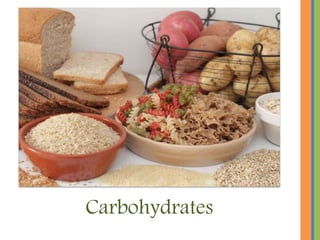
Carbohydrates
By Prof. Liwayway Memije-Cruz
Carbohydrates
Origin of Carbohydrates
 compounds containing C, H and O usually with the
empirical formula Cm(H2O)n.
 Polyhydroxy Aldehydes and Ketones composed of Carbon,
Hydrogen and Oxygen.
 the nomenclature including Mono-, Di-, Oligo- and Poly-
"Saccharide" is preferred over the now obsolete and too-
general term "carbohydrate", since the etymological origin
of the word "carbohydrate" is from the greek words
Carbo- for carbon and hydor- for water which indicates
that the carbohydrates are "hydrates" of carbon and have
the empirical formula Cm(H2O)n, which is not always
true. Instead "saccharide" is derived from the greek word
for "sugar" and hence is much more accurate as it does not
limit the definition to any empirical formula.
Functions of Carbohydrates
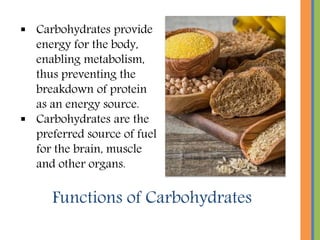
 Carbohydrates provide
energy for the body,
enabling metabolism,
thus preventing the
breakdown of protein
as an energy source.
 Carbohydrates are the
preferred source of fuel
for the brain, muscle
and other organs.
Carbohydrates means
hydrated carbons; examples
are glucose (C6 H12O6) and
ribose (C5H10O5). They
provide an easy and ready to
use source of food.
 Carbohydrates, together with lipids,
proteins and nucleic acids, are one of the
four major classes of biologically essential
organic molecules found in all living
organisms.
 Carbohydrates, all coming from the process
of photosynthesis, represent the major part
of organic substance on Earth, are the most
abundant organic components in the major
part of fruits, vegetables, legumes and cereal
grains, carry out many functions.
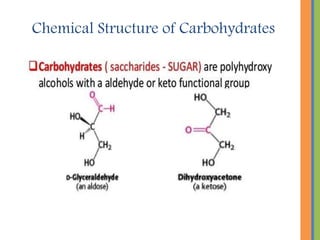
Chemical Structure of Carbohydrates
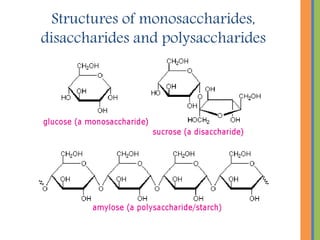
Structures of monosaccharides,
disaccharides and polysaccharides
Monosaccharides are commonly
referred to as simple sugars.
Examples are:
Glucose – blood sugar which is the
universal cellular fuel
Fructose – fruit sugar is converted to
glucose for used by body cells.
Galactose – dairy products
Ribose - form part of the structure of
nucleic acids.
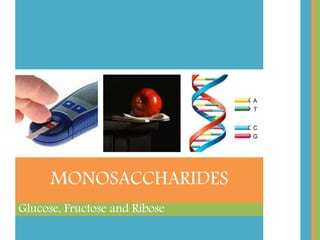
Glucose, Fructose and Ribose
MONOSACCHARIDES
 Monosaccharides are simple sugars,
which possess a free ketone or
aldehyde group. Being the simplest of
sugars, they cannot be further
hydrolyzed. Their chemical formula is
CnH2nOn or Cn(H2O)n.
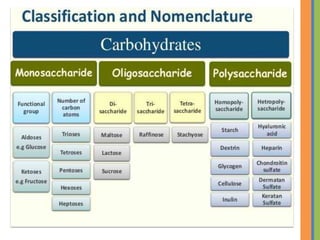
 Monosaccharides are classified into
trioses, tetroses, pentoses, etc., and as
ketoses or aldoses, depending on their
ketone or aldehyde group.
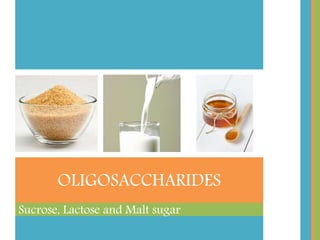
Sucrose, Lactose and Malt sugar
OLIGOSACCHARIDES
 “Oligo” meaning few, oligosaccharides are sugars
that break down into two to 10 molecules of
monosaccharides when hydrolyzed.
 An oligosaccharide that yields two
monosaccharide molecules on hydrolysis is a
disaccharide, while those that break down into
three or four monosaccharides are called
trisaccharides, tetrasaccharides, and so on.
Disaccharides have a chemical formula of Cn
(H2O) n-1 while trisaccharides and others are Cn
(H2O) n-2, etc.
 Oligosaccharide examples include sucrose,
maltose, lactose, raffinose, and stachyose.
Oligosaccharide
Disaccharides are referred to as double sugars.
Some of the important disaccharides in the diet
include:
Sucrose (glucose-fructose), which is cane
sugar.
Lactose (glucose-galactose) found in milk.
Maltose (glucose-glucose) malt sugar.
Disaccharides must be broken down (digested)
to monosaccharide to be absorbed from the
digestive tract in to the blood.
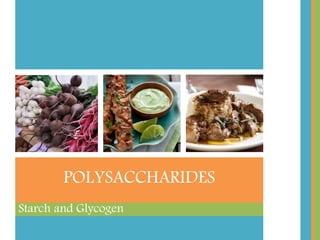
Starch and Glycogen
POLYSACCHARIDES
Polysaccharides
• Polysaccharides are polymers consisting of 20 to
107 monosaccharidic units; they differ each other
for the monosaccharides recurring in the
structure, for the length and the degree of
branching of chains or for the type of links
between units.
• Polysaccharides are defined as:
a. omopolysaccharides - contain only one
type of monosaccharide as starch, glycogen and
chitin;
b. eteropolysaccharides -contain two or
more different kinds (e.g. hyaluronic acid).
 Polysaccharide, which literally means
much sugar, is a polymer of linked
monosaccharides.
 Starch is the storage polysaccharide
formed by plants as starchy foods like
grains and root vegetables (potatoes and
carrots).
 Glycogen is found in animal tissues like
in the muscles and the liver.
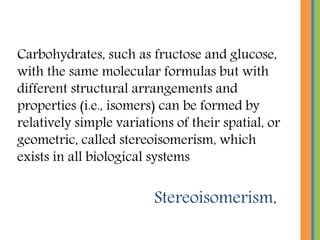
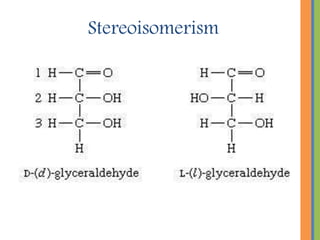
Stereoisomerism,
Carbohydrates, such as fructose and glucose,
with the same molecular formulas but with
different structural arrangements and
properties (i.e., isomers) can be formed by
relatively simple variations of their spatial, or
geometric, called stereoisomerism, which
exists in all biological systems
Stereoisomerism
References
 http://www.tuscany-
diet.net/carbohydrates/classification-
functions/
 http://www.newhealthadvisor.com/Classifi
cation-of-Carbohydrates.html
 https://www.britannica.com/science/carbo
hydrate/Role-in-human-
nutrition#ref593913

Carbohydrates

  • 1.
  • 2.
  • 3.
    Origin of Carbohydrates compounds containing C, H and O usually with the empirical formula Cm(H2O)n.  Polyhydroxy Aldehydes and Ketones composed of Carbon, Hydrogen and Oxygen.  the nomenclature including Mono-, Di-, Oligo- and Poly- "Saccharide" is preferred over the now obsolete and too- general term "carbohydrate", since the etymological origin of the word "carbohydrate" is from the greek words Carbo- for carbon and hydor- for water which indicates that the carbohydrates are "hydrates" of carbon and have the empirical formula Cm(H2O)n, which is not always true. Instead "saccharide" is derived from the greek word for "sugar" and hence is much more accurate as it does not limit the definition to any empirical formula.
  • 4.
    Functions of Carbohydrates Carbohydrates provide energy for the body, enabling metabolism, thus preventing the breakdown of protein as an energy source.  Carbohydrates are the preferred source of fuel for the brain, muscle and other organs.
  • 5.
    Carbohydrates means hydrated carbons;examples are glucose (C6 H12O6) and ribose (C5H10O5). They provide an easy and ready to use source of food.
  • 6.
     Carbohydrates, togetherwith lipids, proteins and nucleic acids, are one of the four major classes of biologically essential organic molecules found in all living organisms.  Carbohydrates, all coming from the process of photosynthesis, represent the major part of organic substance on Earth, are the most abundant organic components in the major part of fruits, vegetables, legumes and cereal grains, carry out many functions.
  • 8.
    Chemical Structure ofCarbohydrates
  • 9.
  • 10.
    Monosaccharides are commonly referredto as simple sugars. Examples are: Glucose – blood sugar which is the universal cellular fuel Fructose – fruit sugar is converted to glucose for used by body cells. Galactose – dairy products Ribose - form part of the structure of nucleic acids.
  • 11.
    Glucose, Fructose andRibose MONOSACCHARIDES
  • 12.
     Monosaccharides aresimple sugars, which possess a free ketone or aldehyde group. Being the simplest of sugars, they cannot be further hydrolyzed. Their chemical formula is CnH2nOn or Cn(H2O)n.  Monosaccharides are classified into trioses, tetroses, pentoses, etc., and as ketoses or aldoses, depending on their ketone or aldehyde group.
  • 13.
    Sucrose, Lactose andMalt sugar OLIGOSACCHARIDES
  • 14.
     “Oligo” meaningfew, oligosaccharides are sugars that break down into two to 10 molecules of monosaccharides when hydrolyzed.  An oligosaccharide that yields two monosaccharide molecules on hydrolysis is a disaccharide, while those that break down into three or four monosaccharides are called trisaccharides, tetrasaccharides, and so on. Disaccharides have a chemical formula of Cn (H2O) n-1 while trisaccharides and others are Cn (H2O) n-2, etc.  Oligosaccharide examples include sucrose, maltose, lactose, raffinose, and stachyose. Oligosaccharide
  • 15.
    Disaccharides are referredto as double sugars. Some of the important disaccharides in the diet include: Sucrose (glucose-fructose), which is cane sugar. Lactose (glucose-galactose) found in milk. Maltose (glucose-glucose) malt sugar. Disaccharides must be broken down (digested) to monosaccharide to be absorbed from the digestive tract in to the blood.
  • 16.
  • 17.
    Polysaccharides • Polysaccharides arepolymers consisting of 20 to 107 monosaccharidic units; they differ each other for the monosaccharides recurring in the structure, for the length and the degree of branching of chains or for the type of links between units. • Polysaccharides are defined as: a. omopolysaccharides - contain only one type of monosaccharide as starch, glycogen and chitin; b. eteropolysaccharides -contain two or more different kinds (e.g. hyaluronic acid).
  • 18.
     Polysaccharide, whichliterally means much sugar, is a polymer of linked monosaccharides.  Starch is the storage polysaccharide formed by plants as starchy foods like grains and root vegetables (potatoes and carrots).  Glycogen is found in animal tissues like in the muscles and the liver.
  • 19.
    Stereoisomerism, Carbohydrates, such asfructose and glucose, with the same molecular formulas but with different structural arrangements and properties (i.e., isomers) can be formed by relatively simple variations of their spatial, or geometric, called stereoisomerism, which exists in all biological systems
  • 20.
  • 21.