BIOMOLECULES
•BIO – LIFE
•MOLECULES – Combination of 2 or
more atoms
•Biomolecules – molecules of life
BIOMOLECULE
-Any molecule that are produced by living
organism, including large macromolecules
such as proteins, polysaccharides, lipids and
nucleic acid.
Four main types of biomolecules
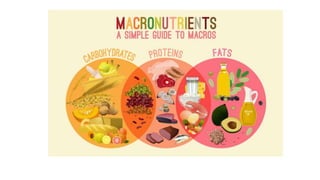
•Carbohydrates
•Proteins
•Nucleic Acids
•Lipids
CARBOHYDRATE
(from FRENCH word) hydrate de carbone means “hydrates of carbon”
Carbohydrate sometimes called
SACCHARIDE from Greek word
“sakcharon” meaning sugar.
WHAT IS CARBOHYDRATES?
 It is the most abundant class of
biomolecules.
 It is the chief source of energy of all living
organisms.
 Plays a vital role in our existence.
(without carbohydrates we will not be able to
think
nor move, no life activities would be possible
and
simple life would not exist).
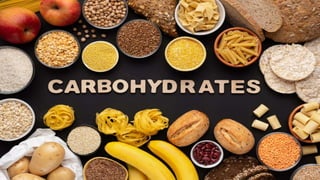
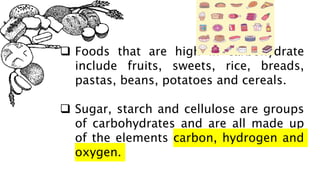
 Foods that are high in carbohydrate
include fruits, sweets, rice, breads,
pastas, beans, potatoes and cereals.
 Sugar, starch and cellulose are groups
of carbohydrates and are all made up
of the elements carbon, hydrogen and
oxygen.
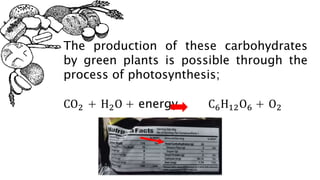
The production of these carbohydrates
by green plants is possible through the
process of photosynthesis;
CO2 + H2O + energy C6H12O6 + O2
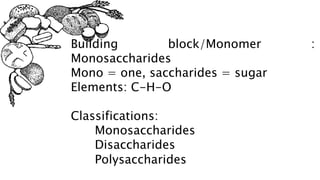
Building block/Monomer :
Monosaccharides
Mono = one, saccharides = sugar
Elements: C-H-O
Classifications:
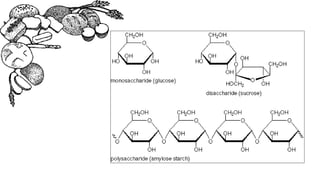
Monosaccharides
Disaccharides
Polysaccharides
Classifications OF
CARBOHYDRATE
S
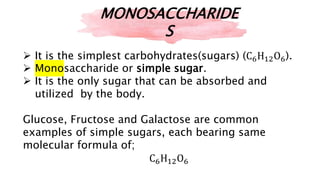
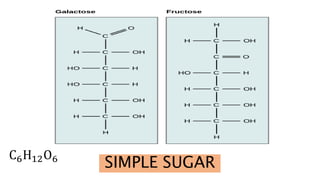
 It is the simplest carbohydrates(sugars) (C6H12O6).
 Monosaccharide or simple sugar.
 It is the only sugar that can be absorbed and
utilized by the body.
Glucose, Fructose and Galactose are common
examples of simple sugars, each bearing same
molecular formula of;
C6H12O6
MONOSACCHARIDE
S
MONOSACCHARIDE
S
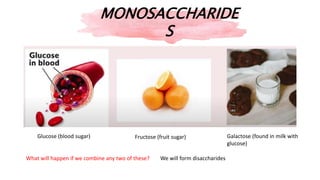
Glucose (blood sugar) Fructose (fruit sugar) Galactose (found in milk with
glucose)
What will happen if we combine any two of these? We will form disaccharides
 Referred to as dextrose.
 Most important and most abundant
Monosaccharide in nature.
 Found in blood stream and provides the immediate
source of
energy of the body’s cell and tissues.
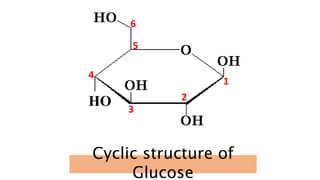
 Glucose molecule may exist both in a chain and
cyclic form.
GLUCOSE
Cyclic structure of
Glucose
1
2
3
4
5
6
HO
SIMPLE SUGAR
C6H12O6
Isomers of
Glucose
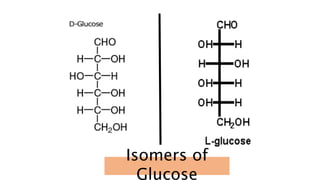
If you notice, glucose contains the
functional groups aldehyde (CHO) and
five hydroxyl groups (OH).
Also, looking at the figure, you will find
the caption as D and L. The D and L is a
designated given which refers to the
asymmetric carbon farthest from the
aldehyde group. It is a D-sugar since the
hydroxyl is on the right side, while, L-
sugar if the hydroxyl is on the left side.
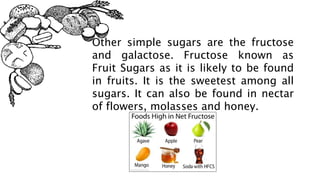
Other simple sugars are the fructose
and galactose. Fructose known as
Fruit Sugars as it is likely to be found
in fruits. It is the sweetest among all
sugars. It can also be found in nectar
of flowers, molasses and honey.
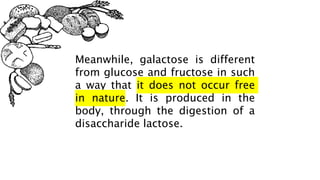
Meanwhile, galactose is different
from glucose and fructose in such
a way that it does not occur free
in nature. It is produced in the
body, through the digestion of a
disaccharide lactose.
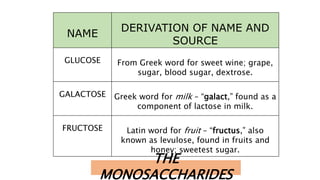
THE
MONOSACCHARIDES
NAME
DERIVATION OF NAME AND
SOURCE
GLUCOSE From Greek word for sweet wine; grape,
sugar, blood sugar, dextrose.
GALACTOSE Greek word for milk – “galact,” found as a
component of lactose in milk.
FRUCTOSE Latin word for fruit – “fructus,” also
known as levulose, found in fruits and
honey; sweetest sugar.
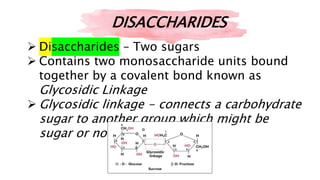
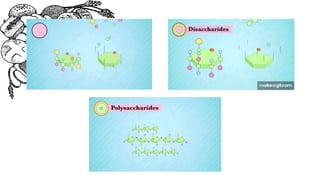
 Disaccharides – Two sugars
 Contains two monosaccharide units bound
together by a covalent bond known as
Glycosidic Linkage
 Glycosidic linkage - connects a carbohydrate
sugar to another group which might be
sugar or not.
DISACCHARIDES
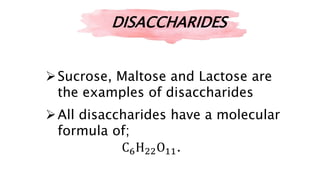
DISACCHARIDES
Sucrose, Maltose and Lactose are
the examples of disaccharides
All disaccharides have a molecular
formula of;
C6H22O11.
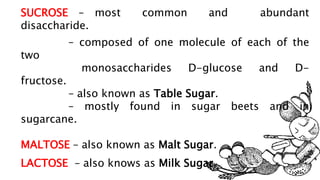
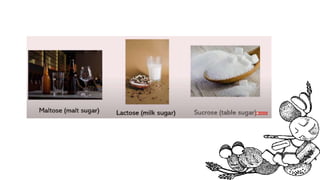
SUCROSE – most common and abundant
disaccharide.
– composed of one molecule of each of the
two
monosaccharides D-glucose and D-
fructose.
– also known as Table Sugar.
– mostly found in sugar beets and in
sugarcane.
MALTOSE – also known as Malt Sugar.
LACTOSE – also knows as Milk Sugar.
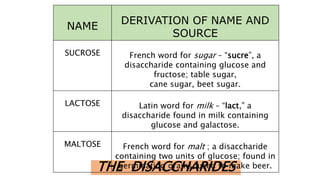
THE DISACCHARIDES
NAME
DERIVATION OF NAME AND
SOURCE
SUCROSE French word for sugar – “sucre”, a
disaccharide containing glucose and
fructose; table sugar,
cane sugar, beet sugar.
LACTOSE Latin word for milk – “lact,” a
disaccharide found in milk containing
glucose and galactose.
MALTOSE French word for malt ; a disaccharide
containing two units of glucose; found in
germinating grains, used to make beer.
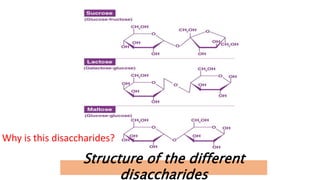
Structure of the different
disaccharides
Why is this disaccharides?
 Carbohydrates that contain ten monosaccharide
units or more are called polysaccharides. Many
Sugars
 Starch, Glycogen and Cellulose are common
polysaccharides.
 (C6H10O5)n
Starch and Glycogen differ from where they are
stored. Glycogen is a stored carbohydrates in
animals, while Starch is the stored carbohydrates in
plants.
POLYSACCHARIDES
 Examples
 Starch
 Used for energy storage in plants
 Provide a quick form of energy
 Examples, potato, pasta, rice grain
 Glycogen
 Used for energy storage in plants
 When the body doesn’t need glucose for
energy, it stores in the live and muscles in the
form of glycogen
POLYSACCHARIDES
 Examples
 Cellulose
 Found in plants, in cell walls and tree barks
 Gives us fibers
 Chitin
 Forms the exoskeleton of certain insects and
crustaceans
POLYSACCHARIDES
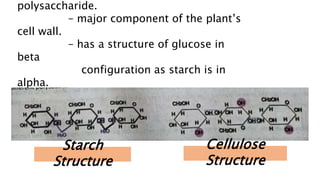
polysaccharide.
– major component of the plant’s
cell wall.
– has a structure of glucose in
beta
configuration as starch is in
alpha.
Starch
Structure
Cellulose
Structure
The difference is the reason why starch is an
important food material , while cellulose is
not . In fact, cellulose cannot be digested
by man. Only the animals like cows and
horses can digest them as these animals
have bacteria in their rumens whose enzyme
can break down the molecules of cellulose
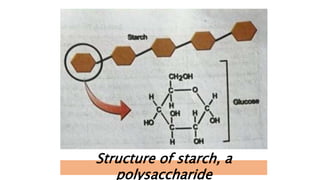
Structure of starch, a
polysaccharide
About two-thirds of the total body’s
glycogen is stored in the muscles and the
remaining one-third is stored in the liver.
POLYSACCHARIDES are of two types:
Homopolysaccharide and
Heteropolysaccharide.
Homopolysaccharide
– Formed by the same type of
monosaccharide.
Just in the case of starch, glycogen and
cellulose. These three polysaccharides are
formed from hundreds of molecules of just
one type of monosaccharide, and that is
glucose, bonded together through
glycosidic linkages.
Heteropolysaccharide
– Formed by the different types of
monosaccharides.
Some common examples of
Heteropolysaccharide are glycos-amines and
peptidoglycans.
THE
POLYSACCHARIDES
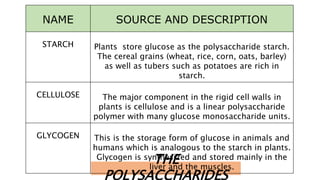
NAME SOURCE AND DESCRIPTION
STARCH Plants store glucose as the polysaccharide starch.
The cereal grains (wheat, rice, corn, oats, barley)
as well as tubers such as potatoes are rich in
starch.
CELLULOSE The major component in the rigid cell walls in
plants is cellulose and is a linear polysaccharide
polymer with many glucose monosaccharide units.
GLYCOGEN This is the storage form of glucose in animals and
humans which is analogous to the starch in plants.
Glycogen is synthesized and stored mainly in the
liver and the muscles.
CARBOHYDRATES
IN THE
HUMAN BODY
Carbohydrates has one basic role in our body; that
is to supply energy. Our body uses carbohydrates
directly from glucose, a monosaccharide. The
disaccharide and polysaccharides should be
broken down first before we can use them.
While we need carbohydrates to supply our
energy, it does not guarantee a fit and healthy
body. We also need other nutrients such as
proteins, water, vitamins and minerals.
Carbohydrates are being absorbed in the body
through digestion. The digestion of food starts
in the mouth. An enzyme known as salivary
amylase or ptyalin present in saliva is mixed with
the food and converts glycogen and starch to
maltose. It continues then to the stomach where
acids like Hydrochloric Acid (HCI) which is
secreted by proteins are present.
These acids and the acids of fruits such as
oranges, lemons and pineapples can destroy the
only starch-splitting enzyme ptyalin. So, for good
health reasons, it is important that you take
carbohydrates at separate meals from protein
foods and acids. It is important also that water
and other liquids be not taken too soon or after
meals for they do not aid in the digestion of food.
In the intestine, digestion of starch and sugar is
acted upon by an enzyme secreted by pancreas
known as pancreatic amylase where it converts the
starches and sugar to disaccharides and maltose,
sucrose and lactose. These disaccharides cannot
be utilized by our body.
They have to be converted first into a
monosaccharide. Hence, maltose is acted upon by
amylases maltase; sucrose by amylases sucrose;
and lactose by amylases lactase.
Fruits are the ideal source of carbohydrates. As
starches are polysaccharide, fruits are
monosaccharide. Which would only mean that
sugar in fruits can pass through the stomach and
can be easily absorbed by the walls of the
intestine without requiring any digestion at all.
These leave more of the body’s energy available
for other activities.
Thank you! 

Carbohydrates.pptx

  • 1.
  • 2.
    •BIO – LIFE •MOLECULES– Combination of 2 or more atoms •Biomolecules – molecules of life
  • 3.
    BIOMOLECULE -Any molecule thatare produced by living organism, including large macromolecules such as proteins, polysaccharides, lipids and nucleic acid.
  • 4.
    Four main typesof biomolecules •Carbohydrates •Proteins •Nucleic Acids •Lipids
  • 6.
    CARBOHYDRATE (from FRENCH word)hydrate de carbone means “hydrates of carbon” Carbohydrate sometimes called SACCHARIDE from Greek word “sakcharon” meaning sugar.
  • 7.
    WHAT IS CARBOHYDRATES? It is the most abundant class of biomolecules.  It is the chief source of energy of all living organisms.  Plays a vital role in our existence. (without carbohydrates we will not be able to think nor move, no life activities would be possible and simple life would not exist).
  • 8.
     Foods thatare high in carbohydrate include fruits, sweets, rice, breads, pastas, beans, potatoes and cereals.  Sugar, starch and cellulose are groups of carbohydrates and are all made up of the elements carbon, hydrogen and oxygen.
  • 9.
    The production ofthese carbohydrates by green plants is possible through the process of photosynthesis; CO2 + H2O + energy C6H12O6 + O2
  • 10.
    Building block/Monomer : Monosaccharides Mono= one, saccharides = sugar Elements: C-H-O Classifications: Monosaccharides Disaccharides Polysaccharides
  • 12.
  • 13.
     It isthe simplest carbohydrates(sugars) (C6H12O6).  Monosaccharide or simple sugar.  It is the only sugar that can be absorbed and utilized by the body. Glucose, Fructose and Galactose are common examples of simple sugars, each bearing same molecular formula of; C6H12O6 MONOSACCHARIDE S
  • 14.
    MONOSACCHARIDE S Glucose (blood sugar)Fructose (fruit sugar) Galactose (found in milk with glucose) What will happen if we combine any two of these? We will form disaccharides
  • 15.
     Referred toas dextrose.  Most important and most abundant Monosaccharide in nature.  Found in blood stream and provides the immediate source of energy of the body’s cell and tissues.  Glucose molecule may exist both in a chain and cyclic form. GLUCOSE
  • 16.
  • 17.
  • 18.
  • 19.
    If you notice,glucose contains the functional groups aldehyde (CHO) and five hydroxyl groups (OH). Also, looking at the figure, you will find the caption as D and L. The D and L is a designated given which refers to the asymmetric carbon farthest from the aldehyde group. It is a D-sugar since the hydroxyl is on the right side, while, L- sugar if the hydroxyl is on the left side.
  • 20.
    Other simple sugarsare the fructose and galactose. Fructose known as Fruit Sugars as it is likely to be found in fruits. It is the sweetest among all sugars. It can also be found in nectar of flowers, molasses and honey.
  • 21.
    Meanwhile, galactose isdifferent from glucose and fructose in such a way that it does not occur free in nature. It is produced in the body, through the digestion of a disaccharide lactose.
  • 22.
    THE MONOSACCHARIDES NAME DERIVATION OF NAMEAND SOURCE GLUCOSE From Greek word for sweet wine; grape, sugar, blood sugar, dextrose. GALACTOSE Greek word for milk – “galact,” found as a component of lactose in milk. FRUCTOSE Latin word for fruit – “fructus,” also known as levulose, found in fruits and honey; sweetest sugar.
  • 23.
     Disaccharides –Two sugars  Contains two monosaccharide units bound together by a covalent bond known as Glycosidic Linkage  Glycosidic linkage - connects a carbohydrate sugar to another group which might be sugar or not. DISACCHARIDES
  • 24.
    DISACCHARIDES Sucrose, Maltose andLactose are the examples of disaccharides All disaccharides have a molecular formula of; C6H22O11.
  • 25.
    SUCROSE – mostcommon and abundant disaccharide. – composed of one molecule of each of the two monosaccharides D-glucose and D- fructose. – also known as Table Sugar. – mostly found in sugar beets and in sugarcane. MALTOSE – also known as Malt Sugar. LACTOSE – also knows as Milk Sugar.
  • 27.
    THE DISACCHARIDES NAME DERIVATION OFNAME AND SOURCE SUCROSE French word for sugar – “sucre”, a disaccharide containing glucose and fructose; table sugar, cane sugar, beet sugar. LACTOSE Latin word for milk – “lact,” a disaccharide found in milk containing glucose and galactose. MALTOSE French word for malt ; a disaccharide containing two units of glucose; found in germinating grains, used to make beer.
  • 28.
    Structure of thedifferent disaccharides Why is this disaccharides?
  • 29.
     Carbohydrates thatcontain ten monosaccharide units or more are called polysaccharides. Many Sugars  Starch, Glycogen and Cellulose are common polysaccharides.  (C6H10O5)n Starch and Glycogen differ from where they are stored. Glycogen is a stored carbohydrates in animals, while Starch is the stored carbohydrates in plants. POLYSACCHARIDES
  • 30.
     Examples  Starch Used for energy storage in plants  Provide a quick form of energy  Examples, potato, pasta, rice grain  Glycogen  Used for energy storage in plants  When the body doesn’t need glucose for energy, it stores in the live and muscles in the form of glycogen POLYSACCHARIDES
  • 31.
     Examples  Cellulose Found in plants, in cell walls and tree barks  Gives us fibers  Chitin  Forms the exoskeleton of certain insects and crustaceans POLYSACCHARIDES
  • 32.
    polysaccharide. – major componentof the plant’s cell wall. – has a structure of glucose in beta configuration as starch is in alpha. Starch Structure Cellulose Structure
  • 33.
    The difference isthe reason why starch is an important food material , while cellulose is not . In fact, cellulose cannot be digested by man. Only the animals like cows and horses can digest them as these animals have bacteria in their rumens whose enzyme can break down the molecules of cellulose
  • 34.
    Structure of starch,a polysaccharide
  • 35.
    About two-thirds ofthe total body’s glycogen is stored in the muscles and the remaining one-third is stored in the liver. POLYSACCHARIDES are of two types: Homopolysaccharide and Heteropolysaccharide.
  • 36.
    Homopolysaccharide – Formed bythe same type of monosaccharide. Just in the case of starch, glycogen and cellulose. These three polysaccharides are formed from hundreds of molecules of just one type of monosaccharide, and that is glucose, bonded together through glycosidic linkages.
  • 37.
    Heteropolysaccharide – Formed bythe different types of monosaccharides. Some common examples of Heteropolysaccharide are glycos-amines and peptidoglycans.
  • 38.
    THE POLYSACCHARIDES NAME SOURCE ANDDESCRIPTION STARCH Plants store glucose as the polysaccharide starch. The cereal grains (wheat, rice, corn, oats, barley) as well as tubers such as potatoes are rich in starch. CELLULOSE The major component in the rigid cell walls in plants is cellulose and is a linear polysaccharide polymer with many glucose monosaccharide units. GLYCOGEN This is the storage form of glucose in animals and humans which is analogous to the starch in plants. Glycogen is synthesized and stored mainly in the liver and the muscles.
  • 39.
  • 40.
    Carbohydrates has onebasic role in our body; that is to supply energy. Our body uses carbohydrates directly from glucose, a monosaccharide. The disaccharide and polysaccharides should be broken down first before we can use them. While we need carbohydrates to supply our energy, it does not guarantee a fit and healthy body. We also need other nutrients such as proteins, water, vitamins and minerals.
  • 41.
    Carbohydrates are beingabsorbed in the body through digestion. The digestion of food starts in the mouth. An enzyme known as salivary amylase or ptyalin present in saliva is mixed with the food and converts glycogen and starch to maltose. It continues then to the stomach where acids like Hydrochloric Acid (HCI) which is secreted by proteins are present.
  • 42.
    These acids andthe acids of fruits such as oranges, lemons and pineapples can destroy the only starch-splitting enzyme ptyalin. So, for good health reasons, it is important that you take carbohydrates at separate meals from protein foods and acids. It is important also that water and other liquids be not taken too soon or after meals for they do not aid in the digestion of food.
  • 44.
    In the intestine,digestion of starch and sugar is acted upon by an enzyme secreted by pancreas known as pancreatic amylase where it converts the starches and sugar to disaccharides and maltose, sucrose and lactose. These disaccharides cannot be utilized by our body.
  • 45.
    They have tobe converted first into a monosaccharide. Hence, maltose is acted upon by amylases maltase; sucrose by amylases sucrose; and lactose by amylases lactase.
  • 46.
    Fruits are theideal source of carbohydrates. As starches are polysaccharide, fruits are monosaccharide. Which would only mean that sugar in fruits can pass through the stomach and can be easily absorbed by the walls of the intestine without requiring any digestion at all. These leave more of the body’s energy available for other activities.
  • 48.