CARBOHYDRATES
Asiyabi .M
Assistant professor
Department of pharmacology
DEFINITION
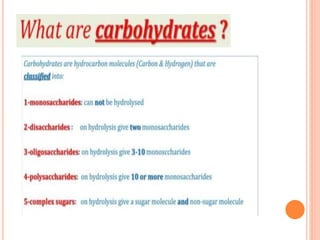
Carbohydrates include a large group of
compounds commonly knowns as starches or
sugar,widely distributed in plants and animals.
 In general carbohydrates are white solids,freely
soluble in water with the exception of certain
polysaccharides. lower molecular weight have a
sweet taste.
Biological significance:
 The chief function of carbohydrates in the body is
that of a fuel. When carbohydrates are oxidised in
the body they liberates carbon dioxide,water and
energy. They supply the major portion of energy
required by living cells.
 Certain products of carbohydrates metabolis as
will be seen later act as catalyst to promote
oxidation of foodstuffs.
 Certain carbohydrates can be used as the starting
material for the biological synthesis of compounds
such as amino acids and fatty acids.
Chemical characteristics:
 Carbohydrates contain
carbon,hydrogen,and oxygen. Generally the
composition of carbohydrates is in the
proportion of two of hydrogen and one of
oxygen atoms as in water.
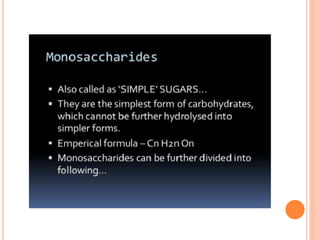
 Glucose that is a simple carbohydrates has
a molecular formula of C6H12O6
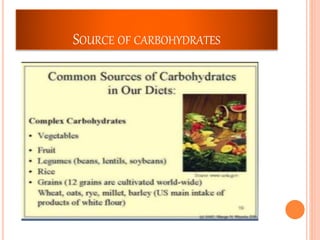
SOURCE OF CARBOHYDRATES
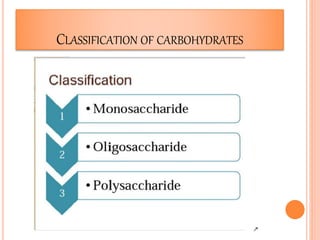
CLASSIFICATION OF CARBOHYDRATES
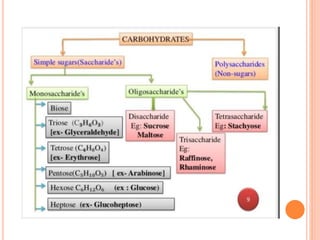
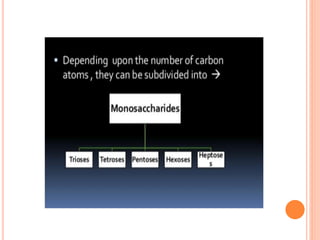
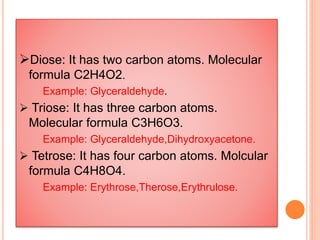
Diose: It has two carbon atoms. Molecular
formula C2H4O2.
Example: Glyceraldehyde.
 Triose: It has three carbon atoms.
Molecular formula C3H6O3.
Example: Glyceraldehyde,Dihydroxyacetone.
 Tetrose: It has four carbon atoms. Molcular
formula C4H8O4.
Example: Erythrose,Therose,Erythrulose.
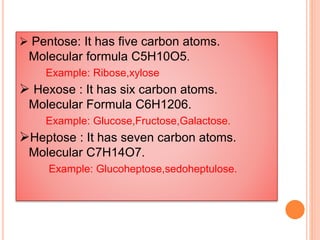
 Pentose: It has five carbon atoms.
Molecular formula C5H10O5.
Example: Ribose,xylose
 Hexose : It has six carbon atoms.
Molecular Formula C6H1206.
Example: Glucose,Fructose,Galactose.
Heptose : It has seven carbon atoms.
Molecular C7H14O7.
Example: Glucoheptose,sedoheptulose.
Carbohydrates
Carbohydrates
Carbohydrates
Carbohydrates
Carbohydrates
Carbohydrates
Carbohydrates
Carbohydrates
Carbohydrates

Carbohydrates

  • 1.
  • 2.
    DEFINITION Carbohydrates include alarge group of compounds commonly knowns as starches or sugar,widely distributed in plants and animals.  In general carbohydrates are white solids,freely soluble in water with the exception of certain polysaccharides. lower molecular weight have a sweet taste.
  • 3.
    Biological significance:  Thechief function of carbohydrates in the body is that of a fuel. When carbohydrates are oxidised in the body they liberates carbon dioxide,water and energy. They supply the major portion of energy required by living cells.  Certain products of carbohydrates metabolis as will be seen later act as catalyst to promote oxidation of foodstuffs.  Certain carbohydrates can be used as the starting material for the biological synthesis of compounds such as amino acids and fatty acids.
  • 4.
    Chemical characteristics:  Carbohydratescontain carbon,hydrogen,and oxygen. Generally the composition of carbohydrates is in the proportion of two of hydrogen and one of oxygen atoms as in water.  Glucose that is a simple carbohydrates has a molecular formula of C6H12O6
  • 5.
  • 6.
  • 11.
    Diose: It hastwo carbon atoms. Molecular formula C2H4O2. Example: Glyceraldehyde.  Triose: It has three carbon atoms. Molecular formula C3H6O3. Example: Glyceraldehyde,Dihydroxyacetone.  Tetrose: It has four carbon atoms. Molcular formula C4H8O4. Example: Erythrose,Therose,Erythrulose.
  • 12.
     Pentose: Ithas five carbon atoms. Molecular formula C5H10O5. Example: Ribose,xylose  Hexose : It has six carbon atoms. Molecular Formula C6H1206. Example: Glucose,Fructose,Galactose. Heptose : It has seven carbon atoms. Molecular C7H14O7. Example: Glucoheptose,sedoheptulose.