BY: KAREEM HUSSIEN
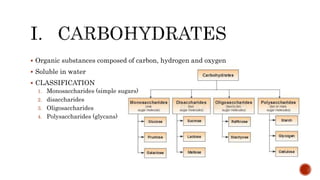
 Organic substances composed of carbon, hydrogen and oxygen
 Soluble in water
 CLASSIFICATION
1. Monosaccharides (simple sugars)
2. disaccharides
3. Oligosaccharides
4. Polysaccharides (glycans)
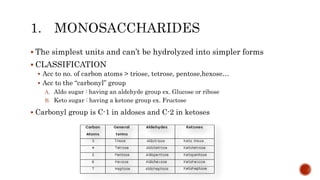
 The simplest units and can’t be hydrolyzed into simpler forms
 CLASSIFICATION
 Acc to no. of carbon atoms > triose, tetrose, pentose,hexose…
 Acc to the “carbonyl” group
A. Aldo sugar : having an aldehyde group ex. Glucose or ribose
B. Keto sugar : having a ketone group ex. Fructose
 Carbonyl group is C-1 in aldoses and C-2 in ketoses
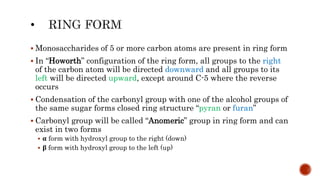
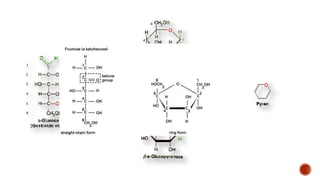
 Monosaccharides of 5 or more carbon atoms are present in ring form
 In “Howorth” configuration of the ring form, all groups to the right
of the carbon atom will be directed downward and all groups to its
left will be directed upward, except around C-5 where the reverse
occurs
 Condensation of the carbonyl group with one of the alcohol groups of
the same sugar forms closed ring structure “pyran or furan”
 Carbonyl group will be called “Anomeric” group in ring form and can
exist in two forms
 α form with hydroxyl group to the right (down)
 β form with hydroxyl group to the left (up)
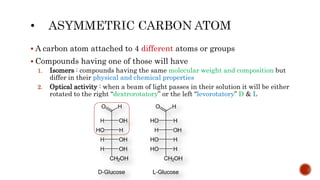
 A carbon atom attached to 4 different atoms or groups
 Compounds having one of those will have
1. Isomers : compounds having the same molecular weight and composition but
differ in their physical and chemical properties
2. Optical activity : when a beam of light passes in their solution it will be either
rotated to the right “dextrorotatory” or the left “levorotatory” D & L
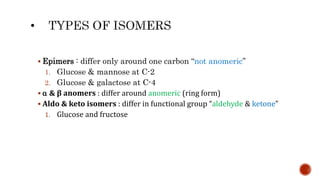
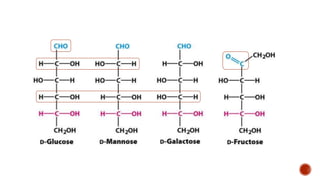
 Epimers : differ only around one carbon “not anomeric”
1. Glucose & mannose at C-2
2. Glucose & galactose at C-4
 α & β anomers : differ around anomeric (ring form)
 Aldo & keto isomers : differ in functional group “aldehyde & ketone”
1. Glucose and fructose
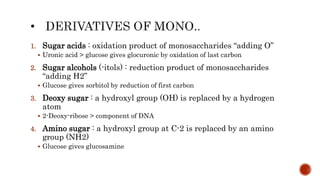
1. Sugar acids : oxidation product of monosaccharides “adding O”
 Uronic acid > glucose gives glocuronic by oxidation of last carbon
2. Sugar alcohols (-itols) : reduction product of monosaccharides
“adding H2”
 Glucose gives sorbitol by reduction of first carbon
3. Deoxy sugar : a hydroxyl group (OH) is replaced by a hydrogen
atom
 2-Deoxy-ribose > component of DNA
4. Amino sugar : a hydroxyl group at C-2 is replaced by an amino
group (NH2)
 Glucose gives glucosamine
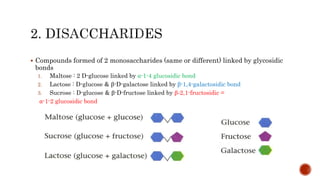
 Compounds formed of 2 monosaccharides (same or different) linked by glycosidic
bonds
1. Maltose : 2 D-glucose linked by α-1-4 glucosidic bond
2. Lactose : D-glucose & β-D-galactose linked by β-1,4-galactosidic bond
3. Sucrose : D-glucose & β-D-fructose linked by β-2,1-fructosidic =
α-1-2 glucosidic bond
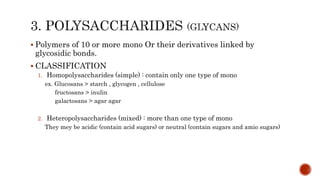
 Polymers of 10 or more mono Or their derivatives linked by
glycosidic bonds.
 CLASSIFICATION
1. Homopolysaccharides (simple) : contain only one type of mono
ex. Glucosans > starch , glycogen , cellulose
fructosans > inulin
galactosans > agar agar
2. Heteropolysaccharides (mixed) : more than one type of mono
They mey be acidic (contain acid sugars) or neutral (contain sugars and amio sugars)
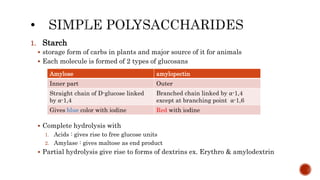
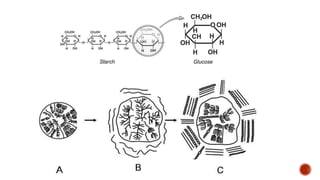
1. Starch
 storage form of carbs in plants and major source of it for animals
 Each molecule is formed of 2 types of glucosans
 Complete hydrolysis with
1. Acids : gives rise to free glucose units
2. Amylase : gives maltose as end product
 Partial hydrolysis give rise to forms of dextrins ex. Erythro & amylodextrin
Amylose amylopectin
Inner part Outer
Straight chain of D-glucose linked
by α-1,4
Branched chain linked by α-1,4
except at branching point α-1,6
Gives blue color with iodine Red with iodine
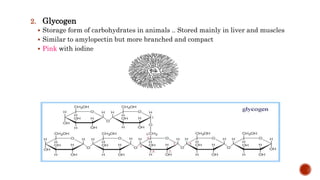
2. Glycogen
 Storage form of carbohydrates in animals .. Stored mainly in liver and muscles
 Similar to amylopectin but more branched and compact
 Pink with iodine
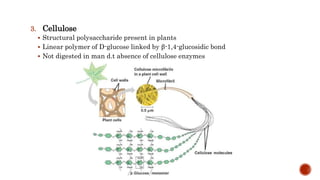
3. Cellulose
 Structural polysaccharide present in plants
 Linear polymer of D-glucose linked by β-1,4-glucosidic bond
 Not digested in man d.t absence of cellulose enzymes
 They are compounds that relate directly or indirectly to fatty acids
 They contain C, H, O ± P, N & S
 They have common properties of being
1. Insoluble in water
2. Soluble in nonpolar solvents as ether and benzene
3. Associated with fatty acids and utilized by living organisms
 IMPORTANCE
1. High caloric value= 9.3 Kcal/g
2. Organ coating
3. Thermal insulator
4. Cell membrane
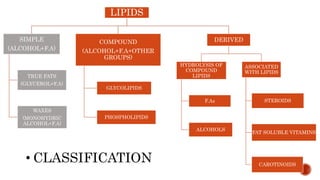
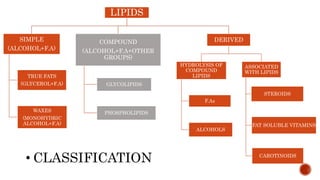
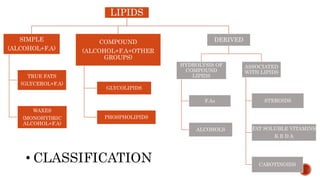
LIPIDS
SIMPLE
(ALCOHOL+F.A)
TRUE FATS
(GLYCEROL+F.A)
WAXES
(MONOHYDRIC
ALCOHOL+F.A)
COMPOUND
(ALCOHOL+F.A+OTHER
GROUPS)
GLYCOLIPIDS
PHOSPHOLIPIDS
DERIVED
HYDROLYSIS OF
COMPOUND
LIPIDS
F.As
ALCOHOLS
ASSOCIATED
WITH LIPIDS
STEROIDS
FAT SOLUBLE VITAMINS
CAROTINOIDS
• CLASSIFICATION
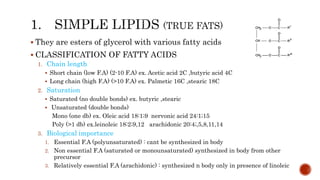
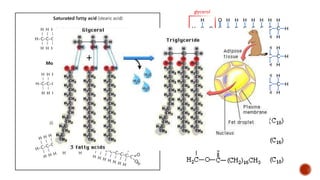
 They are esters of glycerol with various fatty acids
 CLASSIFICATION OF FATTY ACIDS
1. Chain length
 Short chain (low F.A) (2-10 F.A) ex. Acetic acid 2C ,butyric acid 4C
 Long chain (high F.A) (>10 F.A) ex. Palmetic 16C ,stearic 18C
2. Saturation
 Saturated (no double bonds) ex. butyric ,stearic
 Unsaturated (double bonds)
Mono (one db) ex. Oleic acid 18:1;9 nervonic acid 24:1;15
Poly (>1 db) ex.leinoleic 18:2;9,12 arachidonic 20:4;,5,8,11,14
3. Biological importance
1. Essential F.A (polyunsaturated) : cant be synthesized in body
2. Non essential F.A (saturated or monounsaturated) synthesized in body from other
precursor
3. Relatively essential F.A (arachidonic) : synthesized n body only in presence of linoleic
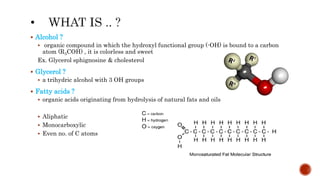
 Alcohol ?
 organic compound in which the hydroxyl functional group (-OH) is bound to a carbon
atom (R3COH) , it is colorless and sweet
Ex. Glycerol sphignosine & cholesterol
 Glycerol ?
 a trihydric alcohol with 3 OH groups
 Fatty acids ?
 organic acids originating from hydrolysis of natural fats and oils
 Aliphatic
 Monocarboxylic
 Even no. of C atoms
LIPIDS
SIMPLE
(ALCOHOL+F.A)
TRUE FATS
(GLYCEROL+F.A)
WAXES
(MONOHYDRIC
ALCOHOL+F.A)
COMPOUND
(ALCOHOL+F.A+OTHER
GROUPS)
GLYCOLIPIDS
PHOSPHOLIPIDS
DERIVED
HYDROLYSIS OF
COMPOUND
LIPIDS
F.As
ALCOHOLS
ASSOCIATED
WITH LIPIDS
STEROIDS
FAT SOLUBLE VITAMINS
CAROTINOIDS
• CLASSIFICATION
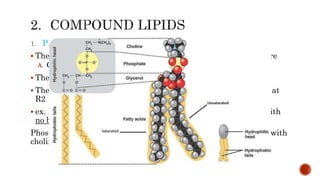
1. PHOSPHOLIPIDS
 They are membrane components amphipathic and ionic in nature
A. GLYCERO-P.L (having glycerol as their alcohol backbone)
 The precursor is (glycerol-3-phosphate)
 The fatty acids present are mostly saturated at R1 unsaturated at
R2
 ex. Phosohatidic acid : simplest form and precursor for others with
no base
Phosphatydyl choline : most abundant present in cell membrane with
choline base
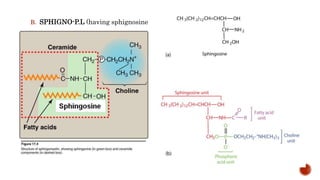
B. SPHIGNO-P.L (having sphignosine as their alcohol backbone)
 Contain sphignosine instead of glycerol, a higher fatty acid,
phosphoric acid and a base
 Important membrane component for animals and plants, they are
present in large amounts in brain and myelin of nerves
 Sphignosine + saturated or unsaturated F.A = CERAMIDE
(the characteristic parent structure for sphignolipids)
2. GLYCOLIPIDS (glyco-sphigno-lipids)
 They are in every tissue of the body especially nervous .. They also
occur at outer leaflet of plasma membrane
A. NEUTRAL G.L (cerebrosides) :
 They contain one or more neutral sugar molecules as their polar
head group .. The monosaccharide is bound to the OH of ceramide
 Ex. Galactocerebroside glucocerebroside
 They are concerned with
 Cell communication and recognition
 Tissue immunity
 Species specificity
 Bloog group antigens
B. ACIDIC G.L :
Ex. Cerebroside sulphate (sulphatides) : sulphate ester of galactocerebroside
gangliosides : neuraminoc acid in addition to glycosyl ceramide
LIPIDS
SIMPLE
(ALCOHOL+F.A)
TRUE FATS
(GLYCEROL+F.A)
WAXES
(MONOHYDRIC
ALCOHOL+F.A)
COMPOUND
(ALCOHOL+F.A+OTHER
GROUPS)
GLYCOLIPIDS
PHOSPHOLIPIDS
DERIVED
HYDROLYSIS OF
COMPOUND
LIPIDS
F.As
ALCOHOLS
ASSOCIATED
WITH LIPIDS
STEROIDS
FAT SOLUBLE VITAMINS
K E D A
CAROTINOIDS
• CLASSIFICATION
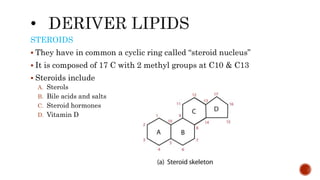
STEROIDS
 They have in common a cyclic ring called “steroid nucleus”
 It is composed of 17 C with 2 methyl groups at C10 & C13
 Steroids include
A. Sterols
B. Bile acids and salts
C. Steroid hormones
D. Vitamin D
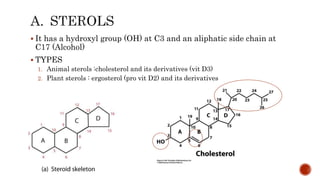
 It has a hydroxyl group (OH) at C3 and an aliphatic side chain at
C17 (Alcohol)
 TYPES
1. Animal sterols :cholesterol and its derivatives (vit D3)
2. Plant sterols : ergosterol (pro vit D2) and its derivatives
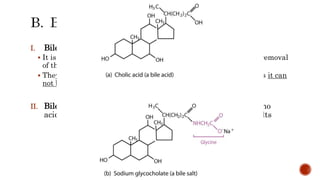
I. Bile acids are hydroxyl derivatives of cholanic acid
 It is obtained in the liver by oxidation of cholesterol at C24 with removal
of the last 3C
 They are the end products of cholesterol catabolism in the body as it can
not break down steroid nucleus
II. Bile salts are products of conjugation of bile acids with amino
acids “glycine and taurine” in their sodium or potassium salts

Carbohydrate and Lipid biochemistry

  • 1.
  • 3.
     Organic substancescomposed of carbon, hydrogen and oxygen  Soluble in water  CLASSIFICATION 1. Monosaccharides (simple sugars) 2. disaccharides 3. Oligosaccharides 4. Polysaccharides (glycans)
  • 4.
     The simplestunits and can’t be hydrolyzed into simpler forms  CLASSIFICATION  Acc to no. of carbon atoms > triose, tetrose, pentose,hexose…  Acc to the “carbonyl” group A. Aldo sugar : having an aldehyde group ex. Glucose or ribose B. Keto sugar : having a ketone group ex. Fructose  Carbonyl group is C-1 in aldoses and C-2 in ketoses
  • 6.
     Monosaccharides of5 or more carbon atoms are present in ring form  In “Howorth” configuration of the ring form, all groups to the right of the carbon atom will be directed downward and all groups to its left will be directed upward, except around C-5 where the reverse occurs  Condensation of the carbonyl group with one of the alcohol groups of the same sugar forms closed ring structure “pyran or furan”  Carbonyl group will be called “Anomeric” group in ring form and can exist in two forms  α form with hydroxyl group to the right (down)  β form with hydroxyl group to the left (up)
  • 8.
     A carbonatom attached to 4 different atoms or groups  Compounds having one of those will have 1. Isomers : compounds having the same molecular weight and composition but differ in their physical and chemical properties 2. Optical activity : when a beam of light passes in their solution it will be either rotated to the right “dextrorotatory” or the left “levorotatory” D & L
  • 9.
     Epimers :differ only around one carbon “not anomeric” 1. Glucose & mannose at C-2 2. Glucose & galactose at C-4  α & β anomers : differ around anomeric (ring form)  Aldo & keto isomers : differ in functional group “aldehyde & ketone” 1. Glucose and fructose
  • 11.
    1. Sugar acids: oxidation product of monosaccharides “adding O”  Uronic acid > glucose gives glocuronic by oxidation of last carbon 2. Sugar alcohols (-itols) : reduction product of monosaccharides “adding H2”  Glucose gives sorbitol by reduction of first carbon 3. Deoxy sugar : a hydroxyl group (OH) is replaced by a hydrogen atom  2-Deoxy-ribose > component of DNA 4. Amino sugar : a hydroxyl group at C-2 is replaced by an amino group (NH2)  Glucose gives glucosamine
  • 12.
     Compounds formedof 2 monosaccharides (same or different) linked by glycosidic bonds 1. Maltose : 2 D-glucose linked by α-1-4 glucosidic bond 2. Lactose : D-glucose & β-D-galactose linked by β-1,4-galactosidic bond 3. Sucrose : D-glucose & β-D-fructose linked by β-2,1-fructosidic = α-1-2 glucosidic bond
  • 13.
     Polymers of10 or more mono Or their derivatives linked by glycosidic bonds.  CLASSIFICATION 1. Homopolysaccharides (simple) : contain only one type of mono ex. Glucosans > starch , glycogen , cellulose fructosans > inulin galactosans > agar agar 2. Heteropolysaccharides (mixed) : more than one type of mono They mey be acidic (contain acid sugars) or neutral (contain sugars and amio sugars)
  • 14.
    1. Starch  storageform of carbs in plants and major source of it for animals  Each molecule is formed of 2 types of glucosans  Complete hydrolysis with 1. Acids : gives rise to free glucose units 2. Amylase : gives maltose as end product  Partial hydrolysis give rise to forms of dextrins ex. Erythro & amylodextrin Amylose amylopectin Inner part Outer Straight chain of D-glucose linked by α-1,4 Branched chain linked by α-1,4 except at branching point α-1,6 Gives blue color with iodine Red with iodine
  • 16.
    2. Glycogen  Storageform of carbohydrates in animals .. Stored mainly in liver and muscles  Similar to amylopectin but more branched and compact  Pink with iodine
  • 17.
    3. Cellulose  Structuralpolysaccharide present in plants  Linear polymer of D-glucose linked by β-1,4-glucosidic bond  Not digested in man d.t absence of cellulose enzymes
  • 18.
     They arecompounds that relate directly or indirectly to fatty acids  They contain C, H, O ± P, N & S  They have common properties of being 1. Insoluble in water 2. Soluble in nonpolar solvents as ether and benzene 3. Associated with fatty acids and utilized by living organisms  IMPORTANCE 1. High caloric value= 9.3 Kcal/g 2. Organ coating 3. Thermal insulator 4. Cell membrane
  • 19.
  • 20.
     They areesters of glycerol with various fatty acids  CLASSIFICATION OF FATTY ACIDS 1. Chain length  Short chain (low F.A) (2-10 F.A) ex. Acetic acid 2C ,butyric acid 4C  Long chain (high F.A) (>10 F.A) ex. Palmetic 16C ,stearic 18C 2. Saturation  Saturated (no double bonds) ex. butyric ,stearic  Unsaturated (double bonds) Mono (one db) ex. Oleic acid 18:1;9 nervonic acid 24:1;15 Poly (>1 db) ex.leinoleic 18:2;9,12 arachidonic 20:4;,5,8,11,14 3. Biological importance 1. Essential F.A (polyunsaturated) : cant be synthesized in body 2. Non essential F.A (saturated or monounsaturated) synthesized in body from other precursor 3. Relatively essential F.A (arachidonic) : synthesized n body only in presence of linoleic
  • 21.
     Alcohol ? organic compound in which the hydroxyl functional group (-OH) is bound to a carbon atom (R3COH) , it is colorless and sweet Ex. Glycerol sphignosine & cholesterol  Glycerol ?  a trihydric alcohol with 3 OH groups  Fatty acids ?  organic acids originating from hydrolysis of natural fats and oils  Aliphatic  Monocarboxylic  Even no. of C atoms
  • 23.
  • 24.
    1. PHOSPHOLIPIDS  Theyare membrane components amphipathic and ionic in nature A. GLYCERO-P.L (having glycerol as their alcohol backbone)  The precursor is (glycerol-3-phosphate)  The fatty acids present are mostly saturated at R1 unsaturated at R2  ex. Phosohatidic acid : simplest form and precursor for others with no base Phosphatydyl choline : most abundant present in cell membrane with choline base
  • 25.
    B. SPHIGNO-P.L (havingsphignosine as their alcohol backbone)  Contain sphignosine instead of glycerol, a higher fatty acid, phosphoric acid and a base  Important membrane component for animals and plants, they are present in large amounts in brain and myelin of nerves  Sphignosine + saturated or unsaturated F.A = CERAMIDE (the characteristic parent structure for sphignolipids)
  • 26.
    2. GLYCOLIPIDS (glyco-sphigno-lipids) They are in every tissue of the body especially nervous .. They also occur at outer leaflet of plasma membrane A. NEUTRAL G.L (cerebrosides) :  They contain one or more neutral sugar molecules as their polar head group .. The monosaccharide is bound to the OH of ceramide  Ex. Galactocerebroside glucocerebroside  They are concerned with  Cell communication and recognition  Tissue immunity  Species specificity  Bloog group antigens B. ACIDIC G.L : Ex. Cerebroside sulphate (sulphatides) : sulphate ester of galactocerebroside gangliosides : neuraminoc acid in addition to glycosyl ceramide
  • 27.
  • 28.
    STEROIDS  They havein common a cyclic ring called “steroid nucleus”  It is composed of 17 C with 2 methyl groups at C10 & C13  Steroids include A. Sterols B. Bile acids and salts C. Steroid hormones D. Vitamin D
  • 29.
     It hasa hydroxyl group (OH) at C3 and an aliphatic side chain at C17 (Alcohol)  TYPES 1. Animal sterols :cholesterol and its derivatives (vit D3) 2. Plant sterols : ergosterol (pro vit D2) and its derivatives
  • 30.
    I. Bile acidsare hydroxyl derivatives of cholanic acid  It is obtained in the liver by oxidation of cholesterol at C24 with removal of the last 3C  They are the end products of cholesterol catabolism in the body as it can not break down steroid nucleus II. Bile salts are products of conjugation of bile acids with amino acids “glycine and taurine” in their sodium or potassium salts