Carbohydrates, Lipids and Proteins review
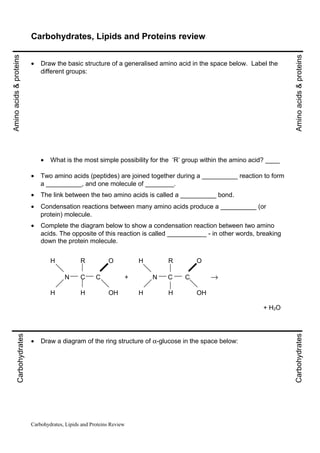
• Draw the basic structure of a generalised amino acid in the space below. Label the
different groups:
• What is the most simple possibility for the ‘R’ group within the amino acid? ____
• Two amino acids (peptides) are joined together during a __________ reaction to form
a __________, and one molecule of ________.
• The link between the two amino acids is called a __________ bond.
• Condensation reactions between many amino acids produce a __________ (or
protein) molecule.
• Complete the diagram below to show a condensation reaction between two amino
acids. The opposite of this reaction is called ___________ - in other words, breaking
down the protein molecule.
H R O H R O
N C C + N C C →
H H OH H H OH
+ H2O
• Draw a diagram of the ring structure of α-glucose in the space below:
Carbohydrates, Lipids and Proteins Review
• Glucose is an example of a monosaccharide.
• Two monosaccharides may be joined together during a ______________ reaction to
form a _____________, and a molecule of water is released during this process.
• The bond formed between the two monosaccharide molecules is a __________ bond.
• When condensation reactions occur between many monosaccharides a
______________ molecule is formed, for example, starch.
• The opposite of condensation is __________ - breaking down the molecule.
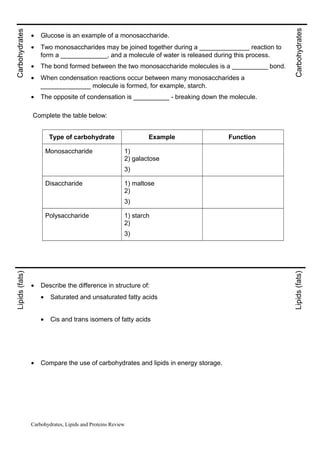
Complete the table below:
Type of carbohydrate Example Function
Monosaccharide 1)
2) galactose
3)
Disaccharide 1) maltose
2)
3)
Polysaccharide 1) starch
2)
3)
• Describe the difference in structure of:
• Saturated and unsaturated fatty acids
• Cis and trans isomers of fatty acids
• Compare the use of carbohydrates and lipids in energy storage.
Carbohydrates, Lipids and Proteins Review
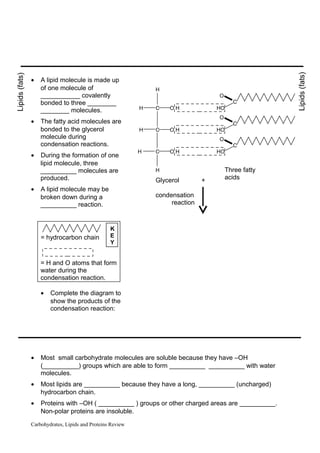
• A lipid molecule is made up
of one molecule of
___________ covalently
bonded to three ________
________ molecules.
• The fatty acid molecules are
bonded to the glycerol
molecule during
condensation reactions.
• During the formation of one
lipid molecule, three
__________ molecules are
produced.
• A lipid molecule may be
broken down during a
__________ reaction.
= hydrocarbon chain
= H and O atoms that form
water during the
condensation reaction.
• Complete the diagram to
show the products of the
condensation reaction:
H
O
C
H C O H HO
O
C
H C O H HO
O
C
H C O H HO
H
Glycerol +
condensation
reaction
• Most small carbohydrate molecules are soluble because they have –OH
(__________) groups which are able to form __________ __________ with water
molecules.
• Most lipids are __________ because they have a long, __________ (uncharged)
hydrocarbon chain.
• Proteins with –OH ( __________ ) groups or other charged areas are __________.
Non-polar proteins are insoluble.
Carbohydrates, Lipids and Proteins Review
Three fatty
acids
K
E
Y
• In general, solubility of any substance decreases, as molecular size increases.
Carbohydrates, Lipids and Proteins Review

Worksheet review carbs, lipids, proteins

  • 1.
    Carbohydrates, Lipids andProteins review • Draw the basic structure of a generalised amino acid in the space below. Label the different groups: • What is the most simple possibility for the ‘R’ group within the amino acid? ____ • Two amino acids (peptides) are joined together during a __________ reaction to form a __________, and one molecule of ________. • The link between the two amino acids is called a __________ bond. • Condensation reactions between many amino acids produce a __________ (or protein) molecule. • Complete the diagram below to show a condensation reaction between two amino acids. The opposite of this reaction is called ___________ - in other words, breaking down the protein molecule. H R O H R O N C C + N C C → H H OH H H OH + H2O • Draw a diagram of the ring structure of α-glucose in the space below: Carbohydrates, Lipids and Proteins Review
  • 2.
    • Glucose isan example of a monosaccharide. • Two monosaccharides may be joined together during a ______________ reaction to form a _____________, and a molecule of water is released during this process. • The bond formed between the two monosaccharide molecules is a __________ bond. • When condensation reactions occur between many monosaccharides a ______________ molecule is formed, for example, starch. • The opposite of condensation is __________ - breaking down the molecule. Complete the table below: Type of carbohydrate Example Function Monosaccharide 1) 2) galactose 3) Disaccharide 1) maltose 2) 3) Polysaccharide 1) starch 2) 3) • Describe the difference in structure of: • Saturated and unsaturated fatty acids • Cis and trans isomers of fatty acids • Compare the use of carbohydrates and lipids in energy storage. Carbohydrates, Lipids and Proteins Review
  • 3.
    • A lipidmolecule is made up of one molecule of ___________ covalently bonded to three ________ ________ molecules. • The fatty acid molecules are bonded to the glycerol molecule during condensation reactions. • During the formation of one lipid molecule, three __________ molecules are produced. • A lipid molecule may be broken down during a __________ reaction. = hydrocarbon chain = H and O atoms that form water during the condensation reaction. • Complete the diagram to show the products of the condensation reaction: H O C H C O H HO O C H C O H HO O C H C O H HO H Glycerol + condensation reaction • Most small carbohydrate molecules are soluble because they have –OH (__________) groups which are able to form __________ __________ with water molecules. • Most lipids are __________ because they have a long, __________ (uncharged) hydrocarbon chain. • Proteins with –OH ( __________ ) groups or other charged areas are __________. Non-polar proteins are insoluble. Carbohydrates, Lipids and Proteins Review Three fatty acids K E Y
  • 4.
    • In general,solubility of any substance decreases, as molecular size increases. Carbohydrates, Lipids and Proteins Review
  • 5.
  • 6.