Principle of Biochemistry
 3-Simple and Complex
     Carbohydrates
   Course code: HFB324
   Credit hours: 3 hours
     Dr. Siham Gritly

          Dr. Siham Gritly   1
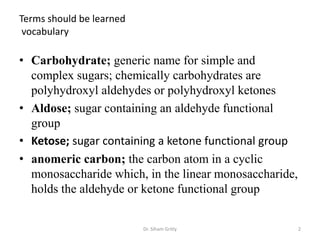
Terms should be learned
 vocabulary

• Carbohydrate; generic name for simple and
  complex sugars; chemically carbohydrates are
  polyhydroxyl aldehydes or polyhydroxyl ketones
• Aldose; sugar containing an aldehyde functional
  group
• Ketose; sugar containing a ketone functional group
• anomeric carbon; the carbon atom in a cyclic
  monosaccharide which, in the linear monosaccharide,
  holds the aldehyde or ketone functional group


                          Dr. Siham Gritly              2
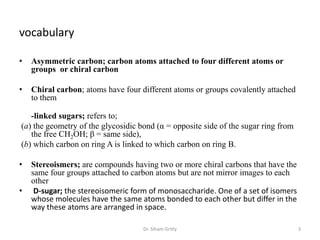
vocabulary

•   Asymmetric carbon; carbon atoms attached to four different atoms or
    groups or chiral carbon

•   Chiral carbon; atoms have four different atoms or groups covalently attached
    to them

   -linked sugars; refers to;
(a) the geometry of the glycosidic bond (α = opposite side of the sugar ring from
   the free CH2OH; β = same side),
(b) which carbon on ring A is linked to which carbon on ring B.

•   Stereoismers; are compounds having two or more chiral carbons that have the
    same four groups attached to carbon atoms but are not mirror images to each
    other
•    D-sugar; the stereoisomeric form of monosaccharide. One of a set of isomers
    whose molecules have the same atoms bonded to each other but differ in the
    way these atoms are arranged in space.

                                    Dr. Siham Gritly                                3
vocabulary

• Furanose; cyclic form of glucose monosaccharide whose
  structure is a five-membered ring

• Pyranose; cyclic form of glucose; monosaccharide in a six-
  membered ring form

• glycosidic bond; ether bond joining two monosaccharides

• hemiacetal or hemiketal; cyclic conformation of simple
  carbohydrates; formed by reaction of the aldehyde (or ketone)
  and one of the hydroxyls on the carbohydrate


                            Dr. Siham Gritly                      4
vocabulary

• Monosaccharides. "Simple sugars" with the formula (C H2O)n. The word
  carbohydrate refers to the fact that this class of molecules consists of
  hydrates of carbon.

• Disaccharides; "Simple sugars" contain two monosaccharides units
  attached to one another through acetal bonds or as known glycosidic bonds

• Oligosaccharides. complex sugar Polymeric molecule of sugar
  comprising 2-10 covalently linked monosaccharide units. Often
  found conjugated to other classes of biomolecules including lipids
  and proteins.

• Polysaccharides. complex sugar Larger polymers of simple sugars.
  On the order of hundreds to thousands of monosaccharide units as
  linear or branched polymers

                                 Dr. Siham Gritly                             5
vocabulary
• Aldehyde ; Any of a class of highly reactive organic chemical
  compounds obtained by oxidation of primary alcohols,
  characterized by the common group CHO, and used in the
  manufacture of dyes, and organic acids.
• Aldehydes are oxidized to carboxylic acids and take part in
  many addition reactions
• ketone Any of a class of organic compounds, such as acetone,
  having a carbonyl group linked to a carbon atom in each of
  two hydrocarbon radicals and having the general formula
  R(CO)R ,
• Ketones don't have that hydrogen atom and are resistant to
  oxidation. They are only oxidised by powerful oxidising
  agents which have the ability to break carbon-carbon bonds.
                           Dr. Siham Gritly                   6
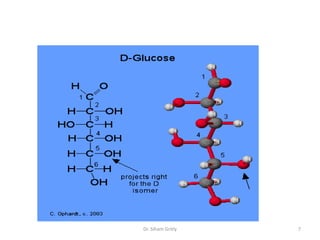
Dr. Siham Gritly   7
Carbohydrates
are polyhydroxy aldehydes or ketones (Constructed
 from the atoms of carbon, oxygen and hydrogen)
• In aldehydes (aldose) the carbonyl is bonded to
  one carbon and one hydrogen and are located at
  the ends of carbon chains. Formula H-
  (CHOH)x(C=O)-


• In ketones (Ketoses) carbonyl group (C= O) is
  bonded to two carbons within a carbon
  skeleton
                      Dr. Siham Gritly              8
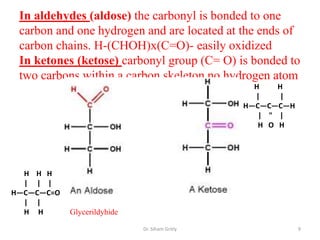
In aldehydes (aldose) the carbonyl is bonded to one
 carbon and one hydrogen and are located at the ends of
 carbon chains. H-(CHOH)x(C=O)- easily oxidized
 In ketones (ketose) carbonyl group (C= O) is bonded to
 two carbons within a carbon skeleton no hydrogen atom
                                                  H    H
                                                  |    |
                                                H—C—C—C—H
                                                   | " |
                                                   H O H


  H H H
  | | |
H—C—C—C=O
  | |
  H H       Glycerildyhide

                             Dr. Siham Gritly               9
• The major carbohydrates found in the body
  are structurally related to the;-
• 1-aldotriose glyceraldehyde
• 2-ketotriose dihydroxyacetone.
• All carbohydrates contain at least one
  asymmetrical (chiral) carbon and are,
  therefore, optically active.


                    Dr. Siham Gritly          10
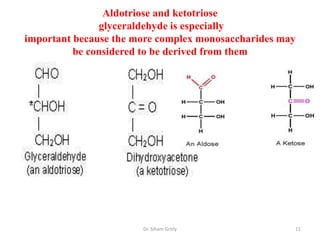
Aldotriose and ketotriose
               glyceraldehyde is especially
important because the more complex monosaccharides may
          be considered to be derived from them


                       Dr. Siham Gritly              11
Carbohydrate Nomenclature

•   Monosaccharide
•   Disaccharides,
•   Oligosaccharides
•   Polysaccharides


                       Dr. Siham Gritly   12
Monosaccharides

• The common monosaccharides (hexoses) of
  living organisms are:
• (glucose, galactose, fructose) C₆H₁₂O₆
• (ribose, deoxyribose, ribulose, xylose) 5-
  carbon pentoses (C5H10O4).
• Contain 3-7 carbon atoms.(trioses, tetroses,
  pentoses, hexoses and heptoses)
• Contain hydroxyl groups -OH
• Carbonyl group C=O

                     Dr. Siham Gritly            13
• The 5-carbon monosaccharide ribose is an
  important component of;-
• - coenzymes (e.g., ATP, FAD, NAD)
• - the backbone of the genetic molecule RNA
• Deoxyribose which is a component of DNA
•


                    Dr. Siham Gritly           14
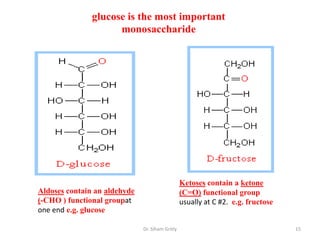
glucose is the most important
                     monosaccharide


                                                 Ketoses contain a ketone
Aldoses contain an aldehyde                      (C=O) functional group
(-CHO ) functional groupat                       usually at C #2. e.g. fructose
one end e.g. glucose

                              Dr. Siham Gritly                                    15
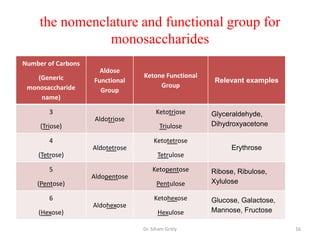
the nomenclature and functional group for
                monosaccharides
Number of Carbons
                      Aldose
    (Generic                      Ketone Functional
                    Functional                         Relevant examples
 monosaccharide                        Group
                      Group
     name)

        3                               Ketotriose    Glyceraldehyde,
                     Aldotriose
     (Triose)                            Triulose     Dihydroxyacetone

        4                              Ketotetrose
                    Aldotetrose                             Erythrose
    (Tetrose)                           Tetrulose

        5                             Ketopentose     Ribose, Ribulose,
                    Aldopentose
    (Pentose)                           Pentulose     Xylulose

        6                              Ketohexose     Glucose, Galactose,
                    Aldohexose
    (Hexose)                            Hexulose      Mannose, Fructose

                                  Dr. Siham Gritly                          16
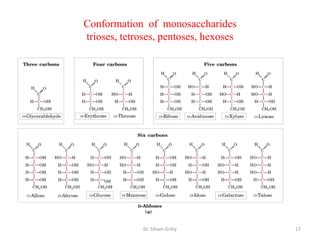
Conformation of monosaccharides
trioses, tetroses, pentoses, hexoses


              Dr. Siham Gritly         17
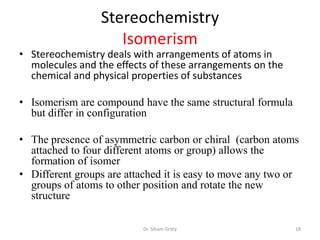
Stereochemistry
                    Isomerism
• Stereochemistry deals with arrangements of atoms in
  molecules and the effects of these arrangements on the
  chemical and physical properties of substances

• Isomerism are compound have the same structural formula
  but differ in configuration

• The presence of asymmetric carbon or chiral (carbon atoms
  attached to four different atoms or group) allows the
  formation of isomer
• Different groups are attached it is easy to move any two or
  groups of atoms to other position and rotate the new
  structure

                           Dr. Siham Gritly                 18
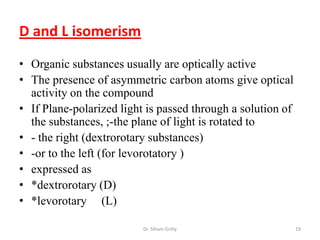
D and L isomerism
• Organic substances usually are optically active
• The presence of asymmetric carbon atoms give optical
  activity on the compound
• If Plane-polarized light is passed through a solution of
  the substances, ;-the plane of light is rotated to
• - the right (dextrorotary substances)
• -or to the left (for levorotatory )
• expressed as
• *dextrorotary (D)
• *levorotary (L)

                          Dr. Siham Gritly                   19
• The direction and extend of the rotation of a
  particular compound depend on;
• -concentration of the substances
• -temperature
• -wave of the light
• Enzyme function specify the particular
  configuration such as L-glutamate
  dehydrogenase
                      Dr. Siham Gritly            20
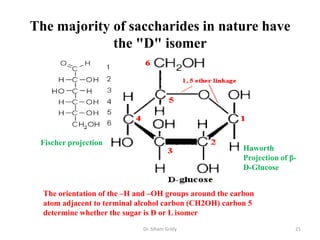
The majority of saccharides in nature have
             the "D" isomer


 Fischer projection
                                                         Haworth
                                                         Projection of β-
                                                         D-Glucose


  The orientation of the –H and –OH groups around the carbon
  atom adjacent to terminal alcohol carbon (CH2OH) carbon 5
  determine whether the sugar is D or L isomer
                             Dr. Siham Gritly                           21
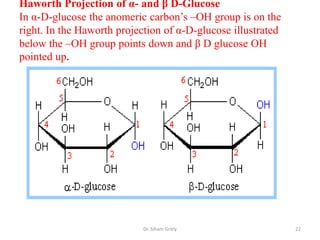
Haworth Projection of α- and β D-Glucose
In α-D-glucose the anomeric carbon’s –OH group is on the
right. In the Haworth projection of α-D-glucose illustrated
below the –OH group points down and β D glucose OH
pointed up.


                           Dr. Siham Gritly                   22
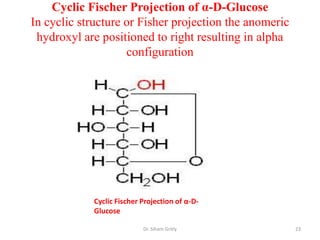
Cyclic Fischer Projection of α-D-Glucose
In cyclic structure or Fisher projection the anomeric
 hydroxyl are positioned to right resulting in alpha
                    configuration


            Cyclic Fischer Projection of α-D-
            Glucose

                           Dr. Siham Gritly             23
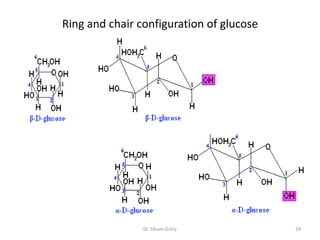
Ring and chair configuration of glucose


                Dr. Siham Gritly          24
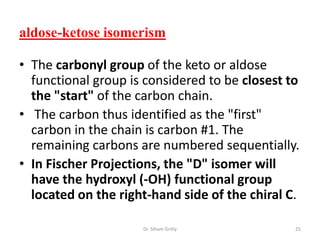
aldose-ketose isomerism

• The carbonyl group of the keto or aldose
  functional group is considered to be closest to
  the "start" of the carbon chain.
• The carbon thus identified as the "first"
  carbon in the chain is carbon #1. The
  remaining carbons are numbered sequentially.
• In Fischer Projections, the "D" isomer will
  have the hydroxyl (-OH) functional group
  located on the right-hand side of the chiral C.

                     Dr. Siham Gritly           25
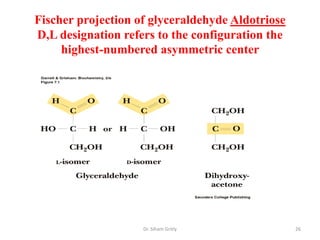
Fischer projection of glyceraldehyde Aldotriose
D,L designation refers to the configuration the
     highest-numbered asymmetric center


                    Dr. Siham Gritly              26
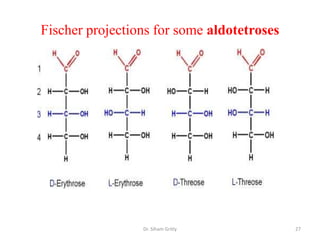
Fischer projections for some aldotetroses


                 Dr. Siham Gritly           27
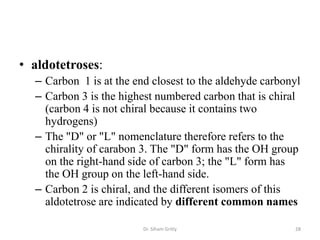
• aldotetroses:
  – Carbon 1 is at the end closest to the aldehyde carbonyl
  – Carbon 3 is the highest numbered carbon that is chiral
    (carbon 4 is not chiral because it contains two
    hydrogens)
  – The "D" or "L" nomenclature therefore refers to the
    chirality of carabon 3. The "D" form has the OH group
    on the right-hand side of carbon 3; the "L" form has
    the OH group on the left-hand side.
  – Carbon 2 is chiral, and the different isomers of this
    aldotetrose are indicated by different common names

                         Dr. Siham Gritly                28
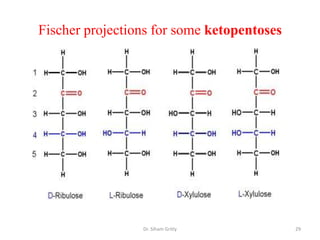
Fischer projections for some ketopentoses


                 Dr. Siham Gritly           29
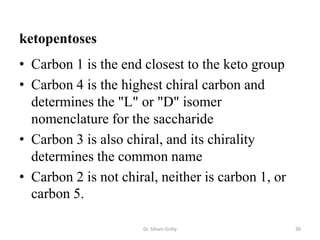
ketopentoses
• Carbon 1 is the end closest to the keto group
• Carbon 4 is the highest chiral carbon and
  determines the "L" or "D" isomer
  nomenclature for the saccharide
• Carbon 3 is also chiral, and its chirality
  determines the common name
• Carbon 2 is not chiral, neither is carbon 1, or
  carbon 5.

                      Dr. Siham Gritly              30
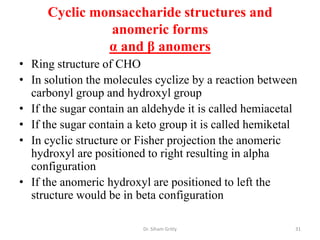
Cyclic monsaccharide structures and
              anomeric forms
              α and β anomers
• Ring structure of CHO
• In solution the molecules cyclize by a reaction between
  carbonyl group and hydroxyl group
• If the sugar contain an aldehyde it is called hemiacetal
• If the sugar contain a keto group it is called hemiketal
• In cyclic structure or Fisher projection the anomeric
  hydroxyl are positioned to right resulting in alpha
  configuration
• If the anomeric hydroxyl are positioned to left the
  structure would be in beta configuration

                         Dr. Siham Gritly                31
• The resulting chirality of the aldehyde carbon
  (or keto carbon in ketoses) in the cyclic
  structure can be either the α- or β- form. This
  carbon is termed the anomeric carbon, and
  the α - and β - forms are anomers.


                      Dr. Siham Gritly              32
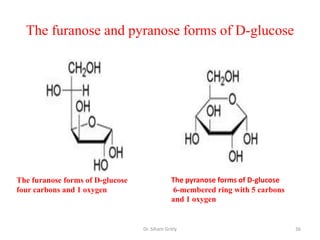
pyranose and furanose ring structures

• "Pyranose" is used to refer to the pyran ring
  structure (6-membered ring with 5 carbons and 1
  oxygen)
   Cyclic sugars that contain a six membered ring
  are called "pyranoses

• For five membered rings (four carbons and 1
  oxygen) the structure is a furanose ring.
  Cyclization is reversible


                      Dr. Siham Gritly              33
Cyclic form of glucose is a pyranose
Cyclic form of fructose is a furanose
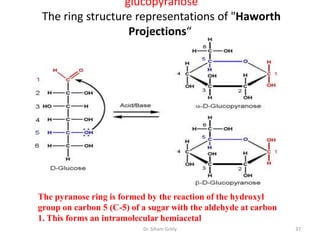
• The pyranose ring is formed by the reaction of
  the hydroxyl group on carbon 5 (C-5) of a sugar
  with the aldehyde at carbon 1.
• This forms an intramolecular hemiacetal.

• If reaction is between the C-4 hydroxyl and the
  aldehyde, a furanose is formed hemiketal.

• The pyranose form is more stable than the
  furanose form,

                      Dr. Siham Gritly              34
• glucose forms an intra-molecular hemiacetal
  by reaction of the aldehyde on C1 with the
  hydroxyl on C5, forming a six-member
  pyranose ring, named after the compound
  pyran


                     Dr. Siham Gritly           35
The furanose and pyranose forms of D-glucose


The furanose forms of D-glucose                The pyranose forms of D-glucose
four carbons and 1 oxygen                      6-membered ring with 5 carbons
                                               and 1 oxygen


                                  Dr. Siham Gritly                               36
glucopyranose
 The ring structure representations of "Haworth
                   Projections“


The pyranose ring is formed by the reaction of the hydroxyl
group on carbon 5 (C-5) of a sugar with the aldehyde at carbon
1. This forms an intramolecular hemiacetal
                           Dr. Siham Gritly                      37
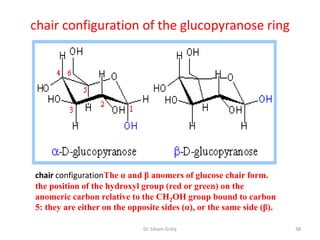
chair configuration of the glucopyranose ring


chair configurationThe α and β anomers of glucose chair form.
the position of the hydroxyl group (red or green) on the
anomeric carbon relative to the CH2OH group bound to carbon
5: they are either on the opposite sides (α), or the same side (β).

                              Dr. Siham Gritly                        38
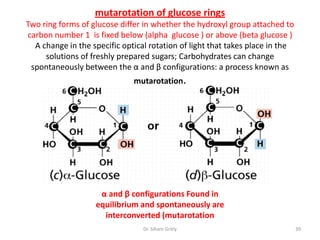
mutarotation of glucose rings
Two ring forms of glucose differ in whether the hydroxyl group attached to
carbon number 1 is fixed below (alpha glucose ) or above (beta glucose )
  A change in the specific optical rotation of light that takes place in the
     solutions of freshly prepared sugars; Carbohydrates can change
 spontaneously between the α and β configurations: a process known as
                              mutarotation.


                    α and β configurations Found in
                   equilibrium and spontaneously are
                     interconverted (mutarotation
                                 Dr. Siham Gritly                              39
Pentose sugar
                  ribose
• Ribose is an organic compound with the
  formula C5H10O5

• Ribose constitutes the backbone of RNA, a
  biopolymer that is the basis of genetic
  transcription
• Once phosphorylated, ribose can become a
  subunit of ATP, NADH, important in
  metabolism

                    Dr. Siham Gritly          40
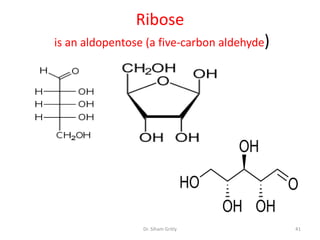
Ribose
is an aldopentose (a five-carbon aldehyde)


                 Dr. Siham Gritly            41
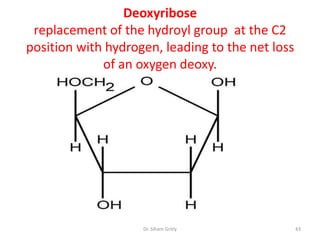
Deoxyribose
• deoxyribose, also called d-2-deoxyribose, five-
  carbon sugar component of DNA
  (deoxyribonucleic acid), where it alternates
  with phosphate groups to form the
  “backbone” of the DNA polymer and binds to
  nitrogenous bases.
• The presence of deoxyribose instead of ribose
  is one difference between DNA and RNA
  (ribonucleic acid).

                     Dr. Siham Gritly           42
Deoxyribose
 replacement of the hydroyl group at the C2
position with hydrogen, leading to the net loss
             of an oxygen deoxy.


                    Dr. Siham Gritly              43
Disaccharides
• Disaccharides; contain two monosaccharides units
  attached to one another through acetal bonds or as
  known glycosidic bonds
• Covalent bonds between the anomeric hydroxyl of a
  cyclic sugar and the hydroxyl of a second sugar (or
  another alcohol containing compound) are termed
  glycosidic bonds, and the resultant molecules are
  glycosides.
• The linkage of two monosaccharides to form
  disaccharides involves a glycosidic bond. Several
  physiogically important disaccharides are sucrose,
  lactose and maltose Dr. Siham Gritly                  44
Glycosidic bond

• Glycosidic bond are formed between hydroxyl
  group of one monosaccharide and hydroxyl
  group of the next with the removal of water

• Glycosidic bonds involve the hydroxyl group
  of the anomeric carbon (keto or aldehyde) of
  one member of the pair of monosaccharide and
  hydroxyl group on carbon 4 or 6 of the second
  member

                    Dr. Siham Gritly          45
•   Glycosidic bond can be α or β
•   Glycosidic bonds may be designated
•   - α 1-4, β 1-4, α 1-6 and so on
•   Important disaccharides are
•   1-maltose
•   2-lactose
•   3-sucrose

                      Dr. Siham Gritly   46
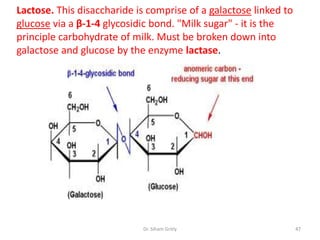
Lactose. This disaccharide is comprise of a galactose linked to
glucose via a β-1-4 glycosidic bond. "Milk sugar" - it is the
principle carbohydrate of milk. Must be broken down into
galactose and glucose by the enzyme lactase.


                            Dr. Siham Gritly                      47
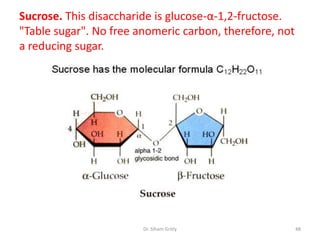
Sucrose. This disaccharide is glucose-α-1,2-fructose.
"Table sugar". No free anomeric carbon, therefore, not
a reducing sugar.


                        Dr. Siham Gritly                 48
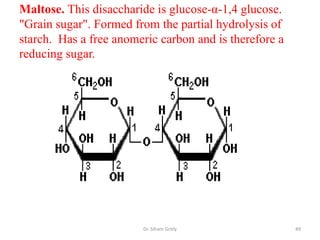
Maltose. This disaccharide is glucose-α-1,4 glucose.
"Grain sugar". Formed from the partial hydrolysis of
starch. Has a free anomeric carbon and is therefore a
reducing sugar.


                        Dr. Siham Gritly                49
Complex carbohydrates
• When polysaccharides are composed of a single
  monosaccharide building block, they are termed
  homopolysaccharides example starch and
  glycogen.
• Polysaccharides composed of more than one type
  of monosaccharide are termed
  heteropolysaccharides, give sugar and
non-sugar like SO4 or NH4 gp e.g.
glycosaminoglycans ( found in connective tissue)
heparin present in mast cells as anticoagulant

                     Dr. Siham Gritly          50
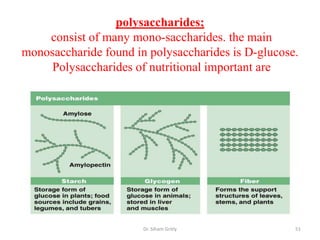
polysaccharides;
    consist of many mono-saccharides. the main
monosaccharide found in polysaccharides is D-glucose.
     Polysaccharides of nutritional important are


                       Dr. Siham Gritly             51
Polysaccharides
                      Glycogen
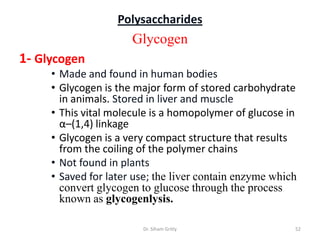
1- Glycogen
     • Made and found in human bodies
     • Glycogen is the major form of stored carbohydrate
       in animals. Stored in liver and muscle
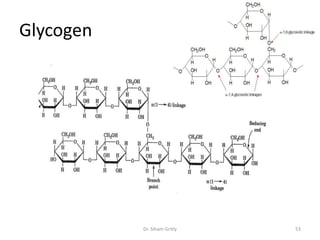
     • This vital molecule is a homopolymer of glucose in
       α–(1,4) linkage
     • Glycogen is a very compact structure that results
       from the coiling of the polymer chains
     • Not found in plants
     • Saved for later use; the liver contain enzyme which
       convert glycogen to glucose through the process
       known as glycogenlysis.

                        Dr. Siham Gritly                 52
Glycogen


           Dr. Siham Gritly   53
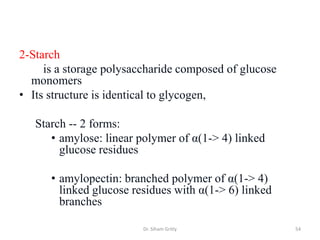
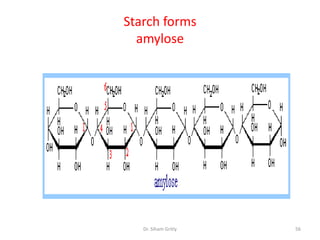
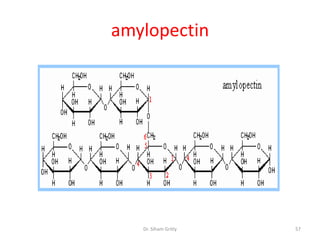
2-Starch
     is a storage polysaccharide composed of glucose
  monomers
• Its structure is identical to glycogen,

   Starch -- 2 forms:
      • amylose: linear polymer of α(1-> 4) linked
        glucose residues

      • amylopectin: branched polymer of α(1-> 4)
        linked glucose residues with α(1-> 6) linked
        branches

                         Dr. Siham Gritly              54
• starch; occur mainly in plant kingdom. Important
  sources are cereals, millets, roots, tubers formed in
  nature in large amounts.
• Starch hydrolyzed by amylase enzyme present in saliva
  and in pancreatic juice to form maltose (disaccharide).

• during hydrolysis starch formed intermediate product
  called dextrin. complete digestion of starch formed
  glucose;
• starch--------dextrin----------maltose------------glucose

                          Dr. Siham Gritly                55
Starch forms
  amylose


   Dr. Siham Gritly   56
amylopectin


   Dr. Siham Gritly   57
• 3-Dietary fiber is a carbohydrates (or a
  polysaccharide) that is incompletely absorbed in
  humans and in some animals.
• *Dietary fiber consists mainly of cellulose, a
  large carbohydrate polymer that is indigestible
  because humans do not have the required
  enzymes to digest it. There are two subcategories:
  soluble and insoluble fiber. Whole grains, fruits
  (especially plums, and figs) and vegetables are
  good sources of dietary fiber.

                       Dr. Siham Gritly            58
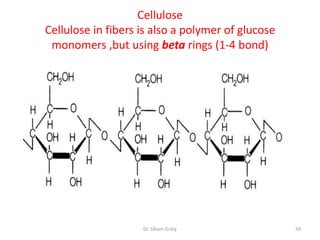
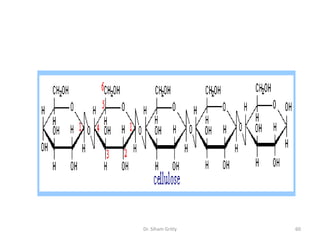
Cellulose
Cellulose in fibers is also a polymer of glucose
 monomers ,but using beta rings (1-4 bond)


                    Dr. Siham Gritly               59
Dr. Siham Gritly   60
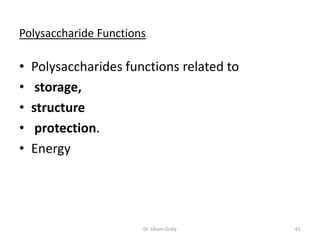
Polysaccharide Functions

•   Polysaccharides functions related to
•    storage,
•   structure
•    protection.
•   Energy


                       Dr. Siham Gritly    61
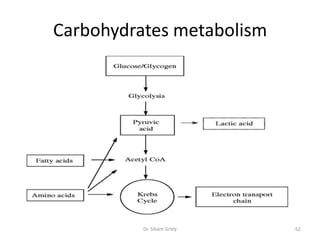
Carbohydrates metabolism


          Dr. Siham Gritly   62
Diseases associated with Carbohydrates

•   Diabetes mellitus
•   Galactosemia
•   Glycogen storage diseases
•   Lactose intolerance


                      Dr. Siham Gritly         63
References
•   Murry K. Robert, Granner K. daryl, Mayes A. peter, Rodwell W. Victor (1999). Harpers Biochemistry. Appleton and
    Lange , twent fifth edition

•   Campbell, Neil A.; Brad Williamson; Robin J. Heyden (2006). Biology: Exploring Life. Boston, Massachusetts:
    Pearson Prentice Hall

•   A. Burtis, Edward R. Ashwood, Norbert W. Tietz (2000), Tietz fundamentals of clinical chemistry

•   Maton, Anthea; Jean Hopkins, Charles William McLaughlin, Susan Johnson, Maryanna Quon Warner, David
    LaHart, Jill D. Wright (1993). Human Biology and Health. Englewood Cliffs, New Jersey, USA: Prentice Hall. pp.
    52–59
•   Maitland, Jr Jones (1998). Organic Chemistry. W W Norton & Co Inc (Np). p. 139. ISBN 0-393-97378-6.

•   Nelson DL, Cox MM (2005). Lehninger's Principles of Biochemistry (4th ed.). New York, New York: W. H.
    Freeman and Company.


•   Matthews, C. E.; K. E. Van Holde; K. G. Ahern (1999) Biochemistry. 3rd edition. Benjamin Cummings.
•   http://wiki.answers.com/Q/What_is_dehydration_synthesis#ixzz2BuiK645


                                                   Dr. Siham Gritly                                               64
• Sareen Gropper, Jack Smith and James Groff, Advanced Nutrition
  and Human Metabolism, fifth ed. WADSWORTH

• Melvin H Williams 2010; Nutrition for Health, Fitness and Sport. 9th
  ed, McGraw Hill
•
• Heymsfield, SB.; Baumgartner N.; Richard and Sheau-Fang P. 1999.
  Modern Nutrition in Health and Disease; Shils E Maurice,
  Olson A. James, Shike Moshe and Ross A. Catharine eds. 9th
  edition

• Guyton, C. Arthur. 1985. Textbook of Medical Physiology. 6th
  edition, W.B. Company


                              Dr. Siham Gritly                      65
• Lehninger. Principles of bochemistry. by Nelson and Cox,
  5th Edition; W.H. Freeman and Company

• Emsley, John (2011). Nature's Building Blocks: An A-Z
  Guide to the Elements (New ed.). New York, NY: Oxford
  University Press. ISBN 978-0-19-960563-7.

• Koppenol, W. H. (2002). "Naming of New Elements
  (IUPAC Recommendations 2002)" (PDF). Pure and Applied
  Chemistry 74 (5): 787–791. doi:10.1351/pac200274050787.
  http://media.iupac.org/publications/pac/2002/pdf/7405x078
  7.pdf.


                          Dr. Siham Gritly                   66

3 simple and complex carbohydrates lec 3

  • 1.
    Principle of Biochemistry 3-Simple and Complex Carbohydrates Course code: HFB324 Credit hours: 3 hours Dr. Siham Gritly Dr. Siham Gritly 1
  • 2.
    Terms should belearned vocabulary • Carbohydrate; generic name for simple and complex sugars; chemically carbohydrates are polyhydroxyl aldehydes or polyhydroxyl ketones • Aldose; sugar containing an aldehyde functional group • Ketose; sugar containing a ketone functional group • anomeric carbon; the carbon atom in a cyclic monosaccharide which, in the linear monosaccharide, holds the aldehyde or ketone functional group Dr. Siham Gritly 2
  • 3.
    vocabulary • Asymmetric carbon; carbon atoms attached to four different atoms or groups or chiral carbon • Chiral carbon; atoms have four different atoms or groups covalently attached to them -linked sugars; refers to; (a) the geometry of the glycosidic bond (α = opposite side of the sugar ring from the free CH2OH; β = same side), (b) which carbon on ring A is linked to which carbon on ring B. • Stereoismers; are compounds having two or more chiral carbons that have the same four groups attached to carbon atoms but are not mirror images to each other • D-sugar; the stereoisomeric form of monosaccharide. One of a set of isomers whose molecules have the same atoms bonded to each other but differ in the way these atoms are arranged in space. Dr. Siham Gritly 3
  • 4.
    vocabulary • Furanose; cyclicform of glucose monosaccharide whose structure is a five-membered ring • Pyranose; cyclic form of glucose; monosaccharide in a six- membered ring form • glycosidic bond; ether bond joining two monosaccharides • hemiacetal or hemiketal; cyclic conformation of simple carbohydrates; formed by reaction of the aldehyde (or ketone) and one of the hydroxyls on the carbohydrate Dr. Siham Gritly 4
  • 5.
    vocabulary • Monosaccharides. "Simplesugars" with the formula (C H2O)n. The word carbohydrate refers to the fact that this class of molecules consists of hydrates of carbon. • Disaccharides; "Simple sugars" contain two monosaccharides units attached to one another through acetal bonds or as known glycosidic bonds • Oligosaccharides. complex sugar Polymeric molecule of sugar comprising 2-10 covalently linked monosaccharide units. Often found conjugated to other classes of biomolecules including lipids and proteins. • Polysaccharides. complex sugar Larger polymers of simple sugars. On the order of hundreds to thousands of monosaccharide units as linear or branched polymers Dr. Siham Gritly 5
  • 6.
    vocabulary • Aldehyde ;Any of a class of highly reactive organic chemical compounds obtained by oxidation of primary alcohols, characterized by the common group CHO, and used in the manufacture of dyes, and organic acids. • Aldehydes are oxidized to carboxylic acids and take part in many addition reactions • ketone Any of a class of organic compounds, such as acetone, having a carbonyl group linked to a carbon atom in each of two hydrocarbon radicals and having the general formula R(CO)R , • Ketones don't have that hydrogen atom and are resistant to oxidation. They are only oxidised by powerful oxidising agents which have the ability to break carbon-carbon bonds. Dr. Siham Gritly 6
  • 7.
  • 8.
    Carbohydrates are polyhydroxy aldehydesor ketones (Constructed from the atoms of carbon, oxygen and hydrogen) • In aldehydes (aldose) the carbonyl is bonded to one carbon and one hydrogen and are located at the ends of carbon chains. Formula H- (CHOH)x(C=O)- • In ketones (Ketoses) carbonyl group (C= O) is bonded to two carbons within a carbon skeleton Dr. Siham Gritly 8
  • 9.
    In aldehydes (aldose)the carbonyl is bonded to one carbon and one hydrogen and are located at the ends of carbon chains. H-(CHOH)x(C=O)- easily oxidized In ketones (ketose) carbonyl group (C= O) is bonded to two carbons within a carbon skeleton no hydrogen atom H H | | H—C—C—C—H | " | H O H H H H | | | H—C—C—C=O | | H H Glycerildyhide Dr. Siham Gritly 9
  • 10.
    • The majorcarbohydrates found in the body are structurally related to the;- • 1-aldotriose glyceraldehyde • 2-ketotriose dihydroxyacetone. • All carbohydrates contain at least one asymmetrical (chiral) carbon and are, therefore, optically active. Dr. Siham Gritly 10
  • 11.
    Aldotriose and ketotriose glyceraldehyde is especially important because the more complex monosaccharides may be considered to be derived from them Dr. Siham Gritly 11
  • 12.
    Carbohydrate Nomenclature • Monosaccharide • Disaccharides, • Oligosaccharides • Polysaccharides Dr. Siham Gritly 12
  • 13.
    Monosaccharides • The commonmonosaccharides (hexoses) of living organisms are: • (glucose, galactose, fructose) C₆H₁₂O₆ • (ribose, deoxyribose, ribulose, xylose) 5- carbon pentoses (C5H10O4). • Contain 3-7 carbon atoms.(trioses, tetroses, pentoses, hexoses and heptoses) • Contain hydroxyl groups -OH • Carbonyl group C=O Dr. Siham Gritly 13
  • 14.
    • The 5-carbonmonosaccharide ribose is an important component of;- • - coenzymes (e.g., ATP, FAD, NAD) • - the backbone of the genetic molecule RNA • Deoxyribose which is a component of DNA • Dr. Siham Gritly 14
  • 15.
    glucose is themost important monosaccharide Ketoses contain a ketone Aldoses contain an aldehyde (C=O) functional group (-CHO ) functional groupat usually at C #2. e.g. fructose one end e.g. glucose Dr. Siham Gritly 15
  • 16.
    the nomenclature andfunctional group for monosaccharides Number of Carbons Aldose (Generic Ketone Functional Functional Relevant examples monosaccharide Group Group name) 3 Ketotriose Glyceraldehyde, Aldotriose (Triose) Triulose Dihydroxyacetone 4 Ketotetrose Aldotetrose Erythrose (Tetrose) Tetrulose 5 Ketopentose Ribose, Ribulose, Aldopentose (Pentose) Pentulose Xylulose 6 Ketohexose Glucose, Galactose, Aldohexose (Hexose) Hexulose Mannose, Fructose Dr. Siham Gritly 16
  • 17.
    Conformation of monosaccharides trioses,tetroses, pentoses, hexoses Dr. Siham Gritly 17
  • 18.
    Stereochemistry Isomerism • Stereochemistry deals with arrangements of atoms in molecules and the effects of these arrangements on the chemical and physical properties of substances • Isomerism are compound have the same structural formula but differ in configuration • The presence of asymmetric carbon or chiral (carbon atoms attached to four different atoms or group) allows the formation of isomer • Different groups are attached it is easy to move any two or groups of atoms to other position and rotate the new structure Dr. Siham Gritly 18
  • 19.
    D and Lisomerism • Organic substances usually are optically active • The presence of asymmetric carbon atoms give optical activity on the compound • If Plane-polarized light is passed through a solution of the substances, ;-the plane of light is rotated to • - the right (dextrorotary substances) • -or to the left (for levorotatory ) • expressed as • *dextrorotary (D) • *levorotary (L) Dr. Siham Gritly 19
  • 20.
    • The directionand extend of the rotation of a particular compound depend on; • -concentration of the substances • -temperature • -wave of the light • Enzyme function specify the particular configuration such as L-glutamate dehydrogenase Dr. Siham Gritly 20
  • 21.
    The majority ofsaccharides in nature have the "D" isomer Fischer projection Haworth Projection of β- D-Glucose The orientation of the –H and –OH groups around the carbon atom adjacent to terminal alcohol carbon (CH2OH) carbon 5 determine whether the sugar is D or L isomer Dr. Siham Gritly 21
  • 22.
    Haworth Projection ofα- and β D-Glucose In α-D-glucose the anomeric carbon’s –OH group is on the right. In the Haworth projection of α-D-glucose illustrated below the –OH group points down and β D glucose OH pointed up. Dr. Siham Gritly 22
  • 23.
    Cyclic Fischer Projectionof α-D-Glucose In cyclic structure or Fisher projection the anomeric hydroxyl are positioned to right resulting in alpha configuration Cyclic Fischer Projection of α-D- Glucose Dr. Siham Gritly 23
  • 24.
    Ring and chairconfiguration of glucose Dr. Siham Gritly 24
  • 25.
    aldose-ketose isomerism • Thecarbonyl group of the keto or aldose functional group is considered to be closest to the "start" of the carbon chain. • The carbon thus identified as the "first" carbon in the chain is carbon #1. The remaining carbons are numbered sequentially. • In Fischer Projections, the "D" isomer will have the hydroxyl (-OH) functional group located on the right-hand side of the chiral C. Dr. Siham Gritly 25
  • 26.
    Fischer projection ofglyceraldehyde Aldotriose D,L designation refers to the configuration the highest-numbered asymmetric center Dr. Siham Gritly 26
  • 27.
    Fischer projections forsome aldotetroses Dr. Siham Gritly 27
  • 28.
    • aldotetroses: – Carbon 1 is at the end closest to the aldehyde carbonyl – Carbon 3 is the highest numbered carbon that is chiral (carbon 4 is not chiral because it contains two hydrogens) – The "D" or "L" nomenclature therefore refers to the chirality of carabon 3. The "D" form has the OH group on the right-hand side of carbon 3; the "L" form has the OH group on the left-hand side. – Carbon 2 is chiral, and the different isomers of this aldotetrose are indicated by different common names Dr. Siham Gritly 28
  • 29.
    Fischer projections forsome ketopentoses Dr. Siham Gritly 29
  • 30.
    ketopentoses • Carbon 1is the end closest to the keto group • Carbon 4 is the highest chiral carbon and determines the "L" or "D" isomer nomenclature for the saccharide • Carbon 3 is also chiral, and its chirality determines the common name • Carbon 2 is not chiral, neither is carbon 1, or carbon 5. Dr. Siham Gritly 30
  • 31.
    Cyclic monsaccharide structuresand anomeric forms α and β anomers • Ring structure of CHO • In solution the molecules cyclize by a reaction between carbonyl group and hydroxyl group • If the sugar contain an aldehyde it is called hemiacetal • If the sugar contain a keto group it is called hemiketal • In cyclic structure or Fisher projection the anomeric hydroxyl are positioned to right resulting in alpha configuration • If the anomeric hydroxyl are positioned to left the structure would be in beta configuration Dr. Siham Gritly 31
  • 32.
    • The resultingchirality of the aldehyde carbon (or keto carbon in ketoses) in the cyclic structure can be either the α- or β- form. This carbon is termed the anomeric carbon, and the α - and β - forms are anomers. Dr. Siham Gritly 32
  • 33.
    pyranose and furanosering structures • "Pyranose" is used to refer to the pyran ring structure (6-membered ring with 5 carbons and 1 oxygen) Cyclic sugars that contain a six membered ring are called "pyranoses • For five membered rings (four carbons and 1 oxygen) the structure is a furanose ring. Cyclization is reversible Dr. Siham Gritly 33
  • 34.
    Cyclic form ofglucose is a pyranose Cyclic form of fructose is a furanose • The pyranose ring is formed by the reaction of the hydroxyl group on carbon 5 (C-5) of a sugar with the aldehyde at carbon 1. • This forms an intramolecular hemiacetal. • If reaction is between the C-4 hydroxyl and the aldehyde, a furanose is formed hemiketal. • The pyranose form is more stable than the furanose form, Dr. Siham Gritly 34
  • 35.
    • glucose formsan intra-molecular hemiacetal by reaction of the aldehyde on C1 with the hydroxyl on C5, forming a six-member pyranose ring, named after the compound pyran Dr. Siham Gritly 35
  • 36.
    The furanose andpyranose forms of D-glucose The furanose forms of D-glucose The pyranose forms of D-glucose four carbons and 1 oxygen 6-membered ring with 5 carbons and 1 oxygen Dr. Siham Gritly 36
  • 37.
    glucopyranose The ringstructure representations of "Haworth Projections“ The pyranose ring is formed by the reaction of the hydroxyl group on carbon 5 (C-5) of a sugar with the aldehyde at carbon 1. This forms an intramolecular hemiacetal Dr. Siham Gritly 37
  • 38.
    chair configuration ofthe glucopyranose ring chair configurationThe α and β anomers of glucose chair form. the position of the hydroxyl group (red or green) on the anomeric carbon relative to the CH2OH group bound to carbon 5: they are either on the opposite sides (α), or the same side (β). Dr. Siham Gritly 38
  • 39.
    mutarotation of glucoserings Two ring forms of glucose differ in whether the hydroxyl group attached to carbon number 1 is fixed below (alpha glucose ) or above (beta glucose ) A change in the specific optical rotation of light that takes place in the solutions of freshly prepared sugars; Carbohydrates can change spontaneously between the α and β configurations: a process known as mutarotation. α and β configurations Found in equilibrium and spontaneously are interconverted (mutarotation Dr. Siham Gritly 39
  • 40.
    Pentose sugar ribose • Ribose is an organic compound with the formula C5H10O5 • Ribose constitutes the backbone of RNA, a biopolymer that is the basis of genetic transcription • Once phosphorylated, ribose can become a subunit of ATP, NADH, important in metabolism Dr. Siham Gritly 40
  • 41.
    Ribose is an aldopentose(a five-carbon aldehyde) Dr. Siham Gritly 41
  • 42.
    Deoxyribose • deoxyribose, alsocalled d-2-deoxyribose, five- carbon sugar component of DNA (deoxyribonucleic acid), where it alternates with phosphate groups to form the “backbone” of the DNA polymer and binds to nitrogenous bases. • The presence of deoxyribose instead of ribose is one difference between DNA and RNA (ribonucleic acid). Dr. Siham Gritly 42
  • 43.
    Deoxyribose replacement ofthe hydroyl group at the C2 position with hydrogen, leading to the net loss of an oxygen deoxy. Dr. Siham Gritly 43
  • 44.
    Disaccharides • Disaccharides; containtwo monosaccharides units attached to one another through acetal bonds or as known glycosidic bonds • Covalent bonds between the anomeric hydroxyl of a cyclic sugar and the hydroxyl of a second sugar (or another alcohol containing compound) are termed glycosidic bonds, and the resultant molecules are glycosides. • The linkage of two monosaccharides to form disaccharides involves a glycosidic bond. Several physiogically important disaccharides are sucrose, lactose and maltose Dr. Siham Gritly 44
  • 45.
    Glycosidic bond • Glycosidicbond are formed between hydroxyl group of one monosaccharide and hydroxyl group of the next with the removal of water • Glycosidic bonds involve the hydroxyl group of the anomeric carbon (keto or aldehyde) of one member of the pair of monosaccharide and hydroxyl group on carbon 4 or 6 of the second member Dr. Siham Gritly 45
  • 46.
    Glycosidic bond can be α or β • Glycosidic bonds may be designated • - α 1-4, β 1-4, α 1-6 and so on • Important disaccharides are • 1-maltose • 2-lactose • 3-sucrose Dr. Siham Gritly 46
  • 47.
    Lactose. This disaccharideis comprise of a galactose linked to glucose via a β-1-4 glycosidic bond. "Milk sugar" - it is the principle carbohydrate of milk. Must be broken down into galactose and glucose by the enzyme lactase. Dr. Siham Gritly 47
  • 48.
    Sucrose. This disaccharideis glucose-α-1,2-fructose. "Table sugar". No free anomeric carbon, therefore, not a reducing sugar. Dr. Siham Gritly 48
  • 49.
    Maltose. This disaccharideis glucose-α-1,4 glucose. "Grain sugar". Formed from the partial hydrolysis of starch. Has a free anomeric carbon and is therefore a reducing sugar. Dr. Siham Gritly 49
  • 50.
    Complex carbohydrates • Whenpolysaccharides are composed of a single monosaccharide building block, they are termed homopolysaccharides example starch and glycogen. • Polysaccharides composed of more than one type of monosaccharide are termed heteropolysaccharides, give sugar and non-sugar like SO4 or NH4 gp e.g. glycosaminoglycans ( found in connective tissue) heparin present in mast cells as anticoagulant Dr. Siham Gritly 50
  • 51.
    polysaccharides; consist of many mono-saccharides. the main monosaccharide found in polysaccharides is D-glucose. Polysaccharides of nutritional important are Dr. Siham Gritly 51
  • 52.
    Polysaccharides Glycogen 1- Glycogen • Made and found in human bodies • Glycogen is the major form of stored carbohydrate in animals. Stored in liver and muscle • This vital molecule is a homopolymer of glucose in α–(1,4) linkage • Glycogen is a very compact structure that results from the coiling of the polymer chains • Not found in plants • Saved for later use; the liver contain enzyme which convert glycogen to glucose through the process known as glycogenlysis. Dr. Siham Gritly 52
  • 53.
    Glycogen Dr. Siham Gritly 53
  • 54.
    2-Starch is a storage polysaccharide composed of glucose monomers • Its structure is identical to glycogen, Starch -- 2 forms: • amylose: linear polymer of α(1-> 4) linked glucose residues • amylopectin: branched polymer of α(1-> 4) linked glucose residues with α(1-> 6) linked branches Dr. Siham Gritly 54
  • 55.
    • starch; occurmainly in plant kingdom. Important sources are cereals, millets, roots, tubers formed in nature in large amounts. • Starch hydrolyzed by amylase enzyme present in saliva and in pancreatic juice to form maltose (disaccharide). • during hydrolysis starch formed intermediate product called dextrin. complete digestion of starch formed glucose; • starch--------dextrin----------maltose------------glucose Dr. Siham Gritly 55
  • 56.
    Starch forms amylose Dr. Siham Gritly 56
  • 57.
    amylopectin Dr. Siham Gritly 57
  • 58.
    • 3-Dietary fiberis a carbohydrates (or a polysaccharide) that is incompletely absorbed in humans and in some animals. • *Dietary fiber consists mainly of cellulose, a large carbohydrate polymer that is indigestible because humans do not have the required enzymes to digest it. There are two subcategories: soluble and insoluble fiber. Whole grains, fruits (especially plums, and figs) and vegetables are good sources of dietary fiber. Dr. Siham Gritly 58
  • 59.
    Cellulose Cellulose in fibersis also a polymer of glucose monomers ,but using beta rings (1-4 bond) Dr. Siham Gritly 59
  • 60.
  • 61.
    Polysaccharide Functions • Polysaccharides functions related to • storage, • structure • protection. • Energy Dr. Siham Gritly 61
  • 62.
    Carbohydrates metabolism Dr. Siham Gritly 62
  • 63.
    Diseases associated withCarbohydrates • Diabetes mellitus • Galactosemia • Glycogen storage diseases • Lactose intolerance Dr. Siham Gritly 63
  • 64.
    References • Murry K. Robert, Granner K. daryl, Mayes A. peter, Rodwell W. Victor (1999). Harpers Biochemistry. Appleton and Lange , twent fifth edition • Campbell, Neil A.; Brad Williamson; Robin J. Heyden (2006). Biology: Exploring Life. Boston, Massachusetts: Pearson Prentice Hall • A. Burtis, Edward R. Ashwood, Norbert W. Tietz (2000), Tietz fundamentals of clinical chemistry • Maton, Anthea; Jean Hopkins, Charles William McLaughlin, Susan Johnson, Maryanna Quon Warner, David LaHart, Jill D. Wright (1993). Human Biology and Health. Englewood Cliffs, New Jersey, USA: Prentice Hall. pp. 52–59 • Maitland, Jr Jones (1998). Organic Chemistry. W W Norton & Co Inc (Np). p. 139. ISBN 0-393-97378-6. • Nelson DL, Cox MM (2005). Lehninger's Principles of Biochemistry (4th ed.). New York, New York: W. H. Freeman and Company. • Matthews, C. E.; K. E. Van Holde; K. G. Ahern (1999) Biochemistry. 3rd edition. Benjamin Cummings. • http://wiki.answers.com/Q/What_is_dehydration_synthesis#ixzz2BuiK645 Dr. Siham Gritly 64
  • 65.
    • Sareen Gropper,Jack Smith and James Groff, Advanced Nutrition and Human Metabolism, fifth ed. WADSWORTH • Melvin H Williams 2010; Nutrition for Health, Fitness and Sport. 9th ed, McGraw Hill • • Heymsfield, SB.; Baumgartner N.; Richard and Sheau-Fang P. 1999. Modern Nutrition in Health and Disease; Shils E Maurice, Olson A. James, Shike Moshe and Ross A. Catharine eds. 9th edition • Guyton, C. Arthur. 1985. Textbook of Medical Physiology. 6th edition, W.B. Company Dr. Siham Gritly 65
  • 66.
    • Lehninger. Principlesof bochemistry. by Nelson and Cox, 5th Edition; W.H. Freeman and Company • Emsley, John (2011). Nature's Building Blocks: An A-Z Guide to the Elements (New ed.). New York, NY: Oxford University Press. ISBN 978-0-19-960563-7. • Koppenol, W. H. (2002). "Naming of New Elements (IUPAC Recommendations 2002)" (PDF). Pure and Applied Chemistry 74 (5): 787–791. doi:10.1351/pac200274050787. http://media.iupac.org/publications/pac/2002/pdf/7405x078 7.pdf. Dr. Siham Gritly 66