CARBOHYDRATE CHEMISTRY
INTRODUCTION TO
CARBOHYDRATES
Monosaccharides
INTRODUCTION
 Carbohydrates are one of the three major
classes of biological molecules.
 Carbohydrates are also the most
abundant biological molecules.
 Carbohydrates derive their name from the
general formula Cn (H2O).
FUNCTIONS
 Variety of important functions in living
systems:
nutritional (energy storage, fuels,
metabolic intermediates)
structural (components of nucleotides,
plant and bacterial cell walls, arthropod
exoskeletons, animal connective tissue)
 informational (cell surface of eukaryotes --
molecular recognition, cell-cell communication)
 Carbohydrates also can combine with
lipids to form glycolipids
OR
 With proteins to form glycoproteins.
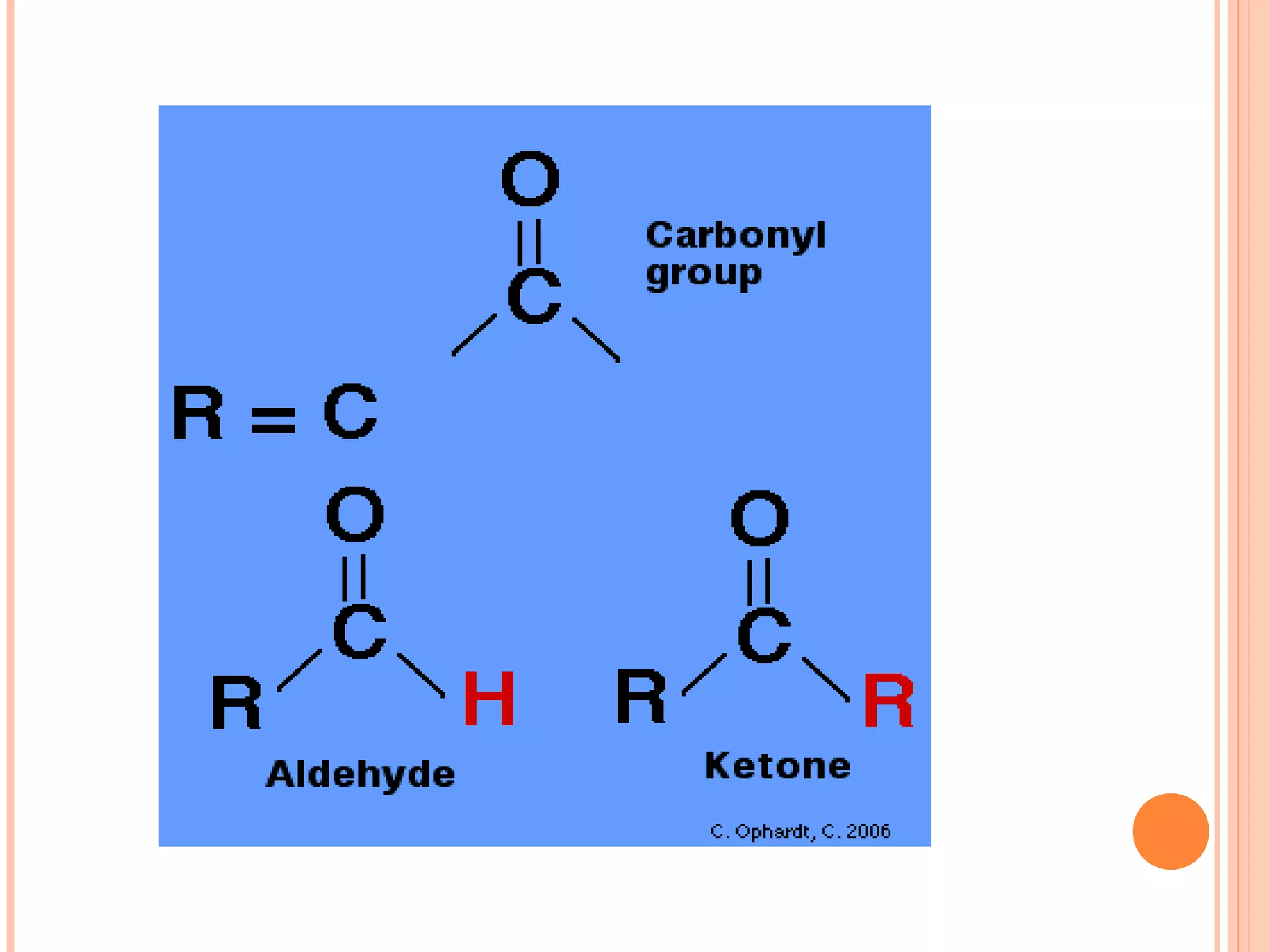
Carbohydrates are chemically
characterized as:
Poly hydroxy aldehydes or
Poly hydroxy ketones.
 Sugars that contain an aldehyde group
are called Aldoses.
 Sugars that contain a keto group are
called Ketoses.
IMPORTANT TERMS REGARDING
CHO
 Asymmetric carbon
 Symmetric carbon
 Carbonyl carbon
 Reference carbon
 Anomeric carbon
ASYMMETRIC CARBON
 A carbon linked to four different atoms or
groups farthest from the carbonyl carbon
 Also called Chiral carbon
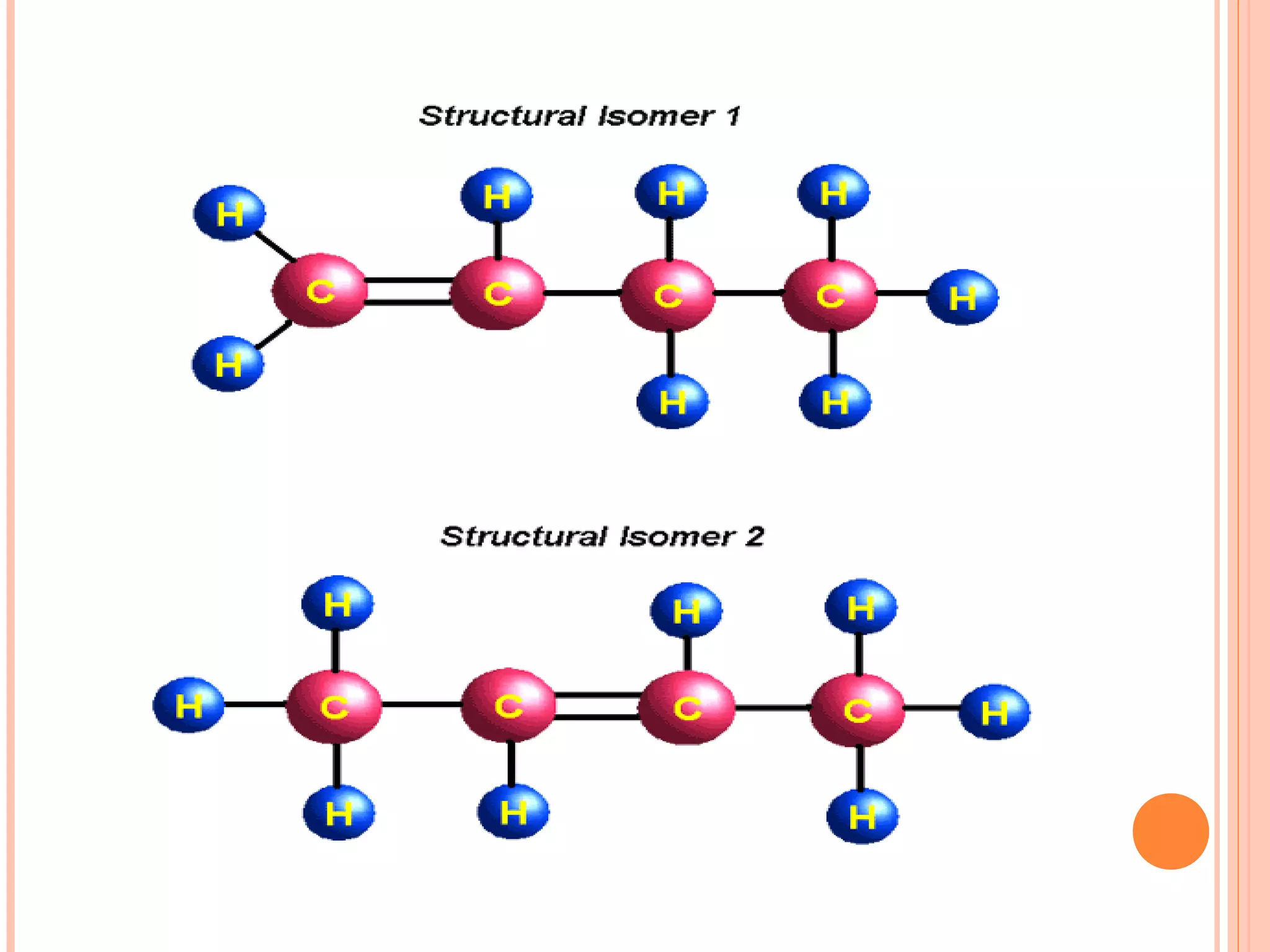
ISOMERS
 Isomers are molecules that have the same
molecular formula, but have a different
arrangement of the atoms in space.
(different structures).
ISOMER 1
Examples of isomers:
1. Glucose
2. Fructose
3. Galactose
4. Mannose
Same chemical formula C6 H12 O6
EPIMERS
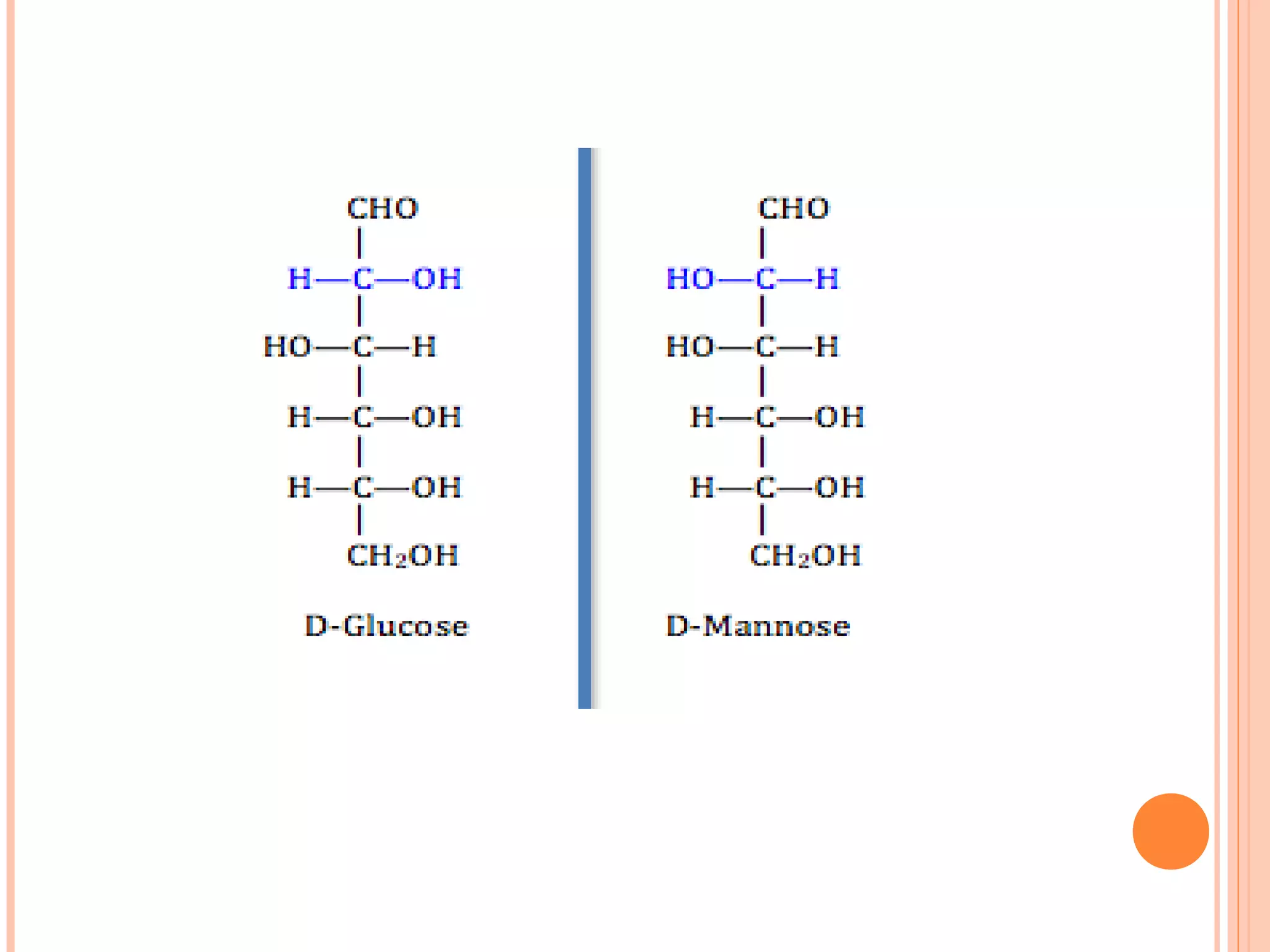
 EPIMERS are sugars that differ in
configuration at ONLY 1 POSITION.
 Examples of epimers :
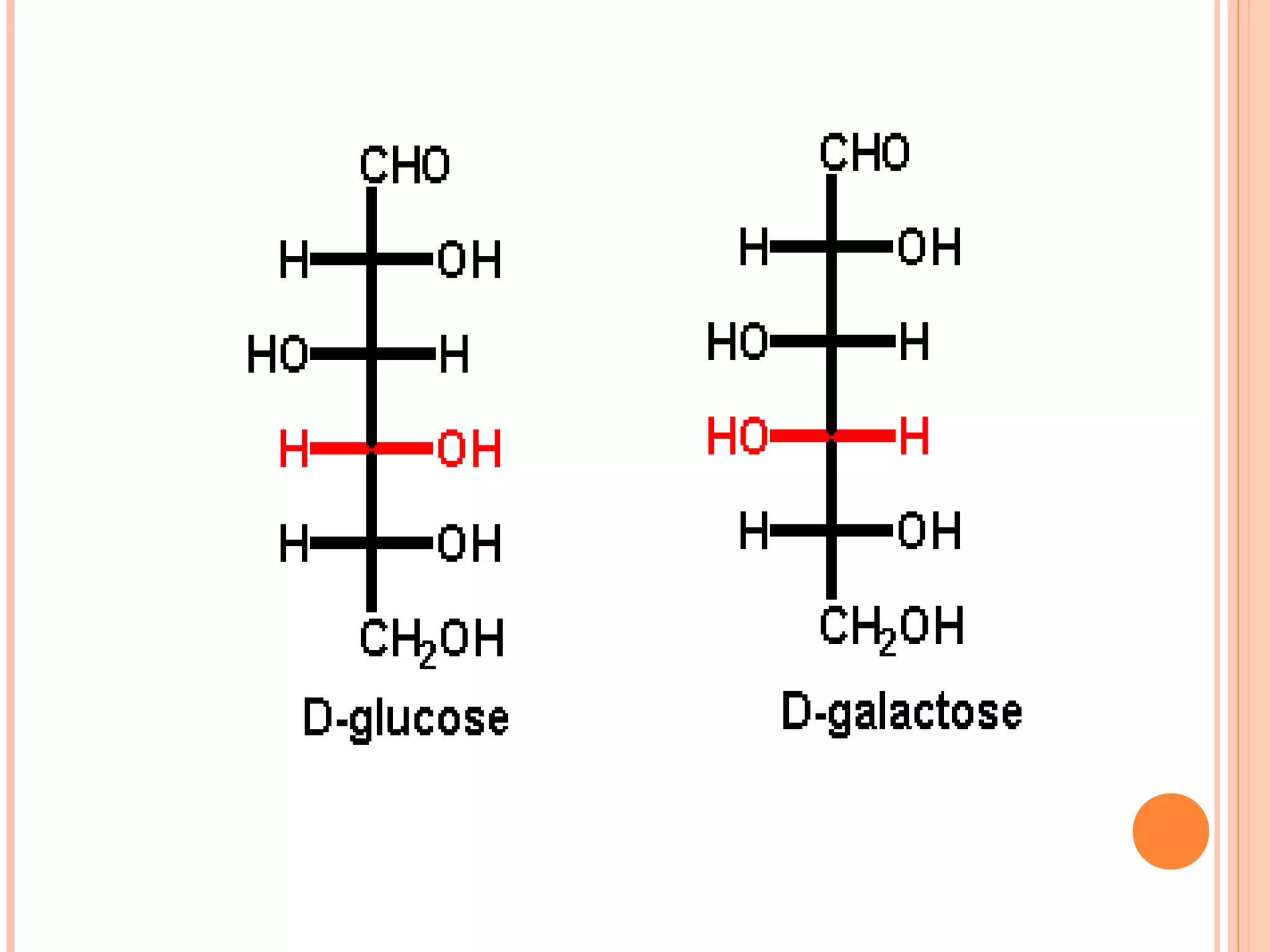
D-glucose & D-galactose (epimeric at
C4)
D-glucose & D-mannose (epimeric at
C2)
D-idose & L-glucose (epimeric at C5)
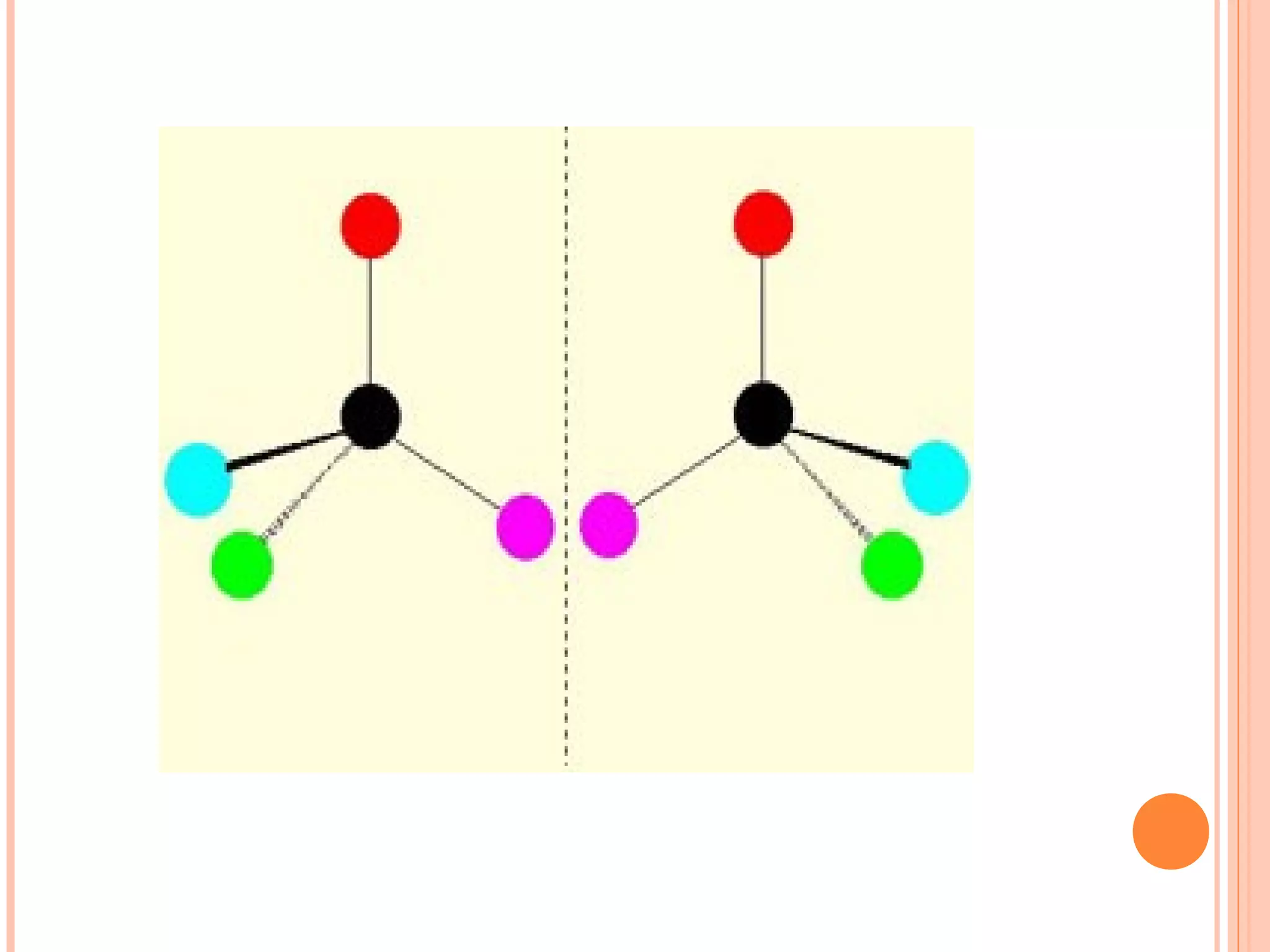
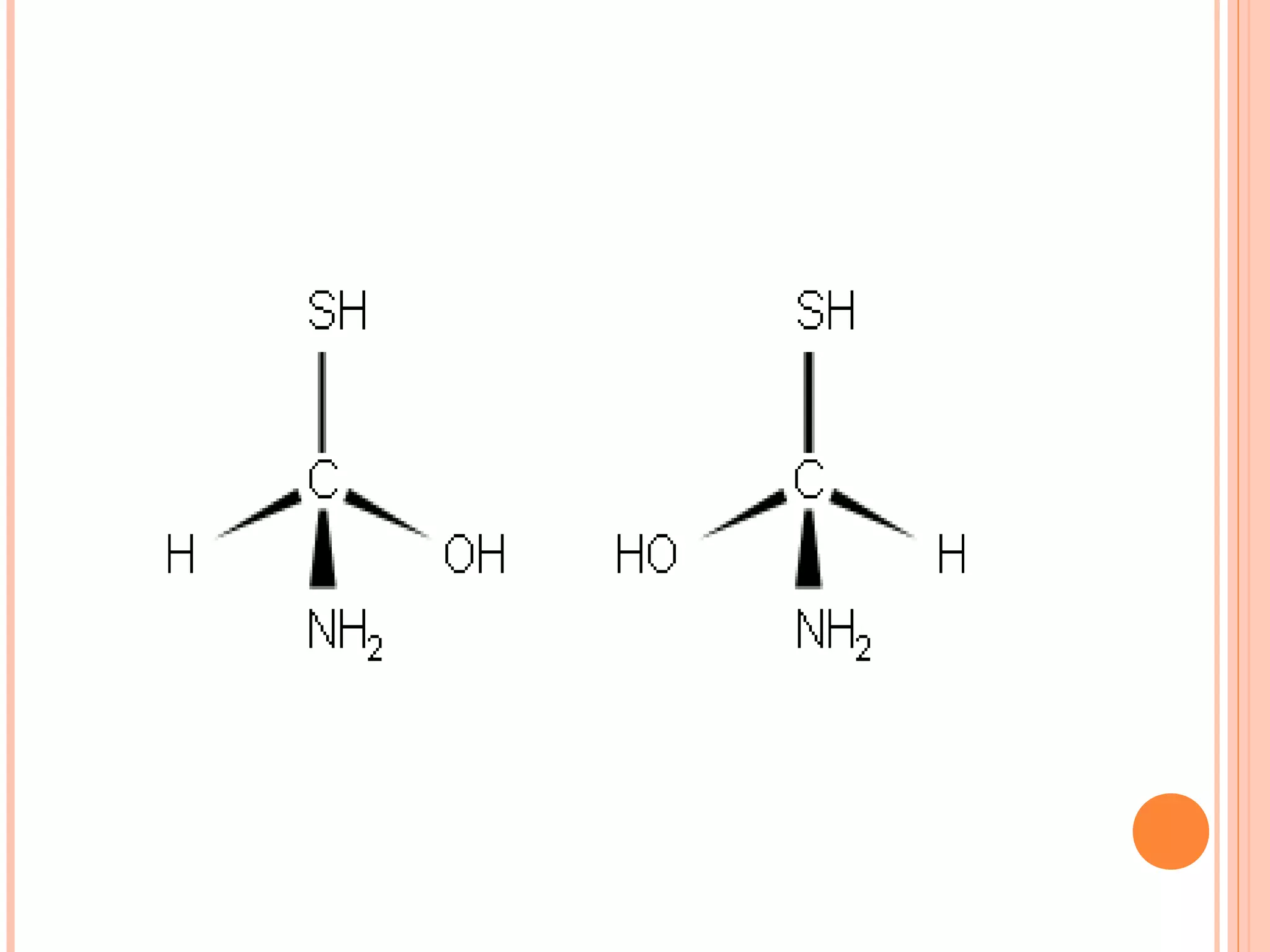
ENANTIOMERS
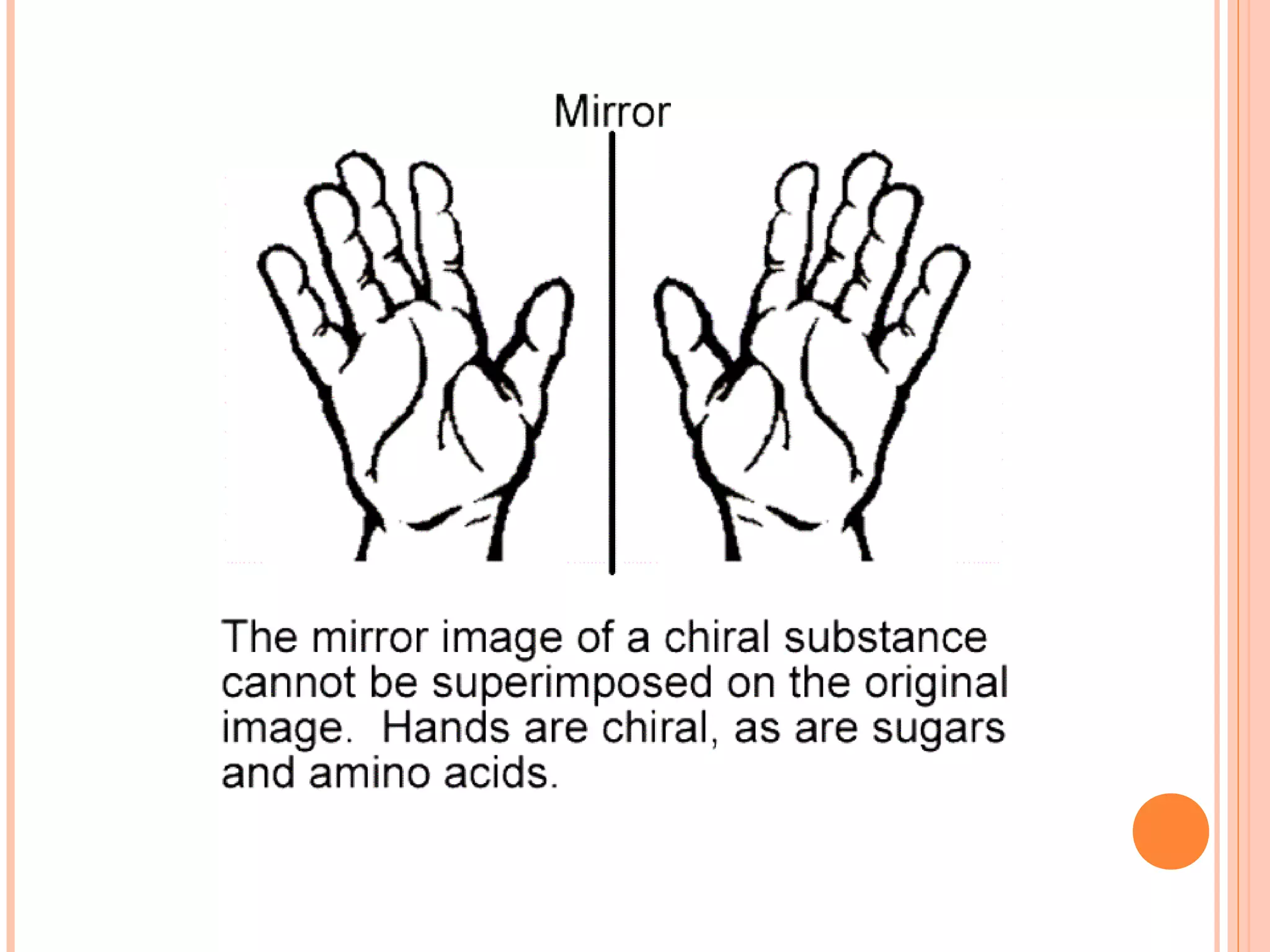
Non-Superimposable COMPLETE mirror
image (differ in configuration at EVERY
CHIRAL CENTER.
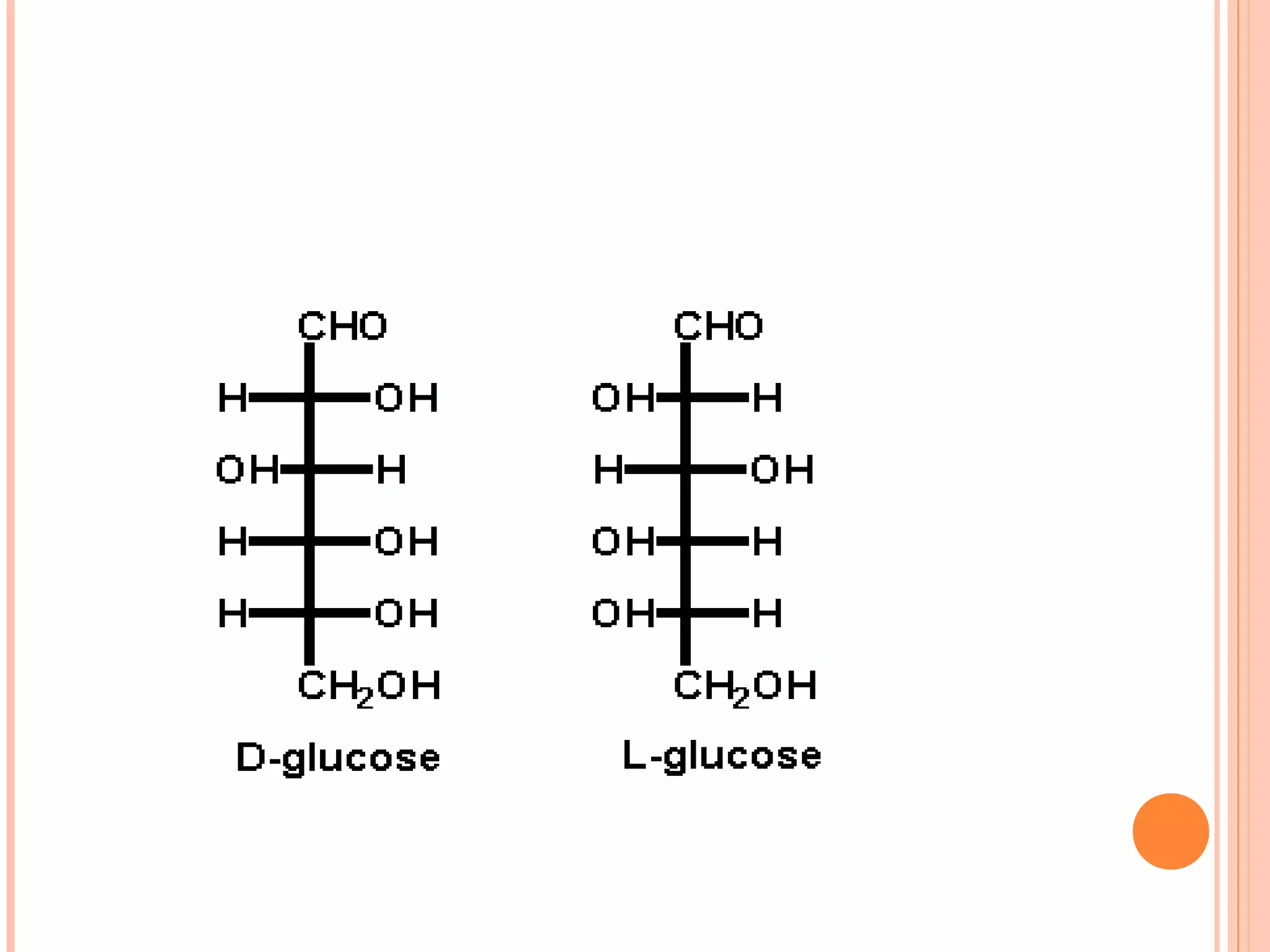
 The two members of the pair are
designated as D and L forms.
 In D form the OH group on the
asymmetric carbon is on the right.
 In L form the OH group is on the left
side.
 D-glucose and L-glucose are
enantiomers:
CYCLIZATION
 Less then 1%of CHO exist in an open
chain form.
 Predominantly found in ring form.
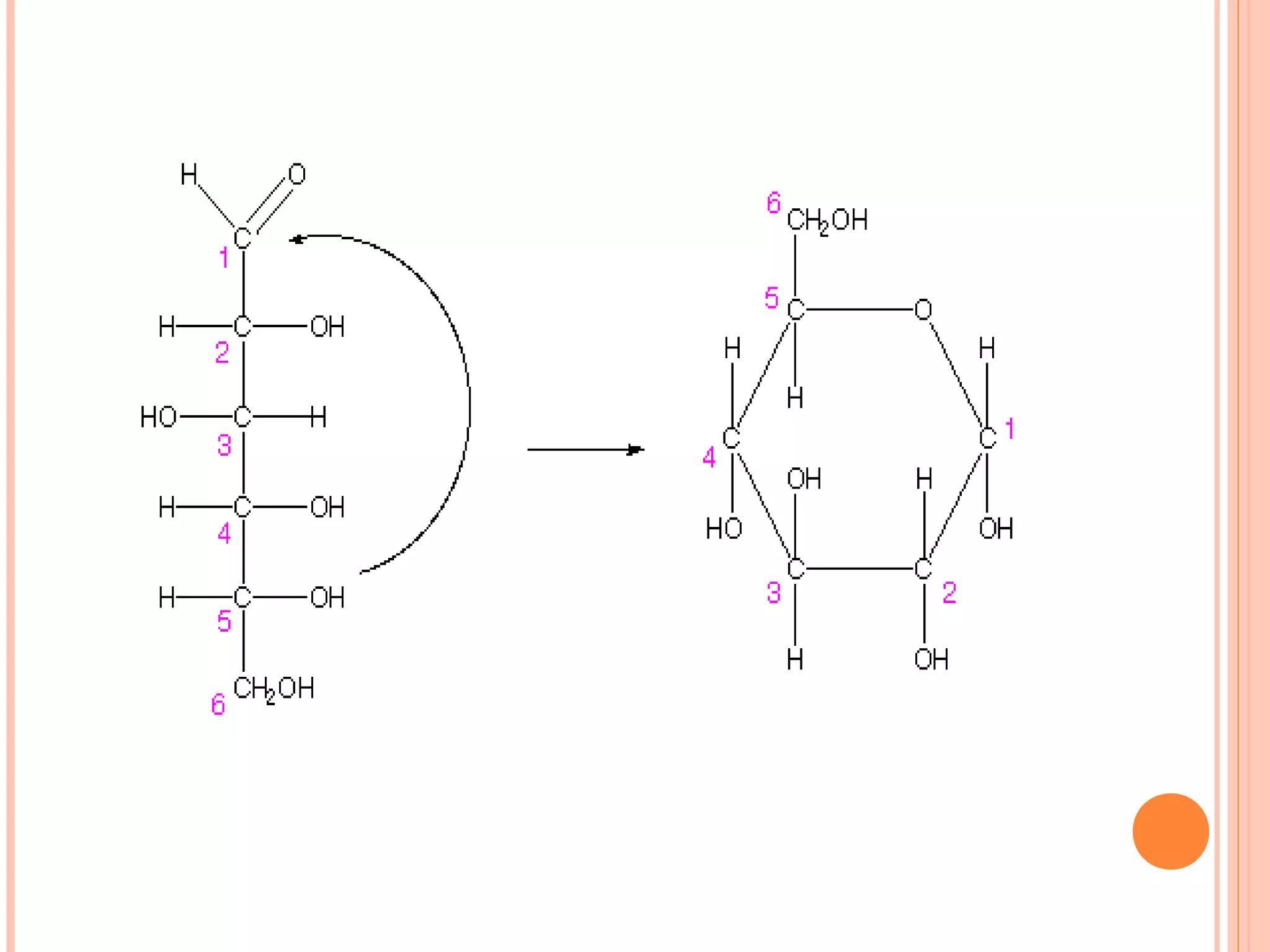
 involving reaction of C-5 OH group with
the C-1 aldehyde group or C-2 of keto
group.
 Six membered ring structures are called
Pyranoses .
 five membered ring structures are called
Furanoses .
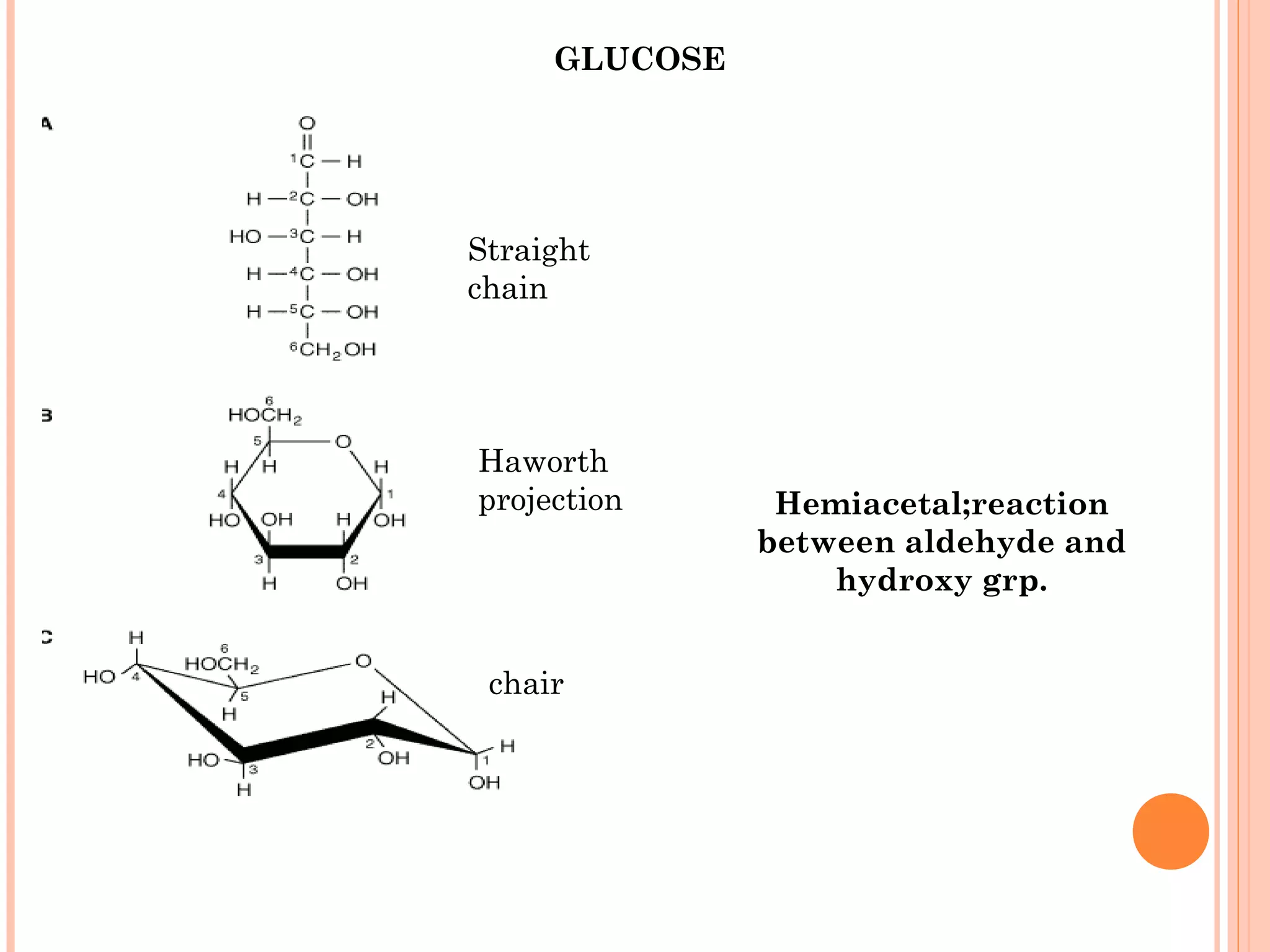
Straight
chain
Haworth
projection
chair
Hemiacetal;reaction
between aldehyde and
hydroxy grp.
GLUCOSE
ANOMERIC CARBON
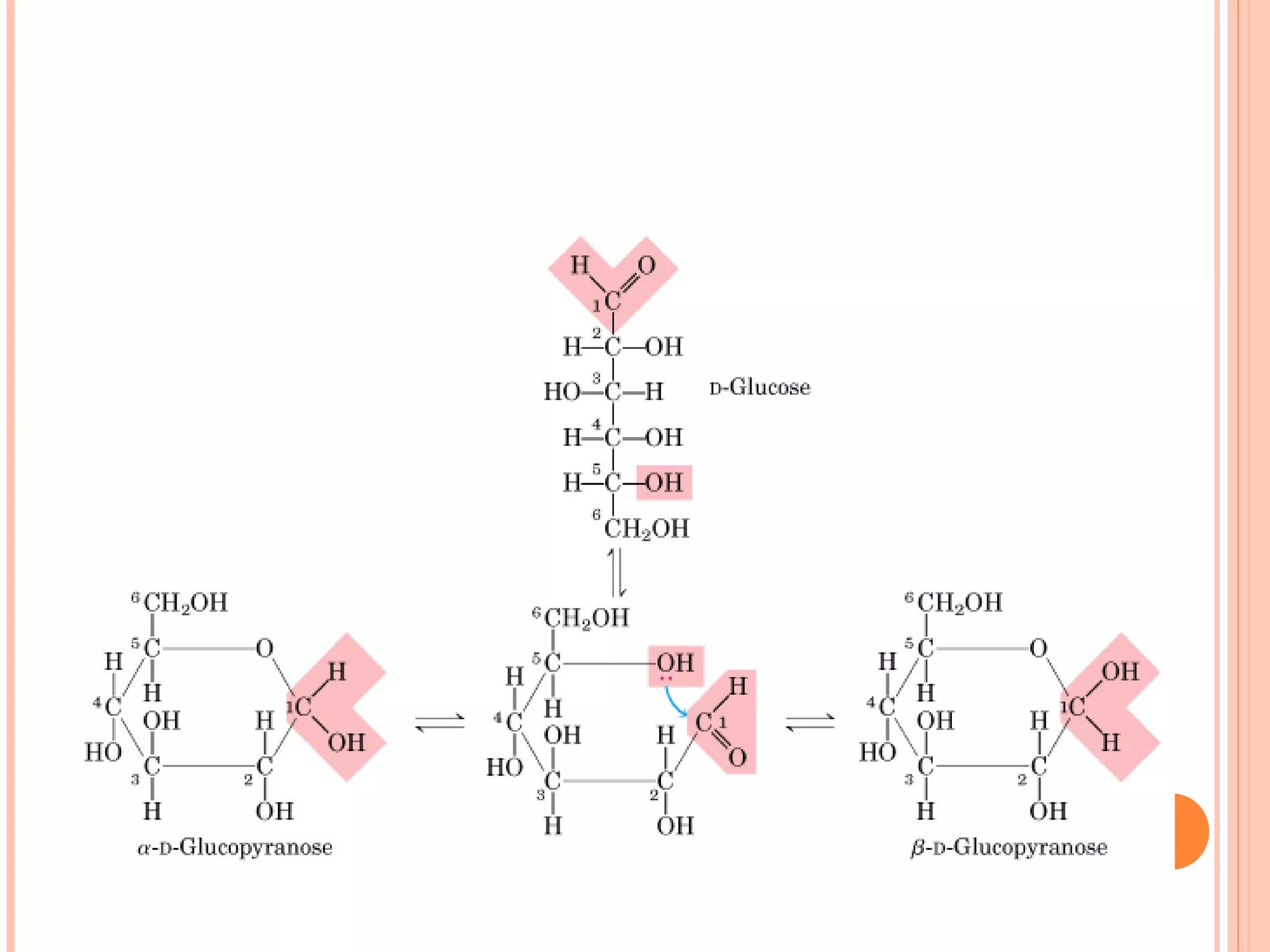
 The carbonyl carbon after cyclization becomes
the anomeric carbon.
 This creates α and β configuration.
 In α configuration the OH is on the same of the
ring in fischer projection. In Haworths it is on
the trans side of CH2OH.
 Such α and β configuration are called
diastereomers and they are not mirror images.
Enzymes can distinguished between these two
forms:
 Glycogen is synthesized from α-D
glucopyranose
 Cellulose is synthesized from β -D
glucopyranose
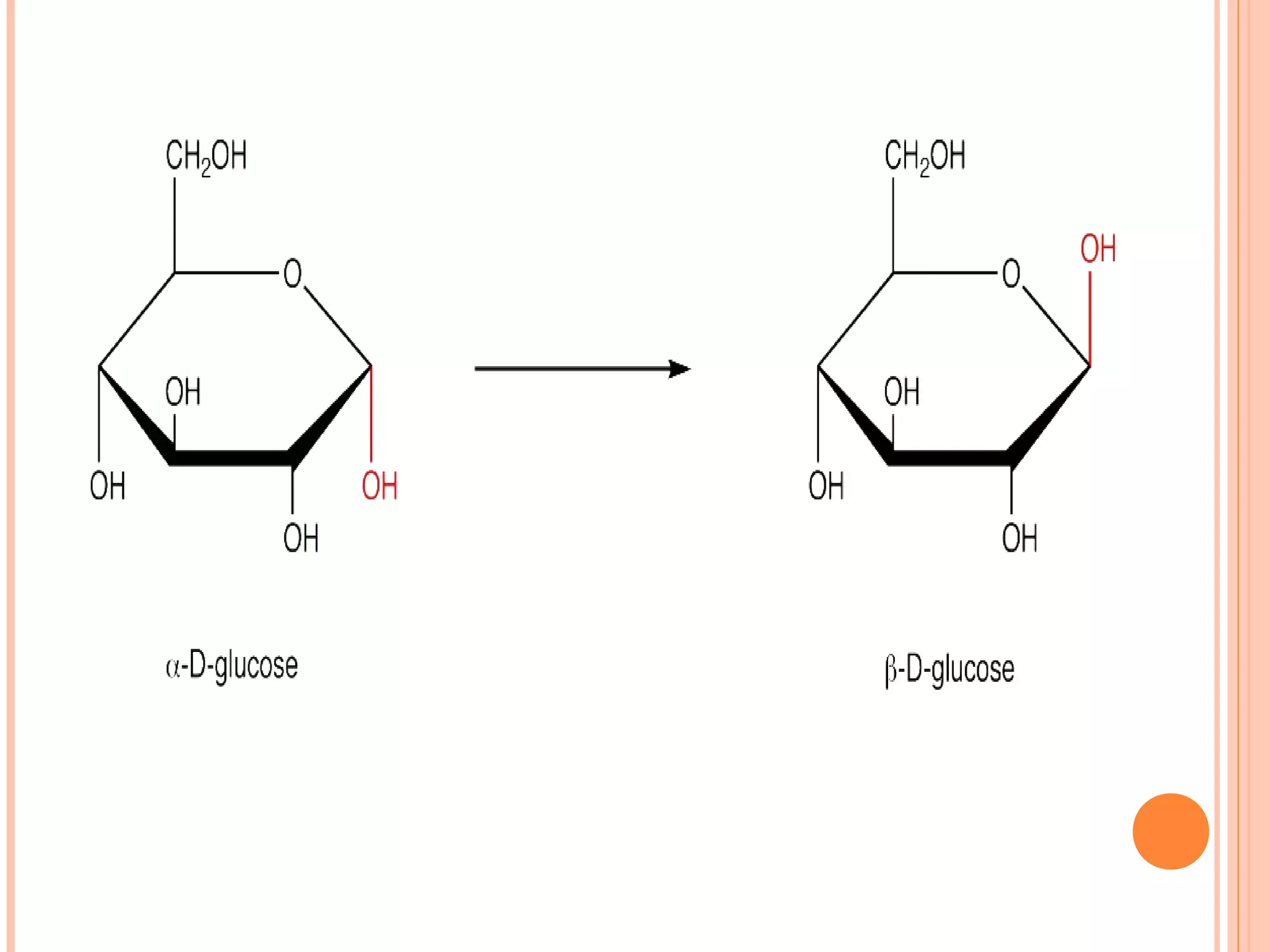
MUTAROTATION
 Unlike the other stereoisomeric forms, α
and β anomers spontaneously
interconvert in solution.
 This is called mutarotation.
OPTICAL ACTIVITY
 When a plane polarized light is passed through a
solution containing monosaccharides the light
will either be rotated towards right or left.
 This rotation is because of the presence of
asymmetric carbon atom.
 If it is rotated towards left- levorotatory (-)
 If it is rotated towards right-
dextrorotatory(+)
REDUCING SUGAR
 Sugars in which the oxygen of the
anomeric carbon is free and not attached
to any other structure, such sugars can
act as reducing agents and are called
reducing sugars.
CLASSIFICATION
All carbohydrates can be classified as
either:
 Monosaccharides
 Disaccharides
 oligosaccharides or Polysaccharides.
 Monosaccharides- one unit of
carbohydrate
 Disaccharides- Two units of
carbohydrates.
 Anywhere from two to ten monosaccharide
units, make up an oligosaccharide.
 Polysaccharides are much larger,
containing hundreds of monosaccharide
units.
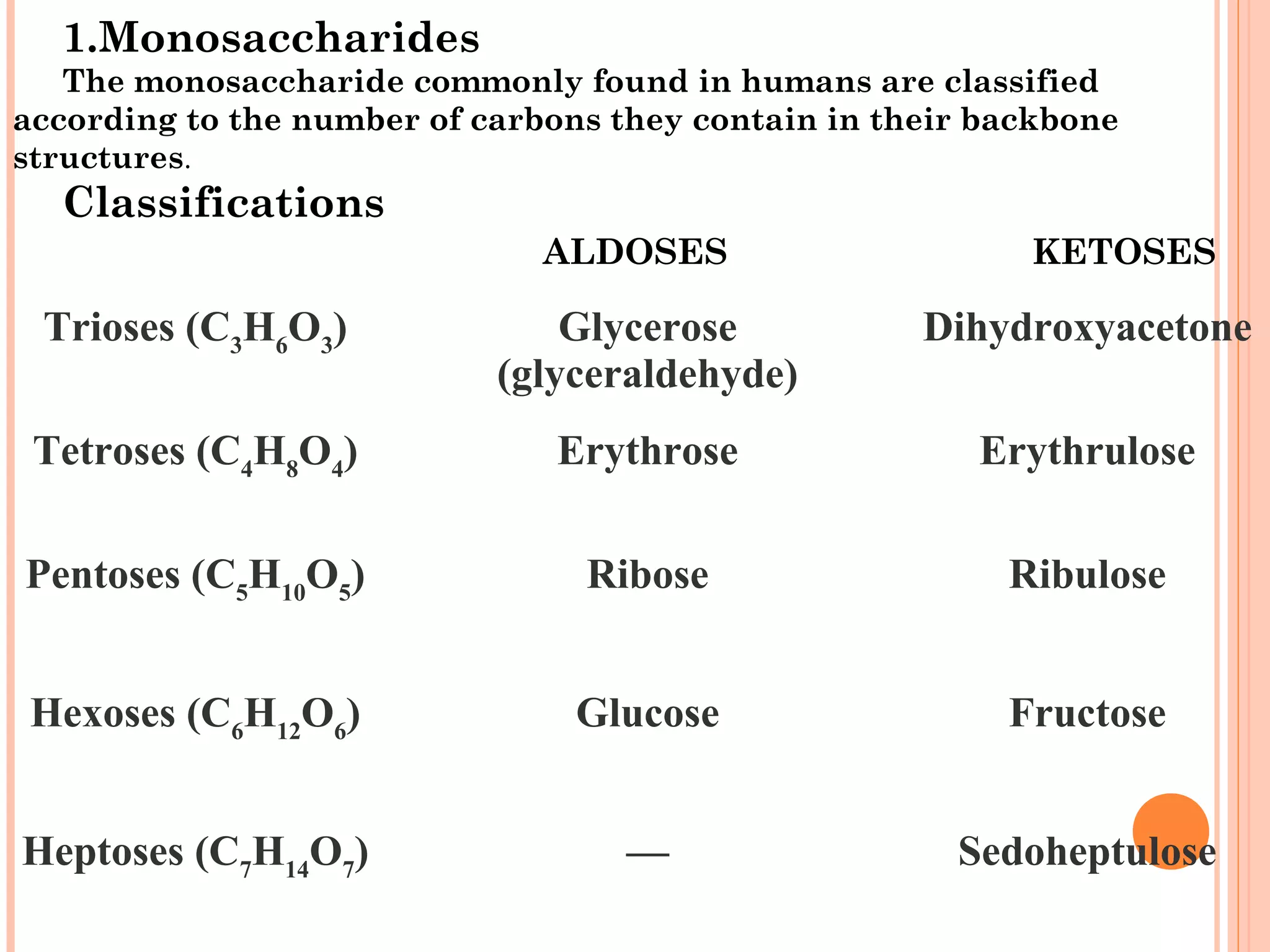
1.Monosaccharides
The monosaccharide commonly found in humans are classified
according to the number of carbons they contain in their backbone
structures.
Classifications
Trioses (C3
H6
O3
) Glycerose
(glyceraldehyde)
Dihydroxyacetone
Tetroses (C4
H8
O4
) Erythrose Erythrulose
Pentoses (C5
H10
O5
) Ribose Ribulose
Hexoses (C6
H12
O6
) Glucose Fructose
Heptoses (C7
H14
O7
) — Sedoheptulose
ALDOSES KETOSES
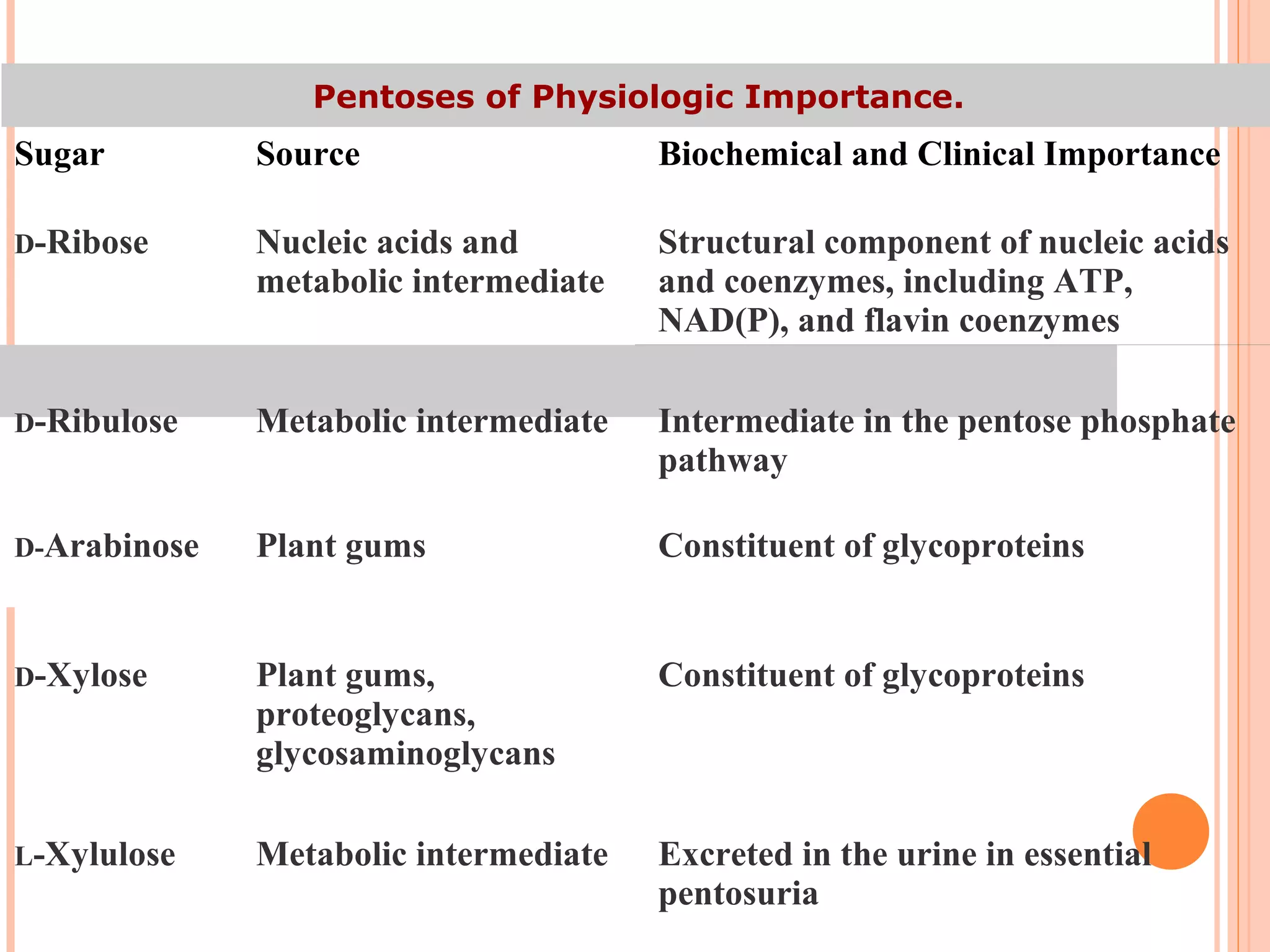
Pentoses of Physiologic Importance.
Sugar Source Biochemical and Clinical Importance
D-Ribose Nucleic acids and
metabolic intermediate
Structural component of nucleic acids
and coenzymes, including ATP,
NAD(P), and flavin coenzymes
D-Ribulose Metabolic intermediate Intermediate in the pentose phosphate
pathway
D-Arabinose Plant gums Constituent of glycoproteins
D-Xylose Plant gums,
proteoglycans,
glycosaminoglycans
Constituent of glycoproteins
L-Xylulose Metabolic intermediate Excreted in the urine in essential
pentosuria
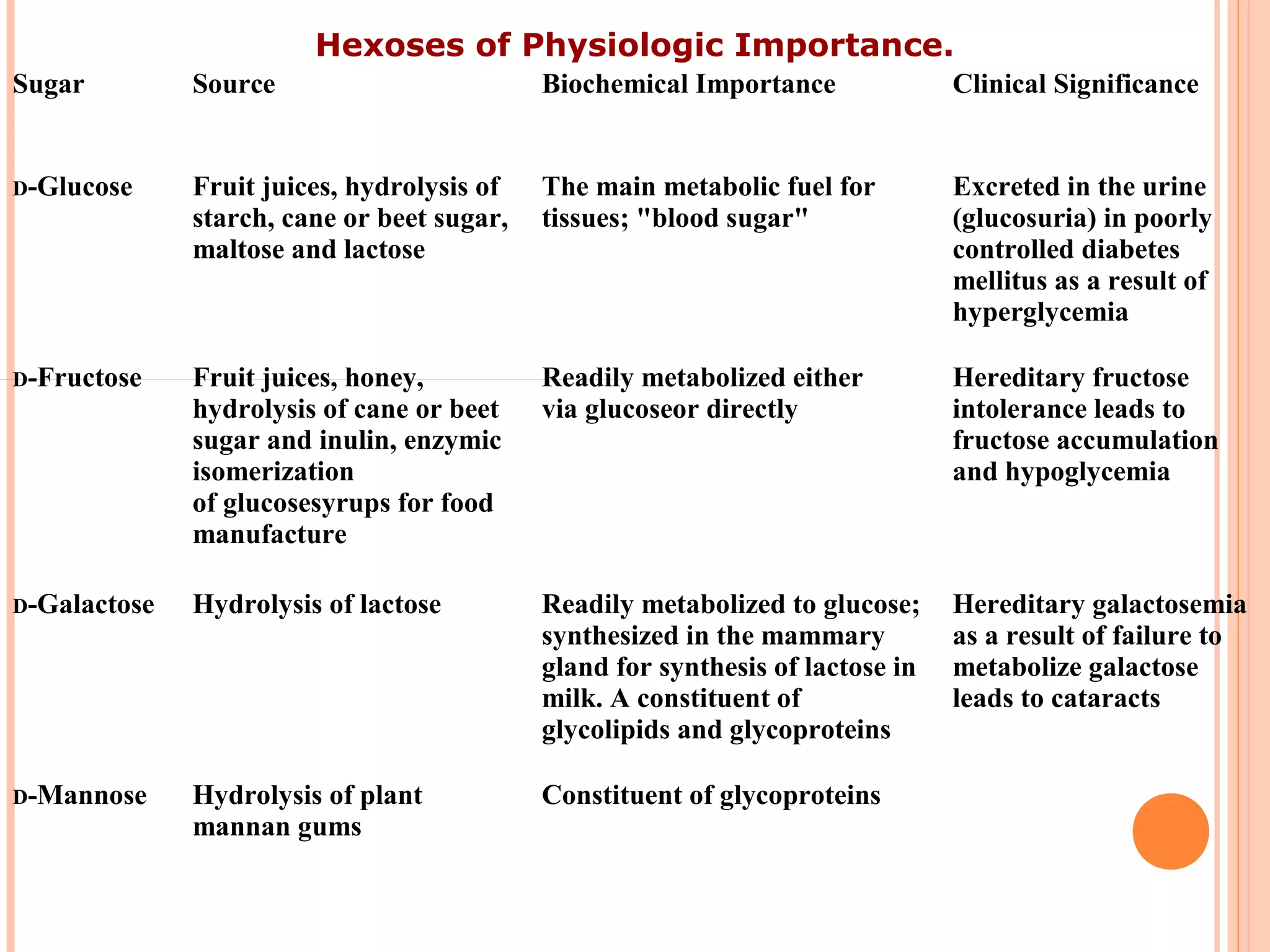
Hexoses of Physiologic Importance.
Sugar Source Biochemical Importance Clinical Significance
D-Glucose Fruit juices, hydrolysis of
starch, cane or beet sugar,
maltose and lactose
The main metabolic fuel for
tissues; "blood sugar"
Excreted in the urine
(glucosuria) in poorly
controlled diabetes
mellitus as a result of
hyperglycemia
D-Fructose Fruit juices, honey,
hydrolysis of cane or beet
sugar and inulin, enzymic
isomerization
of glucosesyrups for food
manufacture
Readily metabolized either
via glucoseor directly
Hereditary fructose
intolerance leads to
fructose accumulation
and hypoglycemia
D-Galactose Hydrolysis of lactose Readily metabolized to glucose;
synthesized in the mammary
gland for synthesis of lactose in
milk. A constituent of
glycolipids and glycoproteins
Hereditary galactosemia
as a result of failure to
metabolize galactose
leads to cataracts
D-Mannose Hydrolysis of plant
mannan gums
Constituent of glycoproteins

Intro to cho and monosaccharides

  • 1.
  • 2.
    INTRODUCTION  Carbohydrates areone of the three major classes of biological molecules.  Carbohydrates are also the most abundant biological molecules.  Carbohydrates derive their name from the general formula Cn (H2O).
  • 3.
    FUNCTIONS  Variety ofimportant functions in living systems: nutritional (energy storage, fuels, metabolic intermediates) structural (components of nucleotides, plant and bacterial cell walls, arthropod exoskeletons, animal connective tissue)  informational (cell surface of eukaryotes -- molecular recognition, cell-cell communication)
  • 4.
     Carbohydrates alsocan combine with lipids to form glycolipids OR  With proteins to form glycoproteins.
  • 5.
    Carbohydrates are chemically characterizedas: Poly hydroxy aldehydes or Poly hydroxy ketones.
  • 6.
     Sugars thatcontain an aldehyde group are called Aldoses.  Sugars that contain a keto group are called Ketoses.
  • 8.
    IMPORTANT TERMS REGARDING CHO Asymmetric carbon  Symmetric carbon  Carbonyl carbon  Reference carbon  Anomeric carbon
  • 9.
    ASYMMETRIC CARBON  Acarbon linked to four different atoms or groups farthest from the carbonyl carbon  Also called Chiral carbon
  • 11.
    ISOMERS  Isomers aremolecules that have the same molecular formula, but have a different arrangement of the atoms in space. (different structures).
  • 12.
  • 14.
    Examples of isomers: 1.Glucose 2. Fructose 3. Galactose 4. Mannose Same chemical formula C6 H12 O6
  • 15.
    EPIMERS  EPIMERS aresugars that differ in configuration at ONLY 1 POSITION.  Examples of epimers : D-glucose & D-galactose (epimeric at C4) D-glucose & D-mannose (epimeric at C2) D-idose & L-glucose (epimeric at C5)
  • 18.
    ENANTIOMERS Non-Superimposable COMPLETE mirror image(differ in configuration at EVERY CHIRAL CENTER.
  • 20.
     The twomembers of the pair are designated as D and L forms.  In D form the OH group on the asymmetric carbon is on the right.  In L form the OH group is on the left side.  D-glucose and L-glucose are enantiomers:
  • 24.
    CYCLIZATION  Less then1%of CHO exist in an open chain form.  Predominantly found in ring form.  involving reaction of C-5 OH group with the C-1 aldehyde group or C-2 of keto group.
  • 25.
     Six memberedring structures are called Pyranoses .  five membered ring structures are called Furanoses .
  • 26.
  • 29.
    ANOMERIC CARBON  Thecarbonyl carbon after cyclization becomes the anomeric carbon.  This creates α and β configuration.  In α configuration the OH is on the same of the ring in fischer projection. In Haworths it is on the trans side of CH2OH.
  • 30.
     Such αand β configuration are called diastereomers and they are not mirror images. Enzymes can distinguished between these two forms:  Glycogen is synthesized from α-D glucopyranose  Cellulose is synthesized from β -D glucopyranose
  • 31.
    MUTAROTATION  Unlike theother stereoisomeric forms, α and β anomers spontaneously interconvert in solution.  This is called mutarotation.
  • 33.
    OPTICAL ACTIVITY  Whena plane polarized light is passed through a solution containing monosaccharides the light will either be rotated towards right or left.  This rotation is because of the presence of asymmetric carbon atom.  If it is rotated towards left- levorotatory (-)  If it is rotated towards right- dextrorotatory(+)
  • 34.
    REDUCING SUGAR  Sugarsin which the oxygen of the anomeric carbon is free and not attached to any other structure, such sugars can act as reducing agents and are called reducing sugars.
  • 35.
    CLASSIFICATION All carbohydrates canbe classified as either:  Monosaccharides  Disaccharides  oligosaccharides or Polysaccharides.
  • 36.
     Monosaccharides- oneunit of carbohydrate  Disaccharides- Two units of carbohydrates.  Anywhere from two to ten monosaccharide units, make up an oligosaccharide.  Polysaccharides are much larger, containing hundreds of monosaccharide units.
  • 37.
    1.Monosaccharides The monosaccharide commonlyfound in humans are classified according to the number of carbons they contain in their backbone structures. Classifications Trioses (C3 H6 O3 ) Glycerose (glyceraldehyde) Dihydroxyacetone Tetroses (C4 H8 O4 ) Erythrose Erythrulose Pentoses (C5 H10 O5 ) Ribose Ribulose Hexoses (C6 H12 O6 ) Glucose Fructose Heptoses (C7 H14 O7 ) — Sedoheptulose ALDOSES KETOSES
  • 38.
    Pentoses of PhysiologicImportance. Sugar Source Biochemical and Clinical Importance D-Ribose Nucleic acids and metabolic intermediate Structural component of nucleic acids and coenzymes, including ATP, NAD(P), and flavin coenzymes D-Ribulose Metabolic intermediate Intermediate in the pentose phosphate pathway D-Arabinose Plant gums Constituent of glycoproteins D-Xylose Plant gums, proteoglycans, glycosaminoglycans Constituent of glycoproteins L-Xylulose Metabolic intermediate Excreted in the urine in essential pentosuria
  • 39.
    Hexoses of PhysiologicImportance. Sugar Source Biochemical Importance Clinical Significance D-Glucose Fruit juices, hydrolysis of starch, cane or beet sugar, maltose and lactose The main metabolic fuel for tissues; "blood sugar" Excreted in the urine (glucosuria) in poorly controlled diabetes mellitus as a result of hyperglycemia D-Fructose Fruit juices, honey, hydrolysis of cane or beet sugar and inulin, enzymic isomerization of glucosesyrups for food manufacture Readily metabolized either via glucoseor directly Hereditary fructose intolerance leads to fructose accumulation and hypoglycemia D-Galactose Hydrolysis of lactose Readily metabolized to glucose; synthesized in the mammary gland for synthesis of lactose in milk. A constituent of glycolipids and glycoproteins Hereditary galactosemia as a result of failure to metabolize galactose leads to cataracts D-Mannose Hydrolysis of plant mannan gums Constituent of glycoproteins