UNIT 6
SPORTS NUTRITION
INTRODUCTION

Food provides elements for:
~ Body structures building & repair
~ Energy production
~ Fluid and electrolyte balance regulation.

OBJECTIVES

At the end of this lesson, participants will be
able to :

a) Define sports nutrition
b) Identify 6 important nutrients & its functions
c) Identify food sources for nutrient
d) Understand the general recommendation &
sports nutrition myths
CONTENT OVERVIEW

1. INTRODUCTION OF SPORTS NUTRITION
Nutrition:
Series of processes starting from food intake to
utilization include eating, digestion, absorption,
transport, metabolism of food nutrients.
Sports Nutrition:
Applies nutrition practices for maximal sports
performance
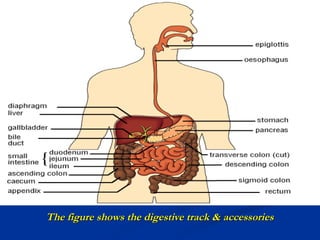
The figure shows the digestive track & accessories
Importance of Nutrition
~ Basic nutrients requirement for health.
~ Provide required fuel for optimal performance.
~ Better & faster recovery.
~ Build and repair muscle damage due to exercise.
~ Prevent injury due to fatigue.
~ Reach and maintain optimal body weight and
body fat level .
2. TYPES OF NUTRIENT
Macronutrients:
Daily requirement > 1 g / day (CHO, protein & fat)
Micronutrients:
Daily requirement < 1 g / day (vitamin & mineral)
Calorie providing nutrient: CHO, protein & fat.
Non energy providing nutrient: vitamin, mineral &
water.
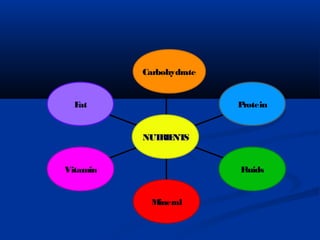
Carbohydrate


  Fat                    Protein


          NUT NT
             RIE S


Vitamin                  Fluids


           Mineral
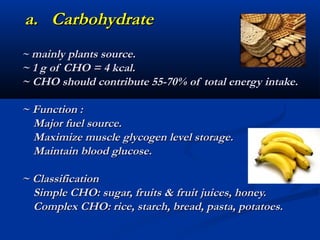
a. Carbohydrate
~ mainly plants source.
~ 1 g of CHO = 4 kcal.
~ CHO should contribute 55-70% of total energy intake.

~ Function :
  Major fuel source.
  Maximize muscle glycogen level storage.
  Maintain blood glucose.

~ Classification
  Simple CHO: sugar, fruits & fruit juices, honey.
  Complex CHO: rice, starch, bread, pasta, potatoes.
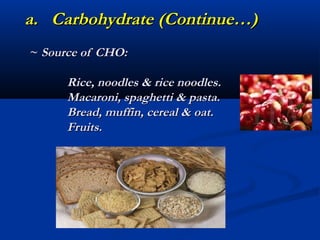
a. Carbohydrate (Continue…)
~ Source of CHO:

      Rice, noodles & rice noodles.
      Macaroni, spaghetti & pasta.
      Bread, muffin, cereal & oat.
      Fruits.
a. Carbohydrate (Continue…)

~ Exchange list 15 g of CHO :

           1/3 bowl of rice.
           2/3 cup macaroni.
           1/2 cup of noodles.
           1 slide of bread.
           3 piece of cream cracker.
           1 whole apple.
           1 piece of banana.
           1 slide of papaya.
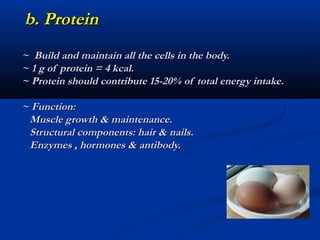
b. Protein
~ Build and maintain all the cells in the body.
~ 1 g of protein = 4 kcal.
~ Protein should contribute 15-20% of total energy intake.

~ Function:
 Muscle growth & maintenance.
 Structural components: hair & nails.
 Enzymes , hormones & antibody.
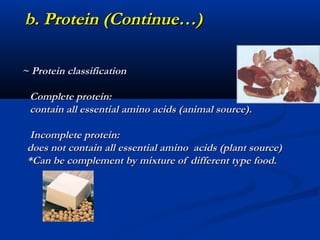
b. Protein (Continue…)

~ Protein classification

 Complete protein:
 contain all essential amino acids (animal source).

  Incomplete protein:
 does not contain all essential amino acids (plant source)
 *Can be complement by mixture of different type food.
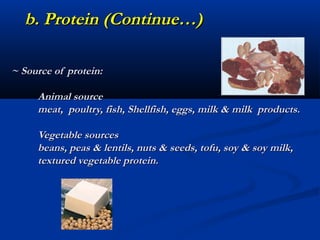
b. Protein (Continue…)

~ Source of protein:

     Animal source
     meat, poultry, fish, Shellfish, eggs, milk & milk products.

     Vegetable sources
     beans, peas & lentils, nuts & seeds, tofu, soy & soy milk,
     textured vegetable protein.
b. Protein (Continue…)


~ Exchange list 7 g of protein:

            ½ piece of chicken breast.
            1 piece of chicken wing.
            1 piece of fish.
            1 matches box size of meat.
            1 cup of milk.
            2 boxes of soy milk.
            1 piece of soy bean curd.
            2/3 cup of beans.
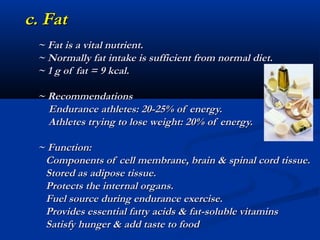
c. Fat
 ~ Fat is a vital nutrient.
 ~ Normally fat intake is sufficient from normal diet.
 ~ 1 g of fat = 9 kcal.

 ~ Recommendations
   Endurance athletes: 20-25% of energy.
   Athletes trying to lose weight: 20% of energy.

 ~ Function:
  Components of cell membrane, brain & spinal cord tissue.
  Stored as adipose tissue.
  Protects the internal organs.
  Fuel source during endurance exercise.
  Provides essential fatty acids & fat-soluble vitamins
  Satisfy hunger & add taste to food
c. Fat (Continue…)

 ~ Fat classification :

   Saturated fatty acids
   Fat from meat and poultry, dairy products (normally
   animal source).

  Unsaturated fatty acids
  Oil from olive, peanuts, almonds, avocado, pears, rapeseed,
  sunflower, corn, soybean, cottonseed and safflower
  (normally plant source).
c. Fat (Continue…)

~ Fat category - according to the visibility:

 Visible fat
 Can be seen by eyes:
 butter, margarine, ghee, oils, fat on skin.

 Invisible fat
 Can not be seen directly:
 whole milk, eggs, meat products, chips, fried food and pastry,
 salad cream, chocolate and creamy sauces.
c. Fat (Continue…)

~ Essential fatty acids (omega-6 and omega-3)
  vital for the development of cell membranes

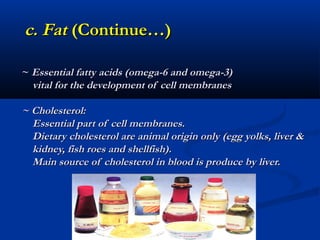
~ Cholesterol:
  Essential part of cell membranes.
  Dietary cholesterol are animal origin only (egg yolks, liver &
  kidney, fish roes and shellfish).
  Main source of cholesterol in blood is produce by liver.
c. Fat (Continue…)

  ~ Exchange list 5 g of fat:

         ½ packet of butter.
         1 teaspoon of margarine.
         1 teaspoon of cooking oil.
         1 teaspoon heap of mayonnaise.
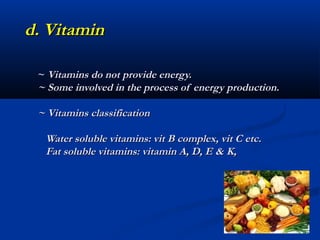
d. Vitamin

 ~ Vitamins do not provide energy.
 ~ Some involved in the process of energy production.

 ~ Vitamins classification

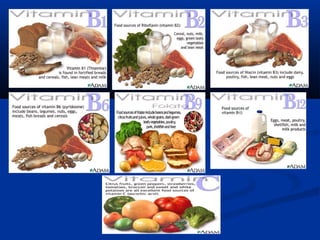
  Water soluble vitamins: vit B complex, vit C etc.
  Fat soluble vitamins: vitamin A, D, E & K,
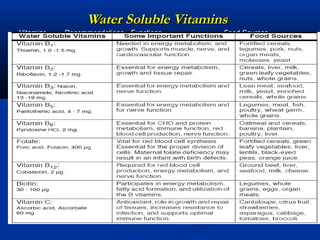
Water Soluble Vitamins
Vitamins      Recommendations Functions                     Food Sources
Vitamin B1    1.0 – 1.5 mg     Needed in energy
Thiamin                        metabolism and growth.       Fortified cereals, legumes,
                               Supports muscle, nerve       nuts, organ meats,
                               and cardiovascular           molasses, and yeast.
                               function.
Vitamin B2    1.2 -1.7 mg      Essential for energy         Cereals, liver, milk, green
Riboflavin                     metabolism; growth and       leafy vegetables, nuts,
                               tissue repair.               whole grains.
Vitamin B3  13 - 19 mg
Niacinamide                    Essential for energy         Lean meat, seafood, milk,
, Nicotinic                    metabolism and nerve         yeast, enriched cereals,
acid.                          function.                    whole grains.

Vitamin B5    4 – 7 mg         Essential for energy         Legumes, meat, fish,
Pantothenic                    metabolism and for nerve     poultry, wheat germ, whole
acid                           function.                    grains.
Vitamin B6    2 mg             Essential for carbohydrate
Pyridoxine                     and protein metabolism,      Oatmeal and cereals,
acid                           immune function, red blood   banana, plantain, poultry,
                               cell production, nerve       liver.
                               function.
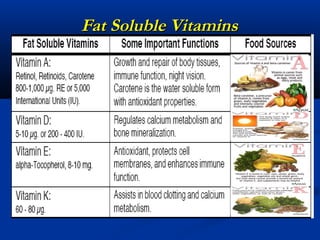
Fat Soluble Vitamins
Vitamins     Recommendations    Functions                    Food Sources
Vitamin A    800 – 1000 μg RE Growth and repair of body
Retinol,     or 5000 IU       tissues, immune function,      Oatmeal, green and
Retinoids,                    night vision. Carotene is      yellow fruits and
Carotene.                     the water soluble form with    vegetable, liver, milk.
                              antioxidant properties.
Vitamin D    5 – 10 μg or       Regulates calcium            Fortified milk, egg
             200 – 400 μg       metabolism and bone          yolk, salmon and
                                mineralization.              sunlight.
Vitamin E    8 – 10 mg                                       Fortified cereals,
Alpha      –                    Antioxidant, protects cell
                                                             nuts, wheat germ,
Tocopherol                      membranes and enhances
                                                             shrimp and green
                                immune function.
                                                             vegetables.
Vitamin K    60 – 80 μg         Assists in blood clotting    Green and leafy
                                and calcium metabolism.      vegetables.
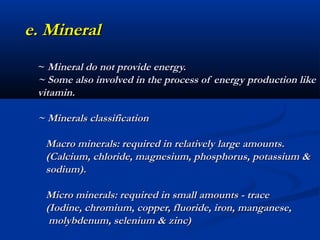
e. Mineral
 ~ Mineral do not provide energy.
 ~ Some also involved in the process of energy production like
 vitamin.

 ~ Minerals classification

  Macro minerals: required in relatively large amounts.
  (Calcium, chloride, magnesium, phosphorus, potassium &
  sodium).

  Micro minerals: required in small amounts - trace
  (Iodine, chromium, copper, fluoride, iron, manganese,
   molybdenum, selenium & zinc)
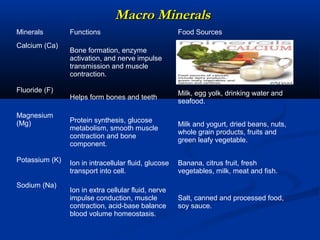
Macro Minerals
Minerals        Functions                             Food Sources
Calcium (Ca)
                Bone formation, enzyme                Milk, cheese, yogurt, dried beans
                activation, and nerve impulse         and peas, dark green leafy
                transmission and muscle               vegetables, calcium – fortified
                contraction.                          products.

Fluoride (F)                                          Milk, egg yolk, drinking water and
                Helps form bones and teeth
                                                      seafood.

Magnesium
(Mg)            Protein synthesis, glucose
                                                      Milk and yogurt, dried beans, nuts,
                metabolism, smooth muscle
                                                      whole grain products, fruits and
                contraction and bone
                                                      green leafy vegetable.
                component.

Potassium (K)   Ion in intracellular fluid, glucose   Banana, citrus fruit, fresh
                transport into cell.                  vegetables, milk, meat and fish.

Sodium (Na)
                Ion in extra cellular fluid, nerve
                impulse conduction, muscle            Salt, canned and processed food,
                contraction, acid-base balance        soy sauce.
                blood volume homeostasis.
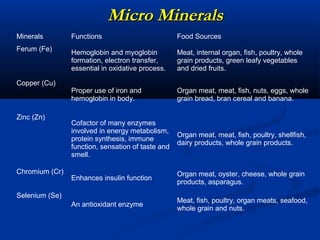
Micro Minerals
Minerals        Functions                          Food Sources
Ferum (Fe)      Hemoglobin and myoglobin           Meat, internal organ, fish, poultry, whole
                formation, electron transfer,      grain products, green leafy vegetables
                essential in oxidative process.    and dried fruits.

Copper (Cu)
                Proper use of iron and             Organ meat, meat, fish, nuts, eggs, whole
                hemoglobin in body.                grain bread, bran cereal and banana.

Zinc (Zn)
                Cofactor of many enzymes
                involved in energy metabolism,
                                                   Organ meat, meat, fish, poultry, shellfish,
                protein synthesis, immune
                                                   dairy products, whole grain products.
                function, sensation of taste and
                smell.

Chromium (Cr)                                      Organ meat, oyster, cheese, whole grain
                Enhances insulin function
                                                   products, asparagus.
Selenium (Se)
                                                   Meat, fish, poultry, organ meats, seafood,
                An antioxidant enzyme
                                                   whole grain and nuts.
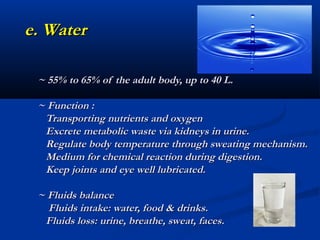
e. Water

 ~ 55% to 65% of the adult body, up to 40 L.

 ~ Function :
  Transporting nutrients and oxygen
  Excrete metabolic waste via kidneys in urine.
  Regulate body temperature through sweating mechanism.
  Medium for chemical reaction during digestion.
  Keep joints and eye well lubricated.

 ~ Fluids balance
   Fluids intake: water, food & drinks.
  Fluids loss: urine, breathe, sweat, faces.
3. ENERGY BALANCE
~ Energy intake (EI): energy absorbed the body.
~ Energy expenditure (EE): energy used in cellular
  metabolism or lost from body.

~ Energy balance: relationship between the level of EI &
EE.

      When EI > EE (positives energy balance):
      energy surplus & potential increase in weight.

      When EE > EI (negative energy balance):
      energy deficit & potential reduction in weight.

      When EE = EI: no change in energy status & weight.
4. GENERAL RECOMMENDATION FOR
ATHLETES
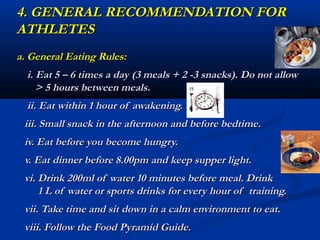
a. General Eating Rules:
  i. Eat 5 – 6 times a day (3 meals + 2 -3 snacks). Do not allow
     > 5 hours between meals.
  ii. Eat within 1 hour of awakening.
 iii. Small snack in the afternoon and before bedtime.
 iv. Eat before you become hungry.
 v. Eat dinner before 8.00pm and keep supper light.
 vi. Drink 200ml of water 10 minutes before meal. Drink
     1 L of water or sports drinks for every hour of training.
 vii. Take time and sit down in a calm environment to eat.
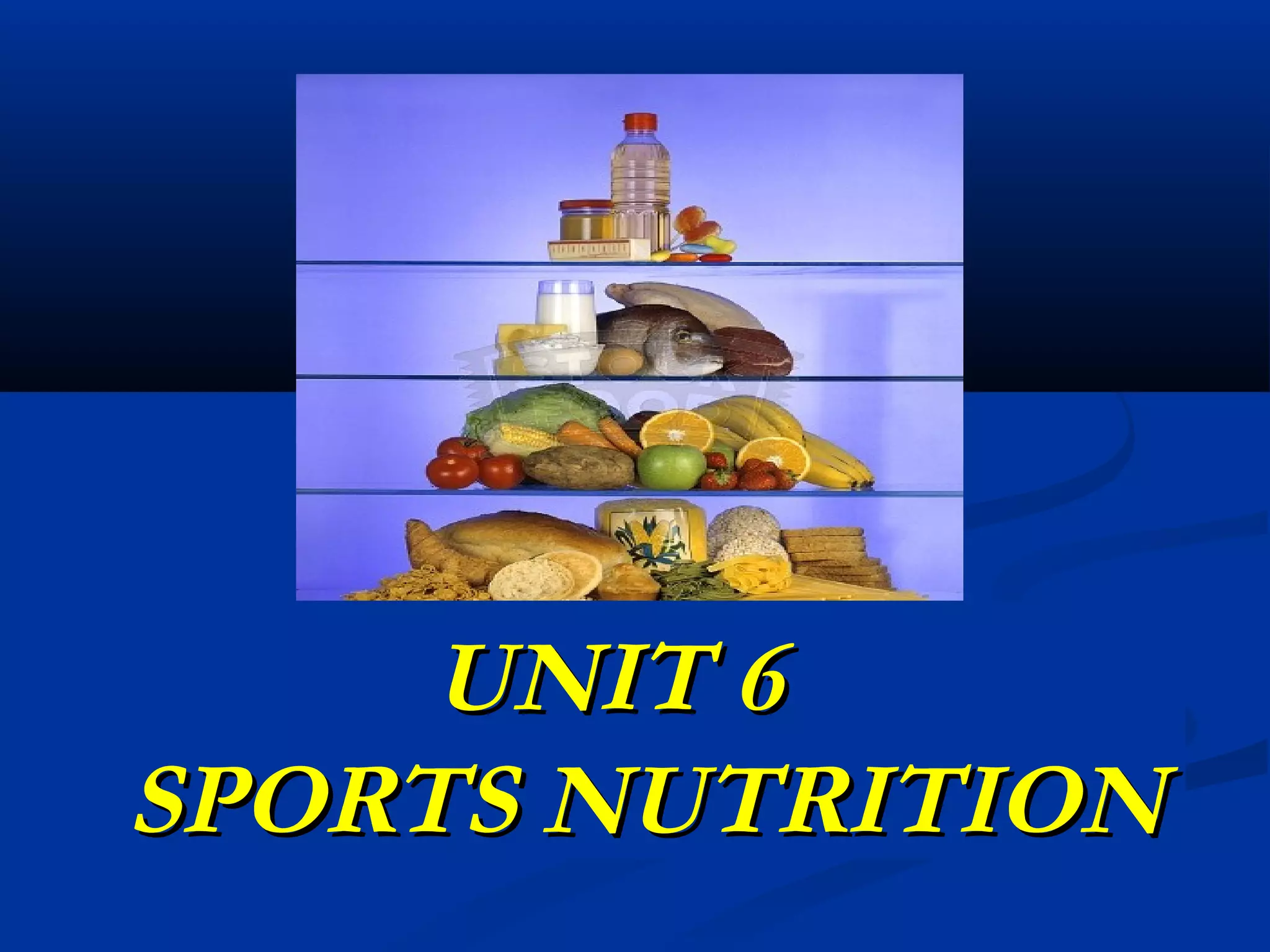
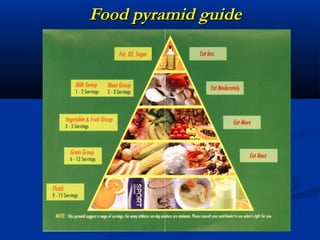
 viii. Follow the Food Pyramid Guide.
Food pyramid guide
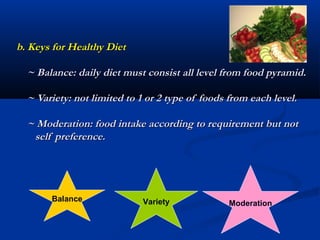
b. Keys for Healthy Diet

  ~ Balance: daily diet must consist all level from food pyramid.

  ~ Variety: not limited to 1 or 2 type of foods from each level.

  ~ Moderation: food intake according to requirement but not
   self preference.


       Balance               Variety             Moderation
c. Food Myths

 ~ Food myths: the incorrect thinking or believe regarding food’s
  function. Example:
     i. Turtle blood will be able to increase hemoglobin level.
     ii. Horse’s flesh could improve speed of running.
     iii. Caffeine contain from Cola drinks can assist in
          sprinting event.
     iv. High protein diet is a good choice to reduce body fat.
     v. Eating more protein will improve someone’s muscularity.
     vi. Eating higher dose of vitamin & mineral will bring more
         benefit & better effect.
THANK YOU!

Presentation sports nutrition

  • 1.
  • 2.
    INTRODUCTION Food provides elementsfor: ~ Body structures building & repair ~ Energy production ~ Fluid and electrolyte balance regulation.
  • 3.
    OBJECTIVES At the endof this lesson, participants will be able to : a) Define sports nutrition b) Identify 6 important nutrients & its functions c) Identify food sources for nutrient d) Understand the general recommendation & sports nutrition myths
  • 4.
    CONTENT OVERVIEW 1. INTRODUCTIONOF SPORTS NUTRITION Nutrition: Series of processes starting from food intake to utilization include eating, digestion, absorption, transport, metabolism of food nutrients. Sports Nutrition: Applies nutrition practices for maximal sports performance
  • 5.
    The figure showsthe digestive track & accessories
  • 6.
    Importance of Nutrition ~Basic nutrients requirement for health. ~ Provide required fuel for optimal performance. ~ Better & faster recovery. ~ Build and repair muscle damage due to exercise. ~ Prevent injury due to fatigue. ~ Reach and maintain optimal body weight and body fat level .
  • 7.
    2. TYPES OFNUTRIENT Macronutrients: Daily requirement > 1 g / day (CHO, protein & fat) Micronutrients: Daily requirement < 1 g / day (vitamin & mineral) Calorie providing nutrient: CHO, protein & fat. Non energy providing nutrient: vitamin, mineral & water.
  • 8.
    Carbohydrate Fat Protein NUT NT RIE S Vitamin Fluids Mineral
  • 9.
    a. Carbohydrate ~ mainlyplants source. ~ 1 g of CHO = 4 kcal. ~ CHO should contribute 55-70% of total energy intake. ~ Function : Major fuel source. Maximize muscle glycogen level storage. Maintain blood glucose. ~ Classification Simple CHO: sugar, fruits & fruit juices, honey. Complex CHO: rice, starch, bread, pasta, potatoes.
  • 10.
    a. Carbohydrate (Continue…) ~Source of CHO: Rice, noodles & rice noodles. Macaroni, spaghetti & pasta. Bread, muffin, cereal & oat. Fruits.
  • 11.
    a. Carbohydrate (Continue…) ~Exchange list 15 g of CHO : 1/3 bowl of rice. 2/3 cup macaroni. 1/2 cup of noodles. 1 slide of bread. 3 piece of cream cracker. 1 whole apple. 1 piece of banana. 1 slide of papaya.
  • 12.
    b. Protein ~ Buildand maintain all the cells in the body. ~ 1 g of protein = 4 kcal. ~ Protein should contribute 15-20% of total energy intake. ~ Function: Muscle growth & maintenance. Structural components: hair & nails. Enzymes , hormones & antibody.
  • 13.
    b. Protein (Continue…) ~Protein classification Complete protein: contain all essential amino acids (animal source). Incomplete protein: does not contain all essential amino acids (plant source) *Can be complement by mixture of different type food.
  • 14.
    b. Protein (Continue…) ~Source of protein: Animal source meat, poultry, fish, Shellfish, eggs, milk & milk products. Vegetable sources beans, peas & lentils, nuts & seeds, tofu, soy & soy milk, textured vegetable protein.
  • 15.
    b. Protein (Continue…) ~Exchange list 7 g of protein: ½ piece of chicken breast. 1 piece of chicken wing. 1 piece of fish. 1 matches box size of meat. 1 cup of milk. 2 boxes of soy milk. 1 piece of soy bean curd. 2/3 cup of beans.
  • 16.
    c. Fat ~Fat is a vital nutrient. ~ Normally fat intake is sufficient from normal diet. ~ 1 g of fat = 9 kcal. ~ Recommendations Endurance athletes: 20-25% of energy. Athletes trying to lose weight: 20% of energy. ~ Function: Components of cell membrane, brain & spinal cord tissue. Stored as adipose tissue. Protects the internal organs. Fuel source during endurance exercise. Provides essential fatty acids & fat-soluble vitamins Satisfy hunger & add taste to food
  • 17.
    c. Fat (Continue…) ~ Fat classification : Saturated fatty acids Fat from meat and poultry, dairy products (normally animal source). Unsaturated fatty acids Oil from olive, peanuts, almonds, avocado, pears, rapeseed, sunflower, corn, soybean, cottonseed and safflower (normally plant source).
  • 18.
    c. Fat (Continue…) ~Fat category - according to the visibility: Visible fat Can be seen by eyes: butter, margarine, ghee, oils, fat on skin. Invisible fat Can not be seen directly: whole milk, eggs, meat products, chips, fried food and pastry, salad cream, chocolate and creamy sauces.
  • 19.
    c. Fat (Continue…) ~Essential fatty acids (omega-6 and omega-3) vital for the development of cell membranes ~ Cholesterol: Essential part of cell membranes. Dietary cholesterol are animal origin only (egg yolks, liver & kidney, fish roes and shellfish). Main source of cholesterol in blood is produce by liver.
  • 20.
    c. Fat (Continue…) ~ Exchange list 5 g of fat: ½ packet of butter. 1 teaspoon of margarine. 1 teaspoon of cooking oil. 1 teaspoon heap of mayonnaise.
  • 21.
    d. Vitamin ~Vitamins do not provide energy. ~ Some involved in the process of energy production. ~ Vitamins classification Water soluble vitamins: vit B complex, vit C etc. Fat soluble vitamins: vitamin A, D, E & K,
  • 22.
    Water Soluble Vitamins Vitamins Recommendations Functions Food Sources Vitamin B1 1.0 – 1.5 mg Needed in energy Thiamin metabolism and growth. Fortified cereals, legumes, Supports muscle, nerve nuts, organ meats, and cardiovascular molasses, and yeast. function. Vitamin B2 1.2 -1.7 mg Essential for energy Cereals, liver, milk, green Riboflavin metabolism; growth and leafy vegetables, nuts, tissue repair. whole grains. Vitamin B3 13 - 19 mg Niacinamide Essential for energy Lean meat, seafood, milk, , Nicotinic metabolism and nerve yeast, enriched cereals, acid. function. whole grains. Vitamin B5 4 – 7 mg Essential for energy Legumes, meat, fish, Pantothenic metabolism and for nerve poultry, wheat germ, whole acid function. grains. Vitamin B6 2 mg Essential for carbohydrate Pyridoxine and protein metabolism, Oatmeal and cereals, acid immune function, red blood banana, plantain, poultry, cell production, nerve liver. function.
  • 24.
    Fat Soluble Vitamins Vitamins Recommendations Functions Food Sources Vitamin A 800 – 1000 μg RE Growth and repair of body Retinol, or 5000 IU tissues, immune function, Oatmeal, green and Retinoids, night vision. Carotene is yellow fruits and Carotene. the water soluble form with vegetable, liver, milk. antioxidant properties. Vitamin D 5 – 10 μg or Regulates calcium Fortified milk, egg 200 – 400 μg metabolism and bone yolk, salmon and mineralization. sunlight. Vitamin E 8 – 10 mg Fortified cereals, Alpha – Antioxidant, protects cell nuts, wheat germ, Tocopherol membranes and enhances shrimp and green immune function. vegetables. Vitamin K 60 – 80 μg Assists in blood clotting Green and leafy and calcium metabolism. vegetables.
  • 25.
    e. Mineral ~Mineral do not provide energy. ~ Some also involved in the process of energy production like vitamin. ~ Minerals classification Macro minerals: required in relatively large amounts. (Calcium, chloride, magnesium, phosphorus, potassium & sodium). Micro minerals: required in small amounts - trace (Iodine, chromium, copper, fluoride, iron, manganese, molybdenum, selenium & zinc)
  • 26.
    Macro Minerals Minerals Functions Food Sources Calcium (Ca) Bone formation, enzyme Milk, cheese, yogurt, dried beans activation, and nerve impulse and peas, dark green leafy transmission and muscle vegetables, calcium – fortified contraction. products. Fluoride (F) Milk, egg yolk, drinking water and Helps form bones and teeth seafood. Magnesium (Mg) Protein synthesis, glucose Milk and yogurt, dried beans, nuts, metabolism, smooth muscle whole grain products, fruits and contraction and bone green leafy vegetable. component. Potassium (K) Ion in intracellular fluid, glucose Banana, citrus fruit, fresh transport into cell. vegetables, milk, meat and fish. Sodium (Na) Ion in extra cellular fluid, nerve impulse conduction, muscle Salt, canned and processed food, contraction, acid-base balance soy sauce. blood volume homeostasis.
  • 27.
    Micro Minerals Minerals Functions Food Sources Ferum (Fe) Hemoglobin and myoglobin Meat, internal organ, fish, poultry, whole formation, electron transfer, grain products, green leafy vegetables essential in oxidative process. and dried fruits. Copper (Cu) Proper use of iron and Organ meat, meat, fish, nuts, eggs, whole hemoglobin in body. grain bread, bran cereal and banana. Zinc (Zn) Cofactor of many enzymes involved in energy metabolism, Organ meat, meat, fish, poultry, shellfish, protein synthesis, immune dairy products, whole grain products. function, sensation of taste and smell. Chromium (Cr) Organ meat, oyster, cheese, whole grain Enhances insulin function products, asparagus. Selenium (Se) Meat, fish, poultry, organ meats, seafood, An antioxidant enzyme whole grain and nuts.
  • 28.
    e. Water ~55% to 65% of the adult body, up to 40 L. ~ Function : Transporting nutrients and oxygen Excrete metabolic waste via kidneys in urine. Regulate body temperature through sweating mechanism. Medium for chemical reaction during digestion. Keep joints and eye well lubricated. ~ Fluids balance Fluids intake: water, food & drinks. Fluids loss: urine, breathe, sweat, faces.
  • 29.
    3. ENERGY BALANCE ~Energy intake (EI): energy absorbed the body. ~ Energy expenditure (EE): energy used in cellular metabolism or lost from body. ~ Energy balance: relationship between the level of EI & EE. When EI > EE (positives energy balance): energy surplus & potential increase in weight. When EE > EI (negative energy balance): energy deficit & potential reduction in weight. When EE = EI: no change in energy status & weight.
  • 30.
    4. GENERAL RECOMMENDATIONFOR ATHLETES a. General Eating Rules: i. Eat 5 – 6 times a day (3 meals + 2 -3 snacks). Do not allow > 5 hours between meals. ii. Eat within 1 hour of awakening. iii. Small snack in the afternoon and before bedtime. iv. Eat before you become hungry. v. Eat dinner before 8.00pm and keep supper light. vi. Drink 200ml of water 10 minutes before meal. Drink 1 L of water or sports drinks for every hour of training. vii. Take time and sit down in a calm environment to eat. viii. Follow the Food Pyramid Guide.
  • 31.
  • 32.
    b. Keys forHealthy Diet ~ Balance: daily diet must consist all level from food pyramid. ~ Variety: not limited to 1 or 2 type of foods from each level. ~ Moderation: food intake according to requirement but not self preference. Balance Variety Moderation
  • 33.
    c. Food Myths ~ Food myths: the incorrect thinking or believe regarding food’s function. Example: i. Turtle blood will be able to increase hemoglobin level. ii. Horse’s flesh could improve speed of running. iii. Caffeine contain from Cola drinks can assist in sprinting event. iv. High protein diet is a good choice to reduce body fat. v. Eating more protein will improve someone’s muscularity. vi. Eating higher dose of vitamin & mineral will bring more benefit & better effect.
  • 34.