Athletes Nutrition
Presenter: Rinad Ali
Course name: Clinical Nutrition
Course Code: 702
Objectives:
 Outline the dietary requirements of athletes and
compare to normal requirement.
 Outline some commonly used supplements and the
scientific basis behind it.
 Present an argument for or against the use of
supplements
Outline the dietary requirements of
athletes and compare to normal
requirement.
 Dietary requirement for normal adults
 Dietary requirement for athletics
 Energy
 Macronutrients
 Micronutrients
 Nutrition for female athletes
Dietary requirement for normal
adults
Nutrient Quantity Per Day
Energy 2000Kcalorie
Protein 50 grams
Fat 70 grams
Saturated Fatty Acids 24 grams
Carbohydrates 310 grams
Sugars 90 grams
Dietary Fiber 30 grams
Sodium (salt) 2.3 grams
Energy
 Each athlete has unique energy requirements, which
support their ability to meet total nutritional goals.
 For everyday dietary planning and evaluation, energy
requirements can be predicted via estimations of RMR
and activity levels. Research methods such as indirect
calorimetry and DLW allow energy requirements to be
measured, and may be useful to confirm situations in
which an athlete has a true energy balance
abnormality.
 Many athletes are over-focused on reducing body
mass and body fat below levels that are consistent with
long-term health and performance.
 Restrained eating can cause significant detrimental
outcomes to body function.
 Leptin may be involved in modulating or mediating
some of these changes.
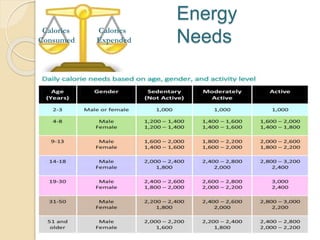
Energy
Needs
Calories
Consumed
Calories
Expended
Carbohydrate
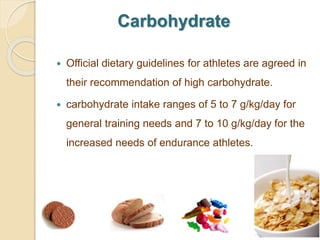
 Official dietary guidelines for athletes are agreed in
their recommendation of high carbohydrate.
 carbohydrate intake ranges of 5 to 7 g/kg/day for
general training needs and 7 to 10 g/kg/day for the
increased needs of endurance athletes.
Why are Carbohydrates
Important for Athletes?
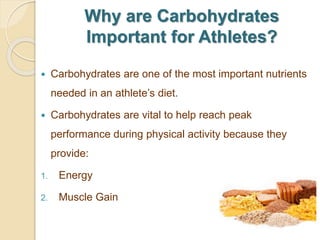
 Carbohydrates are one of the most important nutrients
needed in an athlete’s diet.
 Carbohydrates are vital to help reach peak
performance during physical activity because they
provide:
1. Energy
2. Muscle Gain
Muscle Gain
 Without an adequate amount of stored glucose
in the body, other nutrients, such as fat or muscle
protein, are utilized to make energy.
 With the correct amount of carbohydrates available
to muscles, protein can be free to do its main job of
repairing and rebuilding muscle tissue, which
maximizes muscle gain.
Protein
 The Recommended Dietary Allowance (RDA) for
protein, 0.8 g/kg of body weight per day, is designed to
maintain nitrogen balance in the body for the average
adult; a negative nitrogen balance indicates that
muscle is being broken down and used for energy.
 While maintaining nitrogen balance is critical for
health, studies now suggest that the RDA may not be
the amount of protein needed to promote optimal
health.
 To achieve that, they say, more protein is needed, and
studies now suggest that athletes, active people, and
older individuals require even more.
 A study recently published in the Journal of Nutrition
found that muscle protein synthesis was 25% higher
when protein was distributed across the three meals
compared to when most protein was consumed at one
meal, even when total protein intake was the same.
 A number of well-controlled studies are now published
in which “higher” protein diets have been shown to be
effective in promoting weight reduction, particularly fat
loss.
 Of relevance to athletes and those in clinical practice
is the fact that higher protein diets have quite
consistently been shown to result in greater weight
loss, greater fat loss, and preservation of lean mass as
compared with “lower” protein diets.
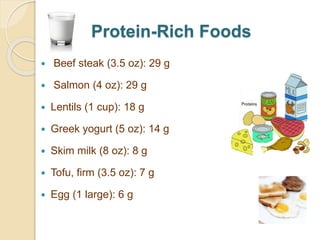
Protein-Rich Foods
 Beef steak (3.5 oz): 29 g
 Salmon (4 oz): 29 g
 Lentils (1 cup): 18 g
 Greek yogurt (5 oz): 14 g
 Skim milk (8 oz): 8 g
 Tofu, firm (3.5 oz): 7 g
 Egg (1 large): 6 g
Protein Specific Guidelines
 Develop a meal plan that will supply adequate calories,
carbohydrate, and protein each day.
 Distribute the protein equally across meals.
 Emphasize high-quality protein.
 Base protein intake on weight, not on percentage of
calories.
 Base protein intake on the individual’s sport and
intensity level.
Fat
 Adequate intake of fat is necessary for numerous
metabolic activities that promote optimal health. For
example, vitamins A, D, and E require fat for proper
absorption. Fat intake for an athlete should range
between 20-35% of total daily calories.
 Current dietary guidelines recommend that 10% of fat
intake should come from monounsaturated sources,
10% from polyunsaturated sources, and no more than
10% from saturated fat.
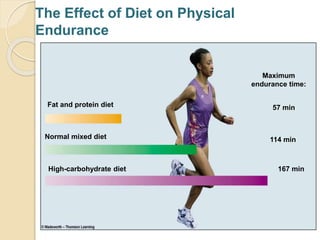
The Effect of Diet on Physical
Endurance
Maximum
endurance time:
57 min
167 min
114 minNormal mixed diet
Fat and protein diet
High-carbohydrate diet
Micronutrients
 Micronutrients function in a variety of roles that optimize
health. They are involved in energy production, blood
synthesis, maintenance of bone health, and immune
function.
 They also aid in the process of muscle and tissue repair
during recovery from exercise or injury.
 Vegetarian athletes may be at risk for low intakes of
iron, calcium, vitamin D, riboflavin, zinc and vitamin
B12.
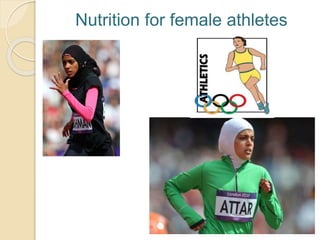
Nutrition for female athletes
 Inadequate nutritional intake is more common in
female athletes than in their male counterparts. Proper
diet is vital for active individuals to maintain adequate
energy during physical activity and for postactivity
recovery.
 Female athletes, particularly endurance athletes, are
less likely to achieve the previous carbohydrate intake
guidelines. This is due to chronic or periodic restriction
of total energy intake in order to achieve or maintain
low levels of body fat.
 Female athletes who participate in sports that
encourage leanness such as gymnastics, distance
running, diving, and classical ballet, have inadequate
nutritional intake.[5, 6]
 Koutedakis and Jamurtas found that female dancers
consume less than 70% of recommended daily energy
needs.[7, 8]
 Female athletes are at increased risk for iron, calcium,
vitamin B, and zinc deficiencies. These nutrients are
vital for building bone and muscle and for energy
production. Vegetarians are particularly at risk for
Some commonly used
supplements & the scientific
basis behind it.
References
1.Burke, L.M., Energy needs of athletes. Can J Appl Physiol, 2001. 26 Suppl: p. S202-19.
2.Burke, L.M., et al., Guidelines for daily carbohydrate intake: do athletes achieve them? Sports
Med, 2001. 31(4): p. 267-99.
3.Phillips, S.M. and L.J. Van Loon, Dietary protein for athletes: from requirements to optimum
adaptation. J Sports Sci, 2011. 29 Suppl 1: p. S29-38.
4.Mamerow MM, Mettler JA, English KL, et al. Dietary protein distribution positively influences 24-
h muscle protein synthesis in healthy adults. J Nutr. doi: 10.3945/jn.113.185280.
5.Montero A, López-Varela S, Nova E, Marcos A. The implication of the binomial nutrition-
immunity on sportswomen's health. Eur J Clin Nutr. 2002 Aug. 56 suppl 3:S38-41. [Medline]. [Full
Text].
6.da Costa NF, Schtscherbyna A, Soares EA, Ribeiro BG. Disordered eating among adolescent
female swimmers: dietary, biochemical, and body composition factors. Nutrition. 2013 Jan.
29(1):172-7. [Medline].
7. Koutedakis Y, Jamurtas A. The dancer as a performing athlete: physiological considerations.
Sports Med. 2004. 34(10):651-61. [Medline].
8.Doyle-Lucas AF, Davy BM. Development and evaluation of an educational intervention program
for pre-professional adolescent ballet dancers: nutrition for optimal performance. J Dance Med
Sci. 2011. 15(2):65-75. [Medline].
9.Gabel KA. Special nutritional concerns for the female athlete. Curr Sports Med Rep. 2006 Jun.
5(4):187-91. [Medline].

Athletes nutrition

  • 1.
    Athletes Nutrition Presenter: RinadAli Course name: Clinical Nutrition Course Code: 702
  • 2.
    Objectives:  Outline thedietary requirements of athletes and compare to normal requirement.  Outline some commonly used supplements and the scientific basis behind it.  Present an argument for or against the use of supplements
  • 3.
    Outline the dietaryrequirements of athletes and compare to normal requirement.  Dietary requirement for normal adults  Dietary requirement for athletics  Energy  Macronutrients  Micronutrients  Nutrition for female athletes
  • 4.
    Dietary requirement fornormal adults Nutrient Quantity Per Day Energy 2000Kcalorie Protein 50 grams Fat 70 grams Saturated Fatty Acids 24 grams Carbohydrates 310 grams Sugars 90 grams Dietary Fiber 30 grams Sodium (salt) 2.3 grams
  • 5.
    Energy  Each athletehas unique energy requirements, which support their ability to meet total nutritional goals.  For everyday dietary planning and evaluation, energy requirements can be predicted via estimations of RMR and activity levels. Research methods such as indirect calorimetry and DLW allow energy requirements to be measured, and may be useful to confirm situations in which an athlete has a true energy balance abnormality.
  • 6.
     Many athletesare over-focused on reducing body mass and body fat below levels that are consistent with long-term health and performance.  Restrained eating can cause significant detrimental outcomes to body function.  Leptin may be involved in modulating or mediating some of these changes.
  • 7.
  • 8.
    Carbohydrate  Official dietaryguidelines for athletes are agreed in their recommendation of high carbohydrate.  carbohydrate intake ranges of 5 to 7 g/kg/day for general training needs and 7 to 10 g/kg/day for the increased needs of endurance athletes.
  • 9.
    Why are Carbohydrates Importantfor Athletes?  Carbohydrates are one of the most important nutrients needed in an athlete’s diet.  Carbohydrates are vital to help reach peak performance during physical activity because they provide: 1. Energy 2. Muscle Gain
  • 10.
    Muscle Gain  Withoutan adequate amount of stored glucose in the body, other nutrients, such as fat or muscle protein, are utilized to make energy.  With the correct amount of carbohydrates available to muscles, protein can be free to do its main job of repairing and rebuilding muscle tissue, which maximizes muscle gain.
  • 11.
    Protein  The RecommendedDietary Allowance (RDA) for protein, 0.8 g/kg of body weight per day, is designed to maintain nitrogen balance in the body for the average adult; a negative nitrogen balance indicates that muscle is being broken down and used for energy.  While maintaining nitrogen balance is critical for health, studies now suggest that the RDA may not be the amount of protein needed to promote optimal health.
  • 12.
     To achievethat, they say, more protein is needed, and studies now suggest that athletes, active people, and older individuals require even more.  A study recently published in the Journal of Nutrition found that muscle protein synthesis was 25% higher when protein was distributed across the three meals compared to when most protein was consumed at one meal, even when total protein intake was the same.
  • 13.
     A numberof well-controlled studies are now published in which “higher” protein diets have been shown to be effective in promoting weight reduction, particularly fat loss.  Of relevance to athletes and those in clinical practice is the fact that higher protein diets have quite consistently been shown to result in greater weight loss, greater fat loss, and preservation of lean mass as compared with “lower” protein diets.
  • 14.
    Protein-Rich Foods  Beefsteak (3.5 oz): 29 g  Salmon (4 oz): 29 g  Lentils (1 cup): 18 g  Greek yogurt (5 oz): 14 g  Skim milk (8 oz): 8 g  Tofu, firm (3.5 oz): 7 g  Egg (1 large): 6 g
  • 15.
    Protein Specific Guidelines Develop a meal plan that will supply adequate calories, carbohydrate, and protein each day.  Distribute the protein equally across meals.  Emphasize high-quality protein.  Base protein intake on weight, not on percentage of calories.  Base protein intake on the individual’s sport and intensity level.
  • 16.
    Fat  Adequate intakeof fat is necessary for numerous metabolic activities that promote optimal health. For example, vitamins A, D, and E require fat for proper absorption. Fat intake for an athlete should range between 20-35% of total daily calories.  Current dietary guidelines recommend that 10% of fat intake should come from monounsaturated sources, 10% from polyunsaturated sources, and no more than 10% from saturated fat.
  • 17.
    The Effect ofDiet on Physical Endurance Maximum endurance time: 57 min 167 min 114 minNormal mixed diet Fat and protein diet High-carbohydrate diet
  • 18.
    Micronutrients  Micronutrients functionin a variety of roles that optimize health. They are involved in energy production, blood synthesis, maintenance of bone health, and immune function.  They also aid in the process of muscle and tissue repair during recovery from exercise or injury.  Vegetarian athletes may be at risk for low intakes of iron, calcium, vitamin D, riboflavin, zinc and vitamin B12.
  • 19.
  • 20.
     Inadequate nutritionalintake is more common in female athletes than in their male counterparts. Proper diet is vital for active individuals to maintain adequate energy during physical activity and for postactivity recovery.  Female athletes, particularly endurance athletes, are less likely to achieve the previous carbohydrate intake guidelines. This is due to chronic or periodic restriction of total energy intake in order to achieve or maintain low levels of body fat.
  • 21.
     Female athleteswho participate in sports that encourage leanness such as gymnastics, distance running, diving, and classical ballet, have inadequate nutritional intake.[5, 6]  Koutedakis and Jamurtas found that female dancers consume less than 70% of recommended daily energy needs.[7, 8]  Female athletes are at increased risk for iron, calcium, vitamin B, and zinc deficiencies. These nutrients are vital for building bone and muscle and for energy production. Vegetarians are particularly at risk for
  • 22.
    Some commonly used supplements& the scientific basis behind it.
  • 23.
    References 1.Burke, L.M., Energyneeds of athletes. Can J Appl Physiol, 2001. 26 Suppl: p. S202-19. 2.Burke, L.M., et al., Guidelines for daily carbohydrate intake: do athletes achieve them? Sports Med, 2001. 31(4): p. 267-99. 3.Phillips, S.M. and L.J. Van Loon, Dietary protein for athletes: from requirements to optimum adaptation. J Sports Sci, 2011. 29 Suppl 1: p. S29-38. 4.Mamerow MM, Mettler JA, English KL, et al. Dietary protein distribution positively influences 24- h muscle protein synthesis in healthy adults. J Nutr. doi: 10.3945/jn.113.185280. 5.Montero A, López-Varela S, Nova E, Marcos A. The implication of the binomial nutrition- immunity on sportswomen's health. Eur J Clin Nutr. 2002 Aug. 56 suppl 3:S38-41. [Medline]. [Full Text]. 6.da Costa NF, Schtscherbyna A, Soares EA, Ribeiro BG. Disordered eating among adolescent female swimmers: dietary, biochemical, and body composition factors. Nutrition. 2013 Jan. 29(1):172-7. [Medline]. 7. Koutedakis Y, Jamurtas A. The dancer as a performing athlete: physiological considerations. Sports Med. 2004. 34(10):651-61. [Medline]. 8.Doyle-Lucas AF, Davy BM. Development and evaluation of an educational intervention program for pre-professional adolescent ballet dancers: nutrition for optimal performance. J Dance Med Sci. 2011. 15(2):65-75. [Medline]. 9.Gabel KA. Special nutritional concerns for the female athlete. Curr Sports Med Rep. 2006 Jun. 5(4):187-91. [Medline].