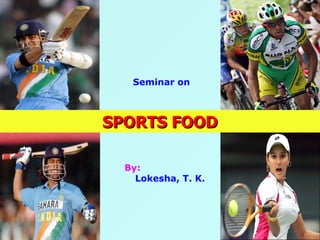
SPORTS FOOD Seminar on By: Lokesha, T. K.
Contents Introduction Intensity and sources of energy Recommended dietary allowances Basic requirements of sports food Classification of sports food Sports drinks Energy drinks Milk and milk products in sports food conclusion
FOOD Food is a material usually of plant or animal origin, that consists of essential body nutrients, that supplies energy to mind and body to perform various functions in the body SPORTS Any physical activity or game under certain rule ATHLETE  Generic term used for sportsmen and sportswomen SPORTS FOOD Food which covers special nutritional requirements of sports person or athlete (www.tax.ohio.gov) INTRODUCTION
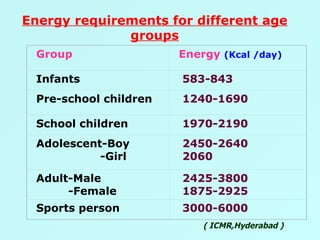
Energy requirements for different age groups ( ICMR,Hyderabad ) Group Energy  (Kcal /day) Infants 583-843 Pre-school children 1240-1690 School children 1970-2190 Adolescent-Boy -Girl   2450-2640 2060 Adult-Male -Female   2425-3800 1875-2925 Sports person 3000-6000
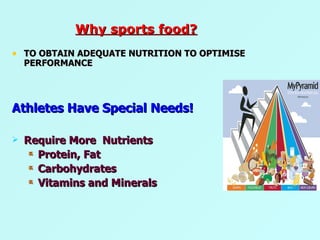
TO OBTAIN ADEQUATE NUTRITION TO OPTIMISE PERFORMANCE Athletes Have Special Needs! Require More  Nutrients Protein, Fat Carbohydrates Vitamins and Minerals Why sports food?
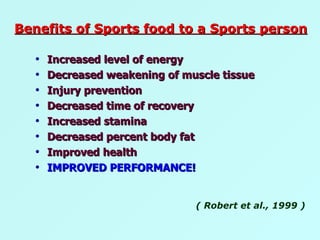
Increased level of energy Decreased weakening of muscle tissue Injury prevention Decreased time of recovery Increased stamina Decreased percent body fat Improved health  IMPROVED PERFORMANCE! ( Robert et al., 1999 )   Benefits of Sports food to a Sports person
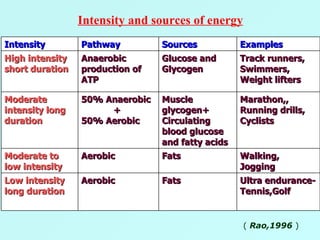
Intensity and sources of energy (  Rao,1996  ) Intensity Pathway Sources Examples High intensity short duration Anaerobic production of ATP Glucose and Glycogen Track runners, Swimmers, Weight lifters Moderate intensity long duration 50% Anaerobic +  50% Aerobic Muscle glycogen+ Circulating blood glucose and fatty acids Marathon,, Running drills, Cyclists Moderate to low intensity Aerobic Fats Walking, Jogging Low intensity long duration Aerobic Fats Ultra endurance- Tennis,Golf
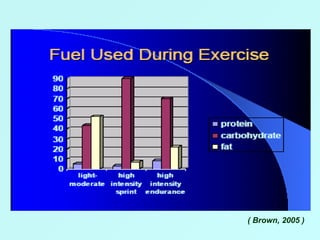
( Brown, 2005 )
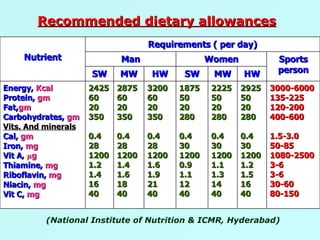
Recommended dietary allowances (National Institute of Nutrition & ICMR, Hyderabad) Nutrient Requirements ( per day) Man Women Sports person SW MW HW SW MW HW Energy,  Kcal Protein,  gm Fat, gm Carbohydrates,  gm Vits. And minerals Cal,  gm Iron,  mg Vit A ,   µ g Thiamine,  mg Riboflavin,  mg Niacin,  mg Vit C,  mg 2425 60 20 350 0.4 28 1200 1.2 1.4 16 40 2875 60 20 350 0.4 28 1200 1.4 1.6 18 40 3200 60 20 350 0.4 28 1200 1.6 1.9 21 40 1875 50 20 280 0.4 30 1200 0.9 1.1 12 40 2225 50 20 280 0.4 30 1200 1.1 1.3 14 40 2925 50 20 280 0.4 30 1200 1.2 1.5 16 40 3000-6000 135-225 120-200 400-600 1.5-3.0 50-85 1080-2500 3-6 3-6 30-60 80-150
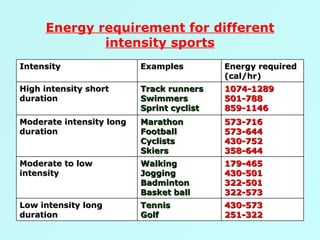
Energy requirement for different intensity sports Intensity Examples Energy required (cal/hr) High intensity short duration Track runners Swimmers Sprint cyclist 1074-1289 501-788 859-1146 Moderate intensity long duration Marathon Football Cyclists Skiers 573-716 573-644 430-752 358-644 Moderate to low intensity Walking  Jogging Badminton Basket ball 179-465 430-501 322-501 322-573 Low intensity long duration Tennis Golf 430-573 251-322
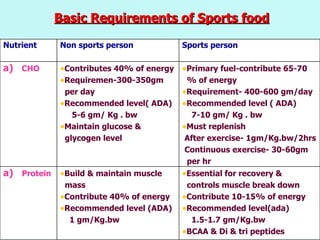
Basic Requirements of Sports food Nutrient Non sports person Sports person CHO Contributes 40% of energy Requiremen-300-350gm per day Recommended level( ADA) 5-6 gm/ Kg . bw Maintain glucose & glycogen level Primary fuel-contribute 65-70 % of energy Requirement- 400-600 gm/day Recommended level ( ADA) 7-10 gm/ Kg . bw Must replenish After exercise- 1gm/Kg.bw/2hrs Continuous exercise- 30-60gm per hr Protein Build & maintain muscle mass Contribute 40% of energy Recommended level (ADA) 1 gm/Kg.bw Essential for recovery &  controls muscle break down Contribute 10-15% of energy Recommended level(ada) 1.5-1.7 gm/Kg.bw BCAA & Di & tri peptides
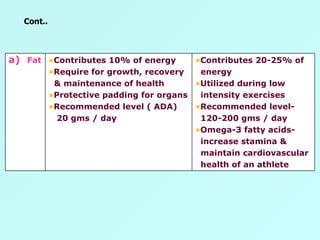
Cont.. Fat Contributes 10% of energy Require for growth, recovery & maintenance of health Protective padding for organs Recommended level ( ADA) 20 gms / day Contributes 20-25% of energy Utilized during low intensity exercises Recommended level- 120-200 gms / day Omega-3 fatty acids- increase stamina &  maintain cardiovascular  health of an athlete
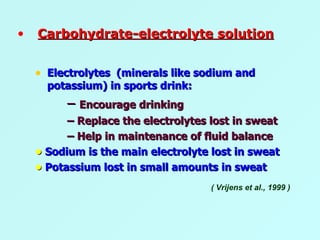
Electrolytes  (minerals like sodium and potassium) in sports drink: –  Encourage drinking –  Replace the electrolytes lost in sweat –  Help in maintenance of fluid balance •  Sodium is the main electrolyte lost in sweat •  Potassium lost in small amounts in sweat ( Vrijens et al., 1999 ) Carbohydrate-electrolyte solution
Essential nutrients Minerals Vitamins Essential fatty acids Other food components Caffeine Creatine Antioxidant (Vit. E & C &   -Carotene): FFA (Oleic, Capric & Caprylic)  Supplements
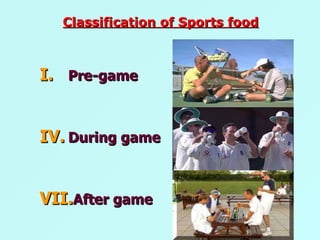
Pre-game During game After game Classification of Sports food
To ensure adequate energy for the body during workouts and to avoid stomach upset  •   Carbohydrates are the best choice •   Eat a small meal or snack 2 hrs before exercise •   Avoid very high fat foods, Sugars and sweets  •   Drink plenty of liquids for pre-exercise hydration  ( McKinley health centre, 2002 ) Pre-game Sports food
Plan properly to access your race-day nutrition Consider weather conditions  Start drinking right away and keep drinking every 15-20  min Carbohydrate-electrolyte solutions are best Why drinking fluids so important? ( McKinley health centre, 2002 ) During game Sports food
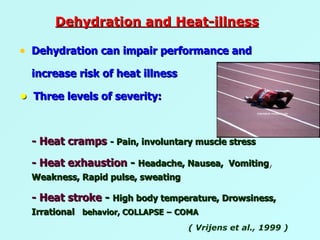
Dehydration can impair performance and increase risk of heat illness •   Three levels of severity: - Heat cramps   - Pain, involuntary muscle stress - Heat exhaustion   -  Headache, Nausea,  Vomiting ,  Weakness, Rapid pulse, sweating - Heat stroke   -  High body temperature, Drowsiness,  Irrational  behavior, COLLAPSE  –  COMA ( Vrijens et al., 1999 ) Dehydration and Heat-illness
Start the muscle recovery process with a combination  of  – CHO- and protein Eat -CHO- rich foods/fluids within 1 to 2 hrs after hard exercise to replenish glycogen stores Try full strength juices as it contain more  – CHO-, potassium  Eat at least 50-100 g of  – CHO- within 2 hrs of a hard workout Drink plenty of fluids!  ( McKinley health centre, 2002 ) After game Sports food
Before Sports -  Drinking 1 to 2 cups of cool water 1 to 2 hrs before  starting sport -  Drinking 1 to 1½ cups of cool water 10 to 15 min  before sport During Sports -  Drinking 1 to 2 cups of sports drink every 20 min more you sweat - more fluid you need to drink After Sports -  Within 2 hrs, drinking 3 cups of cool sports drink for  every pound of body weight lost during exercise “ Drink on a schedule; don’t  wait until thirsty”  ( Wenger et al., 2001 ) When & What To Drink?
Sports drinks are specially formulated  “ -CHO  – electrolyte drinks ”  which are designed to: Boost the performance Deliver nutrients to yield quick energy Also supply fluid It is recommended for activities lasting longer for one hour ( Kim, 2004 ) Sports Drinks
Isotonic sports drink - Similar no. of dissolved particles      per unit vol. as blood plasma Hypotonic sports drink - Quickly replace fluid, no -CHO - For gymnasts Hypertonic sports drink - High level of -CHO - After game or long events ( Kim, 2004 ) Types of sports drinks
Continuous aerobic activity (>30 min) High intensity activity (>45 min) Intermittent activity (>60 min) After exercise to promote recovery Those who do not like water For use in hot weather ( Davis et al., 1999 ) When are sports drinks useful?
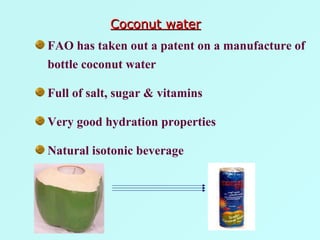
FAO has taken out a patent on a manufacture of bottle coconut water Full of salt, sugar & vitamins Very good hydration properties Natural isotonic beverage Coconut water
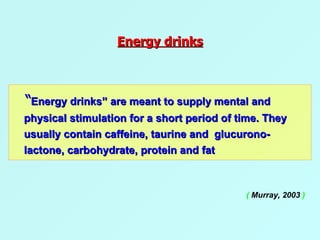
Energy drinks “ Energy drinks” are meant to supply mental and physical stimulation for a short period of time. They usually contain caffeine, taurine and  glucurono-lactone, carbohydrate, protein and fat (  Murray, 2003  )
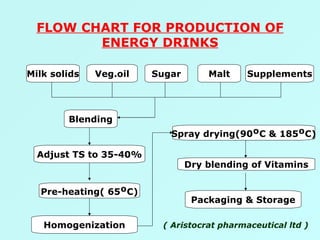
FLOW CHART FOR PRODUCTION OF ENERGY DRINKS Milk solids Veg.oil Sugar Supplements Blending Adjust TS to 35-40% Pre-heating( 65 º C) Homogenization Spray drying(90 º C & 185 º C) Dry blending of Vitamins Packaging & Storage Malt ( Aristocrat pharmaceutical ltd )
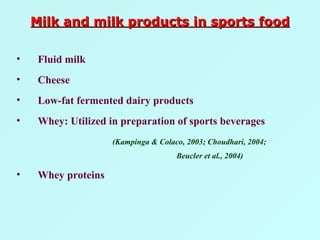
Fluid milk Cheese Low-fat fermented dairy products Whey: Utilized in preparation of sports beverages   (Kampinga & Colaco, 2003; Choudhari, 2004;  Beucler et al., 2004) Whey proteins Milk and milk products in sports food
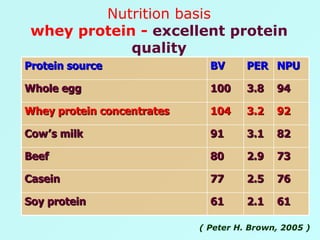
Nutrition basis whey protein -   excellent protein quality ( Peter H. Brown, 2005 ) Protein source BV PER NPU Whole egg 100 3.8 94 Whey protein concentrates 104 3.2 92 Cow ’ s milk 91 3.1 82 Beef  80 2.9 73 Casein 77 2.5 76 Soy protein 61 2.1 61
Essential amino acids profile of key proteins  (mg/g protein) ( Peter H. Brown, 2005 ) Basic nutrition Amino acids WPC 80 Soy Egg Wheat Leu 105 85 86 68 Lys 93 63 70 27 Phy 32 97 93 78 Met 21 24 57 39 Ile 63 47 54 33 Val 68 49 66 43 Thr 69 38 47 29 Trp 18 11 17 11 His 17 - 22 -
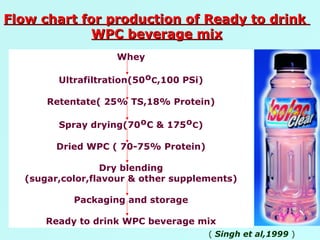
Whey Ultrafiltration(50 º C ,100 PSi) Retentate( 25% TS,18% Protein) Spray drying(70 º C & 175 º C ) Dried WPC ( 70-75% Protein) Dry blending (sugar,color,flavour & other supplements) Packaging and storage Ready to drink WPC beverage mix Flow chart for production of Ready to drink  WPC beverage mix (  Singh et al,1999  )
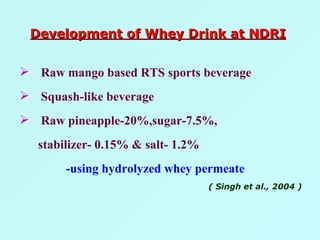
Raw mango based RTS sports beverage Squash-like beverage Raw pineapple-20%,sugar-7.5%, stabilizer- 0.15% & salt- 1.2% -using hydrolyzed whey permeate ( Singh et al., 2004 ) Development of Whey Drink at NDRI
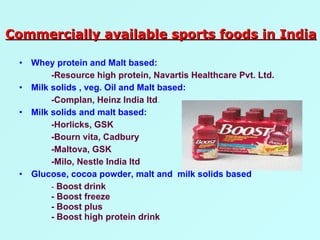
Whey protein and Malt based: -Resource high protein, Navartis Healthcare Pvt. Ltd. Milk solids , veg. Oil and Malt based: -Complan, Heinz India ltd . Milk solids and malt based: -Horlicks, GSK -Bourn vita, Cadbury -Maltova, GSK -Milo, Nestle India ltd Glucose, cocoa powder, malt and  milk solids based -  Boost drink - Boost freeze - Boost plus - Boost high protein drink Commercially available sports foods in India
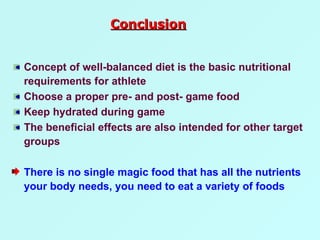
Concept of well-balanced diet is the basic nutritional requirements for athlete Choose a proper pre- and post- game food Keep hydrated during game The beneficial effects are also intended for other target groups  There is no single magic food that has all the nutrients your body needs, you need to eat a variety of foods Conclusion
THANK YOU

Sports Food

  • 1.
    SPORTS FOOD Seminaron By: Lokesha, T. K.
  • 2.
    Contents Introduction Intensityand sources of energy Recommended dietary allowances Basic requirements of sports food Classification of sports food Sports drinks Energy drinks Milk and milk products in sports food conclusion
  • 3.
    FOOD Food isa material usually of plant or animal origin, that consists of essential body nutrients, that supplies energy to mind and body to perform various functions in the body SPORTS Any physical activity or game under certain rule ATHLETE Generic term used for sportsmen and sportswomen SPORTS FOOD Food which covers special nutritional requirements of sports person or athlete (www.tax.ohio.gov) INTRODUCTION
  • 4.
    Energy requirements fordifferent age groups ( ICMR,Hyderabad ) Group Energy (Kcal /day) Infants 583-843 Pre-school children 1240-1690 School children 1970-2190 Adolescent-Boy -Girl   2450-2640 2060 Adult-Male -Female   2425-3800 1875-2925 Sports person 3000-6000
  • 5.
    TO OBTAIN ADEQUATENUTRITION TO OPTIMISE PERFORMANCE Athletes Have Special Needs! Require More Nutrients Protein, Fat Carbohydrates Vitamins and Minerals Why sports food?
  • 6.
    Increased level ofenergy Decreased weakening of muscle tissue Injury prevention Decreased time of recovery Increased stamina Decreased percent body fat Improved health IMPROVED PERFORMANCE! ( Robert et al., 1999 ) Benefits of Sports food to a Sports person
  • 7.
    Intensity and sourcesof energy ( Rao,1996 ) Intensity Pathway Sources Examples High intensity short duration Anaerobic production of ATP Glucose and Glycogen Track runners, Swimmers, Weight lifters Moderate intensity long duration 50% Anaerobic + 50% Aerobic Muscle glycogen+ Circulating blood glucose and fatty acids Marathon,, Running drills, Cyclists Moderate to low intensity Aerobic Fats Walking, Jogging Low intensity long duration Aerobic Fats Ultra endurance- Tennis,Golf
  • 8.
  • 9.
    Recommended dietary allowances(National Institute of Nutrition & ICMR, Hyderabad) Nutrient Requirements ( per day) Man Women Sports person SW MW HW SW MW HW Energy, Kcal Protein, gm Fat, gm Carbohydrates, gm Vits. And minerals Cal, gm Iron, mg Vit A , µ g Thiamine, mg Riboflavin, mg Niacin, mg Vit C, mg 2425 60 20 350 0.4 28 1200 1.2 1.4 16 40 2875 60 20 350 0.4 28 1200 1.4 1.6 18 40 3200 60 20 350 0.4 28 1200 1.6 1.9 21 40 1875 50 20 280 0.4 30 1200 0.9 1.1 12 40 2225 50 20 280 0.4 30 1200 1.1 1.3 14 40 2925 50 20 280 0.4 30 1200 1.2 1.5 16 40 3000-6000 135-225 120-200 400-600 1.5-3.0 50-85 1080-2500 3-6 3-6 30-60 80-150
  • 10.
    Energy requirement fordifferent intensity sports Intensity Examples Energy required (cal/hr) High intensity short duration Track runners Swimmers Sprint cyclist 1074-1289 501-788 859-1146 Moderate intensity long duration Marathon Football Cyclists Skiers 573-716 573-644 430-752 358-644 Moderate to low intensity Walking Jogging Badminton Basket ball 179-465 430-501 322-501 322-573 Low intensity long duration Tennis Golf 430-573 251-322
  • 11.
    Basic Requirements ofSports food Nutrient Non sports person Sports person CHO Contributes 40% of energy Requiremen-300-350gm per day Recommended level( ADA) 5-6 gm/ Kg . bw Maintain glucose & glycogen level Primary fuel-contribute 65-70 % of energy Requirement- 400-600 gm/day Recommended level ( ADA) 7-10 gm/ Kg . bw Must replenish After exercise- 1gm/Kg.bw/2hrs Continuous exercise- 30-60gm per hr Protein Build & maintain muscle mass Contribute 40% of energy Recommended level (ADA) 1 gm/Kg.bw Essential for recovery & controls muscle break down Contribute 10-15% of energy Recommended level(ada) 1.5-1.7 gm/Kg.bw BCAA & Di & tri peptides
  • 12.
    Cont.. Fat Contributes10% of energy Require for growth, recovery & maintenance of health Protective padding for organs Recommended level ( ADA) 20 gms / day Contributes 20-25% of energy Utilized during low intensity exercises Recommended level- 120-200 gms / day Omega-3 fatty acids- increase stamina & maintain cardiovascular health of an athlete
  • 13.
    Electrolytes (mineralslike sodium and potassium) in sports drink: – Encourage drinking – Replace the electrolytes lost in sweat – Help in maintenance of fluid balance • Sodium is the main electrolyte lost in sweat • Potassium lost in small amounts in sweat ( Vrijens et al., 1999 ) Carbohydrate-electrolyte solution
  • 14.
    Essential nutrients MineralsVitamins Essential fatty acids Other food components Caffeine Creatine Antioxidant (Vit. E & C &  -Carotene): FFA (Oleic, Capric & Caprylic) Supplements
  • 15.
    Pre-game During gameAfter game Classification of Sports food
  • 16.
    To ensure adequateenergy for the body during workouts and to avoid stomach upset • Carbohydrates are the best choice • Eat a small meal or snack 2 hrs before exercise • Avoid very high fat foods, Sugars and sweets • Drink plenty of liquids for pre-exercise hydration ( McKinley health centre, 2002 ) Pre-game Sports food
  • 17.
    Plan properly toaccess your race-day nutrition Consider weather conditions Start drinking right away and keep drinking every 15-20 min Carbohydrate-electrolyte solutions are best Why drinking fluids so important? ( McKinley health centre, 2002 ) During game Sports food
  • 18.
    Dehydration can impairperformance and increase risk of heat illness • Three levels of severity: - Heat cramps - Pain, involuntary muscle stress - Heat exhaustion - Headache, Nausea, Vomiting , Weakness, Rapid pulse, sweating - Heat stroke - High body temperature, Drowsiness, Irrational behavior, COLLAPSE – COMA ( Vrijens et al., 1999 ) Dehydration and Heat-illness
  • 19.
    Start the musclerecovery process with a combination of – CHO- and protein Eat -CHO- rich foods/fluids within 1 to 2 hrs after hard exercise to replenish glycogen stores Try full strength juices as it contain more – CHO-, potassium Eat at least 50-100 g of – CHO- within 2 hrs of a hard workout Drink plenty of fluids! ( McKinley health centre, 2002 ) After game Sports food
  • 20.
    Before Sports - Drinking 1 to 2 cups of cool water 1 to 2 hrs before starting sport - Drinking 1 to 1½ cups of cool water 10 to 15 min before sport During Sports - Drinking 1 to 2 cups of sports drink every 20 min more you sweat - more fluid you need to drink After Sports - Within 2 hrs, drinking 3 cups of cool sports drink for every pound of body weight lost during exercise “ Drink on a schedule; don’t wait until thirsty” ( Wenger et al., 2001 ) When & What To Drink?
  • 21.
    Sports drinks arespecially formulated “ -CHO – electrolyte drinks ” which are designed to: Boost the performance Deliver nutrients to yield quick energy Also supply fluid It is recommended for activities lasting longer for one hour ( Kim, 2004 ) Sports Drinks
  • 22.
    Isotonic sports drink- Similar no. of dissolved particles per unit vol. as blood plasma Hypotonic sports drink - Quickly replace fluid, no -CHO - For gymnasts Hypertonic sports drink - High level of -CHO - After game or long events ( Kim, 2004 ) Types of sports drinks
  • 23.
    Continuous aerobic activity(>30 min) High intensity activity (>45 min) Intermittent activity (>60 min) After exercise to promote recovery Those who do not like water For use in hot weather ( Davis et al., 1999 ) When are sports drinks useful?
  • 24.
    FAO has takenout a patent on a manufacture of bottle coconut water Full of salt, sugar & vitamins Very good hydration properties Natural isotonic beverage Coconut water
  • 25.
    Energy drinks “Energy drinks” are meant to supply mental and physical stimulation for a short period of time. They usually contain caffeine, taurine and glucurono-lactone, carbohydrate, protein and fat ( Murray, 2003 )
  • 26.
    FLOW CHART FORPRODUCTION OF ENERGY DRINKS Milk solids Veg.oil Sugar Supplements Blending Adjust TS to 35-40% Pre-heating( 65 º C) Homogenization Spray drying(90 º C & 185 º C) Dry blending of Vitamins Packaging & Storage Malt ( Aristocrat pharmaceutical ltd )
  • 27.
    Fluid milk CheeseLow-fat fermented dairy products Whey: Utilized in preparation of sports beverages (Kampinga & Colaco, 2003; Choudhari, 2004; Beucler et al., 2004) Whey proteins Milk and milk products in sports food
  • 28.
    Nutrition basis wheyprotein - excellent protein quality ( Peter H. Brown, 2005 ) Protein source BV PER NPU Whole egg 100 3.8 94 Whey protein concentrates 104 3.2 92 Cow ’ s milk 91 3.1 82 Beef 80 2.9 73 Casein 77 2.5 76 Soy protein 61 2.1 61
  • 29.
    Essential amino acidsprofile of key proteins (mg/g protein) ( Peter H. Brown, 2005 ) Basic nutrition Amino acids WPC 80 Soy Egg Wheat Leu 105 85 86 68 Lys 93 63 70 27 Phy 32 97 93 78 Met 21 24 57 39 Ile 63 47 54 33 Val 68 49 66 43 Thr 69 38 47 29 Trp 18 11 17 11 His 17 - 22 -
  • 30.
    Whey Ultrafiltration(50 ºC ,100 PSi) Retentate( 25% TS,18% Protein) Spray drying(70 º C & 175 º C ) Dried WPC ( 70-75% Protein) Dry blending (sugar,color,flavour & other supplements) Packaging and storage Ready to drink WPC beverage mix Flow chart for production of Ready to drink WPC beverage mix ( Singh et al,1999 )
  • 31.
    Raw mango basedRTS sports beverage Squash-like beverage Raw pineapple-20%,sugar-7.5%, stabilizer- 0.15% & salt- 1.2% -using hydrolyzed whey permeate ( Singh et al., 2004 ) Development of Whey Drink at NDRI
  • 32.
    Whey protein andMalt based: -Resource high protein, Navartis Healthcare Pvt. Ltd. Milk solids , veg. Oil and Malt based: -Complan, Heinz India ltd . Milk solids and malt based: -Horlicks, GSK -Bourn vita, Cadbury -Maltova, GSK -Milo, Nestle India ltd Glucose, cocoa powder, malt and milk solids based - Boost drink - Boost freeze - Boost plus - Boost high protein drink Commercially available sports foods in India
  • 33.
    Concept of well-balanceddiet is the basic nutritional requirements for athlete Choose a proper pre- and post- game food Keep hydrated during game The beneficial effects are also intended for other target groups There is no single magic food that has all the nutrients your body needs, you need to eat a variety of foods Conclusion
  • 34.