Protein Exhibition By: Alyssa Walter, Jason Snook, Meredith Zimmer, Ben Moyer
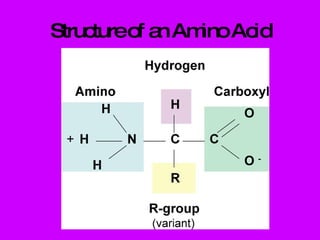
Structure of an Amino Acid
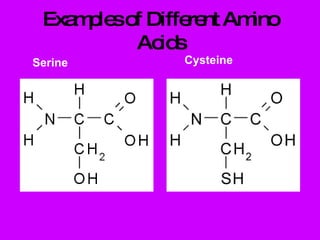
Examples of Different Amino Acids Serine Cysteine
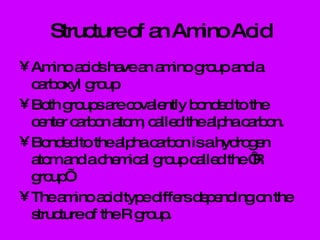
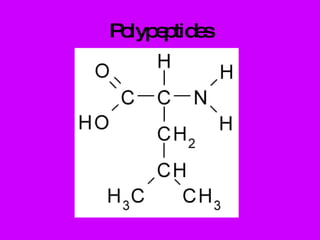
Structure of an Amino Acid Amino acids have an amino group and a carboxyl group Both groups are covalently bonded to the center carbon atom, called the alpha carbon. Bonded to the alpha carbon is a hydrogen atom and a chemical group called the ‘R group’. The amino acid type differs depending on the structure of the R group.
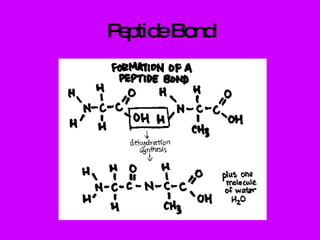
Peptide Bond
Peptide Bond When two amino acids join and go through a condensation reaction. Water molecule removed as carboxyl-group carbon atom bonds to the amino-group nitrogen, of its neighbor. Resulting covalent linkage is called a peptide bond.
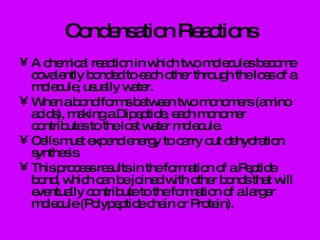
Condensation Reactions A chemical reaction in which two molecules become covalently bonded to each other through the loss of a molecule, usually water. When a bond forms between two monomers (amino acids), making a Dipeptide, each monomer contributes to the lost water molecule. Cells must expend energy to carry out dehydration synthesis. This process results in the formation of a Peptide bond, which can be joined with other bonds that will eventually contribute to the formation of a larger molecule (Polypeptide chain or Protein).
Polypeptides
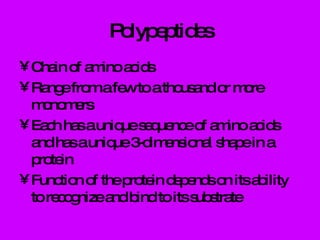
Polypeptides Chain of amino acids Range from a few to a thousand or more monomers Each has a unique sequence of amino acids and has a unique 3-dimensional shape in a protein Function of the protein depends on its ability to recognize and bind to its substrate
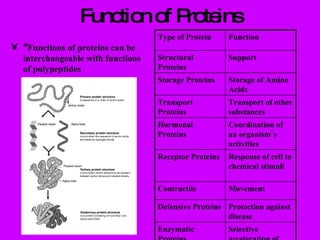
Function of Proteins *Functions of proteins can be interchangeable with functions of polypeptides Type of Protein Function Structural Proteins Support Storage Proteins Storage of Amino Acids Transport Proteins Transport of other substances Hormonal Proteins Coordination of an organism’s activities Receptor Proteins Response of cell to chemical stimuli Contractile Movement Defensive Proteins Protection against disease Enzymatic Proteins Selective acceleration of chemical reactions
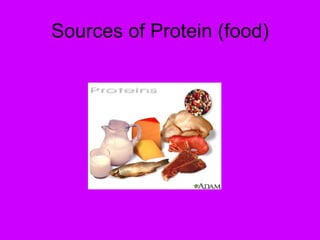
Sources of Protein (food)

Protein Powerpoint

  • 1.
    Protein Exhibition By:Alyssa Walter, Jason Snook, Meredith Zimmer, Ben Moyer
  • 2.
    Structure of anAmino Acid
  • 3.
    Examples of DifferentAmino Acids Serine Cysteine
  • 4.
    Structure of anAmino Acid Amino acids have an amino group and a carboxyl group Both groups are covalently bonded to the center carbon atom, called the alpha carbon. Bonded to the alpha carbon is a hydrogen atom and a chemical group called the ‘R group’. The amino acid type differs depending on the structure of the R group.
  • 5.
  • 6.
    Peptide Bond Whentwo amino acids join and go through a condensation reaction. Water molecule removed as carboxyl-group carbon atom bonds to the amino-group nitrogen, of its neighbor. Resulting covalent linkage is called a peptide bond.
  • 7.
    Condensation Reactions Achemical reaction in which two molecules become covalently bonded to each other through the loss of a molecule, usually water. When a bond forms between two monomers (amino acids), making a Dipeptide, each monomer contributes to the lost water molecule. Cells must expend energy to carry out dehydration synthesis. This process results in the formation of a Peptide bond, which can be joined with other bonds that will eventually contribute to the formation of a larger molecule (Polypeptide chain or Protein).
  • 8.
  • 9.
    Polypeptides Chain ofamino acids Range from a few to a thousand or more monomers Each has a unique sequence of amino acids and has a unique 3-dimensional shape in a protein Function of the protein depends on its ability to recognize and bind to its substrate
  • 10.
    Function of Proteins*Functions of proteins can be interchangeable with functions of polypeptides Type of Protein Function Structural Proteins Support Storage Proteins Storage of Amino Acids Transport Proteins Transport of other substances Hormonal Proteins Coordination of an organism’s activities Receptor Proteins Response of cell to chemical stimuli Contractile Movement Defensive Proteins Protection against disease Enzymatic Proteins Selective acceleration of chemical reactions
  • 11.