Exercise Physiology Step 2:  Sports Dietetics
Ex. Phys. Crash Course Energy Storage Energy metabolism, substrate utilization, and oxygen transport Enzymes and hormones – the good ones and the bad ones! Physiological response to training Fatigue    = practical application
1. Energy Storage
Energy = ability to do work Examples of WORK: exercise, muscle contraction, synthesis, nutrient transport, repair, etc. Splitting ATP bonds   ATP is cellular currency.  Compare it to a bank account with lots of withdrawals (energy expenditure) and deposits (substrates). Generally, about 10 seconds worth of ATP stored in muscle so other energy systems must kick-in very quickly during exercise ENERGY
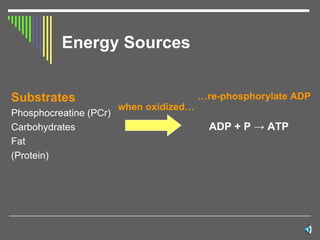
Energy Sources Substrates Phosphocreatine (PCr) Carbohydrates  Fat  (Protein) when oxidized… … re-phosphorylate ADP ADP + P  -> ATP
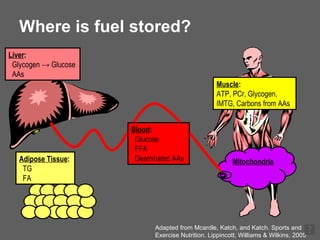
Where is fuel stored? Adapted from Mcardle, Katch, and Katch. Sports and Exercise Nutrition. Lippincott, Williams & Wilkins, 2005 Muscle : ATP, PCr, Glycogen, IMTG, Carbons from AAs Mitochondria Liver : Glycogen  -> Glucose AAs Blood : Glucose FFA Deaminated AAs Adipose Tissue : TG FA
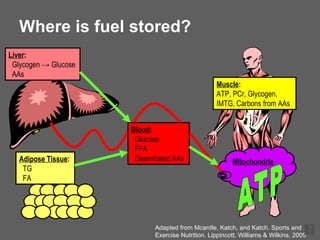
Where is fuel stored? Adapted from Mcardle, Katch, and Katch. Sports and Exercise Nutrition. Lippincott, Williams & Wilkins, 2005 Muscle : ATP, PCr, Glycogen, IMTG, Carbons from AAs Mitochondria Liver : Glycogen  -> Glucose AAs Blood : Glucose FFA Deaminated AAs Adipose Tissue : TG FA ATP
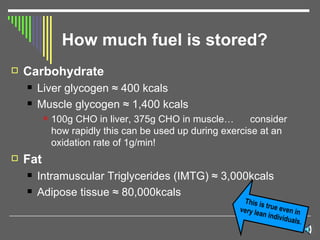
How much fuel is stored? Carbohydrate Liver glycogen  ≈  400 kcals  Muscle glycogen  ≈ 1,400 kcals 100g CHO in liver, 375g CHO in muscle…  consider how rapidly this can be used up during exercise at an oxidation rate of 1g/min! Fat Intramuscular Triglycerides (IMTG)  ≈ 3,000kcals Adipose tissue ≈ 80,000kcals This is true even in very lean individuals.
2. Energy Metabolism,    Substrate Utilization,    & Oxygen Transport
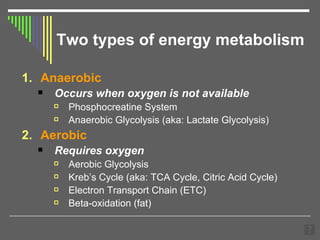
Two types of energy metabolism Anaerobic Occurs when oxygen is not available Phosphocreatine System Anaerobic Glycolysis (aka: Lactate Glycolysis) Aerobic Requires oxygen Aerobic Glycolysis Kreb’s Cycle (aka: TCA Cycle, Citric Acid Cycle) Electron Transport Chain (ETC) Beta-oxidation (fat)
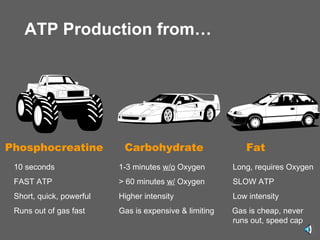
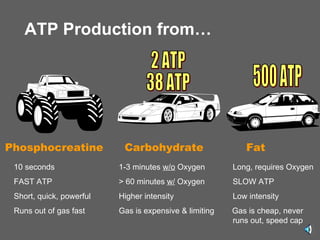
ATP Production from… Phosphocreatine  Carbohydrate  Fat 10 seconds   1-3 minutes  w/o  Oxygen   Long, requires Oxygen FAST ATP   > 60 minutes  w/  Oxygen   SLOW ATP Short, quick, powerful   Higher intensity    Low intensity Runs out of gas fast   Gas is expensive & limiting  Gas is cheap, never    runs out, speed cap
ATP Production from… Phosphocreatine  Carbohydrate  Fat 10 seconds   1-3 minutes  w/o  Oxygen   Long, requires Oxygen FAST ATP   > 60 minutes  w/  Oxygen   SLOW ATP Short, quick, powerful   Higher intensity    Low intensity Runs out of gas fast   Gas is expensive & limiting  Gas is cheap, never    runs out, speed cap 2 ATP 38 ATP 500 ATP
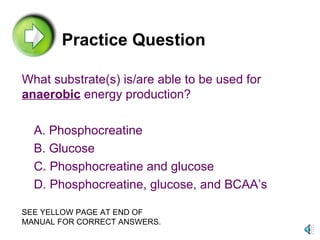
Practice Question What substrate(s) is/are able to be used for anaerobic  energy production? A. Phosphocreatine B. Glucose C. Phosphocreatine and glucose D. Phosphocreatine, glucose, and BCAA’s SEE YELLOW PAGE AT END OF MANUAL FOR CORRECT ANSWERS.
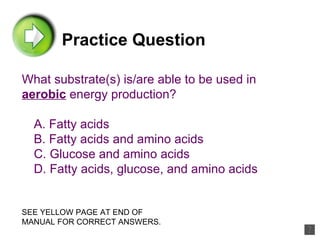
Practice Question What substrate(s) is/are able to be used in  aerobic  energy production? A. Fatty acids B. Fatty acids and amino acids C. Glucose and amino acids D. Fatty acids, glucose, and amino acids  SEE YELLOW PAGE AT END OF MANUAL FOR CORRECT ANSWERS.
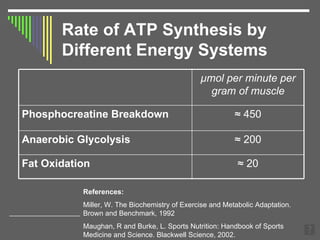
Rate of ATP Synthesis by Different Energy Systems References:   Miller, W. The Biochemistry of Exercise and Metabolic Adaptation. Brown and Benchmark, 1992  Maughan, R and Burke, L. Sports Nutrition: Handbook of Sports Medicine and Science. Blackwell Science, 2002. ≈   20 Fat Oxidation ≈   200 Anaerobic Glycolysis ≈  450 Phosphocreatine Breakdown µmol per minute per gram of muscle
Substrate utilization… …exists on a continuum. Energy systems work simultaneously. All vehicles on the road at the same time (even though one may be leading the way!)
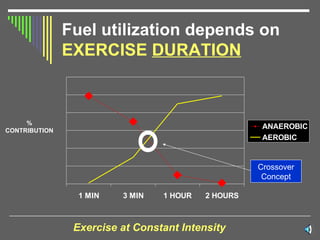
Fuel utilization depends on  EXERCISE  DURATION   Exercise at Constant Intensity % CONTRIBUTION Crossover Concept
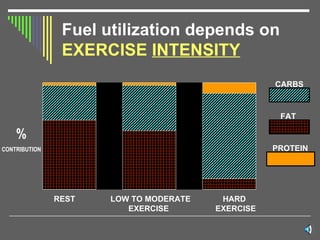
Fuel utilization depends on  EXERCISE  INTENSITY   % CONTRIBUTION REST   LOW TO MODERATE   HARD     EXERCISE   EXERCISE FAT CARBS PROTEIN
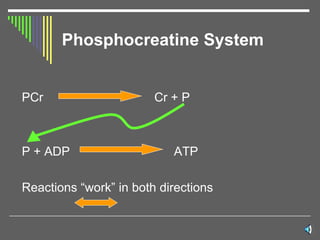
Phosphocreatine System PCr  Cr + P  P + ADP  ATP Reactions “work” in both directions
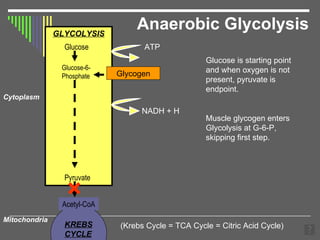
Anaerobic Glycolysis GLYCOLYSIS KREBS  CYCLE Glycogen Cytoplasm Glucose is starting point and when oxygen is not present, pyruvate is endpoint. Muscle glycogen enters Glycolysis at G-6-P, skipping first step. NADH + H Pyruvate Acetyl-CoA Mitochondria (Krebs Cycle = TCA Cycle = Citric Acid Cycle) Glucose Glucose-6-Phosphate ATP ×
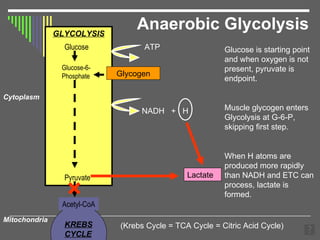
Anaerobic Glycolysis GLYCOLYSIS KREBS  CYCLE Glycogen Cytoplasm Glucose is starting point and when oxygen is not present, pyruvate is endpoint. Muscle glycogen enters Glycolysis at G-6-P, skipping first step. When H atoms are produced more rapidly than NADH and ETC can process, lactate is formed. NADH  +  H Pyruvate Acetyl-CoA Mitochondria (Krebs Cycle = TCA Cycle = Citric Acid Cycle) Glucose Glucose-6-Phosphate ATP × Lactate
Lactate When hydrogen ions are produced too fast to combine with NADH and be oxidized by ETC a back-up of H +  occurs These H +  combine with pyruvate to form  LACTATE Lactate should be considered a BY-PRODUCT rather than a WASTE PRODUCT.  For a period of time, lactate can be recycled through glycolysis to keep producing ATP ( CORI CYCLE ). Remember: glycolysis “works” both ways! This continues until lactate produced in the blood from working muscles  exceeds  lactate clearance from liver ( LACTATE THRESHOLD ).  At Lactate Threshold, H +  builds up and can contribute to fatigue ?
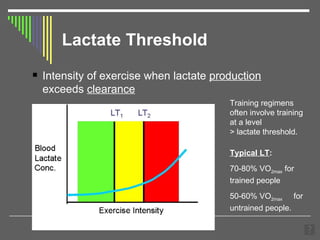
Lactate Threshold Intensity of exercise when lactate  production  exceeds  clearance Training regimens often involve training at a level  > lactate threshold. Typical LT : 70-80% VO 2max  for trained people 50-60% VO 2max   for untrained people.
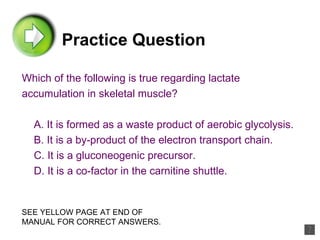
Practice Question Which of the following is true regarding lactate accumulation in skeletal muscle? A. It is formed as a waste product of aerobic glycolysis. B. It is a by-product of the electron transport chain. C. It is a gluconeogenic precursor. D. It is a co-factor in the carnitine shuttle. SEE YELLOW PAGE AT END OF MANUAL FOR CORRECT ANSWERS.
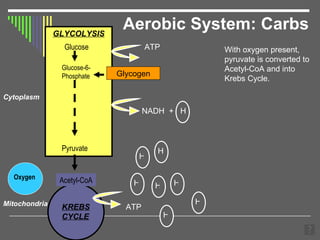
Aerobic System: Carbs GLYCOLYSIS KREBS  CYCLE Glycogen Cytoplasm NADH  +  H Pyruvate Acetyl-CoA Mitochondria Glucose Glucose-6-Phosphate ATP Oxygen H H H H H H H ATP With oxygen present, pyruvate is converted to Acetyl-CoA and into Krebs Cycle.
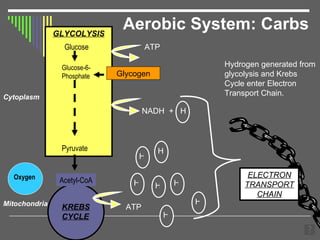
Aerobic System: Carbs GLYCOLYSIS KREBS  CYCLE Glycogen Cytoplasm NADH  +  H Pyruvate Acetyl-CoA Mitochondria Glucose Glucose-6-Phosphate ATP Oxygen H H H H H H H ATP Hydrogen generated from glycolysis and Krebs Cycle enter Electron Transport Chain. ELECTRON TRANSPORT CHAIN
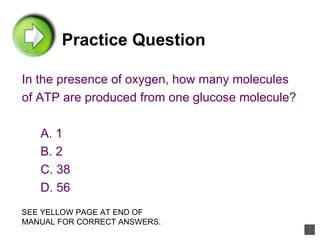
Practice Question In the presence of oxygen, how many molecules  of ATP are produced from one glucose molecule? A. 1 B. 2 C. 38 D. 56 SEE YELLOW PAGE AT END OF MANUAL FOR CORRECT ANSWERS.
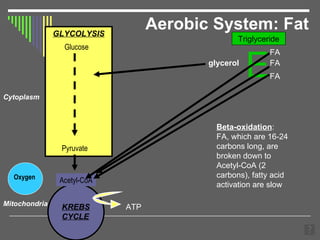
Aerobic System: Fat GLYCOLYSIS KREBS  CYCLE Cytoplasm Pyruvate Acetyl-CoA Mitochondria Glucose Oxygen ATP E FA FA FA glycerol Triglyceride Beta-oxidation :  FA, which are 16-24 carbons long, are broken down to Acetyl-CoA (2 carbons), fatty acid activation are slow
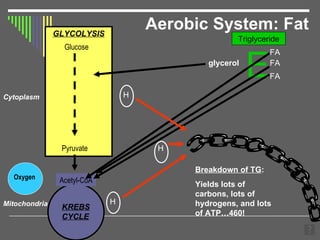
Aerobic System: Fat GLYCOLYSIS KREBS  CYCLE Cytoplasm Pyruvate Acetyl-CoA Mitochondria Glucose Oxygen E FA FA FA glycerol Triglyceride Breakdown of TG : Yields lots of carbons, lots of hydrogens, and lots of ATP…460! H H H
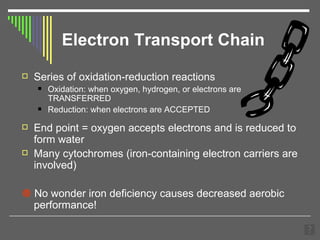
Electron Transport Chain Series of oxidation-reduction reactions Oxidation: when oxygen, hydrogen, or electrons are TRANSFERRED  Reduction: when electrons are ACCEPTED End point = oxygen accepts electrons and is reduced to form water Many cytochromes (iron-containing electron carriers are involved)    No wonder iron deficiency causes decreased aerobic performance!
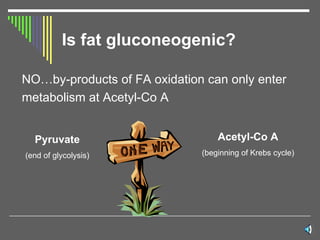
Is fat gluconeogenic? NO…by-products of FA oxidation can only enter  metabolism at Acetyl-Co A Pyruvate (end of glycolysis) Acetyl-Co A (beginning of Krebs cycle)
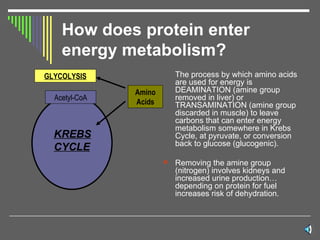
How does protein enter energy metabolism? The process by which amino acids are used for energy is DEAMINATION (amine group removed in liver) or TRANSAMINATION (amine group discarded in muscle) to leave carbons that can enter energy metabolism somewhere in Krebs Cycle, at pyruvate, or conversion back to glucose (glucogenic).  Removing the amine group (nitrogen) involves kidneys and increased urine production…depending on protein for fuel increases risk of dehydration. KREBS  CYCLE GLYCOLYSIS Acetyl-CoA Amino Acids
Notes on Carbohydrate Use At the beginning of exercise, carbs are used at a high rate since fat can’t keep up with early ATP production. Carbs are very valuable…they make ATP fast and facilitate higher intensity exercise Later in exercise, carbs are needed (at pyruvate) to foster fat movement through Krebs Cycle which is why carbs are called the “rate limiting” fuel. In moderate endurance exercise, performance directly correlates with initial muscle glycogen concentration.  Glycogen depleted subjects cycled 57 min at 70% VO 2max Glycogen loaded subjects cycled 114 min at 70% VO 2max   Classic study by Bergstrom et al Acta Physiol Scand 1967.     Many athletes train hard all week long, aren’t eating enough carbs in general or during recovery, and then compete on the weekends.  Major education point!
Notes on Carbohydrate Use Why does carb loading work to enhance performance?  Utilize less fat (means higher intensity is possible) Utilize almost no protein (unless exercise is very long) NOTE: ADA/ ACSM Position Statement on Nutrition for Athletic Performance states that carb loading is effective for exercise LONGER than 90 minutes. Consider that glycogen depletion has now been shown to affect even high intensity, shorter exercise    In sports who don’t typically consider “carb loading”, there may be decreased physical performance, increased risk of injury, poor concentration, and decreased coordination when glycogen stores are too low.
Notes on Carbohydrate Use The amount of carbs used during exercise varies based on: Diet Liver and muscle glycogen stores (i.e.: fasting in am = low liver glycogen = less glucose/more fat used) Body and environmental temperature Carbs consumed during exercise Why take in carbs during exercise? Keeps blood sugar high and favors carbohydrate use (faster ATP production) Blunts FA oxidation
Notes on Fat Use Fat contributes 30-80% of energy for exercise depending on: exercise intensity  duration of exercise fitness level Intramuscular TG contribute 15-35% of energy for exercise Fat becomes more important when exercise is long or carbohydrate stores run low. As blood flow increases w/ exercise, adipose tissue releases more FFA (but there is a lag time) As exercise intensity increases, FFA energy production from adipose stays about the same while IMTG and glycogen breakdown increase
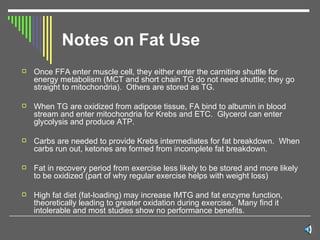
Notes on Fat Use Once FFA enter muscle cell, they either enter the carnitine shuttle for energy metabolism (MCT and short chain TG do not need shuttle; they go straight to mitochondria).  Others are stored as TG. When TG are oxidized from adipose tissue, FA bind to albumin in blood stream and enter mitochondria for Krebs and ETC.  Glycerol can enter glycolysis and produce ATP. Carbs are needed to provide Krebs intermediates for fat breakdown.  When carbs run out, ketones are formed from incomplete fat breakdown.  Fat in recovery period from exercise less likely to be stored and more likely to be oxidized (part of why regular exercise helps with weight loss) High fat diet (fat-loading) may increase IMTG and fat enzyme function, theoretically leading to greater oxidation during exercise.  Many find it intolerable and most studies show no performance benefits.
 Keep client’s goals in mind Exercising for fat-burning is different than exercising for optimal performance. Optimal intensity for fat burning is 55 to 72% VO 2 max but training/performance may be optimized at higher level Burn more fat in fasted state Ability to burn more carbs in fed state help exercisers think of total calories expended
Practice Question Which of the following is not a BCAA? A. Lysine B. Leucine C. Valine D. Isoleucine SEE YELLOW PAGE AT END OF MANUAL FOR CORRECT ANSWERS.
Notes on protein use Depending on novelty of exercise, protein breakdown increases modestly with exercise but protein synthesis increases significantly with BOTH endurance and resistance exercise Some discrepancy over amount of protein that is used for fuel. Generally 2-6% of energy production. Greater use in ultra-endurance. BCAA (leucine, isoleucine, and valine) are oxidized by skeletal muscle rather than liver. Aspartate, glutamine, alanine, asparagine, and lysine can be oxidized in muscle also (with preference given to BCAA). Use more protein for fuel in a glycogen-depleted state or if in chronic negative energy balance Dieters or restrictive eaters may be at risk of lean tissue loss!
Amino Acids ESSENTIAL  (not produced endogenously)  Isoleucine Leucine Lysine Methionine Phenylalanine Threonine  Tryptophan Valine NON-ESSENTIAL   (produced endogenously) Alanine Arginine Asparagine Aspartate Cysteine Glutamate Glutamine Glycine Histidine Proline Serine Tyrosine Some may become essential in certain scenarios…
Bottom line Substrate and energy system used depends on: Exercise intensity Exercise duration Substrate availability Training status Don’t run out of carbs!
Gender differences For females: Carb loading is less effective. They use a lower proportion of carbs and higher proportion of fat than males in similar intensity exercise. With training, there is a shift toward using more fat  (so, greater glycogen-sparing effect) Why? Not fully understood, but possibly: Differences in catecholamine response Estrogen/progesterone may enhance lipolysis and limit glycolysis
Muscle Fiber Types 2 primary types TYPE I: Slow-twitch Contract slowly; primarily aerobic pathways Dense in mitochondria and capillaries (oxygen) Fatigue slowly TYPE II: Fast-twitch Fast contractions Type IIa: both aerobic and anaerobic pathways Type IIb: anaerobic pathways Fatigue quickly Proportion of each type depends on genetics, exercise training, other factors?
Other oxygen-related exercise terminology  Respiratory Quotient (RQ) Ratio of CO 2  produced : O 2  consumed RQ for carbs = 1, fat = .7 An estimate RQ of .82 is used for general activity Using exercise testing to determine RQ at specific workloads can help tailor during-exercise fuel plans VO 2max Measure of cardiorespiratory fitness Greatest rate of oxygen consumption attained during exercise    (L/min) or (ml/kg body weight/min) Don’t have a metabolic cart in your office? HR max  = 220 – age (Karvonen Formula) 70% of HR max  correlates with approximately 75-80% VO 2max MET (Metabolic Equivalents) Measure of workload 1 MET = resting oxygen consumption of average human (3.5 mL/kg/min) Well-trained athletes may be able to work at a level of 15-17+ METS
3. Enzymes & Hormones
Enzymes Definition: protein structure that catalyzes and accelerates chemical reactions without being consumed or changed in the process
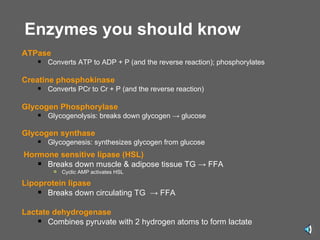
Enzymes you should know ATPase  Converts ATP to ADP + P (and the reverse reaction); phosphorylates Creatine phosphokinase Converts PCr to Cr + P (and the reverse reaction) Glycogen Phosphorylase Glycogenolysis: breaks down glycogen  -> glucose Glycogen synthase   Glycogenesis: synthesizes glycogen from glucose Hormone sensitive lipase (HSL) Breaks down muscle & adipose tissue TG  -> FFA Cyclic AMP activates HSL Lipoprotein lipase   Breaks down circulating TG  -> FFA Lactate dehydrogenase Combines pyruvate with 2 hydrogen atoms to form lactate
Hormones Definition: internally secreted compounds formed in endocrine glands that affect the functions of specifically receptive organs or tissues when transported to them by the body fluids
Hormones you should know Promote glycogen/carb breakdown:   epinephrine, glucagon, norepinephrine Promote glycogen/carb storage:   insulin Promote fat breakdown:   epinephrine, glucagon, growth hormone, norepinephrine Promote fat storage:   insulin Promote protein breakdown (catabolic):   glucagon Prevents protein breakdown:   insulin Promote protein building (anabolic):   growth hormone
Hormones you should know Estrogen, Progesterone, Follicle Stimulating Hormone Testosterone
4. Response to Training
Response to training    glycogen storage capacity    lactate threshold    oxidation and transport of FA and IMTG    increases number of capillaries    plasma volume    Krebs Cycle and ETC activity    transamination enzymes to enhance use of protein for energy    effects of glycogen depletion So, does a well-trained person require as much carbohydrate during exercise someone of lower fitness level?  ex: fast marathoner vs. 5 hour marathoner
5. Fatigue
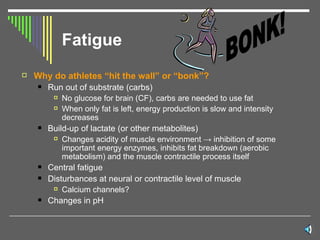
Fatigue Why do athletes “hit the wall” or “bonk”? Run out of substrate (carbs) No glucose for brain (CF), carbs are needed to use fat When only fat is left, energy production is slow and intensity decreases Build-up of lactate (or other metabolites) Changes acidity of muscle environment  -> inhibition of some important energy enzymes, inhibits fat breakdown (aerobic metabolism) and the muscle contractile process itself Central fatigue Disturbances at neural or contractile level of muscle Calcium channels?  Changes in pH  BONK!

Ex Phys Crash Course 2009 Powerpoint Show

  • 1.
    Exercise Physiology Step2: Sports Dietetics
  • 2.
    Ex. Phys. CrashCourse Energy Storage Energy metabolism, substrate utilization, and oxygen transport Enzymes and hormones – the good ones and the bad ones! Physiological response to training Fatigue  = practical application
  • 3.
  • 4.
    Energy = abilityto do work Examples of WORK: exercise, muscle contraction, synthesis, nutrient transport, repair, etc. Splitting ATP bonds  ATP is cellular currency. Compare it to a bank account with lots of withdrawals (energy expenditure) and deposits (substrates). Generally, about 10 seconds worth of ATP stored in muscle so other energy systems must kick-in very quickly during exercise ENERGY
  • 5.
    Energy Sources SubstratesPhosphocreatine (PCr) Carbohydrates Fat (Protein) when oxidized… … re-phosphorylate ADP ADP + P -> ATP
  • 6.
    Where is fuelstored? Adapted from Mcardle, Katch, and Katch. Sports and Exercise Nutrition. Lippincott, Williams & Wilkins, 2005 Muscle : ATP, PCr, Glycogen, IMTG, Carbons from AAs Mitochondria Liver : Glycogen -> Glucose AAs Blood : Glucose FFA Deaminated AAs Adipose Tissue : TG FA
  • 7.
    Where is fuelstored? Adapted from Mcardle, Katch, and Katch. Sports and Exercise Nutrition. Lippincott, Williams & Wilkins, 2005 Muscle : ATP, PCr, Glycogen, IMTG, Carbons from AAs Mitochondria Liver : Glycogen -> Glucose AAs Blood : Glucose FFA Deaminated AAs Adipose Tissue : TG FA ATP
  • 8.
    How much fuelis stored? Carbohydrate Liver glycogen ≈ 400 kcals Muscle glycogen ≈ 1,400 kcals 100g CHO in liver, 375g CHO in muscle… consider how rapidly this can be used up during exercise at an oxidation rate of 1g/min! Fat Intramuscular Triglycerides (IMTG) ≈ 3,000kcals Adipose tissue ≈ 80,000kcals This is true even in very lean individuals.
  • 9.
    2. Energy Metabolism, Substrate Utilization, & Oxygen Transport
  • 10.
    Two types ofenergy metabolism Anaerobic Occurs when oxygen is not available Phosphocreatine System Anaerobic Glycolysis (aka: Lactate Glycolysis) Aerobic Requires oxygen Aerobic Glycolysis Kreb’s Cycle (aka: TCA Cycle, Citric Acid Cycle) Electron Transport Chain (ETC) Beta-oxidation (fat)
  • 11.
    ATP Production from…Phosphocreatine Carbohydrate Fat 10 seconds 1-3 minutes w/o Oxygen Long, requires Oxygen FAST ATP > 60 minutes w/ Oxygen SLOW ATP Short, quick, powerful Higher intensity Low intensity Runs out of gas fast Gas is expensive & limiting Gas is cheap, never runs out, speed cap
  • 12.
    ATP Production from…Phosphocreatine Carbohydrate Fat 10 seconds 1-3 minutes w/o Oxygen Long, requires Oxygen FAST ATP > 60 minutes w/ Oxygen SLOW ATP Short, quick, powerful Higher intensity Low intensity Runs out of gas fast Gas is expensive & limiting Gas is cheap, never runs out, speed cap 2 ATP 38 ATP 500 ATP
  • 13.
    Practice Question Whatsubstrate(s) is/are able to be used for anaerobic energy production? A. Phosphocreatine B. Glucose C. Phosphocreatine and glucose D. Phosphocreatine, glucose, and BCAA’s SEE YELLOW PAGE AT END OF MANUAL FOR CORRECT ANSWERS.
  • 14.
    Practice Question Whatsubstrate(s) is/are able to be used in aerobic energy production? A. Fatty acids B. Fatty acids and amino acids C. Glucose and amino acids D. Fatty acids, glucose, and amino acids SEE YELLOW PAGE AT END OF MANUAL FOR CORRECT ANSWERS.
  • 15.
    Rate of ATPSynthesis by Different Energy Systems References: Miller, W. The Biochemistry of Exercise and Metabolic Adaptation. Brown and Benchmark, 1992 Maughan, R and Burke, L. Sports Nutrition: Handbook of Sports Medicine and Science. Blackwell Science, 2002. ≈ 20 Fat Oxidation ≈ 200 Anaerobic Glycolysis ≈ 450 Phosphocreatine Breakdown µmol per minute per gram of muscle
  • 16.
    Substrate utilization… …existson a continuum. Energy systems work simultaneously. All vehicles on the road at the same time (even though one may be leading the way!)
  • 17.
    Fuel utilization dependson EXERCISE DURATION Exercise at Constant Intensity % CONTRIBUTION Crossover Concept
  • 18.
    Fuel utilization dependson EXERCISE INTENSITY % CONTRIBUTION REST LOW TO MODERATE HARD EXERCISE EXERCISE FAT CARBS PROTEIN
  • 19.
    Phosphocreatine System PCr Cr + P P + ADP ATP Reactions “work” in both directions
  • 20.
    Anaerobic Glycolysis GLYCOLYSISKREBS CYCLE Glycogen Cytoplasm Glucose is starting point and when oxygen is not present, pyruvate is endpoint. Muscle glycogen enters Glycolysis at G-6-P, skipping first step. NADH + H Pyruvate Acetyl-CoA Mitochondria (Krebs Cycle = TCA Cycle = Citric Acid Cycle) Glucose Glucose-6-Phosphate ATP ×
  • 21.
    Anaerobic Glycolysis GLYCOLYSISKREBS CYCLE Glycogen Cytoplasm Glucose is starting point and when oxygen is not present, pyruvate is endpoint. Muscle glycogen enters Glycolysis at G-6-P, skipping first step. When H atoms are produced more rapidly than NADH and ETC can process, lactate is formed. NADH + H Pyruvate Acetyl-CoA Mitochondria (Krebs Cycle = TCA Cycle = Citric Acid Cycle) Glucose Glucose-6-Phosphate ATP × Lactate
  • 22.
    Lactate When hydrogenions are produced too fast to combine with NADH and be oxidized by ETC a back-up of H + occurs These H + combine with pyruvate to form LACTATE Lactate should be considered a BY-PRODUCT rather than a WASTE PRODUCT. For a period of time, lactate can be recycled through glycolysis to keep producing ATP ( CORI CYCLE ). Remember: glycolysis “works” both ways! This continues until lactate produced in the blood from working muscles exceeds lactate clearance from liver ( LACTATE THRESHOLD ). At Lactate Threshold, H + builds up and can contribute to fatigue ?
  • 23.
    Lactate Threshold Intensityof exercise when lactate production exceeds clearance Training regimens often involve training at a level > lactate threshold. Typical LT : 70-80% VO 2max for trained people 50-60% VO 2max for untrained people.
  • 24.
    Practice Question Whichof the following is true regarding lactate accumulation in skeletal muscle? A. It is formed as a waste product of aerobic glycolysis. B. It is a by-product of the electron transport chain. C. It is a gluconeogenic precursor. D. It is a co-factor in the carnitine shuttle. SEE YELLOW PAGE AT END OF MANUAL FOR CORRECT ANSWERS.
  • 25.
    Aerobic System: CarbsGLYCOLYSIS KREBS CYCLE Glycogen Cytoplasm NADH + H Pyruvate Acetyl-CoA Mitochondria Glucose Glucose-6-Phosphate ATP Oxygen H H H H H H H ATP With oxygen present, pyruvate is converted to Acetyl-CoA and into Krebs Cycle.
  • 26.
    Aerobic System: CarbsGLYCOLYSIS KREBS CYCLE Glycogen Cytoplasm NADH + H Pyruvate Acetyl-CoA Mitochondria Glucose Glucose-6-Phosphate ATP Oxygen H H H H H H H ATP Hydrogen generated from glycolysis and Krebs Cycle enter Electron Transport Chain. ELECTRON TRANSPORT CHAIN
  • 27.
    Practice Question Inthe presence of oxygen, how many molecules of ATP are produced from one glucose molecule? A. 1 B. 2 C. 38 D. 56 SEE YELLOW PAGE AT END OF MANUAL FOR CORRECT ANSWERS.
  • 28.
    Aerobic System: FatGLYCOLYSIS KREBS CYCLE Cytoplasm Pyruvate Acetyl-CoA Mitochondria Glucose Oxygen ATP E FA FA FA glycerol Triglyceride Beta-oxidation : FA, which are 16-24 carbons long, are broken down to Acetyl-CoA (2 carbons), fatty acid activation are slow
  • 29.
    Aerobic System: FatGLYCOLYSIS KREBS CYCLE Cytoplasm Pyruvate Acetyl-CoA Mitochondria Glucose Oxygen E FA FA FA glycerol Triglyceride Breakdown of TG : Yields lots of carbons, lots of hydrogens, and lots of ATP…460! H H H
  • 30.
    Electron Transport ChainSeries of oxidation-reduction reactions Oxidation: when oxygen, hydrogen, or electrons are TRANSFERRED Reduction: when electrons are ACCEPTED End point = oxygen accepts electrons and is reduced to form water Many cytochromes (iron-containing electron carriers are involved)  No wonder iron deficiency causes decreased aerobic performance!
  • 31.
    Is fat gluconeogenic?NO…by-products of FA oxidation can only enter metabolism at Acetyl-Co A Pyruvate (end of glycolysis) Acetyl-Co A (beginning of Krebs cycle)
  • 32.
    How does proteinenter energy metabolism? The process by which amino acids are used for energy is DEAMINATION (amine group removed in liver) or TRANSAMINATION (amine group discarded in muscle) to leave carbons that can enter energy metabolism somewhere in Krebs Cycle, at pyruvate, or conversion back to glucose (glucogenic). Removing the amine group (nitrogen) involves kidneys and increased urine production…depending on protein for fuel increases risk of dehydration. KREBS CYCLE GLYCOLYSIS Acetyl-CoA Amino Acids
  • 33.
    Notes on CarbohydrateUse At the beginning of exercise, carbs are used at a high rate since fat can’t keep up with early ATP production. Carbs are very valuable…they make ATP fast and facilitate higher intensity exercise Later in exercise, carbs are needed (at pyruvate) to foster fat movement through Krebs Cycle which is why carbs are called the “rate limiting” fuel. In moderate endurance exercise, performance directly correlates with initial muscle glycogen concentration. Glycogen depleted subjects cycled 57 min at 70% VO 2max Glycogen loaded subjects cycled 114 min at 70% VO 2max Classic study by Bergstrom et al Acta Physiol Scand 1967.  Many athletes train hard all week long, aren’t eating enough carbs in general or during recovery, and then compete on the weekends. Major education point!
  • 34.
    Notes on CarbohydrateUse Why does carb loading work to enhance performance? Utilize less fat (means higher intensity is possible) Utilize almost no protein (unless exercise is very long) NOTE: ADA/ ACSM Position Statement on Nutrition for Athletic Performance states that carb loading is effective for exercise LONGER than 90 minutes. Consider that glycogen depletion has now been shown to affect even high intensity, shorter exercise  In sports who don’t typically consider “carb loading”, there may be decreased physical performance, increased risk of injury, poor concentration, and decreased coordination when glycogen stores are too low.
  • 35.
    Notes on CarbohydrateUse The amount of carbs used during exercise varies based on: Diet Liver and muscle glycogen stores (i.e.: fasting in am = low liver glycogen = less glucose/more fat used) Body and environmental temperature Carbs consumed during exercise Why take in carbs during exercise? Keeps blood sugar high and favors carbohydrate use (faster ATP production) Blunts FA oxidation
  • 36.
    Notes on FatUse Fat contributes 30-80% of energy for exercise depending on: exercise intensity duration of exercise fitness level Intramuscular TG contribute 15-35% of energy for exercise Fat becomes more important when exercise is long or carbohydrate stores run low. As blood flow increases w/ exercise, adipose tissue releases more FFA (but there is a lag time) As exercise intensity increases, FFA energy production from adipose stays about the same while IMTG and glycogen breakdown increase
  • 37.
    Notes on FatUse Once FFA enter muscle cell, they either enter the carnitine shuttle for energy metabolism (MCT and short chain TG do not need shuttle; they go straight to mitochondria). Others are stored as TG. When TG are oxidized from adipose tissue, FA bind to albumin in blood stream and enter mitochondria for Krebs and ETC. Glycerol can enter glycolysis and produce ATP. Carbs are needed to provide Krebs intermediates for fat breakdown. When carbs run out, ketones are formed from incomplete fat breakdown. Fat in recovery period from exercise less likely to be stored and more likely to be oxidized (part of why regular exercise helps with weight loss) High fat diet (fat-loading) may increase IMTG and fat enzyme function, theoretically leading to greater oxidation during exercise. Many find it intolerable and most studies show no performance benefits.
  • 38.
     Keep client’sgoals in mind Exercising for fat-burning is different than exercising for optimal performance. Optimal intensity for fat burning is 55 to 72% VO 2 max but training/performance may be optimized at higher level Burn more fat in fasted state Ability to burn more carbs in fed state help exercisers think of total calories expended
  • 39.
    Practice Question Whichof the following is not a BCAA? A. Lysine B. Leucine C. Valine D. Isoleucine SEE YELLOW PAGE AT END OF MANUAL FOR CORRECT ANSWERS.
  • 40.
    Notes on proteinuse Depending on novelty of exercise, protein breakdown increases modestly with exercise but protein synthesis increases significantly with BOTH endurance and resistance exercise Some discrepancy over amount of protein that is used for fuel. Generally 2-6% of energy production. Greater use in ultra-endurance. BCAA (leucine, isoleucine, and valine) are oxidized by skeletal muscle rather than liver. Aspartate, glutamine, alanine, asparagine, and lysine can be oxidized in muscle also (with preference given to BCAA). Use more protein for fuel in a glycogen-depleted state or if in chronic negative energy balance Dieters or restrictive eaters may be at risk of lean tissue loss!
  • 41.
    Amino Acids ESSENTIAL (not produced endogenously) Isoleucine Leucine Lysine Methionine Phenylalanine Threonine Tryptophan Valine NON-ESSENTIAL (produced endogenously) Alanine Arginine Asparagine Aspartate Cysteine Glutamate Glutamine Glycine Histidine Proline Serine Tyrosine Some may become essential in certain scenarios…
  • 42.
    Bottom line Substrateand energy system used depends on: Exercise intensity Exercise duration Substrate availability Training status Don’t run out of carbs!
  • 43.
    Gender differences Forfemales: Carb loading is less effective. They use a lower proportion of carbs and higher proportion of fat than males in similar intensity exercise. With training, there is a shift toward using more fat (so, greater glycogen-sparing effect) Why? Not fully understood, but possibly: Differences in catecholamine response Estrogen/progesterone may enhance lipolysis and limit glycolysis
  • 44.
    Muscle Fiber Types2 primary types TYPE I: Slow-twitch Contract slowly; primarily aerobic pathways Dense in mitochondria and capillaries (oxygen) Fatigue slowly TYPE II: Fast-twitch Fast contractions Type IIa: both aerobic and anaerobic pathways Type IIb: anaerobic pathways Fatigue quickly Proportion of each type depends on genetics, exercise training, other factors?
  • 45.
    Other oxygen-related exerciseterminology Respiratory Quotient (RQ) Ratio of CO 2 produced : O 2 consumed RQ for carbs = 1, fat = .7 An estimate RQ of .82 is used for general activity Using exercise testing to determine RQ at specific workloads can help tailor during-exercise fuel plans VO 2max Measure of cardiorespiratory fitness Greatest rate of oxygen consumption attained during exercise (L/min) or (ml/kg body weight/min) Don’t have a metabolic cart in your office? HR max = 220 – age (Karvonen Formula) 70% of HR max correlates with approximately 75-80% VO 2max MET (Metabolic Equivalents) Measure of workload 1 MET = resting oxygen consumption of average human (3.5 mL/kg/min) Well-trained athletes may be able to work at a level of 15-17+ METS
  • 46.
    3. Enzymes &Hormones
  • 47.
    Enzymes Definition: proteinstructure that catalyzes and accelerates chemical reactions without being consumed or changed in the process
  • 48.
    Enzymes you shouldknow ATPase Converts ATP to ADP + P (and the reverse reaction); phosphorylates Creatine phosphokinase Converts PCr to Cr + P (and the reverse reaction) Glycogen Phosphorylase Glycogenolysis: breaks down glycogen -> glucose Glycogen synthase Glycogenesis: synthesizes glycogen from glucose Hormone sensitive lipase (HSL) Breaks down muscle & adipose tissue TG -> FFA Cyclic AMP activates HSL Lipoprotein lipase Breaks down circulating TG -> FFA Lactate dehydrogenase Combines pyruvate with 2 hydrogen atoms to form lactate
  • 49.
    Hormones Definition: internallysecreted compounds formed in endocrine glands that affect the functions of specifically receptive organs or tissues when transported to them by the body fluids
  • 50.
    Hormones you shouldknow Promote glycogen/carb breakdown: epinephrine, glucagon, norepinephrine Promote glycogen/carb storage: insulin Promote fat breakdown: epinephrine, glucagon, growth hormone, norepinephrine Promote fat storage: insulin Promote protein breakdown (catabolic): glucagon Prevents protein breakdown: insulin Promote protein building (anabolic): growth hormone
  • 51.
    Hormones you shouldknow Estrogen, Progesterone, Follicle Stimulating Hormone Testosterone
  • 52.
  • 53.
    Response to training glycogen storage capacity  lactate threshold  oxidation and transport of FA and IMTG  increases number of capillaries  plasma volume  Krebs Cycle and ETC activity  transamination enzymes to enhance use of protein for energy  effects of glycogen depletion So, does a well-trained person require as much carbohydrate during exercise someone of lower fitness level? ex: fast marathoner vs. 5 hour marathoner
  • 54.
  • 55.
    Fatigue Why doathletes “hit the wall” or “bonk”? Run out of substrate (carbs) No glucose for brain (CF), carbs are needed to use fat When only fat is left, energy production is slow and intensity decreases Build-up of lactate (or other metabolites) Changes acidity of muscle environment -> inhibition of some important energy enzymes, inhibits fat breakdown (aerobic metabolism) and the muscle contractile process itself Central fatigue Disturbances at neural or contractile level of muscle Calcium channels? Changes in pH BONK!