Packaging Material Science
1.Protectthecontentsfromthefollowingenvironmental
hazards:
Light- protectthecontentsfromlight
Temperature- becapableofwithstandingextremesof
temperature.
Moisture- becapableofwithstandingextremesofhumidity.
Atmospheric gases- protectthecontentsfromtheeffectof
atmosphericgases(e.g.aerialoxidation).
Particles- protectfromparticulatecontamination.
Microorganisms- protectfrommicrobialcontamination.
5
2.Protectsthecontentfromthefollowingmechanicalhazards
 Vibration- Usuallyduetotransportation
 Compression- thisusuallyincludespressureappliedduringstacking.
 Shock- suchasimpact,dropsorrapidretardation.
 Puncture- penetrationfromsharpobjectsorduringhandling
operations.
 Abrasion- thismaycreateelectrostaticeffects.
3.Theymustnotaddorpermitlosstoitscontents:
 Protectthecontentsfrombothlossandgainofwater.
 Protectthecontentsfromlossofvolatilem
aterials
 Mustnotshedparticlesintothecontents.
 Mustnotleachanythingtothecontents.
6
TYPESOFPACKAGING
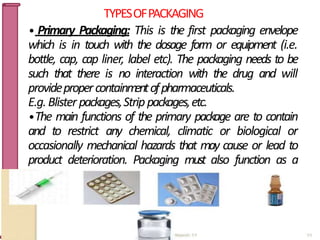
• Primary Packaging: This is the first packaging envelope
which is in touch with the dosage form or equipment (i.e.
bottle, cap, cap liner, label etc). The packaging needs to be
such that there is no interaction with the drug and will
providepropercontainm
entofpharmaceuticals.
E.g.Blister packages,Strippackages,etc.
•The main functions of the primary package are to contain
and to restrict any chemical, climatic or biological or
occasionally mechanical hazards that may cause or lead to
product deterioration. Packaging must also function as a
m
eansofdrugadministrations.
9
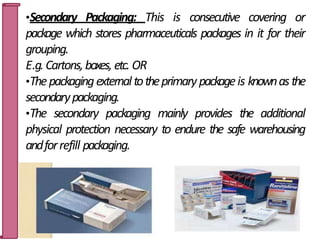
•Secondary Packaging: This is consecutive covering or
package which stores pharmaceuticals packages in it for their
grouping.
E.g.Cartons,boxes, etc. OR
•Thepackagingexternaltotheprimarypackageis knownasthe
secondarypackaging.
•The secondary packaging mainly provides the additional
physical protection necessary to endure the safe warehousing
andforrefill packaging.
10
 Apart from primary and secondary packaging, two types of special
packagingarecurrentlyinuse,asfollows:
 •Unit-dose packaging. This packaging guarantees safer medication
by reducing medication errors; it is also more practical for the
patient. It maybevery useful in improving compliance with treatment
andmayalsobeusefulforlessstableproducts.
 •“Device” packaging. Packaging with the aid of an administration
device is user-friendly and also improves compliance. This type of
packaging permits easier administration by means of devices such as
prefilled syringes, droppers, transdermal delivery systems, pumpsand
aerosol sprays. Such devices ensurethatthemedicinal productis
administeredcorrectlyandin therightamount. 12
Types of primary and secondary packaging material
Material Type Example of use
Glass Primary
Metric medical bottle,
ampoule, vial
Plastic Primary
Ampoule, vial, infusion
fluid container, dropper
bottle
Secondary
Wrapper to contain
primary pack
Cardboard Secondary
Box to contain primary
pack
Paper Secondary
Labels, patient
information leaflet
11
CONTAINER:
 Acontainerforapharmacopoeialarticleisintendedtocontainadrug
substanceordrugproductwithwhichitis,ormaybeindirectcontact.The
closureis apartofthecontainer.
QUALITIES OF GOODCONTAINER:
 Thecontainermustbeneutraltowardsthematerialwhichis storedinit.
 Thecontainer mustnotinteractphysicallyorchemicallywiththesubstance
whichitholds.
 Itshouldhelpinmaintainingthestabilityofproductagainsttheenvironmental
factorswhichcausesitsdeterioration.
 Itshouldbemadeofmaterialswhichcanwithstandwearandtearduring
normal handling.
 Itshouldbemadeofmaterialswhichcanwithstandwearandtearduring
normal handling.
 Itshouldbeabletowithstandchangesinpressureandtemperature.
 Thematerialsusedformakingofthecontainermustbenon-toxic.
13
TYPES OF CONTAINERS:
Containersaredividedintofollowingtypesonthebasisof
theirutility:
Well –closedcontainers: Awell-closedcontainer
protectsthecontentsfromlossduringtransportation,
handling,storageorsale.
Singledosecontainers: Thesecontainersareusedtosupply
onlyoneofmedicamentandholdgenerallyparenteral
products.
E.g.ampoulesandvials
14
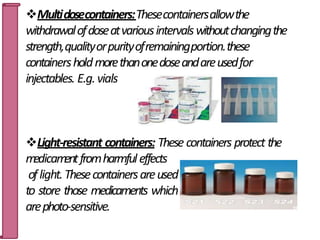
Multidosecontainers:Thesecontainersallowthe
withdrawalofdoseatvariousintervalswithoutchangingthe
strength,qualityorpurityofremainingportion.these
containersholdmorethanonedoseandareusedfor
injectables. E.g.vials
Light-resistant containers: These containers protect the
m
edicam
entfromharmfuleffects
oflight.Thesecontainersareused
to store those medicaments which
arephoto-sensitive. 15
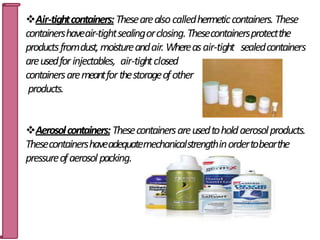
Air-tightcontainers:Thesearealsocalledhermeticcontainers. These
containershaveair-tightsealingorclosing.Thesecontainersprotectthe
productsfromdust,moistureandair. Whereasair-tight sealedcontainers
areusedforinjectables, air-tightclosed
containersaremeantforthestorageofother
products.
Aerosolcontainers:Thesecontainersareusedtoholdaerosolproducts.
Thesecontainershaveadequatemechanicalstrengthinordertobearthe
pressureofaerosol packing.
16
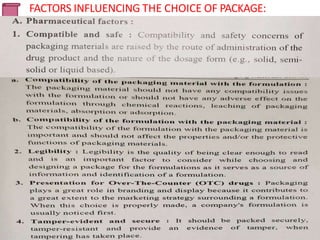
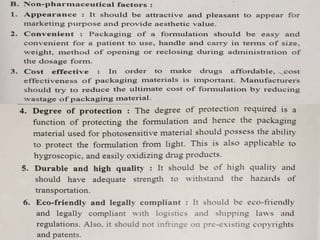
FACTORS INFLUENCING THE CHOICE OF PACKAGE:
17
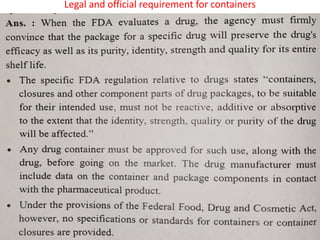
Legal and official requirement for containers
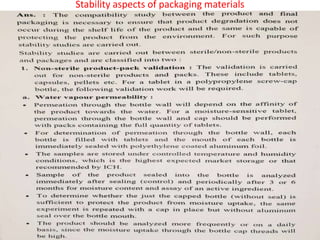
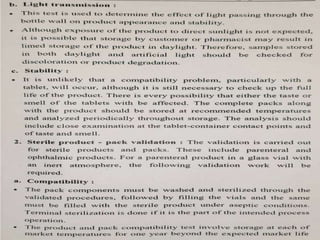
Stability aspects of packaging materials
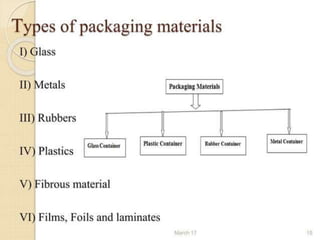
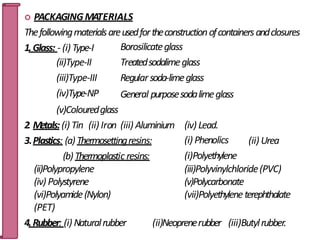
 PACKAGINGMATERIALS
Thefollowingmaterialsareusedfortheconstructionofcontainersandclosures
Borosilicateglass
Treatedsodalimeglass
Regularsoda-limeglass
General purposesodalimeglass
1.Glass: - (i) Type-I
(ii)Type-II
(iii)Type-III
(iv)Type-NP
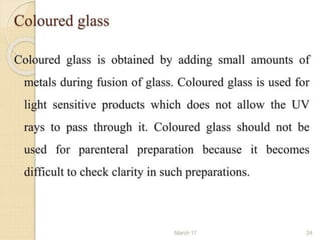
(v)Colouredglass
(ii) Urea
(iv) Lead.
(i) Phenolics
(i)Polyethylene
(iii)Polyvinylchloride(PVC)
(v)Polycarbonate
(vii)Polyethyleneterephthalate
2. Metals:(i) Tin (ii) Iron (iii) Aluminium
3.Plastics: (a)Thermosettingresins:
(b)Thermoplastic resins:
(ii)Polypropylene
(iv) Polystyrene
(vi)Polyamide(Nylon)
(PET)
4.Rubber: (i) Naturalrubber (ii)Neoprenerubber (iii)Butylrubber.
19
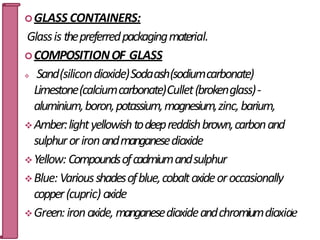
GLASS CONTAINERS:
Glassis thepreferredpackagingmaterial.
COMPOSITIONOF GLASS
 Sand(silicondioxide)Sodaash(sodiumcarbonate)
Limestone(calciumcarbonate)Cullet(brokenglass)-
aluminium,boron,potassium,magnesium,zinc,barium,
Amber:lightyellowishtodeepreddishbrown,carbonand
sulphurorironandmanganesedioxide
Yellow: Compoundsofcadmiumandsulphur
Blue: Variousshadesofblue,cobaltoxideoroccasionally
copper(cupric) oxide
Green:ironoxide, manganesedioxideandchromiumdioxid2
e
0
MANUFACTURE OF GLASS:
Thefourbasicprocessesusedintheproductionof
glass are:
Blowingusescompressedair formthemoltenglassin
thecavityofmetalmold.
Indrawing, moltenglassis pulledthroughdiesor
rollersthatshapethesoftglass.
Inpressingmechanical forceis usedtopressthemolten
glassagainstthesideofamold.
 Castingusesgravityor centrifugal forcetocause
moltenglasstoforminthecavity ofmold. 21
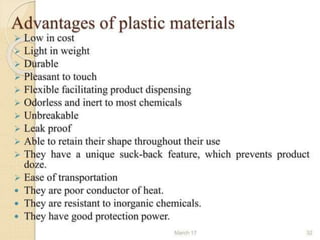
 ADVANTAGES
• Theyarehygienicandsuitableforsterilization
• Theyarerelativelynonreactive( dependingonthegradechosen)
• Itcanacceptavarietyofclosures
• Theycanbeusedonhighspeedpackaginglines
• Theyaretransparent.
• Theyhavegoodprotectionpower.
• Theycanbeeasily labeled.
 DISADVANTAGES
• Itisrelativelyheavy
• Glassisfragilesoeasilybroken.
• Releasealkali toaqueouspreparation
22
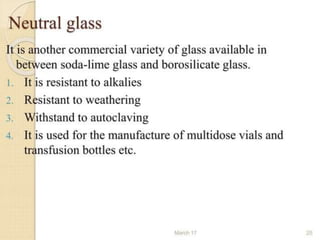
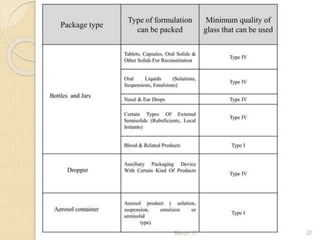
TypeI glass:
Composition: Neutralglass, borosilicate glass (silica (silicon dioxide, SiO2) andboron
oxide).
Advantages:
 Itpossessesahighhydrolyticresistance.
 Itisthemostinerttypeofpharmaceutical glass.
 Ithasthelowestcoefficientof thermalexpansion(and hencesuitable for sterilizationby
heat…..forampoulesandvials).
Disadvantages:
 It hasveryhighglasstransitiontemperaturesoneedscomplicatedprocessing.
 Andthereforeexpensive.
Uses:
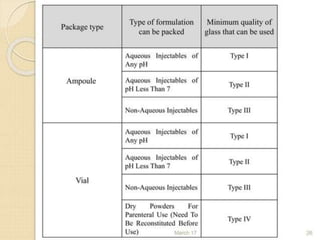
 TypeI glassissuitableforpackingall pharmaceutical preparations.
 It is widelyusedasglassampoulesandvialstopackagefluidsforinjection.
 In contrast to the other types of glass (type II and III), this type has no/little amo2
3
unts
of basic oxides, so It is used to package solutions that could dissolve basic oxides in
theglass.
TypeII glass
Composition:soda-lime-silicaglass.
Soda (Na2CO3) is used to decrease the glass transition temperature of silica.
However, soda would increase water solubility of silica, so lime (CaO) is used to
increasethehydrolyticresistance.Thistypewouldalsocontainotheroxides.
Advantages:
 This glass hasalowermeltingpointthanTypeI glass. It is thuseasier to produce
andconsequentlycheaper.
 Highhydrolyticresistanceduetosurfacetreatmentoftheglass.
Uses:
 TypeII glassusedtopackageaqueouspreparations.
 However,asitcontainsbasic oxides,it is notusedtopackageparenteral formulations
withapH<7 (i.e.acidic);thiswouldincreasethepHoftheformulation andcouldaffect
thedrugstabilityandpotency.
 It is theglass used to produce containers for eye preparations and other dropper
bottles. 24
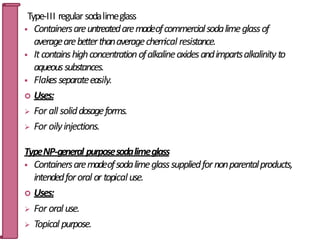
Type-III regular sodalimeglass
 Containersareuntreatedaremadeofcommercialsodalimeglassof
averagearebetterthanaveragechem
ical resistance.
 Itcontainshighconcentrationofalkalineoxidesandimpartsalkalinityto
aqueoussubstances.
 Flakesseparateeasily.
 Uses:
 For all soliddosageforms.
 For oilyinjections.
TypeNP-general purposesodalimeglass
 Containersaremadeofsodalimeglasssuppliedfornonparentalproducts,
intendedfororal or topicaluse.
 Uses:
 For oral use.
 Topical purpose.
25
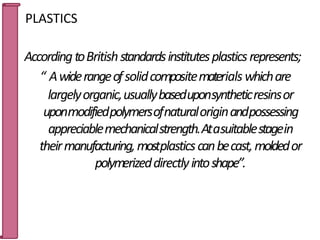
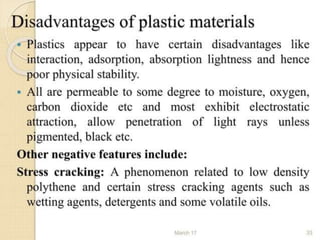
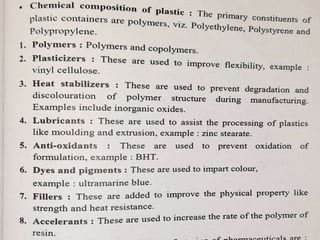
PLASTICS
AccordingtoBritishstandardsinstitutesplasticsrepresents;
“ Awiderangeofsolidcompositematerials whichare
largelyorganic,usuallybaseduponsyntheticresinsor
uponmodifiedpolymersofnaturaloriginandpossessing
appreciablemechanicalstrength.Atasuitablestagein
theirmanufacturing,mostplasticscanbecast,moldedor
polymerizeddirectlyintoshape”.
26
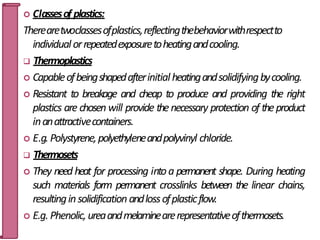
 Classesof plastics:
Therearetwoclassesofplastics,reflectingthebehaviorwithrespectto
individualorrepeatedexposuretoheatingandcooling.
 Thermoplastics
 Capableofbeingshapedafterinitialheatingandsolidifyingbycooling.
 Resistant to breakage and cheap to produce and providing the right
plastics are chosen will provide thenecessary protection of theproduct
inanattractivecontainers.
 E.g.Polystyrene,polyethyleneandpolyvinyl chloride.
 Thermosets
 They need heat for processing intoa permanent shape. During heating
such materials form permanent crosslinks between the linear chains,
resultinginsolidification andlossofplasticflow.
 E.g. Phenolic,ureaandmelaminearerepresentativeofthermosets.
27
TYPES OF PLASTICS
 POLYETHYLENE
 Thisis usedashighandlowdensitypolyethylene
 Low density polyethylene (LDPE) is preferred plastic for
squeezebottles.
Properties: Ease of processing , barrier to moisture, strength
/toughness,flexibility, easeofsealing.
 Highdensitypolyethylene(HDPE) is lesspermeabletogases
andmoreresistanttooils, chemicalsandsolvents.
Properties:Stiffness,strength/toughness,resistance tochemicals.
Itis widelyusedinbottlesforsoliddosageforms.
Drawback: pronetostress cracking in thepresenceof surfactant2
s9
orvegetableormineral oils.
 POLYPROPYLENE
 Ithasgoodresistancetocrackingwhenflexed.
 Goodresistancetoheatsterilization.
 It is colorless,odorlessthermoplasticmaterialwithexcellenttensilepropertiesevenat
hightem
perature.
 Excellent resistancetostrongacidsandalkalis.
 Lowpermeabilitytowatervapour
 Permeability togases is intermediate between polyethylene HD and un-plasticized
PVC
 Suitableforuseinclosures, tabletcontainersandintravenousbottles.
 POLYSTYRENE
 Versatility,insulation,clarity,easilyfoamed(“Styrofoam”).
 It isalsousedforjarsforointmentsandcreamswithlowwatercontent.
 Drawback:Chemicals likeisopropylmyristateproducecrazing(afinenetwo3
r0
kofsurface
cracks)followedbyweakeningandeventuallycollapsibleofthecontainer.
 POLYVINYL CHLORIDE
 Versatility,easeofblending, strength/toughness, resistancetogrease/oil, resistanceto
chemicals,clarity.
 Usedasrigidpackagingmaterialandmaincomponentofintravenousbags.
 Drawback: Poor impact resistance which can be improved by adding elastomers to
theplasticsbutitwillincreaseitspermeability.
 POLY VINYLEDENE CHLORIDE:
• Excellentbarrierpropertiesagainst:moisture,watervapour,UVlight,aroma, inorganic
acids, alkalies, aqueous salt solutions, organic water soluble acids, aliphatic
hydrocarbons , esters of long chain fatty acids, detergentbase materials, em
ulsifying
agentsandwettingagents.
• Goodthermoformability.
• PVDC is very cost-effective, as coating weight can be customized depending on the
requirementsofthebarrierproperties.
• Medical gradeandnon-toxic.
• Highlevelsoftransparencywhichimprovestheaestheticsoftheproduct.
31
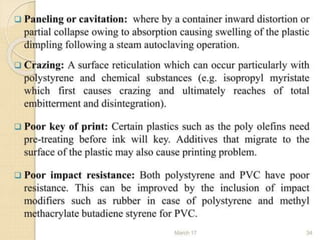
 DRUG-PLASTIC CONSIDERATIONS
 Apackagingsystemmustprotectthedrugwithout
alteringthecompositionoftheproductuntil thelast
doseisremoved.
 Drug-plasticconsiderationshavebeendividedintofive
categories:
1. Permeation
2. Leaching
3. Sorption
4. Chemical reaction
5. Alteration
32
 Permeation:
• Itis thetransmissionofgases,vaporsorliquidsthroughplastic
packagingmaterial.
• Permeation of watervapor andoxygenthrough plasticwallintothe
drugis amajorproblemis thedosageformis sensitivetohydrolysisand
oxidation.
• Thevolatile ingredientsmightchangewhenstoredin plastic containers
andthetasteofthemedicinalproductsmaychangeforthesamereason
ofpermeation.
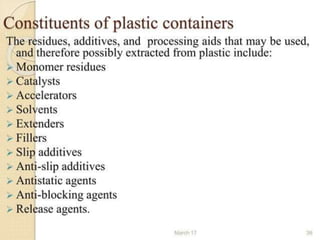
 Leaching:
• Someplasticcontainershaveoneormoreingredientsaddedtostabilize
it, thesemayleachintothedrugproduct.
• Problemsmayarisewithplasticswhencoloringagentsareaddedin
smallquantitiestotheformula.
• Particulardyesmaymigrateintotheparentalsolutionandcauseatoxic
effect.
33
 Sorption:
• Thisprocessinvolvestheremovableofconstituentsfromthedrugproductbythe
packagingmaterial.
• Thetherapeuticefficacyoftheproductmaybereducedduetosorption.
• Sorptionmaychangethechemicalstructure,pH,solventsystem,concentrationof
activeingredientsandtemperatureetc…
 Chemical reactivity:
• Certainingredientsinplasticformulationsmayreactchemicallywithoneormore
componentsofthedrugproduct.
• Eveninmicroquantitiesif incompatibilityoccursmayaltertheappearanceofthe
plasticorthedrugproduct.
 Modification:
• Thephysicalandchemicalalterationofthepackagingmaterialbythedrugproductis
calledmodification.
• Somesolventsystemsfoundtobeconsiderablechangesinthemechanicalpropertiesof
theplastics.
• For exampleoilshaveasofteningeffectonpolyethylene,hydrocarbonsattack
polyethyleneandPVC.
34
METALS
 Metal containers are used solely for medicinal products for non-
parenteraladministration.
 Metal is strong, opaque, impermeable to moisture, gases, odors,
light, bacteria, and shatterproof, it is the ideal packaging material
forpressurizedcontainers.
 Itis resistanttohighandlowtemperatures
 They include tubes, packs made from foil or blisters, cans,
and aerosol andgascylinders.
 Aluminium and stainless steel are the metals of choice for
both primaryandsecondarypackagingformedicinalproducts.
 Formanexcellenttamperevidentcontainers.
35
 ALUMINIUM
• Itis relativelylightyetstrong
• Barrier tolightandchemicals
• Impermeableandeasytoworkinto avariety offormats,dependingon
itsthickness.
• Thickest aluminium is used for rigid containers such as aerosol cans
andtubesforeffervescenttablets.
• Intermediatethickness are whenmechanical integrity is still important
butthepack should becapable of being reformed under areasonable
force.
e.g. Collapsible tubes for semi solid preparations or roll on screw
caps.
• Thinnest aluminium is used in flexible foil that are usuall3
y6 a
componentoflaminatedpackagingmaterial.
 Disadvantagesandtheirovercomesolution
• Major disadvantage is its reactivity in raw state, although it
rapidly forms a protective film of aluminium oxide it is still
liable to corrosion ( when exposed to some liquids and semi
solid formulations, particularly at extreme pH or if the product
containselectrolytes.
 To overcome this problem, Aluminium is lined with epoxide,
vinyl orphenolic
 resins.
• They are work hardening like collapsible tubes are made by
impactextrusionwhichtendstomakealuminiumlessflexible.
 To overcome, flexibility has to restored by an annealing
stage. 37
 TIN
 Advantages:
• Thismetal is veryresistanttochemicalattack.
• Readilycoatsanumberofthemetalse.g.tin-coatedleadtubes
combinethesoftnessofleadwiththeinertnessoftinandforthis
reasonitwasformerlyusedforpackagingfluoridetoothpaste.
 Disadvantages:
Tinis themostexpensivemetalamongtin,lead,aluminiumandiron.
 Uses:
• Tincontainersarepreferredforfoods,likemilkpowdercontainers
arecoatedwithtin.
• Currently,someeyeointment still packagedinpuretinointment
tubes. 38
 IRON
 Advantages:
Ironassuchisnotusedforpharmaceuticalpackaging,large
qualitiesoftin-coatedsteel,popularly called‘tin’, combinesthe
strengthofsteelwiththecorrosionresistanceoftin.
 Disadvantages:
If anaqueousliquid canpenetrateapinholeorotherfaultinthe
layeroftin,whichisvirtuallyashort-circuited galvanic cellis
setupandtheintensechemicalreactionwhich resultsbrings
aboutrapidcorrosionofunderlyingsteel.Asafurther measure
thetinsurfaceis lacquered.
 Uses:
Fabricationofmilkcontainers,screwcapsandaerosolcans. 39
 LEAD
 Advantages:
• Lowestcostofall them
etalsusedinpharmaceutical containers.
• Softm
etal.
 Disadvantages:
Leadwhentakeninternallythereisriskofleadpoisoning.So
leadcontainersandtubesshouldalwayshaveinternalliningof
inertmetalorpolymer.
 Uses:
Withliningleadtubesareusedforsuchproductasfluoride
toothpaste.
58
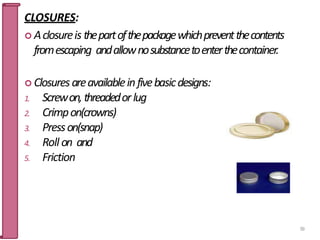
CLOSURES:
 Aclosureis thepartofthepackagewhichpreventthecontents
fromescaping andallownosubstancetoenterthecontainer.
 Closuresareavailableinfivebasicdesigns:
1. Screwon,threadedorlug
2. Crimpon(crowns)
3. Presson(snap)
4. Roll on and
5. Friction
59
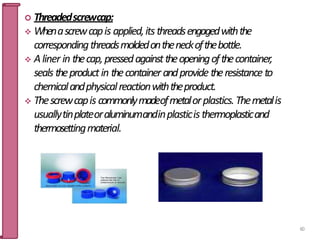
 Threadedscrewcap:
 Whenascrewcapis applied,itsthreadsengagedwiththe
correspondingthreadsmoldedontheneckofthebottle.
 Aliner in thecap,pressedagainsttheopeningofthecontainer,
seals theproductin thecontainerandprovide theresistance to
chemicalandphysicalreactionwiththeproduct.
 Thescrewcapis commonlymadeofmetalorplastics.Themetalis
usuallytinplateoraluminumandinplasticisthermoplasticand
thermosettingmaterial.
60
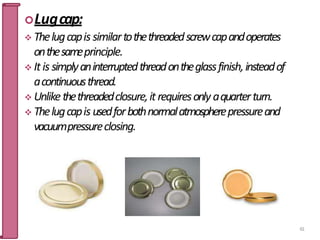
Lugcap:
 Thelugcapis similartothethreadedscrewcapandoperates
onthesameprinciple.
 It is simplyaninterruptedthreadontheglassfinish,insteadof
acontinuousthread.
 Unlikethethreadedclosure,itrequiresonly aquarterturn.
 Thelugcapis usedforbothnormalatmospherepressureand
vacuumpressureclosing.
61
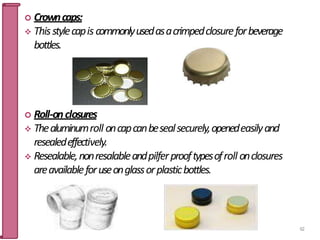
 Crowncaps:
 Thisstylecapis commonlyusedasacrimpedclosureforbeverage
bottles.
 Roll-onclosures
 Thealuminumroll oncapcanbesealsecurely,openedeasilyand
resealedeffectively.
 Resealable,nonresalableandpilferprooftypesofroll onclosures
areavailableforuseonglassorplasticbottles.
62
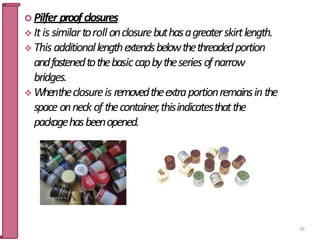
 Pilfer proof closures
 Itis similartoroll onclosurebuthasagreaterskirtlength.
 Thisadditionallengthextendsbelowthethreadedportion
andfastenedtothebasiccapbytheseriesofnarrow
bridges.
 Whentheclosureis removedtheextraportionremainsinthe
space onneck of thecontainer,thisindicatesthatthe
packagehasbeenopened.
63
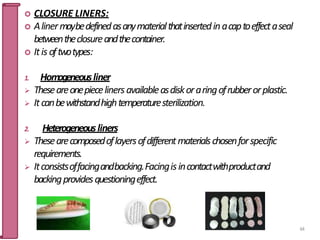
 CLOSURE LINERS:
 Alinermaybedefinedasanymaterialthatinsertedinacaptoeffectaseal
betweentheclosureandthecontainer.
 Itis oftwotypes:
1. Homogeneousliner
 Theseareonepiecelinersavailableasdiskoraringofrubberorplastic.
 Itcanbewithstandhightemperaturesterilization.
2. Heterogeneousliners
 Thesearecomposedoflayersofdifferentmaterialschosenforspecific
requirements.
 Itconsistsoffacingandbacking.Facingisincontactwithproductand
backingprovidesquestioningeffect.
64
 Factorsinselectingaliner:
• Chemicalinertness shouldbechemicallyinert
• Appearance,thicknessetc.
• Gasandwater-vapourtransmissionrates shouldbelow.
• Torquerequiretoremovethecap shouldbeoptimum.
• heatresistance e.g.duringautoclavingshouldbe
thermostable.
• Shelf-life shouldnotchangetheirshapeduringstorage.
• Economics shouldbecheap.
65
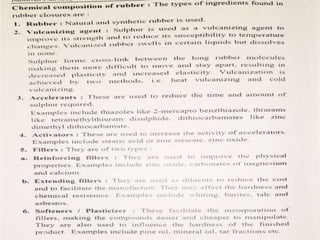
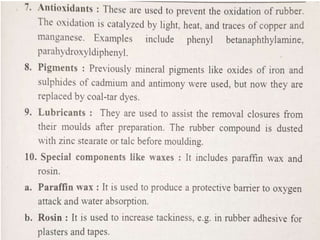
RUBBERS (Elastomers):
• Excellent material for forming seals, used to form closures such as
bungs for vials or in similar applications such as gaskets in aerosol
cans.
 Categoriesof Rubbers:
1) Natural rubbers;
• Suitable for multiple use closures for injectable products as rubber
resealsafter multipleinsertionofneedle.
• Disadvantagesare;
i. It doesn't well toleratemultiple autoclaving becomingbrittle and
leads to relative degree of extractable material in presence of
additives.
ii. Riskofproductabsorbingonorintoarubber.
iii. It hascertaindegreeofmoisture&gaspermeation.
48
2) Synthetic rubber:
• Have fewer additives and thus fewer extractable and tends to
experiencelesssorptionofproductingredients.
• Are less suitable for repeated insertions of needle because they
tend to fragment or core pushing small particles of the rubber
intotheproduct.
• E.g.Silicone,butyl,bromobutyl,chlorobutyletc.
• Silicone is least reactive but it does experience permeability to
moistureandgas.
 Softer rubbers experience less coring and reseal better, harder
rubbersareeasiertoprocessonhighspeedpackaginglines.
49
TYPES OF RUBBER
1.BUTYL RUBBER
Thesearecopolymersofisobutylenewith1-3%ofisopreneorbutadiene.
 Advantages:-
• Aftervulcanization butylrubberpossessesvirtuallynodoublebond,consequentlytheyaremost
resistanttoagingandchemical attack.
• Permeability towatervapourandair is verylow.
• W
ater absorptionis verylow.
• Theyarerelatively cheapercomparedtoothersyntheticrubbers.
 Disadvantages
• Slowdecompositiontakesplaceabove1300C.
• Oil andsolventresistanceis notverygood.
2.NITRILE RUBBER
 Advantages:
• Oil resistantduetopolar nitrilegroup.
• Heatresistant.
 Disadvantage
• Absorptionofbactericide andleachingofextractives areconsiderable.
50
3.CHLOROPRENE RUBBERS (NEOPRENE)
Thesearepolymers of1:4chloprene.
 Advantages
• DuetothepresenceofCl group closetothedouble bondsothebondisresistant
tooxidationhencetheserubbersagewell.
• Thisrubberis morepolarhenceoil resistant.
• Heatstabilityis good(upto1500C).
• Waterabsorptionandpermeabilityarelessthanfornaturalrubbers.
4.SILICONE RUBBERS
 Advantages
• Heatresistance(upto2500C).
• Extremelylowabsorptionandpermeabilityofwater.
• Excellentagingcharacteristicsduetotheirsaturatedchemicalstructures.
• Poor tensilestrength.
 Disadvantages
• Theyareveryexpensive.
51
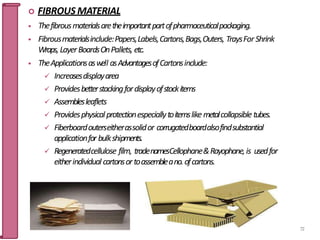
 FIBROUS MATERIAL
 Thefibrousmaterialsaretheimportantpartofpharmaceuticalpackaging.
 Fibrousmaterialsinclude:Papers,Labels,Cartons,Bags,Outers, TraysForShrink
Wraps,LayerBoardsOnPallets, etc.
 TheApplicationsaswell asAdvantagesofCartonsinclude:
 Increasesdisplayarea
 Providesbetterstackingfordisplayofstockitems
 Assemblesleaflets
 Providesphysicalprotectionespeciallytoitemslike metalcollapsibletubes.
 Fiberboardouterseitherassolidor corrugatedboardalsofindsubstantial
applicationfor bulkshipments.
 Regeneratedcellulose film, tradenamesCellophane&Rayophane,is usedfor
eitherindividual cartonsortoassembleano.ofcartons.
72
 FILMS FOILS AND LAMINATES
• Regenerated cellulose film based on viscose ( chemical used for
manufacturingofrayon) & laminatingtwoor moretypesoffilms, cellulose
coatings, foil and paper play diff roles such as supportive, barrier, heat
seal&decorative.
• For Exam
ple:
Aluminumfoil evenin thethinnestgaugesoffersthebestbarrier properties,
whicharenotapproachedevenbythemostimpermeableplastics.
• “Metallization”: A relatively new process whereby particles of metal are
laid down onto a surface under vacuum, can significantly improve the
barrier propertiesofamaterialbutthesedonotapproach thepropertiesof
apurefoil.
• In the newer technology “Co-Extrusion”, a number of plastic plies are
extrudedincombinationtoproducecheaperlaminations.
73
• Usesoffilms, foils, laminations:
 Strippacks
 Blisterpacks
 Sachets
 Diaphragmsealsfor bottles
 Linersforboxeseitherattachedorloosebag-in-boxsystems&bags.
 Foil blisters:
When sealed with a metal foil-cover, the blister can provide a hermetic pack i.e. an isolated
system, which excludes any exchange of gases between the product & surrounding
atmosphere.
 Alu-alu foil is thebestpharmaceuticalpackagingfilmfortablets,capsules,whichis taking
placeofPVC film.
⚫ Applicabletotablets,capsules,pills, etc.
⚫ It'sagoodsubstituteforPVC sheet.
⚫ Nocracking,delaminationorpinholes
⚫ It hasthe quite good blocking properties effectively protecting drugs from water vapor,
oxygenandultraviolet.
⚫ It is particularly suitableforpackingmoisture-sensitive drugsorthosesoldin thehotand
humidareas.
54
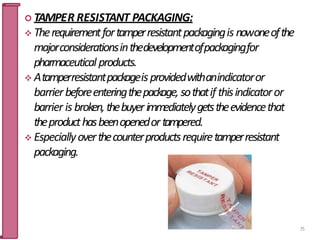
 TAMPER RESISTANT PACKAGING:
 Therequirementfortamperresistantpackagingis nowoneofthe
majorconsiderationsinthedevelopmentofpackagingfor
pharmaceutical products.
 Atamperresistantpackageisprovidedwithanindicatoror
barrierbeforeenteringthepackage, sothatif thisindicatoror
barrier is broken,thebuyerimmediatelygetstheevidencethat
theproducthasbeenopenedortampered.
 Especiallyoverthecounterproductsrequiretamperresistant
packaging.
75
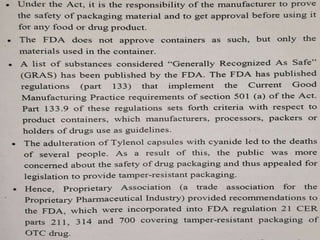
ThefollowingpackagesareapprovedbyFDAas
tamperresistantpackagingsystems:
Film wrappers
Blisterpackage
Strippackage
Bubblepack
Shrinksealsandbands
Foils, paperorplasticpouches
76
Bottleseals
Tapeseals
Breakablecaps
Sealedtubes
Aerosol containers
Sealedcartons.
 Filmwrappers
 Atransparentfilmwithdistinctivedesigniswrappedsecurelyaroundthe
entireproductcontainer.Thefilmmustbecutortorntoremovetheproduct.
Thewrappermusthaveanidentifyingcharacteristic(e.g.apattern,name,
registeredtrademark,logo,orpicture)thatcannotbereadilyduplicated.
Tintedwrappersarenotacceptable as anidentifyingcharacteristicbecause
ofthepossibilitythattheirmaterialmaybeavailabletothepublic.A
reasonablytight"fit"ofthefilmaroundthecontainermustbeachieved,e.g.
byaheatshrinktypeprocess.
 Sealingofafilmwrapperwithoverlappingendflaps
is acceptable only if theendscannotbeopenedand
resealedwithoutleavingvisibleevidenceoftampering.
Theuseofcellophanewithoverlappingendflapsisnot
acceptablebecauseofthepossibilitythattheendscan
beopenedandresealedwithoutleavingvisible evidence
thattam
peringhasoccurred. 57
 Althoughfilmcanbeaccomplishedinseveralwaysandvariesin
configurationfrompackagingequipmenttopackagingequipment,it
canbegenerallycategorizedintofollowingtypes:
 Fin sealwrapper
 End-foldedwrapper
 Shrinkwrapper
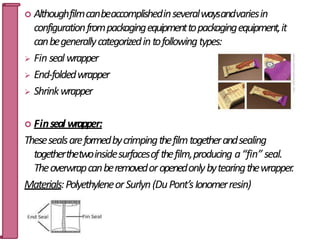
 Finseal wrapper:
Thesesealsareformedbycrimpingthefilmtogetherandsealing
togetherthetwoinsidesurfacesof thefilm,producing a“fin” seal.
Theoverwrapcanberemovedoropenedonlybytearingthewrapper.
Materials:PolyethyleneorSurlyn(DuPont’sIonomerresin)
58
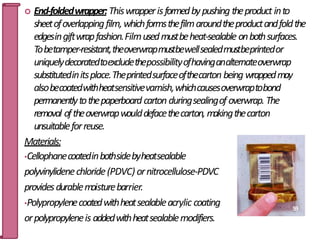
 End-foldedwrapper:Thiswrapperisformedbypushing theproduct into
sheetofoverlappingfilm,whichformsthefilmaroundtheproductandfoldthe
edgesingiftwrapfashion.Filmusedmustbeheat-sealable onbothsurfaces.
Tobetamper-resistant,theoverwrapmustbewellsealedmustbeprintedor
uniquelydecoratedtoexcludethepossibilityofhavinganalternateoverwrap
substitutedinitsplace.Theprintedsurfaceofthecarton being wrappedmay
alsobecoatedwithheatsensitivevarnish,whichcausesoverwraptobond
permanentlytothepaperboard carton duringsealingof overwrap. The
removal oftheoverwrapwoulddefacethecarton, makingthecarton
unsuitableforreuse.
Materials:
•Cellophanecoatedinbothsidebyheatsealable
polyvinylidenechloride(PDVC) ornitrocellulose-PDVC
providesdurablemoisturebarrier.
•Polypropylenecoatedwithheatsealableacrylic coating
orpolypropyleneis addedwithheatsealablemodifiers.
59
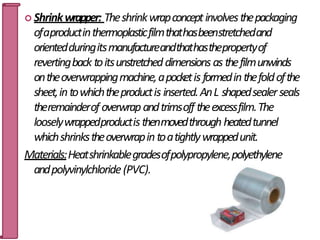
 Shrinkwrapper: Theshrinkwrapconceptinvolvesthepackaging
ofaproductinthermoplasticfilmthathasbeenstretchedand
orientedduringitsmanufactureandthathasthepropertyof
revertingback toitsunstretcheddimensions as thefilmunwinds
ontheoverwrappingmachine,apocketis formedinthefoldofthe
sheet,intowhichtheproductis inserted.AnL shapedsealerseals
theremainderof overwrapandtrimsoff theexcessfilm.The
looselywrappedproductisthenmovedthrough heatedtunnel
whichshrinkstheoverwrapintoatightlywrappedunit.
Materials:Heatshrinkablegradesofpolypropylene,polyethylene
andpolyvinylchloride(PVC).
60
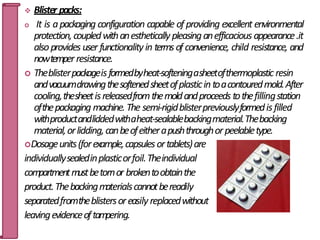
 Blister packs:
 It is apackaging configuration capable of providing excellent environmental
protection,coupledwithanestheticallypleasinganefficacious appearance.it
alsoprovides user functionalityin terms of convenience, child resistance, and
nowtemperresistance.
 Theblisterpackageisformedbyheat-softeningasheetofthermoplastic resin
andvacuumdrawingthesoftenedsheetofplasticintoacontouredmold.After
cooling,thesheetisreleasedfromthemoldandproceeds tothefillingstation
ofthepackaging machine. The semi-rigidblisterpreviouslyformedisfilled
withproductandliddedwithaheat-sealablebackingmaterial.Thebacking
material,orlidding,canbeofeitherapushthroughorpeelabletype.
Dosageunits(forexample,capsulesortablets)are
individuallysealedinplasticorfoil.Theindividual
compartmentmustbetornor brokentoobtainthe
product.Thebackingmaterialscannotbereadily
separatedfromtheblistersoreasily replacedwithout
leavingevidenceoftampering.
61
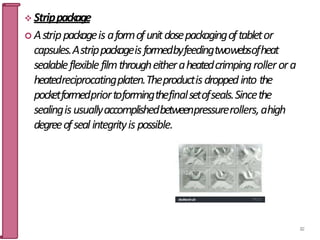
 Strippackage
 Astrippackageis aformofunitdosepackagingoftabletor
capsules.Astrippackageisformedbyfeedingtwowebsofheat
sealableflexiblefilmthrougheitheraheatedcrimpingrollerora
heatedreciprocatingplaten.Theproductisdroppedinto the
pocketformedpriortoformingthefinalsetofseals.Sincethe
sealingisusuallyaccomplishedbetweenpressurerollers,ahigh
degreeofseal integrityis possible.
82
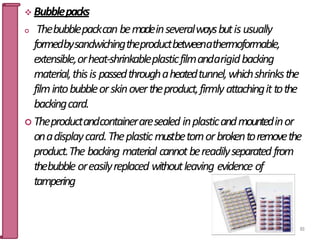
 Bubblepacks
 Thebubblepackcan bemadeinseveralwaysbutisusually
formedbysandwichingtheproductbetweenathermoformable,
extensible,orheat-shrinkableplasticfilmandarigidbacking
material,thisis passedthroughaheatedtunnel,whichshrinksthe
filmintobubbleorskinovertheproduct,firmlyattachingittothe
backingcard.
 Theproductandcontaineraresealed inplasticandmountedinor
onadisplaycard.Theplasticmustbetornorbrokentoremovethe
product.The backing material cannotbereadilyseparated from
thebubble oreasilyreplaced withoutleaving evidence of
tampering
83
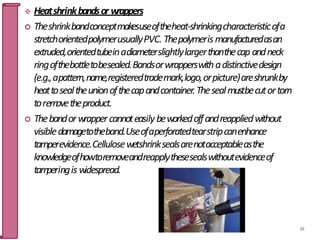
 Heatshrinkbandsor w
rappers
 Theshrinkbandconceptmakesuseoftheheat-shrinkingcharacteristicofa
stretchorientedpolymerusuallyPVC. Thepolymerismanufacturedasan
extruded,orientedtubeinadiameterslightlylargerthanthecap andneck
ringofthebottletobesealed.Bandsorwrapperswithadistinctivedesign
(e.g.,apattern,name,registeredtrademark,logo,orpicture)areshrunkby
heattosealtheunionofthecapandcontainer.Thesealmustbecutortorn
torem
ovetheproduct.
 Thebandorwrappercannoteasily beworkedoffandreappliedwithout
visibledamagetotheband.Useofaperforatedtearstripcanenhance
tamperevidence.Cellulosewetshrinksealsarenotacceptableasthe
knowledgeofhowtoremoveandreapplythesesealswithoutevidenceof
tam
peringis widespread.
84
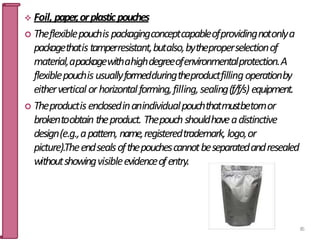
 Foil, paper,orplasticpouches
 Theflexiblepouchispackagingconceptcapableofprovidingnotonlya
packagethatistamperresistant,butalso,bytheproperselectionof
material,apackagewithahighdegreeofenvironmentalprotection.A
flexiblepouchisusuallyformedduringtheproductfillingoperationby
eithervertical orhorizontalforming,filling,sealing(f/f/s) equipment.
 Theproductisenclosedinanindividualpouchthatmustbetornor
brokentoobtain theproduct. Thepouchshouldhaveadistinctive
design(e.g.,apattern, name,registeredtrademark,logo,or
picture).Theendsealsofthepouchescannotbeseparatedandresealed
withoutshowingvisibleevidenceofentry.
85
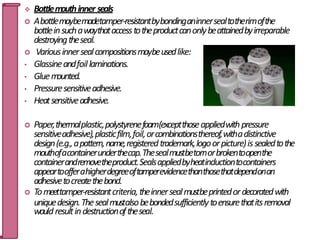
 Bottlemouthinner seals
 Abottlemaybemadetamper-resistantbybondinganinnersealtotherimofthe
bottleinsuchawaythataccesstotheproductcanonlybeattainedbyirreparable
destroyingtheseal.
 Variousinnersealcompositionsmaybeusedlike:
• Glassineandfoillaminations.
• Gluem
ounted.
• Pressuresensitiveadhesive.
• Heatsensitiveadhesive.
 Paper,thermalplastic,polystyrenefoam(exceptthoseappliedwithpressure
sensitiveadhesive),plasticfilm,foil,orcombinationsthereof,withadistinctive
design(e.g.,apattern,name,registeredtrademark,logoorpicture)is sealedtothe
mouthofacontainerunderthecap.Thesealmustbetornorbrokentoopenthe
containerandremovetheproduct.Sealsappliedbyheatinductiontocontainers
appeartoofferahigherdegreeoftamperevidencethanthosethatdependonan
adhesivetocreatethebond.
 Tomeettamper-resistantcriteria,theinnersealmustbeprintedordecoratedwith
uniquedesign.Thesealmustalsobebondedsufficientlytoensurethatitsremoval
wouldresultindestructionoftheseal. 66
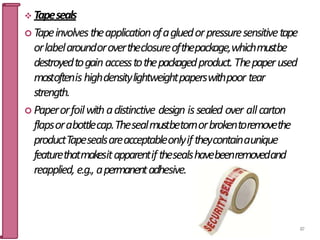
 Tapeseals
 Tapeinvolvestheapplicationofagluedorpressuresensitivetape
orlabelaroundorovertheclosureofthepackage,whichmustbe
destroyedtogainaccesstothepackagedproduct.Thepaperused
mostoftenishighdensitylightweightpaperswithpoor tear
strength.
 Paperorfoilwithadistinctive design issealed over allcarton
flapsorabottlecap.Thesealmustbetornorbrokentoremovethe
productTapesealsareacceptableonlyiftheycontainaunique
featurethatmakesitapparentifthesealshavebeenremovedand
reapplied, e.g., apermanentadhesive.
87
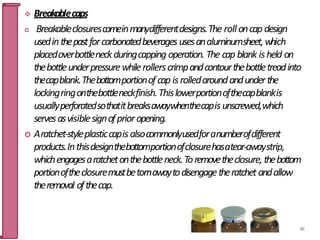
 Breakablecaps
 Breakableclosurescomeinmanydifferentdesigns.The rolloncap design
usedinthepastforcarbonatedbeveragesusesanaluminumsheet,which
placedoverbottleneckduringcapping operation. The cap blank isheld on
thebottleunderpressurewhilerollerscrimpandcontourthebottletreadinto
thecapblank.Thebottomportionof cap isrolledaroundandunderthe
lockingringonthebottleneckfinish.Thislowerportionofthecapblankis
usuallyperforatedsothatitbreaksawaywhenthecapisunscrewed,which
servesasvisiblesignofprioropening.
 Aratchet-styleplasticcapisalsocommonlyusedforanumberofdifferent
products.Inthisdesignthebottomportionofclosurehasatear-awaystrip,
whichengagesaratchetonthebottleneck.Toremovetheclosure,thebottom
portionoftheclosuremustbetornawaytodisengagetheratchet andallow
theremoval ofthecap.
88
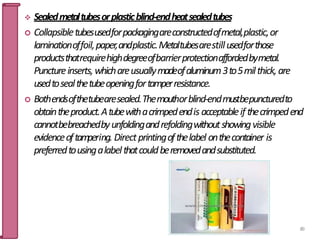
 Sealedmetaltubesorplasticblind-endheatsealedtubes
 Collapsibletubesusedforpackagingareconstructedofmetal,plastic,or
laminationoffoil,paper,andplastic.Metaltubesarestillusedforthose
productsthatrequirehighdegreeofbarrierprotectionaffordedbymetal.
Punctureinserts,whichareusuallymadeofaluminum3to5milthick,are
usedtosealthetubeopeningfortamperresistance.
 Bothendsofthetubearesealed.Themouthorblind-endmustbepuncturedto
obtaintheproduct.Atubewithacrimpedendis acceptableif thecrimpedend
cannotbebreachedbyunfoldingandrefoldingwithoutshowingvisible
evidenceoftam
pering. Directprintingofthelabel onthecontainer is
preferredtousingalabelthatcouldberemovedandsubstituted.
89
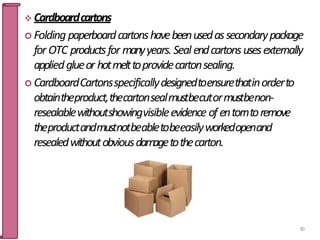
 Cardboardcartons
 Folding paperboardcartonshavebeenusedassecondarypackage
for OTC productsfor manyyears. Seal endcartonsusesexternally
appliedglueor hotmelttoprovidecartonsealing.
 CardboardCartonsspecificallydesignedtoensurethatinorderto
obtaintheproduct,thecartonsealmustbecutormustbenon-
resealablewithoutshowingvisibleevidence of entorntoremove
theproductandmustnotbeabletobeeasilyworkedopenand
resealedwithoutobviousdamagetothecarton.
90
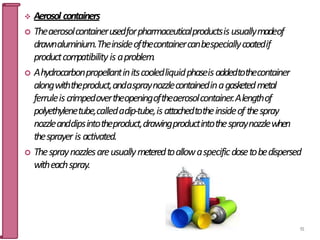
 Aerosol containers
 Theaerosolcontainerusedforpharmaceuticalproductsisusuallymadeof
drawnaluminium.Theinsideofthecontainercanbespeciallycoatedif
productcompatibilityis aproblem.
 Ahydrocarbonpropellantinitscooledliquidphaseisaddedtothecontainer
alongwiththeproduct,andaspraynozzlecontainedinagasketedmetal
ferruleiscrimpedovertheopeningoftheaerosolcontainer.Alengthof
polyethylenetube,calledadip-tube,isattachedtotheinsideof thespray
nozzleanddipsintotheproduct,drawingproductintothespraynozzlewhen
thesprayer is activated.
 Thespraynozzlesareusuallymeteredtoallowaspecificdosetobedispersed
witheachspray.
91
QUALITY CONTROL TESTS FOR GLASSES
1) CHEMICAL RESISTANT OF GLASS CONTAINERS
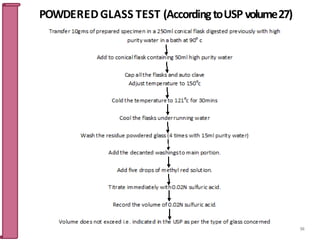
A)POWDEREDGLASS TEST: Itisdonetoestimatetheamountofalkali
leachedfromthepowderedglasswhichusuallyhappensattheelevated
temperatures.Whentheglassis powdered,leachingofalkaliis enhanced,
whichcanbetitratedwith0.02Nsulphuricacidusingmethylredasan
indicator
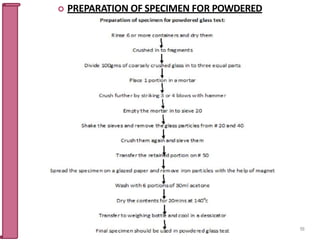
 Step-1:Preparationofglassspecimen:Fewcontainersarerinsed thoroughly
withpurified wateranddried withstreamof cleanair. Grind thecontainers in
amortartoafinepowderandpassthroughsieveno.20and50.
 Step-2: W
ashingthespecimen: 10gmoftheabovespecimenis takeninto250
mlconicalflaskandwashitwith30mlacetone.Repeatthewashing, decant
theacetoneanddriedafterwhichitis usedwithin48hr.
 Procedure:
10gmsampleisaddedwith50mlof high puritywaterina250mlflask.Placeit
inanautoclaveat121⁰C±2⁰Cfor30min.Coolitunderrunning water.Decant
thesolutionintoanotherflask,washagainwith15mlhigh purity waterand
againdecant.Titrateimmediatelywith0.02N sulphuricacidusingmethylr7
e2
d
asanindicator andrecordthevolume.
 PREPARATION OF SPECIMEN FOR POWDERED
GLASS TEST
93
POWDEREDGLASS TEST (AccordingtoUSP volume27)
94
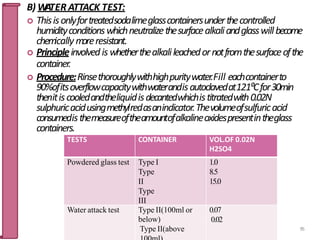
B) W
ATER ATTACK TEST:
 Thisisonlyfortreatedsodalimeglasscontainersunderthecontrolled
humidityconditionswhichneutralizethesurfacealkaliandglasswillbecome
chem
ically moreresistant.
 Principleinvolvedis whetherthealkalileachedornotfromthesurfaceofthe
container.
 Procedure:Rinsethoroughlywithhighpuritywater.Fill eachcontainerto
90%ofitsoverflowcapacitywithwaterandisautoclavedat121⁰Cfor30min
thenitiscooledandtheliquidisdecantedwhichistitratedwith0.02N
sulphuricacidusingmethylredasanindicator.Thevolumeofsulfuricacid
consumedisthemeasureoftheamountofalkalineoxidespresentintheglass
containers.
TESTS CONTAINER VOL.OF 0.02N
H2SO4
Powdered glass test Type I
Type
II
Type
III
1.0
8.5
15.0
Water attack test Type II(100ml or
below)
Type II(above
0.07
0.02
95
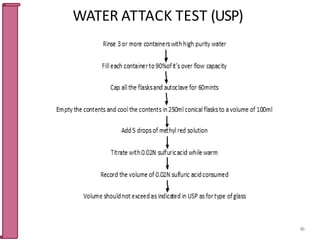
WATER ATTACK TEST (USP)
96
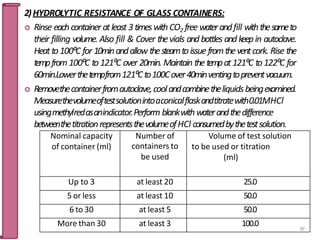
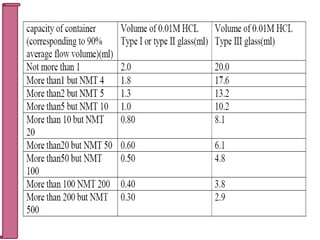
2)HYDROLYTIC RESISTANCE OF GLASS CONTAINERS:
 Rinse eachcontainer atleast 3timeswithCO2 free waterandfill withthesameto
their filling volume. Also fill & Cover thevials andbottles and keepin autoclave.
Heatto100⁰C for 10minandallow thesteamtoissue fromtheventcork. Rise the
tempfrom 100⁰C to121⁰C over 20min. Maintain thetempat121⁰C to122⁰C for
60min.Lowerthetempfrom121⁰Cto100Cover40minventingtopreventvacuum.
 Removethecontainerfromautoclave,coolandcombinetheliquidsbeingexamined.
Measurethevolumeoftestsolutionintoaconicalflaskandtitratewith0.01MHCl
usingmethylredasanindicator.Perform blankwithwaterandthedifference
betweenthetitrationrepresentsthevolumeofHCl consumedbythetestsolution.
Nominal capacity
of container (ml)
Number of
containers to
be used
Volume of test solution
to be used or titration
(ml)
Up to 3 at least 20 25.0
5 or less at least 10 50.0
6 to 30 at least 5 50.0
More than 30 at least 3 100.0 97
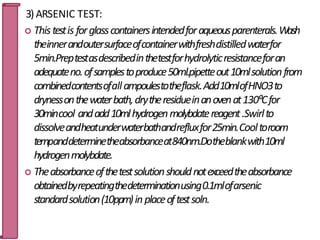
3)ARSENIC TEST:
 Thistestis forglasscontainersintendedforaqueousparenterals.Wash
theinnerandoutersurfaceofcontainerwithfreshdistilledwaterfor
5min.Preptestasdescribedinthetestforhydrolyticresistanceforan
adequateno.ofsamplestoproduce50ml.pipetteout10mlsolutionfrom
combinedcontentsofallampoulestotheflask.Add10mlofHNO3to
drynessonthewaterbath,drytheresidueinanovenat130⁰Cfor
30mincool andadd10mlhydrogenmolybdatereagent.Swirlto
dissolveandheatunderwaterbathandrefluxfor25min.Cooltoroom
tempanddeterminetheabsorbanceat840nm.Dotheblankwith10ml
hydrogenmolybdate.
 Theabsorbanceofthetestsolutionshouldnotexceedtheabsorbance
obtainedbyrepeatingthedeterminationusing0.1mlofarsenic
standardsolution(10ppm)inplaceoftestsoln.
79
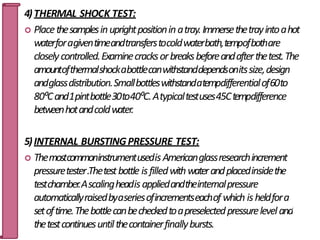
4)THERMAL SHOCK TEST:
 Placethesamplesinuprightpositioninatray.Immersethetrayintoahot
waterforagiventimeandtransferstocoldwaterbath,tempofbothare
closelycontrolled.Examinecracksorbreaksbeforeandafterthetest.The
amountofthermalshockabottlecanwithstanddependsonitssize,design
andglassdistribution.Smallbottleswithstandatempdifferentialof60to
80⁰Cand1pintbottle30to40⁰C.Atypicaltestuses45Ctempdifference
betweenhotandcoldwater.
5)INTERNAL BURSTINGPRESSURE TEST:
 ThemostcommoninstrumentusedisAmericanglassresearchincrement
pressuretester.Thetestbottle isfilledwithwaterandplacedinsidethe
testchamber.Ascalingheadisappliedandtheinternalpressure
automaticallyraisedbyaseriesofincrementseachof which isheldfora
setoftime.Thebottlecanbecheckedtoapreselectedpressureleveland8
0
thetestcontinuesuntilthecontainerfinallybursts.