CAPSULES
NARESH GORANTLA M.Pharm., (Ph.D)
Assoc. Professor,
Dept of Pharmaceutics,
Balaji college of Pharmacy,
Ananthapuramu
CAPSULES
"Capsules are solid dosage forms in which one or more
medicaments are enclosed in a water soluble bio
degradable shell made up of gelatin“
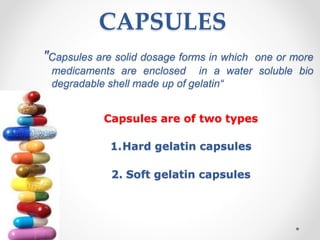
Capsules are of two types
1.Hard gelatin capsules
2. Soft gelatin capsules
Hard gelatin capsules
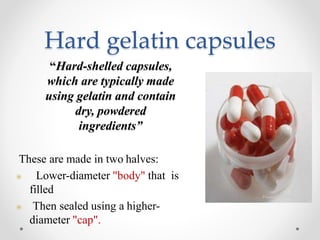
“Hard-shelled capsules,
which are typically made
using gelatin and contain
dry, powdered
ingredients”
These are made in two halves:
 Lower-diameter "body" that is
filled
 Then sealed using a higher-
diameter "cap".
Soft Gelatin capsules
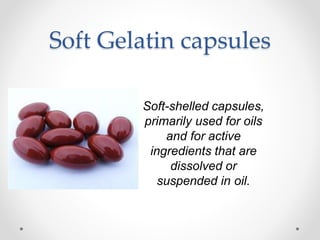
Soft-shelled capsules,
primarily used for oils
and for active
ingredients that are
dissolved or
suspended in oil.
• Advantages:
 Neat and elegant in appearance.
 Tasteless shell to mask the unpleasant taste/odor of the drug.
 Commonly embossed or imprinted on their surface the manufacturer’s
name and product code readily identified.
 The ready solubility of gelatin at gastric pH provides rapid release of
medication in the stomach.
 Packaged and shipped by manufacturers at lower cost less breakage than
liquid forms.
 More stable and longer shelf life.
Disadvantages:
 Capsules are not suitable for liquids that dissolve gelatin, such
as aqueous or hydro alcoholic solutions.
The concentrated solutions which require previous dilution are
unsuitable for capsules because if administered as such lead to
irritation into stomach.
Not useful for efflorescent or deliquescent materials.
Efflorescent cause capsules to soften & Deliquescent may dry
the capsule shell to brittleness.
Constituents of capsule shells
Constituents Examples Function
Gelatin Type A, Type B
Plasticizers Glycerine USP,
glycerol (85% & 98%)
Imparts softness,
Elasticity & hardness
Preservatives Methyl paraben,
Sorbic acid (0.2%)
Retard growth of
microorganisms
Solvents Oils Elegance
Opacifying agents Tio2(0.2-1.2%) Minimize transparency
Colours Veg. colours,FD&C
D&C water soluble dyes,
certified lakes
Gives pleasant appearance to
the shells.
Flavours Ethyl vanillin(0.1-2%) Good flavour
Sugars Sucrose( up to 5%) Sweet taste
Thickening agents Methyl cellulose Adjust viscosity of gelatin
Water
GELATIN
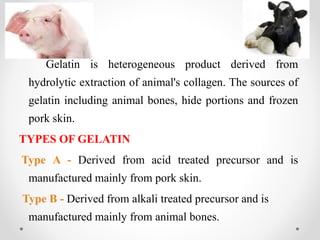
Gelatin is heterogeneous product derived from
hydrolytic extraction of animal's collagen. The sources of
gelatin including animal bones, hide portions and frozen
pork skin.
TYPES OF GELATIN
Type A - Derived from acid treated precursor and is
manufactured mainly from pork skin.
Type B - Derived from alkali treated precursor and is
manufactured mainly from animal bones.
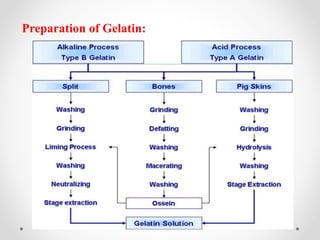
Preparation of Gelatin:
HARD GELATIN CAPSULES
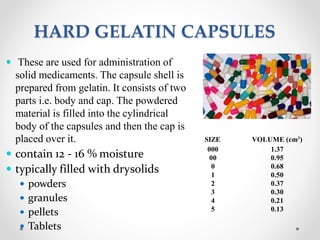
 These are used for administration of
solid medicaments. The capsule shell is
prepared from gelatin. It consists of two
parts i.e. body and cap. The powdered
material is filled into the cylindrical
body of the capsules and then the cap is
placed over it.
 contain 12 - 16 % moisture
 typically filled with drysolids
 powders
 granules
 pellets
 Tablets
SIZE VOLUME (cm3
)
000 1.37
00 0.95
0 0.68
1 0.50
2 0.37
3 0.30
4 0.21
5 0.13
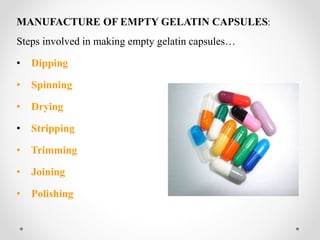
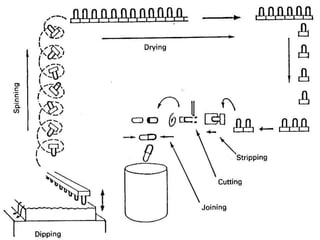
MANUFACTURE OF EMPTY GELATIN CAPSULES:
Steps involved in making empty gelatin capsules…
• Dipping
• Spinning
• Drying
• Stripping
• Trimming
• Joining
• Polishing
• DIPPING :
Pairs of the stainless steel pins are dipped into the dipping solution
to simultaneously form the caps and bodies.
The dipping solution is maintained at a temperature of about 50 degree
centigrade in a heated ,jacketed dipping pan.
• SPINNING:
The pins are rotated to distribute the gelatin over the pins unifomly and
to avoid the formation of a bead at the capsule ends.
• DRYING :
The gelatin is dried by a blast of cool air to form a hard shells.
The pins are moved through a series of air drying kilns to remove
water
• STRIPPING :
A series of bronze jaws strip the cap and body portions of the
capsules from the pins.
• The stripped cap and body portions are trimmed to the
required length by stationary knives.
• After trimming to the right length, the cap and body
portion are joined and ejected from the machine.
POLISHING
Pan Polishing : Acela-cota pan is used to dust and polish.
Cloth Dusting : Capsule are rubbed with cloth.
Brushing : Capsule are feed under soft rotating brush.
TRIMMING AND JOINING
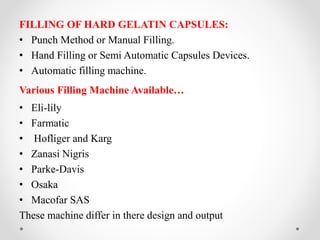
Filling of Hard Gel capsules
FILLING OF HARD GELATIN CAPSULES:
• Punch Method or Manual Filling.
• Hand Filling or Semi Automatic Capsules Devices.
• Automatic filling machine.
Various Filling Machine Available…
• Eli-lily
• Farmatic
• Hofliger and Karg
• Zanasi Nigris
• Parke-Davis
• Osaka
• Macofar SAS
These machine differ in there design and output
In large scale or small preparations of filled hard gelatin
capsules divided into the following general steps:
Developing and preparing formulation.
Filling the capsule shell
Capsule sealing
Cleaning and polishing the filled capsules.
• Diluents and fillers: lactose, microcrystaline cellulose,
starch.
• Disintegrants: sodium starch glycolate , pregelatinised
starch
• Gligants and lubricants: silicon dioxide, magnesium
stearte, calcium stearate
• Wetting agents: SLS
• Punch Method:
• - Powder is placed on a sheet of a clean paper or porcelain plate
using spatula which is formed into a cake having a depth of
approximately one-fourth to one-third the length of the capsule
body.
• - Then empty capsule body is held between the thumb and
forefinger and punched vertically into the powder cake
repeatedly until filled.
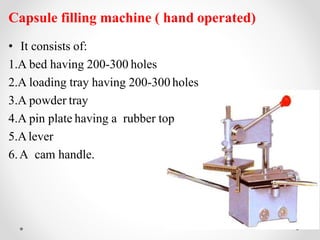
Capsule filling machine ( hand operated)
• It consists of:
1.A bed having 200-300 holes
2.A loading tray having 200-300 holes
3.A powder tray
4.A pin plate having a rubber top
5.Alever
6.A cam handle.
The empty capsules are filled in the loading tray and it is placed over the bed
↓
The cam handle is operated to separate the capsule caps fromtheir bodies.
↓
The powder tray is placed in a proper position and filled with an accurate
quantity of powder with scraper.
↓
The excess of powder is collected on the platform of the powder tray
↓
The pin plate is lowered and the filled powder is pressed by moving the pin
downwards
↓
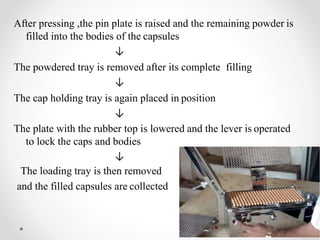
After pressing ,the pin plate is raised and the remaining powder is
filled into the bodies of the capsules
↓
The powdered tray is removed after its complete filling
↓
The cap holding tray is again placed in position
↓
The plate with the rubber top is lowered and the lever is operated
to lock the caps and bodies
↓
The loading tray is then removed
and the filled capsules are collected
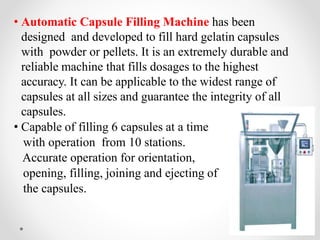
• Automatic Capsule Filling Machine has been
designed and developed to fill hard gelatin capsules
with powder or pellets. It is an extremely durable and
reliable machine that fills dosages to the highest
accuracy. It can be applicable to the widest range of
capsules at all sizes and guarantee the integrity of all
capsules.
• Capable of filling 6 capsules at a time
with operation from 10 stations.
Accurate operation for orientation,
opening, filling, joining and ejecting of
the capsules.
• Finishing of Capsules:
 Cloth dusting: Capsule are rubbed with cloth.
 Polishing
• Pan Polishing : Acela-cota pan is used to dust and
polish which is lined with cheese or a polyurethane cloth.
 Brushing : Capsule are feed under soft rotating brush
• Sorting:
• Rotosort – 1,50,000 capsules/hr.
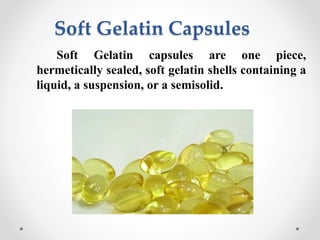
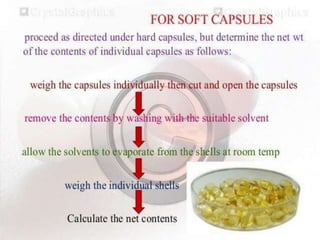
Soft Gelatin Capsules
Soft Gelatin capsules are one piece,
hermetically sealed, soft gelatin shells containing a
liquid, a suspension, or a semisolid.
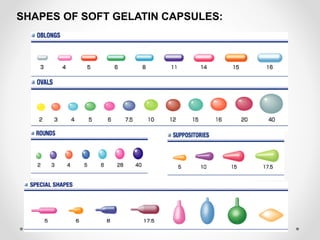
SHAPES OF SOFT GELATIN CAPSULES:
Composition of shell of Soft gel capsules
• The capsule shell is basically composed of Gelatin, a plasticizer
& water. It may contain additional ingredients such as
preservative, coloring & opacifying agents, flavorings, sugars,
acids & medicaments to achieve desired effects
• 1. Capsule shell WATER: NMT 45% w/w the ratio by
weight of water to dry gelatin can vary from 0.7to1.3(water) to
1.0(dry gelatin) depending on the viscosity of the gelatin being
used.
• .2. PLASTICIZER:
• Used to make the soft gel shell elastic & pliable.
• Ratio used is between 0.3 to 1.8 for soft to hard shell on dry
basis. E.g. glycerin , sorbitol.
3.COLOUR:
Used in shell has to be darker than colour of encapsulating
material colours may be natural or synthetic.
4.OPACIFIER:
Usually titanium dioxide, may be added to produce an
opaque shell ,when the fill formulation is a suspension or to
prevent photo degradation of light sensitive fill ingredients.
Concentration of opacifier may be up to 0.5%
5.Chelating Agents:
Iron is always present in raw gelatin, & should not contain
iron more than 15 ppm. Additionally chelating agent may be
used for preventing the reaction of iron with materials or
colours.
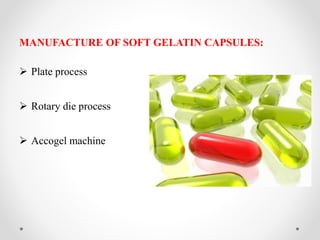
MANUFACTURE OF SOFT GELATIN CAPSULES:
 Plate process
 Rotary die process
 Accogel machine
Plate Process
• A warm sheet of gelatin is placed on the bottom plate of
the mold.
• The liquid medication is poured on it.
• Then the second sheet of the prepared gelatin is carefully
laid in place on top of the medication,and the top plate of
the mold is put in place.
• The entire mold is then subjected to a press where pressure
is applied to form fill and seal the capsules simultaneously.
• Then the capsule is removed.
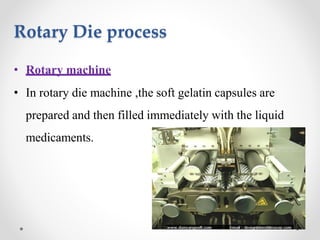
Rotary Die process
• Rotary machine
• In rotary die machine ,the soft gelatin capsules are
prepared and then filled immediately with the liquid
medicaments.
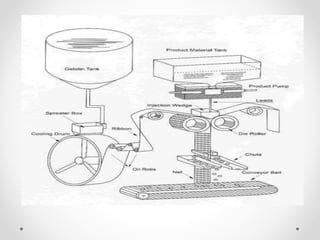
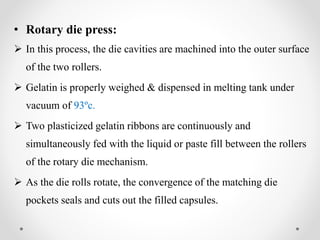
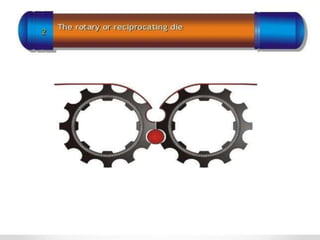
• Rotary die press:
 In this process, the die cavities are machined into the outer surface
of the two rollers.
 Gelatin is properly weighed & dispensed in melting tank under
vacuum of 93ºc.
 Two plasticized gelatin ribbons are continuously and
simultaneously fed with the liquid or paste fill between the rollers
of the rotary die mechanism.
 As the die rolls rotate, the convergence of the matching die
pockets seals and cuts out the filled capsules.
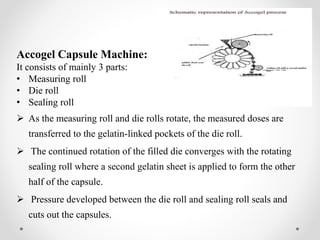
Accogel Capsule Machine:
It consists of mainly 3 parts:
• Measuring roll
• Die roll
• Sealing roll
 As the measuring roll and die rolls rotate, the measured doses are
transferred to the gelatin-linked pockets of the die roll.
 The continued rotation of the filled die converges with the rotating
sealing roll where a second gelatin sheet is applied to form the other
half of the capsule.
 Pressure developed between the die roll and sealing roll seals and
cuts out the capsules.
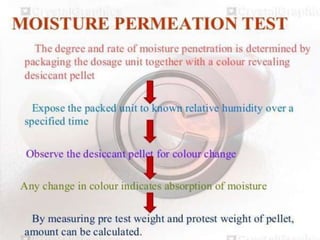
EVALUTION OF CAPSULES:
(1) Weight variation test
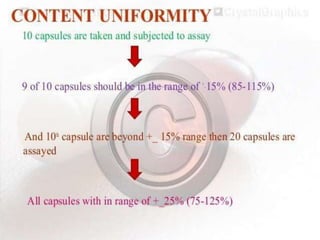
(2) Content uniformity
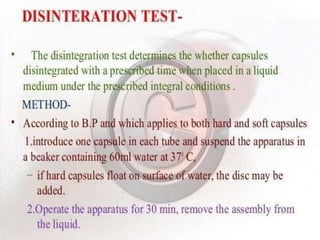
(3) Disintegration test
(4)Dissolution test
(5)Moisture permeation test
Weight variation test:
•20 capsules are taken at random and weighed.
•Their average weight is calculated, then each capsule is
weighed individually and their weight is noted.
•The capsule passes the test if the weight of individual capsule
falls with in 90-110% of the average weight.
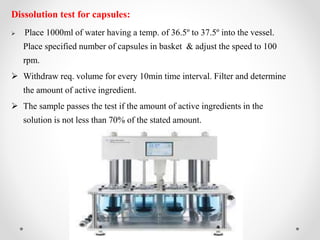
Dissolution test for capsules:
 Place 1000ml of water having a temp. of 36.5º to 37.5º into the vessel.
Place specified number of capsules in basket & adjust the speed to 100
rpm.
 Withdraw req. volume for every 10min time interval. Filter and determine
the amount of active ingredient.
 The sample passes the test if the amount of active ingredients in the
solution is not less than 70% of the stated amount.
PACKING & STORAGE OF CAPSULES:
Capsules should be packed well closed glass & plastic container &
stored at temp. not exceeding 30ºc. Capsules are individually
protected by enclosing in strip & blister packaging.
 In strip packing the capsule is hermetically sealed within the strips
of an aluminum or plastic film.
 In blister packs, a press on the blister forces the capsule through
the backing strip.
Capsules have a larger shelf life in unopened glass bottles than in strip
pack & but this is reversed.
THANK YOU

Capsules

  • 1.
    CAPSULES NARESH GORANTLA M.Pharm.,(Ph.D) Assoc. Professor, Dept of Pharmaceutics, Balaji college of Pharmacy, Ananthapuramu
  • 2.
    CAPSULES "Capsules are soliddosage forms in which one or more medicaments are enclosed in a water soluble bio degradable shell made up of gelatin“ Capsules are of two types 1.Hard gelatin capsules 2. Soft gelatin capsules
  • 3.
    Hard gelatin capsules “Hard-shelledcapsules, which are typically made using gelatin and contain dry, powdered ingredients” These are made in two halves:  Lower-diameter "body" that is filled  Then sealed using a higher- diameter "cap".
  • 4.
    Soft Gelatin capsules Soft-shelledcapsules, primarily used for oils and for active ingredients that are dissolved or suspended in oil.
  • 5.
    • Advantages:  Neatand elegant in appearance.  Tasteless shell to mask the unpleasant taste/odor of the drug.  Commonly embossed or imprinted on their surface the manufacturer’s name and product code readily identified.  The ready solubility of gelatin at gastric pH provides rapid release of medication in the stomach.  Packaged and shipped by manufacturers at lower cost less breakage than liquid forms.  More stable and longer shelf life.
  • 6.
    Disadvantages:  Capsules arenot suitable for liquids that dissolve gelatin, such as aqueous or hydro alcoholic solutions. The concentrated solutions which require previous dilution are unsuitable for capsules because if administered as such lead to irritation into stomach. Not useful for efflorescent or deliquescent materials. Efflorescent cause capsules to soften & Deliquescent may dry the capsule shell to brittleness.
  • 7.
    Constituents of capsuleshells Constituents Examples Function Gelatin Type A, Type B Plasticizers Glycerine USP, glycerol (85% & 98%) Imparts softness, Elasticity & hardness Preservatives Methyl paraben, Sorbic acid (0.2%) Retard growth of microorganisms Solvents Oils Elegance Opacifying agents Tio2(0.2-1.2%) Minimize transparency Colours Veg. colours,FD&C D&C water soluble dyes, certified lakes Gives pleasant appearance to the shells. Flavours Ethyl vanillin(0.1-2%) Good flavour Sugars Sucrose( up to 5%) Sweet taste Thickening agents Methyl cellulose Adjust viscosity of gelatin Water
  • 8.
    GELATIN Gelatin is heterogeneousproduct derived from hydrolytic extraction of animal's collagen. The sources of gelatin including animal bones, hide portions and frozen pork skin. TYPES OF GELATIN Type A - Derived from acid treated precursor and is manufactured mainly from pork skin. Type B - Derived from alkali treated precursor and is manufactured mainly from animal bones.
  • 9.
  • 10.
    HARD GELATIN CAPSULES These are used for administration of solid medicaments. The capsule shell is prepared from gelatin. It consists of two parts i.e. body and cap. The powdered material is filled into the cylindrical body of the capsules and then the cap is placed over it.  contain 12 - 16 % moisture  typically filled with drysolids  powders  granules  pellets  Tablets SIZE VOLUME (cm3 ) 000 1.37 00 0.95 0 0.68 1 0.50 2 0.37 3 0.30 4 0.21 5 0.13
  • 11.
    MANUFACTURE OF EMPTYGELATIN CAPSULES: Steps involved in making empty gelatin capsules… • Dipping • Spinning • Drying • Stripping • Trimming • Joining • Polishing
  • 13.
    • DIPPING : Pairsof the stainless steel pins are dipped into the dipping solution to simultaneously form the caps and bodies. The dipping solution is maintained at a temperature of about 50 degree centigrade in a heated ,jacketed dipping pan. • SPINNING: The pins are rotated to distribute the gelatin over the pins unifomly and to avoid the formation of a bead at the capsule ends. • DRYING : The gelatin is dried by a blast of cool air to form a hard shells. The pins are moved through a series of air drying kilns to remove water • STRIPPING : A series of bronze jaws strip the cap and body portions of the capsules from the pins.
  • 14.
    • The strippedcap and body portions are trimmed to the required length by stationary knives. • After trimming to the right length, the cap and body portion are joined and ejected from the machine. POLISHING Pan Polishing : Acela-cota pan is used to dust and polish. Cloth Dusting : Capsule are rubbed with cloth. Brushing : Capsule are feed under soft rotating brush. TRIMMING AND JOINING
  • 15.
    Filling of HardGel capsules
  • 16.
    FILLING OF HARDGELATIN CAPSULES: • Punch Method or Manual Filling. • Hand Filling or Semi Automatic Capsules Devices. • Automatic filling machine. Various Filling Machine Available… • Eli-lily • Farmatic • Hofliger and Karg • Zanasi Nigris • Parke-Davis • Osaka • Macofar SAS These machine differ in there design and output
  • 17.
    In large scaleor small preparations of filled hard gelatin capsules divided into the following general steps: Developing and preparing formulation. Filling the capsule shell Capsule sealing Cleaning and polishing the filled capsules. • Diluents and fillers: lactose, microcrystaline cellulose, starch. • Disintegrants: sodium starch glycolate , pregelatinised starch • Gligants and lubricants: silicon dioxide, magnesium stearte, calcium stearate • Wetting agents: SLS
  • 18.
    • Punch Method: •- Powder is placed on a sheet of a clean paper or porcelain plate using spatula which is formed into a cake having a depth of approximately one-fourth to one-third the length of the capsule body. • - Then empty capsule body is held between the thumb and forefinger and punched vertically into the powder cake repeatedly until filled.
  • 19.
    Capsule filling machine( hand operated) • It consists of: 1.A bed having 200-300 holes 2.A loading tray having 200-300 holes 3.A powder tray 4.A pin plate having a rubber top 5.Alever 6.A cam handle.
  • 20.
    The empty capsulesare filled in the loading tray and it is placed over the bed ↓ The cam handle is operated to separate the capsule caps fromtheir bodies. ↓ The powder tray is placed in a proper position and filled with an accurate quantity of powder with scraper. ↓ The excess of powder is collected on the platform of the powder tray ↓ The pin plate is lowered and the filled powder is pressed by moving the pin downwards ↓
  • 21.
    After pressing ,thepin plate is raised and the remaining powder is filled into the bodies of the capsules ↓ The powdered tray is removed after its complete filling ↓ The cap holding tray is again placed in position ↓ The plate with the rubber top is lowered and the lever is operated to lock the caps and bodies ↓ The loading tray is then removed and the filled capsules are collected
  • 22.
    • Automatic CapsuleFilling Machine has been designed and developed to fill hard gelatin capsules with powder or pellets. It is an extremely durable and reliable machine that fills dosages to the highest accuracy. It can be applicable to the widest range of capsules at all sizes and guarantee the integrity of all capsules. • Capable of filling 6 capsules at a time with operation from 10 stations. Accurate operation for orientation, opening, filling, joining and ejecting of the capsules.
  • 23.
    • Finishing ofCapsules:  Cloth dusting: Capsule are rubbed with cloth.  Polishing • Pan Polishing : Acela-cota pan is used to dust and polish which is lined with cheese or a polyurethane cloth.  Brushing : Capsule are feed under soft rotating brush • Sorting: • Rotosort – 1,50,000 capsules/hr.
  • 24.
    Soft Gelatin Capsules SoftGelatin capsules are one piece, hermetically sealed, soft gelatin shells containing a liquid, a suspension, or a semisolid.
  • 25.
    SHAPES OF SOFTGELATIN CAPSULES:
  • 26.
    Composition of shellof Soft gel capsules • The capsule shell is basically composed of Gelatin, a plasticizer & water. It may contain additional ingredients such as preservative, coloring & opacifying agents, flavorings, sugars, acids & medicaments to achieve desired effects • 1. Capsule shell WATER: NMT 45% w/w the ratio by weight of water to dry gelatin can vary from 0.7to1.3(water) to 1.0(dry gelatin) depending on the viscosity of the gelatin being used. • .2. PLASTICIZER: • Used to make the soft gel shell elastic & pliable. • Ratio used is between 0.3 to 1.8 for soft to hard shell on dry basis. E.g. glycerin , sorbitol.
  • 27.
    3.COLOUR: Used in shellhas to be darker than colour of encapsulating material colours may be natural or synthetic. 4.OPACIFIER: Usually titanium dioxide, may be added to produce an opaque shell ,when the fill formulation is a suspension or to prevent photo degradation of light sensitive fill ingredients. Concentration of opacifier may be up to 0.5% 5.Chelating Agents: Iron is always present in raw gelatin, & should not contain iron more than 15 ppm. Additionally chelating agent may be used for preventing the reaction of iron with materials or colours.
  • 28.
    MANUFACTURE OF SOFTGELATIN CAPSULES:  Plate process  Rotary die process  Accogel machine
  • 29.
    Plate Process • Awarm sheet of gelatin is placed on the bottom plate of the mold. • The liquid medication is poured on it. • Then the second sheet of the prepared gelatin is carefully laid in place on top of the medication,and the top plate of the mold is put in place. • The entire mold is then subjected to a press where pressure is applied to form fill and seal the capsules simultaneously. • Then the capsule is removed.
  • 30.
    Rotary Die process •Rotary machine • In rotary die machine ,the soft gelatin capsules are prepared and then filled immediately with the liquid medicaments.
  • 32.
    • Rotary diepress:  In this process, the die cavities are machined into the outer surface of the two rollers.  Gelatin is properly weighed & dispensed in melting tank under vacuum of 93ºc.  Two plasticized gelatin ribbons are continuously and simultaneously fed with the liquid or paste fill between the rollers of the rotary die mechanism.  As the die rolls rotate, the convergence of the matching die pockets seals and cuts out the filled capsules.
  • 34.
    Accogel Capsule Machine: Itconsists of mainly 3 parts: • Measuring roll • Die roll • Sealing roll  As the measuring roll and die rolls rotate, the measured doses are transferred to the gelatin-linked pockets of the die roll.  The continued rotation of the filled die converges with the rotating sealing roll where a second gelatin sheet is applied to form the other half of the capsule.  Pressure developed between the die roll and sealing roll seals and cuts out the capsules.
  • 35.
    EVALUTION OF CAPSULES: (1)Weight variation test (2) Content uniformity (3) Disintegration test (4)Dissolution test (5)Moisture permeation test
  • 36.
    Weight variation test: •20capsules are taken at random and weighed. •Their average weight is calculated, then each capsule is weighed individually and their weight is noted. •The capsule passes the test if the weight of individual capsule falls with in 90-110% of the average weight.
  • 41.
    Dissolution test forcapsules:  Place 1000ml of water having a temp. of 36.5º to 37.5º into the vessel. Place specified number of capsules in basket & adjust the speed to 100 rpm.  Withdraw req. volume for every 10min time interval. Filter and determine the amount of active ingredient.  The sample passes the test if the amount of active ingredients in the solution is not less than 70% of the stated amount.
  • 43.
    PACKING & STORAGEOF CAPSULES: Capsules should be packed well closed glass & plastic container & stored at temp. not exceeding 30ºc. Capsules are individually protected by enclosing in strip & blister packaging.  In strip packing the capsule is hermetically sealed within the strips of an aluminum or plastic film.  In blister packs, a press on the blister forces the capsule through the backing strip. Capsules have a larger shelf life in unopened glass bottles than in strip pack & but this is reversed.
  • 44.