Presented By
Miss. Rajdeo Archana Vitthal
M.Pharm
Assistant Prof.
PRES’S Institute of Pharmacy Loni
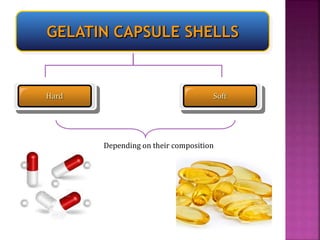
Hard Soft
Depending on their composition
3
There are two basic types of gelatin
TYPE A
It is manufactured mainly from pork skin.
TYPE B
It is manufactured mainly from animal bones
4
• DEFINITION:-
These are solid dosage form of medicaments, in which
drug is enclosed within the shells made up of gelatin.
These capsules are made up of gelatin blends, small
amount of certified dyes, opaquants, plasticizers and
preservatives.
HARD GELATIN CAPSULE
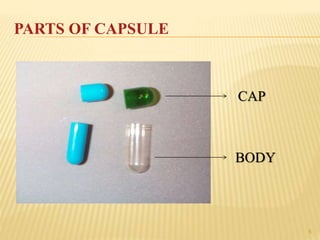
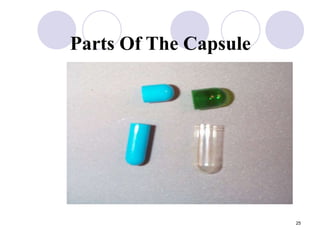
PARTS OF CAPSULE
5
CAP
BODY
7
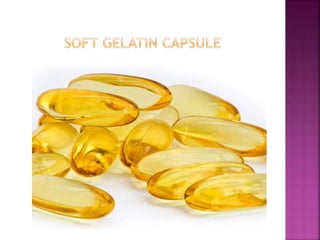
SOFT GELATIN CAPSULE
Definition:-
Soft Gelatin capsules are one piece, hermetically sealed,
soft gelatin shells containing a liquid, a suspension, or a
semisolid.
Soft gelatin is mainly composed of gelatin, plasticizers,
preservative, colouring and opacifying agents, flavoring
agents and sugars.
APPLICATION OF SOFT GELATIN CAPSULE:
The pharmaceutical applications of soft gelatin capsules
are:
as an oral dosage form
as a suppository dosage form
as a specialty package in tube form, for human and
veterinary use, single dose application for topical,
ophthalmic, and rectal ointments.
8
Gelatin
Water
Opacifying agents
Plasticizer
Preservatives
10
Plasticizer and Gelatin ratio
In soft gelatin capsule the amount of plasticizers used is
more
In soft gelatin capsule the plasticizer and gelatin ratio is
0.8 : 1
In hard gelatin capsule the plasticizer and gelatin ratio is
0.4 : 1
11
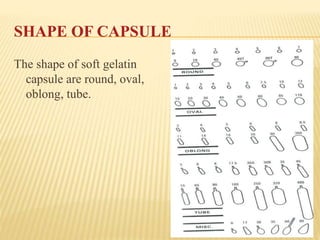
SHAPE OF CAPSULE
The shape of soft gelatin
capsule are round, oval,
oblong, tube.
13
Advantages of capsules
for oral administration
1. Easy to swallow due to their smooth and slippery
nature.
2. Easy to handle and carry.
3. Can mask the unpleasant taste and odour of drug using
tasteless shell.
4. More stable and have longer half life than liquid dosage
forms
5. Better bioavailability than tablets and faster onset of
action than tablets.
6. The shells are physiologically inert and easily and
quickly digested in the gastrointestinal tract.
7. The shells can be opacified (with titanium dioxide) or
coloured, to give protection from light.
Disadvantages of capsules
1. The drugs which are hygroscopic absorb water from
the capsule shell making it brittle and hence are not
suitable for filling into capsules.
2. Aqueous or hydro alcoholic liquids cannot be
enclosed in capsules because they dissolve gelatin.
3. Capsules should not be used for packaging of highly
water-soluble material such as ammonium chloride,
KBr, KCl etc. because sudden release of such
compounds can cause irritation in the stomach.
7. The shells can be opacified (with titanium dioxide) or
coloured, to give protection from light.
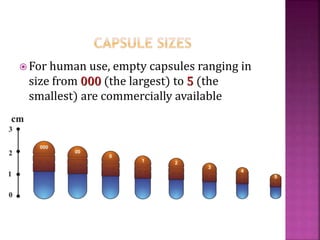
 For human use, empty capsules ranging in
size from 000 (the largest) to 5 (the
smallest) are commercially available
16
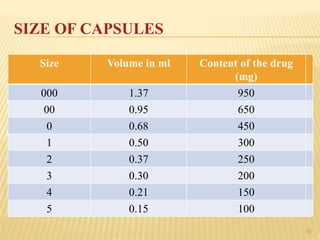
SIZE OF CAPSULES
Size Volume in ml Content of the drug
(mg)
000 1.37 950
00 0.95 650
0 0.68 450
1 0.50 300
2 0.37 250
3 0.30 200
4 0.21 150
5 0.15 100
17
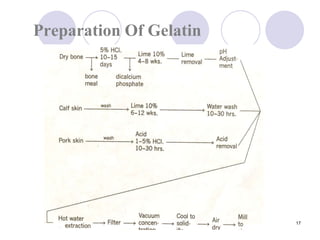
Preparation Of Gelatin
18
Gelatin charecteristics
 Type A gelatin produced by acid hydrolysis, is
manufactured mainly from pork skin
 Type B gelatin produced by alkaline hydrolysis, is
manufactured mainly from animal bones
 The two types are differentiated by isoelectric points
(4.8-5.0 for type B and 7.0-9.0 for type A) and their
viscosity building properties and film-forming
characteristics.
 Bone gelatin contributes firmness, where as pork skin
gelatin contributes plasticity clarity
19
The gelatin solubility :
Insoluble in cold water, soften through the absorption of
up to ten times its weight of water; soluble in hot water
and in warm gastric fluid.
Gelatin, being a protein, is digested by proteolytic
enzymes in stomack
20
Other shell materials
HPMC: Hydroxy propyl methyl cellulose
• HPMC capsules can be made by dipping
technology
• HPMC capsules generally have lower
Equilibrium Moisture Content (EMC) than gelatin
capsules and may show better physical stability on
exposure to extremely low humidities
21
Preparation of filled hard gelatin
capsules
The general steps of preparation:
1) developing and preparing the formulation and
selecting the size of capsule.
2) filling the capsule shells.
3) capsule sealing.
4) cleansing and polishing the filled capsules.
22
Developing the formulation and selection
of capsule size
The pharmaceutical processing in the preparation
of filled hard gelatin capsules
1) Blending: → uniform powder mix, uniform drug
distribution
2) Comminution/Milling: 50~100 microns, suitable
for a drug of low dose (10mg or greater)
3) Micronization: 10~20 microns, suitable for
drugs of lower dose
23
The pharmaceutical excipient in the preparation of filled hard
gelatin capsules
 Diluent/Filler: to produce the proper capsule fill volume; to
provide cohesion to the powders,
e.g. lactose, microcrystalline cellulose and starch
 Disintegrants/Disintegration agents: to assist the break-up and
distribution of the capsule contents
e.g. pre gelatinized starch
 Lubricant or Glidant: to enhance the flow properties of the
powder mix ,e.g. fumed silicon dioxide
 Wetting agents: to facilitate wetting of the dry powder
e.g. Surfactant
EXCIPIENTS USED IN THE FORMULATION
24
Manufacturing of hard gelatin capsule
shells`
The shell consists of two parts, the capsule body and
the capsule cap.
The process of capsule shell production with the
peg/pin method:
dipping→ drying → stripping→ trimming→
joining
The thickness of the gelatin walls must be strictly
controlled.
The caps are slightly larger in diameter than the
bodies.
25
Parts Of The Capsule
26
Capsule sizes
How to select capsule size?
1) The amount of fill material to be encapsulated
2) The density and compressibility of the fill
3) The final determination largely may be the result of
trial.
The sizes of empty capsules
 For human use: 000(the largest) to size 5 (the smallest)
 For veterinary use: No.s 10, 11and 12 having capacities
of 30, 15 and 7.5 g, respectively
27
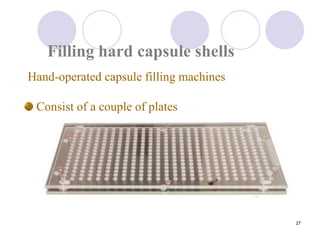
Hand-operated capsule filling machines
Consist of a couple of plates
Filling hard capsule shells
28
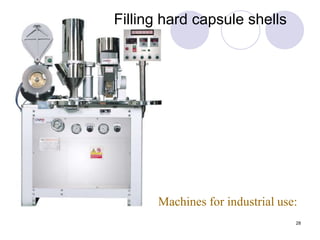
Machines for industrial use:
Filling hard capsule shells
Methods of Filling Hard Gelatin capsules
Capsule filling machine (hand operated):
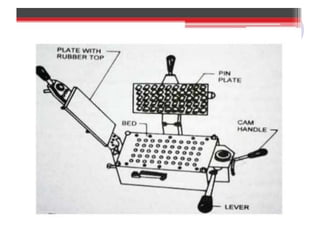
It consists of:
1. A bed having 200-300 holes
2. A loading Tray having 200-300 holes
3. A powder tray
4. A pin plate having 200-300 pins
5. A sealing plate having a rubber top
6. A lever
7. A cam handle
29
30
The Empty capsules are filled in the loading tray and
it is placed over the bed.
The cam handle is operated to separate the capsule
caps from their bodies
The powder tray is placed in a proper position and
filled with an accurate quantity of powder with
scraper. The excess of powder is collected on the
platform of the powder tray. The pin plate is lowered
and the filled powder is pressed by moving the pin
downwords. After pressing the pin plate is raised and
remaining powder is filled into the bodies of
capsules.
31
The powdered tray is removed after its complete
filling. The cap holding tray is again placed in
position. The plate with rubber top is lowered and the
lever is operated to lock the caps and bodies. The
loading tray is then removed and the filled capsules
are collected.
With a 200 hole machine, about 5000 capsules can be
filled in one hour, whereas in machine having 300
holes, about 7500 capsules can be filled in one hour.
32
Cleaning of capsules: All capsules whether they have
filled by hand or machine, will require cleaning.
Small quatities of capsules can be wiped individually
with soft cloth.But in case of large quantities,
capsules are rotated or shaken with crystalline sodium
chloride. The capsules are then rolled on cloth
covered surfaces
Sealing of capsules:
The capsules are then sealed, to ensure that the
medicaments may not come out of the capsule due to
rough handling. This can be done by banding them
with molten gelatin, laid around the joint in a strip
and dried. Capsules can be sealed by spot welding, by
means of a heated metal pin, pressed against the cap
and fusing it to the body.
33
Soft Gelatin capsules
 Method of filling of soft gelatin capsules:
Soft gelatin capsules are generally filled
mechanically. The manufacturing of capsule shell and
the filling of medicament take place simultaneously.
Now a days rotary machine is usec for this purpose.
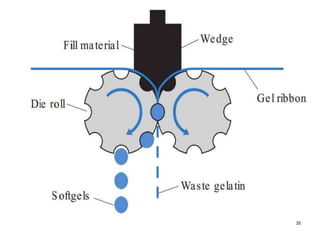
 Rotary machine: In a roratry die machine, soft gelatin
capsules are [prepared and then filled immediately
with the liquid medicaments.
The machine consists of two hoppers. Liquidgelatin
mixture is placed in one hopper and liquid
medicament in the other hopper. There are two
rotating dies whivh rotates in opposite 34
35
 directions. When fluid gelatin mixture enters into the
machine from the hopper, it produces two continuous
ribbons. These ribbons come over hopper, it produces
two continuous ribbons. These ribbons come over the
rotatinf dies from opposite directions and enter in
between thedies. Thushalf shell of the capsules is
formed. At this stage the measured quntity of
medicament is filled into it with stroke of pump. With
subsequent movement of the dies, the other half of
the capsule is formed. The two halves of capsules are
sealed together by the heat and pressure of rotating
dies. The capsules formed are washed thoroughly and
dried.These rotary machines are capable of producing
between 25000 and 30000 capsules in an hour. 36
Properties of powder to be filled in machine
The flow properties of powder depends upon its:
Particle size
Particle shape
Density
Surface texture
Angle of repose
37
Powders may be either free flowing or cohesive.
Powders having very small size,resists to flow due
to cohesive forces between their particles. In order to
have a ubiform flow of powder, the fine powder
should be removed.
Flat or elongated particles has the tendency to pack,
whereas dense particles has afree flowing property.
The flow properties of powder at the time of their
filling in capsules, can be increased by adding
glidants like talc, stearic acid and magnesium
stearate.
38
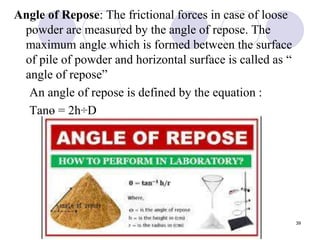
Angle of Repose: The frictional forces in case of loose
powder are measured by the angle of repose. The
maximum angle which is formed between the surface
of pile of powder and horizontal surface is called as “
angle of repose”
An angle of repose is defined by the equation :
Tanɵ = 2h
͟͟͟͟ ÷D
39
Evaluation of Capsules
Following Tests are carried out for evaluation of
capssules:
1.Uniformity of Weight.
2.Content of active ingredients in the capsules
3.Disintegration test
4.Dissolution test.
40
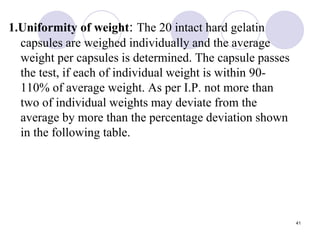
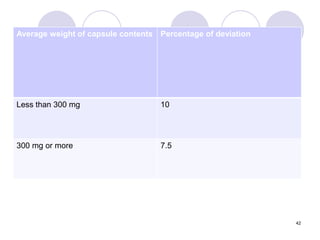
1.Uniformity of weight: The 20 intact hard gelatin
capsules are weighed individually and the average
weight per capsules is determined. The capsule passes
the test, if each of individual weight is within 90-
110% of average weight. As per I.P. not more than
two of individual weights may deviate from the
average by more than the percentage deviation shown
in the following table.
41
42
Average weight of capsule contents Percentage of deviation
Less than 300 mg 10
300 mg or more 7.5
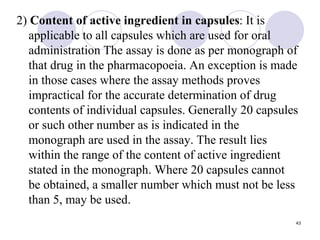
2) Content of active ingredient in capsules: It is
applicable to all capsules which are used for oral
administration The assay is done as per monograph of
that drug in the pharmacopoeia. An exception is made
in those cases where the assay methods proves
impractical for the accurate determination of drug
contents of individual capsules. Generally 20 capsules
or such other number as is indicated in the
monograph are used in the assay. The result lies
within the range of the content of active ingredient
stated in the monograph. Where 20 capsules cannot
be obtained, a smaller number which must not be less
than 5, may be used.
43
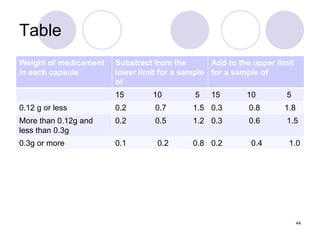
Table
Weight of medicament
in each capsule
Substract from the
lower limit for a sample
of
Add to the upper limit
for a sample of
15 10 5 15 10 5
0.12 g or less 0.2 0.7 1.5 0.3 0.8 1.8
More than 0.12g and
less than 0.3g
0.2 0.5 1.2 0.3 0.6 1.5
0.3g or more 0.1 0.2 0.8 0.2 0.4 1.0
44
Disintegration test for capsules
The apparatus used for the disintegration test for capsules is the
same as that used for disintegration test for tablet.
The disintegration test as per I.p. specifications is used for
performing the test.
The apparatus consists of :
A rigid basket-rack assembly supporting six cylindrical glass
tubes.
45
These tubes are held vertically by two superimposed transparent
plastic plates with six holes having the same diameter as the
tubes. These holes are at an equal distance from the centre of
the plate and are equally spaced from one another. Wowen
wire gauze made from stainless steel is attached to the
underside of the lower plate. The upper and lower plates are
held in position by vertical metal rods at the periphery and a
metal rod in the centre of the upper plate for attachment to a
mechanical device. The assembly should be raised and
lowered between 28 to 32 times per minute in the liquid at
37◦C.Place one capsule in each of the six tubes of basket and
suspend the aasembly in water maintained at 37°± 2°. Do not
use the discs for hard capsules except when the hard capsules
float on the top of the water, the disc may be added.When
testing soft capsules, discs may be used. Operate the apparatus
for 30 minutes in case of hard capsules and for sixty minutes
in case of soft capsules. 46
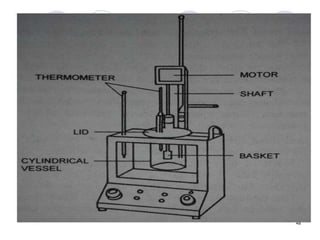
Apparatus: it consists of following parts
1.A cylindrical covered vessel made up of glass or other
transparent material having 1000ml of capacity. The vessel is
fitted with a lid having four holes, one for shaft of stirrer,
second for placing the thermometer and remaining two for
removing the sample.
2.An electric motor which is capable of rotating the basket in the
vessel at varied speed between 25 and 150 revolutions per
minute The shaft is so adjusted.
3. A cylindrical stainless steel basket made of woven wire cloth
having an aperture size of 425 µm. For use with dilute acid
media, the basket may be coated with gold. The top of basket
is attached to the disc on the driving shafter.
4. The vessel is equiped with a suitable device for the withdrawl
of samples of dissolution medium.
47
48
Place 1000ml of water free from dissolved air having
temperature of 36.5° to 37.5° into the vessel. Place the
specified number of capsules in the dry basket
Assemble the apparatus. Start motor and adjust its speed to
100 rpm or such other speed as given in monograph.
Withdraw the required Volume of solution from the vessel
after forty five minutes or after period specified in the
monograph. Filter and determine the amount of active
ingredient present by the method given in the monograph.
Repeat the complete operation four times.
The sample passes the test if the amount of active
ingredients in the solution is an not less than stated
amount given in the monograph.
49
50

Pharmaceutical capsules Pharmaceutics 20111

  • 1.
    Presented By Miss. RajdeoArchana Vitthal M.Pharm Assistant Prof. PRES’S Institute of Pharmacy Loni
  • 2.
    Hard Soft Depending ontheir composition
  • 3.
    3 There are twobasic types of gelatin TYPE A It is manufactured mainly from pork skin. TYPE B It is manufactured mainly from animal bones
  • 4.
    4 • DEFINITION:- These aresolid dosage form of medicaments, in which drug is enclosed within the shells made up of gelatin. These capsules are made up of gelatin blends, small amount of certified dyes, opaquants, plasticizers and preservatives. HARD GELATIN CAPSULE
  • 5.
  • 7.
    7 SOFT GELATIN CAPSULE Definition:- SoftGelatin capsules are one piece, hermetically sealed, soft gelatin shells containing a liquid, a suspension, or a semisolid. Soft gelatin is mainly composed of gelatin, plasticizers, preservative, colouring and opacifying agents, flavoring agents and sugars.
  • 8.
    APPLICATION OF SOFTGELATIN CAPSULE: The pharmaceutical applications of soft gelatin capsules are: as an oral dosage form as a suppository dosage form as a specialty package in tube form, for human and veterinary use, single dose application for topical, ophthalmic, and rectal ointments. 8
  • 9.
  • 10.
    10 Plasticizer and Gelatinratio In soft gelatin capsule the amount of plasticizers used is more In soft gelatin capsule the plasticizer and gelatin ratio is 0.8 : 1 In hard gelatin capsule the plasticizer and gelatin ratio is 0.4 : 1
  • 11.
    11 SHAPE OF CAPSULE Theshape of soft gelatin capsule are round, oval, oblong, tube.
  • 13.
    13 Advantages of capsules fororal administration 1. Easy to swallow due to their smooth and slippery nature. 2. Easy to handle and carry. 3. Can mask the unpleasant taste and odour of drug using tasteless shell. 4. More stable and have longer half life than liquid dosage forms 5. Better bioavailability than tablets and faster onset of action than tablets. 6. The shells are physiologically inert and easily and quickly digested in the gastrointestinal tract. 7. The shells can be opacified (with titanium dioxide) or coloured, to give protection from light.
  • 14.
    Disadvantages of capsules 1.The drugs which are hygroscopic absorb water from the capsule shell making it brittle and hence are not suitable for filling into capsules. 2. Aqueous or hydro alcoholic liquids cannot be enclosed in capsules because they dissolve gelatin. 3. Capsules should not be used for packaging of highly water-soluble material such as ammonium chloride, KBr, KCl etc. because sudden release of such compounds can cause irritation in the stomach. 7. The shells can be opacified (with titanium dioxide) or coloured, to give protection from light.
  • 15.
     For humanuse, empty capsules ranging in size from 000 (the largest) to 5 (the smallest) are commercially available
  • 16.
    16 SIZE OF CAPSULES SizeVolume in ml Content of the drug (mg) 000 1.37 950 00 0.95 650 0 0.68 450 1 0.50 300 2 0.37 250 3 0.30 200 4 0.21 150 5 0.15 100
  • 17.
  • 18.
    18 Gelatin charecteristics  TypeA gelatin produced by acid hydrolysis, is manufactured mainly from pork skin  Type B gelatin produced by alkaline hydrolysis, is manufactured mainly from animal bones  The two types are differentiated by isoelectric points (4.8-5.0 for type B and 7.0-9.0 for type A) and their viscosity building properties and film-forming characteristics.  Bone gelatin contributes firmness, where as pork skin gelatin contributes plasticity clarity
  • 19.
    19 The gelatin solubility: Insoluble in cold water, soften through the absorption of up to ten times its weight of water; soluble in hot water and in warm gastric fluid. Gelatin, being a protein, is digested by proteolytic enzymes in stomack
  • 20.
    20 Other shell materials HPMC:Hydroxy propyl methyl cellulose • HPMC capsules can be made by dipping technology • HPMC capsules generally have lower Equilibrium Moisture Content (EMC) than gelatin capsules and may show better physical stability on exposure to extremely low humidities
  • 21.
    21 Preparation of filledhard gelatin capsules The general steps of preparation: 1) developing and preparing the formulation and selecting the size of capsule. 2) filling the capsule shells. 3) capsule sealing. 4) cleansing and polishing the filled capsules.
  • 22.
    22 Developing the formulationand selection of capsule size The pharmaceutical processing in the preparation of filled hard gelatin capsules 1) Blending: → uniform powder mix, uniform drug distribution 2) Comminution/Milling: 50~100 microns, suitable for a drug of low dose (10mg or greater) 3) Micronization: 10~20 microns, suitable for drugs of lower dose
  • 23.
    23 The pharmaceutical excipientin the preparation of filled hard gelatin capsules  Diluent/Filler: to produce the proper capsule fill volume; to provide cohesion to the powders, e.g. lactose, microcrystalline cellulose and starch  Disintegrants/Disintegration agents: to assist the break-up and distribution of the capsule contents e.g. pre gelatinized starch  Lubricant or Glidant: to enhance the flow properties of the powder mix ,e.g. fumed silicon dioxide  Wetting agents: to facilitate wetting of the dry powder e.g. Surfactant EXCIPIENTS USED IN THE FORMULATION
  • 24.
    24 Manufacturing of hardgelatin capsule shells` The shell consists of two parts, the capsule body and the capsule cap. The process of capsule shell production with the peg/pin method: dipping→ drying → stripping→ trimming→ joining The thickness of the gelatin walls must be strictly controlled. The caps are slightly larger in diameter than the bodies.
  • 25.
  • 26.
    26 Capsule sizes How toselect capsule size? 1) The amount of fill material to be encapsulated 2) The density and compressibility of the fill 3) The final determination largely may be the result of trial. The sizes of empty capsules  For human use: 000(the largest) to size 5 (the smallest)  For veterinary use: No.s 10, 11and 12 having capacities of 30, 15 and 7.5 g, respectively
  • 27.
    27 Hand-operated capsule fillingmachines Consist of a couple of plates Filling hard capsule shells
  • 28.
    28 Machines for industrialuse: Filling hard capsule shells
  • 29.
    Methods of FillingHard Gelatin capsules Capsule filling machine (hand operated): It consists of: 1. A bed having 200-300 holes 2. A loading Tray having 200-300 holes 3. A powder tray 4. A pin plate having 200-300 pins 5. A sealing plate having a rubber top 6. A lever 7. A cam handle 29
  • 30.
  • 31.
    The Empty capsulesare filled in the loading tray and it is placed over the bed. The cam handle is operated to separate the capsule caps from their bodies The powder tray is placed in a proper position and filled with an accurate quantity of powder with scraper. The excess of powder is collected on the platform of the powder tray. The pin plate is lowered and the filled powder is pressed by moving the pin downwords. After pressing the pin plate is raised and remaining powder is filled into the bodies of capsules. 31
  • 32.
    The powdered trayis removed after its complete filling. The cap holding tray is again placed in position. The plate with rubber top is lowered and the lever is operated to lock the caps and bodies. The loading tray is then removed and the filled capsules are collected. With a 200 hole machine, about 5000 capsules can be filled in one hour, whereas in machine having 300 holes, about 7500 capsules can be filled in one hour. 32
  • 33.
    Cleaning of capsules:All capsules whether they have filled by hand or machine, will require cleaning. Small quatities of capsules can be wiped individually with soft cloth.But in case of large quantities, capsules are rotated or shaken with crystalline sodium chloride. The capsules are then rolled on cloth covered surfaces Sealing of capsules: The capsules are then sealed, to ensure that the medicaments may not come out of the capsule due to rough handling. This can be done by banding them with molten gelatin, laid around the joint in a strip and dried. Capsules can be sealed by spot welding, by means of a heated metal pin, pressed against the cap and fusing it to the body. 33
  • 34.
    Soft Gelatin capsules Method of filling of soft gelatin capsules: Soft gelatin capsules are generally filled mechanically. The manufacturing of capsule shell and the filling of medicament take place simultaneously. Now a days rotary machine is usec for this purpose.  Rotary machine: In a roratry die machine, soft gelatin capsules are [prepared and then filled immediately with the liquid medicaments. The machine consists of two hoppers. Liquidgelatin mixture is placed in one hopper and liquid medicament in the other hopper. There are two rotating dies whivh rotates in opposite 34
  • 35.
  • 36.
     directions. Whenfluid gelatin mixture enters into the machine from the hopper, it produces two continuous ribbons. These ribbons come over hopper, it produces two continuous ribbons. These ribbons come over the rotatinf dies from opposite directions and enter in between thedies. Thushalf shell of the capsules is formed. At this stage the measured quntity of medicament is filled into it with stroke of pump. With subsequent movement of the dies, the other half of the capsule is formed. The two halves of capsules are sealed together by the heat and pressure of rotating dies. The capsules formed are washed thoroughly and dried.These rotary machines are capable of producing between 25000 and 30000 capsules in an hour. 36
  • 37.
    Properties of powderto be filled in machine The flow properties of powder depends upon its: Particle size Particle shape Density Surface texture Angle of repose 37
  • 38.
    Powders may beeither free flowing or cohesive. Powders having very small size,resists to flow due to cohesive forces between their particles. In order to have a ubiform flow of powder, the fine powder should be removed. Flat or elongated particles has the tendency to pack, whereas dense particles has afree flowing property. The flow properties of powder at the time of their filling in capsules, can be increased by adding glidants like talc, stearic acid and magnesium stearate. 38
  • 39.
    Angle of Repose:The frictional forces in case of loose powder are measured by the angle of repose. The maximum angle which is formed between the surface of pile of powder and horizontal surface is called as “ angle of repose” An angle of repose is defined by the equation : Tanɵ = 2h ͟͟͟͟ ÷D 39
  • 40.
    Evaluation of Capsules FollowingTests are carried out for evaluation of capssules: 1.Uniformity of Weight. 2.Content of active ingredients in the capsules 3.Disintegration test 4.Dissolution test. 40
  • 41.
    1.Uniformity of weight:The 20 intact hard gelatin capsules are weighed individually and the average weight per capsules is determined. The capsule passes the test, if each of individual weight is within 90- 110% of average weight. As per I.P. not more than two of individual weights may deviate from the average by more than the percentage deviation shown in the following table. 41
  • 42.
    42 Average weight ofcapsule contents Percentage of deviation Less than 300 mg 10 300 mg or more 7.5
  • 43.
    2) Content ofactive ingredient in capsules: It is applicable to all capsules which are used for oral administration The assay is done as per monograph of that drug in the pharmacopoeia. An exception is made in those cases where the assay methods proves impractical for the accurate determination of drug contents of individual capsules. Generally 20 capsules or such other number as is indicated in the monograph are used in the assay. The result lies within the range of the content of active ingredient stated in the monograph. Where 20 capsules cannot be obtained, a smaller number which must not be less than 5, may be used. 43
  • 44.
    Table Weight of medicament ineach capsule Substract from the lower limit for a sample of Add to the upper limit for a sample of 15 10 5 15 10 5 0.12 g or less 0.2 0.7 1.5 0.3 0.8 1.8 More than 0.12g and less than 0.3g 0.2 0.5 1.2 0.3 0.6 1.5 0.3g or more 0.1 0.2 0.8 0.2 0.4 1.0 44
  • 45.
    Disintegration test forcapsules The apparatus used for the disintegration test for capsules is the same as that used for disintegration test for tablet. The disintegration test as per I.p. specifications is used for performing the test. The apparatus consists of : A rigid basket-rack assembly supporting six cylindrical glass tubes. 45
  • 46.
    These tubes areheld vertically by two superimposed transparent plastic plates with six holes having the same diameter as the tubes. These holes are at an equal distance from the centre of the plate and are equally spaced from one another. Wowen wire gauze made from stainless steel is attached to the underside of the lower plate. The upper and lower plates are held in position by vertical metal rods at the periphery and a metal rod in the centre of the upper plate for attachment to a mechanical device. The assembly should be raised and lowered between 28 to 32 times per minute in the liquid at 37◦C.Place one capsule in each of the six tubes of basket and suspend the aasembly in water maintained at 37°± 2°. Do not use the discs for hard capsules except when the hard capsules float on the top of the water, the disc may be added.When testing soft capsules, discs may be used. Operate the apparatus for 30 minutes in case of hard capsules and for sixty minutes in case of soft capsules. 46
  • 47.
    Apparatus: it consistsof following parts 1.A cylindrical covered vessel made up of glass or other transparent material having 1000ml of capacity. The vessel is fitted with a lid having four holes, one for shaft of stirrer, second for placing the thermometer and remaining two for removing the sample. 2.An electric motor which is capable of rotating the basket in the vessel at varied speed between 25 and 150 revolutions per minute The shaft is so adjusted. 3. A cylindrical stainless steel basket made of woven wire cloth having an aperture size of 425 µm. For use with dilute acid media, the basket may be coated with gold. The top of basket is attached to the disc on the driving shafter. 4. The vessel is equiped with a suitable device for the withdrawl of samples of dissolution medium. 47
  • 48.
  • 49.
    Place 1000ml ofwater free from dissolved air having temperature of 36.5° to 37.5° into the vessel. Place the specified number of capsules in the dry basket Assemble the apparatus. Start motor and adjust its speed to 100 rpm or such other speed as given in monograph. Withdraw the required Volume of solution from the vessel after forty five minutes or after period specified in the monograph. Filter and determine the amount of active ingredient present by the method given in the monograph. Repeat the complete operation four times. The sample passes the test if the amount of active ingredients in the solution is an not less than stated amount given in the monograph. 49
  • 50.