Formulation, Evaluation and Recent
advancements in capsule
Capsules are solid dosage forms in which drug substance
is enclosed within hard or soft soluble shell. The shells
are generally formed from gelatin.
INTRODUCTION
Capsules are of two types
1. Hard gelatin capsules
2. Soft gelatin capsules
 Tasteless, odorless and can easily be administered.
 Combination of powders we can use
 There are attractive in appearance.
 The drugs having un-pleasant odor and taste are enclosed
in a tasteless shell.
 They can be filled quickly and conveniently.
 Physician can change the dose and combination of drug
according to patient requirement.
 They are economical.
 They are easy to handle and carry.
Advantages
 Hygroscopic drugs are not suitable for filling into
capsules, because they absorb water present in capsule
shell makes shell very brittle and ultimately lead to
crumble into pieces.
 The concentrated solutions which require previous
dilution are unsuitable for capsules because if
administered as such lead to irritation into stomach
Disadvantages:-
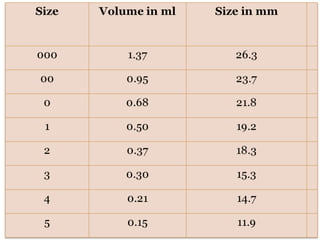
For human use, empty capsules ranging in size
from 000 the largest to 5 the smallest.
Generally, hard gelatin capsule are used to
encapsulate between 65 mg to 1 gram.
Capsule size
GELATIN
Gelatin is heterogeneous product derived by hydrolytic
extraction of animal's collagen.
The sources of gelatins including animal bones, hide portions
and frozen pork skin.
TYPES OF GELATIN
Type A
Type B
Types of gelatin
TYPE A
Derived from acid treated precursor that exhibits
an iso electric point at pH-9. It is manufactured mainly
from pork skin.
TYPE B
Derived from alkali treated precursor that exhibits
an iso electric point at pH-4.7. It is manufactured mainly
from animal bones
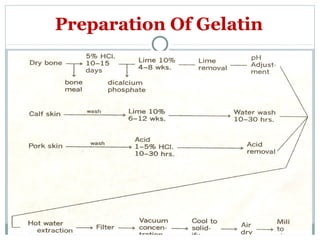
Preparation Of Gelatin
Steps involved in making empty gelatin
capsules…
1.Dipping
2.Spinning
3.Drying
4.Stripping
5.Trimming and Joining
6.Polishing
Manufacturing of hard gelatin capsules
Dipping :
Pairs of the stainless steel pins are dipped into the
dipping solution to simultaneously form the caps and
bodies.
The dipping solution is maintained at a temperature of
about 500
C in a heated, jacketed dipping pan.
Spinning :
The pins are rotated to distribute the gelatin over the pins
uniformly and to avoid the formation of a bead at the
capsule ends.
.
Drying :
The gelatin is dried by a blast of cool air to form a hard
shells.
The pins are moved through a series of air drying kilns
to remove water
Stripping :
A series of bronze jaws strip the cap and body portions
of the capsules from the pins
Trimming and joining:
The stripped cap and body portions are trimmed to the
required length by stationary knives.
After trimming to the right length, the cap and body
portion are joined and ejected from the machine.
Polishing:
Pan Polishing : Acela-cota pan is used to dust and polish.
Cloth Dusting : Capsule are rubbed with cloth.
Brushing : Capsule are feed under soft rotating brush.
In large scale or small preparations of filled hard gelatin
capsules divided into the following general steps:
 Developing and preparing formulation.
 Filling the capsule shell.
 Capsule sealing
 Cleaning and polishing the filled capsules.
Filling hard gelatin capsules:
Developing and preparing the
formulation
Diluents and fillers: lactose, microcrystaline cellulose,
starch.
Disintegrants: sodium starch glicolate ,pregelatinised
starch
Gligants and lubricants: silicon dioxide,magnesium
stearte,calcium stearate
Wetting agents: SLS
Methods of filling:
16
• Hand Operated methods.
ex: feton capsule filling machine
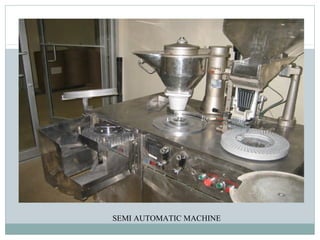
• Semi Automatic Capsules Devices.
• Automatic filling machine.
ex: osaka capsule filling machine ,macofar capsule filling
machine
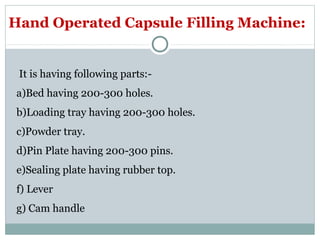
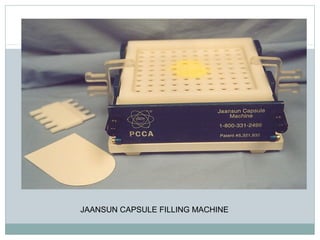
Hand Operated Capsule Filling Machine:
It is having following parts:-
a)Bed having 200-300 holes.
b)Loading tray having 200-300 holes.
c)Powder tray.
d)Pin Plate having 200-300 pins.
e)Sealing plate having rubber top.
f) Lever
g) Cam handle
JAANSUN CAPSULE FILLING MACHINE
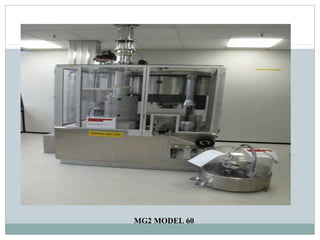
SEMI AUTOMATIC MACHINE
MG2 MODEL 60
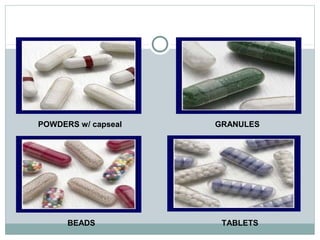
POWDERS w/ capseal GRANULES
BEADS TABLETS
1. Tamper evident capsules by sealing the joint between the 2
capsule parts
2. Distinctive looking capsules by sealing them with colored
band of gelatin (Kapseals). If removed, the band cannot be
restored without expert sealing with gelatin
3. Through a heat welding process that fuses the capsule cap to
the ring around the capsule where heat welded
Example: Weld’s gelatin seal
CAPSULE SEALING:
4. Lightly coating the inner surface of the cap with a warm
gelatin solution immediately prior to placement on the
filled capsule body.
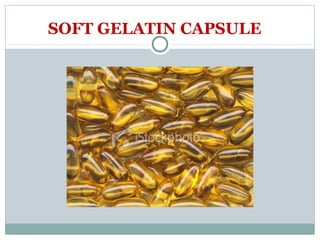
SOFT GELATIN CAPSULE
Soft Gelatin capsules are one piece, hermetically sealed, soft
gelatin shells containing a liquid, a suspension, or a semisolid.
Soft gelatin is mainly composed of gelatin, plasticizers,
preservative, colouring and opacifying agents, flavoring agents
and sugars.
Definition:
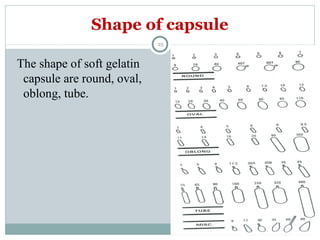
Shape of capsule
25
The shape of soft gelatin
capsule are round, oval,
oblong, tube.
The basic component of soft gelatin shell is gelatin;
however, the shell has been plasticize
The ratio of dry plasticizer to dry gelatin determines the
“hardness” of the shell and can vary from 0.3-1.0 for very
hard shell to 1.0-1.8 for very soft shell
Up to 5% sugar may be included to give a “chewable”
quality to the shell
The residual shell moisture content of finished capsules will
be in the range of 6-10%.
Composition of the shell:

Bloom strength
A measure of cohesive strength of gelatin film
Typically 150-280 "bloom-grams“
The weight in g required to depress a plunger 12.7 mm
diameter 4 mm into a 6.67% gel held for 17 hours at 10
degrees (O.T. Bloom, 1925)

Viscosity
Single most important factor controlling shell thickness
Capillary viscometer; 6.67% soln.
Typical range 25-45 millipoise.
Properties of gelatin:
Formulation :
 Formulation for soft gelatin capsules involves liquid,
rather than powder technology.
 Materials are generally formulated to produce the
smallest possible capsule consistent with maximum
stability, therapeutic effectiveness and manufacture
efficiency.
 The liquids are limited to those that do not have an
adverse effect on gelatin walls.
 Emulsion can not be filled because water will be
released that will affect the shell
 The pH of the liquid can be between 2.5 and 7.5.
29
Is manufactured by four methods
1)Plate process
2)Rotary die process
3)Reciprocating die
4)Accogel machine
Manufacturing of Soft Gelatin Capsule
Plate process:
30
•Place the gelatin sheet over a die plate containing numerous
die pockets.
•Application of vacuum to draw the sheet in to the die pockets.
•Fill the pockets with liquid or paste.
•Place another gelatin sheet over the filled pockets, and
•Sandwich under a die press where the capsules are formed
and cut out.
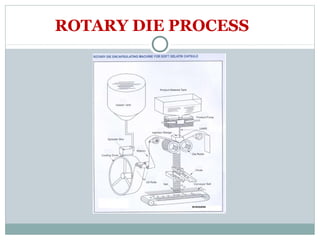
1) In this machine the soft gelatin capsules are prepared & then
filled immediately with liquid medicaments it is having two
hoppers & two rotating dies
2) Liquid mixture is placed in one hopper & the liquid
medicament in other Hooper.
3) The two rotating dies rotate in opposite directions when the
fluid gelatin mixture enters the machine from the hopper it
produces two continuous ribbons .
4) These half shell of the capsule is formed.
ROTARY DIE PROCESS:
5) At this stage the measured quantity of the medicament is
filled in to it with the stroke of a pump with the subsequent
movement of the dies the other half capsule is formed.
6) The two halves' of the capsules are sealed together by
the heat & pressure of the rotating dies.
7) As the die rolls rotate, the convergence of the matching
die pockets seals and cuts out the filled capsules
ROTARY DIE PROCESS
Accogel Capsule Machine Or Stern machine, uses a
system of rotary dies but is unique in that it is the only
machine that can successfully fill dry powder into a soft
gelatin capsule.
Acogel Capsule Machine
Formulation of soft gelatin capsule:
vehicles used in soft gelatin capsules:
Two main groups :
1)Water immiscible, volatile or more likely more volatile
liquids such as vegetable oils, mineral oils, medium-chain
triglycerides and acetylated glycerin.
2)Water miscible, nonvolatile liquids such as low molecular
weight PEG have come in to use more recently because of
their ability to mix with water readily and accelerate
dissolution of dissolved or suspended drugs.
All liquids used for filling must flow by gravity at a
temperature of 350
C or less.
The sealing temperature of gelatin films is 37-400
C
1) Two piece (large body & short cap)
2) Cylindrical shape.
3) Powder drug or pallets coated with
drug are encapsulated.
4) Gelatin in Hard form is used.
5) Capsules are sealed after they are
filled to ensure that the medicaments
may not come out of the capsule due
to rough handling.
6) 8 different type of sizes are available
SOFT GELATIN
CAPSULES
SOFT GELATIN
CAPSULES
1) One piece & hermetically
sealed.
2) Available in round , oval &
tube like shapes.
3) Liquid & Semi liquid fill &
unstable substances are
encapsulated.
4) Molten gelatin are used.
5) Filling & sealing of soft gelatin
capsules are done in a
combined operation on
machine.
6) No specific sizes are available.
HARD GELATIN
CAPSULES
HARD GELATIN
CAPSULES
Steps Of Capsule Manufacturing
 Mfg of Gelatin Shell.
 Drying of shells in controlled humidity.
 Mfg of granules/spanzules.
 Filling of Shells.
 Packaging & Labeling.
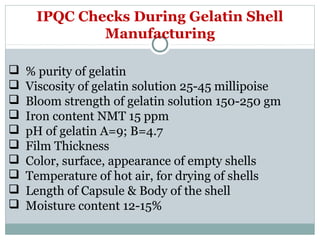
IPQC Checks During Gelatin Shell
Manufacturing
 % purity of gelatin
 Viscosity of gelatin solution 25-45 millipoise
 Bloom strength of gelatin solution 150-250 gm
 Iron content NMT 15 ppm
 pH of gelatin A=9; B=4.7
 Film Thickness
 Color, surface, appearance of empty shells
 Temperature of hot air, for drying of shells
 Length of Capsule & Body of the shell
 Moisture content 12-15%
 Sorting of defective shells
 After the capsules have been inspected either electronically
or manually, they are sampled by the
QA inspector & checked for the defects and then sorted out.
 Printing inspection on shell
 Inspection of defects like:-
• Hardening of shells
• Softening of shells
• Swelling of shells
• Cracking of shells
• Discoloration of shells
• Misprinting of logo on shells
IPQC Checks During Filling Of Empty
Capsule Shells
 During filling process equipment should be labeled
with :-product name, Batch No, Time of starting, Sign
 During Filling: flow property of granules or powders
 Weight Variation :
For hard gel caps-
Limit NMT 2 caps should deviate from avg wt.
AVG WT %DEVIATION
<300mg 10%
>300mg or more 7.5%
 MACHINE OUTPUT INSPECTION:
•Machine output is monitored in a specific time interval
•Total batch or number of caps filled are counted in a
specific time interval & then machine is calibrated and
speed is maintained.
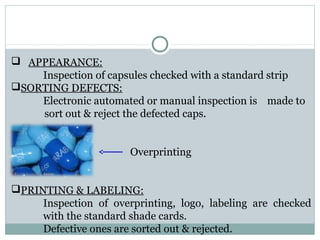
 APPEARANCE:
Inspection of capsules checked with a standard strip
SORTING DEFECTS:
Electronic automated or manual inspection is made to
sort out & reject the defected caps.
 Overprinting
PRINTING & LABELING:
Inspection of overprinting, logo, labeling are checked
with the standard shade cards.
Defective ones are sorted out & rejected.
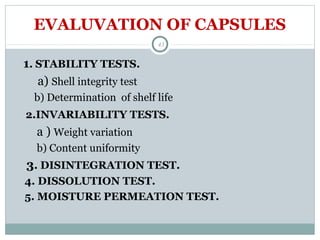
EVALUVATION OF CAPSULES
1. STABILITY TESTS.
a) Shell integrity test
b) Determination of shelf life
2.INVARIABILITY TESTS.
a ) Weight variation
b) Content uniformity
3. DISINTEGRATION TEST.
4. DISSOLUTION TEST.
5. MOISTURE PERMEATION TEST.
43
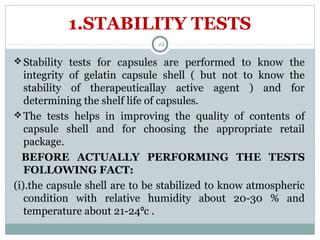
1.STABILITY TESTS
Stability tests for capsules are performed to know the
integrity of gelatin capsule shell ( but not to know the
stability of therapeuticallay active agent ) and for
determining the shelf life of capsules.
The tests helps in improving the quality of contents of
capsule shell and for choosing the appropriate retail
package.
BEFORE ACTUALLY PERFORMING THE TESTS
FOLLOWING FACT:
(i).the capsule shell are to be stabilized to know atmospheric
condition with relative humidity about 20-30 % and
temperature about 21-24 c .⁰
44
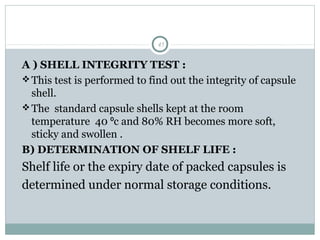
A ) SHELL INTEGRITY TEST :
This test is performed to find out the integrity of capsule
shell.
The standard capsule shells kept at the room
temperature 40 c and 80% RH becomes more soft,⁰
sticky and swollen .
B) DETERMINATION OF SHELF LIFE :
Shelf life or the expiry date of packed capsules is
determined under normal storage conditions.
45
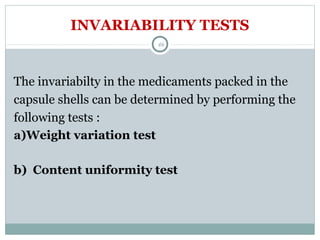
INVARIABILITY TESTS
The invariabilty in the medicaments packed in the
capsule shells can be determined by performing the
following tests :
a)Weight variation test
b) Content uniformity test
46
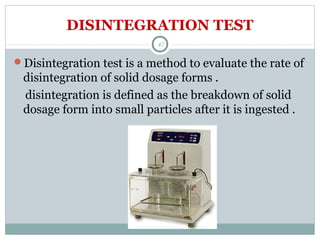
DISINTEGRATION TEST
Disintegration test is a method to evaluate the rate of
disintegration of solid dosage forms .
disintegration is defined as the breakdown of solid
dosage form into small particles after it is ingested .
47
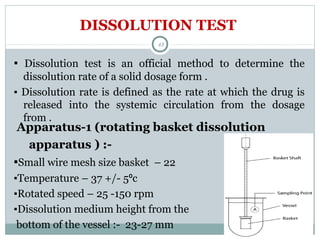
DISSOLUTION TEST
▪ Dissolution test is an official method to determine the
dissolution rate of a solid dosage form .
▪ Dissolution rate is defined as the rate at which the drug is
released into the systemic circulation from the dosage
from .
48
Apparatus-1 (rotating basket dissolution
apparatus ) :-
▪Small wire mesh size basket – 22
▪Temperature – 37 +/- 5⁰c
▪Rotated speed – 25 -150 rpm
▪Dissolution medium height from the
bottom of the vessel :- 23-27 mm
MOISTURE PERMEATION TEST
To assure the suitability of containers for
packaging capsules .
The moisture permeating feature of capsules
packaged in
▪ single unit containers – blister pack or strip pack
▪ unit dose containers – glass or plastic bottles
Are to be determined .
49
Disadvantages of conventional capsule:
1) Gelatin shells are permeable for moisture and air.
2) Some persons give vometic response to gelatin capsules
due to its odor.
Innovations In Capsule Shells:
1) Improve in Shell Property and provide physical
strength.
2) Protection From light, moisture, and microbial
contamination.
3) Encapsulation of various kinds of material.
4) Improve Compatibility of fill material with shell.
Recent advancements in capsule
NON GELATIN CAPSULES
Gelatin Alternatives:-
HPMC Capsules
Starch Capsules
Alginate capsules.
IDEAL REQUIREMENTS-
Good film forming property.
Good gelation property so that capsule film can be cast or
dipped.
Fast dissolution in biological fluids at 37 C.⁰
Low toxicity.
HPMC and starch capsules are also called vegetable capsules.
Raw material contain the basic contents of polysaccharide and
vegetable cell wall.
Beside natural concept, superiority, these capsules can also
promote digestion of proteins, fats and carbohydrate .
.
HGC made from potato starch were developed by Capsugel.
Steps-
Starch containing 13-14% is heated at a temp of 140-190 C .⁰
Glassy mass formed which flow without degradation.
Injection molded separately to form cap and body portions
and finally dried.
Moisture content in starch capsules lies between 12-14% w/w
with more than 50% being tightly bound to starch.This
bound water indicates that the syarch capsules may provide
better stability properties and reduced susceptibility to
changes on storage.
Starch Capsules
Advantages-
 Ready for filling immediately following mfg.
 pH independent dissolution.
 Offers greater resistance to humidity and heat
than gelatin.
 Good surface finish.
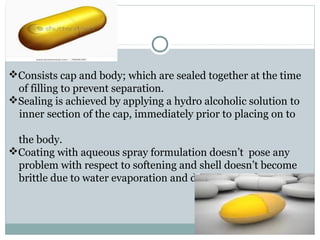
Consists cap and body; which are sealed together at the time
of filling to prevent separation.
Sealing is achieved by applying a hydro alcoholic solution to
inner section of the cap, immediately prior to placing on to
the body.
Coating with aqueous spray formulation doesn’t pose any
problem with respect to softening and shell doesn’t become
brittle due to water evaporation and drying.
TARGET TECHNOLOGY –
Based on applying enteric polymer coatings to the starch
capsule.
Used for site specific delivery to colon.
Coating of starch capsules appear to be less problematic because
of the smooth seal together with the higher bulk density of
capsules which provide more uniform coating bed.

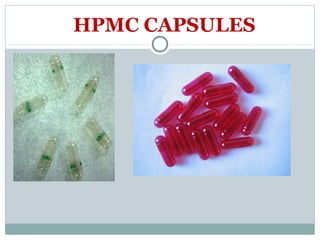
HPMC CAPSULES
HPMC Capsules (Hypromellose)
QUALI-V developed by Shinogi Qualicapsis the first HPMC
capsule developed for use in pharmaceutical products.
Advantages:-
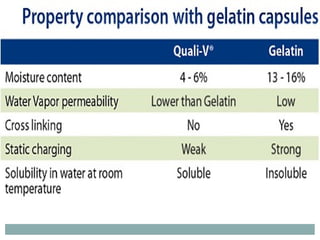
Cross-linking-HPMC hard capsules avoid the issues of
gelatin cross-linking & product vulnerability to aldehydes
(no Maillard reaction)
 Moisture content-HPMC hard capsules(Quali-v) have
low moisture content. These doesn’t crack even with 1%
or low in moisture content. HGCs breaks easily when
moisture drops below 10%.)
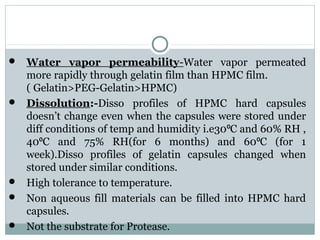
 Water vapor permeability-Water vapor permeated
more rapidly through gelatin film than HPMC film.
( Gelatin>PEG-Gelatin>HPMC)
 Dissolution:-Disso profiles of HPMC hard capsules
doesn’t change even when the capsules were stored under
diff conditions of temp and humidity i.e30 C and 60% RH ,⁰
40 C and 75% RH(for 6 months) and 60 C (for 1⁰ ⁰
week).Disso profiles of gelatin capsules changed when
stored under similar conditions.
 High tolerance to temperature.
 Non aqueous fill materials can be filled into HPMC hard
capsules.
 Not the substrate for Protease.
60
61
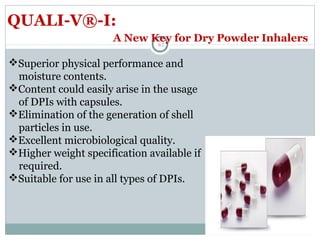
QUALI-V®-I:
Superior physical performance and
moisture contents.
Content could easily arise in the usage
of DPIs with capsules.
Elimination of the generation of shell
particles in use.
Excellent microbiological quality.
Higher weight specification available if
required.
Suitable for use in all types of DPIs.
A New Key for Dry Powder Inhalers
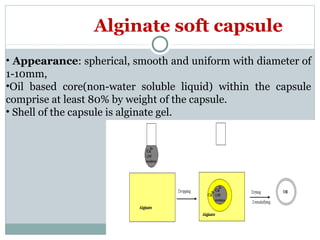
Alginate soft capsule
• Appearance: spherical, smooth and uniform with diameter of
1-10mm,
•Oil based core(non-water soluble liquid) within the capsule
comprise at least 80% by weight of the capsule.
• Shell of the capsule is alginate gel.
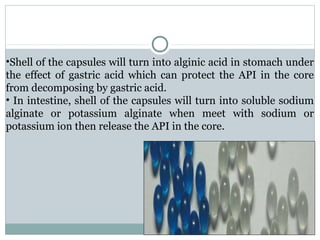
•Shell of the capsules will turn into alginic acid in stomach under
the effect of gastric acid which can protect the API in the core
from decomposing by gastric acid.
• In intestine, shell of the capsules will turn into soluble sodium
alginate or potassium alginate when meet with sodium or
potassium ion then release the API in the core.
Advantages-
Alginate, the major material of the shell, is extracted from
algae which is cheap and is full of human necessary
microelement.
Shell of the capsule comprise at most 15% by weight of the
capsule which can improve the loading capacity of the API
within the capsule.
Alginates shell with little water content has antibiotic
property which means there is no need or less need for
preservatives.
Pdf seminar final

Pdf seminar final

  • 1.
    Formulation, Evaluation andRecent advancements in capsule
  • 2.
    Capsules are soliddosage forms in which drug substance is enclosed within hard or soft soluble shell. The shells are generally formed from gelatin. INTRODUCTION Capsules are of two types 1. Hard gelatin capsules 2. Soft gelatin capsules
  • 3.
     Tasteless, odorlessand can easily be administered.  Combination of powders we can use  There are attractive in appearance.  The drugs having un-pleasant odor and taste are enclosed in a tasteless shell.  They can be filled quickly and conveniently.  Physician can change the dose and combination of drug according to patient requirement.  They are economical.  They are easy to handle and carry. Advantages
  • 4.
     Hygroscopic drugsare not suitable for filling into capsules, because they absorb water present in capsule shell makes shell very brittle and ultimately lead to crumble into pieces.  The concentrated solutions which require previous dilution are unsuitable for capsules because if administered as such lead to irritation into stomach Disadvantages:-
  • 5.
    For human use,empty capsules ranging in size from 000 the largest to 5 the smallest. Generally, hard gelatin capsule are used to encapsulate between 65 mg to 1 gram. Capsule size
  • 7.
    GELATIN Gelatin is heterogeneousproduct derived by hydrolytic extraction of animal's collagen. The sources of gelatins including animal bones, hide portions and frozen pork skin. TYPES OF GELATIN Type A Type B
  • 8.
    Types of gelatin TYPEA Derived from acid treated precursor that exhibits an iso electric point at pH-9. It is manufactured mainly from pork skin. TYPE B Derived from alkali treated precursor that exhibits an iso electric point at pH-4.7. It is manufactured mainly from animal bones
  • 9.
  • 10.
    Steps involved inmaking empty gelatin capsules… 1.Dipping 2.Spinning 3.Drying 4.Stripping 5.Trimming and Joining 6.Polishing Manufacturing of hard gelatin capsules
  • 11.
    Dipping : Pairs ofthe stainless steel pins are dipped into the dipping solution to simultaneously form the caps and bodies. The dipping solution is maintained at a temperature of about 500 C in a heated, jacketed dipping pan. Spinning : The pins are rotated to distribute the gelatin over the pins uniformly and to avoid the formation of a bead at the capsule ends. .
  • 12.
    Drying : The gelatinis dried by a blast of cool air to form a hard shells. The pins are moved through a series of air drying kilns to remove water Stripping : A series of bronze jaws strip the cap and body portions of the capsules from the pins
  • 13.
    Trimming and joining: Thestripped cap and body portions are trimmed to the required length by stationary knives. After trimming to the right length, the cap and body portion are joined and ejected from the machine. Polishing: Pan Polishing : Acela-cota pan is used to dust and polish. Cloth Dusting : Capsule are rubbed with cloth. Brushing : Capsule are feed under soft rotating brush.
  • 14.
    In large scaleor small preparations of filled hard gelatin capsules divided into the following general steps:  Developing and preparing formulation.  Filling the capsule shell.  Capsule sealing  Cleaning and polishing the filled capsules. Filling hard gelatin capsules:
  • 15.
    Developing and preparingthe formulation Diluents and fillers: lactose, microcrystaline cellulose, starch. Disintegrants: sodium starch glicolate ,pregelatinised starch Gligants and lubricants: silicon dioxide,magnesium stearte,calcium stearate Wetting agents: SLS
  • 16.
    Methods of filling: 16 •Hand Operated methods. ex: feton capsule filling machine • Semi Automatic Capsules Devices. • Automatic filling machine. ex: osaka capsule filling machine ,macofar capsule filling machine
  • 17.
    Hand Operated CapsuleFilling Machine: It is having following parts:- a)Bed having 200-300 holes. b)Loading tray having 200-300 holes. c)Powder tray. d)Pin Plate having 200-300 pins. e)Sealing plate having rubber top. f) Lever g) Cam handle
  • 18.
  • 19.
  • 20.
  • 21.
    POWDERS w/ capsealGRANULES BEADS TABLETS
  • 22.
    1. Tamper evidentcapsules by sealing the joint between the 2 capsule parts 2. Distinctive looking capsules by sealing them with colored band of gelatin (Kapseals). If removed, the band cannot be restored without expert sealing with gelatin 3. Through a heat welding process that fuses the capsule cap to the ring around the capsule where heat welded Example: Weld’s gelatin seal CAPSULE SEALING: 4. Lightly coating the inner surface of the cap with a warm gelatin solution immediately prior to placement on the filled capsule body.
  • 23.
  • 24.
    Soft Gelatin capsulesare one piece, hermetically sealed, soft gelatin shells containing a liquid, a suspension, or a semisolid. Soft gelatin is mainly composed of gelatin, plasticizers, preservative, colouring and opacifying agents, flavoring agents and sugars. Definition:
  • 25.
    Shape of capsule 25 Theshape of soft gelatin capsule are round, oval, oblong, tube.
  • 26.
    The basic componentof soft gelatin shell is gelatin; however, the shell has been plasticize The ratio of dry plasticizer to dry gelatin determines the “hardness” of the shell and can vary from 0.3-1.0 for very hard shell to 1.0-1.8 for very soft shell Up to 5% sugar may be included to give a “chewable” quality to the shell The residual shell moisture content of finished capsules will be in the range of 6-10%. Composition of the shell:
  • 27.
     Bloom strength A measureof cohesive strength of gelatin film Typically 150-280 "bloom-grams“ The weight in g required to depress a plunger 12.7 mm diameter 4 mm into a 6.67% gel held for 17 hours at 10 degrees (O.T. Bloom, 1925)  Viscosity Single most important factor controlling shell thickness Capillary viscometer; 6.67% soln. Typical range 25-45 millipoise. Properties of gelatin:
  • 28.
    Formulation :  Formulationfor soft gelatin capsules involves liquid, rather than powder technology.  Materials are generally formulated to produce the smallest possible capsule consistent with maximum stability, therapeutic effectiveness and manufacture efficiency.  The liquids are limited to those that do not have an adverse effect on gelatin walls.  Emulsion can not be filled because water will be released that will affect the shell  The pH of the liquid can be between 2.5 and 7.5.
  • 29.
    29 Is manufactured byfour methods 1)Plate process 2)Rotary die process 3)Reciprocating die 4)Accogel machine Manufacturing of Soft Gelatin Capsule
  • 30.
    Plate process: 30 •Place thegelatin sheet over a die plate containing numerous die pockets. •Application of vacuum to draw the sheet in to the die pockets. •Fill the pockets with liquid or paste. •Place another gelatin sheet over the filled pockets, and •Sandwich under a die press where the capsules are formed and cut out.
  • 31.
    1) In thismachine the soft gelatin capsules are prepared & then filled immediately with liquid medicaments it is having two hoppers & two rotating dies 2) Liquid mixture is placed in one hopper & the liquid medicament in other Hooper. 3) The two rotating dies rotate in opposite directions when the fluid gelatin mixture enters the machine from the hopper it produces two continuous ribbons . 4) These half shell of the capsule is formed. ROTARY DIE PROCESS:
  • 32.
    5) At thisstage the measured quantity of the medicament is filled in to it with the stroke of a pump with the subsequent movement of the dies the other half capsule is formed. 6) The two halves' of the capsules are sealed together by the heat & pressure of the rotating dies. 7) As the die rolls rotate, the convergence of the matching die pockets seals and cuts out the filled capsules
  • 33.
  • 34.
    Accogel Capsule MachineOr Stern machine, uses a system of rotary dies but is unique in that it is the only machine that can successfully fill dry powder into a soft gelatin capsule. Acogel Capsule Machine
  • 35.
    Formulation of softgelatin capsule: vehicles used in soft gelatin capsules: Two main groups : 1)Water immiscible, volatile or more likely more volatile liquids such as vegetable oils, mineral oils, medium-chain triglycerides and acetylated glycerin. 2)Water miscible, nonvolatile liquids such as low molecular weight PEG have come in to use more recently because of their ability to mix with water readily and accelerate dissolution of dissolved or suspended drugs. All liquids used for filling must flow by gravity at a temperature of 350 C or less. The sealing temperature of gelatin films is 37-400 C
  • 36.
    1) Two piece(large body & short cap) 2) Cylindrical shape. 3) Powder drug or pallets coated with drug are encapsulated. 4) Gelatin in Hard form is used. 5) Capsules are sealed after they are filled to ensure that the medicaments may not come out of the capsule due to rough handling. 6) 8 different type of sizes are available SOFT GELATIN CAPSULES SOFT GELATIN CAPSULES 1) One piece & hermetically sealed. 2) Available in round , oval & tube like shapes. 3) Liquid & Semi liquid fill & unstable substances are encapsulated. 4) Molten gelatin are used. 5) Filling & sealing of soft gelatin capsules are done in a combined operation on machine. 6) No specific sizes are available. HARD GELATIN CAPSULES HARD GELATIN CAPSULES
  • 37.
    Steps Of CapsuleManufacturing  Mfg of Gelatin Shell.  Drying of shells in controlled humidity.  Mfg of granules/spanzules.  Filling of Shells.  Packaging & Labeling.
  • 38.
    IPQC Checks DuringGelatin Shell Manufacturing  % purity of gelatin  Viscosity of gelatin solution 25-45 millipoise  Bloom strength of gelatin solution 150-250 gm  Iron content NMT 15 ppm  pH of gelatin A=9; B=4.7  Film Thickness  Color, surface, appearance of empty shells  Temperature of hot air, for drying of shells  Length of Capsule & Body of the shell  Moisture content 12-15%
  • 39.
     Sorting ofdefective shells  After the capsules have been inspected either electronically or manually, they are sampled by the QA inspector & checked for the defects and then sorted out.  Printing inspection on shell  Inspection of defects like:- • Hardening of shells • Softening of shells • Swelling of shells • Cracking of shells • Discoloration of shells • Misprinting of logo on shells
  • 40.
    IPQC Checks DuringFilling Of Empty Capsule Shells  During filling process equipment should be labeled with :-product name, Batch No, Time of starting, Sign  During Filling: flow property of granules or powders  Weight Variation : For hard gel caps- Limit NMT 2 caps should deviate from avg wt. AVG WT %DEVIATION <300mg 10% >300mg or more 7.5%
  • 41.
     MACHINE OUTPUTINSPECTION: •Machine output is monitored in a specific time interval •Total batch or number of caps filled are counted in a specific time interval & then machine is calibrated and speed is maintained.
  • 42.
     APPEARANCE: Inspection ofcapsules checked with a standard strip SORTING DEFECTS: Electronic automated or manual inspection is made to sort out & reject the defected caps.  Overprinting PRINTING & LABELING: Inspection of overprinting, logo, labeling are checked with the standard shade cards. Defective ones are sorted out & rejected.
  • 43.
    EVALUVATION OF CAPSULES 1.STABILITY TESTS. a) Shell integrity test b) Determination of shelf life 2.INVARIABILITY TESTS. a ) Weight variation b) Content uniformity 3. DISINTEGRATION TEST. 4. DISSOLUTION TEST. 5. MOISTURE PERMEATION TEST. 43
  • 44.
    1.STABILITY TESTS Stability testsfor capsules are performed to know the integrity of gelatin capsule shell ( but not to know the stability of therapeuticallay active agent ) and for determining the shelf life of capsules. The tests helps in improving the quality of contents of capsule shell and for choosing the appropriate retail package. BEFORE ACTUALLY PERFORMING THE TESTS FOLLOWING FACT: (i).the capsule shell are to be stabilized to know atmospheric condition with relative humidity about 20-30 % and temperature about 21-24 c .⁰ 44
  • 45.
    A ) SHELLINTEGRITY TEST : This test is performed to find out the integrity of capsule shell. The standard capsule shells kept at the room temperature 40 c and 80% RH becomes more soft,⁰ sticky and swollen . B) DETERMINATION OF SHELF LIFE : Shelf life or the expiry date of packed capsules is determined under normal storage conditions. 45
  • 46.
    INVARIABILITY TESTS The invariabiltyin the medicaments packed in the capsule shells can be determined by performing the following tests : a)Weight variation test b) Content uniformity test 46
  • 47.
    DISINTEGRATION TEST Disintegration testis a method to evaluate the rate of disintegration of solid dosage forms . disintegration is defined as the breakdown of solid dosage form into small particles after it is ingested . 47
  • 48.
    DISSOLUTION TEST ▪ Dissolutiontest is an official method to determine the dissolution rate of a solid dosage form . ▪ Dissolution rate is defined as the rate at which the drug is released into the systemic circulation from the dosage from . 48 Apparatus-1 (rotating basket dissolution apparatus ) :- ▪Small wire mesh size basket – 22 ▪Temperature – 37 +/- 5⁰c ▪Rotated speed – 25 -150 rpm ▪Dissolution medium height from the bottom of the vessel :- 23-27 mm
  • 49.
    MOISTURE PERMEATION TEST Toassure the suitability of containers for packaging capsules . The moisture permeating feature of capsules packaged in ▪ single unit containers – blister pack or strip pack ▪ unit dose containers – glass or plastic bottles Are to be determined . 49
  • 50.
    Disadvantages of conventionalcapsule: 1) Gelatin shells are permeable for moisture and air. 2) Some persons give vometic response to gelatin capsules due to its odor. Innovations In Capsule Shells: 1) Improve in Shell Property and provide physical strength. 2) Protection From light, moisture, and microbial contamination. 3) Encapsulation of various kinds of material. 4) Improve Compatibility of fill material with shell. Recent advancements in capsule
  • 51.
    NON GELATIN CAPSULES GelatinAlternatives:- HPMC Capsules Starch Capsules Alginate capsules.
  • 52.
    IDEAL REQUIREMENTS- Good filmforming property. Good gelation property so that capsule film can be cast or dipped. Fast dissolution in biological fluids at 37 C.⁰ Low toxicity. HPMC and starch capsules are also called vegetable capsules. Raw material contain the basic contents of polysaccharide and vegetable cell wall. Beside natural concept, superiority, these capsules can also promote digestion of proteins, fats and carbohydrate .
  • 53.
    . HGC made frompotato starch were developed by Capsugel. Steps- Starch containing 13-14% is heated at a temp of 140-190 C .⁰ Glassy mass formed which flow without degradation. Injection molded separately to form cap and body portions and finally dried. Moisture content in starch capsules lies between 12-14% w/w with more than 50% being tightly bound to starch.This bound water indicates that the syarch capsules may provide better stability properties and reduced susceptibility to changes on storage. Starch Capsules
  • 54.
    Advantages-  Ready forfilling immediately following mfg.  pH independent dissolution.  Offers greater resistance to humidity and heat than gelatin.  Good surface finish.
  • 55.
    Consists cap andbody; which are sealed together at the time of filling to prevent separation. Sealing is achieved by applying a hydro alcoholic solution to inner section of the cap, immediately prior to placing on to the body. Coating with aqueous spray formulation doesn’t pose any problem with respect to softening and shell doesn’t become brittle due to water evaporation and drying.
  • 56.
    TARGET TECHNOLOGY – Basedon applying enteric polymer coatings to the starch capsule. Used for site specific delivery to colon. Coating of starch capsules appear to be less problematic because of the smooth seal together with the higher bulk density of capsules which provide more uniform coating bed. 
  • 57.
  • 58.
    HPMC Capsules (Hypromellose) QUALI-Vdeveloped by Shinogi Qualicapsis the first HPMC capsule developed for use in pharmaceutical products. Advantages:- Cross-linking-HPMC hard capsules avoid the issues of gelatin cross-linking & product vulnerability to aldehydes (no Maillard reaction)  Moisture content-HPMC hard capsules(Quali-v) have low moisture content. These doesn’t crack even with 1% or low in moisture content. HGCs breaks easily when moisture drops below 10%.)
  • 59.
     Water vaporpermeability-Water vapor permeated more rapidly through gelatin film than HPMC film. ( Gelatin>PEG-Gelatin>HPMC)  Dissolution:-Disso profiles of HPMC hard capsules doesn’t change even when the capsules were stored under diff conditions of temp and humidity i.e30 C and 60% RH ,⁰ 40 C and 75% RH(for 6 months) and 60 C (for 1⁰ ⁰ week).Disso profiles of gelatin capsules changed when stored under similar conditions.  High tolerance to temperature.  Non aqueous fill materials can be filled into HPMC hard capsules.  Not the substrate for Protease.
  • 60.
  • 61.
    61 QUALI-V®-I: Superior physical performanceand moisture contents. Content could easily arise in the usage of DPIs with capsules. Elimination of the generation of shell particles in use. Excellent microbiological quality. Higher weight specification available if required. Suitable for use in all types of DPIs. A New Key for Dry Powder Inhalers
  • 62.
    Alginate soft capsule •Appearance: spherical, smooth and uniform with diameter of 1-10mm, •Oil based core(non-water soluble liquid) within the capsule comprise at least 80% by weight of the capsule. • Shell of the capsule is alginate gel.
  • 63.
    •Shell of thecapsules will turn into alginic acid in stomach under the effect of gastric acid which can protect the API in the core from decomposing by gastric acid. • In intestine, shell of the capsules will turn into soluble sodium alginate or potassium alginate when meet with sodium or potassium ion then release the API in the core.
  • 64.
    Advantages- Alginate, the majormaterial of the shell, is extracted from algae which is cheap and is full of human necessary microelement. Shell of the capsule comprise at most 15% by weight of the capsule which can improve the loading capacity of the API within the capsule. Alginates shell with little water content has antibiotic property which means there is no need or less need for preservatives.