UNIT-III 08 Hours
Capsules:
a. Hard gelatin capsules: Introduction, Production of hard gelatin
capsule shells. size of capsules, Filling, finishing and special
techniques of formulation of hard gelatin capsules,
manufacturing defects. In process and final product quality
control tests for capsules.
b. Soft gelatin capsules: Nature of shell and capsule content, size
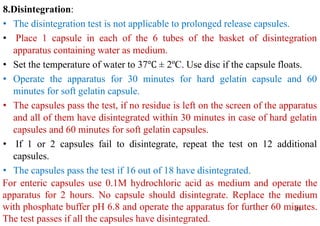
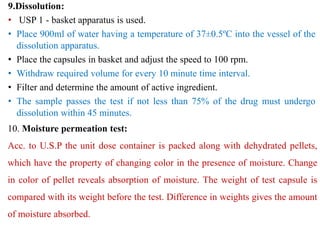
of capsules, importance of base adsorption and minim/gram
factors, production, in process and final product quality control
tests. Packing, storage and stability testing of soft gelatin
capsules and their applications.
Pellets:
Introduction, formulation requirements, pelletization process,
equipment for manufacture of pellets.
CAPSULES
Definition: Capsules are solid oral dosage forms in which the
medicaments and diluents are encapsulated in a hard or soft soluble shell
made up of gelatin. Capsules may be classified as either Hard or Soft,
depending on the nature of the shell.
• The word capsule is derived from the Latin word capsula, meaning a
small box or container. .
• In pharmacy the word is used to describe an edible package made
from gelatin or other suitable material which is filled with medicines
to produce a unit dosage, mainly for oral use. The medication may be
a powder, a liquid or a semisolid mass.
• Capsules are usually intended to be administered orally by
swallowing them whole. Occasionally, capsules may be administered
rectally or vaginal insertion as suppositories.
• The hard gelatin capsule can be used for dry fills such as powder,
granules, pellets and semisolids while the soft gelatin capsule shell is
exclusively used for liquids and semisolids.
2
3
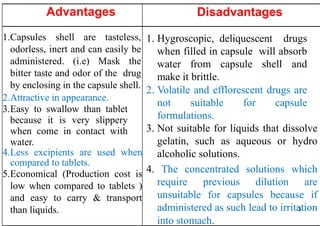
Advantages
1.Capsules shell are tasteless,
odorless, inert and can easily be
administered. (i.e) Mask the
bitter taste and odor of the drug
by enclosing in the capsule shell.
2.Attractive in appearance.
3.Easy to swallow than tablet
because it is very slippery
when come in contact with
water.
4.Less excipients are used when
compared to tablets.
5.Economical (Production cost is
low when compared to tablets )
and easy to carry & transport
than liquids.
Disadvantages
1. Hygroscopic, deliquescent drugs
when filled in capsule will absorb
water from capsule shell and
make it brittle.
2. Volatile and efflorescent drugs are
not suitable for capsule
formulations.
3. Not suitable for liquids that dissolve
gelatin, such as aqueous or hydro
alcoholic solutions.
4. The concentrated solutions which
require previous dilution are
unsuitable for capsules because if
administered as such lead to irritation
into stomach.
4
Advantages
6.They can be filled quickly and
conveniently.
7. The ready solubility of gelatin
at gastric pH provides rapid
release of medication in the
stomach.
8.Packaged and shipped by
manufacturers at lower cost &
less breakage than liquid dosage
forms.
9.More stable and longer shelf
life. It protects the medicaments
from environmental effects.
10.The shells can be opacified or
colored to protect from light.
Disadvantages
5.Slow operation than tablet
manufacturing operation.
6.Uniformity of filling is difficult in
hard gelatin capsules.
7. Dust formation during filling of hard
gelatin capsules.
8.Special mfg equipment is required.
9. Storage is difficult (prone to
fluctuations in humidity).
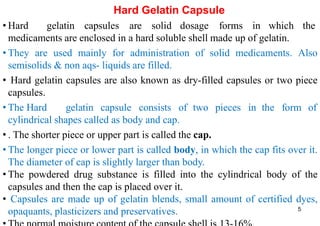
Hard Gelatin Capsule
• Hard gelatin capsules are solid dosage forms in which the
medicaments are enclosed in a hard soluble shell made up of gelatin.
• They are used mainly for administration of solid medicaments. Also
semisolids & non aqs- liquids are filled.
• Hard gelatin capsules are also known as dry-filled capsules or two piece
capsules.
• The Hard gelatin capsule consists of two pieces in the form of
cylindrical shapes called as body and cap.
• . The shorter piece or upper part is called the cap.
• The longer piece or lower part is called body, in which the cap fits over it.
The diameter of cap is slightly larger than body.
• The powdered drug substance is filled into the cylindrical body of the
capsules and then the cap is placed over it.
• Capsules are made up of gelatin blends, small amount of certified dyes,
opaquants, plasticizers and preservatives. 5
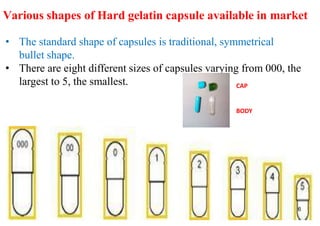
Various shapes of Hard gelatin capsule available in market
6
• The standard shape of capsules is traditional, symmetrical
bullet shape.
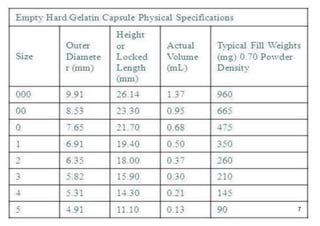
• There are eight different sizes of capsules varying from 000, the
largest to 5, the smallest. CAP
BODY
7
Formulation or Raw materials or Constituents of
Capsule Shell
I. Raw material used:
The raw materials used in the manufacture of both types of capsule are
similar. Both contain gelatin, water, colorants and optional materials
such as process aids and preservatives in addition, soft capsules
contain more plasticizers.
a) Gelatin: It is a biopolymer material (heterogeneous product)
composed of polypeptide chains prepared by the hydrolysis of
collagen obtained from animal connective tissues, bones and pork
skin. It is the major component of the capsule.
The reason for this is that gelatin possesses following basic
properties:
1- Non-toxic, widely used in foodstuffs and acceptable for use
worldwide.
2- It is readily soluble in biological fluids at body temperature.
3- It is a good film-forming material, producing a strong flexible film.
4- It melts when heated & solidifies when cooled.
There are two types of gelatin. Type A and Type B gelatin.
• Type A (Acid hydrolysis of pork skin) - Low viscous but high
bloom (hardness of gelatin). Iso-electric point of Type A
gelatin is near to PH 9. The acid process takes about 7-10 days
and is used mainly from animal skins, because they require less
pretreatment than bones.
• Type B (Alkaline hydrolysis of bones) - High viscous but lower
bloom. Iso electric point of Type B gelatin is near to PH 4.7.
The basic process takes about 10 times as long and is used
mainly from bovine bones.
• Bone gelatin imparts firmness ( but tends to be hazy & brittle).
Pork gelatin imparts plasticity & clarity thus reduce cloudiness
in the finished capsule. So blends of bone & pork gelatin used.
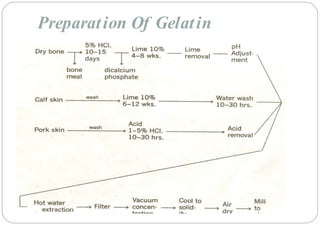
Preparation Of Gelatin
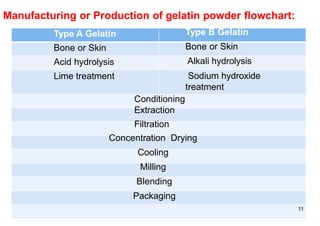
Type A Gelatin
Bone or Skin
Acid hydrolysis
Lime treatment
Type B Gelatin
Bone or Skin
Alkali hydrolysis
Sodium hydroxide
treatment
Conditioning
Extraction
Filtration
Concentration Drying
Cooling
Milling
Blending
Packaging
11
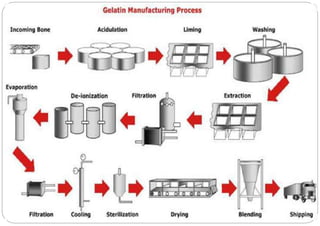
Manufacturing or Production of gelatin powder flowchart:
I
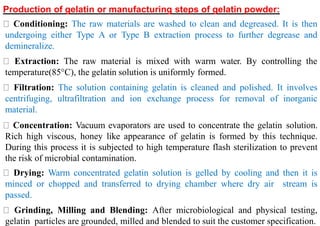
Production of gelatin or manufacturing steps of gelatin powder:
Conditioning: The raw materials are washed to clean and degreased. It is then
undergoing either Type A or Type B extraction process to further degrease and
demineralize.
Extraction: The raw material is mixed with warm water. By controlling the
temperature(85°C), the gelatin solution is uniformly formed.
Filtration: The solution containing gelatin is cleaned and polished. It involves
centrifuging, ultrafiltration and ion exchange process for removal of inorganic
material.
Concentration: Vacuum evaporators are used to concentrate the gelatin solution.
Rich high viscous, honey like appearance of gelatin is formed by this technique.
During this process it is subjected to high temperature flash sterilization to prevent
the risk of microbial contamination.
Drying: Warm concentrated gelatin solution is gelled by cooling and then it is
minced or chopped and transferred to drying chamber where dry air stream is
passed.
Grinding, Milling and Blending: After microbiological and physical testing,
gelatin particles are grounded, milled and blended to suit the customer specification.
9
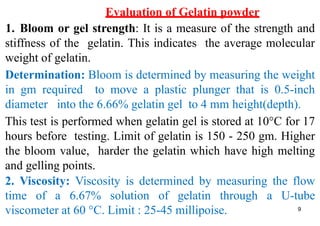
Evaluation of Gelatin powder
1. Bloom or gel strength: It is a measure of the strength and
stiffness of the gelatin. This indicates the average molecular
weight of gelatin.
Determination: Bloom is determined by measuring the weight
in gm required to move a plastic plunger that is 0.5-inch
diameter into the 6.66% gelatin gel to 4 mm height(depth).
This test is performed when gelatin gel is stored at 10°C for 17
hours before testing. Limit of gelatin is 150 - 250 gm. Higher
the bloom value, harder the gelatin which have high melting
and gelling points.
2. Viscosity: Viscosity is determined by measuring the flow
time of a 6.67% solution of gelatin through a U-tube
viscometer at 60 °C. Limit : 25-45 millipoise.
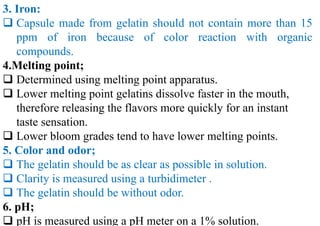
3. Iron:
 Capsule made from gelatin should not contain more than 15
ppm of iron because of color reaction with organic
compounds.
4.Melting point;
 Determined using melting point apparatus.
 Lower melting point gelatins dissolve faster in the mouth,
therefore releasing the flavors more quickly for an instant
taste sensation.
 Lower bloom grades tend to have lower melting points.
5. Color and odor;
 The gelatin should be as clear as possible in solution.
 Clarity is measured using a turbidimeter .
 The gelatin should be without odor.
6. pH;
 pH is measured using a pH meter on a 1% solution.
Other raw materials used:
b)Certified Dyes: Gives pleasant appearance to the shells. The colorants
used are of two types: water-soluble dyes & insoluble pigments. To make a
range of colours dyes and pigments are mixed together as solutions or
suspensions. Colors used are approved by D & C act. Most dyes used
currently are erythrosine, indigo, carmine, quinolone yellow, etc. Two
types of pigment used are iron oxides- black, red and yellow and titanium di
oxide which is white and used to make capsule opaque.
c) Plasticizers: Imparts softness & Elasticity. E.g- Sorbitol, Glycerin,PG.
d) Preservatives: Added to prevent microbiological contamination during
manufacture. E.g-Propyl and Methyl Parabens, Benzoic acid,etc.
e) Water - 12 to 16 % (vary depending on the storage condition).
f)Sulfurdioxide(15%):- prevent gelatin decomposition during manufacture.
g) Sugars & flavors: To impart sweet taste & good odor. E.g- Sucrose( up
to 5%).Vanillin.
h) Thickening agents: To adjust viscosity of gelatin. E.g- Methyl cellulose.
i) Anti-dusting agents: Generally edible oils are used to control dusting.
10
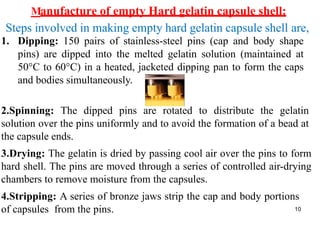
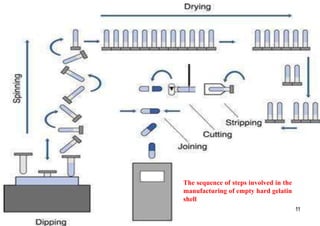
Manufacture of empty Hard gelatin capsule shell:
Steps involved in making empty hard gelatin capsule shell are,
1. Dipping: 150 pairs of stainless-steel pins (cap and body shape
pins) are dipped into the melted gelatin solution (maintained at
50°C to 60°C) in a heated, jacketed dipping pan to form the caps
and bodies simultaneously.
2.Spinning: The dipped pins are rotated to distribute the gelatin
solution over the pins uniformly and to avoid the formation of a bead at
the capsule ends.
3.Drying: The gelatin is dried by passing cool air over the pins to form
hard shell. The pins are moved through a series of controlled air-drying
chambers to remove moisture from the capsules.
4.Stripping: A series of bronze jaws strip the cap and body portions
of capsules from the pins.
5.Trimming and Joining: The stripped cap and body portions are trimmed to
required length with help of stationary knives. After being trimmed to exact
length, the cap and body of the shell are joined to form hard gelatin empty
capsule shell. Finished capsules are finally ejected from the machine. The
entire cycle of the machine lasts approximately 45 min.
6.Polishing: The joined capsule shell is polished by pan polishing or cloth
dusting and brushing.
Pan polishing: Acela-cota pan is used to dust and polish the capsules.This
process removes adhering materials from the surface of the capsules.
Cloth dusting: Capsules are rubbed with cloth which helps to remove
remaining materials and impart gloss.
Brushing: Capsules are feed under soft rotating brush which removes all the
materials.
7.Sorting: Capsule quality is monitored throughout the production process
including size, moisture content, single wall thickness, and color. Capsules
are sorted and visually inspected on specially designed Inspection Stations.
8.Printing: Perfect capsules are imprinted with the client logo on high-speed
printing machine.
11
The sequence of steps involved in the
manufacturing of empty hard gelatin
shell
Evaluation of Hard gelatin empty capsule shell are,
1. Capsule thickness – Film thickness of the capsule is
measured using vernier caliper.
2. Cut length of both cap and body – Cap and body of the
capsule is standard for all sizes of the capsules. It is measured
using vernier calliper.
3. Color and size of the capsule – Color and size of capsule is
noted.
4. Moisture content – Moisture content is measured through Karl
Fischer titration. Limit is 13 to 16%.
5. Solubility - Readily Soluble at 37°C in water.
6. Humidity - Maintain a relative humidity of 40-60% when
handling and storing capsules. At low humidities they will lose
moisture and become brittle, and at high humidities they will
gain moisture and soften.
Formulation of Filled hard gelatin capsules / Excipients used in
powder which is to be filled in capsules
I. Ingredients or Raw materials used:
1. Active Pharmaceutical ingredients(API): API is the part of any
drug that produces the intended effects. E.g- Amoxicillin,
Tetracycline, Lansoprazole, Omeprazole, etc.
2. Excipients(Non Active Ingredients):
Diluents(Fillers): Diluents are used to increase the bulk volume of
capsules, when the quantity of active ingredient is not sufficient to
make up the required bulk. E.g- Lactose, dicalcium phosphate,
microcrystalline cellulose, starch, etc.
Disintegrants: These are used to promote the breakup of the capsule
contents into smaller fragments in an aqueous environment thereby
increasing the available surface area and promoting a more rapid
release of the drug substance. E.g- Crospovidone, croscarmellose
sodium, sodium starch glycolate, etc.
Wetting agents: These are used for wetting and
dissolution of insoluble drugs. E.g- Sodium lauryl sulfate,
Polyethylene glycol, etc.
Glidants: These are the materials used to improve the
flow properties of powder during filling. E.g- Silicones,
corn starch, magnesium stearate, stearic acid and talc.
Flavours: These are used to impart a pleasant flavour and
often odour to capsule formulation. Fruit or citrus and
cocoa flavours are commonly used. E.g- Cinnamon,
orange, raspberry, etc.
Sugars: These are used to impart sweetness to the
product. E.g- Sucrose, dextrose, mannitol, etc.
Protective sorbents: Added to retard the moisture
absorption by hygroscopic agents. E.g-Kaolin, Mgo,caco3
Manufacturing steps of Filling hard gelatin capsule:
Steps involved in the filling of hard gelatin capsules are,
The processes involved in filling are separation of cap from the
body, filling the bodies with powdered materials, replacing the
caps, cleaning the filled capsules and finally ejection of the
capsules.
1. Filling: Filling of hard gelatin capsules is done by manual hand
filling machine in small scale industries or semi automatic or
automatic filling machine in large scale industries.
2. Sealing: Locking & Sealing of filled hard gelatin capsules
to prevent the powder loss.
3. Finishing: Finishing steps involved after filling process are
Polishing, cloth dusting, brushing, inspection and packaging.
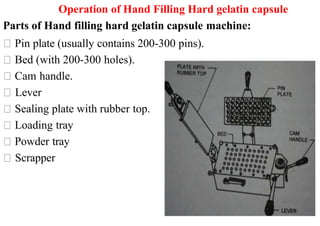
Operation of Hand Filling Hard gelatin capsule
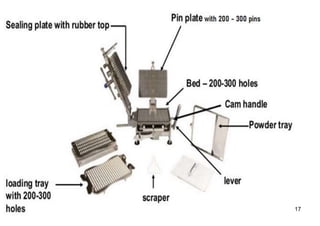
Parts of Hand filling hard gelatin capsule machine:
Pin plate (usually contains 200-300 pins).
Bed (with 200-300 holes).
Cam handle.
Lever
Sealing plate with rubber top.
Loading tray
Powder tray
Scrapper
Procedure of Hand filling hard gelatin capsule machine:
 Empty capsules of required size are selected and filled into the
loading tray of the filling machine (i.e) placed over bed.
 By turning the cam handle, the bodies of the capsules are locked in
the holes.(i.e)The cam handle is operated to hold the bodies of the
capsules.
 By operating the lever downwards, the caps are separated from the
loading tray. (i.e) The loading tray is lifted to separate the caps from
the capsule bodies.
 The powder tray is placed in proper position over the bed. A weighed
amount of drug and diluents are taken for total amount of capsules
to be filled for one operation and transfer to powder tray.
 The powder (drug with additives) is filled with the help of scrapper
to fill the powder uniformly in the body of capsules and the excess
powder is scrapped off.
16
 Lower the pin plate and move it downward to press the filled powder
in the body of capsule and remove the air present in between the
powder particles.
 After pressing, the pin plate is raised and the remaining powder is
filled into the bodies of the capsules uniformly.
 Then remove the powder tray after filling and place the loading tray
which contains caps in position.
 The plate with rubber top is lowered and the lever is locked to seal
the caps and bodies firmly. The lever is finally unlocked and the
plate with rubber top is lifted.
 Remove the loading tray and collect the filled capsules in a tray.
 The capsules are then dusted and polished by rubbing with a muslin
cloth.
 With 200/300 holes machine about 5000/7500 capsules can be filled
per hour.
17
Liquids that are filled in the Hard gelatin Capsules:
• Liquids that are to be filled in the shell, should not
solubilize the gelatin.
• Alcohol solution, Fixed and Volatile oils may be
filled in the gelatin.
• The liquid can be measured using micropipette before
filling.
• The gelatin caps softened by using moist towel.
• Then it is placed in the body of capsule and twisted
slightly for locking to prevent the leakage.
19
Operation of Automatic Hard gelatin capsule in Industrial
scale filling
Roto-weigh capsule filling machine:
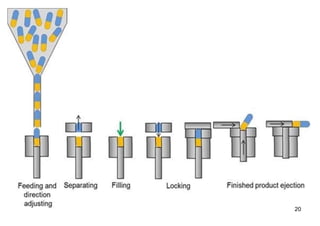
• About 5000 to 15000 capsules are filled per hour. Steps involved
are,
1. Feeding of empty capsules in the Feeder.
2. Capsule alignment
3. Separation of body of the capsule from the cap.
4. Filling of powder through dosing system.
5. Locking of cap in the filled capsule body.
6. Sealing of cap.
7. Ejection of filled capsule.
8. Polishing of filled capsule.
9. Defective capsule is rejected by auto screening of the
machine.
10. Imprinting
Rectification:
• The empty capsules pass one at a time through a channel just wide
enough to provide grip at cap end.
• The capsules will always be aligned body end downwards, regardless
of which end entered the channel first with the help of specially
designated blades (make the capsule to rotate so body end
downwards).
Separation of caps from bodies:
• Separation takes place due to difference in diameters of body &
cap.
• The rectified capsules are delivered body end first into the upper
portion of split filling rings.
• A vacuum applied from below pulls the bodies down into the lower
portion of the split bushing.
• The split bushings are then separated to expose the bodies for filling.
20
Dosing Systems of Rotoweigh Fill Machine (Filling of powder
through dosing system)
These are used to fill the measured powder in the Hard gelatin capsule.
The dosing systems divided into two groups: Dependent or
independent.
Dependent dosing system:
• It involves the measurement of powder directly into the body of
capsule by gravity (use capsule body directly to measure powder).
• In automatic machine the capsule body passes below the powder hopper,
and it is over filled directly by vibrating or tamping aid, and it is
compressed by raising the body against flat surface before closing.
• Uniformity of fill weight can only be achieved if the capsule filled
completely..
Independent dosing system:
• It involves the measurement in special measuring device.
• Weight uniformity is not dependent on filling the body completely.
• Auger or Screw method: Auger a device is placed in powder
hopper which rotates at constant rate (spiral mechanical movement)
that fills the capsule body steadily.
Empty capsules are fed into a pair of ring holders, the caps being
retained in one half and the bodies in the other.
The body holder is placed on a variable- speed revolving turntable;
the powder hopper is pulled over the top of this plate.
In the hopper a revolving auger forces Powder down into the capsule
bodies (i.e,The auger drives the drug into capsule bodies). Finally caps
and bodies are joined & ejected.
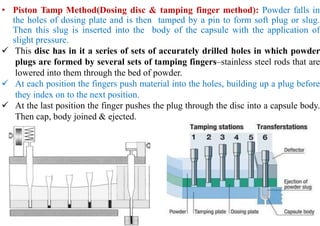
• Piston Tamp Method(Dosing disc & tamping finger method): Powder falls in
the holes of dosing plate and is then tamped by a pin to form soft plug or slug.
Then this slug is inserted into the body of the capsule with the application of
slight pressure.
 This disc has in it a series of sets of accurately drilled holes in which powder
plugs are formed by several sets of tamping fingers–stainless steel rods that are
lowered into them through the bed of powder.
 At each position the fingers push material into the holes, building up a plug before
they index on to the next position.
 At the last position the finger pushes the plug through the disc into a capsule body.
Then cap, body joined & ejected.
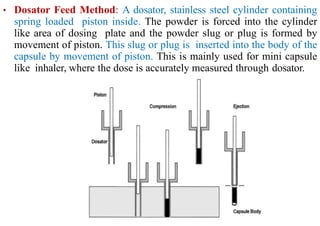
• Dosator Feed Method: A dosator, stainless steel cylinder containing
spring loaded piston inside. The powder is forced into the cylinder
like area of dosing plate and the powder slug or plug is formed by
movement of piston. This slug or plug is inserted into the body of the
capsule by movement of piston. This is mainly used for mini capsule
like inhaler, where the dose is accurately measured through dosator.
Locking and Sealing of Capsules:
Different methods as follows,
Banding – Capsules are sealed by placing gelatin color bands at
the meeting point of caps and the bodies.
Moistening – Moistening the inner surface of caps with lukewarm
gelatin solution & quickly slipped over the filled bodies.
Spot Welding – Heat or Spot welding process which causes the cap
& body to fuse at the joints which leaves a ring like appearance at
the point of sealing.
Thermal welding – Applying wetting solution at the meeting
points of caps & bodies which causes lowering of M.Pt at
specified area. Finally they are sealed at a temp. 40-45ºC.
By using Coni-snap capsules – Caps moves over the body &
Grooves help to lock the caps with the bodies.
Finishing / Polishing of capsules:
Finished capsules require some sort of dusting and polishing operation
before inspection and labeling.
• Pan Polishing: Accela Cota tablet coating pan is used for polishing.
Inside of the pan is lined by polyurethane or cheese cloth. This will
remove the dust as well as impart a gloss finish to the capsules.
• Cloth dusting: Bulk filled capsules are rubbed with cloth which is
dipped with inert oil. This procedure is done by hand operation.
This will remove dust as well as impart gloss finish to the capsules.
• Brushing: Capsules are fed under rotating soft brushes, which
remove the dust from the capsule shell. It is accompanied by
vacuum.
Inspection: To remove imperfect capsules. Visual or by automatic
electronic sorting device.
Imprinting: Printed with product identification information and or
company name using machines.
Various Filling Machine Available…
Eli-lily, Farmatic, Zanasi Nigris, Parke-Davis, Osaka, etc.These
machine differ in there design and output.
Packaging:
• It should be properly packaged in suitable container(glass or plastic)
(Aluminium strip pack or PVC or PVDC / Alu blister pack or bottle
with tamper proof closure).
Storage:
• It should be stored in a cool place-15 to 30°C or room
temperature to maintain the moisture content of the capsule at 13
- 16% moisture.
• < 12% MC, the capsule shells become brittle.
• >16% make them too soft and loose their shape.
• To maintain a relative humidity of 40-60% when handling and storing
capsules.
• Avoid sudden temperature change.
• Shelf life of capsule is 3 years when properly stored and packaged.
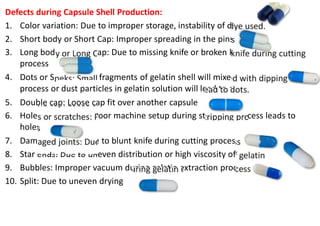
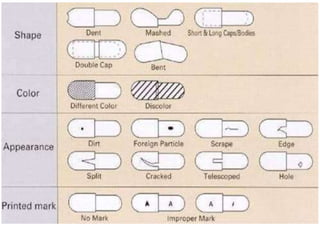
Defects during Capsule Shell Production:
1. Color variation: Due to improper storage, instability of dye used.
2. Short body or Short Cap: Improper spreading in the pins
3. Long body or Long Cap: Due to missing knife or broken knife during cutting
process
4. Dots or Speks: Small fragments of gelatin shell will mixed with dipping
process or dust particles in gelatin solution will lead to dots.
5. Double cap: Loose cap fit over another capsule
6. Holes or scratches: Poor machine setup during stripping process leads to
holes
7. Damaged joints: Due to blunt knife during cutting process
8. Star ends: Due to uneven distribution or high viscosity of gelatin
9. Bubbles: Improper vacuum during gelatin extraction process
10. Split: Due to uneven drying
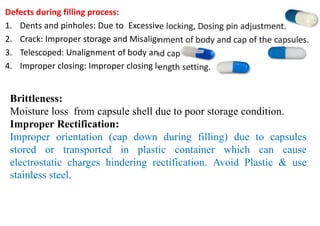
Defects during filling process:
1. Dents and pinholes: Due to Excessive locking, Dosing pin adjustment.
2. Crack: Improper storage and Misalignment of body and cap of the capsules.
3. Telescoped: Unalignment of body and cap
4. Improper closing: Improper closing length setting.
Brittleness:
Moisture loss from capsule shell due to poor storage condition.
Improper Rectification:
Improper orientation (cap down during filling) due to capsules
stored or transported in plastic container which can cause
electrostatic charges hindering rectification. Avoid Plastic & use
stainless steel.
Inprocess and Finished product quality control test for
Hard gelatin capsules:
• Description, Identification, Size & shape, Unique identification
markings.
• Content of active ingredients.
• Content uniformity.
• Weight variation test.
• Disintegration (not applied for modified release capsule).
• Dissolution.
• Moisture permeation test.
• Stability test.
1. Description: It should comply the manufacturers specification.
E.g- White, cap and red body, imprinted with Rx on cap.
2.Identification: API present in capsule is verified by
identification test mentioned in pharmacopoeia or
manufacturers spec.
3.Size and Shape: The size of the capsule (000 to 5 size) is to be
mentioned and shape like spherical, ovoid or tubes is to be
mentioned.
4.Unique identification markings: Symbols inthe capsulefor
better identification of drug or manufacturer is identified.
5.Content of Active ingredients: The amount of active
ingredient present in each of 20 capsules is determined by
suitable assay method. The result should fall within the range of
90-110% for the capsules. 30
6.Content Uniformity test: 30 Capsules are selected and 10 of these are
assayed individually. The amount of active ingredient should be within the
range of 85% to 115% of the label amount for 9 of 10 capsules, with no unit
outside the range of 75% to 125% of label amount. When two values
crosses this limit of ±15% of average value, then the test should be repeated
with another 20 numbers. The requirements are met if all the 30 capsules
are within 75 to 125 % of the specified potency range, and not less than 27
of the 30 are within the 85 to 115% range.
7. Weight variation test: 20 capsules are taken at random and weighed.
Their average weight is calculated, then each capsule is weighed
individually and their weight is noted. Not more than two of the individual
weights deviate from the average weight by more than the percentage
deviation and none should deviate by more than twice that percentage
shown below, (If req. not met, the contents from shell are removed &
weight of contents for individual capsule is determined and compared with
average weight of contents)
Less than 300 mg - ±10% & 300 mg or more - ± 7.5%
31
8.Disintegration:
• The disintegration test is not applicable to prolonged release capsules.
• Place 1 capsule in each of the 6 tubes of the basket of disintegration
apparatus containing water as medium.
• Set the temperature of water to 37℃ ± 2ºC. Use disc if the capsule floats.
• Operate the apparatus for 30 minutes for hard gelatin capsule and 60
minutes for soft gelatin capsule.
• The capsules pass the test, if no residue is left on the screen of the apparatus
and all of them have disintegrated within 30 minutes in case of hard gelatin
capsules and 60 minutes for soft gelatin capsules.
• If 1 or 2 capsules fail to disintegrate, repeat the test on 12 additional
capsules.
• The capsules pass the test if 16 out of 18 have disintegrated.
For enteric capsules use 0.1M hydrochloric acid as medium and operate the
apparatus for 2 hours. No capsule should disintegrate. Replace the medium
with phosphate buffer pH 6.8 and operate the apparatus for further 60 minutes.
The test passes if all the capsules have disintegrated.
9.Dissolution:
• USP 1 - basket apparatus is used.
• Place 900ml of water having a temperature of 37±0.5ºC into the vessel of the
dissolution apparatus.
• Place the capsules in basket and adjust the speed to 100 rpm.
• Withdraw required volume for every 10 minute time interval.
• Filter and determine the amount of active ingredient.
• The sample passes the test if not less than 75% of the drug must undergo
dissolution within 45 minutes.
10. Moisture permeation test:
Acc. to U.S.P the unit dose container is packed along with dehydrated pellets,
which have the property of changing color in the presence of moisture. Change
in color of pellet reveals absorption of moisture. The weight of test capsule is
compared with its weight before the test. Difference in weights gives the amount
of moisture absorbed.
SOFT GELATIN CAPSULE (Soft gels)
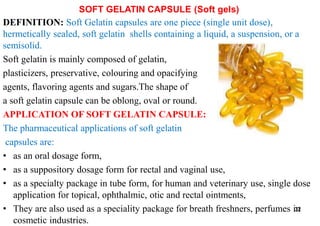
DEFINITION: Soft Gelatin capsules are one piece (single unit dose),
hermetically sealed, soft gelatin shells containing a liquid, a suspension, or a
semisolid.
Soft gelatin is mainly composed of gelatin,
plasticizers, preservative, colouring and opacifying
agents, flavoring agents and sugars.The shape of
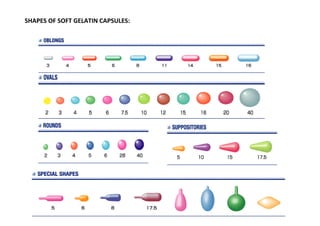
a soft gelatin capsule can be oblong, oval or round.
APPLICATION OF SOFT GELATIN CAPSULE:
The pharmaceutical applications of soft gelatin
capsules are:
• as an oral dosage form,
• as a suppository dosage form for rectal and vaginal use,
• as a specialty package in tube form, for human and veterinary use, single dose
application for topical, ophthalmic, otic and rectal ointments,
• They are also used as a speciality package for breath freshners, perfumes in
cosmetic industries.
32
SHAPES OF SOFT GELATIN CAPSULES:
Advantages:
• Ready availability of drug hence faster action. Improved
bioavailability.
• Superior patient compliance.(Odour and taste masking &
Elegance in appearance).
• Easy to swallow & unit dose delivery.
• The release of the drug can be modified by formulating the
capsules as immediate-release (IR), slow or sustained-release
(SR), or enteric capsules.
• Can be used for ophthalmic preparations & vaginal/ rectal
suppositories. Available in different color, size (capacity ranging
from 0.1 ml – 30ml) & shapes.
• Convenient administration of liquid and semisolid medicaments
in soft gelatin capsules.
• Protect the drugs from atmospheric effects (good stability).
Limitations:
• Powder dosage form cannot be filled.
• Liquids that can easily migrate through the capsule shell are not
suitable for soft gelatin capsules.
• Stability concerns with compounds susceptible to hydrolysis.
• Hygroscopic, deliquescent and efflorescent drugs cannot be
incorporated in soft capsules.
• Temperature and pressure control parameters required during the
filling of medicaments in soft gelatin capsules.
• The manufacturing process of soft gelatin capsules is complex
and it needs a trained person to perform the processes.
• Soft gelatin capsules are more expensive than the tablets as it
requires special manufacturing equipments, storage conditions
and special packing.
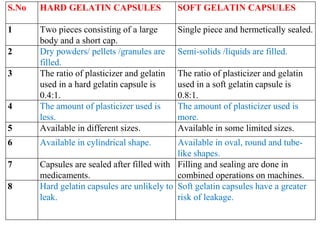
S.No HARD GELATIN CAPSULES SOFT GELATIN CAPSULES
1 Two pieces consisting of a large
body and a short cap.
Single piece and hermetically sealed.
2 Dry powders/ pellets /granules are
filled.
Semi-solids /liquids are filled.
3 The ratio of plasticizer and gelatin
used in a hard gelatin capsule is
0.4:1.
The ratio of plasticizer and gelatin
used in a soft gelatin capsule is
0.8:1.
4 The amount of plasticizer used is
less.
The amount of plasticizer used is
more.
5 Available in different sizes. Available in some limited sizes.
6 Available in cylindrical shape. Available in oval, round and tube-
like shapes.
7 Capsules are sealed after filled with
medicaments.
Filling and sealing are done in
combined operations on machines.
8 Hard gelatin capsules are unlikely to
leak.
Soft gelatin capsules have a greater
risk of leakage.
Nature of soft gelatin capsule shell:
• Size and Shape: Round (0.05 - 5ml), Oval (0.05 - 7ml), Oblong (0.3-
5ml), Tube (0.5-10ml).
• It is composed of Gelatin, Plasticizer (Glycerin, sorbitol) and Water.
The shells of soft gelatin capsules are made elastic by the addition of
plasticizer(high concentration than hard gelatin).
• Ingredients added in the gelatin formulation such as preservatives
(Methyl paraben & Propyl paraben), coloring (FDC approved water-
soluble dyes, Water insoluble dyes (lakes, pigments) and opacifying
agents (0.2- 1.2% TiO2), flavors (0.1% Vanillin, Essential oils),
sweeteners (E.g-mannitol, sucrose) , acids (1% Fumaric acid for
solubility) and medicaments.
• Specifications to be checked for soft gelatin capsule shell are bloom
strength, viscosity and iron content and then plasticizers amount
(Glycerin to Gelatin ratio is (0.7 - 1.3) : 1.0).
33
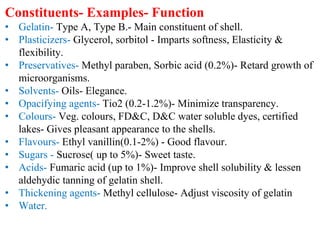
Constituents- Examples- Function
• Gelatin- Type A, Type B.- Main constituent of shell.
• Plasticizers- Glycerol, sorbitol - Imparts softness, Elasticity &
flexibility.
• Preservatives- Methyl paraben, Sorbic acid (0.2%)- Retard growth of
microorganisms.
• Solvents- Oils- Elegance.
• Opacifying agents- Tio2 (0.2-1.2%)- Minimize transparency.
• Colours- Veg. colours, FD&C, D&C water soluble dyes, certified
lakes- Gives pleasant appearance to the shells.
• Flavours- Ethyl vanillin(0.1-2%) - Good flavour.
• Sugars - Sucrose( up to 5%)- Sweet taste.
• Acids- Fumaric acid (up to 1%)- Improve shell solubility & lessen
aldehydic tanning of gelatin shell.
• Thickening agents- Methyl cellulose- Adjust viscosity of gelatin
• Water.
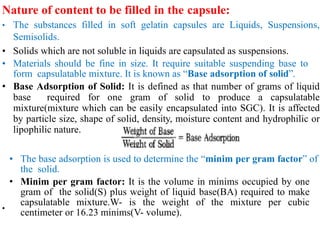
Nature of content to be filled in the capsule:
• The substances filled in soft gelatin capsules are Liquids, Suspensions,
Semisolids.
• Solids which are not soluble in liquids are capsulated as suspensions.
• Materials should be fine in size. It require suitable suspending base to
form capsulatable mixture. It is known as “Base adsorption of solid”.
• Base Adsorption of Solid: It is defined as that number of grams of liquid
base required for one gram of solid to produce a capsulatable
mixture(mixture which can be easily encapsulated into SGC). It is affected
by particle size, shape of solid, density, moisture content and hydrophilic or
lipophilic nature.
•
• The base adsorption is used to determine the “minim per gram factor” of
the solid.
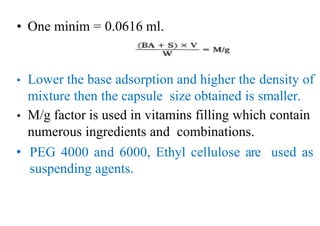
• Minim per gram factor: It is the volume in minims occupied by one
gram of the solid(S) plus weight of liquid base(BA) required to make
capsulatable mixture.W- is the weight of the mixture per cubic
centimeter or 16.23 minims(V- volume).
• One minim = 0.0616 ml.
• Lower the base adsorption and higher the density of
mixture then the capsule size obtained is smaller.
• M/g factor is used in vitamins filling which contain
numerous ingredients and combinations.
• PEG 4000 and 6000, Ethyl cellulose are used as
suspending agents.
Is manufactured by four methods
1) Plate process
2) Accogel machine
3) Rotary die process
4) Reciprocating die process
Plate process:
•Prepare the ingredients required for filling.
•Place warm gelatin sheet over a die plate containing numerous die pockets.
•Apply vacuum to draw the gelatin sheet in to the die pockets.
•Fill the pockets with material (liquid or paste).
•Place another gelatin sheet over the filled pockets, apply pressure and
sandwich under a die press where capsules are formed, sealed and cut out.
• Finally the capsules are removed from the plates, cleaned and dried.
Accogel Capsule Machine / Stem machine process:
It consists of mainly 3 parts: Measuring roll, Die roll & Sealing roll.
Measuring roll rotates directly over the die roll, and the pockets in the 2
rolls are aligned each other.
Accogel Capsule Machine / Stem machine: Contd..
 As the measuring roll and die rolls rotate, the measured doses are
transferred to the gelatin-linked pockets of the die roll.
 The continuous rotation of the filled die converges with the rotating
sealing roll where a second gelatin sheet is applied to form the other
half of the capsule.
 Pressure developed between the die roll and sealing roll seals and cuts
out the capsules.
It uses a system of rotary dies but is unique in that it is the only
machine that can successfully fill dry powder into a soft gelatin
capsule.
35
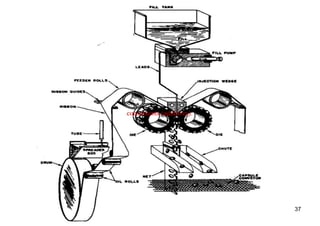
Rotary Die Process:
• Rotary die process is used for filling of Soft gelatin capsules. Capsules
are filled and sealed by the continuous process. The rotary die process
involves continuous formation of a heat seal between two ribbons of
gelatin with simultaneous filling of material into each capsule, shaped,
hermetically sealed and finally cut from the gelatin ribbon.
• Gelatin is weighed and mixed with water & it is then transferred to
melting tanks and melted at 93°C. To this add constituents (additives).
• Liquids or powders that are to be suspended to form mixture is
prepared in mixing area. After mixing it is milled or homogenized
and deaerated.
• The rotary die consists of a set of vertical die rotating in opposite
direction. The fluid gelatin mixture enters the machine from the tank
which produces two separate gelatin ribbons. Each ribbon provides one
half of the softgel.
36
• Accurately metered volumes of materials to be filled is injected through a
positive displacement pump (wedge device) into the space between the
gelatin ribbons as they pass between the die rolls.
• When the pressure of the material forces the gelatin ribbons into the die
pockets, where the two softgel capsule halves are sealed together by the
application of heat and pressure. (i.e)Two plasticized gelatin ribbons are
continuously and simultaneously fed with the liquid or paste fill between
the rollers of the rotary die mechanism.
• The filled capsules are subsequently sealed as the die assembly rotates.
Sealing of the capsule is achieved at 37oC to 40oC. The softgel capsules
are cut automatically from the gelatin ribbon (Figure).
• Then the capsules are passed through the naphtha wash to remove mineral
oil and dried.
• After drying, the softgels are sorted (sized), polished, printed and
inspected for their quality(Visually inspected for checking malformed
damaged or improper filled capsule and rejected).
• The softgels are then packed into suitable containers(Capacity 25000-
30000 capsules per hour.
37
constituents (additives).
38
Reciprocating die process:
• The process is similar to rotary die process, the only
difference (in encapsulating step) being that the gelatin
ribbons are fed between a pair of vertical dies that
continuously open & close to form rows of pockets in the
gelatin ribbons.
• These pockets are filled with the fill material, hermetically
sealed, shaped & cut off from the ribbon as the move
through the machine.
•
Physical stability:
• Unprotected soft gelatin capsules rapidly reach equilibrium with
atmospheric conditions and deformed. Glycerin to gelatin ratio
(0.5 to 1) and Water to gelatin ratio (1 to 1) is to be maintained at
30 % RH and 21-24 °C.
• Physical stability is associated with gain or loss of water by
capsule shell. If the Capsule is properly packaged it will retain
the physical stability at temperatures ranging from just above
freezing temp to 60°C.
• Unprotected capsule will produce brittleness at high
temperatures > 38 °C.
• As humidity increased, the unprotected capsule will pickup
moisture and the capsule become softer, tackier and bloated.
38
Physical stability: Cont…
• During manufacturing, the formulator check the physical
stability at various conditions. 80% RH at room temp in
an open container, 40°C in an open container and closed
container.
• The effect of the conditions like Brittleness, softness,
leakage, Colorfading, Disintegration are observed.
Capsule packaging & Storage:
• Capsules are packaged in well closed glass or plastic
containers or strip packaged or blister packaged and
immediately double packed with secondary carton & stored
at temp. not exceeding 30ºC.
39
In process quality control test: Four important test to be
conducted are,
1. Gel ribbon thickness.
2. Soft gel seal thickness at the time of encapsulation.
3. Fill mixture weight and capsule shell weight.
4. Moisture and hardness of soft gel capsule at the end of
drying stage.
Finished product testing or Quality control test for Soft
gelatin capsule:
1. Appearance, Permeability, Sealing and leakage.
2. Assay.
3. Impurity testing.
49
4. Weight variation test - Weigh an intact capsule. To remove the
contents of soft capsule, the shell may be washed with ether or
other suitable solvent and the shell is allowed to stand until the
odour of the solvent is no longer detectable. The shell is weighed.
The weight of the contents is the difference between the
weighings. Repeat the procedure with further 19 capsules.
Determine the average weight of capsule contents. Not more than
two of the individual weights deviate from the average weight by
more than the percentage deviation shown and none should
deviate by more than twice that percentage shown below,
< 300 mg - 10%
300 mg or more - 7.5%
5. Content uniformity - Procedure same as hard gelatin
capsules.
6.Disintegration:The procedure is same as hard gelatin
capsules except, the apparatus is operated for 60
minutes for soft gelatin capsule.
7.Dissolution: USP 1 or IP 2 apparatus. It should comply
the pharmacopoeia.The procedure is same as hard gelatin
capsules.
8.Moisture content: Determined by Karl Fisher
Titrimetry.
9.Stability testing: Carried out in accelerated
temperature studies (45°C and 75% RH) and
different temperatures, humidity and light.
Packaging & Storage: Refer hard gelatin capsules.

Unit 3 - Capsules- Rajesh.pptx

  • 1.
    UNIT-III 08 Hours Capsules: a.Hard gelatin capsules: Introduction, Production of hard gelatin capsule shells. size of capsules, Filling, finishing and special techniques of formulation of hard gelatin capsules, manufacturing defects. In process and final product quality control tests for capsules. b. Soft gelatin capsules: Nature of shell and capsule content, size of capsules, importance of base adsorption and minim/gram factors, production, in process and final product quality control tests. Packing, storage and stability testing of soft gelatin capsules and their applications. Pellets: Introduction, formulation requirements, pelletization process, equipment for manufacture of pellets.
  • 2.
    CAPSULES Definition: Capsules aresolid oral dosage forms in which the medicaments and diluents are encapsulated in a hard or soft soluble shell made up of gelatin. Capsules may be classified as either Hard or Soft, depending on the nature of the shell. • The word capsule is derived from the Latin word capsula, meaning a small box or container. . • In pharmacy the word is used to describe an edible package made from gelatin or other suitable material which is filled with medicines to produce a unit dosage, mainly for oral use. The medication may be a powder, a liquid or a semisolid mass. • Capsules are usually intended to be administered orally by swallowing them whole. Occasionally, capsules may be administered rectally or vaginal insertion as suppositories. • The hard gelatin capsule can be used for dry fills such as powder, granules, pellets and semisolids while the soft gelatin capsule shell is exclusively used for liquids and semisolids. 2
  • 3.
    3 Advantages 1.Capsules shell aretasteless, odorless, inert and can easily be administered. (i.e) Mask the bitter taste and odor of the drug by enclosing in the capsule shell. 2.Attractive in appearance. 3.Easy to swallow than tablet because it is very slippery when come in contact with water. 4.Less excipients are used when compared to tablets. 5.Economical (Production cost is low when compared to tablets ) and easy to carry & transport than liquids. Disadvantages 1. Hygroscopic, deliquescent drugs when filled in capsule will absorb water from capsule shell and make it brittle. 2. Volatile and efflorescent drugs are not suitable for capsule formulations. 3. Not suitable for liquids that dissolve gelatin, such as aqueous or hydro alcoholic solutions. 4. The concentrated solutions which require previous dilution are unsuitable for capsules because if administered as such lead to irritation into stomach.
  • 4.
    4 Advantages 6.They can befilled quickly and conveniently. 7. The ready solubility of gelatin at gastric pH provides rapid release of medication in the stomach. 8.Packaged and shipped by manufacturers at lower cost & less breakage than liquid dosage forms. 9.More stable and longer shelf life. It protects the medicaments from environmental effects. 10.The shells can be opacified or colored to protect from light. Disadvantages 5.Slow operation than tablet manufacturing operation. 6.Uniformity of filling is difficult in hard gelatin capsules. 7. Dust formation during filling of hard gelatin capsules. 8.Special mfg equipment is required. 9. Storage is difficult (prone to fluctuations in humidity).
  • 5.
    Hard Gelatin Capsule •Hard gelatin capsules are solid dosage forms in which the medicaments are enclosed in a hard soluble shell made up of gelatin. • They are used mainly for administration of solid medicaments. Also semisolids & non aqs- liquids are filled. • Hard gelatin capsules are also known as dry-filled capsules or two piece capsules. • The Hard gelatin capsule consists of two pieces in the form of cylindrical shapes called as body and cap. • . The shorter piece or upper part is called the cap. • The longer piece or lower part is called body, in which the cap fits over it. The diameter of cap is slightly larger than body. • The powdered drug substance is filled into the cylindrical body of the capsules and then the cap is placed over it. • Capsules are made up of gelatin blends, small amount of certified dyes, opaquants, plasticizers and preservatives. 5
  • 6.
    Various shapes ofHard gelatin capsule available in market 6 • The standard shape of capsules is traditional, symmetrical bullet shape. • There are eight different sizes of capsules varying from 000, the largest to 5, the smallest. CAP BODY
  • 7.
  • 8.
    Formulation or Rawmaterials or Constituents of Capsule Shell I. Raw material used: The raw materials used in the manufacture of both types of capsule are similar. Both contain gelatin, water, colorants and optional materials such as process aids and preservatives in addition, soft capsules contain more plasticizers. a) Gelatin: It is a biopolymer material (heterogeneous product) composed of polypeptide chains prepared by the hydrolysis of collagen obtained from animal connective tissues, bones and pork skin. It is the major component of the capsule. The reason for this is that gelatin possesses following basic properties: 1- Non-toxic, widely used in foodstuffs and acceptable for use worldwide. 2- It is readily soluble in biological fluids at body temperature.
  • 9.
    3- It isa good film-forming material, producing a strong flexible film. 4- It melts when heated & solidifies when cooled. There are two types of gelatin. Type A and Type B gelatin. • Type A (Acid hydrolysis of pork skin) - Low viscous but high bloom (hardness of gelatin). Iso-electric point of Type A gelatin is near to PH 9. The acid process takes about 7-10 days and is used mainly from animal skins, because they require less pretreatment than bones. • Type B (Alkaline hydrolysis of bones) - High viscous but lower bloom. Iso electric point of Type B gelatin is near to PH 4.7. The basic process takes about 10 times as long and is used mainly from bovine bones. • Bone gelatin imparts firmness ( but tends to be hazy & brittle). Pork gelatin imparts plasticity & clarity thus reduce cloudiness in the finished capsule. So blends of bone & pork gelatin used.
  • 10.
  • 11.
    Type A Gelatin Boneor Skin Acid hydrolysis Lime treatment Type B Gelatin Bone or Skin Alkali hydrolysis Sodium hydroxide treatment Conditioning Extraction Filtration Concentration Drying Cooling Milling Blending Packaging 11 Manufacturing or Production of gelatin powder flowchart:
  • 12.
    I Production of gelatinor manufacturing steps of gelatin powder: Conditioning: The raw materials are washed to clean and degreased. It is then undergoing either Type A or Type B extraction process to further degrease and demineralize. Extraction: The raw material is mixed with warm water. By controlling the temperature(85°C), the gelatin solution is uniformly formed. Filtration: The solution containing gelatin is cleaned and polished. It involves centrifuging, ultrafiltration and ion exchange process for removal of inorganic material. Concentration: Vacuum evaporators are used to concentrate the gelatin solution. Rich high viscous, honey like appearance of gelatin is formed by this technique. During this process it is subjected to high temperature flash sterilization to prevent the risk of microbial contamination. Drying: Warm concentrated gelatin solution is gelled by cooling and then it is minced or chopped and transferred to drying chamber where dry air stream is passed. Grinding, Milling and Blending: After microbiological and physical testing, gelatin particles are grounded, milled and blended to suit the customer specification.
  • 14.
    9 Evaluation of Gelatinpowder 1. Bloom or gel strength: It is a measure of the strength and stiffness of the gelatin. This indicates the average molecular weight of gelatin. Determination: Bloom is determined by measuring the weight in gm required to move a plastic plunger that is 0.5-inch diameter into the 6.66% gelatin gel to 4 mm height(depth). This test is performed when gelatin gel is stored at 10°C for 17 hours before testing. Limit of gelatin is 150 - 250 gm. Higher the bloom value, harder the gelatin which have high melting and gelling points. 2. Viscosity: Viscosity is determined by measuring the flow time of a 6.67% solution of gelatin through a U-tube viscometer at 60 °C. Limit : 25-45 millipoise.
  • 15.
    3. Iron:  Capsulemade from gelatin should not contain more than 15 ppm of iron because of color reaction with organic compounds. 4.Melting point;  Determined using melting point apparatus.  Lower melting point gelatins dissolve faster in the mouth, therefore releasing the flavors more quickly for an instant taste sensation.  Lower bloom grades tend to have lower melting points. 5. Color and odor;  The gelatin should be as clear as possible in solution.  Clarity is measured using a turbidimeter .  The gelatin should be without odor. 6. pH;  pH is measured using a pH meter on a 1% solution.
  • 16.
    Other raw materialsused: b)Certified Dyes: Gives pleasant appearance to the shells. The colorants used are of two types: water-soluble dyes & insoluble pigments. To make a range of colours dyes and pigments are mixed together as solutions or suspensions. Colors used are approved by D & C act. Most dyes used currently are erythrosine, indigo, carmine, quinolone yellow, etc. Two types of pigment used are iron oxides- black, red and yellow and titanium di oxide which is white and used to make capsule opaque. c) Plasticizers: Imparts softness & Elasticity. E.g- Sorbitol, Glycerin,PG. d) Preservatives: Added to prevent microbiological contamination during manufacture. E.g-Propyl and Methyl Parabens, Benzoic acid,etc. e) Water - 12 to 16 % (vary depending on the storage condition). f)Sulfurdioxide(15%):- prevent gelatin decomposition during manufacture. g) Sugars & flavors: To impart sweet taste & good odor. E.g- Sucrose( up to 5%).Vanillin. h) Thickening agents: To adjust viscosity of gelatin. E.g- Methyl cellulose. i) Anti-dusting agents: Generally edible oils are used to control dusting.
  • 17.
    10 Manufacture of emptyHard gelatin capsule shell: Steps involved in making empty hard gelatin capsule shell are, 1. Dipping: 150 pairs of stainless-steel pins (cap and body shape pins) are dipped into the melted gelatin solution (maintained at 50°C to 60°C) in a heated, jacketed dipping pan to form the caps and bodies simultaneously. 2.Spinning: The dipped pins are rotated to distribute the gelatin solution over the pins uniformly and to avoid the formation of a bead at the capsule ends. 3.Drying: The gelatin is dried by passing cool air over the pins to form hard shell. The pins are moved through a series of controlled air-drying chambers to remove moisture from the capsules. 4.Stripping: A series of bronze jaws strip the cap and body portions of capsules from the pins.
  • 18.
    5.Trimming and Joining:The stripped cap and body portions are trimmed to required length with help of stationary knives. After being trimmed to exact length, the cap and body of the shell are joined to form hard gelatin empty capsule shell. Finished capsules are finally ejected from the machine. The entire cycle of the machine lasts approximately 45 min. 6.Polishing: The joined capsule shell is polished by pan polishing or cloth dusting and brushing. Pan polishing: Acela-cota pan is used to dust and polish the capsules.This process removes adhering materials from the surface of the capsules. Cloth dusting: Capsules are rubbed with cloth which helps to remove remaining materials and impart gloss. Brushing: Capsules are feed under soft rotating brush which removes all the materials. 7.Sorting: Capsule quality is monitored throughout the production process including size, moisture content, single wall thickness, and color. Capsules are sorted and visually inspected on specially designed Inspection Stations. 8.Printing: Perfect capsules are imprinted with the client logo on high-speed printing machine.
  • 19.
    11 The sequence ofsteps involved in the manufacturing of empty hard gelatin shell
  • 20.
    Evaluation of Hardgelatin empty capsule shell are, 1. Capsule thickness – Film thickness of the capsule is measured using vernier caliper. 2. Cut length of both cap and body – Cap and body of the capsule is standard for all sizes of the capsules. It is measured using vernier calliper. 3. Color and size of the capsule – Color and size of capsule is noted. 4. Moisture content – Moisture content is measured through Karl Fischer titration. Limit is 13 to 16%. 5. Solubility - Readily Soluble at 37°C in water. 6. Humidity - Maintain a relative humidity of 40-60% when handling and storing capsules. At low humidities they will lose moisture and become brittle, and at high humidities they will gain moisture and soften.
  • 21.
    Formulation of Filledhard gelatin capsules / Excipients used in powder which is to be filled in capsules I. Ingredients or Raw materials used: 1. Active Pharmaceutical ingredients(API): API is the part of any drug that produces the intended effects. E.g- Amoxicillin, Tetracycline, Lansoprazole, Omeprazole, etc. 2. Excipients(Non Active Ingredients): Diluents(Fillers): Diluents are used to increase the bulk volume of capsules, when the quantity of active ingredient is not sufficient to make up the required bulk. E.g- Lactose, dicalcium phosphate, microcrystalline cellulose, starch, etc. Disintegrants: These are used to promote the breakup of the capsule contents into smaller fragments in an aqueous environment thereby increasing the available surface area and promoting a more rapid release of the drug substance. E.g- Crospovidone, croscarmellose sodium, sodium starch glycolate, etc.
  • 22.
    Wetting agents: Theseare used for wetting and dissolution of insoluble drugs. E.g- Sodium lauryl sulfate, Polyethylene glycol, etc. Glidants: These are the materials used to improve the flow properties of powder during filling. E.g- Silicones, corn starch, magnesium stearate, stearic acid and talc. Flavours: These are used to impart a pleasant flavour and often odour to capsule formulation. Fruit or citrus and cocoa flavours are commonly used. E.g- Cinnamon, orange, raspberry, etc. Sugars: These are used to impart sweetness to the product. E.g- Sucrose, dextrose, mannitol, etc. Protective sorbents: Added to retard the moisture absorption by hygroscopic agents. E.g-Kaolin, Mgo,caco3
  • 23.
    Manufacturing steps ofFilling hard gelatin capsule: Steps involved in the filling of hard gelatin capsules are, The processes involved in filling are separation of cap from the body, filling the bodies with powdered materials, replacing the caps, cleaning the filled capsules and finally ejection of the capsules. 1. Filling: Filling of hard gelatin capsules is done by manual hand filling machine in small scale industries or semi automatic or automatic filling machine in large scale industries. 2. Sealing: Locking & Sealing of filled hard gelatin capsules to prevent the powder loss. 3. Finishing: Finishing steps involved after filling process are Polishing, cloth dusting, brushing, inspection and packaging.
  • 24.
    Operation of HandFilling Hard gelatin capsule Parts of Hand filling hard gelatin capsule machine: Pin plate (usually contains 200-300 pins). Bed (with 200-300 holes). Cam handle. Lever Sealing plate with rubber top. Loading tray Powder tray Scrapper
  • 25.
    Procedure of Handfilling hard gelatin capsule machine:  Empty capsules of required size are selected and filled into the loading tray of the filling machine (i.e) placed over bed.  By turning the cam handle, the bodies of the capsules are locked in the holes.(i.e)The cam handle is operated to hold the bodies of the capsules.  By operating the lever downwards, the caps are separated from the loading tray. (i.e) The loading tray is lifted to separate the caps from the capsule bodies.  The powder tray is placed in proper position over the bed. A weighed amount of drug and diluents are taken for total amount of capsules to be filled for one operation and transfer to powder tray.  The powder (drug with additives) is filled with the help of scrapper to fill the powder uniformly in the body of capsules and the excess powder is scrapped off. 16
  • 26.
     Lower thepin plate and move it downward to press the filled powder in the body of capsule and remove the air present in between the powder particles.  After pressing, the pin plate is raised and the remaining powder is filled into the bodies of the capsules uniformly.  Then remove the powder tray after filling and place the loading tray which contains caps in position.  The plate with rubber top is lowered and the lever is locked to seal the caps and bodies firmly. The lever is finally unlocked and the plate with rubber top is lifted.  Remove the loading tray and collect the filled capsules in a tray.  The capsules are then dusted and polished by rubbing with a muslin cloth.  With 200/300 holes machine about 5000/7500 capsules can be filled per hour.
  • 27.
  • 28.
    Liquids that arefilled in the Hard gelatin Capsules: • Liquids that are to be filled in the shell, should not solubilize the gelatin. • Alcohol solution, Fixed and Volatile oils may be filled in the gelatin. • The liquid can be measured using micropipette before filling. • The gelatin caps softened by using moist towel. • Then it is placed in the body of capsule and twisted slightly for locking to prevent the leakage.
  • 29.
    19 Operation of AutomaticHard gelatin capsule in Industrial scale filling Roto-weigh capsule filling machine: • About 5000 to 15000 capsules are filled per hour. Steps involved are, 1. Feeding of empty capsules in the Feeder. 2. Capsule alignment 3. Separation of body of the capsule from the cap. 4. Filling of powder through dosing system. 5. Locking of cap in the filled capsule body. 6. Sealing of cap. 7. Ejection of filled capsule. 8. Polishing of filled capsule. 9. Defective capsule is rejected by auto screening of the machine. 10. Imprinting
  • 30.
    Rectification: • The emptycapsules pass one at a time through a channel just wide enough to provide grip at cap end. • The capsules will always be aligned body end downwards, regardless of which end entered the channel first with the help of specially designated blades (make the capsule to rotate so body end downwards). Separation of caps from bodies: • Separation takes place due to difference in diameters of body & cap. • The rectified capsules are delivered body end first into the upper portion of split filling rings. • A vacuum applied from below pulls the bodies down into the lower portion of the split bushing. • The split bushings are then separated to expose the bodies for filling.
  • 31.
  • 32.
    Dosing Systems ofRotoweigh Fill Machine (Filling of powder through dosing system) These are used to fill the measured powder in the Hard gelatin capsule. The dosing systems divided into two groups: Dependent or independent. Dependent dosing system: • It involves the measurement of powder directly into the body of capsule by gravity (use capsule body directly to measure powder). • In automatic machine the capsule body passes below the powder hopper, and it is over filled directly by vibrating or tamping aid, and it is compressed by raising the body against flat surface before closing. • Uniformity of fill weight can only be achieved if the capsule filled completely.. Independent dosing system: • It involves the measurement in special measuring device. • Weight uniformity is not dependent on filling the body completely.
  • 33.
    • Auger orScrew method: Auger a device is placed in powder hopper which rotates at constant rate (spiral mechanical movement) that fills the capsule body steadily. Empty capsules are fed into a pair of ring holders, the caps being retained in one half and the bodies in the other. The body holder is placed on a variable- speed revolving turntable; the powder hopper is pulled over the top of this plate. In the hopper a revolving auger forces Powder down into the capsule bodies (i.e,The auger drives the drug into capsule bodies). Finally caps and bodies are joined & ejected.
  • 34.
    • Piston TampMethod(Dosing disc & tamping finger method): Powder falls in the holes of dosing plate and is then tamped by a pin to form soft plug or slug. Then this slug is inserted into the body of the capsule with the application of slight pressure.  This disc has in it a series of sets of accurately drilled holes in which powder plugs are formed by several sets of tamping fingers–stainless steel rods that are lowered into them through the bed of powder.  At each position the fingers push material into the holes, building up a plug before they index on to the next position.  At the last position the finger pushes the plug through the disc into a capsule body. Then cap, body joined & ejected.
  • 35.
    • Dosator FeedMethod: A dosator, stainless steel cylinder containing spring loaded piston inside. The powder is forced into the cylinder like area of dosing plate and the powder slug or plug is formed by movement of piston. This slug or plug is inserted into the body of the capsule by movement of piston. This is mainly used for mini capsule like inhaler, where the dose is accurately measured through dosator.
  • 36.
    Locking and Sealingof Capsules: Different methods as follows, Banding – Capsules are sealed by placing gelatin color bands at the meeting point of caps and the bodies. Moistening – Moistening the inner surface of caps with lukewarm gelatin solution & quickly slipped over the filled bodies. Spot Welding – Heat or Spot welding process which causes the cap & body to fuse at the joints which leaves a ring like appearance at the point of sealing. Thermal welding – Applying wetting solution at the meeting points of caps & bodies which causes lowering of M.Pt at specified area. Finally they are sealed at a temp. 40-45ºC. By using Coni-snap capsules – Caps moves over the body & Grooves help to lock the caps with the bodies.
  • 37.
    Finishing / Polishingof capsules: Finished capsules require some sort of dusting and polishing operation before inspection and labeling. • Pan Polishing: Accela Cota tablet coating pan is used for polishing. Inside of the pan is lined by polyurethane or cheese cloth. This will remove the dust as well as impart a gloss finish to the capsules. • Cloth dusting: Bulk filled capsules are rubbed with cloth which is dipped with inert oil. This procedure is done by hand operation. This will remove dust as well as impart gloss finish to the capsules. • Brushing: Capsules are fed under rotating soft brushes, which remove the dust from the capsule shell. It is accompanied by vacuum. Inspection: To remove imperfect capsules. Visual or by automatic electronic sorting device. Imprinting: Printed with product identification information and or company name using machines.
  • 38.
    Various Filling MachineAvailable… Eli-lily, Farmatic, Zanasi Nigris, Parke-Davis, Osaka, etc.These machine differ in there design and output. Packaging: • It should be properly packaged in suitable container(glass or plastic) (Aluminium strip pack or PVC or PVDC / Alu blister pack or bottle with tamper proof closure). Storage: • It should be stored in a cool place-15 to 30°C or room temperature to maintain the moisture content of the capsule at 13 - 16% moisture. • < 12% MC, the capsule shells become brittle. • >16% make them too soft and loose their shape. • To maintain a relative humidity of 40-60% when handling and storing capsules. • Avoid sudden temperature change. • Shelf life of capsule is 3 years when properly stored and packaged.
  • 39.
    Defects during CapsuleShell Production: 1. Color variation: Due to improper storage, instability of dye used. 2. Short body or Short Cap: Improper spreading in the pins 3. Long body or Long Cap: Due to missing knife or broken knife during cutting process 4. Dots or Speks: Small fragments of gelatin shell will mixed with dipping process or dust particles in gelatin solution will lead to dots. 5. Double cap: Loose cap fit over another capsule 6. Holes or scratches: Poor machine setup during stripping process leads to holes 7. Damaged joints: Due to blunt knife during cutting process 8. Star ends: Due to uneven distribution or high viscosity of gelatin 9. Bubbles: Improper vacuum during gelatin extraction process 10. Split: Due to uneven drying
  • 40.
    Defects during fillingprocess: 1. Dents and pinholes: Due to Excessive locking, Dosing pin adjustment. 2. Crack: Improper storage and Misalignment of body and cap of the capsules. 3. Telescoped: Unalignment of body and cap 4. Improper closing: Improper closing length setting. Brittleness: Moisture loss from capsule shell due to poor storage condition. Improper Rectification: Improper orientation (cap down during filling) due to capsules stored or transported in plastic container which can cause electrostatic charges hindering rectification. Avoid Plastic & use stainless steel.
  • 42.
    Inprocess and Finishedproduct quality control test for Hard gelatin capsules: • Description, Identification, Size & shape, Unique identification markings. • Content of active ingredients. • Content uniformity. • Weight variation test. • Disintegration (not applied for modified release capsule). • Dissolution. • Moisture permeation test. • Stability test.
  • 43.
    1. Description: Itshould comply the manufacturers specification. E.g- White, cap and red body, imprinted with Rx on cap. 2.Identification: API present in capsule is verified by identification test mentioned in pharmacopoeia or manufacturers spec. 3.Size and Shape: The size of the capsule (000 to 5 size) is to be mentioned and shape like spherical, ovoid or tubes is to be mentioned. 4.Unique identification markings: Symbols inthe capsulefor better identification of drug or manufacturer is identified. 5.Content of Active ingredients: The amount of active ingredient present in each of 20 capsules is determined by suitable assay method. The result should fall within the range of 90-110% for the capsules. 30
  • 44.
    6.Content Uniformity test:30 Capsules are selected and 10 of these are assayed individually. The amount of active ingredient should be within the range of 85% to 115% of the label amount for 9 of 10 capsules, with no unit outside the range of 75% to 125% of label amount. When two values crosses this limit of ±15% of average value, then the test should be repeated with another 20 numbers. The requirements are met if all the 30 capsules are within 75 to 125 % of the specified potency range, and not less than 27 of the 30 are within the 85 to 115% range. 7. Weight variation test: 20 capsules are taken at random and weighed. Their average weight is calculated, then each capsule is weighed individually and their weight is noted. Not more than two of the individual weights deviate from the average weight by more than the percentage deviation and none should deviate by more than twice that percentage shown below, (If req. not met, the contents from shell are removed & weight of contents for individual capsule is determined and compared with average weight of contents) Less than 300 mg - ±10% & 300 mg or more - ± 7.5%
  • 45.
    31 8.Disintegration: • The disintegrationtest is not applicable to prolonged release capsules. • Place 1 capsule in each of the 6 tubes of the basket of disintegration apparatus containing water as medium. • Set the temperature of water to 37℃ ± 2ºC. Use disc if the capsule floats. • Operate the apparatus for 30 minutes for hard gelatin capsule and 60 minutes for soft gelatin capsule. • The capsules pass the test, if no residue is left on the screen of the apparatus and all of them have disintegrated within 30 minutes in case of hard gelatin capsules and 60 minutes for soft gelatin capsules. • If 1 or 2 capsules fail to disintegrate, repeat the test on 12 additional capsules. • The capsules pass the test if 16 out of 18 have disintegrated. For enteric capsules use 0.1M hydrochloric acid as medium and operate the apparatus for 2 hours. No capsule should disintegrate. Replace the medium with phosphate buffer pH 6.8 and operate the apparatus for further 60 minutes. The test passes if all the capsules have disintegrated.
  • 46.
    9.Dissolution: • USP 1- basket apparatus is used. • Place 900ml of water having a temperature of 37±0.5ºC into the vessel of the dissolution apparatus. • Place the capsules in basket and adjust the speed to 100 rpm. • Withdraw required volume for every 10 minute time interval. • Filter and determine the amount of active ingredient. • The sample passes the test if not less than 75% of the drug must undergo dissolution within 45 minutes. 10. Moisture permeation test: Acc. to U.S.P the unit dose container is packed along with dehydrated pellets, which have the property of changing color in the presence of moisture. Change in color of pellet reveals absorption of moisture. The weight of test capsule is compared with its weight before the test. Difference in weights gives the amount of moisture absorbed.
  • 47.
    SOFT GELATIN CAPSULE(Soft gels) DEFINITION: Soft Gelatin capsules are one piece (single unit dose), hermetically sealed, soft gelatin shells containing a liquid, a suspension, or a semisolid. Soft gelatin is mainly composed of gelatin, plasticizers, preservative, colouring and opacifying agents, flavoring agents and sugars.The shape of a soft gelatin capsule can be oblong, oval or round. APPLICATION OF SOFT GELATIN CAPSULE: The pharmaceutical applications of soft gelatin capsules are: • as an oral dosage form, • as a suppository dosage form for rectal and vaginal use, • as a specialty package in tube form, for human and veterinary use, single dose application for topical, ophthalmic, otic and rectal ointments, • They are also used as a speciality package for breath freshners, perfumes in cosmetic industries. 32
  • 48.
    SHAPES OF SOFTGELATIN CAPSULES:
  • 49.
    Advantages: • Ready availabilityof drug hence faster action. Improved bioavailability. • Superior patient compliance.(Odour and taste masking & Elegance in appearance). • Easy to swallow & unit dose delivery. • The release of the drug can be modified by formulating the capsules as immediate-release (IR), slow or sustained-release (SR), or enteric capsules. • Can be used for ophthalmic preparations & vaginal/ rectal suppositories. Available in different color, size (capacity ranging from 0.1 ml – 30ml) & shapes. • Convenient administration of liquid and semisolid medicaments in soft gelatin capsules. • Protect the drugs from atmospheric effects (good stability).
  • 50.
    Limitations: • Powder dosageform cannot be filled. • Liquids that can easily migrate through the capsule shell are not suitable for soft gelatin capsules. • Stability concerns with compounds susceptible to hydrolysis. • Hygroscopic, deliquescent and efflorescent drugs cannot be incorporated in soft capsules. • Temperature and pressure control parameters required during the filling of medicaments in soft gelatin capsules. • The manufacturing process of soft gelatin capsules is complex and it needs a trained person to perform the processes. • Soft gelatin capsules are more expensive than the tablets as it requires special manufacturing equipments, storage conditions and special packing.
  • 51.
    S.No HARD GELATINCAPSULES SOFT GELATIN CAPSULES 1 Two pieces consisting of a large body and a short cap. Single piece and hermetically sealed. 2 Dry powders/ pellets /granules are filled. Semi-solids /liquids are filled. 3 The ratio of plasticizer and gelatin used in a hard gelatin capsule is 0.4:1. The ratio of plasticizer and gelatin used in a soft gelatin capsule is 0.8:1. 4 The amount of plasticizer used is less. The amount of plasticizer used is more. 5 Available in different sizes. Available in some limited sizes. 6 Available in cylindrical shape. Available in oval, round and tube- like shapes. 7 Capsules are sealed after filled with medicaments. Filling and sealing are done in combined operations on machines. 8 Hard gelatin capsules are unlikely to leak. Soft gelatin capsules have a greater risk of leakage.
  • 52.
    Nature of softgelatin capsule shell: • Size and Shape: Round (0.05 - 5ml), Oval (0.05 - 7ml), Oblong (0.3- 5ml), Tube (0.5-10ml). • It is composed of Gelatin, Plasticizer (Glycerin, sorbitol) and Water. The shells of soft gelatin capsules are made elastic by the addition of plasticizer(high concentration than hard gelatin). • Ingredients added in the gelatin formulation such as preservatives (Methyl paraben & Propyl paraben), coloring (FDC approved water- soluble dyes, Water insoluble dyes (lakes, pigments) and opacifying agents (0.2- 1.2% TiO2), flavors (0.1% Vanillin, Essential oils), sweeteners (E.g-mannitol, sucrose) , acids (1% Fumaric acid for solubility) and medicaments. • Specifications to be checked for soft gelatin capsule shell are bloom strength, viscosity and iron content and then plasticizers amount (Glycerin to Gelatin ratio is (0.7 - 1.3) : 1.0). 33
  • 53.
    Constituents- Examples- Function •Gelatin- Type A, Type B.- Main constituent of shell. • Plasticizers- Glycerol, sorbitol - Imparts softness, Elasticity & flexibility. • Preservatives- Methyl paraben, Sorbic acid (0.2%)- Retard growth of microorganisms. • Solvents- Oils- Elegance. • Opacifying agents- Tio2 (0.2-1.2%)- Minimize transparency. • Colours- Veg. colours, FD&C, D&C water soluble dyes, certified lakes- Gives pleasant appearance to the shells. • Flavours- Ethyl vanillin(0.1-2%) - Good flavour. • Sugars - Sucrose( up to 5%)- Sweet taste. • Acids- Fumaric acid (up to 1%)- Improve shell solubility & lessen aldehydic tanning of gelatin shell. • Thickening agents- Methyl cellulose- Adjust viscosity of gelatin • Water.
  • 54.
    Nature of contentto be filled in the capsule: • The substances filled in soft gelatin capsules are Liquids, Suspensions, Semisolids. • Solids which are not soluble in liquids are capsulated as suspensions. • Materials should be fine in size. It require suitable suspending base to form capsulatable mixture. It is known as “Base adsorption of solid”. • Base Adsorption of Solid: It is defined as that number of grams of liquid base required for one gram of solid to produce a capsulatable mixture(mixture which can be easily encapsulated into SGC). It is affected by particle size, shape of solid, density, moisture content and hydrophilic or lipophilic nature. • • The base adsorption is used to determine the “minim per gram factor” of the solid. • Minim per gram factor: It is the volume in minims occupied by one gram of the solid(S) plus weight of liquid base(BA) required to make capsulatable mixture.W- is the weight of the mixture per cubic centimeter or 16.23 minims(V- volume).
  • 55.
    • One minim= 0.0616 ml. • Lower the base adsorption and higher the density of mixture then the capsule size obtained is smaller. • M/g factor is used in vitamins filling which contain numerous ingredients and combinations. • PEG 4000 and 6000, Ethyl cellulose are used as suspending agents.
  • 56.
    Is manufactured byfour methods 1) Plate process 2) Accogel machine 3) Rotary die process 4) Reciprocating die process
  • 57.
    Plate process: •Prepare theingredients required for filling. •Place warm gelatin sheet over a die plate containing numerous die pockets. •Apply vacuum to draw the gelatin sheet in to the die pockets. •Fill the pockets with material (liquid or paste). •Place another gelatin sheet over the filled pockets, apply pressure and sandwich under a die press where capsules are formed, sealed and cut out. • Finally the capsules are removed from the plates, cleaned and dried. Accogel Capsule Machine / Stem machine process: It consists of mainly 3 parts: Measuring roll, Die roll & Sealing roll. Measuring roll rotates directly over the die roll, and the pockets in the 2 rolls are aligned each other.
  • 58.
    Accogel Capsule Machine/ Stem machine: Contd..  As the measuring roll and die rolls rotate, the measured doses are transferred to the gelatin-linked pockets of the die roll.  The continuous rotation of the filled die converges with the rotating sealing roll where a second gelatin sheet is applied to form the other half of the capsule.  Pressure developed between the die roll and sealing roll seals and cuts out the capsules. It uses a system of rotary dies but is unique in that it is the only machine that can successfully fill dry powder into a soft gelatin capsule.
  • 59.
    35 Rotary Die Process: •Rotary die process is used for filling of Soft gelatin capsules. Capsules are filled and sealed by the continuous process. The rotary die process involves continuous formation of a heat seal between two ribbons of gelatin with simultaneous filling of material into each capsule, shaped, hermetically sealed and finally cut from the gelatin ribbon. • Gelatin is weighed and mixed with water & it is then transferred to melting tanks and melted at 93°C. To this add constituents (additives). • Liquids or powders that are to be suspended to form mixture is prepared in mixing area. After mixing it is milled or homogenized and deaerated. • The rotary die consists of a set of vertical die rotating in opposite direction. The fluid gelatin mixture enters the machine from the tank which produces two separate gelatin ribbons. Each ribbon provides one half of the softgel.
  • 60.
    36 • Accurately meteredvolumes of materials to be filled is injected through a positive displacement pump (wedge device) into the space between the gelatin ribbons as they pass between the die rolls. • When the pressure of the material forces the gelatin ribbons into the die pockets, where the two softgel capsule halves are sealed together by the application of heat and pressure. (i.e)Two plasticized gelatin ribbons are continuously and simultaneously fed with the liquid or paste fill between the rollers of the rotary die mechanism. • The filled capsules are subsequently sealed as the die assembly rotates. Sealing of the capsule is achieved at 37oC to 40oC. The softgel capsules are cut automatically from the gelatin ribbon (Figure). • Then the capsules are passed through the naphtha wash to remove mineral oil and dried. • After drying, the softgels are sorted (sized), polished, printed and inspected for their quality(Visually inspected for checking malformed damaged or improper filled capsule and rejected). • The softgels are then packed into suitable containers(Capacity 25000- 30000 capsules per hour.
  • 61.
  • 62.
    38 Reciprocating die process: •The process is similar to rotary die process, the only difference (in encapsulating step) being that the gelatin ribbons are fed between a pair of vertical dies that continuously open & close to form rows of pockets in the gelatin ribbons. • These pockets are filled with the fill material, hermetically sealed, shaped & cut off from the ribbon as the move through the machine. •
  • 63.
    Physical stability: • Unprotectedsoft gelatin capsules rapidly reach equilibrium with atmospheric conditions and deformed. Glycerin to gelatin ratio (0.5 to 1) and Water to gelatin ratio (1 to 1) is to be maintained at 30 % RH and 21-24 °C. • Physical stability is associated with gain or loss of water by capsule shell. If the Capsule is properly packaged it will retain the physical stability at temperatures ranging from just above freezing temp to 60°C. • Unprotected capsule will produce brittleness at high temperatures > 38 °C. • As humidity increased, the unprotected capsule will pickup moisture and the capsule become softer, tackier and bloated. 38
  • 64.
    Physical stability: Cont… •During manufacturing, the formulator check the physical stability at various conditions. 80% RH at room temp in an open container, 40°C in an open container and closed container. • The effect of the conditions like Brittleness, softness, leakage, Colorfading, Disintegration are observed. Capsule packaging & Storage: • Capsules are packaged in well closed glass or plastic containers or strip packaged or blister packaged and immediately double packed with secondary carton & stored at temp. not exceeding 30ºC.
  • 65.
    39 In process qualitycontrol test: Four important test to be conducted are, 1. Gel ribbon thickness. 2. Soft gel seal thickness at the time of encapsulation. 3. Fill mixture weight and capsule shell weight. 4. Moisture and hardness of soft gel capsule at the end of drying stage. Finished product testing or Quality control test for Soft gelatin capsule: 1. Appearance, Permeability, Sealing and leakage. 2. Assay. 3. Impurity testing.
  • 66.
    49 4. Weight variationtest - Weigh an intact capsule. To remove the contents of soft capsule, the shell may be washed with ether or other suitable solvent and the shell is allowed to stand until the odour of the solvent is no longer detectable. The shell is weighed. The weight of the contents is the difference between the weighings. Repeat the procedure with further 19 capsules. Determine the average weight of capsule contents. Not more than two of the individual weights deviate from the average weight by more than the percentage deviation shown and none should deviate by more than twice that percentage shown below, < 300 mg - 10% 300 mg or more - 7.5% 5. Content uniformity - Procedure same as hard gelatin capsules.
  • 67.
    6.Disintegration:The procedure issame as hard gelatin capsules except, the apparatus is operated for 60 minutes for soft gelatin capsule. 7.Dissolution: USP 1 or IP 2 apparatus. It should comply the pharmacopoeia.The procedure is same as hard gelatin capsules. 8.Moisture content: Determined by Karl Fisher Titrimetry. 9.Stability testing: Carried out in accelerated temperature studies (45°C and 75% RH) and different temperatures, humidity and light. Packaging & Storage: Refer hard gelatin capsules.