INTRODUCTION TO
CAPSULE
DOSAGE FORM
Ms. Sunidhi Mahant
Himalayan Institute of Pharmacy
DEFINITION:- Latin Word: Capsula: means the small box.
These are solid dosage form of medicaments, in which
drug is enclosed in either a hard or soft water soluble container or
shell made up of gelatin.
CAPSULE SHELL:-
These are made up of gelatin blends, small
amount of certified dyes, opaquing agents , plasticizers and
preservatives.
As per USP:-
Capsules are defined as solid dosage forms in which the active
ingredients are sealed in hard or soft container or shell.
As Per European Pharmacopoeia:-
Capsules are solid preparations with hard or soft shells of various
shapes and capacities , Usually containing a single dose of active
ingredient . They are intended for oral , Vaginal , rectal administration.
The basic idea of a capsule is to enclose the drug or
active pharmaceutical ingredient (API) in an
odorless, tasteless, elegant, easy-to-swallow, and
easy-to-fill shell.
Today there are two main types of capsules: the
hard gelatin capsule and the soft gelatin capsule,
often called softshells.
The hard gelatin capsule can be used for dry fills
such as powder, Pellets, Granules, Tablets liquids,
and semisolids, while the softshell is exclusively
used for liquids and semisolids.
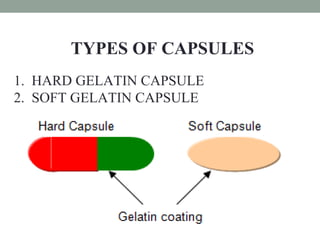
TYPES OF CAPSULES
1. HARD GELATIN CAPSULE
2. SOFT GELATIN CAPSULE
CAP
BODY
History
Capsules were first patented for use in 1830 by Joseph Gerard
Auguste Dublanc and Francois Achille. The first patented capsules
were made from soft gelatin. In 1846 Jules Lehuby obtained a
patent for two-piece hard capsules, such as those that are in use
today. Since these capsules were made by hand, there was
difficulty obtaining precision to get the two parts to fit together
well. In 1931, Arthur Colton invented a machine to make both
parts of hard capsules, so they fit together properly. The machines
that make hard capsules today are based on Colton's invention.
Advantages:
Neat and elegant in appearance.
Tasteless shell to mask the unpleasant taste/odor of the drug.
 The contents may be removed from the gelatin shell and
employed as a pre measured medicinal powder, the capsule
shell being use to contain a dose of the medicinal substance.
Example: Theo -dur Sprinkle
 Commonly embossed or imprinted on their surface the
manufacturer’s name and product code readily identified.
 The ready solubility of gelatin at gastric pH provides rapid
release of medication in the stomach.
 Packaged and shipped by manufacturers at lower cost less
breakage than liquid forms.
 More stable and longer shelf life.
Disadvantages:
 Capsules are not suitable for liquids that dissolve gelatin, such
as aqueous or hydro alcoholic solutions.
The concentrated solutions which require previous dilution are
unsuitable for capsules because if administered as such lead to
irritation into stomach.
Not useful for efflorescent or deliquescent materials.
Efflorescent cause capsules to soften & Deliquescent may dry
the capsule shell to brittleness.
Constituents of Capsule Shell:
Constituents Examples Function
Gelatin Type A, Type B Capsule Shell
Plasticizers Glycerine USP,
glycerol (85% & 98%) sorbitol,sucrose
acacia
Imparts softness,
Elasticity & hardness
Preservatives Methyl paraben, Sodium bisulfite, Sodium
Metabisulfite,sulfur oxide
Benzoic acid , Propanoic acid Sorbic acid
(0.2%)
Retard growth of
microorganisms
Solvents Oils Elegance
Opacifying agents Tio2(0.2-1.2%) Minimize transparency
Colours Veg. colours,FD&C
D&C water soluble dyes, certified lakes
Indigo, quinolin yellow , iron oxide
Gives pleasant appearance
to the shells.
Flavours Ethyl vanillin(0.1-2%) Good flavour
Sugars Sucrose( up to 5%) Sweet taste
Acids Fumaric acid(up to 1%) Lessen aldehydic tanning of
gelatin
Thickening agents Methyl cellulose Adjust viscosity of gelatin
Wetting Agent Sodium Lauryl Sulphate 0.15 w/w Surfactant, wetability
GELATIN
Gelatin is heterogeneous product derived by
hydrolytic extraction of animal's collagen. The sources
of gelatins including animal bones, hide portions and
frozen pork skin.
TYPES OF GELATIN
Type A
Type B
TYPE A - Derived from acid treated precursor that
exhibits an iso electric point at pH-9. It is
manufactured mainly from pork skin.
TYPE B - Derived from alkali treated precursor that
exhibits an iso electric point at pH-4.7. It is
manufactured mainly from animal bones.
PREPRATION OF GELATIN
1. Bloom value
Is a measurement of the gelling power and the
strength of the resulting gel.
Gelatin generally falls between 50 and 300 bloom
strength. Bloom range:150-250 g.
2. Gelling power
The key function of gelatin.
The gelling power varies depending on the grade of
gelatin
Its measured in terms of bloom value. The higher
the bloom value, the greater the ability to form gels
PROPERTIES OF GELATIN:
3. Viscosity
In general the higher the bloom, the greater the
viscosity.
Beef bone grades tend to have higher viscosity.
Viscosity is determined by measuring the flow time of
4. Foamability
In general pig skin grades tend to have better foaming
properties.
Gelatin lowers the surface tension, allowing for the
incorporation of air, and stabilizes the foam
Gelatin will also prevent crystal formation of sugars in
the foam and maintain smoothness in texture.
U- tube viscometer at 60 °C. Viscosity measurement is given in
millipoise units and varies between 20 and 50mps.
5. Melting point
Lower melting point gelatins dissolve faster in the
mouth, therefore releasing the flavors more quickly for
an instant taste sensation.
Lower bloom grades tend to have lower melting
points.
6. Color and odor
The gelatin should be as clear as possible in solution.
Clarity is measured using a turbidity meter .
The gelatin should be without odor.
7. Conductivity
is a key parameter in photographic applications and no
conductivity are required. De-ionized grades have an
advantage because of their low conductivity.
9.Iron content
It is present in raw gelatin as well as water used in
mfg. excess qty. of iron can effect FD &C & react with
organic compounds. Hence, iron is used in the concentration
of not more than 15ppm
8. pH
pH is measured using a pH meter on a 1% solution and
typically for gelatin solutions falls between pH4.5
EQUIPMENTS USED FOR
PRODUCTION OF
CAPSULES
Eli Lilly and Company, Indianapolis, IN.
R.P. Scherer Corporation, Troy MI.
Capsugel, Greenwood , SC .
• Once raw materials have been received and released by Quality
Control, the gelatin and hot demineralized water are mixed
under vacuum in Stainless Steel Gelatin Melting System.
• From receiving tanks, the gelatin solution is transferred to
stainless steel feed tanks.
• Dyes, opacifants, and any needed water are added to the gelatin
in the feed tanks to complete the gelatin preparation procedure.
• From the feed tank, the gelatin is gravity fed to Dipper section.
MANUFACTURE OF EMPTY GELATIN CAPSULES:
Steps involved in making empty gelatin capsules…
• Dipping
• Spinning
• Drying
• Stripping
• Trimming
• Joining
• Polishing
• Storage
Dipping : Pairs of the stainless steel pins are dipped into the
gelatin solution to simultaneously form the caps and bodies for
12sec. The dipping solution is maintained at a temperature of
about 50º C in a heated, jacketed dipping pan & pins are at 22ºc.
Spinning : The pins are rotated to distribute the gelatin over the
pins uniformly and to avoid the formation of a bead at the capsule
ends it is rotated 2½ times by moving upward.
Drying : The gelatin is dried by cool air to form a hard shells.
The pins are moved through a series of air drying kilns, Here
gently moving air which is precisely controlled for volume,
temperature, and humidity, removes the exact amount of moisture
from the capsule halves.
Stripping : Capsules are stripped from the pins by series of
bronze jaws , the cap and body portions of the capsules strip from
the pins.
Trimming and joining: The stripped cap and body portions are
trimmed to the required length by stationary knives. The cap and
body lengths are precisely trimmed to a ±0.15 mm tolerance.
After trimming to the right length, the cap and body portion are
joined.
• Finished capsules are pushed onto a conveyer belt which carries
them out to a container.
• Capsule quality is monitored throughout the production process
including size, moisture content, single wall thickness, and color.
• Capsules are sorted and visually inspected on specially designed
Inspection Stations.
• Perfect capsules are imprinted with the client logo on high-speed
POLISHING
Pan Polishing : Acela-cota pan is used to dust and polish.
Cloth Dusting : Capsule are rubbed with cloth.
Brushing : Capsule are feed under soft rotating brush.
Storage
Finished capsules normally contain an equilibrium moisture
content of 15-18%w/w.
To maintain a relative humidity of 40-60% handling and
storing capsules.
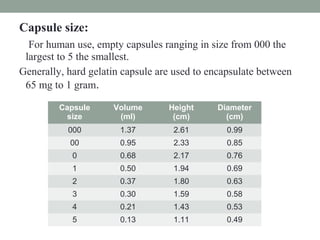
Capsule size:
For human use, empty capsules ranging in size from 000 the
largest to 5 the smallest.
Generally, hard gelatin capsule are used to encapsulate between
65 mg to 1 gram.
Capsule
size
Volume
(ml)
Height
(cm)
Diameter
(cm)
000 1.37 2.61 0.99
00 0.95 2.33 0.85
0 0.68 2.17 0.76
1 0.50 1.94 0.69
2 0.37 1.80 0.63
3 0.30 1.59 0.58
4 0.21 1.43 0.53
5 0.13 1.11 0.49
Hard Gelatin Capsules
These are used for administration of solid medicaments. The
capsule shell is prepared from gelatin. It consists of two parts i.e.
body and cap. The powdered material is filled into the cylindrical
body of the capsules and then the cap is placed over it.
ALTERNATIVE MATERIAL FOR HARD GELATIN
CAPSULES
• HPMC has become a successful alternative material for
two piece capsules .
• Firstly HPMC Capsules was developed by Shionogi
Qualicaps pharmaceuticals.
FORMULATION TYPES FOR FILLING INTO
HARD CAPSULES
Dry solids: Powders, Granules, Pellets, Tablets Capsules
Semisolids: Thixotropic mixtures, Pastes
Liquids:Oily liquids ,Non-aqueous solutions and
suspensions
Excipients Used In Filling Of Capsules
Diluents: Lactose Mannitol, Sorbitol, Starch
Absorbents: Magnesium Oxide, Magnesium Carbonate,
kaolin
Glidants : Magnesium Sterate ,Calcium Sterate, Silicon
Dioxide Talc, Boric acid
Antidusting Compounds: edible oils
Wetting Agents : Sodium Lauryl Sulphate
Disintegrants : Crospovidone , Sodium Starch Glycolate
FILLING OF HARD GELATIN CAPSULES:
•Punch Method or Manual Filling.
•Hand Filling or Semi Automatic Capsules Devices.
•Automatic filling machine.
Various Filling Machine / Equipments Available…
•Eli-lily
•Farmatic
• Hofliger and Karg
•Zanasi Nigris
•Parke-Davis
•Osaka
•Macofar SAS
These machine differ in there design and output
• Roto-fill: - 2 lakh capsules/day
• Acco-fill: - 75,000 capsules/hr
• Roto-sort: - 1,50,000 capsules/hr
Recent Filling Equipments
Lilly Capsule SEMI AUTOMATIC CAPSULES FILLING MACHINE
ZANASI AUTOMATIC
CAPSULE FILLING
MACHINE
HOFLIGER KARG AUTOMATIC
CAPSULE FILLING MACHINE
OSAKA MODEL R-180
SEMI AUTOMATIC CAPSULE
FILLING MACHINE
Principles of capsule Filling:
Auger Fill principle:
empty capsules – rectifying unit
Rectifier descends the capsules such that caps are turned up and
bodies down. From rectifying unit these are placed one by one in
filling ring kept on rotating mode. The lower ring is rotated with a
suitable speed and the hopper containing powdered drug is held
over this ring. The auger drives the drug into bodies.
Vibratory Fill Principle:
The feed is placed in the feed hopper and the capsule bodies are
passed under it. A perforated resin plate is placed in the feed
hopper. Due the vibrations of the resin plate, the powder flows
freely through the pores into bodies.
- Osaka machines follows this principle.
Piston – Tamp principle:
These piston tamps alter the shape of powder by compressing the
powder to form slugs. These plugs are transferred into the empty
capsule bodies with the application of slight pressure. Finally the
bodies are ejected from the machine. Compression force 50-200N
a)Dosator machine b) Dosing Disc
Vacuum Fill principle:
It consists of an open ended cylinder. The upper end of this is fitted
with a piston. The open end is placed in bulk powder. Vacuum is
applied & the piston is moved upward by sucking the predetermined
amount of powder which results in filling of the cylinder.
Diagrammatic representation of the dosing disc filling principle
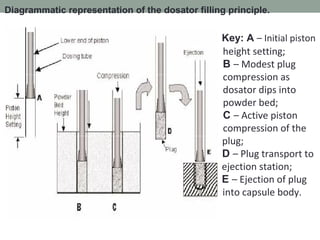
Diagrammatic representation of the dosator filling principle.
Key: A – Initial piston
height setting;
B – Modest plug
compression as
dosator dips into
powder bed;
C – Active piston
compression of the
plug;
D – Plug transport to
ejection station;
E – Ejection of plug
into capsule body.
Punch Method:
- Powder is placed on a sheet of a clean paper or porcelain plate
using spatula which is formed into a cake having a depth of
approximately one-fourth to one-third the length of the capsule
body.
- Then empty capsule body is held between the thumb and
forefinger and punched vertically into the powder cake repeatedly
until filled.
HAND OPERATED CAPSULE FILLING MACHINE
It is having following parts:-
a) Bed having 200-300 holes.
b) Loading tray having 200-300 holes.
c) Powder tray.
d) Pin Plate having 200-300 pins.
e) Sealing plate having rubber top.
f) Lever
g) Cam handel
Hand filling machine or semi automatic machine:
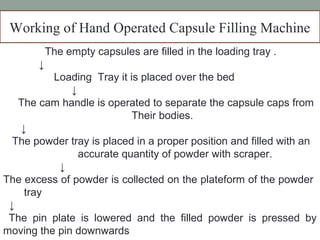
The empty capsules are filled in the loading tray .
↓
Loading Tray it is placed over the bed
↓
The cam handle is operated to separate the capsule caps from
Their bodies.
↓
The powder tray is placed in a proper position and filled with an
accurate quantity of powder with scraper.
↓
The excess of powder is collected on the plateform of the powder
tray
↓
The pin plate is lowered and the filled powder is pressed by
moving the pin downwards
Working of Hand Operated Capsule Filling Machine
After pressing ,the pin plate is raised and the remaining
powder is filled into the bodies of the capsules
↓
The powdered tray is removed after its complete filling
↓
The cap holding tray is again placed in position
↓
The plate with the rubber top is lowered and the lever is
operated to lock the caps and bodies
↓
The loading tray is then removed
and the filled capsules are collected
With a 200 hole machine 5000 capsule can be filled in 1
hr, & having 300 holes 7500 capsule are filled in 1 hr.
Flow Diagram For Hard Gelatin
Capsule
WORKING
Capsules are placed in to the perforated capsule filling ring
↓
Orientation takes place so that cap is on the top
↓
Vaccum pulls the bodies in to lower half of ring and cap is set aside
↓
The body is then moved to another turntable where it is rotated
mechanically under a powder hopper
↓
Hopper contains auger which feeds the powder in bodies
↓
After filling cap and body rings are rejoined
↓
Filled capsules are removed, dusted using clean cloth and packaged
FILLING OF HARD CAPSULE SHELL
The process of working:
Rectification
Separating the caps from empty capsules
Filling the bodies
Scraping the excess powder
Replacing the caps
Sealing the capsules
Cleaning the outside of the filled capsules
160,000 capsules per 8hour shift
OSAKA MODEL R-180
SEMI AUTOMATIC CAPSULE
FILLING MACHINE
Rectification ( act of making straight or correct)
The empty capsules are oriented so that all
point the same direction i.e. body end downwards.
In general, capsule pass one at a time through
a channel just wide enough to provide grip at cap end.
The capsules will always be aligned body end
downwards, regardless of which end entered the
channel first with the help of specially designated
blades.
SEPERATION OF CAP FROM BODY:
This process also depends on the difference in
diameters between cap and body portions. Here the recti
capsules are delivered body-end into the upper portion o
split bushing or shift filling rings.
A vaccum applied from the below , pull the bodies
down into the longer portion of the split bushings.
The diameter of the caps is too large to allow them
to follow the bodies into the lower bushing portion. The spli
bushing are then separated to expose the bodies for filling.
DOSING OF FILL MATERIAL
Various methods are employed in filling of capsules
Auger feeding unit
Dosater/dosing tube
Piston filling
Punch filling method
REPLACEMENT / REJOINING OF CAPS & EJECTION OF
FILLED CAPSULES:
The cap and body bushing portion are required. Pins are used
to push the filled bodies up into the caps for closures and to push
the closed capsules out of the bushings.
Compressed air also may be used to eject the capsule.
These machines may be either semiautomatic or fully automatic.
These machines are capable of filling as many as 120,000-
160,000 capsule in an 8hr shift.
Semi-Automatic Machines
Semi-automatic machines, which require an operator to be in
attendance at all times, were once the workhorses of the capsule filling
industry. Today, they are more likely to be employed when smaller batch
sizes are required, such as production of early phase clinical supplies.
Quoted production capacities for powder filling range from 6000-
8000 capsules/hour up to as high as 15,000 capsules/hour, depending
on the capsule size.
The rectified capsules are delivered into holes in a split ring
(equivalent to the split bushings above). As the ring rotates
on a turntable, vacuum pulls the capsule bodies into the lower ring,
leaving the caps behind in the upper ring.
After capsule separation, the operator separates the rings
and places the body ring on another turntable that rotates
beneath the foot of the powder hopper. An auger in the hopper
rotates to encourage a more or less constant downward flow of
the formulation while the filling ring rotates.
The amount of formulation delivered to the capsule
bodies depends primarily on the dwell time of the bodies under
the foot of the hopper, i.e., the speed of rotation of the filling ring
Fill weight uniformity depends primarily on uniformity of flow
from the hopper, and formulations should be designed
accordingly.
Maintaining a more or less uniform bed height in the hopper is
also important to the maintenance of a uniform powder feed rate.
However, any over run of already filled capsules under the
hopper can cause an increase in the fill weight of those capsules.
some fill weight variation also can result because of
differences in the angular velocity of capsule bodies in the filling
ring at different radial distances from the center of rotation.
Examples of these “ring machines” are Capsugel Cap 8 and
Qualifill 8S machines.
Fully Automatic Machines
Most modern automatic filling machines employ pistons or tamping
pins that lightly compress the powder into plugs (sometimes referred to
as “slugs”), and eject the plugs into the empty capsule bodies.
The compression forces are low, often in the range of 50–150N, up
to about 100- fold less than that employed in typical tablet compression.
Often, the plugs will be very soft compacts and not able to be recovered
intact from filled capsules.
There are two main types of these fillers: dosator machines and
dosingdisc machines. In a recent survey of the pharmaceutical industry,
it was reported that dosator machines were used slightly more
frequently among the firms responding; however, about 18% of the
firms indicated that they use both types of filling machines.
CAPSULE SEALING
Tamper evident capsules by sealing the joint between the 2
capsule parts
Distinctive looking capsules by sealing them with colored band of
gelatin (Kapseals).
Through a heat welding process that fuses the capsule cap to the
ring around the capsule where heat welded
Example: Weld’s gelatin seal
Capsule may also be sealed through a heat welding process
that fuse capsule cap to the body .
fuses the capsule cap to the body through the double wall thickness at
their juncture The process results in a distinctive ring around where heat
welded.
Heat-welding process
lowers the melting point in the contact areas of the capsule’s cap
and body and then thermally bonds the two parts using low
temperatures
Liquid wetting agent
Locking and Sealing of Capsules :
Banding – Placing gelatin color bands at the meeting
point of caps and the bodies.
Moistening – Moistening the inner surface of caps with
lukewarm gelatin solution.
Spot Welding – Spot welding the joints which leaves a
ring like appearance at the point of sealing
Thermal welding – Applying wetting sol. At the meeting
points which causes lowering of M.P at applied area.
Finally they are sealed at a temp. 40-45ºc.
By using Coni-snap capsules – Grooves help to lock
the caps with the bodies.
Cleaning and Polishing Capsules
On small scale
Cleaned individually
in small numbers
Rubbing with a
clean gauze or cloth.
On large scale
Cleaning vacuum affixed
with filling machine
cleaning and polishing by
Accela-Cota apparatus.
Finishing of Capsules
Finished Capsules from all filling equipments (Erweka KEA
dedusting & polishing machine) require some sort of dusting
or polishing operation.
Cloth Dusting: Capsule are rubbed with cloth. It imparts gloss
to the capsules.s
Pan Polishing : Acela-cota pan is used to dust and
polish which is lined with cheese or a polyurethane cloth. It is
used to removed dust as well as impart gloss to capsules.
Brushing :
Capsule are feed under soft rotating brushes, which serve
to remove dust from capsule shell by applying vacuum.
Sorting :
Rotosort – Capsule sorting Machine that remove loose
powder , unfilled joined capsule, loose caps and handle
up 1,50,000 capsules/hr.
Soft Gelatin Capsules / Soft Gel
Soft Gelatin capsules are one piece, hermetically
sealed, soft gelatin shells containing a liquid, a
suspension, or a semisolid. Soft gelatin is mainly
composed of Flexible gelatin film, plasticizers,
preservative, colouring and opacifying agents,
flavoring agents and sugars.
SHAPES OF SOFT GELATIN CAPSULES:
MANUFACTURING SOFT GELATIN CAPSULES
Composition of the shell
•   The basic component of soft gelatin shell is gelatin; however,
the shell has been plasticize
•   The ratio of dry plasticizer to dry gelatin determines the
“hardness” of the shell and can vary from 0.3-1.0 for very hard
shell to 1.0-1.8 for very soft shell . Plastisizer such as glycerin and
poly propylene glycol can use.
•   Up to 5% sugar may be included to give a “chewable” quality
to the shell
•   The residual shell moisture content of finished capsules will be
in the range of 6-10%. The pH of the liquid can be between 2.5
and 7.5.
MANUFACTURE OF SOFT GELATIN CAPSULES:
Plate process
Rotary die process
Accogel machine
Bubble Method
Plate process:
• Place the one gelatin sheet over a die plate / mold
containing numerous die pockets.
• Application of vacuum to draw the sheet in to the die
pockets.
• Fill the pockets with liquid or paste.
• Place another / secondgelatin sheet over the filled
pockets, and Sandwich under a die press where the
capsules are formed and cut out.
Rotary die press:
In this process, the die cavities are machined into the outer surface
of the two rollers.
Gelatin is properly weighed & dispensed in melting tank under
vacuum of 93ºc.
Two plasticized gelatin ribbons are transported to die continuously
and simultaneously where liquid or paste fill between the rollers of
the rotary die mechanism.
As the die rolls rotate, the convergence of the matching die pockets
seals and cuts out the filled capsules.
1) In this machine the soft gelatin capsules are prepared &
then filled immediately  with liquid medicaments it is having
two hoppers & two rotating dies
2) Liquid mixture is placed in one hopper & the liquid
medicament in other Hooper.
3) The  two rotating dies rotate in opposite  directions when
the fluid gelatin mixture enters the machine from the hopper it
produces two continuous ribbons .
4) These half shell of the capsule  is formed.
Working of Rotary Die Machine
5) At this stage  the measured quantity of the medicament
is filled  in to it with the stroke of a pump with the
subsequent movement of the dies the other half capsule is
formed.
6) The  two halves' of the capsules  are sealed together  by 
the heat & pressure of the rotating dies.
7) As the die rolls rotate, the convergence of the matching
die pockets seals and cuts out the filled capsules
ROTARY DIE MACHINE:
  
Accogel Capsule Machine:
It consists of mainly 3 parts:
• Measuring roll
• Die roll
• Sealing roll
As the measuring roll and die rolls rotate, the measured doses
are transferred to the gelatin-linked pockets of the die roll.
 The continued rotation of the filled die converges with the
rotating sealing roll where a second gelatin sheet is applied to
form the other half of the capsule.
 Pressure developed between the die roll and sealing roll seals
and cuts out the capsules.
Bubble method:
•The Globex Mark II capsulator produces truly seal less, one-
piece soft gelatin capsules by a “bubble method”.
• A concentric tube dispenser simultaneously discharges the
molten gelatin from the outer annulus and the liquid content
from the tube.
• By means of a pulsating pump mechanism, the liquids are
discharged from the concentric tube orifice into a chilled-oil
column as droplets that consists of a liquid medicament core
within a molten gelatin envelop.
     Whether capsules are produced on a small scale or large scale all
of them are required to pass through certain tests i.e., quality
control tests to test the quality of the finished product.
        QUALITY CONTROL OF CAPSULES
Hard & Soft Gelatin Capsules Subjected for
Following Quality Control Tests For Their
Standardization
• Shape and Size
• Color
• Thickness of Capsule Shell
• Leakage Test for Soft Gelatin Capsule
• Content uniformity
• Disintegration test
• Weight variation test
• Moisture permeation test
• Dissolution Test
Thickness of Capsule Shell
Is measured under a microscope and it should one half to two
third of the ribbon thickness.
Capsule fragility or rupture test
Force required to rupture the capsule is determined.
Content uniformity:
The amount of active ingredient should be within the
range of 85% to 115% of the label amount for 9 of 10
capsules, with no unit outside the range of 70% to
125% of label amount.
CONTENT UNIFORMITY
             10 capsules are taken and subjected to assay
    9 of 10 capsules should be in the range of  15% (85-115%)
 And 10  capsule are beyond +_ 15% range then 20 capsules are assayed
      All capsules with in range of +_25% (75-125%)
Disintegration test for capsules:
Place 1 capsule in each of the 6 tubes of the basket & suspend the assembly in
water at 37 ± 2ºC,℃ which is repeatedly immersed 30 times per minute. Do not
use disc for hard capsules expects when they float on top of the water , for soft
gelatin capsules disc may be used , for hard capsule operate the test for 30min &
for soft capsule for 1 hour .
The capsules pass the test if no residue of drug or other than fragments of shell
remains on No. 10 mesh screen of the tubes.
If one or two capsules fail to disintegrate , repeat the test for twelve additional
capsules so as not less than sixteen of the total no. of eighteen capsules tested get
disintegrated.
Weight variation test: 20 capsules are taken at random and
weighed. Their average weight is calculated, then each capsule is
weighed individually and their weight is noted. The capsule passes
the test if the weight of individual capsule falls with in 90-110% of
the average weight.
Average weight of
capsule contents
Percentage of Deviation
Less than 300 mg 10
300 mg or more 7.5
Moisture permeation test:
Acc. to U.S.P the unit dose container is packed along
with dehydrated pellets, which have the property of
changing color in the presence of moisture. The weight
of test capsule is compared with the under test capsules.
Diff. in weights gives the amount of moisture absorbed.
MOISTURE PERMEATION TEST
    The degree and rate of moisture penetration is determined by
packaging the dosage unit together with a colour revealing
desiccant pellet
    Expose the packed unit to known relative humidity over a       
               specified    time 
     Observe the desiccant pellet for colour change
   Any change in colour indicates absorption of moisture
       By measuring pre test weight and protest weight of pellet,
amount can be calculated.
Dissolution test for capsules:
 Place 1000ml of water having a temp. of 36.5º to
37.5º into the vessel. Place specified number of
capsules in dry basket adjust the speed to 100 rpm.
Withdraw req. volume for every 10min time interval.
Filter and determine the amount of active ingredient.
The sample passes the test if the amount of active
ingredients in the solution is not less than 70% of the
stated amount.
PACKING & STORAGE OF CAPSULES:
Capsules should be packed well closed glass & plastic container &
stored at temp. not exceeding 30ºc. Capsules are individually
protected by enclosing in strip & blister packaging.
 In strip packing the capsule is hermetically sealed within the strips
of an aluminum or plastic film.
 In blister packs, a press on the blister forces the capsule through the
backing strip.
Capsules have a larger shelf life in unopened glass bottles than in
strip pack & but this is reversed.
Capsules

Capsules

  • 1.
    INTRODUCTION TO CAPSULE DOSAGE FORM Ms.Sunidhi Mahant Himalayan Institute of Pharmacy
  • 2.
    DEFINITION:- Latin Word:Capsula: means the small box. These are solid dosage form of medicaments, in which drug is enclosed in either a hard or soft water soluble container or shell made up of gelatin. CAPSULE SHELL:- These are made up of gelatin blends, small amount of certified dyes, opaquing agents , plasticizers and preservatives. As per USP:- Capsules are defined as solid dosage forms in which the active ingredients are sealed in hard or soft container or shell. As Per European Pharmacopoeia:- Capsules are solid preparations with hard or soft shells of various shapes and capacities , Usually containing a single dose of active ingredient . They are intended for oral , Vaginal , rectal administration.
  • 3.
    The basic ideaof a capsule is to enclose the drug or active pharmaceutical ingredient (API) in an odorless, tasteless, elegant, easy-to-swallow, and easy-to-fill shell. Today there are two main types of capsules: the hard gelatin capsule and the soft gelatin capsule, often called softshells. The hard gelatin capsule can be used for dry fills such as powder, Pellets, Granules, Tablets liquids, and semisolids, while the softshell is exclusively used for liquids and semisolids.
  • 4.
    TYPES OF CAPSULES 1.HARD GELATIN CAPSULE 2. SOFT GELATIN CAPSULE
  • 5.
  • 7.
    History Capsules were firstpatented for use in 1830 by Joseph Gerard Auguste Dublanc and Francois Achille. The first patented capsules were made from soft gelatin. In 1846 Jules Lehuby obtained a patent for two-piece hard capsules, such as those that are in use today. Since these capsules were made by hand, there was difficulty obtaining precision to get the two parts to fit together well. In 1931, Arthur Colton invented a machine to make both parts of hard capsules, so they fit together properly. The machines that make hard capsules today are based on Colton's invention.
  • 8.
    Advantages: Neat and elegantin appearance. Tasteless shell to mask the unpleasant taste/odor of the drug.  The contents may be removed from the gelatin shell and employed as a pre measured medicinal powder, the capsule shell being use to contain a dose of the medicinal substance. Example: Theo -dur Sprinkle
  • 9.
     Commonly embossedor imprinted on their surface the manufacturer’s name and product code readily identified.  The ready solubility of gelatin at gastric pH provides rapid release of medication in the stomach.  Packaged and shipped by manufacturers at lower cost less breakage than liquid forms.  More stable and longer shelf life.
  • 10.
    Disadvantages:  Capsules arenot suitable for liquids that dissolve gelatin, such as aqueous or hydro alcoholic solutions. The concentrated solutions which require previous dilution are unsuitable for capsules because if administered as such lead to irritation into stomach. Not useful for efflorescent or deliquescent materials. Efflorescent cause capsules to soften & Deliquescent may dry the capsule shell to brittleness.
  • 11.
    Constituents of CapsuleShell: Constituents Examples Function Gelatin Type A, Type B Capsule Shell Plasticizers Glycerine USP, glycerol (85% & 98%) sorbitol,sucrose acacia Imparts softness, Elasticity & hardness Preservatives Methyl paraben, Sodium bisulfite, Sodium Metabisulfite,sulfur oxide Benzoic acid , Propanoic acid Sorbic acid (0.2%) Retard growth of microorganisms Solvents Oils Elegance Opacifying agents Tio2(0.2-1.2%) Minimize transparency Colours Veg. colours,FD&C D&C water soluble dyes, certified lakes Indigo, quinolin yellow , iron oxide Gives pleasant appearance to the shells. Flavours Ethyl vanillin(0.1-2%) Good flavour Sugars Sucrose( up to 5%) Sweet taste Acids Fumaric acid(up to 1%) Lessen aldehydic tanning of gelatin Thickening agents Methyl cellulose Adjust viscosity of gelatin Wetting Agent Sodium Lauryl Sulphate 0.15 w/w Surfactant, wetability
  • 12.
    GELATIN Gelatin is heterogeneousproduct derived by hydrolytic extraction of animal's collagen. The sources of gelatins including animal bones, hide portions and frozen pork skin. TYPES OF GELATIN Type A Type B
  • 13.
    TYPE A -Derived from acid treated precursor that exhibits an iso electric point at pH-9. It is manufactured mainly from pork skin. TYPE B - Derived from alkali treated precursor that exhibits an iso electric point at pH-4.7. It is manufactured mainly from animal bones.
  • 14.
  • 15.
    1. Bloom value Isa measurement of the gelling power and the strength of the resulting gel. Gelatin generally falls between 50 and 300 bloom strength. Bloom range:150-250 g. 2. Gelling power The key function of gelatin. The gelling power varies depending on the grade of gelatin Its measured in terms of bloom value. The higher the bloom value, the greater the ability to form gels PROPERTIES OF GELATIN:
  • 16.
    3. Viscosity In generalthe higher the bloom, the greater the viscosity. Beef bone grades tend to have higher viscosity. Viscosity is determined by measuring the flow time of 4. Foamability In general pig skin grades tend to have better foaming properties. Gelatin lowers the surface tension, allowing for the incorporation of air, and stabilizes the foam Gelatin will also prevent crystal formation of sugars in the foam and maintain smoothness in texture. U- tube viscometer at 60 °C. Viscosity measurement is given in millipoise units and varies between 20 and 50mps.
  • 17.
    5. Melting point Lowermelting point gelatins dissolve faster in the mouth, therefore releasing the flavors more quickly for an instant taste sensation. Lower bloom grades tend to have lower melting points. 6. Color and odor The gelatin should be as clear as possible in solution. Clarity is measured using a turbidity meter . The gelatin should be without odor. 7. Conductivity is a key parameter in photographic applications and no conductivity are required. De-ionized grades have an advantage because of their low conductivity.
  • 18.
    9.Iron content It ispresent in raw gelatin as well as water used in mfg. excess qty. of iron can effect FD &C & react with organic compounds. Hence, iron is used in the concentration of not more than 15ppm 8. pH pH is measured using a pH meter on a 1% solution and typically for gelatin solutions falls between pH4.5
  • 19.
    EQUIPMENTS USED FOR PRODUCTIONOF CAPSULES Eli Lilly and Company, Indianapolis, IN. R.P. Scherer Corporation, Troy MI. Capsugel, Greenwood , SC .
  • 20.
    • Once rawmaterials have been received and released by Quality Control, the gelatin and hot demineralized water are mixed under vacuum in Stainless Steel Gelatin Melting System. • From receiving tanks, the gelatin solution is transferred to stainless steel feed tanks. • Dyes, opacifants, and any needed water are added to the gelatin in the feed tanks to complete the gelatin preparation procedure. • From the feed tank, the gelatin is gravity fed to Dipper section.
  • 21.
    MANUFACTURE OF EMPTYGELATIN CAPSULES: Steps involved in making empty gelatin capsules… • Dipping • Spinning • Drying • Stripping • Trimming • Joining • Polishing • Storage
  • 22.
    Dipping : Pairsof the stainless steel pins are dipped into the gelatin solution to simultaneously form the caps and bodies for 12sec. The dipping solution is maintained at a temperature of about 50º C in a heated, jacketed dipping pan & pins are at 22ºc. Spinning : The pins are rotated to distribute the gelatin over the pins uniformly and to avoid the formation of a bead at the capsule ends it is rotated 2½ times by moving upward.
  • 23.
    Drying : Thegelatin is dried by cool air to form a hard shells. The pins are moved through a series of air drying kilns, Here gently moving air which is precisely controlled for volume, temperature, and humidity, removes the exact amount of moisture from the capsule halves. Stripping : Capsules are stripped from the pins by series of bronze jaws , the cap and body portions of the capsules strip from the pins.
  • 24.
    Trimming and joining:The stripped cap and body portions are trimmed to the required length by stationary knives. The cap and body lengths are precisely trimmed to a ±0.15 mm tolerance. After trimming to the right length, the cap and body portion are joined. • Finished capsules are pushed onto a conveyer belt which carries them out to a container. • Capsule quality is monitored throughout the production process including size, moisture content, single wall thickness, and color. • Capsules are sorted and visually inspected on specially designed Inspection Stations. • Perfect capsules are imprinted with the client logo on high-speed
  • 25.
    POLISHING Pan Polishing :Acela-cota pan is used to dust and polish. Cloth Dusting : Capsule are rubbed with cloth. Brushing : Capsule are feed under soft rotating brush. Storage Finished capsules normally contain an equilibrium moisture content of 15-18%w/w. To maintain a relative humidity of 40-60% handling and storing capsules.
  • 27.
    Capsule size: For humanuse, empty capsules ranging in size from 000 the largest to 5 the smallest. Generally, hard gelatin capsule are used to encapsulate between 65 mg to 1 gram. Capsule size Volume (ml) Height (cm) Diameter (cm) 000 1.37 2.61 0.99 00 0.95 2.33 0.85 0 0.68 2.17 0.76 1 0.50 1.94 0.69 2 0.37 1.80 0.63 3 0.30 1.59 0.58 4 0.21 1.43 0.53 5 0.13 1.11 0.49
  • 29.
    Hard Gelatin Capsules Theseare used for administration of solid medicaments. The capsule shell is prepared from gelatin. It consists of two parts i.e. body and cap. The powdered material is filled into the cylindrical body of the capsules and then the cap is placed over it.
  • 30.
    ALTERNATIVE MATERIAL FORHARD GELATIN CAPSULES • HPMC has become a successful alternative material for two piece capsules . • Firstly HPMC Capsules was developed by Shionogi Qualicaps pharmaceuticals.
  • 31.
    FORMULATION TYPES FORFILLING INTO HARD CAPSULES Dry solids: Powders, Granules, Pellets, Tablets Capsules Semisolids: Thixotropic mixtures, Pastes Liquids:Oily liquids ,Non-aqueous solutions and suspensions
  • 32.
    Excipients Used InFilling Of Capsules Diluents: Lactose Mannitol, Sorbitol, Starch Absorbents: Magnesium Oxide, Magnesium Carbonate, kaolin Glidants : Magnesium Sterate ,Calcium Sterate, Silicon Dioxide Talc, Boric acid Antidusting Compounds: edible oils Wetting Agents : Sodium Lauryl Sulphate Disintegrants : Crospovidone , Sodium Starch Glycolate
  • 34.
    FILLING OF HARDGELATIN CAPSULES: •Punch Method or Manual Filling. •Hand Filling or Semi Automatic Capsules Devices. •Automatic filling machine. Various Filling Machine / Equipments Available… •Eli-lily •Farmatic • Hofliger and Karg •Zanasi Nigris •Parke-Davis •Osaka •Macofar SAS These machine differ in there design and output
  • 35.
    • Roto-fill: -2 lakh capsules/day • Acco-fill: - 75,000 capsules/hr • Roto-sort: - 1,50,000 capsules/hr Recent Filling Equipments
  • 36.
    Lilly Capsule SEMIAUTOMATIC CAPSULES FILLING MACHINE
  • 37.
    ZANASI AUTOMATIC CAPSULE FILLING MACHINE HOFLIGERKARG AUTOMATIC CAPSULE FILLING MACHINE
  • 38.
    OSAKA MODEL R-180 SEMIAUTOMATIC CAPSULE FILLING MACHINE
  • 39.
    Principles of capsuleFilling: Auger Fill principle: empty capsules – rectifying unit Rectifier descends the capsules such that caps are turned up and bodies down. From rectifying unit these are placed one by one in filling ring kept on rotating mode. The lower ring is rotated with a suitable speed and the hopper containing powdered drug is held over this ring. The auger drives the drug into bodies. Vibratory Fill Principle: The feed is placed in the feed hopper and the capsule bodies are passed under it. A perforated resin plate is placed in the feed hopper. Due the vibrations of the resin plate, the powder flows freely through the pores into bodies. - Osaka machines follows this principle.
  • 41.
    Piston – Tampprinciple: These piston tamps alter the shape of powder by compressing the powder to form slugs. These plugs are transferred into the empty capsule bodies with the application of slight pressure. Finally the bodies are ejected from the machine. Compression force 50-200N a)Dosator machine b) Dosing Disc Vacuum Fill principle: It consists of an open ended cylinder. The upper end of this is fitted with a piston. The open end is placed in bulk powder. Vacuum is applied & the piston is moved upward by sucking the predetermined amount of powder which results in filling of the cylinder.
  • 42.
    Diagrammatic representation ofthe dosing disc filling principle
  • 43.
    Diagrammatic representation ofthe dosator filling principle. Key: A – Initial piston height setting; B – Modest plug compression as dosator dips into powder bed; C – Active piston compression of the plug; D – Plug transport to ejection station; E – Ejection of plug into capsule body.
  • 44.
    Punch Method: - Powderis placed on a sheet of a clean paper or porcelain plate using spatula which is formed into a cake having a depth of approximately one-fourth to one-third the length of the capsule body. - Then empty capsule body is held between the thumb and forefinger and punched vertically into the powder cake repeatedly until filled.
  • 45.
    HAND OPERATED CAPSULEFILLING MACHINE It is having following parts:- a) Bed having 200-300 holes. b) Loading tray having 200-300 holes. c) Powder tray. d) Pin Plate having 200-300 pins. e) Sealing plate having rubber top. f) Lever g) Cam handel
  • 46.
    Hand filling machineor semi automatic machine:
  • 48.
    The empty capsulesare filled in the loading tray . ↓ Loading Tray it is placed over the bed ↓ The cam handle is operated to separate the capsule caps from Their bodies. ↓ The powder tray is placed in a proper position and filled with an accurate quantity of powder with scraper. ↓ The excess of powder is collected on the plateform of the powder tray ↓ The pin plate is lowered and the filled powder is pressed by moving the pin downwards Working of Hand Operated Capsule Filling Machine
  • 49.
    After pressing ,thepin plate is raised and the remaining powder is filled into the bodies of the capsules ↓ The powdered tray is removed after its complete filling ↓ The cap holding tray is again placed in position ↓ The plate with the rubber top is lowered and the lever is operated to lock the caps and bodies ↓ The loading tray is then removed and the filled capsules are collected With a 200 hole machine 5000 capsule can be filled in 1 hr, & having 300 holes 7500 capsule are filled in 1 hr.
  • 53.
    Flow Diagram ForHard Gelatin Capsule
  • 54.
    WORKING Capsules are placedin to the perforated capsule filling ring ↓ Orientation takes place so that cap is on the top ↓ Vaccum pulls the bodies in to lower half of ring and cap is set aside ↓ The body is then moved to another turntable where it is rotated mechanically under a powder hopper ↓ Hopper contains auger which feeds the powder in bodies ↓ After filling cap and body rings are rejoined ↓ Filled capsules are removed, dusted using clean cloth and packaged
  • 55.
    FILLING OF HARDCAPSULE SHELL The process of working: Rectification Separating the caps from empty capsules Filling the bodies Scraping the excess powder Replacing the caps Sealing the capsules Cleaning the outside of the filled capsules 160,000 capsules per 8hour shift OSAKA MODEL R-180 SEMI AUTOMATIC CAPSULE FILLING MACHINE
  • 56.
    Rectification ( actof making straight or correct) The empty capsules are oriented so that all point the same direction i.e. body end downwards. In general, capsule pass one at a time through a channel just wide enough to provide grip at cap end. The capsules will always be aligned body end downwards, regardless of which end entered the channel first with the help of specially designated blades.
  • 57.
    SEPERATION OF CAPFROM BODY: This process also depends on the difference in diameters between cap and body portions. Here the recti capsules are delivered body-end into the upper portion o split bushing or shift filling rings. A vaccum applied from the below , pull the bodies down into the longer portion of the split bushings. The diameter of the caps is too large to allow them to follow the bodies into the lower bushing portion. The spli bushing are then separated to expose the bodies for filling.
  • 58.
    DOSING OF FILLMATERIAL Various methods are employed in filling of capsules Auger feeding unit Dosater/dosing tube Piston filling Punch filling method
  • 59.
    REPLACEMENT / REJOININGOF CAPS & EJECTION OF FILLED CAPSULES: The cap and body bushing portion are required. Pins are used to push the filled bodies up into the caps for closures and to push the closed capsules out of the bushings. Compressed air also may be used to eject the capsule. These machines may be either semiautomatic or fully automatic. These machines are capable of filling as many as 120,000- 160,000 capsule in an 8hr shift.
  • 61.
    Semi-Automatic Machines Semi-automatic machines,which require an operator to be in attendance at all times, were once the workhorses of the capsule filling industry. Today, they are more likely to be employed when smaller batch sizes are required, such as production of early phase clinical supplies. Quoted production capacities for powder filling range from 6000- 8000 capsules/hour up to as high as 15,000 capsules/hour, depending on the capsule size. The rectified capsules are delivered into holes in a split ring (equivalent to the split bushings above). As the ring rotates on a turntable, vacuum pulls the capsule bodies into the lower ring, leaving the caps behind in the upper ring.
  • 62.
    After capsule separation,the operator separates the rings and places the body ring on another turntable that rotates beneath the foot of the powder hopper. An auger in the hopper rotates to encourage a more or less constant downward flow of the formulation while the filling ring rotates. The amount of formulation delivered to the capsule bodies depends primarily on the dwell time of the bodies under the foot of the hopper, i.e., the speed of rotation of the filling ring Fill weight uniformity depends primarily on uniformity of flow from the hopper, and formulations should be designed accordingly.
  • 63.
    Maintaining a moreor less uniform bed height in the hopper is also important to the maintenance of a uniform powder feed rate. However, any over run of already filled capsules under the hopper can cause an increase in the fill weight of those capsules. some fill weight variation also can result because of differences in the angular velocity of capsule bodies in the filling ring at different radial distances from the center of rotation. Examples of these “ring machines” are Capsugel Cap 8 and Qualifill 8S machines.
  • 64.
    Fully Automatic Machines Mostmodern automatic filling machines employ pistons or tamping pins that lightly compress the powder into plugs (sometimes referred to as “slugs”), and eject the plugs into the empty capsule bodies. The compression forces are low, often in the range of 50–150N, up to about 100- fold less than that employed in typical tablet compression. Often, the plugs will be very soft compacts and not able to be recovered intact from filled capsules. There are two main types of these fillers: dosator machines and dosingdisc machines. In a recent survey of the pharmaceutical industry, it was reported that dosator machines were used slightly more frequently among the firms responding; however, about 18% of the firms indicated that they use both types of filling machines.
  • 65.
    CAPSULE SEALING Tamper evidentcapsules by sealing the joint between the 2 capsule parts Distinctive looking capsules by sealing them with colored band of gelatin (Kapseals). Through a heat welding process that fuses the capsule cap to the ring around the capsule where heat welded Example: Weld’s gelatin seal Capsule may also be sealed through a heat welding process that fuse capsule cap to the body .
  • 66.
    fuses the capsulecap to the body through the double wall thickness at their juncture The process results in a distinctive ring around where heat welded. Heat-welding process lowers the melting point in the contact areas of the capsule’s cap and body and then thermally bonds the two parts using low temperatures Liquid wetting agent
  • 67.
    Locking and Sealingof Capsules : Banding – Placing gelatin color bands at the meeting point of caps and the bodies. Moistening – Moistening the inner surface of caps with lukewarm gelatin solution. Spot Welding – Spot welding the joints which leaves a ring like appearance at the point of sealing Thermal welding – Applying wetting sol. At the meeting points which causes lowering of M.P at applied area. Finally they are sealed at a temp. 40-45ºc. By using Coni-snap capsules – Grooves help to lock the caps with the bodies.
  • 68.
    Cleaning and PolishingCapsules On small scale Cleaned individually in small numbers Rubbing with a clean gauze or cloth. On large scale Cleaning vacuum affixed with filling machine cleaning and polishing by Accela-Cota apparatus.
  • 69.
    Finishing of Capsules FinishedCapsules from all filling equipments (Erweka KEA dedusting & polishing machine) require some sort of dusting or polishing operation. Cloth Dusting: Capsule are rubbed with cloth. It imparts gloss to the capsules.s Pan Polishing : Acela-cota pan is used to dust and polish which is lined with cheese or a polyurethane cloth. It is used to removed dust as well as impart gloss to capsules.
  • 70.
    Brushing : Capsule arefeed under soft rotating brushes, which serve to remove dust from capsule shell by applying vacuum. Sorting : Rotosort – Capsule sorting Machine that remove loose powder , unfilled joined capsule, loose caps and handle up 1,50,000 capsules/hr.
  • 71.
    Soft Gelatin Capsules/ Soft Gel Soft Gelatin capsules are one piece, hermetically sealed, soft gelatin shells containing a liquid, a suspension, or a semisolid. Soft gelatin is mainly composed of Flexible gelatin film, plasticizers, preservative, colouring and opacifying agents, flavoring agents and sugars.
  • 72.
    SHAPES OF SOFTGELATIN CAPSULES:
  • 73.
    MANUFACTURING SOFT GELATINCAPSULES Composition of the shell •   The basic component of soft gelatin shell is gelatin; however, the shell has been plasticize •   The ratio of dry plasticizer to dry gelatin determines the “hardness” of the shell and can vary from 0.3-1.0 for very hard shell to 1.0-1.8 for very soft shell . Plastisizer such as glycerin and poly propylene glycol can use. •   Up to 5% sugar may be included to give a “chewable” quality to the shell •   The residual shell moisture content of finished capsules will be in the range of 6-10%. The pH of the liquid can be between 2.5 and 7.5.
  • 74.
    MANUFACTURE OF SOFTGELATIN CAPSULES: Plate process Rotary die process Accogel machine Bubble Method
  • 75.
    Plate process: • Placethe one gelatin sheet over a die plate / mold containing numerous die pockets. • Application of vacuum to draw the sheet in to the die pockets. • Fill the pockets with liquid or paste. • Place another / secondgelatin sheet over the filled pockets, and Sandwich under a die press where the capsules are formed and cut out.
  • 76.
    Rotary die press: Inthis process, the die cavities are machined into the outer surface of the two rollers. Gelatin is properly weighed & dispensed in melting tank under vacuum of 93ºc. Two plasticized gelatin ribbons are transported to die continuously and simultaneously where liquid or paste fill between the rollers of the rotary die mechanism. As the die rolls rotate, the convergence of the matching die pockets seals and cuts out the filled capsules.
  • 77.
  • 78.
  • 79.
  • 81.
    Accogel Capsule Machine: Itconsists of mainly 3 parts: • Measuring roll • Die roll • Sealing roll As the measuring roll and die rolls rotate, the measured doses are transferred to the gelatin-linked pockets of the die roll.  The continued rotation of the filled die converges with the rotating sealing roll where a second gelatin sheet is applied to form the other half of the capsule.  Pressure developed between the die roll and sealing roll seals and cuts out the capsules.
  • 82.
    Bubble method: •The GlobexMark II capsulator produces truly seal less, one- piece soft gelatin capsules by a “bubble method”. • A concentric tube dispenser simultaneously discharges the molten gelatin from the outer annulus and the liquid content from the tube. • By means of a pulsating pump mechanism, the liquids are discharged from the concentric tube orifice into a chilled-oil column as droplets that consists of a liquid medicament core within a molten gelatin envelop.
  • 84.
  • 85.
    Hard & SoftGelatin Capsules Subjected for Following Quality Control Tests For Their Standardization • Shape and Size • Color • Thickness of Capsule Shell • Leakage Test for Soft Gelatin Capsule • Content uniformity • Disintegration test • Weight variation test • Moisture permeation test • Dissolution Test
  • 86.
    Thickness of CapsuleShell Is measured under a microscope and it should one half to two third of the ribbon thickness. Capsule fragility or rupture test Force required to rupture the capsule is determined.
  • 87.
    Content uniformity: The amountof active ingredient should be within the range of 85% to 115% of the label amount for 9 of 10 capsules, with no unit outside the range of 70% to 125% of label amount.
  • 88.
  • 89.
    Disintegration test forcapsules: Place 1 capsule in each of the 6 tubes of the basket & suspend the assembly in water at 37 ± 2ºC,℃ which is repeatedly immersed 30 times per minute. Do not use disc for hard capsules expects when they float on top of the water , for soft gelatin capsules disc may be used , for hard capsule operate the test for 30min & for soft capsule for 1 hour . The capsules pass the test if no residue of drug or other than fragments of shell remains on No. 10 mesh screen of the tubes. If one or two capsules fail to disintegrate , repeat the test for twelve additional capsules so as not less than sixteen of the total no. of eighteen capsules tested get disintegrated.
  • 90.
    Weight variation test:20 capsules are taken at random and weighed. Their average weight is calculated, then each capsule is weighed individually and their weight is noted. The capsule passes the test if the weight of individual capsule falls with in 90-110% of the average weight. Average weight of capsule contents Percentage of Deviation Less than 300 mg 10 300 mg or more 7.5
  • 91.
    Moisture permeation test: Acc.to U.S.P the unit dose container is packed along with dehydrated pellets, which have the property of changing color in the presence of moisture. The weight of test capsule is compared with the under test capsules. Diff. in weights gives the amount of moisture absorbed.
  • 92.
  • 93.
    Dissolution test forcapsules:  Place 1000ml of water having a temp. of 36.5º to 37.5º into the vessel. Place specified number of capsules in dry basket adjust the speed to 100 rpm. Withdraw req. volume for every 10min time interval. Filter and determine the amount of active ingredient. The sample passes the test if the amount of active ingredients in the solution is not less than 70% of the stated amount.
  • 94.
    PACKING & STORAGEOF CAPSULES: Capsules should be packed well closed glass & plastic container & stored at temp. not exceeding 30ºc. Capsules are individually protected by enclosing in strip & blister packaging.  In strip packing the capsule is hermetically sealed within the strips of an aluminum or plastic film.  In blister packs, a press on the blister forces the capsule through the backing strip. Capsules have a larger shelf life in unopened glass bottles than in strip pack & but this is reversed.