Capacity Planning
ADLM 22.1F, 21.1F, 21.2P – Operations Management
Academic Year 2022
Uditha Wijayaratne – Head of Operations
National Institute of Business Management
Content
► Strategic Capacity Planning Defined
► Importance
► Measuring Capacity
► Capacity Utilization
► Basic Capacity Planning Concepts
► Determining Capacity Requirements
► Adjusting Capacity to Meet the Demand
Strategic Capacity Planning
►Capacity can be defined as the ability to hold, receive,
store, or accommodate.
►Strategic capacity planning is an approach for
determining the overall capacity level of capital
intensive resources, including facilities, equipment, and
overall labour force size.
Importance
 Capacity decisions have a real impact on the ability of the
organization to meet future demands for products and services
 Capacity decisions affect operating costs
 Capacity is usually a major determinant of initial cost
 Capacity decisions often involve long-term commitment of
resources
 Capacity decisions can affect competitiveness
 Capacity affects the ease of management
Measuring Capacity
►Capacity often refers to an upper limit on the rate of output
 Rupee amounts (poor measure of capacity)
 Output in terms of each product
– 100 refrigerators per day
– 80 freezers per day
 Availability of inputs
– No. of beds in a hospital
– No. of machine hours available in a factory
– No. of seats on a bus
No single measure of capacity will be appropriate in every situation. Rather, the meas
capacity must be tailored to the situation.
Measures of capacity
Definitions of Capacity
 Design capacity:
– The maximum output rate or service capacity an operation, process, or
facility is designed for.
– maximum rate of output achieved under ideal conditions
 Effective capacity:
– Design capacity minus allowances such as personal time, and
maintenance.
 Actual output:
– The rate of output actually achieved. It cannot exceed effective
capacity and is often less than effective capacity due to breakdowns,
defective output, shortages of materials and similar factors.
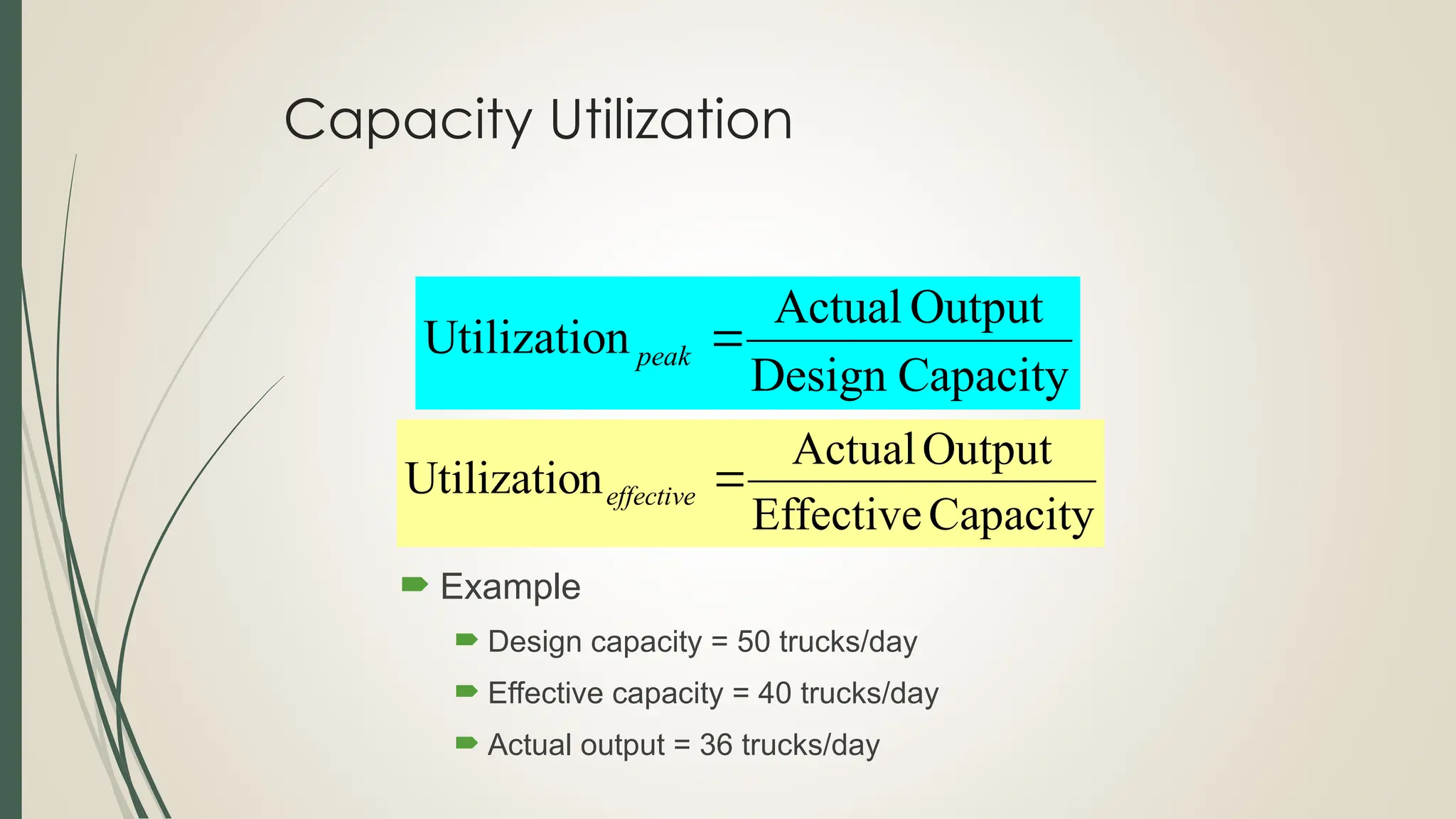
Capacity Utilization
 Example
 Design capacity = 50 trucks/day
 Effective capacity = 40 trucks/day
 Actual output = 36 trucks/day
Capacity
Design
Output
Actual
n
Utilizatio 
peak
Capacity
Effective
Output
Actual
n
Utilizatio 
effective
Example of Capacity Utilization
 During one week of production, a plant produced 83 units of a
product. Its historic highest or best utilization recorded was 120 units
per week. What is this plant’s capacity utilization rate?
Answer:
Capacity utilization rate = Capacity used .
Best operating level
= 83/120
= 0.69 or 69%
Basic Capacity Planning Concepts
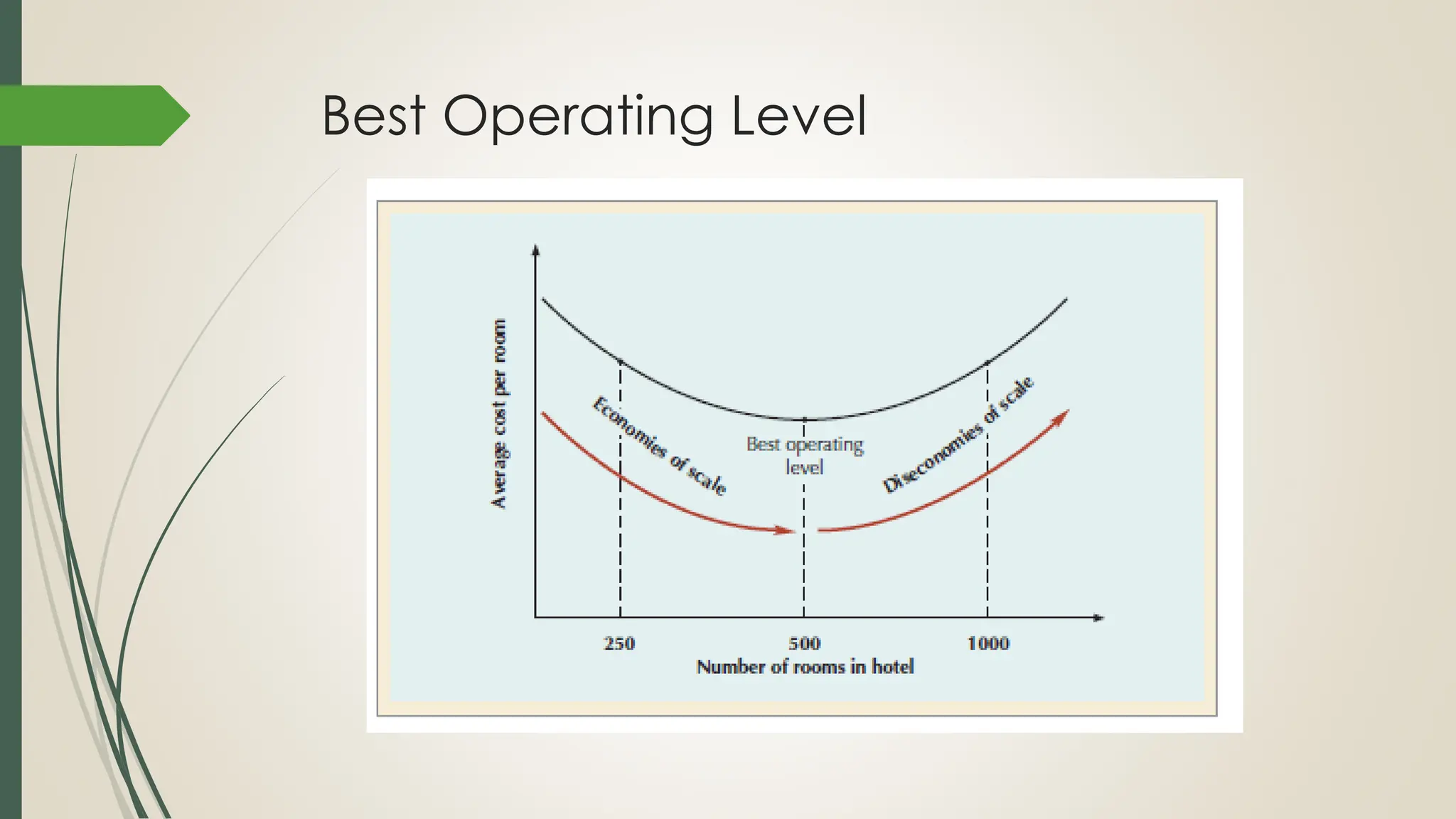
 Best Operating Level
 Economies & Diseconomies of Scale
 Capacity Focus
 Capacity Flexibility
 Capacity Cushion
Best Operating Level
Economies & Diseconomies of Scale
200 units
plant
400 units
plant
300 units
plant
Diseconomies
of scale
Economies
of scale
Capacity Focus
 The concept of the focused factory holds that a production facility
works best when it focuses on a fairly limited set of production
objectives.
 For example, a firm should not expect to excel in every aspect of
manufacturing performance: cost, quality, flexibility, new product
introductions, reliability, short lead times, and low investment.
 It should select a limited set of tasks that contribute the most to
corporate objectives.
Capacity Focus
 Capacity focus concept can also be operationalized through
the mechanism of Plants Within Plants (PWPs)
 A focused plant may have several PWPs
 This, in effect, permits finding the best operating level for each
department of the organization and thereby carries the focus
concept down to the operating level
Capacity Flexibility
 Having the ability to rapidly increase or decrease production
levels or to shift production capacity quickly from one product
tor service to another
 Such flexibility is achieved through flexible plants, processes,
and workers
Capacity Flexibility
 Flexible plants
 Using movable equipment, knockdown walls easily accessible and re routable
utilities, such a plant can adapt to change in real time.
 Flexible processes
 Flexible processes are optimized by flexible manufacturing systems on the one
hand and simple, easily setup equipment on the other.
 Flexible workers
 Flexible workers have multiple skills and the ability to switch easily from one kind
of task to another.
Capacity Cushion
 Capacity in excess of expected demand
 Capacity Cushion = 100 – Utilization %
 When a firm's design capacity is less than the capacity required to
meet it is said to have a negative capacity cushion
Capacity Cushion Example
 A firm has a demand of $12 million in products per year but can produce only $10
million per year.
Utilization = 12/10*100% = 120%
Capacity Cushion = 100 – 120 % = -20 %
 If the expected annual demand on a facility is $10 million in products per year and the
design capacity is $12 million per year.
Utilization = 10/12*100% = 83.33%
Capacity Cushion = 100 – 83.33 % = 16.67 %
Considerations in Adding Capacity
 Maintaining System Balance
Stage 1 Stage 2 Stage 3
Units per
month
6,000 7,000 5,000
Unbalanced stages of production
Units per
month 6,000 6,000 6,000
Maintaining System Balance: Output of one stage is the exact input
requirements for the next stage
Stage 1 Stage 2 Stage 3
Balanced stages of production
Considerations in Adding Capacity
 Frequency of
Capacity
Additions
– Upgrading
capacity too
frequently
– Upgrading
capacity too
infrequently
Considerations in Adding Capacity
External Sources of Capacity
– Subcontracting
– Sharing capacity
Adjusting Capacity to Meet the Demand
Change the capacity in short term
– Inventories and Backlogs
– Employment Levels
– Work Force Utilization
– Employee Training
– Process Design
– Subcontracting
– Maintenance
Adjusting Capacity to Meet the
Demand
 Change the Capacity in Long Term
– Expansion
• Expansion of own capacity
• Acquisition and Mergers
– Contraction and Constant Capacity
• Selling off existing facilities, equipment and inventories
• Firing employees
Determining Capacity Requirements
 Forecast sales within each individual product line
 Calculate equipment and labor requirements to meet the
forecasts
 Project equipment and labor availability over the planning
horizon
Example 1:
The Ceylon Flavors Company produces two flavors of salad dressings:
A and B. Each is available in bottles serving plastic bags.
‑
Management would like to determine equipment and la­
bor
requirements for the next five years.
The marketing department, which is now running a promotional
campaign for dressing B, provided the following forecasted demand
values (in thousands) for the next five years. The campaign is
expected to continue for the next two years.
Year 1 2 3 4 5
A
Bottles (000s) 60 100 150 200 250
Plastic bags (000s) 100 200 300 400 500
B
Bottles (000s) 75 85 95 97 98
Plastic bags (000s) 200 400 600 650 680
Currently three machines that can package up to 150,000 bottles each
per year are available. Each machine requires two operators and can
produce bottles of both B and Dressing A. Six bottle machine operators
are available. Also, five that can package up to 250,000 plastic bags
each per year are available. Three are 3 operators required for each
machine, which can produce plastic bags of both B and Dressing As.
Currently, 20 plastic bag machine operators are available.
Calculate machine and labour requirements for both bottles and plastic
bag operations.
Example 2
ABC company would like to determine capacity requirements for the
next four years. Currently two production lines are in place for bronze
and plastic sprinklers. Three types of sprinklers are available in both
bronze and plastic; 90-degree nozzle sprinklers, 180-degree nozzle
sprinklers, and 360-degree nozzle sprinklers. Management has
forecasted demand for the next 4 years as follows.
Year (demands ‘000 )
1 2 3 4
Plastic 90 32 44 55 56
Plastic 180 15 16 17 18
Plastic 360 50 55 64 67
Bronze 90 7 8 9 10
Bronze 180 3 4 5 6
Bronze 360 11 12 15 18
Both production lines can produce all the different types of nozzles. Each
bronze machine requires two operators to run and can produce up to
12000 sprinklers. The plastic injection modeling machine 4 operators to
run and can produce up to 200000 sprinklers. Three bronze machines and
only one injection molding machine are available. What are the
capacity requirements for the next 4 years?
Summary
► Strategic Capacity Planning Defined
► Importance
► Measuring Capacity
► Capacity Utilization
► Basic Capacity Planning Concepts
► Determining Capacity Requirements
► Adjusting Capacity to Meet the Demand

Supply chain management - Capacity planning

  • 1.
    Capacity Planning ADLM 22.1F,21.1F, 21.2P – Operations Management Academic Year 2022 Uditha Wijayaratne – Head of Operations National Institute of Business Management
  • 2.
    Content ► Strategic CapacityPlanning Defined ► Importance ► Measuring Capacity ► Capacity Utilization ► Basic Capacity Planning Concepts ► Determining Capacity Requirements ► Adjusting Capacity to Meet the Demand
  • 3.
    Strategic Capacity Planning ►Capacitycan be defined as the ability to hold, receive, store, or accommodate. ►Strategic capacity planning is an approach for determining the overall capacity level of capital intensive resources, including facilities, equipment, and overall labour force size.
  • 4.
    Importance  Capacity decisionshave a real impact on the ability of the organization to meet future demands for products and services  Capacity decisions affect operating costs  Capacity is usually a major determinant of initial cost  Capacity decisions often involve long-term commitment of resources  Capacity decisions can affect competitiveness  Capacity affects the ease of management
  • 5.
    Measuring Capacity ►Capacity oftenrefers to an upper limit on the rate of output  Rupee amounts (poor measure of capacity)  Output in terms of each product – 100 refrigerators per day – 80 freezers per day  Availability of inputs – No. of beds in a hospital – No. of machine hours available in a factory – No. of seats on a bus No single measure of capacity will be appropriate in every situation. Rather, the meas capacity must be tailored to the situation.
  • 6.
  • 7.
    Definitions of Capacity Design capacity: – The maximum output rate or service capacity an operation, process, or facility is designed for. – maximum rate of output achieved under ideal conditions  Effective capacity: – Design capacity minus allowances such as personal time, and maintenance.  Actual output: – The rate of output actually achieved. It cannot exceed effective capacity and is often less than effective capacity due to breakdowns, defective output, shortages of materials and similar factors.
  • 9.
    Capacity Utilization  Example Design capacity = 50 trucks/day  Effective capacity = 40 trucks/day  Actual output = 36 trucks/day Capacity Design Output Actual n Utilizatio  peak Capacity Effective Output Actual n Utilizatio  effective
  • 10.
    Example of CapacityUtilization  During one week of production, a plant produced 83 units of a product. Its historic highest or best utilization recorded was 120 units per week. What is this plant’s capacity utilization rate? Answer: Capacity utilization rate = Capacity used . Best operating level = 83/120 = 0.69 or 69%
  • 11.
    Basic Capacity PlanningConcepts  Best Operating Level  Economies & Diseconomies of Scale  Capacity Focus  Capacity Flexibility  Capacity Cushion
  • 12.
  • 13.
    Economies & Diseconomiesof Scale 200 units plant 400 units plant 300 units plant Diseconomies of scale Economies of scale
  • 14.
    Capacity Focus  Theconcept of the focused factory holds that a production facility works best when it focuses on a fairly limited set of production objectives.  For example, a firm should not expect to excel in every aspect of manufacturing performance: cost, quality, flexibility, new product introductions, reliability, short lead times, and low investment.  It should select a limited set of tasks that contribute the most to corporate objectives.
  • 15.
    Capacity Focus  Capacityfocus concept can also be operationalized through the mechanism of Plants Within Plants (PWPs)  A focused plant may have several PWPs  This, in effect, permits finding the best operating level for each department of the organization and thereby carries the focus concept down to the operating level
  • 16.
    Capacity Flexibility  Havingthe ability to rapidly increase or decrease production levels or to shift production capacity quickly from one product tor service to another  Such flexibility is achieved through flexible plants, processes, and workers
  • 17.
    Capacity Flexibility  Flexibleplants  Using movable equipment, knockdown walls easily accessible and re routable utilities, such a plant can adapt to change in real time.  Flexible processes  Flexible processes are optimized by flexible manufacturing systems on the one hand and simple, easily setup equipment on the other.  Flexible workers  Flexible workers have multiple skills and the ability to switch easily from one kind of task to another.
  • 18.
    Capacity Cushion  Capacityin excess of expected demand  Capacity Cushion = 100 – Utilization %  When a firm's design capacity is less than the capacity required to meet it is said to have a negative capacity cushion
  • 19.
    Capacity Cushion Example A firm has a demand of $12 million in products per year but can produce only $10 million per year. Utilization = 12/10*100% = 120% Capacity Cushion = 100 – 120 % = -20 %  If the expected annual demand on a facility is $10 million in products per year and the design capacity is $12 million per year. Utilization = 10/12*100% = 83.33% Capacity Cushion = 100 – 83.33 % = 16.67 %
  • 20.
    Considerations in AddingCapacity  Maintaining System Balance Stage 1 Stage 2 Stage 3 Units per month 6,000 7,000 5,000 Unbalanced stages of production Units per month 6,000 6,000 6,000 Maintaining System Balance: Output of one stage is the exact input requirements for the next stage Stage 1 Stage 2 Stage 3 Balanced stages of production
  • 21.
    Considerations in AddingCapacity  Frequency of Capacity Additions – Upgrading capacity too frequently – Upgrading capacity too infrequently
  • 22.
    Considerations in AddingCapacity External Sources of Capacity – Subcontracting – Sharing capacity
  • 23.
    Adjusting Capacity toMeet the Demand Change the capacity in short term – Inventories and Backlogs – Employment Levels – Work Force Utilization – Employee Training – Process Design – Subcontracting – Maintenance
  • 24.
    Adjusting Capacity toMeet the Demand  Change the Capacity in Long Term – Expansion • Expansion of own capacity • Acquisition and Mergers – Contraction and Constant Capacity • Selling off existing facilities, equipment and inventories • Firing employees
  • 25.
    Determining Capacity Requirements Forecast sales within each individual product line  Calculate equipment and labor requirements to meet the forecasts  Project equipment and labor availability over the planning horizon
  • 26.
    Example 1: The CeylonFlavors Company produces two flavors of salad dressings: A and B. Each is available in bottles serving plastic bags. ‑ Management would like to determine equipment and la­ bor requirements for the next five years. The marketing department, which is now running a promotional campaign for dressing B, provided the following forecasted demand values (in thousands) for the next five years. The campaign is expected to continue for the next two years.
  • 27.
    Year 1 23 4 5 A Bottles (000s) 60 100 150 200 250 Plastic bags (000s) 100 200 300 400 500 B Bottles (000s) 75 85 95 97 98 Plastic bags (000s) 200 400 600 650 680
  • 28.
    Currently three machinesthat can package up to 150,000 bottles each per year are available. Each machine requires two operators and can produce bottles of both B and Dressing A. Six bottle machine operators are available. Also, five that can package up to 250,000 plastic bags each per year are available. Three are 3 operators required for each machine, which can produce plastic bags of both B and Dressing As. Currently, 20 plastic bag machine operators are available. Calculate machine and labour requirements for both bottles and plastic bag operations.
  • 30.
    Example 2 ABC companywould like to determine capacity requirements for the next four years. Currently two production lines are in place for bronze and plastic sprinklers. Three types of sprinklers are available in both bronze and plastic; 90-degree nozzle sprinklers, 180-degree nozzle sprinklers, and 360-degree nozzle sprinklers. Management has forecasted demand for the next 4 years as follows.
  • 31.
    Year (demands ‘000) 1 2 3 4 Plastic 90 32 44 55 56 Plastic 180 15 16 17 18 Plastic 360 50 55 64 67 Bronze 90 7 8 9 10 Bronze 180 3 4 5 6 Bronze 360 11 12 15 18
  • 32.
    Both production linescan produce all the different types of nozzles. Each bronze machine requires two operators to run and can produce up to 12000 sprinklers. The plastic injection modeling machine 4 operators to run and can produce up to 200000 sprinklers. Three bronze machines and only one injection molding machine are available. What are the capacity requirements for the next 4 years?
  • 33.
    Summary ► Strategic CapacityPlanning Defined ► Importance ► Measuring Capacity ► Capacity Utilization ► Basic Capacity Planning Concepts ► Determining Capacity Requirements ► Adjusting Capacity to Meet the Demand