Cancer and its Types
Dr. Ashish Jawarkar M.D.
Pathologist
Parul Sevashram Hospital
OVERVIEW
•
•
•
•
•
•

How common is cancer
Understand cancer
History
How cancer starts
How cancer spreads
Stop cancer
How common is cancer
• According to national cancer control
programme – there are nearly 2.5 million
cancer patients in India
• About 0.7 million new cases are
diagnosed each year, and nearly half of
them die
• More than 60% of these patients are in
the age of 35-60, prime of their life
• It is expected that with improved life
expectency – the number of cases will
triple in the coming years
• About 1 in 4 of us will get cancer
• About 1 in 5 of will die due to
cancer
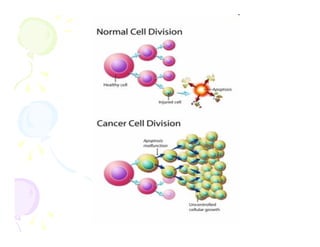
Normal cell division
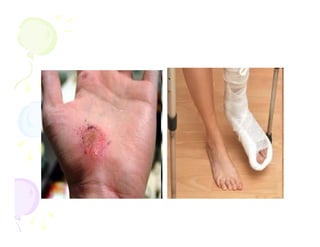
• There are trillions of cells in our body
• Healthy cells are programmed to
“know what to do and when to
do it”.
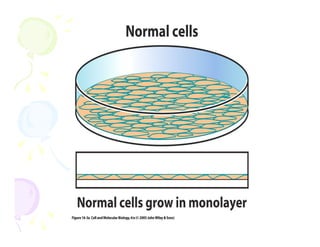
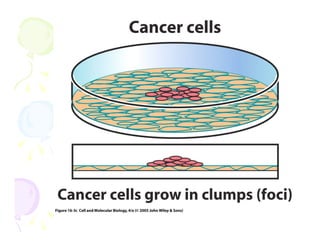
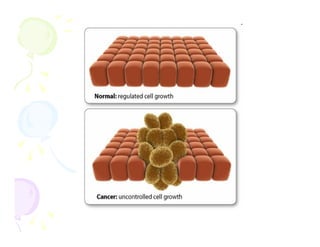
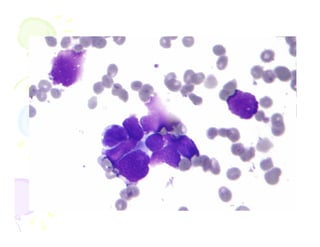
What is Cancer
• Cancer is a general name for more
than 100 different diseases
• The common point about all these
different diseases is that a particular
cell of the body is growing out of
control
• Cancer cells donot know “what to
do, and when to do”
• This division uses up all the
resources required by other cells of
the body
Some commonly used terms
• Neo-plasm – new growth
• Tumor – swelling caused by
neoplasm
• Benign neoplasm – one which is
restricted by its capsule – doesnot
spread to other areas of body
• Malignant – one which spreads to
different parts of the body
History
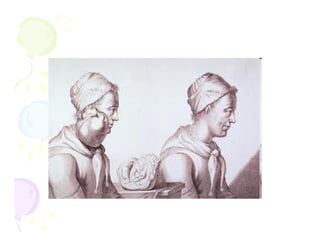
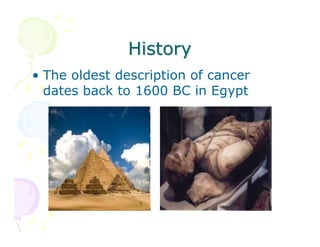
• The oldest description of cancer
dates back to 1600 BC in Egypt
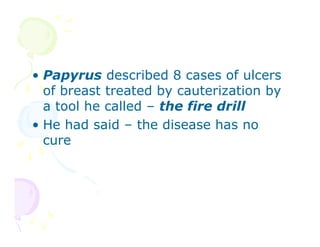
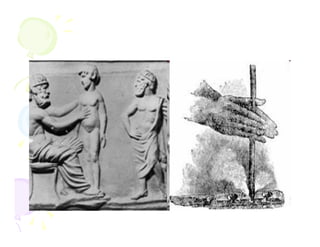
• Papyrus described 8 cases of ulcers
of breast treated by cauterization by
a tool he called – the fire drill
• He had said – the disease has no
cure
History
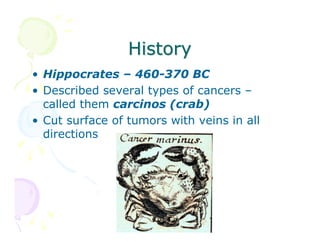
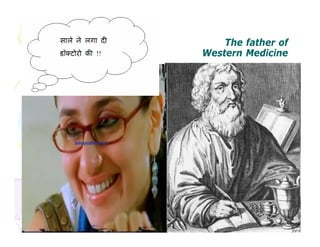
• Hippocrates – 460-370 BC
• Described several types of cancers –
called them carcinos (crab)
• Cut surface of tumors with veins in all
directions
The father of
Western Medicine
CELCUS AND GALEN
• Celcus (25 BC) translated carcinos
into latin – cancer
• Galen suggested the word oncos for
swelling – Oncology thus was named
Cause of cancer Humoral theory
• Though Hippocrates, Celcus and Galen
described cancer, they did not know the
cause
• Cause of cancer was said to be
imbalance of body fluids
• black/yellow bile,blood and phlegm
• Cancer was said to be caused by excess of
black bile
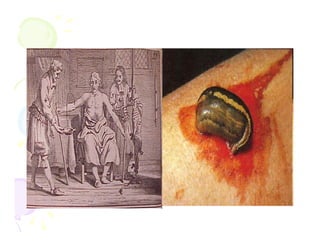
• Accordingly treatment was change of
diet/blood letting /laxatives
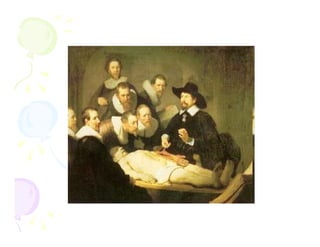
Morgagni
• In 1761, Morgagni first performed
autopsies
• He studied postmortem findings and
suggested causes of diseases
• This lead the foundation of
scientific study of cancer oncology
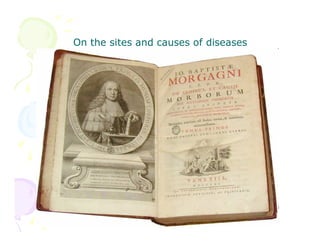
On the sites and causes of diseases
Era of cancer surgery
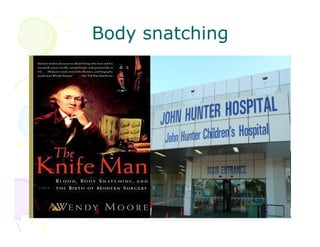
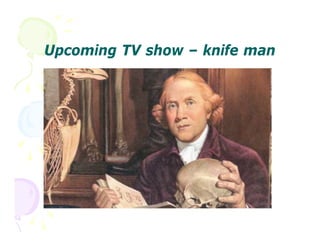
• The famous Scottish surgeon John
Hunter (1728−1793) suggested
that some cancers might be cured
by surgery.
• If the tumor had not invaded nearby
tissue and was “moveable,” he said,
“There is no impropriety in removing
it.”
• He conducted a lot of autopsies and
studied cancer
Body snatching
Upcoming TV show – knife man
Primitive surgery
• No asepsis / anaesthetic techniques
were available
• Mortality was more due to
secondary infections that cancer
per se
RECURRED
• It took nearly a century for the
development of anesthesia and
asepsis
• This allowed surgery to flourish and
classic cancer operations such as the
radical mastectomy could be done
effectively
• Any and every cancer was removed
– this prolonged life somewhat – but
cancer recurred
• Till this time – no one had
actually seen cancer cells!!!
Birth of microscopic
pathology
• The 19th century modern microscope
was invented and cancerous tissue
could be studied.
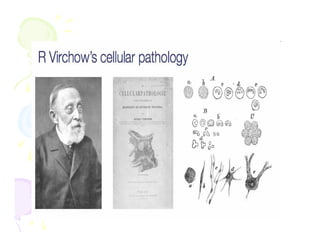
• Rudolf Virchow, often called the
founder of cellular pathology,
linked microscopic findings with
cancer types.
First actual cause of cancer
discovery
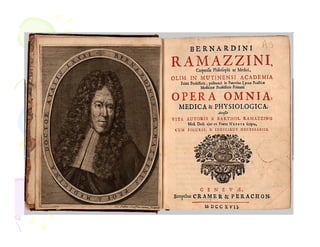
• In 1713, Bernardino Ramazzini, an Italian
doctor, reported the virtual absence of
cervical cancer and relatively high
incidence of breast cancer in nuns
• This was linked to their celibate life style
• This observation was an important step
toward identifying and understanding the
importance of hormones and cancer risk
Scrotal cancer
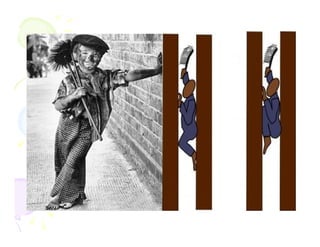
• In 1775, Percival Pott of Saint
Bartholomew’s Hospital in London
described an occupational cancer in
chimney sweeps, cancer of the scrotum
• was caused by soot collecting in the skin
folds of the scrotum.
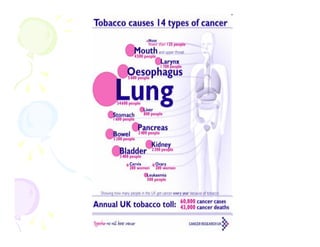
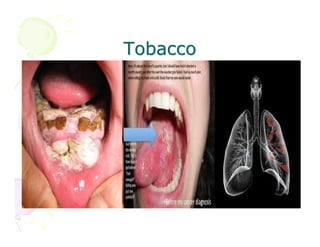
Tobacco
• Thomas Venner of London was
one of the first to warn about
tobacco dangers in his Via Recta,
published in London in 1620.
• He wrote that “immoderate use of
tobacco hurts the brain and the
eye and induces trembling of the
limbs and the heart.”
• And 150 years later, in 1761, only a
few decades after recreational
tobacco became popular in London,
John Hill wrote a book entitled Cautions Against the Immoderate
Use of Snuff.
• Inspite of this, tobacco use continued
unabeted
• Lead to an epidemic of sorts, of
tobacco related cancers
• These first observations linking
tobacco and cancer led to
epidemiologic research many years
later (in the 1950s and early 1960s)
which showed that smoking causes
lung cancer and led to the US
Surgeon General’s 1964 report
Smoking and Health.
• This report lead to some regulations
on tobacco companies
• They had to affix warnings on their
products
Powerful tobacco lobby

• Still they avoided the word - CANCER
Genetic cause
• The genetic basis of cancer was
proposed by German zoologist
Boveri in 1902
• He suggested the mutations of
chromosomes lead to cancer
Radiotherapy
• Marie curie discovered radium, and
radiation at the end of 19th century
• This marked the discovery of first
non surgical mode of cancer
treatment
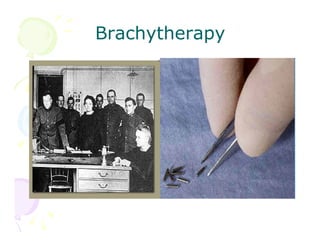
Brachytherapy
Complete cancer cure
• During World war II, the nuclear
bombings of Hiroshima and Nagasaki
took place
• It was observed that the radiation of
the bombings destroyed the marrow
of the victims
• This in turn gave a hope of curing
cancer completely by radiation
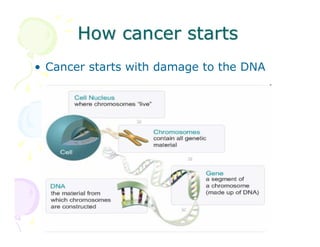
How cancer starts
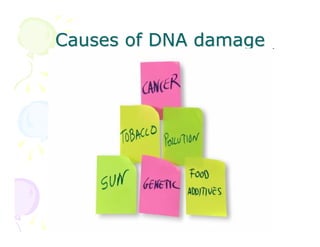
• Cancer starts with damage to the DNA
Causes of DNA damage
Tobacco
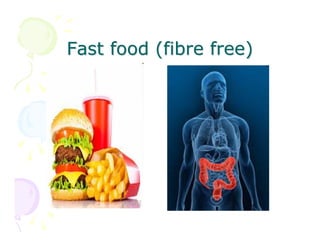
Fast food (fibre free)
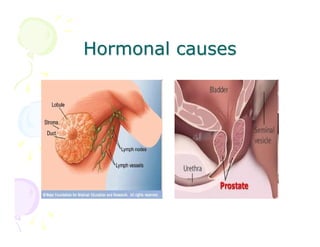
Hormonal causes
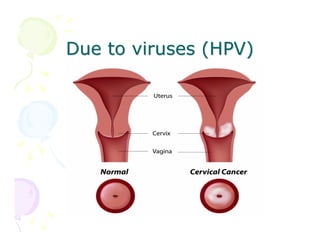
Due to viruses (HPV)
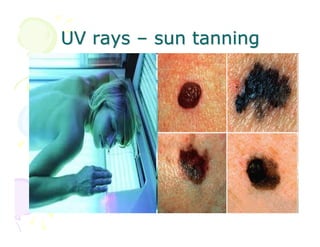
UV rays – sun tanning
Signs and symptoms of
cancer
• Depends on the location
–
–
–
–
–
–
–

Change in bowel or bladder habits
A sore that does not heal
Unusual bleeding or discharge
Thickening or lump in breast or elsewhere
Indigestion or difficulty in swelling
Obvious change in wart or mole
Nagging cough or hoarseness
Spread of cancer
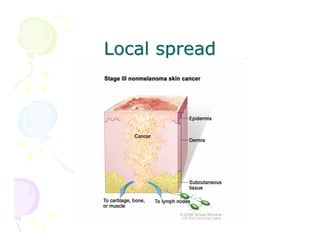
• Local spread
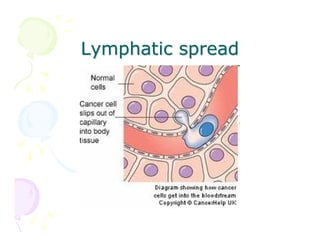
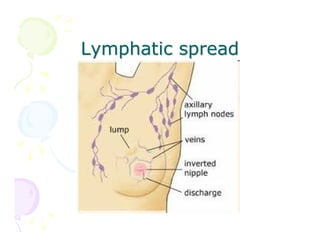
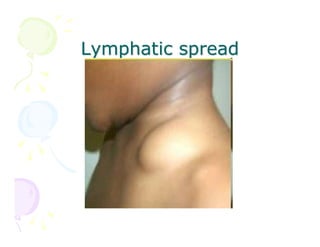
• Lymphatic spread
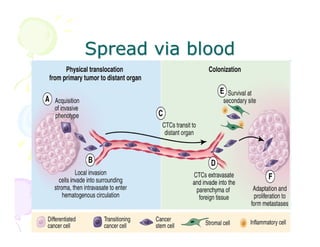
• Metastasis
Local spread
Lymphatic spread
Lymphatic spread
Lymphatic spread
Spread via blood
Can we treat cancer??
• Cancer cells are our cells –
• killing them = killing ourselves
• Main treatments available
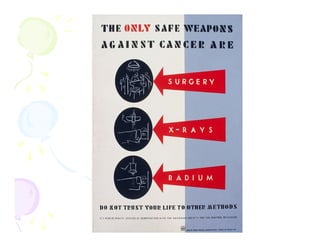
– Surgery – Recurs
– Chemotherapy – damages normal cells
– Radiotherapy – damages nearby areas
Newer treatments
• Imatinib – revolutionized treatment
of CML
• Herceptin – for treatment of breast
cancer
• Rituximab – against NHL
Still… Prevention is cure
•
•
•
•
•

Limiting tobacco exposure
Limiting alcohol intake
Modifying diet
Limiting exposure to UV rays
Screening programs
What is screening??
• looking for cancer before a person
has any symptoms
• When abnormal tissue is found early
stage, it may be possible to treat it
completely
• Following cancers are amenable to
screening
–
–
–
–
–

Breast
Prostate
Cervix
Colon and rectum
Lung
Breast cancer screening
• Has lead to a 15-20% reduction in
deaths due to breast cancer
• American cancer society
recommends breast cancer
screening for all women more
than age 40 , every year
• Includes
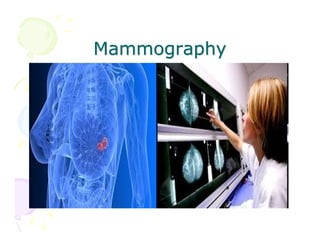
– Mammography
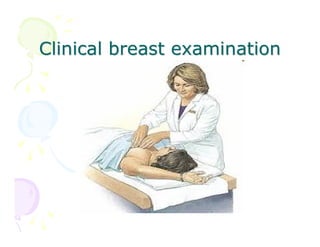
– Clinical breast examination
– Breast self examination
Mammography
Clinical breast examination
Breast self examination
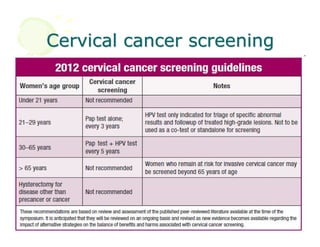
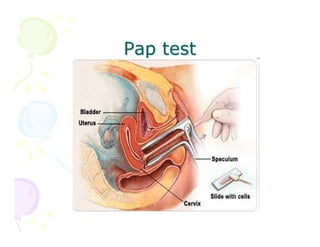
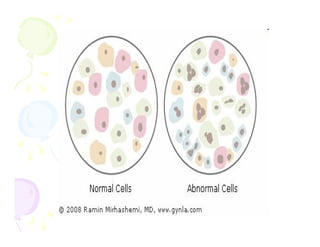
Cervical cancer screening
Pap test
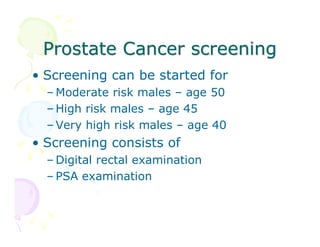
Prostate Cancer screening
• Screening can be started for
– Moderate risk males – age 50
– High risk males – age 45
– Very high risk males – age 40

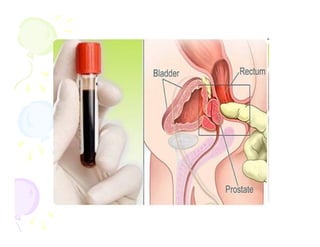
• Screening consists of
– Digital rectal examination
– PSA examination
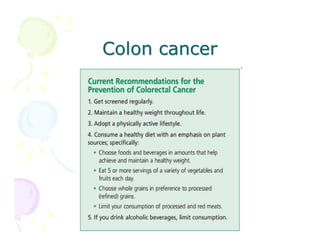
Colon cancer
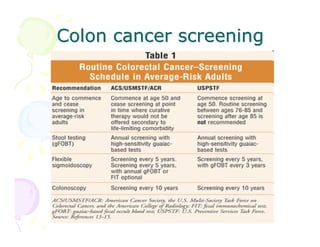
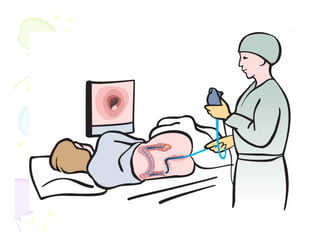
Colon cancer screening
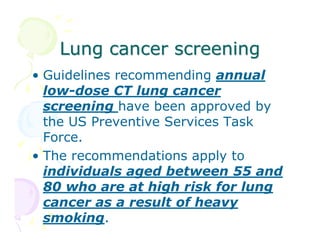
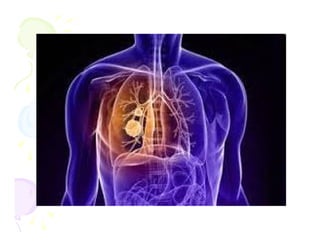
Lung cancer screening
• Guidelines recommending annual
low-dose CT lung cancer
screening have been approved by
the US Preventive Services Task
Force.
• The recommendations apply to
individuals aged between 55 and
80 who are at high risk for lung
cancer as a result of heavy
smoking.
Take home message
• Cancer is a group of diseases affecting
human kind since ages
• It is controllable – not yet completely
curable at early stages
• Screening programs help in reducing
morbidity and mortality from cancer
• Gearing cancer research towards knowing
the molecular mechanisms of cancer can
help in developing treatment modules
References
• The Emperor of all maladies - by
Siddhartha Mukherjee
• Robbins pathology
• A lot of wikipedia
• Google baba ki Jai Ho!!
Cancer and its types - an introduction to cancer

Cancer and its types - an introduction to cancer

  • 1.
    Cancer and itsTypes Dr. Ashish Jawarkar M.D. Pathologist Parul Sevashram Hospital
  • 2.
    OVERVIEW • • • • • • How common iscancer Understand cancer History How cancer starts How cancer spreads Stop cancer
  • 3.
    How common iscancer • According to national cancer control programme – there are nearly 2.5 million cancer patients in India • About 0.7 million new cases are diagnosed each year, and nearly half of them die • More than 60% of these patients are in the age of 35-60, prime of their life • It is expected that with improved life expectency – the number of cases will triple in the coming years
  • 4.
    • About 1in 4 of us will get cancer • About 1 in 5 of will die due to cancer
  • 6.
    Normal cell division •There are trillions of cells in our body • Healthy cells are programmed to “know what to do and when to do it”.
  • 15.
    What is Cancer •Cancer is a general name for more than 100 different diseases • The common point about all these different diseases is that a particular cell of the body is growing out of control • Cancer cells donot know “what to do, and when to do” • This division uses up all the resources required by other cells of the body
  • 16.
    Some commonly usedterms • Neo-plasm – new growth • Tumor – swelling caused by neoplasm • Benign neoplasm – one which is restricted by its capsule – doesnot spread to other areas of body • Malignant – one which spreads to different parts of the body
  • 18.
    History • The oldestdescription of cancer dates back to 1600 BC in Egypt
  • 19.
    • Papyrus described8 cases of ulcers of breast treated by cauterization by a tool he called – the fire drill • He had said – the disease has no cure
  • 21.
    History • Hippocrates –460-370 BC • Described several types of cancers – called them carcinos (crab) • Cut surface of tumors with veins in all directions
  • 22.
  • 23.
    CELCUS AND GALEN •Celcus (25 BC) translated carcinos into latin – cancer • Galen suggested the word oncos for swelling – Oncology thus was named
  • 24.
    Cause of cancerHumoral theory • Though Hippocrates, Celcus and Galen described cancer, they did not know the cause • Cause of cancer was said to be imbalance of body fluids • black/yellow bile,blood and phlegm • Cancer was said to be caused by excess of black bile • Accordingly treatment was change of diet/blood letting /laxatives
  • 26.
    Morgagni • In 1761,Morgagni first performed autopsies • He studied postmortem findings and suggested causes of diseases • This lead the foundation of scientific study of cancer oncology
  • 28.
    On the sitesand causes of diseases
  • 29.
    Era of cancersurgery • The famous Scottish surgeon John Hunter (1728−1793) suggested that some cancers might be cured by surgery. • If the tumor had not invaded nearby tissue and was “moveable,” he said, “There is no impropriety in removing it.” • He conducted a lot of autopsies and studied cancer
  • 30.
  • 31.
    Upcoming TV show– knife man
  • 32.
    Primitive surgery • Noasepsis / anaesthetic techniques were available • Mortality was more due to secondary infections that cancer per se
  • 33.
    RECURRED • It tooknearly a century for the development of anesthesia and asepsis • This allowed surgery to flourish and classic cancer operations such as the radical mastectomy could be done effectively • Any and every cancer was removed – this prolonged life somewhat – but cancer recurred
  • 34.
    • Till thistime – no one had actually seen cancer cells!!!
  • 35.
    Birth of microscopic pathology •The 19th century modern microscope was invented and cancerous tissue could be studied. • Rudolf Virchow, often called the founder of cellular pathology, linked microscopic findings with cancer types.
  • 37.
    First actual causeof cancer discovery • In 1713, Bernardino Ramazzini, an Italian doctor, reported the virtual absence of cervical cancer and relatively high incidence of breast cancer in nuns • This was linked to their celibate life style • This observation was an important step toward identifying and understanding the importance of hormones and cancer risk
  • 39.
    Scrotal cancer • In1775, Percival Pott of Saint Bartholomew’s Hospital in London described an occupational cancer in chimney sweeps, cancer of the scrotum • was caused by soot collecting in the skin folds of the scrotum.
  • 41.
    Tobacco • Thomas Vennerof London was one of the first to warn about tobacco dangers in his Via Recta, published in London in 1620. • He wrote that “immoderate use of tobacco hurts the brain and the eye and induces trembling of the limbs and the heart.”
  • 42.
    • And 150years later, in 1761, only a few decades after recreational tobacco became popular in London, John Hill wrote a book entitled Cautions Against the Immoderate Use of Snuff.
  • 43.
    • Inspite ofthis, tobacco use continued unabeted • Lead to an epidemic of sorts, of tobacco related cancers
  • 44.
    • These firstobservations linking tobacco and cancer led to epidemiologic research many years later (in the 1950s and early 1960s) which showed that smoking causes lung cancer and led to the US Surgeon General’s 1964 report Smoking and Health.
  • 45.
    • This reportlead to some regulations on tobacco companies • They had to affix warnings on their products
  • 46.
    Powerful tobacco lobby •Still they avoided the word - CANCER
  • 47.
    Genetic cause • Thegenetic basis of cancer was proposed by German zoologist Boveri in 1902 • He suggested the mutations of chromosomes lead to cancer
  • 48.
    Radiotherapy • Marie curiediscovered radium, and radiation at the end of 19th century • This marked the discovery of first non surgical mode of cancer treatment
  • 49.
  • 51.
    Complete cancer cure •During World war II, the nuclear bombings of Hiroshima and Nagasaki took place • It was observed that the radiation of the bombings destroyed the marrow of the victims • This in turn gave a hope of curing cancer completely by radiation
  • 54.
    How cancer starts •Cancer starts with damage to the DNA
  • 55.
  • 57.
  • 58.
  • 59.
  • 60.
  • 61.
    UV rays –sun tanning
  • 62.
    Signs and symptomsof cancer • Depends on the location – – – – – – – Change in bowel or bladder habits A sore that does not heal Unusual bleeding or discharge Thickening or lump in breast or elsewhere Indigestion or difficulty in swelling Obvious change in wart or mole Nagging cough or hoarseness
  • 63.
    Spread of cancer •Local spread • Lymphatic spread • Metastasis
  • 64.
  • 65.
  • 66.
  • 67.
  • 68.
  • 69.
    Can we treatcancer?? • Cancer cells are our cells – • killing them = killing ourselves • Main treatments available – Surgery – Recurs – Chemotherapy – damages normal cells – Radiotherapy – damages nearby areas
  • 70.
    Newer treatments • Imatinib– revolutionized treatment of CML • Herceptin – for treatment of breast cancer • Rituximab – against NHL
  • 71.
    Still… Prevention iscure • • • • • Limiting tobacco exposure Limiting alcohol intake Modifying diet Limiting exposure to UV rays Screening programs
  • 72.
    What is screening?? •looking for cancer before a person has any symptoms • When abnormal tissue is found early stage, it may be possible to treat it completely • Following cancers are amenable to screening – – – – – Breast Prostate Cervix Colon and rectum Lung
  • 73.
  • 74.
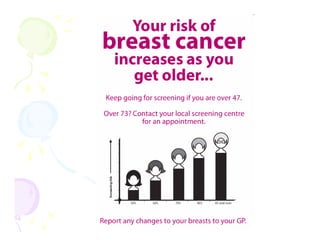
    Breast cancer screening •Has lead to a 15-20% reduction in deaths due to breast cancer • American cancer society recommends breast cancer screening for all women more than age 40 , every year • Includes – Mammography – Clinical breast examination – Breast self examination
  • 75.
  • 76.
  • 77.
  • 79.
  • 80.
  • 82.
    Prostate Cancer screening •Screening can be started for – Moderate risk males – age 50 – High risk males – age 45 – Very high risk males – age 40 • Screening consists of – Digital rectal examination – PSA examination
  • 84.
  • 85.
  • 88.
    Lung cancer screening •Guidelines recommending annual low-dose CT lung cancer screening have been approved by the US Preventive Services Task Force. • The recommendations apply to individuals aged between 55 and 80 who are at high risk for lung cancer as a result of heavy smoking.
  • 90.
    Take home message •Cancer is a group of diseases affecting human kind since ages • It is controllable – not yet completely curable at early stages • Screening programs help in reducing morbidity and mortality from cancer • Gearing cancer research towards knowing the molecular mechanisms of cancer can help in developing treatment modules
  • 91.
    References • The Emperorof all maladies - by Siddhartha Mukherjee • Robbins pathology • A lot of wikipedia • Google baba ki Jai Ho!!