An introduction to Cancer 
SALMAN UL ISLAM 
2014-11-05 
2013298039 
Kyungpook National University
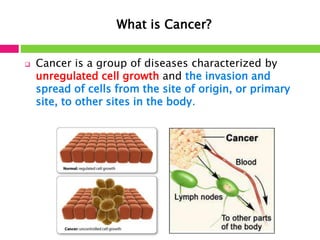
What is Cancer? 
 Cancer is a group of diseases characterized by 
unregulated cell growth and the invasion and 
spread of cells from the site of origin, or primary 
site, to other sites in the body.
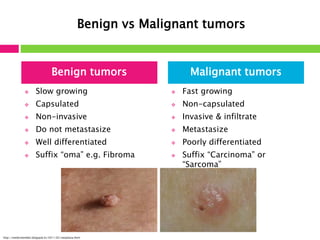
Benign vs Malignant tumors 
Benign tumors Malignant tumors 
 Slow growing 
 Capsulated 
 Non-invasive 
 Do not metastasize 
 Well differentiated 
 Suffix “oma” e.g. Fibroma 
 Fast growing 
 Non-capsulated 
 Invasive & infiltrate 
 Metastasize 
 Poorly differentiated 
 Suffix “Carcinoma” or 
“Sarcoma” 
http://medicinembbs.blogspot.kr/2011/02/neoplasia.html
Classification of cancer 
 There are more than 100 types of cancer. These 
are classified on the basis of tissue of origin. 
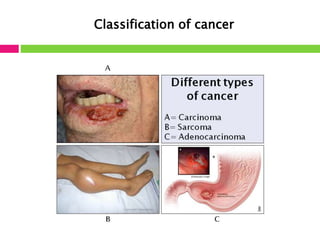
 Carcinomas: Cancers of epithelial cells. They 
constitute approximately 85% of all cancers. 
 Sarcomas: Cancers of mesoderm cells (e.g. bone, 
muscle). 
 Adenocarcinomas: Cancers of glandular tissue (e.g. 
breast).
Classification of cancer
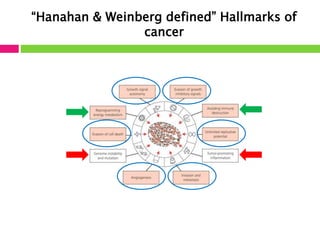
“Hanahan & Weinberg defined” Hallmarks of 
cancer
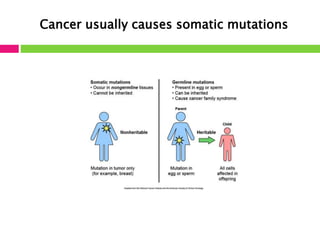
Cancer usually causes somatic mutations 
 Somatic cells: All the body cells except the 
reproductive (germ) cells. 
 Germ cells: Either the egg or the sperm cell; a 
reproductive cell. 
 Almost all of the mutations identified in tumor 
cells are somatic mutations. These mutations are 
not passed on to the next generation. 
 Only germline mutations will be passed on to off-spring.
Cancer usually causes somatic mutations
Normal body processes regulate body net 
cells number 
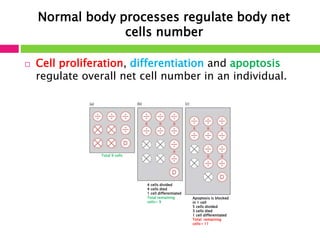
 Cell proliferation, differentiation and apoptosis 
regulate overall net cell number in an individual. 
Total 9 cells 
4 cells divided 
4 cells died 
1 cell differentiated 
Total remaining 
cells= 9 
Apoptosis is blocked 
in 1 cell 
5 cells divided 
3 cells died 
1 cell differentiated 
Total remaining 
cells= 11
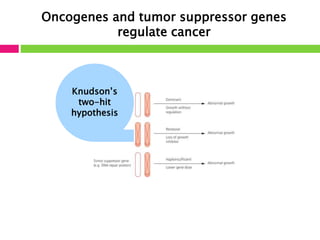
Oncogenes and tumor suppressor genes 
regulate cancer 
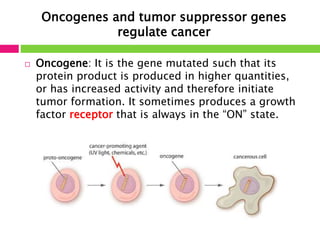
 Oncogene: It is the gene mutated such that its 
protein product is produced in higher quantities, 
or has increased activity and therefore initiate 
tumor formation. It sometimes produces a growth 
factor receptor that is always in the “ON” state.
Oncogenes and tumor suppressor genes 
regulate cancer 
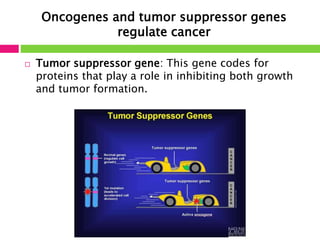
 Tumor suppressor gene: This gene codes for 
proteins that play a role in inhibiting both growth 
and tumor formation.
Oncogenes and tumor suppressor genes 
regulate cancer 
Knudson’s 
two-hit 
hypothesis
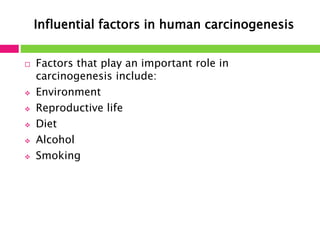
Influential factors in human carcinogenesis 
 Factors that play an important role in 
carcinogenesis include: 
 Environment 
 Reproductive life 
 Diet 
 Alcohol 
 Smoking
Influential factors in human carcinogenesis 
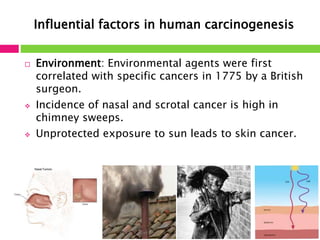
 Environment: Environmental agents were first 
correlated with specific cancers in 1775 by a British 
surgeon. 
 Incidence of nasal and scrotal cancer is high in 
chimney sweeps. 
 Unprotected exposure to sun leads to skin cancer.
Influential factors in human carcinogenesis 
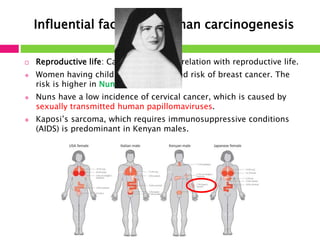
 Reproductive life: Cancer has a great relation with reproductive life. 
 Women having children have a reduced risk of breast cancer. The 
risk is higher in Nuns. 
 Nuns have a low incidence of cervical cancer, which is caused by 
sexually transmitted human papillomaviruses. 
 Kaposi’s sarcoma, which requires immunosuppressive conditions 
(AIDS) is predominant in Kenyan males.
Influential factors in human carcinogenesis 
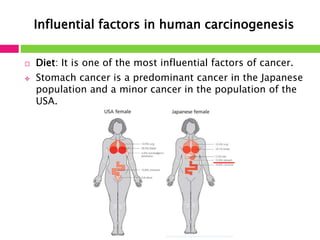
 Diet: It is one of the most influential factors of cancer. 
 Stomach cancer is a predominant cancer in the Japanese 
population and a minor cancer in the population of the 
USA.
Influential factors in human carcinogenesis 
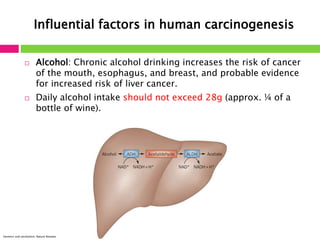
 Alcohol: Chronic alcohol drinking increases the risk of cancer 
of the mouth, esophagus, and breast, and probable evidence 
for increased risk of liver cancer. 
 Daily alcohol intake should not exceed 28g (approx. ¼ of a 
bottle of wine). 
Genetics and alcoholism. Nature Reviews
Influential factors in human carcinogenesis 
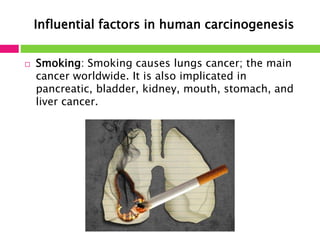
 Smoking: Smoking causes lungs cancer; the main 
cancer worldwide. It is also implicated in 
pancreatic, bladder, kidney, mouth, stomach, and 
liver cancer.
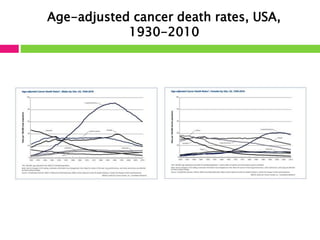
Age-adjusted cancer death rates, USA, 
1930-2010
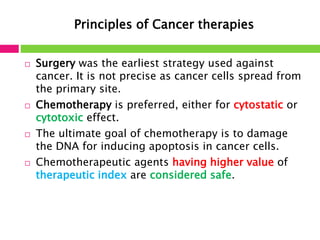
Principles of Cancer therapies 
 Surgery was the earliest strategy used against 
cancer. It is not precise as cancer cells spread from 
the primary site. 
 Chemotherapy is preferred, either for cytostatic or 
cytotoxic effect. 
 The ultimate goal of chemotherapy is to damage 
the DNA for inducing apoptosis in cancer cells. 
 Chemotherapeutic agents having higher value of 
therapeutic index are considered safe.
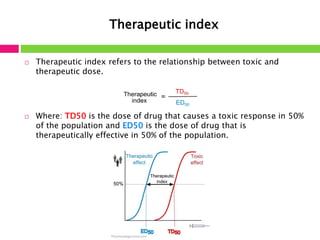
Therapeutic index 
 Therapeutic index refers to the relationship between toxic and 
therapeutic dose. 
 Where: TD50 is the dose of drug that causes a toxic response in 50% 
of the population and ED50 is the dose of drug that is 
therapeutically effective in 50% of the population.
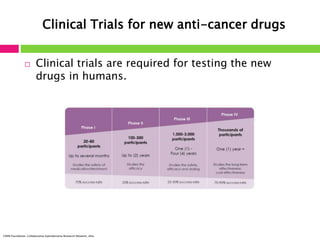
Clinical Trials for new anti-cancer drugs 
 Clinical trials are required for testing the new 
drugs in humans. 
CERN Foundation, Collaborative Ependymoma Research Network, ohio
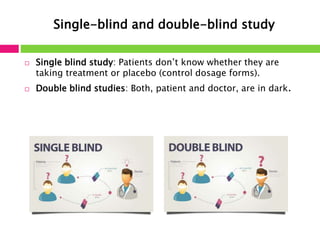
Single-blind and double-blind study 
 Single blind study: Patients don’t know whether they are 
taking treatment or placebo (control dosage forms). 
 Double blind studies: Both, patient and doctor, are in dark.
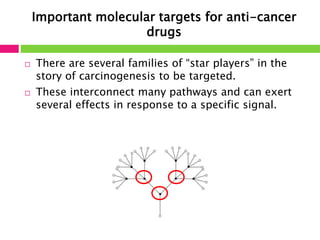
Important molecular targets for anti-cancer 
drugs 
 There are several families of “star players” in the 
story of carcinogenesis to be targeted. 
 These interconnect many pathways and can exert 
several effects in response to a specific signal.
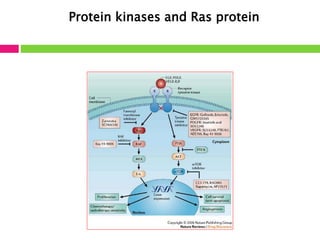
Protein kinases and Ras protein
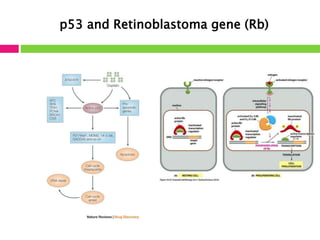
p53 and Retinoblastoma gene (Rb)
Cancer genome 
 The sequencing and mapping of human genome has 
paved the way of cancer genomics. 
 Learning the difference between genome of cancer and 
a normal cell will have a great contribution in designing 
more powerful and specific drugs. 
 International Cancer Genome Consortium (ICGC) is 
trying to characterize at least 50 classes of cancer, 
creating an open access to the entire research 
community. 
 The international SNP Map Working Group is anlazing 
single nucleotide polymorphism (SNPs). 
 It will help in identifying mutations within the genome 
that may be linked with cancer.
Summary 
 Cancer is the uncontrolled and unregulated 
growth of cells which metastasize throughout 
the body. 
 Cancer is a genome disease at the cellular 
level. 
 Changes in lifestyle can affect cancer risk. 
 Protein kinases are important molecules in 
carcinogenesis. 
 Cancer genomics is being used to define 
molecular targets for tumor-specific effects.

An introduction to cancer

  • 1.
    An introduction toCancer SALMAN UL ISLAM 2014-11-05 2013298039 Kyungpook National University
  • 2.
    What is Cancer?  Cancer is a group of diseases characterized by unregulated cell growth and the invasion and spread of cells from the site of origin, or primary site, to other sites in the body.
  • 3.
    Benign vs Malignanttumors Benign tumors Malignant tumors  Slow growing  Capsulated  Non-invasive  Do not metastasize  Well differentiated  Suffix “oma” e.g. Fibroma  Fast growing  Non-capsulated  Invasive & infiltrate  Metastasize  Poorly differentiated  Suffix “Carcinoma” or “Sarcoma” http://medicinembbs.blogspot.kr/2011/02/neoplasia.html
  • 4.
    Classification of cancer  There are more than 100 types of cancer. These are classified on the basis of tissue of origin.  Carcinomas: Cancers of epithelial cells. They constitute approximately 85% of all cancers.  Sarcomas: Cancers of mesoderm cells (e.g. bone, muscle).  Adenocarcinomas: Cancers of glandular tissue (e.g. breast).
  • 5.
  • 6.
    “Hanahan & Weinbergdefined” Hallmarks of cancer
  • 7.
    Cancer usually causessomatic mutations  Somatic cells: All the body cells except the reproductive (germ) cells.  Germ cells: Either the egg or the sperm cell; a reproductive cell.  Almost all of the mutations identified in tumor cells are somatic mutations. These mutations are not passed on to the next generation.  Only germline mutations will be passed on to off-spring.
  • 8.
    Cancer usually causessomatic mutations
  • 9.
    Normal body processesregulate body net cells number  Cell proliferation, differentiation and apoptosis regulate overall net cell number in an individual. Total 9 cells 4 cells divided 4 cells died 1 cell differentiated Total remaining cells= 9 Apoptosis is blocked in 1 cell 5 cells divided 3 cells died 1 cell differentiated Total remaining cells= 11
  • 10.
    Oncogenes and tumorsuppressor genes regulate cancer  Oncogene: It is the gene mutated such that its protein product is produced in higher quantities, or has increased activity and therefore initiate tumor formation. It sometimes produces a growth factor receptor that is always in the “ON” state.
  • 11.
    Oncogenes and tumorsuppressor genes regulate cancer  Tumor suppressor gene: This gene codes for proteins that play a role in inhibiting both growth and tumor formation.
  • 12.
    Oncogenes and tumorsuppressor genes regulate cancer Knudson’s two-hit hypothesis
  • 13.
    Influential factors inhuman carcinogenesis  Factors that play an important role in carcinogenesis include:  Environment  Reproductive life  Diet  Alcohol  Smoking
  • 14.
    Influential factors inhuman carcinogenesis  Environment: Environmental agents were first correlated with specific cancers in 1775 by a British surgeon.  Incidence of nasal and scrotal cancer is high in chimney sweeps.  Unprotected exposure to sun leads to skin cancer.
  • 15.
    Influential factors inhuman carcinogenesis  Reproductive life: Cancer has a great relation with reproductive life.  Women having children have a reduced risk of breast cancer. The risk is higher in Nuns.  Nuns have a low incidence of cervical cancer, which is caused by sexually transmitted human papillomaviruses.  Kaposi’s sarcoma, which requires immunosuppressive conditions (AIDS) is predominant in Kenyan males.
  • 16.
    Influential factors inhuman carcinogenesis  Diet: It is one of the most influential factors of cancer.  Stomach cancer is a predominant cancer in the Japanese population and a minor cancer in the population of the USA.
  • 17.
    Influential factors inhuman carcinogenesis  Alcohol: Chronic alcohol drinking increases the risk of cancer of the mouth, esophagus, and breast, and probable evidence for increased risk of liver cancer.  Daily alcohol intake should not exceed 28g (approx. ¼ of a bottle of wine). Genetics and alcoholism. Nature Reviews
  • 18.
    Influential factors inhuman carcinogenesis  Smoking: Smoking causes lungs cancer; the main cancer worldwide. It is also implicated in pancreatic, bladder, kidney, mouth, stomach, and liver cancer.
  • 19.
    Age-adjusted cancer deathrates, USA, 1930-2010
  • 20.
    Principles of Cancertherapies  Surgery was the earliest strategy used against cancer. It is not precise as cancer cells spread from the primary site.  Chemotherapy is preferred, either for cytostatic or cytotoxic effect.  The ultimate goal of chemotherapy is to damage the DNA for inducing apoptosis in cancer cells.  Chemotherapeutic agents having higher value of therapeutic index are considered safe.
  • 21.
    Therapeutic index Therapeutic index refers to the relationship between toxic and therapeutic dose.  Where: TD50 is the dose of drug that causes a toxic response in 50% of the population and ED50 is the dose of drug that is therapeutically effective in 50% of the population.
  • 22.
    Clinical Trials fornew anti-cancer drugs  Clinical trials are required for testing the new drugs in humans. CERN Foundation, Collaborative Ependymoma Research Network, ohio
  • 23.
    Single-blind and double-blindstudy  Single blind study: Patients don’t know whether they are taking treatment or placebo (control dosage forms).  Double blind studies: Both, patient and doctor, are in dark.
  • 24.
    Important molecular targetsfor anti-cancer drugs  There are several families of “star players” in the story of carcinogenesis to be targeted.  These interconnect many pathways and can exert several effects in response to a specific signal.
  • 25.
  • 26.
  • 27.
    Cancer genome The sequencing and mapping of human genome has paved the way of cancer genomics.  Learning the difference between genome of cancer and a normal cell will have a great contribution in designing more powerful and specific drugs.  International Cancer Genome Consortium (ICGC) is trying to characterize at least 50 classes of cancer, creating an open access to the entire research community.  The international SNP Map Working Group is anlazing single nucleotide polymorphism (SNPs).  It will help in identifying mutations within the genome that may be linked with cancer.
  • 28.
    Summary  Canceris the uncontrolled and unregulated growth of cells which metastasize throughout the body.  Cancer is a genome disease at the cellular level.  Changes in lifestyle can affect cancer risk.  Protein kinases are important molecules in carcinogenesis.  Cancer genomics is being used to define molecular targets for tumor-specific effects.