Human Biology III Oncology I Ken Bauer [email_address]
Objectives Following the lecture the student should be able to: 1. Differentiate between the characteristics   of benign and malignant tumors. 2. List the 5 broad categories of cancer   etiology 3. Describe the effect cigarette smoking has   had on cancer incidence and death rates   from 1930 to present.
Objectives 4. Explain the roles of oncogenes   proro-oncogenes, and tumor suppressor   genes in the malignant transformation . 5.  List the 3 most common tumor types in   men and women by gender
Cancer Terminology Cancer is a disorder that occurs at a cellular level Cancer occurs when genetic alterations result in the unregulated proliferation of cells
Cancer Terminology Cancer - A group of diseases Anaplasia - Lack of differentiation Dysplasia - Abnormal size, shape Hyperplasia - Increase in number of cells
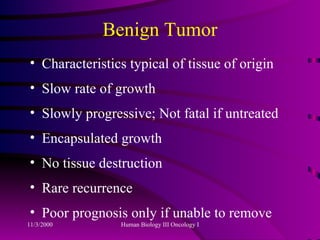
Benign Tumor Characteristics typical of tissue of origin Slow rate of growth Slowly progressive; Not fatal if untreated Encapsulated growth No tissue destruction Rare recurrence  Poor prognosis only if unable to remove
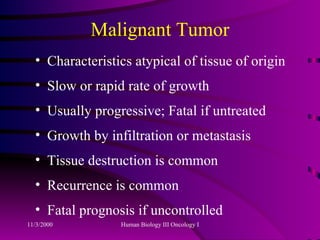
Malignant Tumor Characteristics atypical of tissue of origin Slow or rapid rate of growth Usually progressive; Fatal if untreated Growth by infiltration or metastasis Tissue destruction is common Recurrence is common Fatal prognosis if uncontrolled
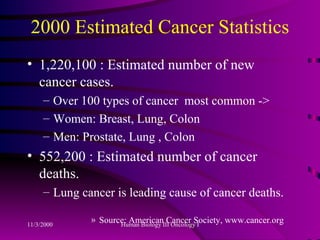
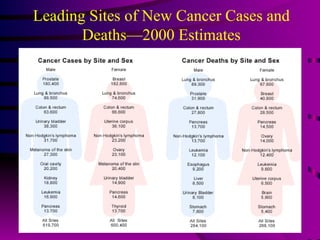
2000 Estimated Cancer Statistics 1,220,100 : Estimated number of new cancer cases. Over 100 types of cancer  most common -> Women: Breast, Lung, Colon Men: Prostate, Lung , Colon 552,200 : Estimated number of cancer deaths. Lung cancer is leading cause of cancer deaths. Source: American Cancer Society, www.cancer.org
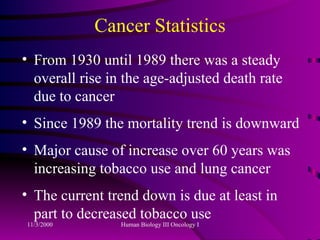
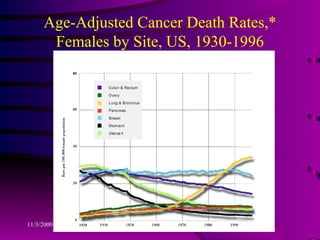
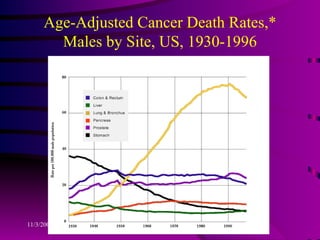
Cancer Statistics From 1930 until 1989 there was a steady overall rise in the age-adjusted death rate due to cancer Since 1989 the mortality trend is downward Major cause of increase over 60 years was increasing tobacco use and lung cancer The current trend down is due at least in part to decreased tobacco use
Leading Sites of New Cancer Cases and Deaths—2000 Estimates
Age-Adjusted Cancer Death Rates,* Females by Site, US, 1930-1996
Age-Adjusted Cancer Death Rates,* Males by Site, US, 1930-1996
Etiology of Cancer The most common way of treating cancer today is to treat after detection Ideal strategy is prevention: eliminate/reduce controllable risk factors smoking, diet, alcohol chemoprevention tamoxifen {breast} finasteride {prostate} -investigational retinoids {head and neck} -investigational
Etiology of Cancer Environmental factors Viruses Lifestyle factors Medical - Drugs and Hormones Hereditary
Environmental Factors Industrial/Occupational Coal miners, factory workers, asbestos Ultraviolet Light    risk of skin cancers Ionizing Radiation  (Lifestyle Factor?) X-rays, nuclear weapons or accidents evidence from Japan & Chernobyl    risk of breast cancer and leukemias Thyroid irradiation (for hyperthyroid)    risk thyroid cancer
Viruses Epstein-Barr virus - Hodgkin’s lymphoma Human Immuno-deficiency virus - NHL and Kaposi’s sarcoma Human Papilloma virus - Cervical cancer Hepatitis A, B - Hepatocellular cancer HTLV-1  -  T-cell leukemia
Lifestyle Factors Tobacco - Cigarette Smoking  lung, oropharygeal, and bladder cancers “If cigarettes did not exist lung cancer would be an rarity” Radon lung cancer Electromagnetic fields cell phones and high tension power lines causal relationship ?
Lifestyle Factors Alcohol associated with several cancers including esophogeal, liver, oropharynx, breast and larynx usually associated with another carcinogen Diet implicated in colorectal cancer Decrease Fat, Increase Fruits and Vegetables
Drugs and Hormones Alkylating Agents Cyclophosphamide - bladder melphalan - leukemia Antimetabolites Azathioprine - NHL, skin Corticosteroids Prednisone - NHL
Drugs and Hormones Estrogens Diethylstilbestrol - vaginal Ca in offspring Combined Modalities Chemo + Radiation - leukemia Others  Phenacetin - renal  Phenytoin - liver (rats) Chloramphenicol - leukemia
Hereditary/Genetic Cancer as Primary Manifestation Retinoblastoma, neuroblastoma, pheochromocytoma Inherited Condition Familial polyposis, Fanconi’s anemia, xeroderma pigmentosum Inherited Disease of Immune System Wiskott-Aldrich Syndrome Chromosomal Aberrations Down’s Syndrome, Fanconi’s anemia
Hereditary/Genetic Breast cancer If first degree relative has(d) breast cancer greatly increases the risk  BRCA1 mutation Retinoblastoma Rb
Genetic Regulation Oncogenes/Proto-Oncogenes normal exons which when mutated promote oncogenesis wt = proto-oncogene (no tumor promoting effect) mutant = oncogene Tumor Suppressor Genes Genes which regulate cell proliferation and prevent cell from dividing ‘out of control’ wt = ‘prevent’ cell from becoming a tumor mutant = unable to prevent tumor-genesis
Proto-Oncogenes and Malignant Transformation N-myc {transcription factor} Neuroblastoma Erb-B(her2neu) {cell surface receptor} Breast cancer RAS {intracellular messenger} Acute Myeloid Leukemia BCL {transcription factor/apoptosis} Chronic Myeloid Leukemia
Tumor Supressor Genes Rb (cell cycle) retinoblastoma, osteosarcoma p53 (growth arrest/apoptosis) sarcomas, breast, and brain tumors BRCA1 and BRCA2 (DNA repair) breast and ovarian tumors E-Cadherin (cell adhesion regulator) breast, colon, skin, and lung
Cell Cycle Entry to Death: Regulation Growth Factor Receptor Activation Intracellular Kinase Cascade Early Nuclear Proteins (myc, fos, jun etc.) Cell Cycle Activators (cyclins) Regulators (Rb) Genome Checkers (p53) Apoptosis: Cell Cycle Balancers (bcl-2 family)
Malignant Transformation Genetic alterations transform  normal cells into malignant cells Two (multiple) hit hypothesis predisposition + external factor multiple external factors
Questions?

Human Bio Iii Oncology I

  • 1.
    Human Biology IIIOncology I Ken Bauer [email_address]
  • 2.
    Objectives Following thelecture the student should be able to: 1. Differentiate between the characteristics of benign and malignant tumors. 2. List the 5 broad categories of cancer etiology 3. Describe the effect cigarette smoking has had on cancer incidence and death rates from 1930 to present.
  • 3.
    Objectives 4. Explainthe roles of oncogenes proro-oncogenes, and tumor suppressor genes in the malignant transformation . 5. List the 3 most common tumor types in men and women by gender
  • 4.
    Cancer Terminology Canceris a disorder that occurs at a cellular level Cancer occurs when genetic alterations result in the unregulated proliferation of cells
  • 5.
    Cancer Terminology Cancer- A group of diseases Anaplasia - Lack of differentiation Dysplasia - Abnormal size, shape Hyperplasia - Increase in number of cells
  • 6.
    Benign Tumor Characteristicstypical of tissue of origin Slow rate of growth Slowly progressive; Not fatal if untreated Encapsulated growth No tissue destruction Rare recurrence Poor prognosis only if unable to remove
  • 7.
    Malignant Tumor Characteristicsatypical of tissue of origin Slow or rapid rate of growth Usually progressive; Fatal if untreated Growth by infiltration or metastasis Tissue destruction is common Recurrence is common Fatal prognosis if uncontrolled
  • 8.
    2000 Estimated CancerStatistics 1,220,100 : Estimated number of new cancer cases. Over 100 types of cancer most common -> Women: Breast, Lung, Colon Men: Prostate, Lung , Colon 552,200 : Estimated number of cancer deaths. Lung cancer is leading cause of cancer deaths. Source: American Cancer Society, www.cancer.org
  • 9.
    Cancer Statistics From1930 until 1989 there was a steady overall rise in the age-adjusted death rate due to cancer Since 1989 the mortality trend is downward Major cause of increase over 60 years was increasing tobacco use and lung cancer The current trend down is due at least in part to decreased tobacco use
  • 10.
    Leading Sites ofNew Cancer Cases and Deaths—2000 Estimates
  • 11.
    Age-Adjusted Cancer DeathRates,* Females by Site, US, 1930-1996
  • 12.
    Age-Adjusted Cancer DeathRates,* Males by Site, US, 1930-1996
  • 13.
    Etiology of CancerThe most common way of treating cancer today is to treat after detection Ideal strategy is prevention: eliminate/reduce controllable risk factors smoking, diet, alcohol chemoprevention tamoxifen {breast} finasteride {prostate} -investigational retinoids {head and neck} -investigational
  • 14.
    Etiology of CancerEnvironmental factors Viruses Lifestyle factors Medical - Drugs and Hormones Hereditary
  • 15.
    Environmental Factors Industrial/OccupationalCoal miners, factory workers, asbestos Ultraviolet Light  risk of skin cancers Ionizing Radiation (Lifestyle Factor?) X-rays, nuclear weapons or accidents evidence from Japan & Chernobyl  risk of breast cancer and leukemias Thyroid irradiation (for hyperthyroid)  risk thyroid cancer
  • 16.
    Viruses Epstein-Barr virus- Hodgkin’s lymphoma Human Immuno-deficiency virus - NHL and Kaposi’s sarcoma Human Papilloma virus - Cervical cancer Hepatitis A, B - Hepatocellular cancer HTLV-1 - T-cell leukemia
  • 17.
    Lifestyle Factors Tobacco- Cigarette Smoking lung, oropharygeal, and bladder cancers “If cigarettes did not exist lung cancer would be an rarity” Radon lung cancer Electromagnetic fields cell phones and high tension power lines causal relationship ?
  • 18.
    Lifestyle Factors Alcoholassociated with several cancers including esophogeal, liver, oropharynx, breast and larynx usually associated with another carcinogen Diet implicated in colorectal cancer Decrease Fat, Increase Fruits and Vegetables
  • 19.
    Drugs and HormonesAlkylating Agents Cyclophosphamide - bladder melphalan - leukemia Antimetabolites Azathioprine - NHL, skin Corticosteroids Prednisone - NHL
  • 20.
    Drugs and HormonesEstrogens Diethylstilbestrol - vaginal Ca in offspring Combined Modalities Chemo + Radiation - leukemia Others Phenacetin - renal Phenytoin - liver (rats) Chloramphenicol - leukemia
  • 21.
    Hereditary/Genetic Cancer asPrimary Manifestation Retinoblastoma, neuroblastoma, pheochromocytoma Inherited Condition Familial polyposis, Fanconi’s anemia, xeroderma pigmentosum Inherited Disease of Immune System Wiskott-Aldrich Syndrome Chromosomal Aberrations Down’s Syndrome, Fanconi’s anemia
  • 22.
    Hereditary/Genetic Breast cancerIf first degree relative has(d) breast cancer greatly increases the risk BRCA1 mutation Retinoblastoma Rb
  • 23.
    Genetic Regulation Oncogenes/Proto-Oncogenesnormal exons which when mutated promote oncogenesis wt = proto-oncogene (no tumor promoting effect) mutant = oncogene Tumor Suppressor Genes Genes which regulate cell proliferation and prevent cell from dividing ‘out of control’ wt = ‘prevent’ cell from becoming a tumor mutant = unable to prevent tumor-genesis
  • 24.
    Proto-Oncogenes and MalignantTransformation N-myc {transcription factor} Neuroblastoma Erb-B(her2neu) {cell surface receptor} Breast cancer RAS {intracellular messenger} Acute Myeloid Leukemia BCL {transcription factor/apoptosis} Chronic Myeloid Leukemia
  • 25.
    Tumor Supressor GenesRb (cell cycle) retinoblastoma, osteosarcoma p53 (growth arrest/apoptosis) sarcomas, breast, and brain tumors BRCA1 and BRCA2 (DNA repair) breast and ovarian tumors E-Cadherin (cell adhesion regulator) breast, colon, skin, and lung
  • 26.
    Cell Cycle Entryto Death: Regulation Growth Factor Receptor Activation Intracellular Kinase Cascade Early Nuclear Proteins (myc, fos, jun etc.) Cell Cycle Activators (cyclins) Regulators (Rb) Genome Checkers (p53) Apoptosis: Cell Cycle Balancers (bcl-2 family)
  • 27.
    Malignant Transformation Geneticalterations transform normal cells into malignant cells Two (multiple) hit hypothesis predisposition + external factor multiple external factors
  • 28.