CANCER: Know the Warning Signs Donna V. Puleio, M. D.  UPMC-NW
Reduce the Risk…… When cancers are found early they are nearly always easier to treat and cure. Knowing what to look out for gives you a better chance of finding the disease early
Reducing the Risk Know your body so that you can notice any changes and see a doctor if you do.  Know what screening tests are suggested
Breast Cancer  1 in 8 women will get breast cancer in her lifetime Breast cancer is the most common cancer in women  This year about 200, 000 women in the USA will develop breast cancer Incidence increases with age
Breast Cancer Warning signs Lump or thickening in breast or underarm Change in size of breast Nipple discharge or tenderness Inverted nipple Ridges or pitting in the breast  Change in look or feel ( temperature, swelling, redness or scaly feel)
ACS Guidelines Breast Cancer Yearly mammograms starting age 40 Clinical breast exam every 3 years for women in their 20’s and 30’s and every year for women 40 and over. Breast self examination option for women starting in their 20’s
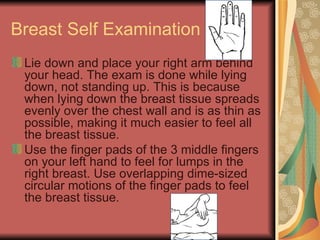
Breast Self Examination Lie down and place your right arm behind your head. The exam is done while lying down, not standing up. This is because when lying down the breast tissue spreads evenly over the chest wall and is as thin as possible, making it much easier to feel all the breast tissue.  Use the finger pads of the 3 middle fingers on your left hand to feel for lumps in the right breast. Use overlapping dime-sized circular motions of the finger pads to feel the breast tissue.
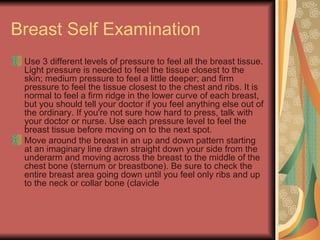
Breast Self Examination Use 3 different levels of pressure to feel all the breast tissue. Light pressure is needed to feel the tissue closest to the skin; medium pressure to feel a little deeper; and firm pressure to feel the tissue closest to the chest and ribs. It is normal to feel a firm ridge in the lower curve of each breast, but you should tell your doctor if you feel anything else out of the ordinary. If you're not sure how hard to press, talk with your doctor or nurse. Use each pressure level to feel the breast tissue before moving on to the next spot.  Move around the breast in an up and down pattern starting at an imaginary line drawn straight down your side from the underarm and moving across the breast to the middle of the chest bone (sternum or breastbone). Be sure to check the entire breast area going down until you feel only ribs and up to the neck or collar bone (clavicle
Breast Self Examination There is some evidence to suggest that the up-and-down pattern (sometimes called the vertical pattern) is the most effective pattern for covering the entire breast, without missing any breast tissue.
Breast Self Examination While standing in front of a mirror with your hands pressing firmly down on your hips, look at your breasts for any changes of size, shape, contour, or dimpling, or redness or scaliness of the nipple or breast skin. (The pressing down on the hips position contracts the chest wall muscles and enhances any breast changes.)  Examine each underarm while sitting up or standing and with your arm only slightly raised so you can easily feel in this area. Raising your arm straight up tightens the tissue in this area and makes it harder to examine.
Medicare Coverage  Mammogram screening is covered for all women with Medicare age 40 and older every 12 months. You can also get one baseline mammogram between ages 35 and 39. You pay 20% of the Medicare-approved amount with no Part B deductible. Medicare also covers new digital technologies for mammogram screenings. Medicare provides 80% coverage for a clinical breast exam once every 24 months, without Part B deductible.  At this time, Medicare's cancer screening coverage information does not include MRI in addition to mammogram as a covered screening method for women who are at high risk for breast cancer. If you and your doctor agree that you are at high risk for breast cancer, you may be able to find out more by talking with your doctor's billing service about possible Medicare coverage for breast MRI.
Risk Reduction  Talk with your doctor about the risks and benefits of hormone replacement therapy for your specific situation  􀂉  Get at least 30 minutes of physical activity on 5 or more days a week 􀂉  Get to and stay at a healthy weight  􀂉  Cut back to not more than 1 alcoholic drink per day, if you drink at all
LUNG CANCER The American Cancer Society's most recent estimates for lung cancer in the United States are for 2009:  219,440 new cases of lung cancer (both small cell and non-small cell)  159,390 deaths from lung cancer  Lung cancer (both small cell and non-small cell) is the leading cause of cancer death for both men and women. More people die of lung cancer than of colon, breast, and prostate cancers combined. Lung cancer is rare in people under the age of 45. The average lifetime chance that a man will develop lung cancer is about 1 in 13. For a woman it is 1 in 16. These numbers include both smokers and non-smokers. For smokers the risk is much higher, while for non-smokers the risk is lower.
Lung Cancer Warning Signs Wheezing or shortness of breath Chronic cough or chest pain
Lung Cancer early detection No screening test have been proven to diagnose lung cancer early enough to improve survival
Lung Cancer Risk Factors Smoking Asbestos exposure Exposure to Uranium, arsenic, vinyl chloride Exposure to second hand smoke
Lung Cancer Risk Reduction Quit Smoking Avoid areas where people are smoking Consider radon testing
Medicare Coverage May cover tobacco cessation counseling (you pay 20% of the medicare approved amount after you meet the yearly deductible) Medicare part D may cover some pre scription drugs to help you stop smoking
COLON CANCER The American Cancer Society's most recent estimates for colorectal cancer in the United States are for 2009:  106,100 new cases of colon cancer  40,870 new cases of rectal cancer  49,920 deaths from colorectal cancer  Not counting skin cancers, colorectal cancer is the third most common cancer found in men and women in this country. The risk of a person having colorecal cancer in their lifetime is about 1 in 19.
Colon Cancer Warning Signs  A change in your bowel habits, including diarrhea or constipation or a change in the consistency of your stool for more than a couple of weeks  Rectal bleeding or blood in your stool  Persistent abdominal discomfort, such as cramps, gas or pain  A feeling that your bowel doesn't empty completely  Weakness or fatigue  Unexplained weight loss
Colon  Cancer Early Detection Starting at age 50,*  you should follow one of the 6 options below. The tests that are designed to find both early cancer and polyps are preferred if these tests are available to you and you are willing to have one of these more invasive tests. Talk to your doctor about which test is best for you.  Tests that can find polyps and cancer:  Double contrast barium enema every 5 years  Flexible sigmoidoscopy every 5 years  Colonoscopy every 10 years  CT colonography (virtual colonoscopy) every 5 years  Tests that mainly find cancer:  Yearly take-home package for fecal occult blood test (FOBT), or fecal immunochemical test (FIT)
Colon Cancer  Risk Factors Colorectal cancer or polyps in a parent, sibling, or child younger than 60 (or in 2 such relatives of any age)  Colorectal cancer syndromes in your family  You have had colorectal cancer or adenomatous polyps  You have or have had chronic inflammatory bowel disease for several years
Colon Cancer Risk Factors Has anyone in your family had colon or rectal cancer?  􀂉  Do you have a colorectal cancer syndrome in your family, such as familial adenomatous polyposis (FAP) or hereditary nonpolyposis colon cancer (HNPCC, also called Lynch syndrome)?  􀂉  Have you ever had a type of intestinal polyp called an adenomatous polyp?  􀂉  Have you had chronic inflammatory bowel disease such as Crohn’s disease or  ulcerative colitis
Colon Cancer Risk Factors Are you over 50 years of age?  Do you eat a lot of red meat (beef, pork, lamb) or processed meats (luncheon meat, hotdogs, bacon)?  Are you physically inactive?  Are you overweight?  Do you use tobacco?  Do you average more than 1 alcoholic drink per day?
Colon Cancer risk reduction  Follow early detection guidelines to find and remove adenomatous polyps before they become cancer  􀂉  Get at least 30-45 minutes of physical activity on at least 5 days per week.  Get to and stay at a healthy weight  􀂉  Eat plenty of fruits, vegetables, and whole-grain foods, and limit processed meats, and red meats  􀂉  Quit smoking  􀂉  Cut back to not more than 1 alcoholic drink per day,  if you drink
Medicare  Medicare covers colorectal screening tests to help find pre-cancerous polyps (growths in the colon) so they can be removed before they turn into cancer.  For people with Medicare aged 50 and older at  average risk  of colorectal cancer, coverage includes:  fecal occult blood test (FOBT) every 12 months  flexible sigmoidoscopy once every 4 years  colonoscopy once every 10 years (but not within 4 years of a flexible sigmoidoscopy)  barium enema once every 4 years (instead of colonoscopy or flexible sigmoidoscopy)  For people with Medicare aged 50 and older at  high risk  for colon cancer, Medicare pays for some tests at shorter intervals:  colonoscopy once every 2 years (with no minimum age specified)  barium enema once every 2 years (instead of colonoscopy or flexible sigmoidoscopy)
Ovarian Cancer Ovarian cancer is the ninth most common cancer in women (not counting skin cancer). It ranks fifth as the cause of cancer death in women. Around two-thirds of women with ovarian cancer are 55 or older. It is slightly more common in white women that African-American women.  A woman's risk of getting invasive ovarian cancer during her lifetime is about 1 in 71. Her lifetime chance of dying from invasive ovarian cancer is about 1 in 95.
Ovarian Cancer Warning signs  Watching for and reporting signs and symptoms may allow earlier detection. Although all these symptoms can have other causes, see your doctor if you have these almost daily for more than a few weeks:  Bloating  Pain in the pelvis or abdomen  Trouble eating or feeling full quickly  Urinary urgency or frequency
Ovarian Cancer early detection  There are no effective and proven screening tests for early detection of ovarian cancer.  If your mother, sister, or daughter has had ovarian cancer or breast cancer, or if your parent, sibling, or child has had colorectal cancer, you are at high risk of ovarian cancer. If you have had breast cancer, you are also at high risk. You may want to talk to your doctor about:  Pelvic exam  Pelvic ultrasound  CA-125 blood test
Ovarian Cancer Risk Factors Have you already gone through menopause?  􀂉  Did you begin menstruating before age 12, or go through menopause after age 50?  􀂉  Did you have your first child after age 30 (or have no children)?  􀂉  Has your mother, sister, or daughter had ovarian or breast cancer?  􀂉  Has one of your parents, siblings, or children had colorectal cancer?  􀂉  Does anyone in your family have hereditary nonpolyposis colorectal cancer (HNPCC, also called Lynch syndrome), or are you at risk for HNPCC?  􀂉  Have you had breast cancer?  􀂉  Have you been on estrogen replacement therapy
CERVICAL CANCER The American Cancer Society's most recent estimates for cervical cancer in the United States are for 2009:  about 11,270 new cases of invasive cervical cancer will be diagnosed.  about 4,070 women will die from cervical cancer.
Cervical Cancer Warning signs  Abnormal Vaginal Bleeding/spotting Bleeding/spotting after intercourse Pelvic Pain Blood in urine Back pain Pain with intercourse
Cervical Cancer Early Detection  Yearly Pap test to begin about 3 years after you first have sex, or by age 21, whichever is earlier.  After age 30, if you have had 3 normal test results in a row, you may be tested every 2-3 years with Pap or liquid Pap tests, or every 3 years with an HPV DNA test plus a Pap.  If you are 70 years old or older, and have had 3 or more normal Pap tests in a row with no abnormal Pap tests in the past 10 years, you may choose to stop Pap testing  If you have had a total hysterectomy and you are not at high risk (see below), you may choose to stop Pap testing after 3 or more normal Pap tests in a row,
Cervical Cancer risk factors  Have you ever been told that you had human papilloma virus (HPV)?  􀂉  Have you ever had genital warts?  􀂉  Do you smoke?  􀂉  Do you have human immunodeficiency virus (HIV) infection or AIDS?  􀂉  Did your mother take diethylstilbestrol (DES) when she was pregnant with you?
Cervical Cancer risk reduction  If you are sexually active, you can reduce your risk of getting HPV and cervical cancer by:  Practicing safer sex by using condoms each time you have sex  􀂉  Quit smoking  􀂉  Have regular Pap tests  Vaccination:  The HPV vaccine is given in a 3-dose series to fight HPV infection. HPV vaccine must be given before the woman is infected. The HPV vaccine:  is best given between ages 11 and 13 (may be given as young as age 9)  may be given between ages 13 and 18 to "catch up"  is of uncertain value for women aged 19-26  does not replace
Endometrial Cancer
Endometrial Cancer 42,160 new cases of uterus cancer (most of these will be endometrial cancer--cancers that start in the lining of the uterus)  7,780 deaths from endometrial cancer  In this country, cancer of the endometrium is the most common cancer found in women's reproductive organs. The chance of a woman having this cancer during her lifetime is about one in 41.
Endometrial Cancer Warning Signs  Unusual bleeding or Discharge Bleeding after intercourse Pain with urination or when having a bowel movement Pain with intercourse Pelvic pain Fibroids that grow quickly especially after menopause
Endometrial Cancer early detection  There is no simple screening test that has been proven to diagnose endometrial cancer early enough to improve survival.  Talk with your doctor, especially at the time of menopause, about the risks and symptoms of endometrial cancer  Watch for and report any abnormal vaginal bleeding or spotting, or any bleeding after menopause, and report it to your doctor  If you have or are at risk for HNPCC, consider yearly testing with endometrial biopsy beginning at age 35
Endometrial Cancer Risk factors  Do you or anyone in your family have hereditary nonpolyposis colorectal cancer (HNPCC, also called Lynch syndrome)?  Are you over age 40?  Did you begin menstruating before age 12, or go through menopause after age 50?  Do you have a history of infertility or never giving birth?  Are you obese (very overweight)?  Do you eat a lot of animal fat?  Do you have diabetes?  Have you taken tamoxifen or long-term estrogen replacement therapy  without progesterone  (if you still have your uterus)?  Have you had breast or ovarian cancer?  Have you had radiation therapy to your pelvis?
SKIN CANCER  Cancer of the skin (including melanoma and non-melanoma skin cancer) is the most common of all cancers. It accounts for about half of all cancers. The exact number of basal and squamous cell cancers is not known for certain. This means that the numbers given here are estimates.  More than 1 million basal and squamous cell skin cancers are found each year each year. Most of these (about 800,000 to 900,000) are basal cell cancers. Squamous cell cancer is less common – there are about 200,000 to 300,000 cases per year.
SKIN CANCER Melanoma is a cancer that begins in the melanocytes..  Skin cancer is the most common of all cancers. Melanoma accounts for less than 5% of skin cancer cases. But it causes most skin cancer deaths
Skin Cancer Melanoma is a cancer that begins in the melanocytes..
SKIN CANCER WARNING SIGNS  Sores that do not heal Any wart, mole or freckle that changes color, size , shape or loses its definite borders
SKIN CANCER WARNING SIGNS  ABCD rule  A symmetry: One half of the mole does not match the other half.  B order irregularity: The edges of the mole are irregular or not smooth. They may look ragged, blurred, or notched.  C olor: The color over the mole is not the same all over. There may be shades of tan, brown, or black, and sometimes patches of pink, red, blue, or white.  D iameter: The mole is larger than about ÂĽ inch-- about the size of a pencil eraser-- although sometimes melanomas can be smaller.
SKIN CANCER EARLY DETECTION  Regular self exam:  Become familiar with any moles, freckles, or other spots on your skin. Use mirrors or have a family member or close friend look at areas you can’t see (ears, scalp, lower back). For more information on skin self-exam, read  Skin Cancer Prevention and Early Detection  on  www.cancer.org .  Check for skin changes once a month. Show any suspicious or changing areas to your doctor  Cancer-related check-up  (including skin exam) with your doctor is recommended during regular visits for people age 20 and older, especially those with risk factors for skin cancer
SKIN CANCER RISK REDUCTION Stay out of the sun as much as possible, especially between 10 AM and 4 PM  Wear a broad-brimmed hat, a shirt, and UV-protective sunglasses when out in the sun  Use a sunscreen with an SPF of 15 or higher, and reapply it often  Wear wrap-around sunglasses with at least 99% UV absorption, labeled as blocking UVA and UVB light; or "UV absorption to 400 nm," which means UVA and UVB protection  Do not use tanning beds or sunlamps  Protect young children from excess sun exposure  Check your skin often for abnormal or changing areas, especially moles, and have them examined by your doctor
MORE INFORMATION AMERICAN CANCER SOCIETY www.cancer.org National Cancer Institute www.cancer.gov

Cancer Warning Signs

  • 1.
    CANCER: Know theWarning Signs Donna V. Puleio, M. D. UPMC-NW
  • 2.
    Reduce the Risk……When cancers are found early they are nearly always easier to treat and cure. Knowing what to look out for gives you a better chance of finding the disease early
  • 3.
    Reducing the RiskKnow your body so that you can notice any changes and see a doctor if you do. Know what screening tests are suggested
  • 4.
    Breast Cancer 1 in 8 women will get breast cancer in her lifetime Breast cancer is the most common cancer in women This year about 200, 000 women in the USA will develop breast cancer Incidence increases with age
  • 5.
    Breast Cancer Warningsigns Lump or thickening in breast or underarm Change in size of breast Nipple discharge or tenderness Inverted nipple Ridges or pitting in the breast Change in look or feel ( temperature, swelling, redness or scaly feel)
  • 6.
    ACS Guidelines BreastCancer Yearly mammograms starting age 40 Clinical breast exam every 3 years for women in their 20’s and 30’s and every year for women 40 and over. Breast self examination option for women starting in their 20’s
  • 7.
    Breast Self ExaminationLie down and place your right arm behind your head. The exam is done while lying down, not standing up. This is because when lying down the breast tissue spreads evenly over the chest wall and is as thin as possible, making it much easier to feel all the breast tissue. Use the finger pads of the 3 middle fingers on your left hand to feel for lumps in the right breast. Use overlapping dime-sized circular motions of the finger pads to feel the breast tissue.
  • 8.
    Breast Self ExaminationUse 3 different levels of pressure to feel all the breast tissue. Light pressure is needed to feel the tissue closest to the skin; medium pressure to feel a little deeper; and firm pressure to feel the tissue closest to the chest and ribs. It is normal to feel a firm ridge in the lower curve of each breast, but you should tell your doctor if you feel anything else out of the ordinary. If you're not sure how hard to press, talk with your doctor or nurse. Use each pressure level to feel the breast tissue before moving on to the next spot. Move around the breast in an up and down pattern starting at an imaginary line drawn straight down your side from the underarm and moving across the breast to the middle of the chest bone (sternum or breastbone). Be sure to check the entire breast area going down until you feel only ribs and up to the neck or collar bone (clavicle
  • 9.
    Breast Self ExaminationThere is some evidence to suggest that the up-and-down pattern (sometimes called the vertical pattern) is the most effective pattern for covering the entire breast, without missing any breast tissue.
  • 10.
    Breast Self ExaminationWhile standing in front of a mirror with your hands pressing firmly down on your hips, look at your breasts for any changes of size, shape, contour, or dimpling, or redness or scaliness of the nipple or breast skin. (The pressing down on the hips position contracts the chest wall muscles and enhances any breast changes.) Examine each underarm while sitting up or standing and with your arm only slightly raised so you can easily feel in this area. Raising your arm straight up tightens the tissue in this area and makes it harder to examine.
  • 11.
    Medicare Coverage Mammogram screening is covered for all women with Medicare age 40 and older every 12 months. You can also get one baseline mammogram between ages 35 and 39. You pay 20% of the Medicare-approved amount with no Part B deductible. Medicare also covers new digital technologies for mammogram screenings. Medicare provides 80% coverage for a clinical breast exam once every 24 months, without Part B deductible. At this time, Medicare's cancer screening coverage information does not include MRI in addition to mammogram as a covered screening method for women who are at high risk for breast cancer. If you and your doctor agree that you are at high risk for breast cancer, you may be able to find out more by talking with your doctor's billing service about possible Medicare coverage for breast MRI.
  • 12.
    Risk Reduction Talk with your doctor about the risks and benefits of hormone replacement therapy for your specific situation 􀂉 Get at least 30 minutes of physical activity on 5 or more days a week 􀂉 Get to and stay at a healthy weight 􀂉 Cut back to not more than 1 alcoholic drink per day, if you drink at all
  • 13.
    LUNG CANCER TheAmerican Cancer Society's most recent estimates for lung cancer in the United States are for 2009: 219,440 new cases of lung cancer (both small cell and non-small cell) 159,390 deaths from lung cancer Lung cancer (both small cell and non-small cell) is the leading cause of cancer death for both men and women. More people die of lung cancer than of colon, breast, and prostate cancers combined. Lung cancer is rare in people under the age of 45. The average lifetime chance that a man will develop lung cancer is about 1 in 13. For a woman it is 1 in 16. These numbers include both smokers and non-smokers. For smokers the risk is much higher, while for non-smokers the risk is lower.
  • 14.
    Lung Cancer WarningSigns Wheezing or shortness of breath Chronic cough or chest pain
  • 15.
    Lung Cancer earlydetection No screening test have been proven to diagnose lung cancer early enough to improve survival
  • 16.
    Lung Cancer RiskFactors Smoking Asbestos exposure Exposure to Uranium, arsenic, vinyl chloride Exposure to second hand smoke
  • 17.
    Lung Cancer RiskReduction Quit Smoking Avoid areas where people are smoking Consider radon testing
  • 18.
    Medicare Coverage Maycover tobacco cessation counseling (you pay 20% of the medicare approved amount after you meet the yearly deductible) Medicare part D may cover some pre scription drugs to help you stop smoking
  • 19.
    COLON CANCER TheAmerican Cancer Society's most recent estimates for colorectal cancer in the United States are for 2009: 106,100 new cases of colon cancer 40,870 new cases of rectal cancer 49,920 deaths from colorectal cancer Not counting skin cancers, colorectal cancer is the third most common cancer found in men and women in this country. The risk of a person having colorecal cancer in their lifetime is about 1 in 19.
  • 20.
    Colon Cancer WarningSigns A change in your bowel habits, including diarrhea or constipation or a change in the consistency of your stool for more than a couple of weeks Rectal bleeding or blood in your stool Persistent abdominal discomfort, such as cramps, gas or pain A feeling that your bowel doesn't empty completely Weakness or fatigue Unexplained weight loss
  • 21.
    Colon CancerEarly Detection Starting at age 50,* you should follow one of the 6 options below. The tests that are designed to find both early cancer and polyps are preferred if these tests are available to you and you are willing to have one of these more invasive tests. Talk to your doctor about which test is best for you. Tests that can find polyps and cancer: Double contrast barium enema every 5 years Flexible sigmoidoscopy every 5 years Colonoscopy every 10 years CT colonography (virtual colonoscopy) every 5 years Tests that mainly find cancer: Yearly take-home package for fecal occult blood test (FOBT), or fecal immunochemical test (FIT)
  • 22.
    Colon Cancer Risk Factors Colorectal cancer or polyps in a parent, sibling, or child younger than 60 (or in 2 such relatives of any age) Colorectal cancer syndromes in your family You have had colorectal cancer or adenomatous polyps You have or have had chronic inflammatory bowel disease for several years
  • 23.
    Colon Cancer RiskFactors Has anyone in your family had colon or rectal cancer? 􀂉 Do you have a colorectal cancer syndrome in your family, such as familial adenomatous polyposis (FAP) or hereditary nonpolyposis colon cancer (HNPCC, also called Lynch syndrome)? 􀂉 Have you ever had a type of intestinal polyp called an adenomatous polyp? 􀂉 Have you had chronic inflammatory bowel disease such as Crohn’s disease or ulcerative colitis
  • 24.
    Colon Cancer RiskFactors Are you over 50 years of age? Do you eat a lot of red meat (beef, pork, lamb) or processed meats (luncheon meat, hotdogs, bacon)? Are you physically inactive? Are you overweight? Do you use tobacco? Do you average more than 1 alcoholic drink per day?
  • 25.
    Colon Cancer riskreduction Follow early detection guidelines to find and remove adenomatous polyps before they become cancer 􀂉 Get at least 30-45 minutes of physical activity on at least 5 days per week. Get to and stay at a healthy weight 􀂉 Eat plenty of fruits, vegetables, and whole-grain foods, and limit processed meats, and red meats 􀂉 Quit smoking 􀂉 Cut back to not more than 1 alcoholic drink per day, if you drink
  • 26.
    Medicare Medicarecovers colorectal screening tests to help find pre-cancerous polyps (growths in the colon) so they can be removed before they turn into cancer. For people with Medicare aged 50 and older at average risk of colorectal cancer, coverage includes: fecal occult blood test (FOBT) every 12 months flexible sigmoidoscopy once every 4 years colonoscopy once every 10 years (but not within 4 years of a flexible sigmoidoscopy) barium enema once every 4 years (instead of colonoscopy or flexible sigmoidoscopy) For people with Medicare aged 50 and older at high risk for colon cancer, Medicare pays for some tests at shorter intervals: colonoscopy once every 2 years (with no minimum age specified) barium enema once every 2 years (instead of colonoscopy or flexible sigmoidoscopy)
  • 27.
    Ovarian Cancer Ovariancancer is the ninth most common cancer in women (not counting skin cancer). It ranks fifth as the cause of cancer death in women. Around two-thirds of women with ovarian cancer are 55 or older. It is slightly more common in white women that African-American women. A woman's risk of getting invasive ovarian cancer during her lifetime is about 1 in 71. Her lifetime chance of dying from invasive ovarian cancer is about 1 in 95.
  • 28.
    Ovarian Cancer Warningsigns Watching for and reporting signs and symptoms may allow earlier detection. Although all these symptoms can have other causes, see your doctor if you have these almost daily for more than a few weeks: Bloating Pain in the pelvis or abdomen Trouble eating or feeling full quickly Urinary urgency or frequency
  • 29.
    Ovarian Cancer earlydetection There are no effective and proven screening tests for early detection of ovarian cancer. If your mother, sister, or daughter has had ovarian cancer or breast cancer, or if your parent, sibling, or child has had colorectal cancer, you are at high risk of ovarian cancer. If you have had breast cancer, you are also at high risk. You may want to talk to your doctor about: Pelvic exam Pelvic ultrasound CA-125 blood test
  • 30.
    Ovarian Cancer RiskFactors Have you already gone through menopause? 􀂉 Did you begin menstruating before age 12, or go through menopause after age 50? 􀂉 Did you have your first child after age 30 (or have no children)? 􀂉 Has your mother, sister, or daughter had ovarian or breast cancer? 􀂉 Has one of your parents, siblings, or children had colorectal cancer? 􀂉 Does anyone in your family have hereditary nonpolyposis colorectal cancer (HNPCC, also called Lynch syndrome), or are you at risk for HNPCC? 􀂉 Have you had breast cancer? 􀂉 Have you been on estrogen replacement therapy
  • 31.
    CERVICAL CANCER TheAmerican Cancer Society's most recent estimates for cervical cancer in the United States are for 2009: about 11,270 new cases of invasive cervical cancer will be diagnosed. about 4,070 women will die from cervical cancer.
  • 32.
    Cervical Cancer Warningsigns Abnormal Vaginal Bleeding/spotting Bleeding/spotting after intercourse Pelvic Pain Blood in urine Back pain Pain with intercourse
  • 33.
    Cervical Cancer EarlyDetection Yearly Pap test to begin about 3 years after you first have sex, or by age 21, whichever is earlier. After age 30, if you have had 3 normal test results in a row, you may be tested every 2-3 years with Pap or liquid Pap tests, or every 3 years with an HPV DNA test plus a Pap. If you are 70 years old or older, and have had 3 or more normal Pap tests in a row with no abnormal Pap tests in the past 10 years, you may choose to stop Pap testing If you have had a total hysterectomy and you are not at high risk (see below), you may choose to stop Pap testing after 3 or more normal Pap tests in a row,
  • 34.
    Cervical Cancer riskfactors Have you ever been told that you had human papilloma virus (HPV)? 􀂉 Have you ever had genital warts? 􀂉 Do you smoke? 􀂉 Do you have human immunodeficiency virus (HIV) infection or AIDS? 􀂉 Did your mother take diethylstilbestrol (DES) when she was pregnant with you?
  • 35.
    Cervical Cancer riskreduction If you are sexually active, you can reduce your risk of getting HPV and cervical cancer by: Practicing safer sex by using condoms each time you have sex 􀂉 Quit smoking 􀂉 Have regular Pap tests Vaccination: The HPV vaccine is given in a 3-dose series to fight HPV infection. HPV vaccine must be given before the woman is infected. The HPV vaccine: is best given between ages 11 and 13 (may be given as young as age 9) may be given between ages 13 and 18 to "catch up" is of uncertain value for women aged 19-26 does not replace
  • 36.
  • 37.
    Endometrial Cancer 42,160new cases of uterus cancer (most of these will be endometrial cancer--cancers that start in the lining of the uterus) 7,780 deaths from endometrial cancer In this country, cancer of the endometrium is the most common cancer found in women's reproductive organs. The chance of a woman having this cancer during her lifetime is about one in 41.
  • 38.
    Endometrial Cancer WarningSigns Unusual bleeding or Discharge Bleeding after intercourse Pain with urination or when having a bowel movement Pain with intercourse Pelvic pain Fibroids that grow quickly especially after menopause
  • 39.
    Endometrial Cancer earlydetection There is no simple screening test that has been proven to diagnose endometrial cancer early enough to improve survival. Talk with your doctor, especially at the time of menopause, about the risks and symptoms of endometrial cancer Watch for and report any abnormal vaginal bleeding or spotting, or any bleeding after menopause, and report it to your doctor If you have or are at risk for HNPCC, consider yearly testing with endometrial biopsy beginning at age 35
  • 40.
    Endometrial Cancer Riskfactors Do you or anyone in your family have hereditary nonpolyposis colorectal cancer (HNPCC, also called Lynch syndrome)? Are you over age 40? Did you begin menstruating before age 12, or go through menopause after age 50? Do you have a history of infertility or never giving birth? Are you obese (very overweight)? Do you eat a lot of animal fat? Do you have diabetes? Have you taken tamoxifen or long-term estrogen replacement therapy without progesterone (if you still have your uterus)? Have you had breast or ovarian cancer? Have you had radiation therapy to your pelvis?
  • 41.
    SKIN CANCER Cancer of the skin (including melanoma and non-melanoma skin cancer) is the most common of all cancers. It accounts for about half of all cancers. The exact number of basal and squamous cell cancers is not known for certain. This means that the numbers given here are estimates. More than 1 million basal and squamous cell skin cancers are found each year each year. Most of these (about 800,000 to 900,000) are basal cell cancers. Squamous cell cancer is less common – there are about 200,000 to 300,000 cases per year.
  • 42.
    SKIN CANCER Melanomais a cancer that begins in the melanocytes.. Skin cancer is the most common of all cancers. Melanoma accounts for less than 5% of skin cancer cases. But it causes most skin cancer deaths
  • 43.
    Skin Cancer Melanomais a cancer that begins in the melanocytes..
  • 44.
    SKIN CANCER WARNINGSIGNS Sores that do not heal Any wart, mole or freckle that changes color, size , shape or loses its definite borders
  • 45.
    SKIN CANCER WARNINGSIGNS ABCD rule A symmetry: One half of the mole does not match the other half. B order irregularity: The edges of the mole are irregular or not smooth. They may look ragged, blurred, or notched. C olor: The color over the mole is not the same all over. There may be shades of tan, brown, or black, and sometimes patches of pink, red, blue, or white. D iameter: The mole is larger than about ÂĽ inch-- about the size of a pencil eraser-- although sometimes melanomas can be smaller.
  • 46.
    SKIN CANCER EARLYDETECTION Regular self exam: Become familiar with any moles, freckles, or other spots on your skin. Use mirrors or have a family member or close friend look at areas you can’t see (ears, scalp, lower back). For more information on skin self-exam, read Skin Cancer Prevention and Early Detection on www.cancer.org . Check for skin changes once a month. Show any suspicious or changing areas to your doctor Cancer-related check-up (including skin exam) with your doctor is recommended during regular visits for people age 20 and older, especially those with risk factors for skin cancer
  • 47.
    SKIN CANCER RISKREDUCTION Stay out of the sun as much as possible, especially between 10 AM and 4 PM Wear a broad-brimmed hat, a shirt, and UV-protective sunglasses when out in the sun Use a sunscreen with an SPF of 15 or higher, and reapply it often Wear wrap-around sunglasses with at least 99% UV absorption, labeled as blocking UVA and UVB light; or "UV absorption to 400 nm," which means UVA and UVB protection Do not use tanning beds or sunlamps Protect young children from excess sun exposure Check your skin often for abnormal or changing areas, especially moles, and have them examined by your doctor
  • 48.
    MORE INFORMATION AMERICANCANCER SOCIETY www.cancer.org National Cancer Institute www.cancer.gov