
CANCER
When What, and How
Background
• Cells divide and multiply as the
body needs them. When these
cells continue multiplying when
the body doesn't need them, the
result is a mass or growth, also
called a tumor.
Background
• These growths are considered either
benign or malignant.
• Each type of cancer is unique with its
own causes, symptoms, and methods
of treatment. Like with all groups of
disease, some types of cancer are
more common than others.
Cancer
• a malignant tumor of
potentially unlimited growth
that expands locally by
invasion and metastasis
Cancer
• Cancer is one of the most common
diseases in the world:
• 1 in 4 deaths are due to cancer
• Lung cancer is the most common
cancer in men
• Breast cancer is the most common
cancer in women
• There are over 100 different forms of
cancer
Cancer
• The division (mitosis) of normal cells is
precisely controlled. New cells are only
formed for growth or to replace dead ones.
• Cancerous cells divide repeatedly out of
control even though they are not needed,
they crowd out other normal cells and
function abnormally.
• They can also destroy the correct
functioning of major organs.
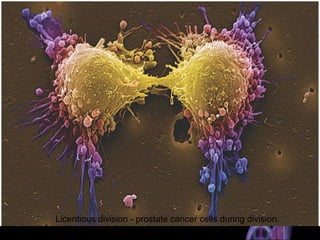
Cancer Is One Outcome of A Runaway Cell Cycle
Licentious division - prostate cancer cells during division.
The Cell Cycle and Cancer
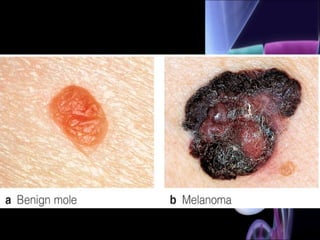
 Neoplasm-Neoplasm- abnormal growth of cellsabnormal growth of cells
 BenignBenign neoplasms areneoplasms are not cancerousnot cancerous
Encapsulated; Do not invadeEncapsulated; Do not invade
neighboring tissue or spreadneighboring tissue or spread
 MalignantMalignant neoplasms areneoplasms are cancerouscancerous
Not encapsulated; Readily invadeNot encapsulated; Readily invade
neighboring tissuesneighboring tissues
May also detach and lodge in distantMay also detach and lodge in distant
places – metastasisplaces – metastasis
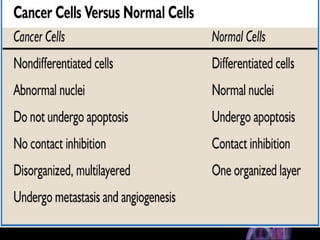
Characteristics of Cancer Cells
 Lack differentiation (control)Lack differentiation (control)
 Have abnormal nucleiHave abnormal nuclei
 Form tumorsForm tumors
 Mitosis controlled by contact withMitosis controlled by contact with
neighboring cells – contact inhibitionneighboring cells – contact inhibition
 Cancer cells have lost contactCancer cells have lost contact
inhibitioninhibition
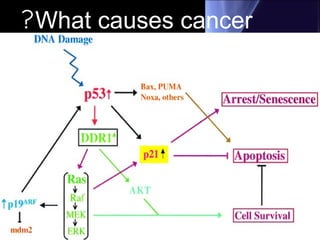
What causes cancer?
• Cancer arises from the mutation
of a normal gene.
• Lack of apoptosis (self destruction)
• P53 and P 21 genes
• these genes could actually be
mutated be chemotherapy
• Microtubules ( there are some drugs
that targets them make the cell grow
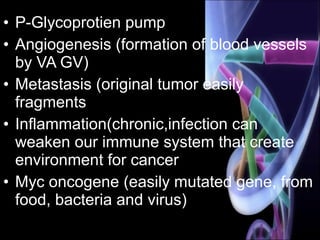
• P-Glycoprotien pump
• Angiogenesis (formation of blood vessels
by VA GV)
• Metastasis (original tumor easily
fragments
• Inflammation(chronic,infection can
weaken our immune system that create
environment for cancer
• Myc oncogene (easily mutated gene, from
food, bacteria and virus)
• Exosomes (booms that inhibit the
action of NK cells
• ER- and ER-ß( estrogen receptorɑ
cancer)
• Milieu(environment)
Carcinogens
• Ionising radiation – X Rays, UV light
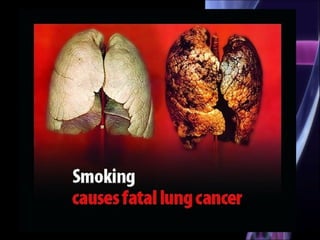
• Chemicals – tar from cigarettes
• Virus infection – papilloma virus can
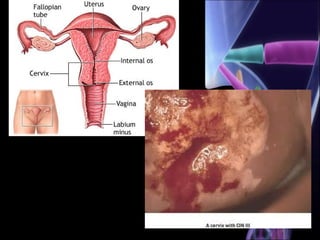
be responsible for cervical cancer.
• Hereditary predisposition – Some
families are more susceptible to
getting certain cancers. Remember
you can’t inherit cancer its just that
you maybe more susceptible to
getting it.
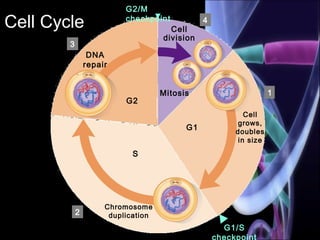
Cell Cycle 4
Cell
division
Mitosis
3
DNA
repair
G2
1
Cell
grows,
doubles
in size
G1
S
2
Chromosome
duplication
G2/M
checkpoint
G1/S
checkpoint
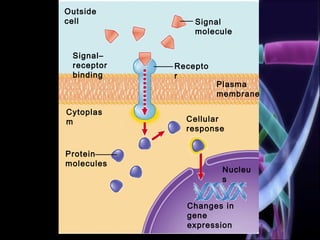
Signal Transduction
• In normal cells, signals from outside cell
can
–Activate tumor suppressor genes
(turning off cell division) or
–Activate proto-oncogenes (turning on
cell division)
• Signals can be proteins, hormones, or
nerve signals
• May include steroids, pollutants, and other
molecules
Process of Signal Transduction
• Signal binds to a receptor in plasma
membrane
• Binding sets off series of interactions
inside cell
• Signal molecule may remain outside
cell
• Binding of signal changes shape of
receptor and allows it to transmit
signal to other proteins
• May alter gene expression
Outside
cell
Recepto
r
Plasma
membrane
Cytoplas
m
Nucleu
s
Changes in
gene
expression
Signal
molecule
Signal–
receptor
binding
Cellular
response
Protein
molecules
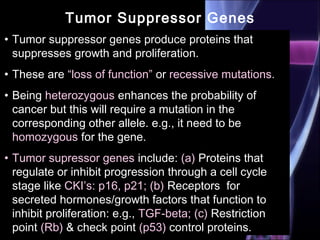
Tumor Suppressor Genes
• Tumor suppressor genes produce proteins that
suppresses growth and proliferation.
• These are “loss of function” or recessive mutations.
• Being heterozygous enhances the probability of
cancer but this will require a mutation in the
corresponding other allele. e.g., it need to be
homozygous for the gene.
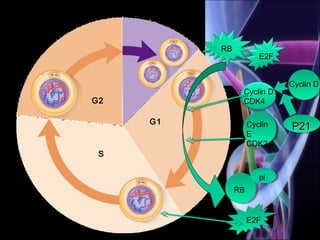
• Tumor supressor genes include: (a) Proteins that
regulate or inhibit progression through a cell cycle
stage like CKI’s: p16, p21; (b) Receptors for
secreted hormones/growth factors that function to
inhibit proliferation: e.g., TGF-beta; (c) Restriction
point (Rb) & check point (p53) control proteins.
G1
S
G2
M
S
G2
M
G1
RB
RB
pi
E2F
E2F
Cyclin D
CDK4
Cyclin
E
CDK2
Cyclin D
P21P21P21P21
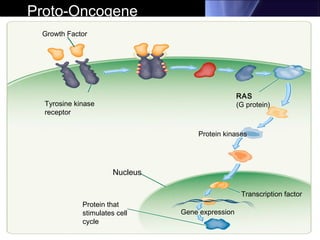
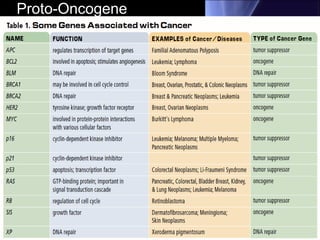
Proto-Oncogene
Growth Factor
Tyrosine kinase
receptor
RAS
(G protein)
Protein kinases
Nucleus
Protein that
stimulates cell
cycle
Transcription factor
Gene expression
Proto-Oncogene
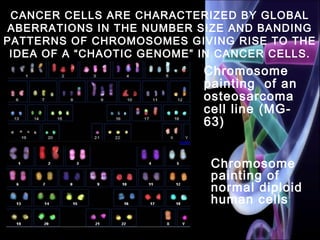
CANCER CELLS ARE CHARACTERIZED BY GLOBAL
ABERRATIONS IN THE NUMBER SIZE AND BANDING
PATTERNS OF CHROMOSOMES GIVING RISE TO THE
IDEA OF A “CHAOTIC GENOME” IN CANCER CELLS.
Chromosome
painting of
normal diploid
human cells
Chromosome
painting of an
osteosarcoma
cell line (MG-
63)
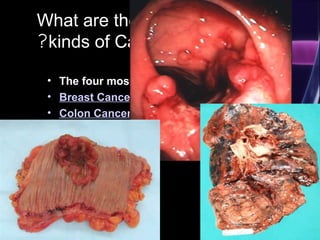
What are the different
kinds of Cancer?
• The four most common cancers are:
• Breast Cancer
• Colon Cancer
• Lung Cancer
• Prostate Cancer
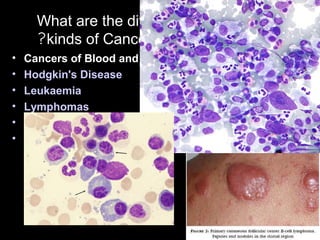
What are the different
kinds of Cancer?
• Cancers of Blood and Lymphatic Systems:
• Hodgkin's Disease
• Leukaemia
• Lymphomas
• Multiple Myeloma
• Waldenström's Disease
What are the different
kinds of Cancer?
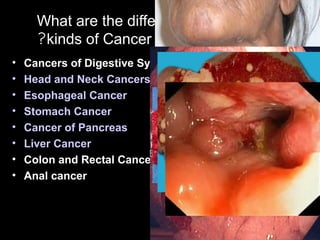
• Cancers of Digestive Systems:
• Head and Neck Cancers
• Esophageal Cancer
• Stomach Cancer
• Cancer of Pancreas
• Liver Cancer
• Colon and Rectal Cancer
• Anal cancer
What are the different
kinds of Cancer?
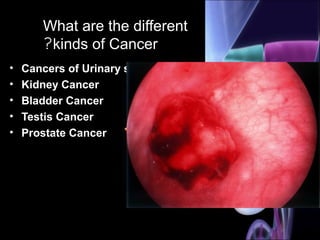
• Cancers of Urinary system:
• Kidney Cancer
• Bladder Cancer
• Testis Cancer
• Prostate Cancer
What are the different kinds of Cancer?
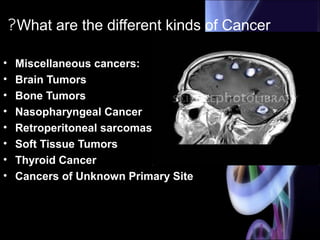
• Miscellaneous cancers:
• Brain Tumors
• Bone Tumors
• Nasopharyngeal Cancer
• Retroperitoneal sarcomas
• Soft Tissue Tumors
• Thyroid Cancer
• Cancers of Unknown Primary Site
Cancer Treatment
• Chemotherapy treatment
• uses medicine to weaken and
destroy cancer cells in the
body, including cells at the
original cancer site and any
cancer cells that may have
spread to another part of the
body.
Cancer Treatment
• Chemotherapy treatment
• or "chemo," is a systemic therapy,
which means it affects the whole
body by going through the
bloodstream.
• In some cases, chemotherapy is
given before surgery to shrink the
cancer
Cancer Treatment
• Radiation therapy (also called
radiotherapy)
• Like surgery, radiation therapy
is a local treatment; it affects
cancer cells only in the treated
area. Radiation can come from a
machine (external radiation).
Cancer Treatment
It can also come from an implant (a
small container of radioactive
material) placed directly into or
near the tumor (internal radiation).
Some patients receive both kinds
of radiation therapy.
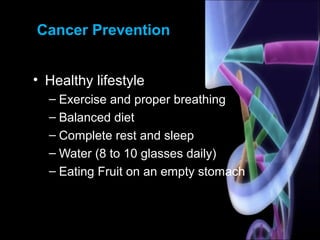
Cancer Prevention
• Healthy lifestyle
– Exercise and proper breathing
– Balanced diet
– Complete rest and sleep
– Water (8 to 10 glasses daily)
– Eating Fruit on an empty stomach
THANK
YOU
ALL

cancer how when and what

  • 1.
  • 2.
    Background • Cells divideand multiply as the body needs them. When these cells continue multiplying when the body doesn't need them, the result is a mass or growth, also called a tumor.
  • 3.
    Background • These growthsare considered either benign or malignant. • Each type of cancer is unique with its own causes, symptoms, and methods of treatment. Like with all groups of disease, some types of cancer are more common than others.
  • 4.
    Cancer • a malignanttumor of potentially unlimited growth that expands locally by invasion and metastasis
  • 5.
    Cancer • Cancer isone of the most common diseases in the world: • 1 in 4 deaths are due to cancer • Lung cancer is the most common cancer in men • Breast cancer is the most common cancer in women • There are over 100 different forms of cancer
  • 6.
    Cancer • The division(mitosis) of normal cells is precisely controlled. New cells are only formed for growth or to replace dead ones. • Cancerous cells divide repeatedly out of control even though they are not needed, they crowd out other normal cells and function abnormally. • They can also destroy the correct functioning of major organs.
  • 7.
    Cancer Is OneOutcome of A Runaway Cell Cycle Licentious division - prostate cancer cells during division.
  • 10.
    The Cell Cycleand Cancer  Neoplasm-Neoplasm- abnormal growth of cellsabnormal growth of cells  BenignBenign neoplasms areneoplasms are not cancerousnot cancerous Encapsulated; Do not invadeEncapsulated; Do not invade neighboring tissue or spreadneighboring tissue or spread  MalignantMalignant neoplasms areneoplasms are cancerouscancerous Not encapsulated; Readily invadeNot encapsulated; Readily invade neighboring tissuesneighboring tissues May also detach and lodge in distantMay also detach and lodge in distant places – metastasisplaces – metastasis
  • 12.
    Characteristics of CancerCells  Lack differentiation (control)Lack differentiation (control)  Have abnormal nucleiHave abnormal nuclei  Form tumorsForm tumors  Mitosis controlled by contact withMitosis controlled by contact with neighboring cells – contact inhibitionneighboring cells – contact inhibition  Cancer cells have lost contactCancer cells have lost contact inhibitioninhibition
  • 13.
    What causes cancer? •Cancer arises from the mutation of a normal gene. • Lack of apoptosis (self destruction) • P53 and P 21 genes • these genes could actually be mutated be chemotherapy • Microtubules ( there are some drugs that targets them make the cell grow
  • 14.
    • P-Glycoprotien pump •Angiogenesis (formation of blood vessels by VA GV) • Metastasis (original tumor easily fragments • Inflammation(chronic,infection can weaken our immune system that create environment for cancer • Myc oncogene (easily mutated gene, from food, bacteria and virus)
  • 15.
    • Exosomes (boomsthat inhibit the action of NK cells • ER- and ER-ß( estrogen receptorɑ cancer) • Milieu(environment)
  • 17.
    Carcinogens • Ionising radiation– X Rays, UV light • Chemicals – tar from cigarettes • Virus infection – papilloma virus can be responsible for cervical cancer. • Hereditary predisposition – Some families are more susceptible to getting certain cancers. Remember you can’t inherit cancer its just that you maybe more susceptible to getting it.
  • 18.
    Cell Cycle 4 Cell division Mitosis 3 DNA repair G2 1 Cell grows, doubles insize G1 S 2 Chromosome duplication G2/M checkpoint G1/S checkpoint
  • 19.
    Signal Transduction • Innormal cells, signals from outside cell can –Activate tumor suppressor genes (turning off cell division) or –Activate proto-oncogenes (turning on cell division) • Signals can be proteins, hormones, or nerve signals • May include steroids, pollutants, and other molecules
  • 20.
    Process of SignalTransduction • Signal binds to a receptor in plasma membrane • Binding sets off series of interactions inside cell • Signal molecule may remain outside cell • Binding of signal changes shape of receptor and allows it to transmit signal to other proteins • May alter gene expression
  • 21.
  • 22.
    Tumor Suppressor Genes •Tumor suppressor genes produce proteins that suppresses growth and proliferation. • These are “loss of function” or recessive mutations. • Being heterozygous enhances the probability of cancer but this will require a mutation in the corresponding other allele. e.g., it need to be homozygous for the gene. • Tumor supressor genes include: (a) Proteins that regulate or inhibit progression through a cell cycle stage like CKI’s: p16, p21; (b) Receptors for secreted hormones/growth factors that function to inhibit proliferation: e.g., TGF-beta; (c) Restriction point (Rb) & check point (p53) control proteins.
  • 23.
  • 24.
    Proto-Oncogene Growth Factor Tyrosine kinase receptor RAS (Gprotein) Protein kinases Nucleus Protein that stimulates cell cycle Transcription factor Gene expression
  • 25.
  • 26.
    CANCER CELLS ARECHARACTERIZED BY GLOBAL ABERRATIONS IN THE NUMBER SIZE AND BANDING PATTERNS OF CHROMOSOMES GIVING RISE TO THE IDEA OF A “CHAOTIC GENOME” IN CANCER CELLS. Chromosome painting of normal diploid human cells Chromosome painting of an osteosarcoma cell line (MG- 63)
  • 27.
    What are thedifferent kinds of Cancer? • The four most common cancers are: • Breast Cancer • Colon Cancer • Lung Cancer • Prostate Cancer
  • 28.
    What are thedifferent kinds of Cancer? • Cancers of Blood and Lymphatic Systems: • Hodgkin's Disease • Leukaemia • Lymphomas • Multiple Myeloma • Waldenström's Disease
  • 29.
    What are thedifferent kinds of Cancer? • Cancers of Digestive Systems: • Head and Neck Cancers • Esophageal Cancer • Stomach Cancer • Cancer of Pancreas • Liver Cancer • Colon and Rectal Cancer • Anal cancer
  • 30.
    What are thedifferent kinds of Cancer? • Cancers of Urinary system: • Kidney Cancer • Bladder Cancer • Testis Cancer • Prostate Cancer
  • 31.
    What are thedifferent kinds of Cancer? • Miscellaneous cancers: • Brain Tumors • Bone Tumors • Nasopharyngeal Cancer • Retroperitoneal sarcomas • Soft Tissue Tumors • Thyroid Cancer • Cancers of Unknown Primary Site
  • 32.
    Cancer Treatment • Chemotherapytreatment • uses medicine to weaken and destroy cancer cells in the body, including cells at the original cancer site and any cancer cells that may have spread to another part of the body.
  • 33.
    Cancer Treatment • Chemotherapytreatment • or "chemo," is a systemic therapy, which means it affects the whole body by going through the bloodstream. • In some cases, chemotherapy is given before surgery to shrink the cancer
  • 34.
    Cancer Treatment • Radiationtherapy (also called radiotherapy) • Like surgery, radiation therapy is a local treatment; it affects cancer cells only in the treated area. Radiation can come from a machine (external radiation).
  • 35.
    Cancer Treatment It canalso come from an implant (a small container of radioactive material) placed directly into or near the tumor (internal radiation). Some patients receive both kinds of radiation therapy.
  • 37.
    Cancer Prevention • Healthylifestyle – Exercise and proper breathing – Balanced diet – Complete rest and sleep – Water (8 to 10 glasses daily) – Eating Fruit on an empty stomach
  • 39.