

Cancer
OPTOM FASLU MUHAMMED
CancerCancer
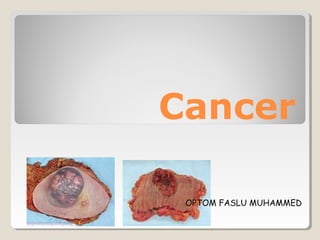
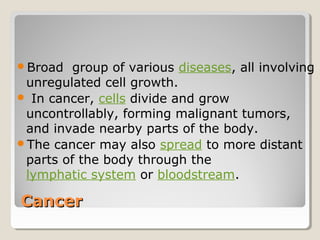
Broad group of various diseases, all involving
unregulated cell growth.
 In cancer, cells divide and grow
uncontrollably, forming malignant tumors,
and invade nearby parts of the body.
The cancer may also spread to more distant
parts of the body through the
lymphatic system or bloodstream.
Cont….Cont….
Not all tumors are cancerous.
Benign tumors do not grow
uncontrollably, do not invade neighboring
tissues, and do not spread throughout the
body.
There are over 200 different known
cancers that afflict humans.
CausesCauses
Many things are known to increase the risk of
cancer, including
Tobacco use
Certain infections
Radiation
lack of physical activity
Obesity
environmental pollutants
Cont..Cont..
The most significant risk factor for
developing cancer is old age.
Diet, physical inactivity, and obesity are
related to approximately 30–35% of
cancer deaths.
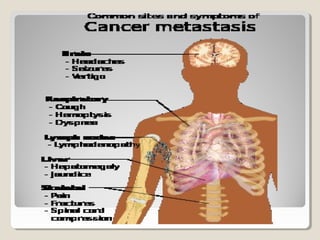
Local symptoms may occur due to the
mass of the tumor or its ulceration.
For example, mass effects from
lung cancer can cause blockage of the
bronchus resulting in cough orpneumonia
; esophageal cancer can cause narrowing
of the esophagus, making it difficult or
painful to swallow; and colorectal cancer
may lead to narrowing or blockages in
the bowel, resulting in changes in bowel
habits.
if it occurs in the lung, will lead to
coughing up blood, in the bowels to
anemia or rectal bleeding, in the bladder
to blood in the urine, and in the uterus to
vaginal bleeding.
Cont…Cont…
General symptoms occur due to distant effects of
the cancer that are not related to direct or
metastatic spread.
These may include:
unintentional weight loss
Fever
being excessively tired
and changes to the skin
 leukemias
cancers of the liver or kidney can cause a
persistent fever of unknown origin
Cancer can be detected in a number of
ways:
signs and symptoms
screening tests or medical imaging.
microscopic examination
tissue sample.
Cont..Cont..
While cancer can affect people of all ages
few types of cancer are more common in
children.
the risk of developing cancer generally
increases with age.
In 2007, cancer caused about 13% of
all human deaths worldwide (7.9 million).
Incidence
In 2008 approximately 12.7 million cancer were
diagnosed
7.6 million people died of cancer worldwide.
Cancers as a group account for approximately 13%
of all deaths each year with the most common
being:
lung cancer (1.4 million deaths),
stomach cancer (740,000 deaths)
liver cancer (700,000 deaths)
colorectal cancer (610,000 deaths)
breast cancer (460,000 deaths).
Incidence
Cancer is the second-leading cause of death
in the United States, with about 23% of all
deaths in the United States due to this
disease.
 Each year, approximately 2 million new
cases are diagnosed, and some 550,000
deaths occur.
More than 3 million Americans have
survived cancer,
more than 2 million of these cases
Cancer is actually many different diseases;
questions of etiology, cancer prevention, and
cancer cure must address the specific types of
tumors.
Nonmelanotic skin cancers are the most common
tumors in adult Americans.
After these types, the most common forms of
cancer in adult Americans are lung, breast,
prostate, and colorectal.
Approximately 80% of adult cancers arise from the
epithelial tissues; leukemias and sarcomas are
relatively rare in adults.
Etiology
Cancer is caused by mutations in genes that
control cell division. Some of these genes,
called oncogenes, stimulate cell division.
others, called tumor-suppressor genes, slow
this process.
Oncogene is a gene that has the potential
to cause cancer.
In tumor cells, they are often mutated or
expressed at high levels.
Cont….Cont….
Tumor suppressor gene, or anti-
oncogene, is a gene that protects a cell
from one step on the path to cancer
When this gene is mutated to cause a loss
or reduction in its function, the cell can
progress to cancer, usually in combination
with other genetic changes.
Cont..Cont..
In the normal state, both types of genes
work together, enabling the body to
replace dead cells and repair damaged
ones.
Mutations in these genes cause cells to
proliferate out of control.
environmental origin - cigarette smoking
Carcinogenic Factors
Chemical:
Alcohol
Smoking
tobacco use :cancer in thelung, larynx,
head, neck, stomach, bladder, kidney,
esophagus and pancreas
Tobacco smoke contains over fifty known
carcinogens, including nitrosamines and
polycyclic aromatic hydrocarbons
Carcinogenesis
Cancer arises from genetic mutations that
cause a cell to grow and divide without
regard for cell death.
The cell cycle is regulated biochemically,
Radiation in carcinogenesis
The general population is exposed to both
naturally occurring ionizing radiation and
man-made ionizing radiation.
Man-made sources deliver an average of
106 mrem per year to each person.
These sources include:
 medical diagnostic equipment
 technologically altered natural sources
 global fallout from atmospheric testing of
atomic weapons
 nuclear power
 high-altitude jet flight
 occupational exposure
 consumer products
Viral carcinogenesis
Play a role in the etiology of cancer.
The inoculation of animals with specific
viruses may produce tumors.
Several human cancers
(Burkitt lymphoma, nasopharyngeal
carcinoma, carcinoma of the cervix, and
hepatocellular carcinoma) show a definite
correlation with viral infection,
Infectious causes of cancer
Worldwide approximately 18% of cancer
deaths are related to infectious diseases.
This proportion varies in different regions
of the world from a high of 25% in Africa
to less than 10% in the developed world.
Viruses are the usual infectious agents
that cause cancer but bacteria and
parasites may also have an effect.
Cont….Cont….
A virus that can cause cancer is called an
oncovirus.
These include human papillomavirus (
cervical carcinoma)
Epstein–Barr virus (
B-cell lymphoproliferative disease
and nasopharyngeal carcinoma)
Kaposi's sarcoma herpesvirus (Kaposi's
sarcoma and primary effusion lymphomas)
hepatitis B and hepatitis C viruses
(hepatocellular carcinoma)
Human T-cell leukemia virus-1 (T-cell
leukemias).
CONT….CONT….
The human herpes viruses that are
associated with disease include Epstein-Barr
virus, herpes simplex virus type 1, herpes
simplex virus type 2, cytomegalovirus, and
varicellazoster virus.
 The Epstein-Barr virus, which causes
infectious mononucleosis, has been
associated with Burkitt lymphoma and
nasopharyngeal carcinoma.
CONT…CONT…The herpes simplex virus type 1, which
causes gingivostomatitis, encephalitis,
keratoconjunctivitis, neuralgia, and labialis,
has been associated with carcinoma of the
lip and oropharynx.
The herpes simplex virus type 2, which
causes genital herpes, disseminated
neonatal herpes, encephalitis, and
neuralgia, has been associated with cancer
of the uterine cervix, vulva, kidney, and
nasopharynx.
Genetic and familial factors
in human carcinogenesis. A heritable component
may be more important in some forms of cancer
and less important in others Certain cancers
show an ethnic predilection.
Cancers may aggregate in a nonrandom manner
in certain families. These cancers may be of the
same type or dissimilar. Such cancer-cluster
families may have several children with soft
tissue sarcoma and relatives with a variety of
cancers, especially of the breast in young
women.
Multiple endocrine neoplasiais yet another
example of familial cancers.
Therapy
Therapy:
Radiation
Effects of irradiation on the eye and
adnexa
Chemotherapy
Natural products
Angiogenesis inhibitors
Biological therapies
Ophthalmic Considerations
The eye and its adnexa are frequently
involved in systemic malignancies as well
as in extra ocular malignancies that
extend into ocular structures.
Breast and lung cancers are common
intraocular tumors in adults.
Acute myelogenous and lymphocytic
leukemias frequently have uveal and
posterior choroidal infiltrates as part of
their generalized disease
Cont.Cont.
..
In children, these manifestations are often
signs of central nervous system involvement.
malignant lymphomas do not usually involve
the uveal tract.
Histiocytic lymphoma - involves the vitreous
and presents as uveitis.
The retina and choroid may also be involved.
Cancer

Cancer

  • 1.
  • 2.
    CancerCancer Broad group ofvarious diseases, all involving unregulated cell growth.  In cancer, cells divide and grow uncontrollably, forming malignant tumors, and invade nearby parts of the body. The cancer may also spread to more distant parts of the body through the lymphatic system or bloodstream.
  • 3.
    Cont….Cont…. Not all tumorsare cancerous. Benign tumors do not grow uncontrollably, do not invade neighboring tissues, and do not spread throughout the body. There are over 200 different known cancers that afflict humans.
  • 4.
    CausesCauses Many things areknown to increase the risk of cancer, including Tobacco use Certain infections Radiation lack of physical activity Obesity environmental pollutants
  • 5.
    Cont..Cont.. The most significantrisk factor for developing cancer is old age. Diet, physical inactivity, and obesity are related to approximately 30–35% of cancer deaths.
  • 7.
    Local symptoms mayoccur due to the mass of the tumor or its ulceration. For example, mass effects from lung cancer can cause blockage of the bronchus resulting in cough orpneumonia ; esophageal cancer can cause narrowing of the esophagus, making it difficult or painful to swallow; and colorectal cancer may lead to narrowing or blockages in the bowel, resulting in changes in bowel habits.
  • 8.
    if it occursin the lung, will lead to coughing up blood, in the bowels to anemia or rectal bleeding, in the bladder to blood in the urine, and in the uterus to vaginal bleeding.
  • 9.
    Cont…Cont… General symptoms occurdue to distant effects of the cancer that are not related to direct or metastatic spread. These may include: unintentional weight loss Fever being excessively tired and changes to the skin  leukemias cancers of the liver or kidney can cause a persistent fever of unknown origin
  • 10.
    Cancer can bedetected in a number of ways: signs and symptoms screening tests or medical imaging. microscopic examination tissue sample.
  • 11.
    Cont..Cont.. While cancer canaffect people of all ages few types of cancer are more common in children. the risk of developing cancer generally increases with age. In 2007, cancer caused about 13% of all human deaths worldwide (7.9 million).
  • 12.
    Incidence In 2008 approximately12.7 million cancer were diagnosed 7.6 million people died of cancer worldwide. Cancers as a group account for approximately 13% of all deaths each year with the most common being: lung cancer (1.4 million deaths), stomach cancer (740,000 deaths) liver cancer (700,000 deaths) colorectal cancer (610,000 deaths) breast cancer (460,000 deaths).
  • 13.
    Incidence Cancer is thesecond-leading cause of death in the United States, with about 23% of all deaths in the United States due to this disease.  Each year, approximately 2 million new cases are diagnosed, and some 550,000 deaths occur. More than 3 million Americans have survived cancer, more than 2 million of these cases
  • 14.
    Cancer is actuallymany different diseases; questions of etiology, cancer prevention, and cancer cure must address the specific types of tumors. Nonmelanotic skin cancers are the most common tumors in adult Americans. After these types, the most common forms of cancer in adult Americans are lung, breast, prostate, and colorectal. Approximately 80% of adult cancers arise from the epithelial tissues; leukemias and sarcomas are relatively rare in adults.
  • 15.
    Etiology Cancer is causedby mutations in genes that control cell division. Some of these genes, called oncogenes, stimulate cell division. others, called tumor-suppressor genes, slow this process. Oncogene is a gene that has the potential to cause cancer. In tumor cells, they are often mutated or expressed at high levels.
  • 16.
    Cont….Cont…. Tumor suppressor gene,or anti- oncogene, is a gene that protects a cell from one step on the path to cancer When this gene is mutated to cause a loss or reduction in its function, the cell can progress to cancer, usually in combination with other genetic changes.
  • 17.
    Cont..Cont.. In the normalstate, both types of genes work together, enabling the body to replace dead cells and repair damaged ones. Mutations in these genes cause cells to proliferate out of control. environmental origin - cigarette smoking
  • 18.
    Carcinogenic Factors Chemical: Alcohol Smoking tobacco use:cancer in thelung, larynx, head, neck, stomach, bladder, kidney, esophagus and pancreas Tobacco smoke contains over fifty known carcinogens, including nitrosamines and polycyclic aromatic hydrocarbons
  • 19.
    Carcinogenesis Cancer arises fromgenetic mutations that cause a cell to grow and divide without regard for cell death. The cell cycle is regulated biochemically,
  • 20.
    Radiation in carcinogenesis Thegeneral population is exposed to both naturally occurring ionizing radiation and man-made ionizing radiation. Man-made sources deliver an average of 106 mrem per year to each person.
  • 21.
    These sources include: medical diagnostic equipment  technologically altered natural sources  global fallout from atmospheric testing of atomic weapons  nuclear power  high-altitude jet flight  occupational exposure  consumer products
  • 22.
    Viral carcinogenesis Play arole in the etiology of cancer. The inoculation of animals with specific viruses may produce tumors. Several human cancers (Burkitt lymphoma, nasopharyngeal carcinoma, carcinoma of the cervix, and hepatocellular carcinoma) show a definite correlation with viral infection,
  • 23.
    Infectious causes ofcancer Worldwide approximately 18% of cancer deaths are related to infectious diseases. This proportion varies in different regions of the world from a high of 25% in Africa to less than 10% in the developed world. Viruses are the usual infectious agents that cause cancer but bacteria and parasites may also have an effect.
  • 24.
    Cont….Cont…. A virus thatcan cause cancer is called an oncovirus. These include human papillomavirus ( cervical carcinoma) Epstein–Barr virus ( B-cell lymphoproliferative disease and nasopharyngeal carcinoma) Kaposi's sarcoma herpesvirus (Kaposi's sarcoma and primary effusion lymphomas) hepatitis B and hepatitis C viruses (hepatocellular carcinoma) Human T-cell leukemia virus-1 (T-cell leukemias).
  • 25.
    CONT….CONT…. The human herpesviruses that are associated with disease include Epstein-Barr virus, herpes simplex virus type 1, herpes simplex virus type 2, cytomegalovirus, and varicellazoster virus.  The Epstein-Barr virus, which causes infectious mononucleosis, has been associated with Burkitt lymphoma and nasopharyngeal carcinoma.
  • 26.
    CONT…CONT…The herpes simplexvirus type 1, which causes gingivostomatitis, encephalitis, keratoconjunctivitis, neuralgia, and labialis, has been associated with carcinoma of the lip and oropharynx. The herpes simplex virus type 2, which causes genital herpes, disseminated neonatal herpes, encephalitis, and neuralgia, has been associated with cancer of the uterine cervix, vulva, kidney, and nasopharynx.
  • 27.
    Genetic and familialfactors in human carcinogenesis. A heritable component may be more important in some forms of cancer and less important in others Certain cancers show an ethnic predilection. Cancers may aggregate in a nonrandom manner in certain families. These cancers may be of the same type or dissimilar. Such cancer-cluster families may have several children with soft tissue sarcoma and relatives with a variety of cancers, especially of the breast in young women. Multiple endocrine neoplasiais yet another example of familial cancers.
  • 28.
  • 29.
    Therapy: Radiation Effects of irradiationon the eye and adnexa Chemotherapy Natural products Angiogenesis inhibitors Biological therapies
  • 30.
    Ophthalmic Considerations The eyeand its adnexa are frequently involved in systemic malignancies as well as in extra ocular malignancies that extend into ocular structures. Breast and lung cancers are common intraocular tumors in adults. Acute myelogenous and lymphocytic leukemias frequently have uveal and posterior choroidal infiltrates as part of their generalized disease
  • 31.
    Cont.Cont. .. In children, thesemanifestations are often signs of central nervous system involvement. malignant lymphomas do not usually involve the uveal tract. Histiocytic lymphoma - involves the vitreous and presents as uveitis. The retina and choroid may also be involved.