Nutrition: Eating For Optimum Health 9
Assessing Eating Behavior Appetite Personal preferences Habit Ethnic heritage Social interactions Availability Emotional comfort Values Body image Nutrition
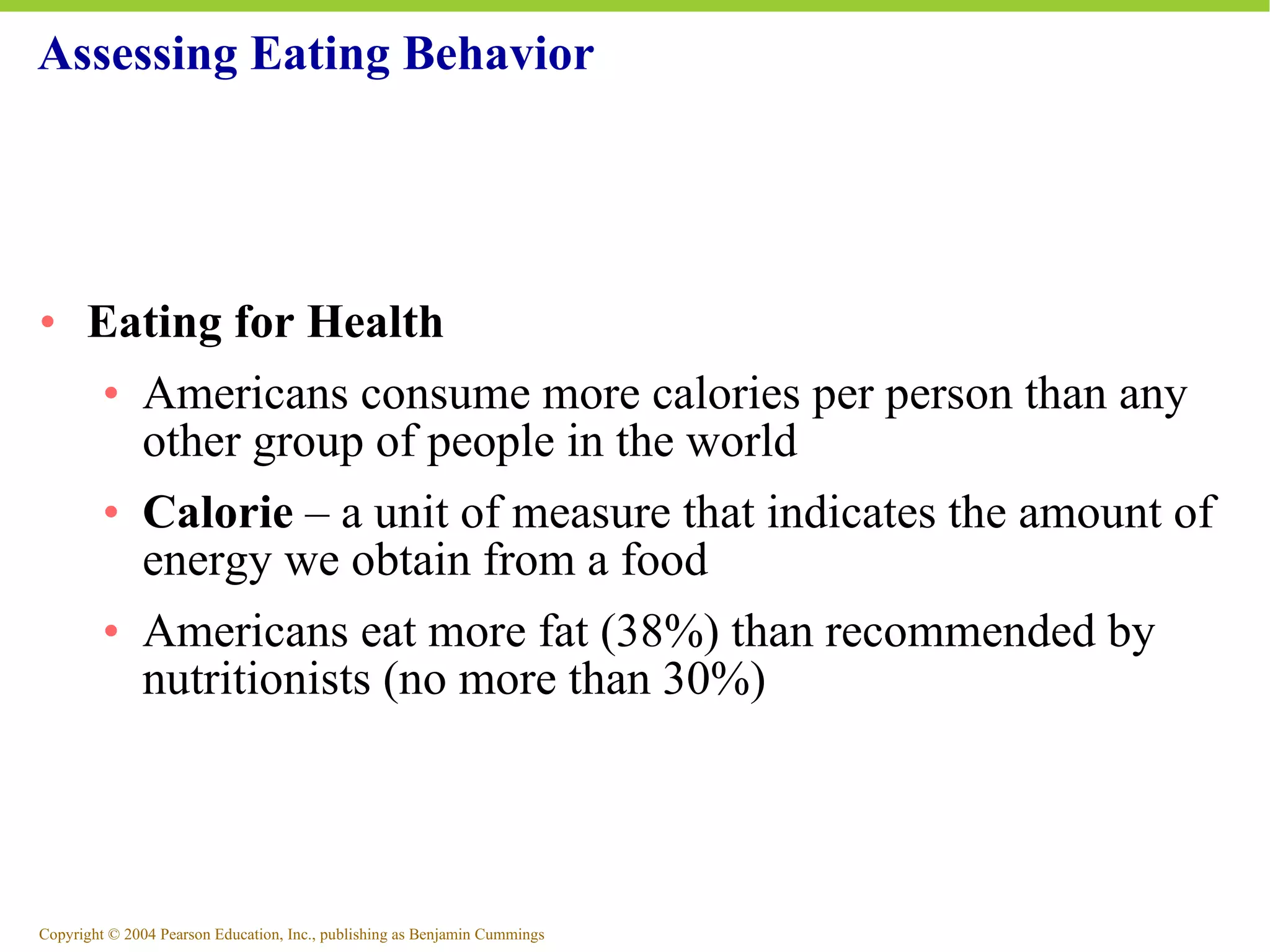
Assessing Eating Behavior Eating for Health Americans consume more calories per person than any other group of people in the world Calorie  – a unit of measure that indicates the amount of energy we obtain from a food Americans eat more fat (38%) than recommended by nutritionists (no more than 30%)
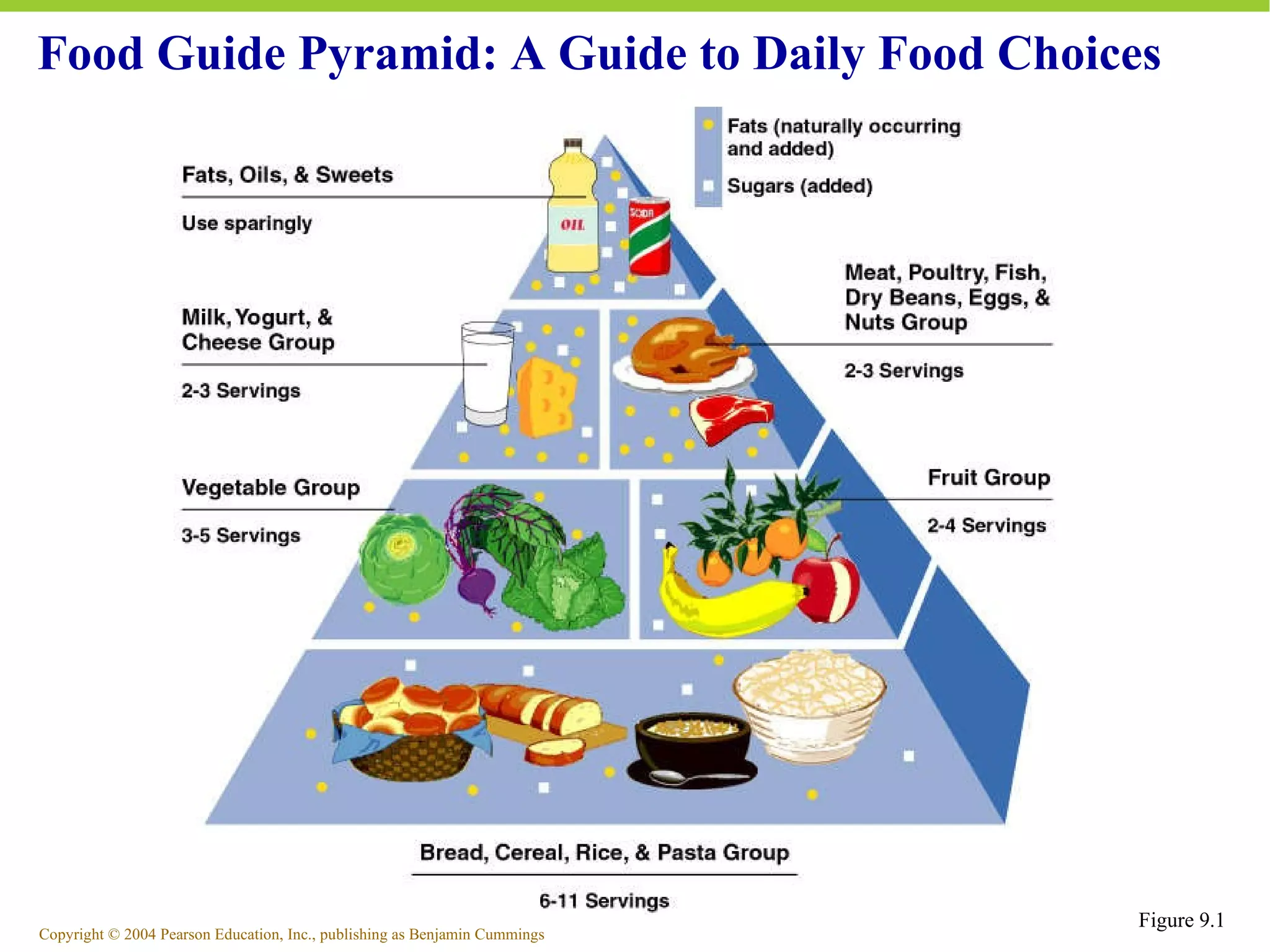
Food Guide Pyramid: A Guide to Daily Food Choices Figure 9.1
Assessing Eating Behaviors Researchers at Harvard have suggested a new pyramid The new pyramid would place meat at the top with refined sweets
Proposed New Food Guide Pyramid Figure 9.2
The Digestive Process Body must break food down Enzymes Saliva has some enzymes Esophagus moves food to stomach Stomach has acid and more enzymes Small intestine furthers digestion (20-foot tube) Duodenum Jejunum Ileum
The Digestive Process Enzymes from liver and pancreas help Nutrients absorbed into bloodstream Liver is the organ that determines fate of most nutrients Process takes approximately 24 hours
Obtaining Essential Nutrients Water 8 glasses a day (8 ounces) 50-60% of body is water
Obtaining Essential Nutrients Protein Major component of every cell Role in developing/repairing bone Muscle Skin Key element in antibodies
Obtaining Essential Nutrients Protein (continued) Amino acids link together to form Complete protein Incomplete protein Fad diet controversy Can you give examples of complete proteins?
Obtaining Essential Nutrients Carbohydrates Best fuel – they provide energy Simple sugars Glucose (monosaccharide) Fructose (monosaccharide) Sucrose (disaccharide)
Obtaining Essential Nutrients Complex carbohydrates Starches Fiber Stored in the body as glycogen
Obtaining Essential Nutrients Carbohydrates and Athletes Sugar may be counterproductive Carbohydrate loading Myth of Sugar and Hyperactivity Not related in long-term studies Does not increase violence
Obtaining Essential Nutrients Fiber “ Bulk” or “roughage” Indigestible portion of plants Soluble Insoluble Offers many health protections Most American eat far less than recommended Average is 12 grams and 20-30 grams are recommended
Obtaining Essential Nutrients Fats Maintain healthy skin Insulate body organs Maintain body temperature Promote healthy cell function Carry fat-soluble vitamins A, D, E, and K Are a concentrated form of energy 95% as triglycerides in the body
Obtaining Essential Nutrients Fats (continued) 5% as substances like cholesterol Plaque is buildup on artery walls Ratio of cholesterol HDL/LDL Saturated fat Unsaturated fat Trans-fatty acids (margarine or butter debate)
Obtaining Essential Nutrients Vitamins Potent, essential, organic compounds Water soluble – dissolve in water Fat soluble – absorb through intestinal tract with fat Why do you think so many people take vitamin supplements?
Obtaining Essential Nutrients Vitamins People in the U.S. are rarely deficient Hypervitaminosis may be a problem
Obtaining Essential Nutrients Minerals See Table 9.2 in book for a guide to minerals Inorganic, indestructible elements that aid the body Macrominerals are needed in large amounts Trace minerals are needed in small amounts Your text highlights sodium, calcium, and iron
The Medicinal Value of Food Compelling evidence that diet may be as effective as drugs Dietary Approaches to Stop Hypertension (DASH) Dietary Intervention Study (DIS) Antioxidants
The Medicinal Value of Food Folate Form of vitamin B Folate fortification 1998 Neural tube defects Heart disease
Gender and Nutrition Men and women have different needs Women have cyclical changes Men have more lean tissue (burn more)
Gender and Nutrition Reasons to change the “Meat and Potatoes Man” Men who eat red meat as a main dish 5 times a week have 4 times the risk of colon cancer over those eating red meat once a month More prostate cancer Fruits and vegetables reduce stroke
Determining Nutritional Needs Recommended Dietary Allowances (RDAs) Adequate Intake Daily Values Recommended Daily Intakes (DRIs) Daily Reference Values (DRV) Reading food labels can help determine needs
Reading a Food Label Figure 9.3
Vegetarianism: Eating for Health Types of vegetarian diets Vegans Lacto-vegetarians Ovo-vegetarians Lacto-ovo-vegetarians Pesco-vegetarians Semivegetarians Vegetarian food guide pyramids are available
Vegetarianism: Eating for Health Reasons why 5-15% of the population is vegetarian Aesthetic Animal rights Economic Personal Health Cultural Religious
Improved Eating for the College Student Eating on the run Funds may be short What are some of the things you buy to eat? Have you found ways to eat healthy?
Food Safety: A Growing Concern Food-Borne Illness Affects millions of people each year Responsible for 9,000 deaths a year Signs Cramping Nausea Vomiting Diarrhea
Food Safety: A Growing Concern Key Factors why Food-Borne Illness has Increased Globalization of food supply Inadvertent introduction of pathogens to new geographic regions Exposure to unfamiliar food-borne hazards Changes in microbial populations Increases susceptibility of varying populations Insufficient education about food safety
Food Safety: A Growing Concern Practice Responsible Food Handling at Home Don’t keep foods out of the refrigerator for long Don’t keep fresh meats more than one or two days Eat leftovers within three days Wash hands, cutting boards, and knives well
Food Safety: A Growing Concern Food Irradiation: How Safe Is It? February 2000 the USDA approved Use gamma irradiation from radioactive cobalt, cesium, or other X-ray sources Breaks chemical bonds in the DNA of bacteria Rays essentially pass through the food Facts seem to support use despite concerns raised by some groups
Food Safety: A Growing Concern Food Additives Reduce food-borne illness Enhance nutrients Intentional Food Additives Antimicrobial agents: salt, sugar, nitrates Antioxidants: preserve color and flavor Artificial color Nutrient additives (Vitamin D and folate)
Food Safety: A Growing Concern Indirect Food Additives Substances that inadvertently get into food products from packaging Dioxins: found in coffee filters, milk containers, and frozen foods Methylene chloride: found in decaffeinated coffee Hormones: bovine growth hormone found in animals
Food Safety: A Growing Concern Food Allergies Found in 5% of children and 10% of adults Occurs when the body treats a food, usually protein, as an invader Initial signs include rapid breathing or wheezing, hives, rash, eczema, or runny nose More dramatic symptoms: facial swelling or respiratory problems (anaphylactic reaction)
Food Safety: A Growing Concern Food Allergies Anaphylactic reaction requires a shot of epinephrine, a hormone that stimulates the heart Can be mistaken for food intolerance or reactions to food additives Reaction may also occur in response to food substances Organic Pesticide and chemical-free
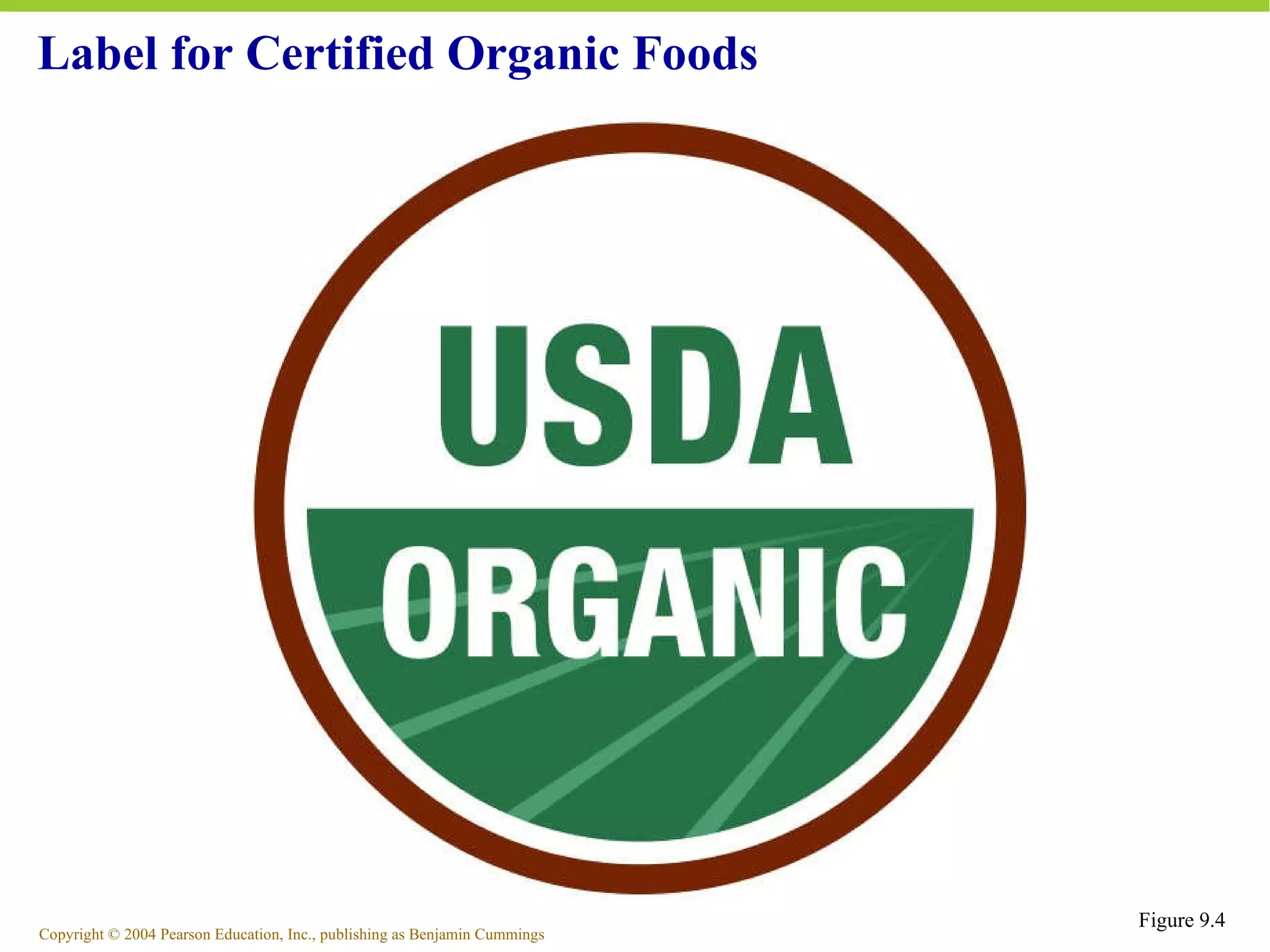
Label for Certified Organic Foods Figure 9.4

Sexuality Presentation 2009

  • 1.
    Nutrition: Eating ForOptimum Health 9
  • 2.
    Assessing Eating BehaviorAppetite Personal preferences Habit Ethnic heritage Social interactions Availability Emotional comfort Values Body image Nutrition
  • 3.
    Assessing Eating BehaviorEating for Health Americans consume more calories per person than any other group of people in the world Calorie – a unit of measure that indicates the amount of energy we obtain from a food Americans eat more fat (38%) than recommended by nutritionists (no more than 30%)
  • 4.
    Food Guide Pyramid:A Guide to Daily Food Choices Figure 9.1
  • 5.
    Assessing Eating BehaviorsResearchers at Harvard have suggested a new pyramid The new pyramid would place meat at the top with refined sweets
  • 6.
    Proposed New FoodGuide Pyramid Figure 9.2
  • 7.
    The Digestive ProcessBody must break food down Enzymes Saliva has some enzymes Esophagus moves food to stomach Stomach has acid and more enzymes Small intestine furthers digestion (20-foot tube) Duodenum Jejunum Ileum
  • 8.
    The Digestive ProcessEnzymes from liver and pancreas help Nutrients absorbed into bloodstream Liver is the organ that determines fate of most nutrients Process takes approximately 24 hours
  • 9.
    Obtaining Essential NutrientsWater 8 glasses a day (8 ounces) 50-60% of body is water
  • 10.
    Obtaining Essential NutrientsProtein Major component of every cell Role in developing/repairing bone Muscle Skin Key element in antibodies
  • 11.
    Obtaining Essential NutrientsProtein (continued) Amino acids link together to form Complete protein Incomplete protein Fad diet controversy Can you give examples of complete proteins?
  • 12.
    Obtaining Essential NutrientsCarbohydrates Best fuel – they provide energy Simple sugars Glucose (monosaccharide) Fructose (monosaccharide) Sucrose (disaccharide)
  • 13.
    Obtaining Essential NutrientsComplex carbohydrates Starches Fiber Stored in the body as glycogen
  • 14.
    Obtaining Essential NutrientsCarbohydrates and Athletes Sugar may be counterproductive Carbohydrate loading Myth of Sugar and Hyperactivity Not related in long-term studies Does not increase violence
  • 15.
    Obtaining Essential NutrientsFiber “ Bulk” or “roughage” Indigestible portion of plants Soluble Insoluble Offers many health protections Most American eat far less than recommended Average is 12 grams and 20-30 grams are recommended
  • 16.
    Obtaining Essential NutrientsFats Maintain healthy skin Insulate body organs Maintain body temperature Promote healthy cell function Carry fat-soluble vitamins A, D, E, and K Are a concentrated form of energy 95% as triglycerides in the body
  • 17.
    Obtaining Essential NutrientsFats (continued) 5% as substances like cholesterol Plaque is buildup on artery walls Ratio of cholesterol HDL/LDL Saturated fat Unsaturated fat Trans-fatty acids (margarine or butter debate)
  • 18.
    Obtaining Essential NutrientsVitamins Potent, essential, organic compounds Water soluble – dissolve in water Fat soluble – absorb through intestinal tract with fat Why do you think so many people take vitamin supplements?
  • 19.
    Obtaining Essential NutrientsVitamins People in the U.S. are rarely deficient Hypervitaminosis may be a problem
  • 20.
    Obtaining Essential NutrientsMinerals See Table 9.2 in book for a guide to minerals Inorganic, indestructible elements that aid the body Macrominerals are needed in large amounts Trace minerals are needed in small amounts Your text highlights sodium, calcium, and iron
  • 21.
    The Medicinal Valueof Food Compelling evidence that diet may be as effective as drugs Dietary Approaches to Stop Hypertension (DASH) Dietary Intervention Study (DIS) Antioxidants
  • 22.
    The Medicinal Valueof Food Folate Form of vitamin B Folate fortification 1998 Neural tube defects Heart disease
  • 23.
    Gender and NutritionMen and women have different needs Women have cyclical changes Men have more lean tissue (burn more)
  • 24.
    Gender and NutritionReasons to change the “Meat and Potatoes Man” Men who eat red meat as a main dish 5 times a week have 4 times the risk of colon cancer over those eating red meat once a month More prostate cancer Fruits and vegetables reduce stroke
  • 25.
    Determining Nutritional NeedsRecommended Dietary Allowances (RDAs) Adequate Intake Daily Values Recommended Daily Intakes (DRIs) Daily Reference Values (DRV) Reading food labels can help determine needs
  • 26.
    Reading a FoodLabel Figure 9.3
  • 27.
    Vegetarianism: Eating forHealth Types of vegetarian diets Vegans Lacto-vegetarians Ovo-vegetarians Lacto-ovo-vegetarians Pesco-vegetarians Semivegetarians Vegetarian food guide pyramids are available
  • 28.
    Vegetarianism: Eating forHealth Reasons why 5-15% of the population is vegetarian Aesthetic Animal rights Economic Personal Health Cultural Religious
  • 29.
    Improved Eating forthe College Student Eating on the run Funds may be short What are some of the things you buy to eat? Have you found ways to eat healthy?
  • 30.
    Food Safety: AGrowing Concern Food-Borne Illness Affects millions of people each year Responsible for 9,000 deaths a year Signs Cramping Nausea Vomiting Diarrhea
  • 31.
    Food Safety: AGrowing Concern Key Factors why Food-Borne Illness has Increased Globalization of food supply Inadvertent introduction of pathogens to new geographic regions Exposure to unfamiliar food-borne hazards Changes in microbial populations Increases susceptibility of varying populations Insufficient education about food safety
  • 32.
    Food Safety: AGrowing Concern Practice Responsible Food Handling at Home Don’t keep foods out of the refrigerator for long Don’t keep fresh meats more than one or two days Eat leftovers within three days Wash hands, cutting boards, and knives well
  • 33.
    Food Safety: AGrowing Concern Food Irradiation: How Safe Is It? February 2000 the USDA approved Use gamma irradiation from radioactive cobalt, cesium, or other X-ray sources Breaks chemical bonds in the DNA of bacteria Rays essentially pass through the food Facts seem to support use despite concerns raised by some groups
  • 34.
    Food Safety: AGrowing Concern Food Additives Reduce food-borne illness Enhance nutrients Intentional Food Additives Antimicrobial agents: salt, sugar, nitrates Antioxidants: preserve color and flavor Artificial color Nutrient additives (Vitamin D and folate)
  • 35.
    Food Safety: AGrowing Concern Indirect Food Additives Substances that inadvertently get into food products from packaging Dioxins: found in coffee filters, milk containers, and frozen foods Methylene chloride: found in decaffeinated coffee Hormones: bovine growth hormone found in animals
  • 36.
    Food Safety: AGrowing Concern Food Allergies Found in 5% of children and 10% of adults Occurs when the body treats a food, usually protein, as an invader Initial signs include rapid breathing or wheezing, hives, rash, eczema, or runny nose More dramatic symptoms: facial swelling or respiratory problems (anaphylactic reaction)
  • 37.
    Food Safety: AGrowing Concern Food Allergies Anaphylactic reaction requires a shot of epinephrine, a hormone that stimulates the heart Can be mistaken for food intolerance or reactions to food additives Reaction may also occur in response to food substances Organic Pesticide and chemical-free
  • 38.
    Label for CertifiedOrganic Foods Figure 9.4