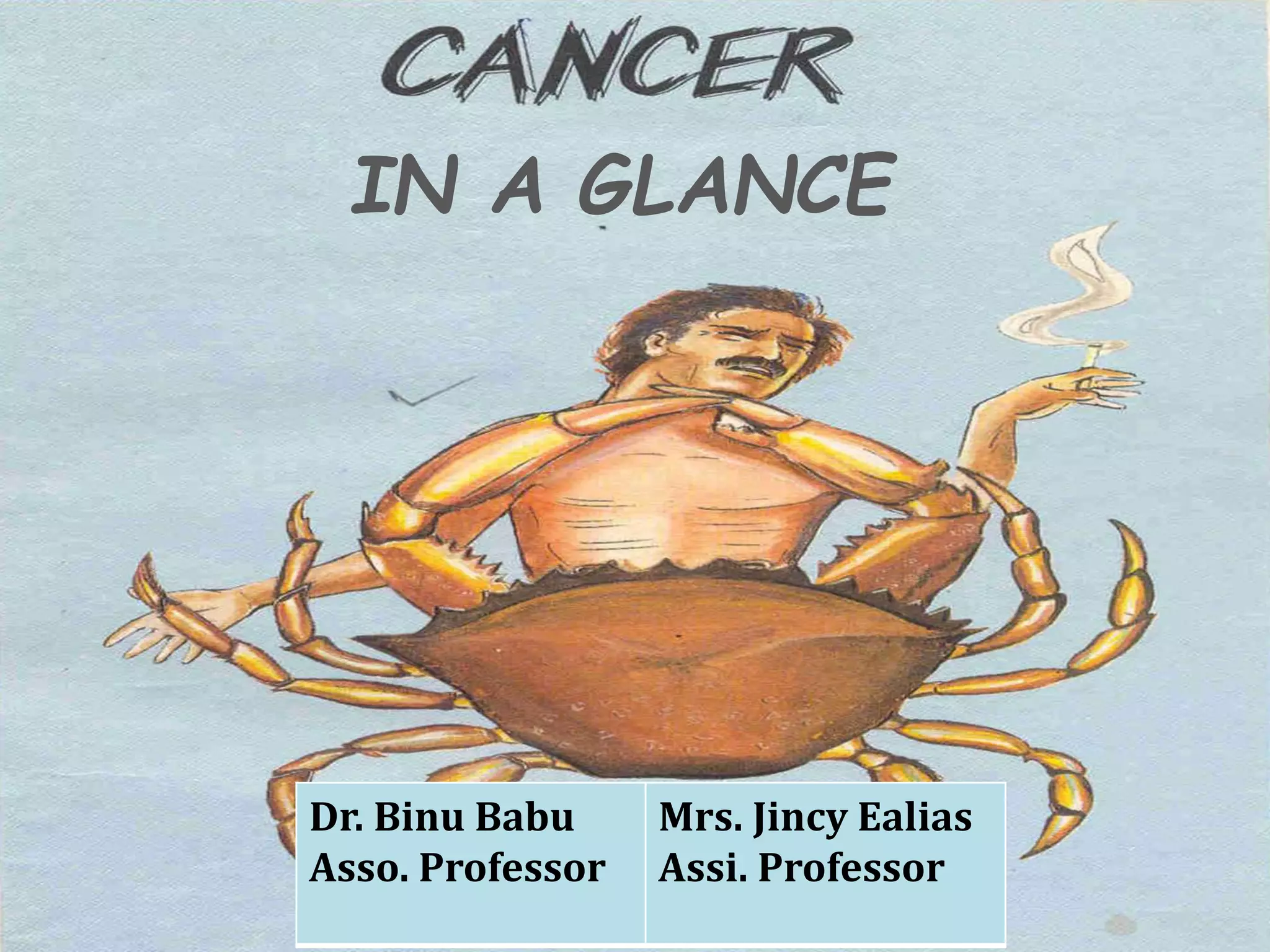
Dr. Binu Babu
Asso. Professor
Mrs. Jincy Ealias
Assi. Professor
IN A GLANCE
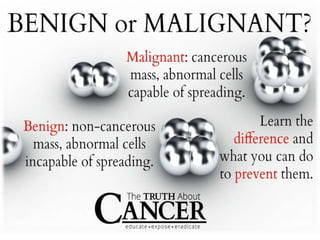
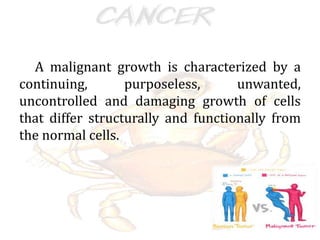
A malignant growth is characterized by a
continuing, purposeless, unwanted,
uncontrolled and damaging growth of cells
that differ structurally and functionally from
the normal cells.
• Cancer cells also have different features and
take on a different microscopic appearance
from the cells from which they developed.
Cancer cells become bizarre in size, shape
and other features. As a rule, the more
bizarre they become, the more aggressive
and malignant is their behavior.
PREVALENCE OF CANCER
• Cancer is known to occur in all societies and
in all parts of the world. It affects animals as
well as man. The types of cancer most
prevalent in a community will vary with
– Age & sex distribution
– Race of people in the community
– The geographical situation
– The economic and environmental situation
– Habits of the people including their diets.
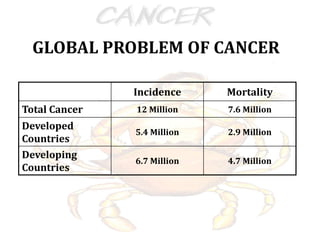
GLOBAL PROBLEM OF CANCER
Incidence Mortality
Total Cancer 12 Million 7.6 Million
Developed
Countries
5.4 Million 2.9 Million
Developing
Countries
6.7 Million 4.7 Million
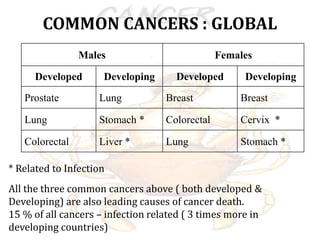
COMMON CANCERS : GLOBAL
Males Females
Developed Developing Developed Developing
Prostate Lung Breast Breast
Lung Stomach * Colorectal Cervix *
Colorectal Liver * Lung Stomach *
* Related to Infection
All the three common cancers above ( both developed &
Developing) are also leading causes of cancer death.
15 % of all cancers – infection related ( 3 times more in
developing countries)
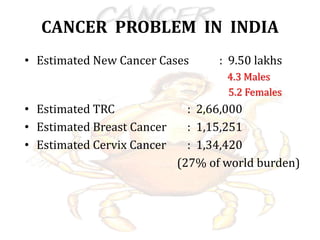
CANCER PROBLEM IN INDIA
• Estimated New Cancer Cases : 9.50 lakhs
4.3 Males
5.2 Females
• Estimated TRC : 2,66,000
• Estimated Breast Cancer : 1,15,251
• Estimated Cervix Cancer : 1,34,420
(27% of world burden)
Etiology
• There is no single cause for cancer. It is
believed that it is the interaction of many
factors together that produces cancer.
• The factors involved may be genetic,
environmental, or constitutional
characteristics of the individual.
Etiology
• Lifestyle factors:- Smoking, a high-fat diet, and working with
toxic chemicals
• Family history, inheritance, and genetics may play an important
role in some childhood cancers.
• Some genetic disorders.
– Wiskott-Aldrich and Beckwith-Wiedemann syndrome are known to
alter the immune system.
• Exposures to certain viruses.
– Epstein-Barr virus
– HIV
• Environmental exposures
– Pesticides
– fertilizers
• Some forms of high-dose chemotherapy and radiation.
Genetic Factors
• All cancers are genetic, in that cancers are
caused by genetic mutations in genes that
lead to malignancy
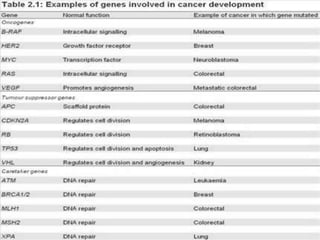
– Proto-oncogene
– Tumor Suppressor gene
– DNA repair gene
Types of genes linked to cancer
Many of the genes that contribute to cancer
development fall into broad categories:
Tumor suppressor genes. These are protective genes.
Normally, they limit cell growth by:
• Monitoring how quickly cells divide into new cells
• Repairing mismatched DNA
• Controlling when a cell dies
• When a tumor suppressor gene mutates, cells grow
uncontrollably. And they may eventually form a
tumor.
• Oncogenes. These turn a healthy cell into a
cancerous cell. Mutations in these genes are
not known to be inherited.
• DNA repair genes. These fix mistakes made
when DNA is copied. Many of them function
as tumor suppressor genes.
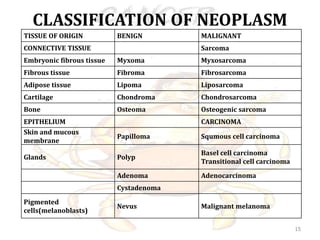
CLASSIFICATION OF NEOPLASM
TISSUE OF ORIGIN BENIGN MALIGNANT
CONNECTIVE TISSUE Sarcoma
Embryonic fibrous tissue Myxoma Myxosarcoma
Fibrous tissue Fibroma Fibrosarcoma
Adipose tissue Lipoma Liposarcoma
Cartilage Chondroma Chondrosarcoma
Bone Osteoma Osteogenic sarcoma
EPITHELIUM CARCINOMA
Skin and mucous
membrane
Papilloma Squmous cell carcinoma
Glands Polyp
Basel cell carcinoma
Transitional cell carcinoma
Adenoma Adenocarcinoma
Cystadenoma
Pigmented
cells(melanoblasts)
Nevus Malignant melanoma
15
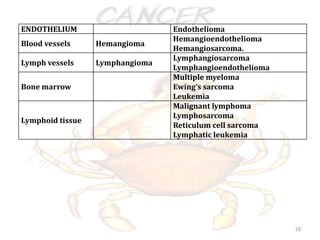
ENDOTHELIUM Endothelioma
Blood vessels Hemangioma
Hemangioendothelioma
Hemangiosarcoma.
Lymph vessels Lymphangioma
Lymphangiosarcoma
Lymphangioendothelioma
Bone marrow
Multiple myeloma
Ewing’s sarcoma
Leukemia
Lymphoid tissue
Malignant lymphoma
Lymphosarcoma
Reticulum cell sarcoma
Lymphatic leukemia
16
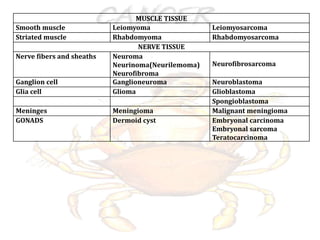
MUSCLE TISSUE
Smooth muscle Leiomyoma Leiomyosarcoma
Striated muscle Rhabdomyoma Rhabdomyosarcoma
NERVE TISSUE
Nerve fibers and sheaths Neuroma
Neurinoma(Neurilemoma)
Neurofibroma
Neurofibrosarcoma
Ganglion cell Ganglioneuroma Neuroblastoma
Glia cell Glioma Glioblastoma
Spongioblastoma
Meninges Meningioma Malignant meningioma
GONADS Dermoid cyst Embryonal carcinoma
Embryonal sarcoma
Teratocarcinoma
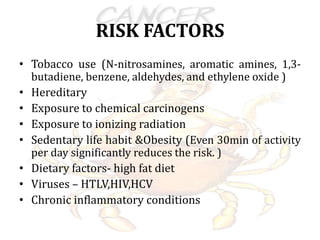
RISK FACTORS
• Tobacco use (N-nitrosamines, aromatic amines, 1,3-
butadiene, benzene, aldehydes, and ethylene oxide )
• Hereditary
• Exposure to chemical carcinogens
• Exposure to ionizing radiation
• Sedentary life habit &Obesity (Even 30min of activity
per day significantly reduces the risk. )
• Dietary factors- high fat diet
• Viruses – HTLV,HIV,HCV
• Chronic inflammatory conditions
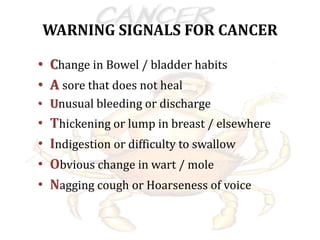
WARNING SIGNALS FOR CANCER
• Change in Bowel / bladder habits
• A sore that does not heal
• Unusual bleeding or discharge
• Thickening or lump in breast / elsewhere
• Indigestion or difficulty to swallow
• Obvious change in wart / mole
• Nagging cough or Hoarseness of voice
Screening for cancer
• Early detection provides the best
opportunity for successful treatment
• Cancer screening examinations are medical
tests performed when you’re healthy
• Reliable screening tests are available for
certain cancers Ex: Cervix, Breast, Colon etc.
DIAGNOSIS
Screening tests
• Organ imaging
• X-rays, isotopes, CT, ultrasound
• MRI (magnetic resonance imaging)
• PET (positron emission tomography)
• Indirect evidence of cancer blood and serum
tests
• Direct evidence of cancer biopsy
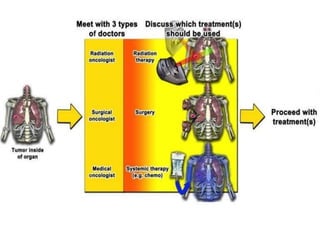
TREATMENT
• Surgery:-The goal of surgery is to remove the
cancer or as much of the cancer as possible.
• Chemotherapy:- Chemotherapy uses drugs to
kill cancer cells.
• Radiation therapy
• Bone marrow transplant
• Immunotherapy
• Hormone therapy
• Targeted drug therapy
• Cryoablation
PREVENTION
• Protect skin from sunlight
• Stay away from tobacco and alcohol
• Get to and stay at a healthy weight
• Get moving with regular physical activity
• Eat healthy with plenty of fruits and vegetables
• Self identification
• Have regular checkups and cancer screening
tests
PREVENTION
Limit your intake of processed and red meats.
Choose fish, poultry as an alternative to beef, pork, and
lamb.
Increasing consumption of fruits and vegetables,
legumes, whole grains and nuts. Choose whole grain
instead of refined grains and sugars.
Limiting intake of free sugars;
Limiting salt consumption and ensuring that salt is
iodized.
Avoiding consumption of food and drinks that are
very hot in temperature
References
• Connie Henke Yarbro, Wujcik, D., & Barbara
Holmes Gobel. (2018). Cancer nursing :
principles and practice. Jones & Bartlett
Learning.
• Belcher, A. E. (1992). Cancer nursing. Mosby
Year Book.
Cancer in a glance

Cancer in a glance

  • 1.
    Dr. Binu Babu Asso.Professor Mrs. Jincy Ealias Assi. Professor IN A GLANCE
  • 3.
    A malignant growthis characterized by a continuing, purposeless, unwanted, uncontrolled and damaging growth of cells that differ structurally and functionally from the normal cells.
  • 4.
    • Cancer cellsalso have different features and take on a different microscopic appearance from the cells from which they developed. Cancer cells become bizarre in size, shape and other features. As a rule, the more bizarre they become, the more aggressive and malignant is their behavior.
  • 5.
    PREVALENCE OF CANCER •Cancer is known to occur in all societies and in all parts of the world. It affects animals as well as man. The types of cancer most prevalent in a community will vary with – Age & sex distribution – Race of people in the community – The geographical situation – The economic and environmental situation – Habits of the people including their diets.
  • 6.
    GLOBAL PROBLEM OFCANCER Incidence Mortality Total Cancer 12 Million 7.6 Million Developed Countries 5.4 Million 2.9 Million Developing Countries 6.7 Million 4.7 Million
  • 7.
    COMMON CANCERS :GLOBAL Males Females Developed Developing Developed Developing Prostate Lung Breast Breast Lung Stomach * Colorectal Cervix * Colorectal Liver * Lung Stomach * * Related to Infection All the three common cancers above ( both developed & Developing) are also leading causes of cancer death. 15 % of all cancers – infection related ( 3 times more in developing countries)
  • 8.
    CANCER PROBLEM ININDIA • Estimated New Cancer Cases : 9.50 lakhs 4.3 Males 5.2 Females • Estimated TRC : 2,66,000 • Estimated Breast Cancer : 1,15,251 • Estimated Cervix Cancer : 1,34,420 (27% of world burden)
  • 9.
    Etiology • There isno single cause for cancer. It is believed that it is the interaction of many factors together that produces cancer. • The factors involved may be genetic, environmental, or constitutional characteristics of the individual.
  • 10.
    Etiology • Lifestyle factors:-Smoking, a high-fat diet, and working with toxic chemicals • Family history, inheritance, and genetics may play an important role in some childhood cancers. • Some genetic disorders. – Wiskott-Aldrich and Beckwith-Wiedemann syndrome are known to alter the immune system. • Exposures to certain viruses. – Epstein-Barr virus – HIV • Environmental exposures – Pesticides – fertilizers • Some forms of high-dose chemotherapy and radiation.
  • 11.
    Genetic Factors • Allcancers are genetic, in that cancers are caused by genetic mutations in genes that lead to malignancy – Proto-oncogene – Tumor Suppressor gene – DNA repair gene
  • 12.
    Types of geneslinked to cancer Many of the genes that contribute to cancer development fall into broad categories: Tumor suppressor genes. These are protective genes. Normally, they limit cell growth by: • Monitoring how quickly cells divide into new cells • Repairing mismatched DNA • Controlling when a cell dies • When a tumor suppressor gene mutates, cells grow uncontrollably. And they may eventually form a tumor.
  • 13.
    • Oncogenes. Theseturn a healthy cell into a cancerous cell. Mutations in these genes are not known to be inherited. • DNA repair genes. These fix mistakes made when DNA is copied. Many of them function as tumor suppressor genes.
  • 15.
    CLASSIFICATION OF NEOPLASM TISSUEOF ORIGIN BENIGN MALIGNANT CONNECTIVE TISSUE Sarcoma Embryonic fibrous tissue Myxoma Myxosarcoma Fibrous tissue Fibroma Fibrosarcoma Adipose tissue Lipoma Liposarcoma Cartilage Chondroma Chondrosarcoma Bone Osteoma Osteogenic sarcoma EPITHELIUM CARCINOMA Skin and mucous membrane Papilloma Squmous cell carcinoma Glands Polyp Basel cell carcinoma Transitional cell carcinoma Adenoma Adenocarcinoma Cystadenoma Pigmented cells(melanoblasts) Nevus Malignant melanoma 15
  • 16.
    ENDOTHELIUM Endothelioma Blood vesselsHemangioma Hemangioendothelioma Hemangiosarcoma. Lymph vessels Lymphangioma Lymphangiosarcoma Lymphangioendothelioma Bone marrow Multiple myeloma Ewing’s sarcoma Leukemia Lymphoid tissue Malignant lymphoma Lymphosarcoma Reticulum cell sarcoma Lymphatic leukemia 16
  • 17.
    MUSCLE TISSUE Smooth muscleLeiomyoma Leiomyosarcoma Striated muscle Rhabdomyoma Rhabdomyosarcoma NERVE TISSUE Nerve fibers and sheaths Neuroma Neurinoma(Neurilemoma) Neurofibroma Neurofibrosarcoma Ganglion cell Ganglioneuroma Neuroblastoma Glia cell Glioma Glioblastoma Spongioblastoma Meninges Meningioma Malignant meningioma GONADS Dermoid cyst Embryonal carcinoma Embryonal sarcoma Teratocarcinoma
  • 18.
    RISK FACTORS • Tobaccouse (N-nitrosamines, aromatic amines, 1,3- butadiene, benzene, aldehydes, and ethylene oxide ) • Hereditary • Exposure to chemical carcinogens • Exposure to ionizing radiation • Sedentary life habit &Obesity (Even 30min of activity per day significantly reduces the risk. ) • Dietary factors- high fat diet • Viruses – HTLV,HIV,HCV • Chronic inflammatory conditions
  • 19.
    WARNING SIGNALS FORCANCER • Change in Bowel / bladder habits • A sore that does not heal • Unusual bleeding or discharge • Thickening or lump in breast / elsewhere • Indigestion or difficulty to swallow • Obvious change in wart / mole • Nagging cough or Hoarseness of voice
  • 20.
    Screening for cancer •Early detection provides the best opportunity for successful treatment • Cancer screening examinations are medical tests performed when you’re healthy • Reliable screening tests are available for certain cancers Ex: Cervix, Breast, Colon etc.
  • 21.
    DIAGNOSIS Screening tests • Organimaging • X-rays, isotopes, CT, ultrasound • MRI (magnetic resonance imaging) • PET (positron emission tomography) • Indirect evidence of cancer blood and serum tests • Direct evidence of cancer biopsy
  • 23.
    TREATMENT • Surgery:-The goalof surgery is to remove the cancer or as much of the cancer as possible. • Chemotherapy:- Chemotherapy uses drugs to kill cancer cells. • Radiation therapy • Bone marrow transplant • Immunotherapy • Hormone therapy • Targeted drug therapy • Cryoablation
  • 24.
    PREVENTION • Protect skinfrom sunlight • Stay away from tobacco and alcohol • Get to and stay at a healthy weight • Get moving with regular physical activity • Eat healthy with plenty of fruits and vegetables • Self identification • Have regular checkups and cancer screening tests
  • 25.
    PREVENTION Limit your intakeof processed and red meats. Choose fish, poultry as an alternative to beef, pork, and lamb. Increasing consumption of fruits and vegetables, legumes, whole grains and nuts. Choose whole grain instead of refined grains and sugars. Limiting intake of free sugars; Limiting salt consumption and ensuring that salt is iodized. Avoiding consumption of food and drinks that are very hot in temperature
  • 26.
    References • Connie HenkeYarbro, Wujcik, D., & Barbara Holmes Gobel. (2018). Cancer nursing : principles and practice. Jones & Bartlett Learning. • Belcher, A. E. (1992). Cancer nursing. Mosby Year Book.