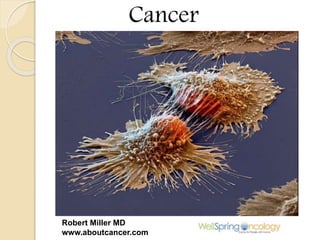
Cancer
Robert Miller MD
www.aboutcancer.com
What is Cancer?
“Cancer is a name given to a collection
of related diseases, where some of the
body’s cells begin to divide without
stopping and spread into surrounding
tissue.”
www.cancer.gov
What Causes Cancer?
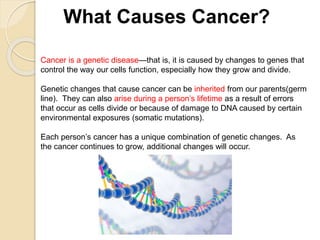
Cancer is a genetic disease—that is, it is caused by changes to genes that
control the way our cells function, especially how they grow and divide.
Genetic changes that cause cancer can be inherited from our parents(germ
line). They can also arise during a person’s lifetime as a result of errors
that occur as cells divide or because of damage to DNA caused by certain
environmental exposures (somatic mutations).
Each person’s cancer has a unique combination of genetic changes. As
the cancer continues to grow, additional changes will occur.
‘Driver’ Mutations
Each cancer is characterized by
numerous somatic mutations, of which
only a subset contributes to the
tumor’s progression.
Scientists want to be able to
distinguish these “driver”
mutations from the
preponderance of neutral
“passenger” mutations that
characterize each cancer,
Genetic Drivers of Cancer
The genetic changes that contribute to cancer tend to
affect three main types of genes:
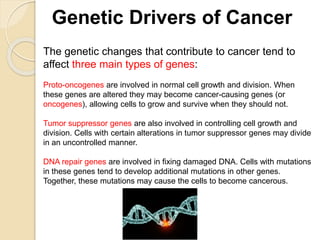
Proto-oncogenes are involved in normal cell growth and division. When
these genes are altered they may become cancer-causing genes (or
oncogenes), allowing cells to grow and survive when they should not.
Tumor suppressor genes are also involved in controlling cell growth and
division. Cells with certain alterations in tumor suppressor genes may divide
in an uncontrolled manner.
DNA repair genes are involved in fixing damaged DNA. Cells with mutations
in these genes tend to develop additional mutations in other genes.
Together, these mutations may cause the cells to become cancerous.
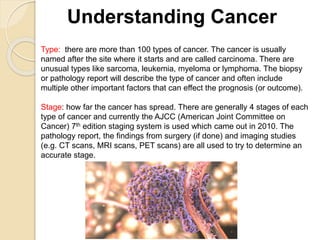
Understanding Cancer
Type: there are more than 100 types of cancer. The cancer is usually
named after the site where it starts and are called carcinoma. There are
unusual types like sarcoma, leukemia, myeloma or lymphoma. The biopsy
or pathology report will describe the type of cancer and often include
multiple other important factors that can effect the prognosis (or outcome).
Stage: how far the cancer has spread. There are generally 4 stages of each
type of cancer and currently the AJCC (American Joint Committee on
Cancer) 7th edition staging system is used which came out in 2010. The
pathology report, the findings from surgery (if done) and imaging studies
(e.g. CT scans, MRI scans, PET scans) are all used to try to determine an
accurate stage.
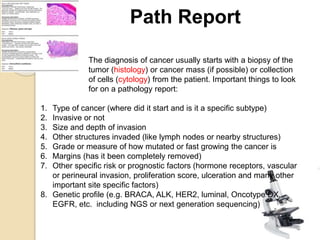
Path Report
The diagnosis of cancer usually starts with a biopsy of the
tumor (histology) or cancer mass (if possible) or collection
of cells (cytology) from the patient. Important things to look
for on a pathology report:
1. Type of cancer (where did it start and is it a specific subtype)
2. Invasive or not
3. Size and depth of invasion
4. Other structures invaded (like lymph nodes or nearby structures)
5. Grade or measure of how mutated or fast growing the cancer is
6. Margins (has it been completely removed)
7. Other specific risk or prognostic factors (hormone receptors, vascular
or perineural invasion, proliferation score, ulceration and many other
important site specific factors)
8. Genetic profile (e.g. BRACA, ALK, HER2, luminal, Oncotype DX,
EGFR, etc. including NGS or next generation sequencing)
Genetic Profile
Oncotype will determine the risk
of a recurrence
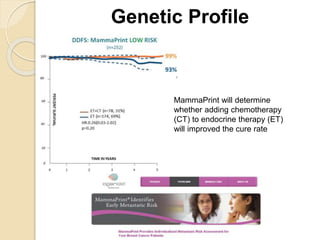
Genetic Profile
MammaPrint will determine
whether adding chemotherapy
(CT) to endocrine therapy (ET)
will improved the cure rate
Genetic Profile
Prosigna will classify breast
cancer into a molecular category
that will have much different risks
of recurrence
Using Adjuvant Online to Calculate
the Benefit from taking
Chemotherapy based on genetic
recurrence risk score
Low risk
High risk
Understanding Cancer
Stage: how far the cancer has spread. There are
generally 4 stages of each type of cancer and
currently the AJCC (American Joint Committee
on Cancer) 7th edition staging system is used
which came out in 2010.
The pathology report, the findings from surgery
(if done) and imaging studies (e.g. CT scans,
MRI scans, PET scans) are all used to try to
determine an accurate stage.
Understanding The Stage
AJCC 7th Ed Staging System is based
on the TNM System
T: stand for tumor and cancer be based on size or depth of
invasion and commonly goes from T0 to T4
N: stands for lymph node spread based on the number of
nodes, size of nodes or location of nodes and is usually from N0
to N3
M: stands for evidence of distant metastases and is usually M0
or M1
Stage: generally combines all 3 of these (and sometime other
factors as well) to group patients into stage categories generally
from 0 to 4 but can include sub stages like IVa , IVb or IVc
For breast cancer, the size and number of nodes combine to determine
the stage
For colon cancer, the depth of invasion is critical to determine the stage
Understanding The Stage
Why is the stage
important?
Because it guides
treatment strategies and
predicts outcome and
Survival by Stage for Breast
Cancer
Years
0
I
II
III
IV
Understanding
Treatment Options
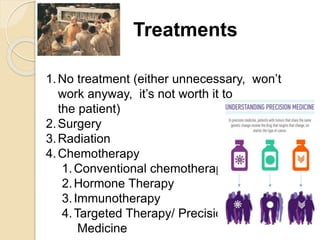
Treatments
1.No treatment (either unnecessary, won’t
work anyway, it’s not worth it to
the patient)
2.Surgery
3.Radiation
4.Chemotherapy
1.Conventional chemotherapy
2.Hormone Therapy
3.Immunotherapy
4.Targeted Therapy/ Precision
Medicine
Surgery : local treatment, may be disfiguring but if
the tumor can be removed it is quite successful
Radiation: regional treatment, may have less side
effects then surgery, successful if the cancer is radio-
sensitive
Chemotherapy: widespread, treats the whole body,
may have significant side effects, success depends
completely on whether the cancer is sensitive to the
available drugs
Basic Treatments
Combined Modality Therapy in the
Treatment of Pediatric
Rhabdomyosarcoma
Treatment 5 Year Survival
Surgery 10 – 20%
Surgery plus PostOp Radiation 40 – 50%
Surgery, Rad. then Chemotherapy 80 – 90%
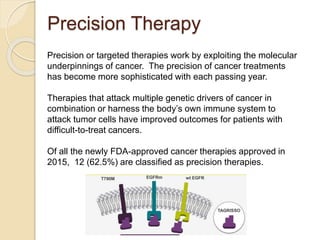
Precision Therapy
Precision or targeted therapies work by exploiting the molecular
underpinnings of cancer. The precision of cancer treatments
has become more sophisticated with each passing year.
Therapies that attack multiple genetic drivers of cancer in
combination or harness the body’s own immune system to
attack tumor cells have improved outcomes for patients with
difficult-to-treat cancers.
Of all the newly FDA-approved cancer therapies approved in
2015, 12 (62.5%) are classified as precision therapies.
New Cancer Drugs and Biological FDA
Approved in 2015
Best Treatment
How do patients know if they are receiving the
best, current available therapy?
Treatment decisions should be made by the patient and
family in consultation with a multi disciplinary panel of
cancer specialists c/w current NCCN guidelines. These
can be accessed free online at NCCN.org or the patient
site at www.nccn.org/patients
Treatment decisions should be
made by the patient and family in
consultation with a multi
disciplinary panel of cancer
specialists c/w current NCCN
Should be a
Team
Approach
www.nccn.org/patient
s
Prognosis
Note that there are many factors that effect
the odds and length of survival
1.The type and location of the cancer
2.The stage and site of spread
3.The cancer grade or speed of growth
4.Other specific traits of the cancer cell
5.The patient’s own health,
age and performance score
6.The response to treatment
0 – Asymptomatic (Fully active, able to carry on all pre-disease activities
without restriction)
1 – Symptomatic but completely ambulatory (Restricted in physically
strenuous activity but ambulatory and able to carry out work of a light or
sedentary nature. For example, light housework, office work)
2 – Symptomatic, <50% in bed during the day (Ambulatory and capable
of all self care but unable to carry out any work activities. Up and about
more than 50% of waking hours)
3 – Symptomatic, >50% in bed, but not bedbound (Capable of only
limited self-care, confined to bed or chair 50% or more of waking hours)
4 – Bedbound (Completely disabled. Cannot carry on any self-care.
Totally confined to bed or chair)
5 – Death
ECOG Performance Score
JOP September 2014 vol. 10no. 5 e335-
e341
Survival in Patients with Advanced
Cancer Based on Performance Score
If the patient has a good response to
treatment then survival will be prolonged
Survival with Advanced Colon Cancer
Based on the Response to
Chemotherapy
Impact of Response to Chemotherapy on
Breast Cancer Patients by Cancer Type
Luminal- A Type Cancers Triple Negative
Definition and Impact of Pathologic Complete Response on Prognosis After Neoadjuvant
Chemotherapy in Various Intrinsic Breast Cancer Subtypes
JCO May 20, 2012 vol. 30 no. 15 1796-1804
Recommended Web Sites from
Doctor Miller
 The best site would be the NCCN / esp. the patient
site: www.nccn.org or www.nccn.org/patients
 The next best would be from the NCI (National
Cancer Institute) or CancerNet at www.cancer.gov
the NCI booklets are very good at
www.cancer.gov/publications/patient-education
 CancerNet from ASCO (American Society of Clinical
Oncology) is very good at www.cancer.net
 American Cancer Society at www.cancer.org is
good
 Finally Doctor Miller’s site at
www.aboutcancer.com has a large amount of
information and a medical video channel

Basic Cancer 2016

  • 1.
  • 2.
    What is Cancer? “Canceris a name given to a collection of related diseases, where some of the body’s cells begin to divide without stopping and spread into surrounding tissue.” www.cancer.gov
  • 3.
    What Causes Cancer? Canceris a genetic disease—that is, it is caused by changes to genes that control the way our cells function, especially how they grow and divide. Genetic changes that cause cancer can be inherited from our parents(germ line). They can also arise during a person’s lifetime as a result of errors that occur as cells divide or because of damage to DNA caused by certain environmental exposures (somatic mutations). Each person’s cancer has a unique combination of genetic changes. As the cancer continues to grow, additional changes will occur.
  • 4.
    ‘Driver’ Mutations Each canceris characterized by numerous somatic mutations, of which only a subset contributes to the tumor’s progression. Scientists want to be able to distinguish these “driver” mutations from the preponderance of neutral “passenger” mutations that characterize each cancer,
  • 5.
    Genetic Drivers ofCancer The genetic changes that contribute to cancer tend to affect three main types of genes: Proto-oncogenes are involved in normal cell growth and division. When these genes are altered they may become cancer-causing genes (or oncogenes), allowing cells to grow and survive when they should not. Tumor suppressor genes are also involved in controlling cell growth and division. Cells with certain alterations in tumor suppressor genes may divide in an uncontrolled manner. DNA repair genes are involved in fixing damaged DNA. Cells with mutations in these genes tend to develop additional mutations in other genes. Together, these mutations may cause the cells to become cancerous.
  • 6.
    Understanding Cancer Type: thereare more than 100 types of cancer. The cancer is usually named after the site where it starts and are called carcinoma. There are unusual types like sarcoma, leukemia, myeloma or lymphoma. The biopsy or pathology report will describe the type of cancer and often include multiple other important factors that can effect the prognosis (or outcome). Stage: how far the cancer has spread. There are generally 4 stages of each type of cancer and currently the AJCC (American Joint Committee on Cancer) 7th edition staging system is used which came out in 2010. The pathology report, the findings from surgery (if done) and imaging studies (e.g. CT scans, MRI scans, PET scans) are all used to try to determine an accurate stage.
  • 7.
    Path Report The diagnosisof cancer usually starts with a biopsy of the tumor (histology) or cancer mass (if possible) or collection of cells (cytology) from the patient. Important things to look for on a pathology report: 1. Type of cancer (where did it start and is it a specific subtype) 2. Invasive or not 3. Size and depth of invasion 4. Other structures invaded (like lymph nodes or nearby structures) 5. Grade or measure of how mutated or fast growing the cancer is 6. Margins (has it been completely removed) 7. Other specific risk or prognostic factors (hormone receptors, vascular or perineural invasion, proliferation score, ulceration and many other important site specific factors) 8. Genetic profile (e.g. BRACA, ALK, HER2, luminal, Oncotype DX, EGFR, etc. including NGS or next generation sequencing)
  • 8.
    Genetic Profile Oncotype willdetermine the risk of a recurrence
  • 9.
    Genetic Profile MammaPrint willdetermine whether adding chemotherapy (CT) to endocrine therapy (ET) will improved the cure rate
  • 10.
    Genetic Profile Prosigna willclassify breast cancer into a molecular category that will have much different risks of recurrence
  • 11.
    Using Adjuvant Onlineto Calculate the Benefit from taking Chemotherapy based on genetic recurrence risk score Low risk High risk
  • 12.
    Understanding Cancer Stage: howfar the cancer has spread. There are generally 4 stages of each type of cancer and currently the AJCC (American Joint Committee on Cancer) 7th edition staging system is used which came out in 2010. The pathology report, the findings from surgery (if done) and imaging studies (e.g. CT scans, MRI scans, PET scans) are all used to try to determine an accurate stage.
  • 13.
    Understanding The Stage AJCC7th Ed Staging System is based on the TNM System T: stand for tumor and cancer be based on size or depth of invasion and commonly goes from T0 to T4 N: stands for lymph node spread based on the number of nodes, size of nodes or location of nodes and is usually from N0 to N3 M: stands for evidence of distant metastases and is usually M0 or M1 Stage: generally combines all 3 of these (and sometime other factors as well) to group patients into stage categories generally from 0 to 4 but can include sub stages like IVa , IVb or IVc
  • 14.
    For breast cancer,the size and number of nodes combine to determine the stage
  • 15.
    For colon cancer,the depth of invasion is critical to determine the stage
  • 16.
    Understanding The Stage Whyis the stage important? Because it guides treatment strategies and predicts outcome and
  • 17.
    Survival by Stagefor Breast Cancer Years 0 I II III IV
  • 18.
  • 19.
    Treatments 1.No treatment (eitherunnecessary, won’t work anyway, it’s not worth it to the patient) 2.Surgery 3.Radiation 4.Chemotherapy 1.Conventional chemotherapy 2.Hormone Therapy 3.Immunotherapy 4.Targeted Therapy/ Precision Medicine
  • 20.
    Surgery : localtreatment, may be disfiguring but if the tumor can be removed it is quite successful Radiation: regional treatment, may have less side effects then surgery, successful if the cancer is radio- sensitive Chemotherapy: widespread, treats the whole body, may have significant side effects, success depends completely on whether the cancer is sensitive to the available drugs Basic Treatments
  • 21.
    Combined Modality Therapyin the Treatment of Pediatric Rhabdomyosarcoma Treatment 5 Year Survival Surgery 10 – 20% Surgery plus PostOp Radiation 40 – 50% Surgery, Rad. then Chemotherapy 80 – 90%
  • 22.
    Precision Therapy Precision ortargeted therapies work by exploiting the molecular underpinnings of cancer. The precision of cancer treatments has become more sophisticated with each passing year. Therapies that attack multiple genetic drivers of cancer in combination or harness the body’s own immune system to attack tumor cells have improved outcomes for patients with difficult-to-treat cancers. Of all the newly FDA-approved cancer therapies approved in 2015, 12 (62.5%) are classified as precision therapies.
  • 23.
    New Cancer Drugsand Biological FDA Approved in 2015
  • 24.
    Best Treatment How dopatients know if they are receiving the best, current available therapy?
  • 25.
    Treatment decisions shouldbe made by the patient and family in consultation with a multi disciplinary panel of cancer specialists c/w current NCCN guidelines. These can be accessed free online at NCCN.org or the patient site at www.nccn.org/patients
  • 26.
    Treatment decisions shouldbe made by the patient and family in consultation with a multi disciplinary panel of cancer specialists c/w current NCCN Should be a Team Approach
  • 28.
  • 29.
    Prognosis Note that thereare many factors that effect the odds and length of survival 1.The type and location of the cancer 2.The stage and site of spread 3.The cancer grade or speed of growth 4.Other specific traits of the cancer cell 5.The patient’s own health, age and performance score 6.The response to treatment
  • 30.
    0 – Asymptomatic(Fully active, able to carry on all pre-disease activities without restriction) 1 – Symptomatic but completely ambulatory (Restricted in physically strenuous activity but ambulatory and able to carry out work of a light or sedentary nature. For example, light housework, office work) 2 – Symptomatic, <50% in bed during the day (Ambulatory and capable of all self care but unable to carry out any work activities. Up and about more than 50% of waking hours) 3 – Symptomatic, >50% in bed, but not bedbound (Capable of only limited self-care, confined to bed or chair 50% or more of waking hours) 4 – Bedbound (Completely disabled. Cannot carry on any self-care. Totally confined to bed or chair) 5 – Death ECOG Performance Score
  • 31.
    JOP September 2014vol. 10no. 5 e335- e341 Survival in Patients with Advanced Cancer Based on Performance Score
  • 32.
    If the patienthas a good response to treatment then survival will be prolonged
  • 33.
    Survival with AdvancedColon Cancer Based on the Response to Chemotherapy
  • 34.
    Impact of Responseto Chemotherapy on Breast Cancer Patients by Cancer Type Luminal- A Type Cancers Triple Negative Definition and Impact of Pathologic Complete Response on Prognosis After Neoadjuvant Chemotherapy in Various Intrinsic Breast Cancer Subtypes JCO May 20, 2012 vol. 30 no. 15 1796-1804
  • 35.
    Recommended Web Sitesfrom Doctor Miller  The best site would be the NCCN / esp. the patient site: www.nccn.org or www.nccn.org/patients  The next best would be from the NCI (National Cancer Institute) or CancerNet at www.cancer.gov the NCI booklets are very good at www.cancer.gov/publications/patient-education  CancerNet from ASCO (American Society of Clinical Oncology) is very good at www.cancer.net  American Cancer Society at www.cancer.org is good  Finally Doctor Miller’s site at www.aboutcancer.com has a large amount of information and a medical video channel