POTENTIAL PLANTS MOLECULE IN
CANCER DISEASE
Presented by
Bondre Rameshwar B.
M.Pharm pharmacology
(S.R.T.M.U),INDIA
1
 Introduction
 Type of cancer
Pathophysiology
Different herbal plants shows
anticancer activity
References
2
CONTENT
S
CANCER:-
Cancer is characterized by rapid and uncontrolled
formation of abnormal cells which may mass
together to form a growth or tumor, or proliferate
throughout the body, initiating abnormal growth at
other sites.
ANTI-CANCER DRUGS:-
The Drugs that are used in inhibiting the abnormal
cell growth or killing the cancer cells.
3
INTRODUCTION:
WORLD WIDE DEATH RATE OF
CANCER
4
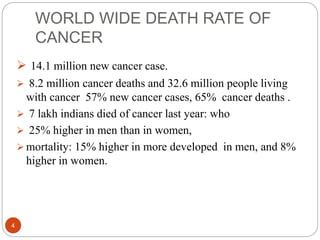
 14.1 million new cancer case.
 8.2 million cancer deaths and 32.6 million people living
with cancer 57% new cancer cases, 65% cancer deaths .
 7 lakh indians died of cancer last year: who
 25% higher in men than in women,
 mortality: 15% higher in more developed in men, and 8%
higher in women.
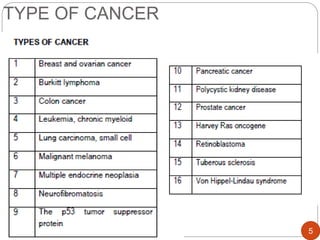
TYPE OF CANCER
5
5
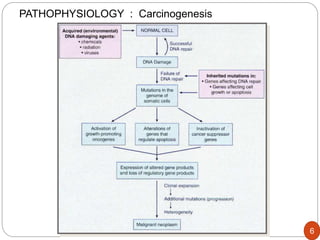
PATHOPHYSIOLOGY : Carcinogenesis
6
7
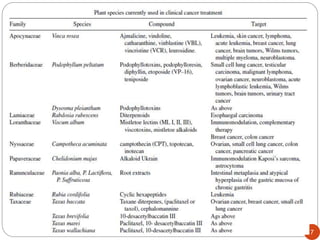
Plant Species Currently Used in Clinical Cancer Treatment
8
 1. Campotheca acuminata L. (Nyssaceae; Chinese Happy ,Tree—Xi
Shu, Cancer Tree)
 Campotheca acuminata is a native tree of Southern China and Tibet.
 MOA : It contains the quinoline alkaloid camptothecin (CPT), which
inhibits topoisomerase I and therefore DNA replication
 USE : Traditionally used in China to treat different kind of cancers,
especially cancers of the stomach and liver, and breast cancer, colon
cancers, malignant melanoma, small-cell lung cancer and leukemia.
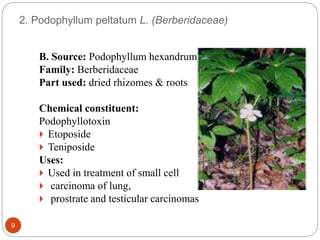
2. Podophyllum peltatum L. (Berberidaceae)
9
B. Source: Podophyllum hexandrum
Family: Berberidaceae
Part used: dried rhizomes & roots
Chemical constituent:
Podophyllotoxin
 Etoposide
 Teniposide
Uses:
 Used in treatment of small cell
 carcinoma of lung,
 prostrate and testicular carcinomas
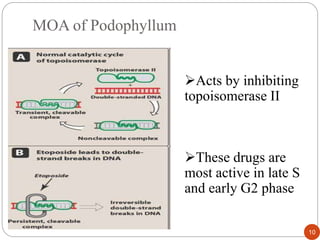
MOA of Podophyllum
10
Acts by inhibiting
topoisomerase II
These drugs are
most active in late S
and early G2 phase
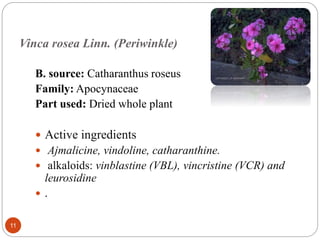
Vinca rosea Linn. (Periwinkle)
11
B. source: Catharanthus roseus
Family: Apocynaceae
Part used: Dried whole plant
 Active ingredients
 Ajmalicine, vindoline, catharanthine.
 alkaloids: vinblastine (VBL), vincristine (VCR) and
leurosidine
 .
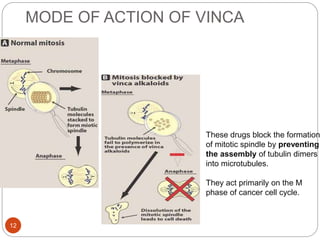
MODE OF ACTION OF VINCA
12
These drugs block the formation
of mitotic spindle by preventing
the assembly of tubulin dimers
into microtubules.
They act primarily on the M
phase of cancer cell cycle.
USES OF VINCA
13
 Traditional uses include
 soothing and healing of inflammatory ailments of the skin, as well as
eye irritations and infections. In modern medicine,
 the plant extract has been used for the treatment of diabetes, high
 blood pressure, asthma, constipation, and menstrual problems
Leukemia, skin cancer, lymphoma,
 acute leukemia, breast cancer, lung
 cancer, brain tumors, Wilms tumors,
 multiple myeloma, neuroblastoma.
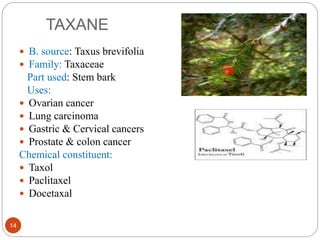
TAXANE
14
 B. source: Taxus brevifolia
 Family: Taxaceae
Part used: Stem bark
Uses:
 Ovarian cancer
 Lung carcinoma
 Gastric & Cervical cancers
 Prostate & colon cancer
Chemical constituent:
 Taxol
 Paclitaxel
 Docetaxal
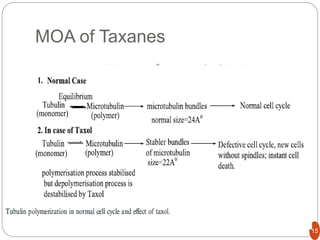
MOA of Taxanes
15
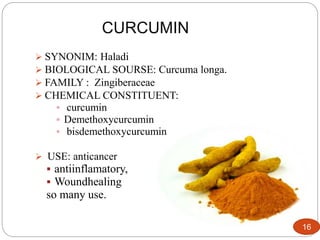
CURCUMIN
 SYNONIM: Haladi
 BIOLOGICAL SOURSE: Curcuma longa.
 FAMILY : Zingiberaceae
 CHEMICAL CONSTITUENT:
 curcumin
 Demethoxycurcumin
 bisdemethoxycurcumin
 USE: anticancer
 antiinflamatory,
 Woundhealing
so many use.
16
Anticancer activity
 Mediated partly through inhibition of protein tyrosine kinase and the apoptotic
effect may partly be mediated through inhibition of protein tyrosine kinase,
 Curcumin induces apoptotic cell death by DNA-damage in human cancer cell
 Suppression of cyclooxygenase-2 (COX-2) and lipooxygenase expression,
which blocks production of prostaglandins and leukotrienes
 Suppression of cyclin D1 which is a proto-oncogene overexpressed in many
cancers (e.g., breast, esophagus, lung, liver, head and neck, colon, and prostate
 Suppression of various inflammatory cytokines, including tumor necrosis
factor, angiogenesis, a crucial step in the growth and metastasis of many
cancers
9
 Curcumin also suppresses tumour growth through Nitric
oxide (NO) and its derivatives play a major role in tumour
promotion.
 Curcumin inhibit COX-2 production by suppression of
NFkB activation.
 Curcumin also increases NO production in Natural Killer
(NR) cells after prolonged treatment, culminating in a
stronger tumouricidal effect.
 curcumin, to suppress the growth of a variety of tumor
cells.
10
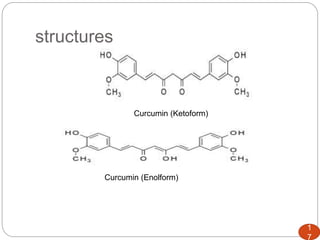
structures
Curcumin (Ketoform)
Curcumin (Enolform)
1
7
20
21
22
Conclusion
23
 Over the years, a number of approaches have been
developed for clinical use and a number of anticancer
drugs have come out of these as a result, good number
of anticancer agents have been developed from plants
or their derived agents, development of a safe,
economic and site-specific anticancer drug is still a
challenge. Perhaps, scientists will have to look towards
nature for another diverse molecule with a novel mode
of action to Treat this dreadful Disease(cancer).
References:
24
 A. D. Kinghorn, N. R. Farnsworth, D. D. Soejarto, G. A. Cordell, S. M.
Swanson, J. M. Pezzuto, M. C. Wani, M. E. Wall, N. H. Oberlies, D. J. Kroll, R.
A. Kramer, W. C. Rose, G. D. Vite, C. R. Fairchild, R. W. Peterson, R. Wild,
Pharm. Biol. 2003,
 Ram Prakash Rastogi and Bhola Nath Dhawan, Anticancer and Antiviral
Activities in Indian Medicinal Plants: A Review . Drug Dev. Res. 19:l-12, 1990
 Vandana Srivastava, Arvind Singh Negi,* J. K. Kumar, Plant-based anticancer
molecules: A chemical and biological profile of some important leads.
Bioorganic & Medicinal Chemistry 13 (2005)
 Let´ıcia Veras Costa-Lotufo a,∗, Mahmud Tareq Hassan Khanb,1, Arjumand
Ather c,Diego Veras Wilke a, Studies of the anticancer potential of plants used
in Bangladeshi folk medicine Journal of EthnoSpharmacology 99 (2005) 21–30
References:
25
 PLANTS THAT FIGHT CANCER, Edited by Spiridon E. Kintzios and Maria G.
Barberaki
 DavidG.I.Kingston,Plants Derived Natural Productsas Anticancer Agents , Springer
Science+Business Media B.V. 2011
 Mary Ann Jordan and Leslie Wilson, Microtubules as a Targets for Anticancer Drugs ,
Nature Reviewe Cancer vol 4 | Apr 2004
 Diwaker A K*1, Jadon Gu,njan Plant-Based Anticancer Molecules: A Chemical and
Biological Profile of Some Important Leads .IJARPB, 2012; Vol.2 (1):16-24
 YasukoKitagishi,MayumiKobayashi,andSatoruMatsuda, Protection against Cancer with
Medicinal Herbs via Activation of Tumor Suppressor. Journal of Oncology Volume 2012
 Spiridon E. Kintzios, Terrestrial Plant-Derived Anticancer Agents and Plant Species Used
in Anticancer Research . Critical Reviews in Plant Sciences, 25:2, 79-113
THANK YOU
26

potential of plant in cancer

  • 1.
    POTENTIAL PLANTS MOLECULEIN CANCER DISEASE Presented by Bondre Rameshwar B. M.Pharm pharmacology (S.R.T.M.U),INDIA 1
  • 2.
     Introduction  Typeof cancer Pathophysiology Different herbal plants shows anticancer activity References 2 CONTENT S
  • 3.
    CANCER:- Cancer is characterizedby rapid and uncontrolled formation of abnormal cells which may mass together to form a growth or tumor, or proliferate throughout the body, initiating abnormal growth at other sites. ANTI-CANCER DRUGS:- The Drugs that are used in inhibiting the abnormal cell growth or killing the cancer cells. 3 INTRODUCTION:
  • 4.
    WORLD WIDE DEATHRATE OF CANCER 4  14.1 million new cancer case.  8.2 million cancer deaths and 32.6 million people living with cancer 57% new cancer cases, 65% cancer deaths .  7 lakh indians died of cancer last year: who  25% higher in men than in women,  mortality: 15% higher in more developed in men, and 8% higher in women.
  • 5.
  • 6.
  • 7.
  • 8.
    Plant Species CurrentlyUsed in Clinical Cancer Treatment 8  1. Campotheca acuminata L. (Nyssaceae; Chinese Happy ,Tree—Xi Shu, Cancer Tree)  Campotheca acuminata is a native tree of Southern China and Tibet.  MOA : It contains the quinoline alkaloid camptothecin (CPT), which inhibits topoisomerase I and therefore DNA replication  USE : Traditionally used in China to treat different kind of cancers, especially cancers of the stomach and liver, and breast cancer, colon cancers, malignant melanoma, small-cell lung cancer and leukemia.
  • 9.
    2. Podophyllum peltatumL. (Berberidaceae) 9 B. Source: Podophyllum hexandrum Family: Berberidaceae Part used: dried rhizomes & roots Chemical constituent: Podophyllotoxin  Etoposide  Teniposide Uses:  Used in treatment of small cell  carcinoma of lung,  prostrate and testicular carcinomas
  • 10.
    MOA of Podophyllum 10 Actsby inhibiting topoisomerase II These drugs are most active in late S and early G2 phase
  • 11.
    Vinca rosea Linn.(Periwinkle) 11 B. source: Catharanthus roseus Family: Apocynaceae Part used: Dried whole plant  Active ingredients  Ajmalicine, vindoline, catharanthine.  alkaloids: vinblastine (VBL), vincristine (VCR) and leurosidine  .
  • 12.
    MODE OF ACTIONOF VINCA 12 These drugs block the formation of mitotic spindle by preventing the assembly of tubulin dimers into microtubules. They act primarily on the M phase of cancer cell cycle.
  • 13.
    USES OF VINCA 13 Traditional uses include  soothing and healing of inflammatory ailments of the skin, as well as eye irritations and infections. In modern medicine,  the plant extract has been used for the treatment of diabetes, high  blood pressure, asthma, constipation, and menstrual problems Leukemia, skin cancer, lymphoma,  acute leukemia, breast cancer, lung  cancer, brain tumors, Wilms tumors,  multiple myeloma, neuroblastoma.
  • 14.
    TAXANE 14  B. source:Taxus brevifolia  Family: Taxaceae Part used: Stem bark Uses:  Ovarian cancer  Lung carcinoma  Gastric & Cervical cancers  Prostate & colon cancer Chemical constituent:  Taxol  Paclitaxel  Docetaxal
  • 15.
  • 16.
    CURCUMIN  SYNONIM: Haladi BIOLOGICAL SOURSE: Curcuma longa.  FAMILY : Zingiberaceae  CHEMICAL CONSTITUENT:  curcumin  Demethoxycurcumin  bisdemethoxycurcumin  USE: anticancer  antiinflamatory,  Woundhealing so many use. 16
  • 17.
    Anticancer activity  Mediatedpartly through inhibition of protein tyrosine kinase and the apoptotic effect may partly be mediated through inhibition of protein tyrosine kinase,  Curcumin induces apoptotic cell death by DNA-damage in human cancer cell  Suppression of cyclooxygenase-2 (COX-2) and lipooxygenase expression, which blocks production of prostaglandins and leukotrienes  Suppression of cyclin D1 which is a proto-oncogene overexpressed in many cancers (e.g., breast, esophagus, lung, liver, head and neck, colon, and prostate  Suppression of various inflammatory cytokines, including tumor necrosis factor, angiogenesis, a crucial step in the growth and metastasis of many cancers 9
  • 18.
     Curcumin alsosuppresses tumour growth through Nitric oxide (NO) and its derivatives play a major role in tumour promotion.  Curcumin inhibit COX-2 production by suppression of NFkB activation.  Curcumin also increases NO production in Natural Killer (NR) cells after prolonged treatment, culminating in a stronger tumouricidal effect.  curcumin, to suppress the growth of a variety of tumor cells. 10
  • 19.
  • 20.
  • 21.
  • 22.
  • 23.
    Conclusion 23  Over theyears, a number of approaches have been developed for clinical use and a number of anticancer drugs have come out of these as a result, good number of anticancer agents have been developed from plants or their derived agents, development of a safe, economic and site-specific anticancer drug is still a challenge. Perhaps, scientists will have to look towards nature for another diverse molecule with a novel mode of action to Treat this dreadful Disease(cancer).
  • 24.
    References: 24  A. D.Kinghorn, N. R. Farnsworth, D. D. Soejarto, G. A. Cordell, S. M. Swanson, J. M. Pezzuto, M. C. Wani, M. E. Wall, N. H. Oberlies, D. J. Kroll, R. A. Kramer, W. C. Rose, G. D. Vite, C. R. Fairchild, R. W. Peterson, R. Wild, Pharm. Biol. 2003,  Ram Prakash Rastogi and Bhola Nath Dhawan, Anticancer and Antiviral Activities in Indian Medicinal Plants: A Review . Drug Dev. Res. 19:l-12, 1990  Vandana Srivastava, Arvind Singh Negi,* J. K. Kumar, Plant-based anticancer molecules: A chemical and biological profile of some important leads. Bioorganic & Medicinal Chemistry 13 (2005)  Let´ıcia Veras Costa-Lotufo a,∗, Mahmud Tareq Hassan Khanb,1, Arjumand Ather c,Diego Veras Wilke a, Studies of the anticancer potential of plants used in Bangladeshi folk medicine Journal of EthnoSpharmacology 99 (2005) 21–30
  • 25.
    References: 25  PLANTS THATFIGHT CANCER, Edited by Spiridon E. Kintzios and Maria G. Barberaki  DavidG.I.Kingston,Plants Derived Natural Productsas Anticancer Agents , Springer Science+Business Media B.V. 2011  Mary Ann Jordan and Leslie Wilson, Microtubules as a Targets for Anticancer Drugs , Nature Reviewe Cancer vol 4 | Apr 2004  Diwaker A K*1, Jadon Gu,njan Plant-Based Anticancer Molecules: A Chemical and Biological Profile of Some Important Leads .IJARPB, 2012; Vol.2 (1):16-24  YasukoKitagishi,MayumiKobayashi,andSatoruMatsuda, Protection against Cancer with Medicinal Herbs via Activation of Tumor Suppressor. Journal of Oncology Volume 2012  Spiridon E. Kintzios, Terrestrial Plant-Derived Anticancer Agents and Plant Species Used in Anticancer Research . Critical Reviews in Plant Sciences, 25:2, 79-113
  • 26.