In this section you will learn
what is cancer ….
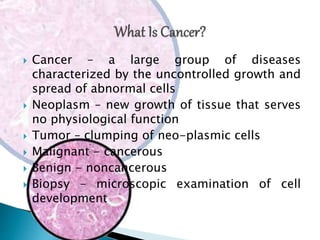
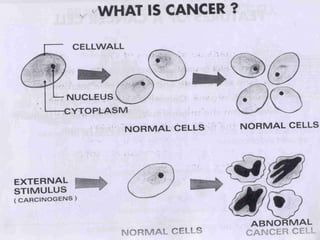
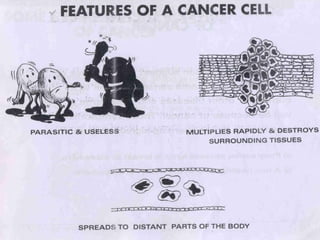
 Cancer – a large group of diseases
characterized by the uncontrolled growth and
spread of abnormal cells
 Neoplasm – new growth of tissue that serves
no physiological function
 Tumor – clumping of neo-plasmic cells
 Malignant - cancerous
 Benign - noncancerous
 Biopsy – microscopic examination of cell
development
 Metastasis – malignant tumors that are not
enclosed in a protective capsule have the
ability to spread to other organs
 Mutant cells – disruption of RNA and DNA
within normal cells may produce cells that
differ in form, quality and function from the
normal cell
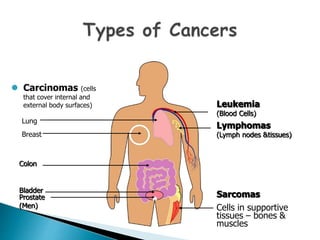
 Carcinomas (cells
that cover internal and
external body surfaces)
Lung
Breast
Colon
Bladder
Prostate
(Men)
Leukemia
(Blood Cells)
Lymphomas
(Lymph nodes &tissues)
Sarcomas
Cells in supportive
tissues – bones &
muscles
In this section you will get to
know the signs and symptoms
of cancer…
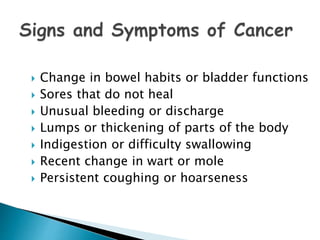
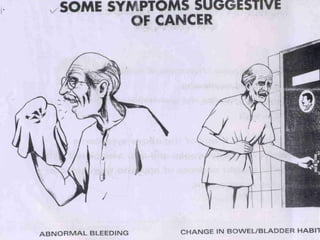
 Change in bowel habits or bladder functions
 Sores that do not heal
 Unusual bleeding or discharge
 Lumps or thickening of parts of the body
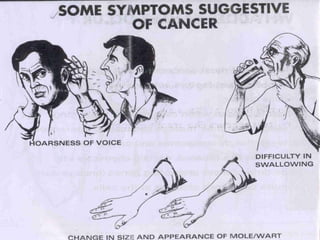
 Indigestion or difficulty swallowing
 Recent change in wart or mole
 Persistent coughing or hoarseness
In this section you will learn
the factors that cause cancer…
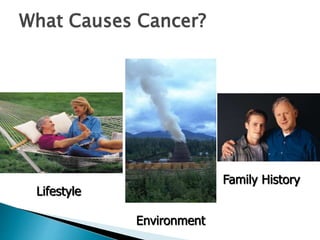
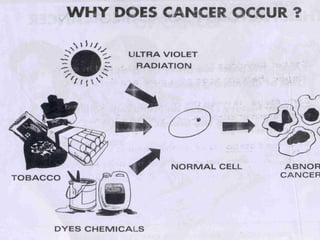
What Causes Cancer?
Lifestyle
Environment
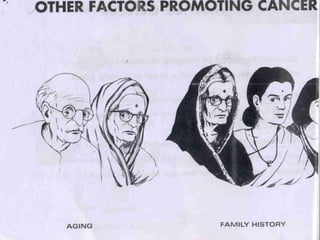
Family History
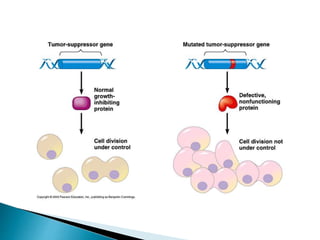
 Cancer arises from the mutation of a normal
gene.
 Mutated genes that cause cancer are called
oncogenes.
 It is thought that several mutations need to
occur to give rise to cancer
 Cells that are old or not functioning properly
normally self destruct and are replaced by new
cells.
 However, cancerous cells do not self destruct
and continue to divide rapidly producing
millions of new cancerous cells.
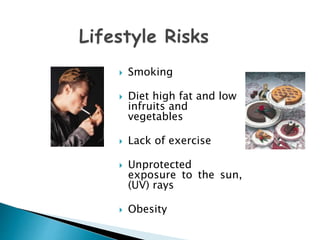
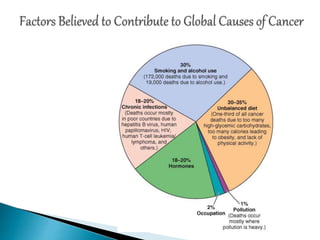
 Smoking
 Diet high fat and low
infruits and
vegetables
 Lack of exercise
 Unprotected
exposure to the sun,
(UV) rays
 Obesity
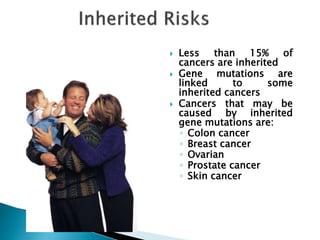
 Less than 15% of
cancers are inherited
 Gene mutations are
linked to some
inherited cancers
 Cancers that may be
caused by inherited
gene mutations are:
◦ Colon cancer
◦ Breast cancer
◦ Ovarian
◦ Prostate cancer
◦ Skin cancer
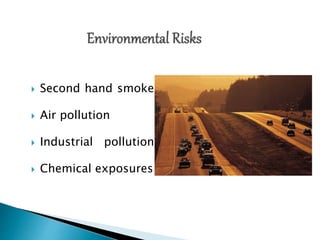
 Second hand smoke
 Air pollution
 Industrial pollution
 Chemical exposures
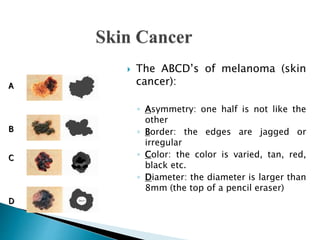
 The ABCD’s of melanoma (skin
cancer):
◦ Asymmetry: one half is not like the
other
◦ Border: the edges are jagged or
irregular
◦ Color: the color is varied, tan, red,
black etc.
◦ Diameter: the diameter is larger than
8mm (the top of a pencil eraser)
A
B
C
D
 Ionising radiation – X Rays, UV light
 Chemicals – Tar from cigarettes
 Virus infection – Papilloma virus can be responsible
for cervical cancer.
 Hereditary predisposition – Some families are more
susceptible to getting certain cancers. Remember
you can’t inherit cancer its just that you maybe
more susceptible to getting it.
 Being overweight or obese increases risk of several
cancers including colon and breast
 Two – thirds of men and half of women in Britain are
overweight
 An estimated 13,000 cases of cancer could be
prevented each year in the UK if no one had BMI
greater than 25
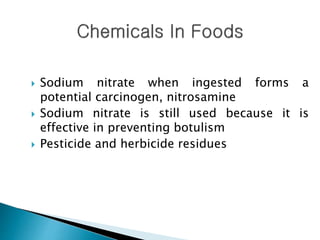
 Sodium nitrate when ingested forms a
potential carcinogen, nitrosamine
 Sodium nitrate is still used because it is
effective in preventing botulism
 Pesticide and herbicide residues
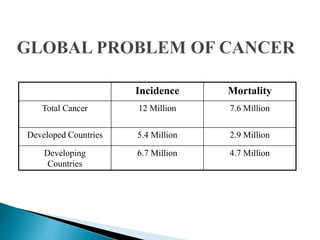
Incidence Mortality
Total Cancer 12 Million 7.6 Million
Developed Countries 5.4 Million 2.9 Million
Developing
Countries
6.7 Million 4.7 Million
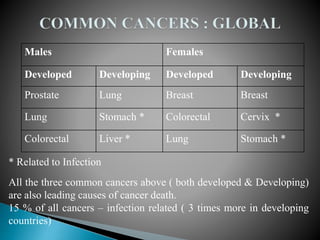
Males Females
Developed Developing Developed Developing
Prostate Lung Breast Breast
Lung Stomach * Colorectal Cervix *
Colorectal Liver * Lung Stomach *
* Related to Infection
All the three common cancers above ( both developed & Developing)
are also leading causes of cancer death.
15 % of all cancers – infection related ( 3 times more in developing
countries)
 Deaths from infectious diseases
 Childhood mortality
 Longevity
 Adoption of Western Life style
◦ Cigarette Smoking
◦ Higher consumption of saturated fat
◦ Consumption of Calorie dense foods
◦ Physical activity
Survival rates poorer in developing countries (lack
of availability of early detection and treatment
services)
 Estimated Population : 1,048 million
 Estimated New Cancer Cases : 9.50 lakhs
4.3 Males
5.2 Females
 Estimated Tobacco Related
Cancer : 2,66,000
 Estimated Breast Cancer : 1,15,251
 Estimated Cervix Cancer : 1,34,420
(27% of world
burden)
In this section you will see
how cancer can be prevented..
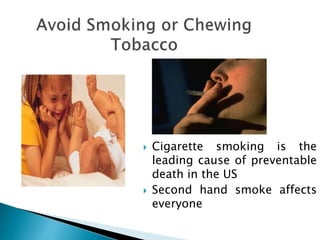
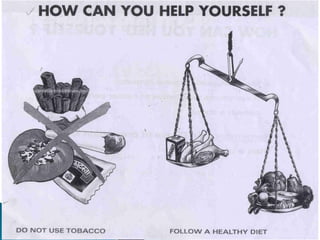
 Cigarette smoking is the
leading cause of preventable
death in the US
 Second hand smoke affects
everyone
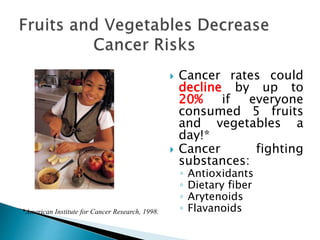
 Cancer rates could
decline by up to
20% if everyone
consumed 5 fruits
and vegetables a
day!*
 Cancer fighting
substances:
◦ Antioxidants
◦ Dietary fiber
◦ Arytenoids
◦ Flavanoids*American Institute for Cancer Research, 1998.
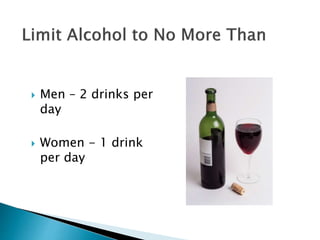
 Men – 2 drinks per
day
 Women - 1 drink
per day
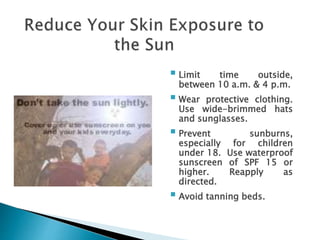
 Limit time outside,
between 10 a.m. & 4 p.m.
 Wear protective clothing.
Use wide-brimmed hats
and sunglasses.
 Prevent sunburns,
especially for children
under 18. Use waterproof
sunscreen of SPF 15 or
higher. Reapply as
directed.
 Avoid tanning beds.
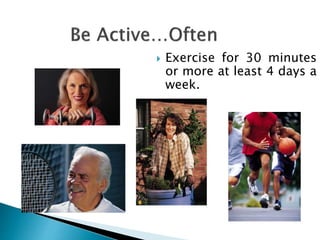
 Exercise for 30 minutes
or more at least 4 days a
week.
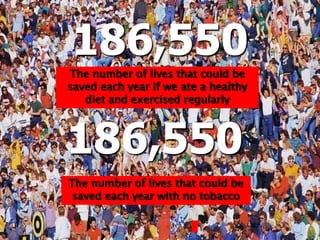
186,550
The number of lives that could be
saved each year if we ate a healthy
diet and exercised regularly
186,550
The number of lives that could be
saved each year with no tobacco
My cancer ppt
My cancer ppt
My cancer ppt

My cancer ppt

  • 2.
    In this sectionyou will learn what is cancer ….
  • 3.
     Cancer –a large group of diseases characterized by the uncontrolled growth and spread of abnormal cells  Neoplasm – new growth of tissue that serves no physiological function  Tumor – clumping of neo-plasmic cells  Malignant - cancerous  Benign - noncancerous  Biopsy – microscopic examination of cell development
  • 4.
     Metastasis –malignant tumors that are not enclosed in a protective capsule have the ability to spread to other organs  Mutant cells – disruption of RNA and DNA within normal cells may produce cells that differ in form, quality and function from the normal cell
  • 8.
     Carcinomas (cells thatcover internal and external body surfaces) Lung Breast Colon Bladder Prostate (Men) Leukemia (Blood Cells) Lymphomas (Lymph nodes &tissues) Sarcomas Cells in supportive tissues – bones & muscles
  • 10.
    In this sectionyou will get to know the signs and symptoms of cancer…
  • 11.
     Change inbowel habits or bladder functions  Sores that do not heal  Unusual bleeding or discharge  Lumps or thickening of parts of the body  Indigestion or difficulty swallowing  Recent change in wart or mole  Persistent coughing or hoarseness
  • 14.
    In this sectionyou will learn the factors that cause cancer…
  • 15.
  • 16.
     Cancer arisesfrom the mutation of a normal gene.  Mutated genes that cause cancer are called oncogenes.  It is thought that several mutations need to occur to give rise to cancer  Cells that are old or not functioning properly normally self destruct and are replaced by new cells.  However, cancerous cells do not self destruct and continue to divide rapidly producing millions of new cancerous cells.
  • 19.
     Smoking  Diethigh fat and low infruits and vegetables  Lack of exercise  Unprotected exposure to the sun, (UV) rays  Obesity
  • 20.
     Less than15% of cancers are inherited  Gene mutations are linked to some inherited cancers  Cancers that may be caused by inherited gene mutations are: ◦ Colon cancer ◦ Breast cancer ◦ Ovarian ◦ Prostate cancer ◦ Skin cancer
  • 21.
     Second handsmoke  Air pollution  Industrial pollution  Chemical exposures
  • 22.
     The ABCD’sof melanoma (skin cancer): ◦ Asymmetry: one half is not like the other ◦ Border: the edges are jagged or irregular ◦ Color: the color is varied, tan, red, black etc. ◦ Diameter: the diameter is larger than 8mm (the top of a pencil eraser) A B C D
  • 23.
     Ionising radiation– X Rays, UV light  Chemicals – Tar from cigarettes  Virus infection – Papilloma virus can be responsible for cervical cancer.  Hereditary predisposition – Some families are more susceptible to getting certain cancers. Remember you can’t inherit cancer its just that you maybe more susceptible to getting it.
  • 24.
     Being overweightor obese increases risk of several cancers including colon and breast  Two – thirds of men and half of women in Britain are overweight  An estimated 13,000 cases of cancer could be prevented each year in the UK if no one had BMI greater than 25
  • 25.
     Sodium nitratewhen ingested forms a potential carcinogen, nitrosamine  Sodium nitrate is still used because it is effective in preventing botulism  Pesticide and herbicide residues
  • 28.
    Incidence Mortality Total Cancer12 Million 7.6 Million Developed Countries 5.4 Million 2.9 Million Developing Countries 6.7 Million 4.7 Million
  • 29.
    Males Females Developed DevelopingDeveloped Developing Prostate Lung Breast Breast Lung Stomach * Colorectal Cervix * Colorectal Liver * Lung Stomach * * Related to Infection All the three common cancers above ( both developed & Developing) are also leading causes of cancer death. 15 % of all cancers – infection related ( 3 times more in developing countries)
  • 30.
     Deaths frominfectious diseases  Childhood mortality  Longevity  Adoption of Western Life style ◦ Cigarette Smoking ◦ Higher consumption of saturated fat ◦ Consumption of Calorie dense foods ◦ Physical activity Survival rates poorer in developing countries (lack of availability of early detection and treatment services)
  • 31.
     Estimated Population: 1,048 million  Estimated New Cancer Cases : 9.50 lakhs 4.3 Males 5.2 Females  Estimated Tobacco Related Cancer : 2,66,000  Estimated Breast Cancer : 1,15,251  Estimated Cervix Cancer : 1,34,420 (27% of world burden)
  • 32.
    In this sectionyou will see how cancer can be prevented..
  • 33.
     Cigarette smokingis the leading cause of preventable death in the US  Second hand smoke affects everyone
  • 34.
     Cancer ratescould decline by up to 20% if everyone consumed 5 fruits and vegetables a day!*  Cancer fighting substances: ◦ Antioxidants ◦ Dietary fiber ◦ Arytenoids ◦ Flavanoids*American Institute for Cancer Research, 1998.
  • 35.
     Men –2 drinks per day  Women - 1 drink per day
  • 36.
     Limit timeoutside, between 10 a.m. & 4 p.m.  Wear protective clothing. Use wide-brimmed hats and sunglasses.  Prevent sunburns, especially for children under 18. Use waterproof sunscreen of SPF 15 or higher. Reapply as directed.  Avoid tanning beds.
  • 37.
     Exercise for30 minutes or more at least 4 days a week.
  • 39.
    186,550 The number oflives that could be saved each year if we ate a healthy diet and exercised regularly 186,550 The number of lives that could be saved each year with no tobacco