Cancer
Mohammed Sami Abd_Elaziz
College Science , Al_AZHAR University
Egypt
Phone : 00201157017514
Email : mohammedsamy1196@gmail.com
linked in : linkedin.com/in/mohammed-sami-2106a4125
Objectives:
• Introduction
• What is Cancer ?
• Benign & Malignant .
• Types of Cancer .
• Number of Cases, Deaths and Survivors .
• Causes of Cancer (Factors are dealing to mutation) .
• Genetics of cancer .
• Cancer Hallmarks
• Types of cancer treatment .
• cancer prevention .
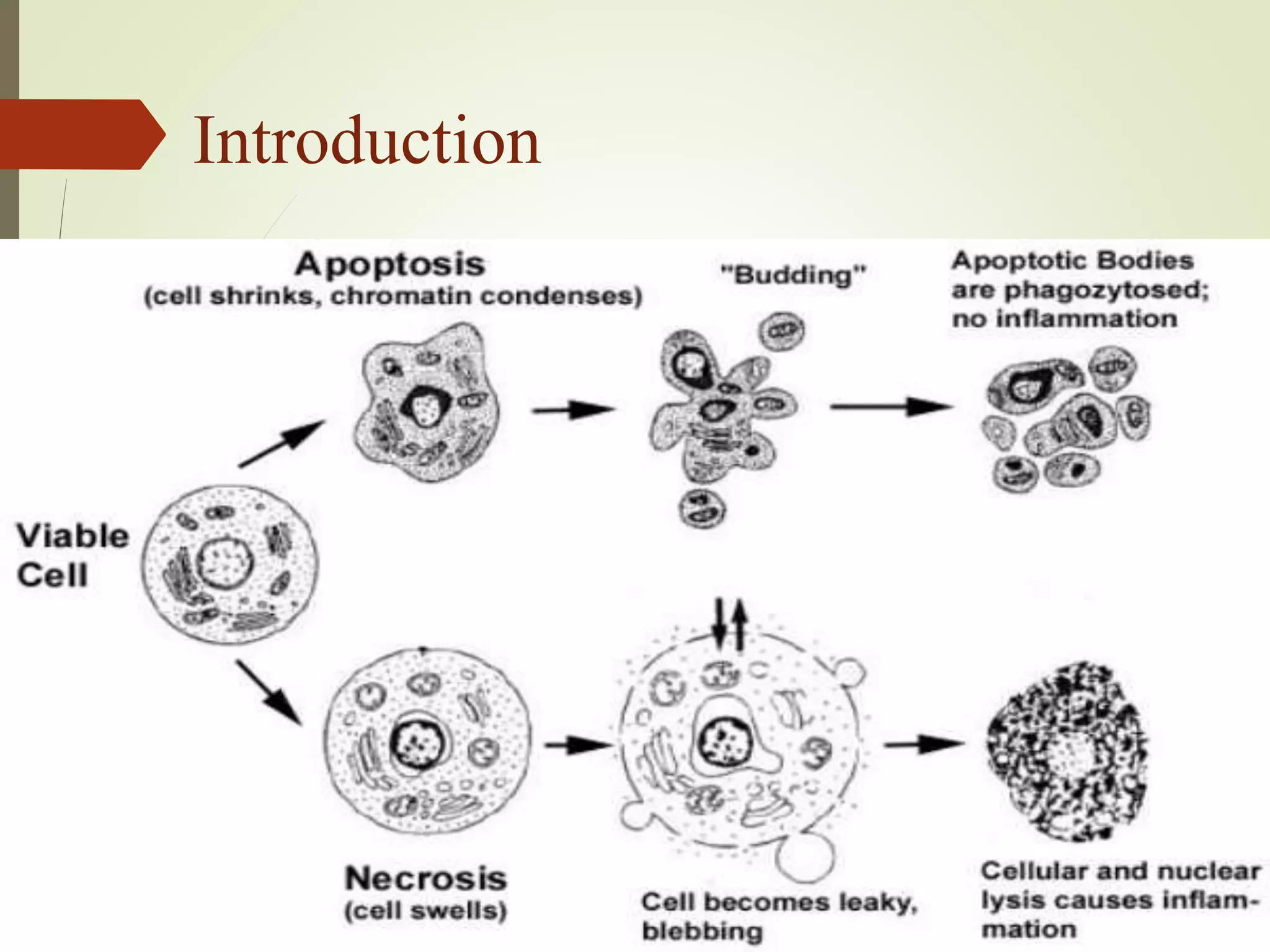
Introduction
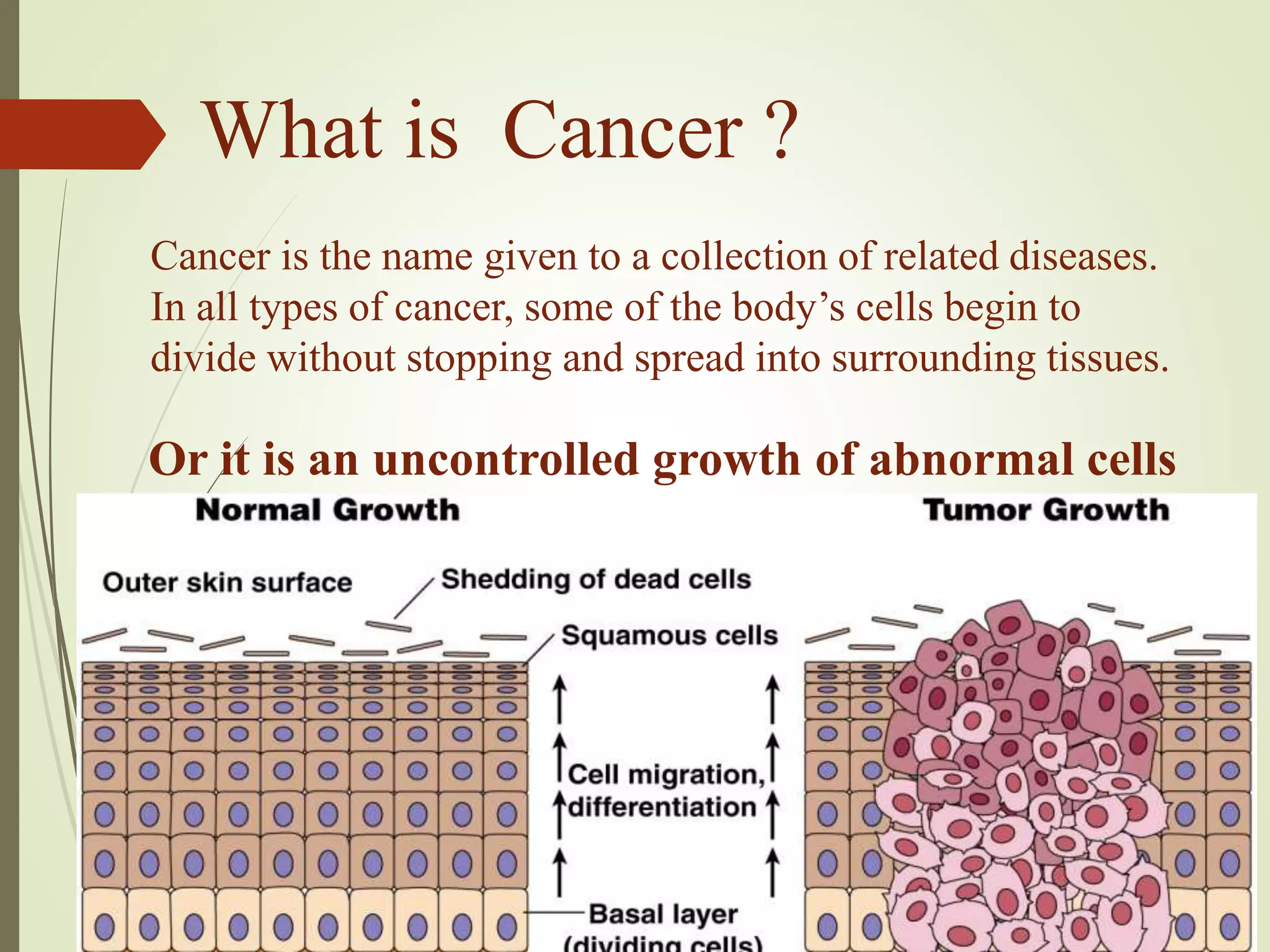
What is Cancer ?
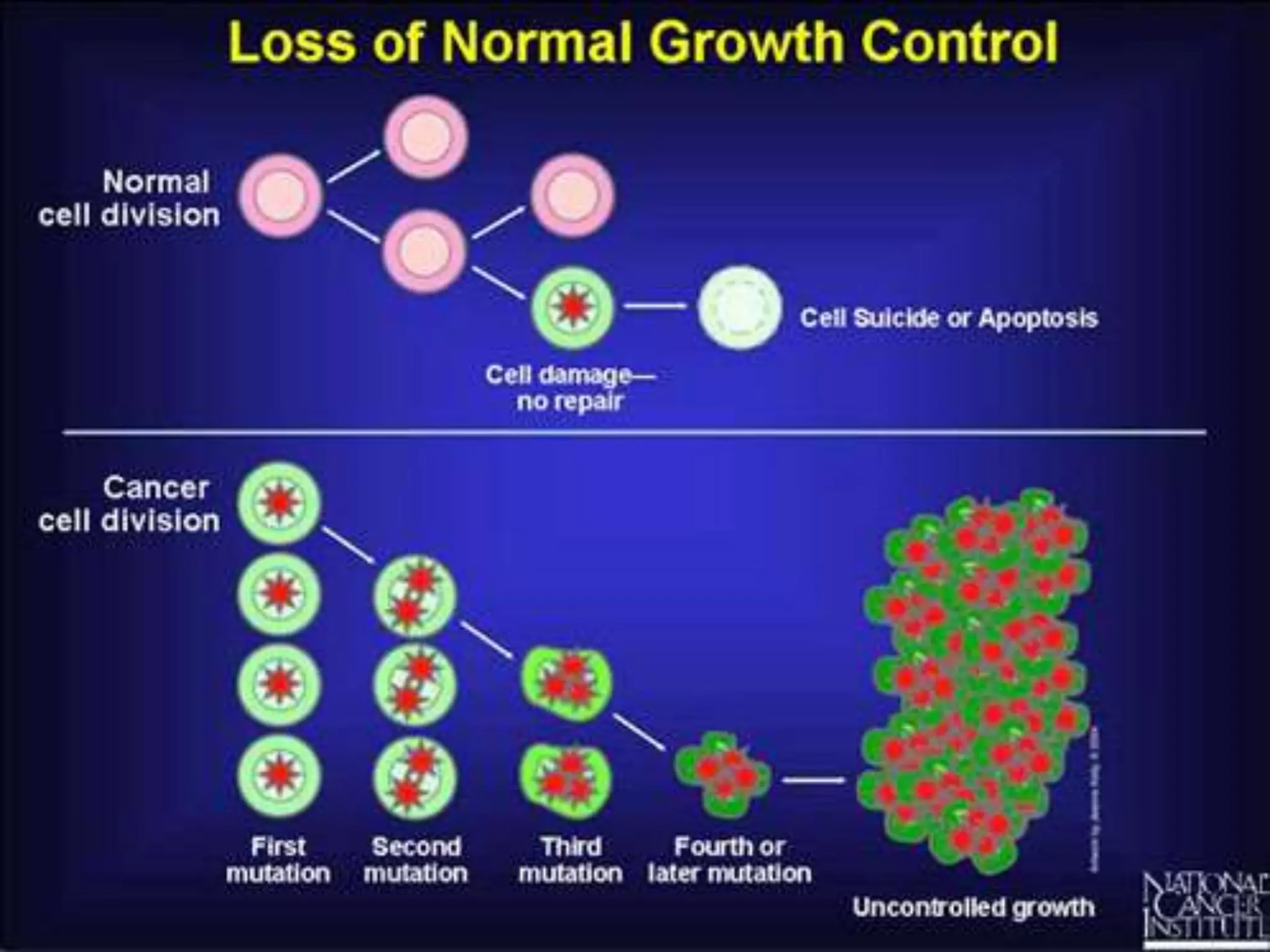
Cancer is the name given to a collection of related diseases.
In all types of cancer, some of the body’s cells begin to
divide without stopping and spread into surrounding tissues.
Or it is an uncontrolled growth of abnormal cells
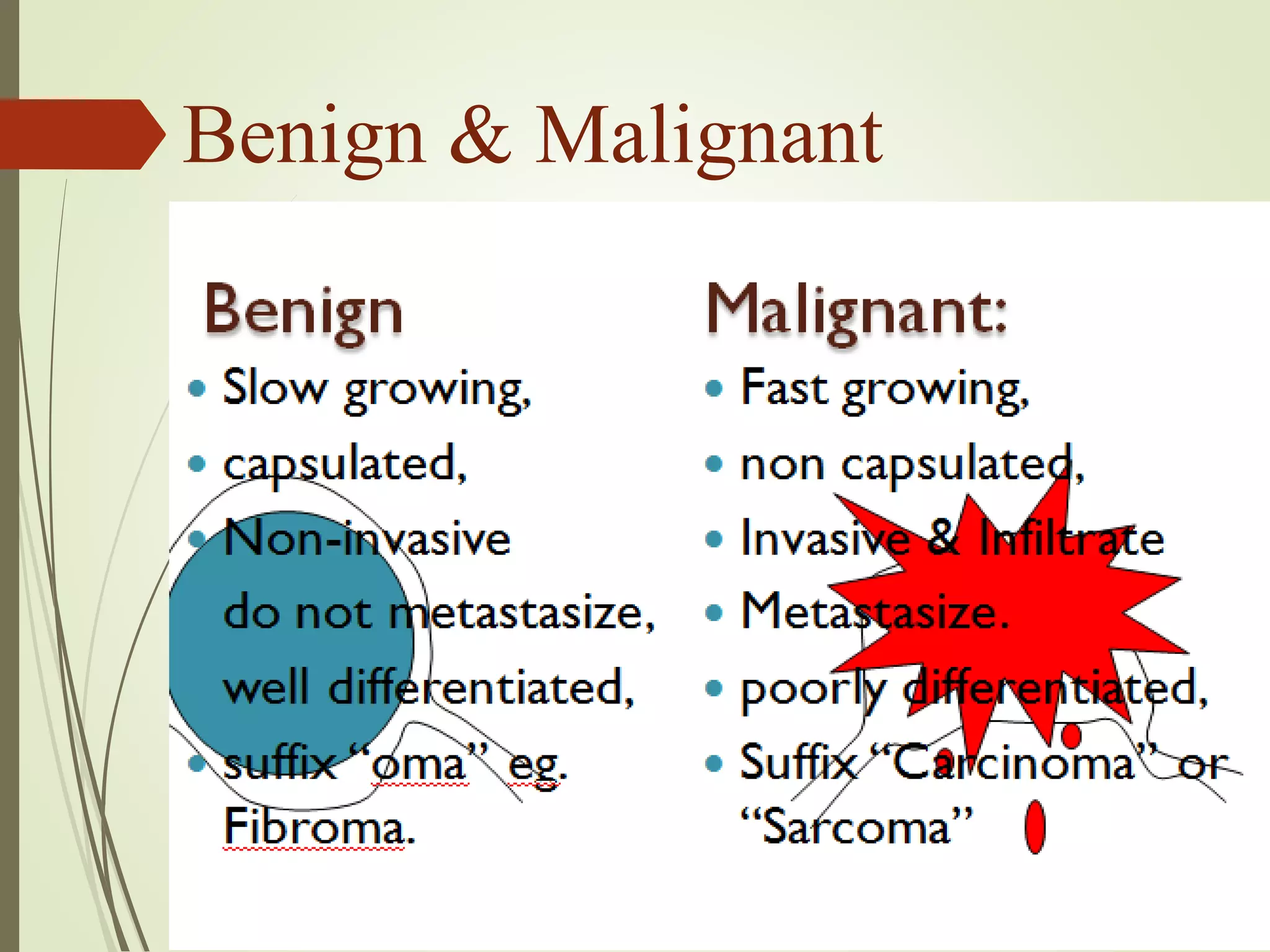
Benign & Malignant
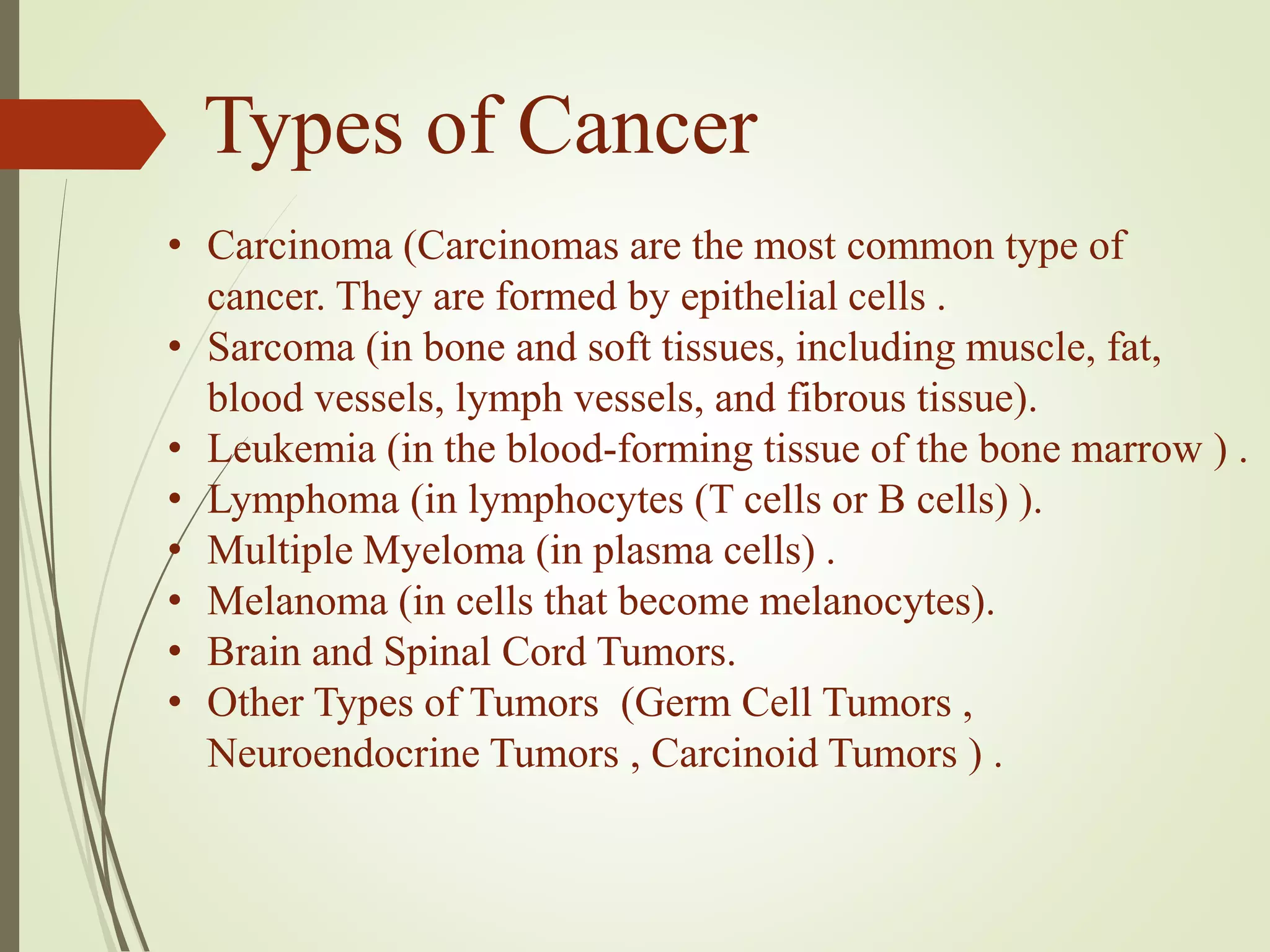
Types of Cancer
• Carcinoma (Carcinomas are the most common type of
cancer. They are formed by epithelial cells .
• Sarcoma (in bone and soft tissues, including muscle, fat,
blood vessels, lymph vessels, and fibrous tissue).
• Leukemia (in the blood-forming tissue of the bone marrow ) .
• Lymphoma (in lymphocytes (T cells or B cells) ).
• Multiple Myeloma (in plasma cells) .
• Melanoma (in cells that become melanocytes).
• Brain and Spinal Cord Tumors.
• Other Types of Tumors (Germ Cell Tumors ,
Neuroendocrine Tumors , Carcinoid Tumors ) .
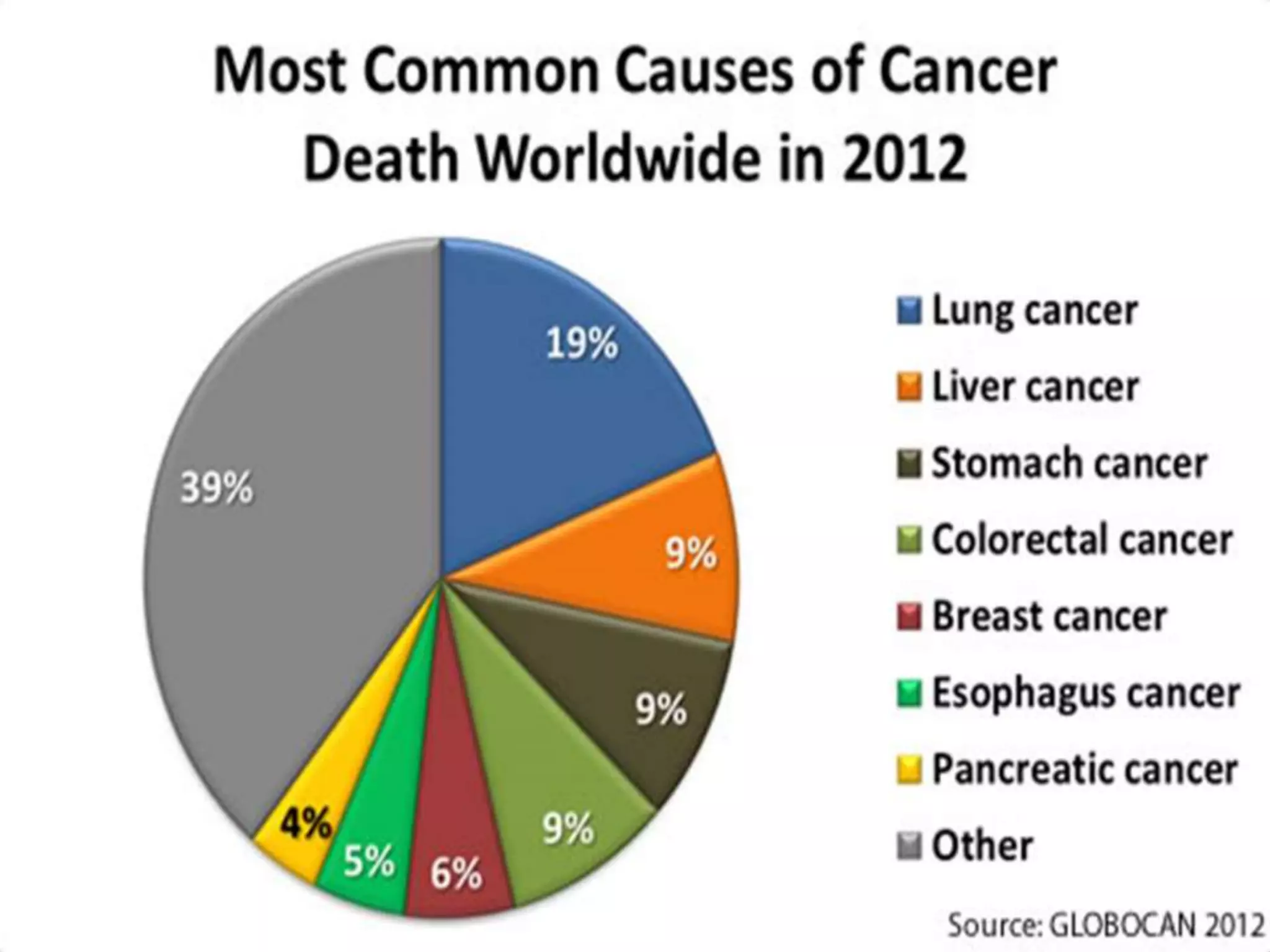
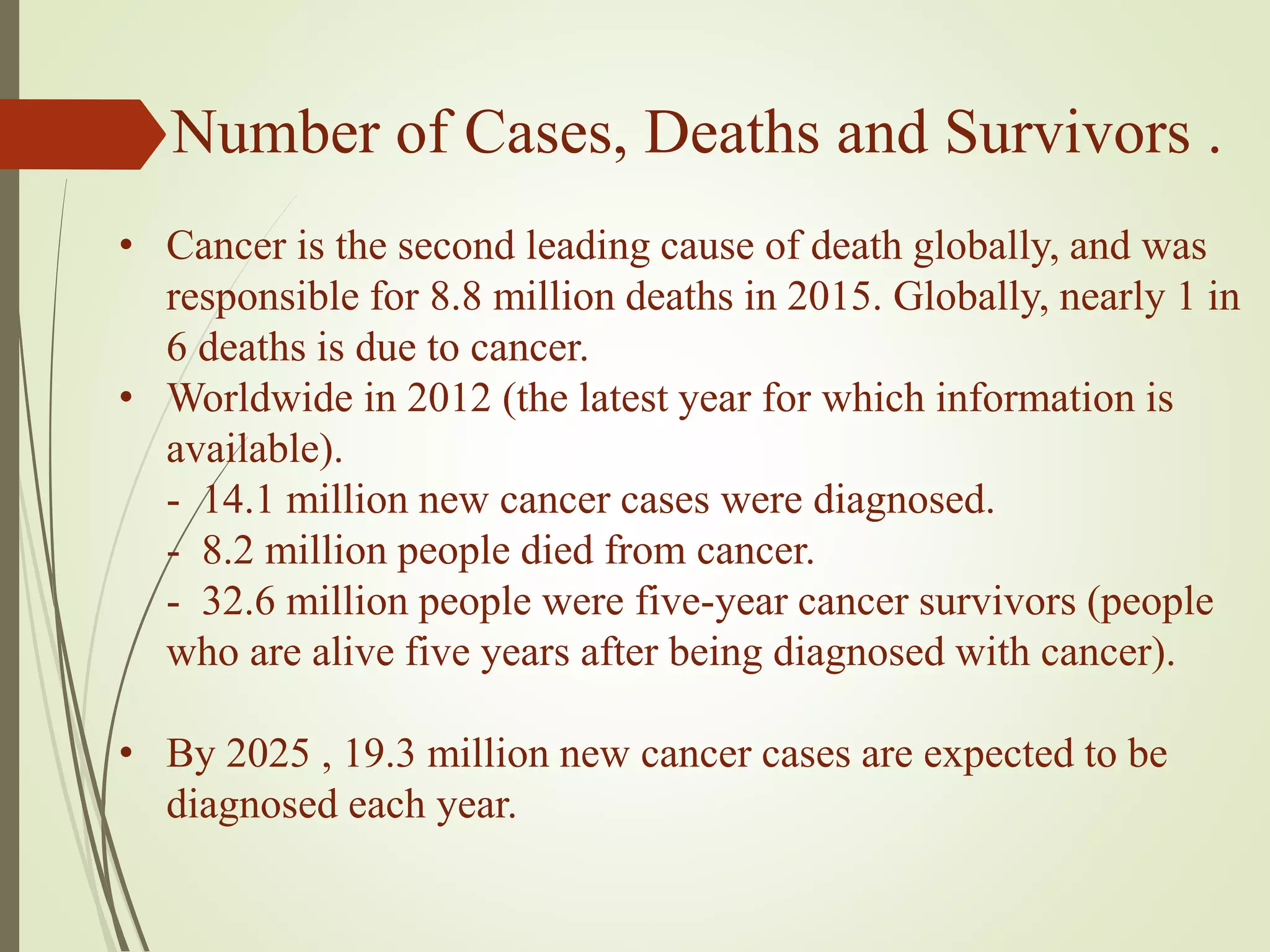
Number of Cases, Deaths and Survivors .
• Cancer is the second leading cause of death globally, and was
responsible for 8.8 million deaths in 2015. Globally, nearly 1 in
6 deaths is due to cancer.
• Worldwide in 2012 (the latest year for which information is
available).
- 14.1 million new cancer cases were diagnosed.
- 8.2 million people died from cancer.
- 32.6 million people were five-year cancer survivors (people
who are alive five years after being diagnosed with cancer).
• By 2025 , 19.3 million new cancer cases are expected to be
diagnosed each year.
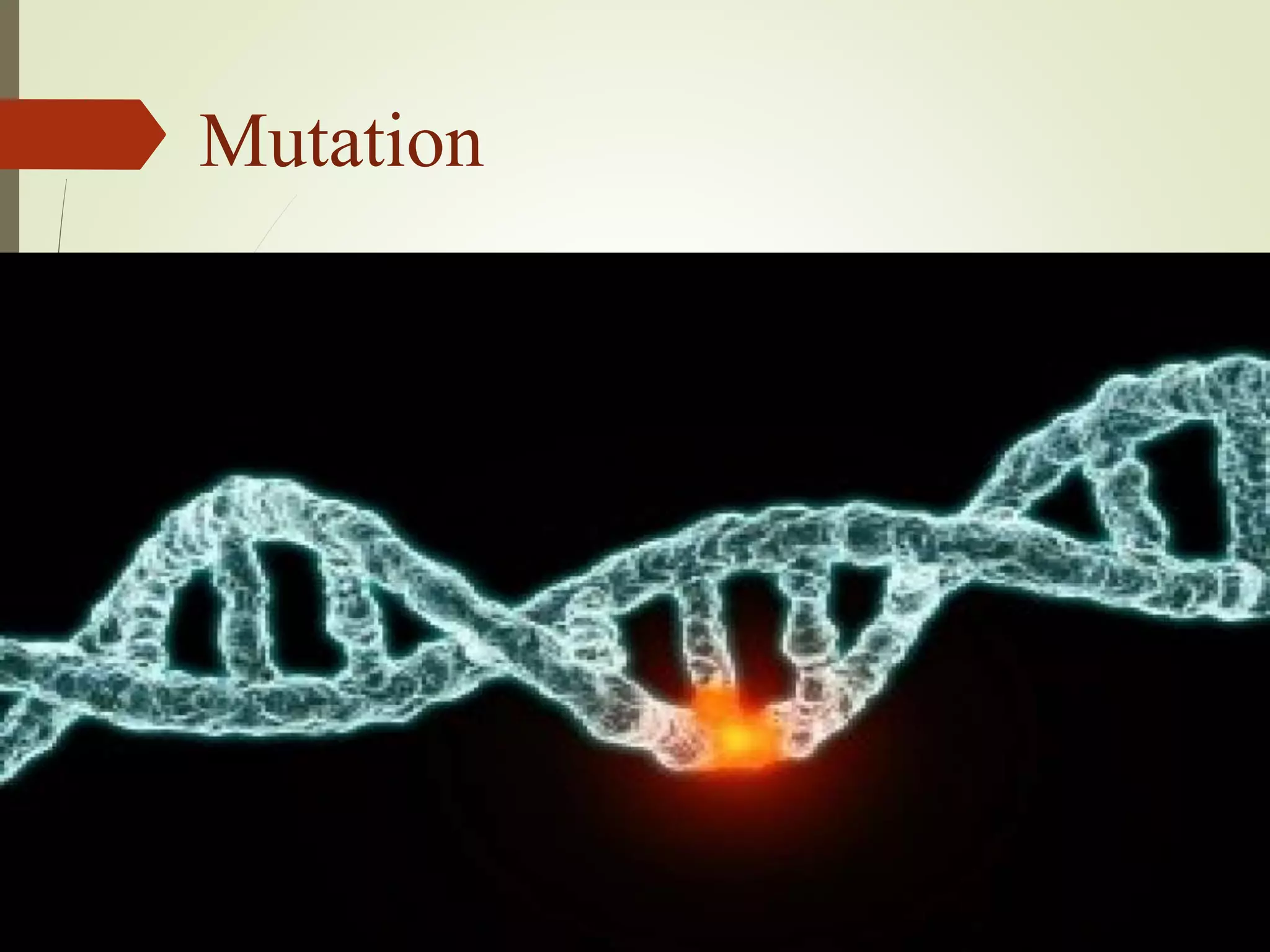
Mutation
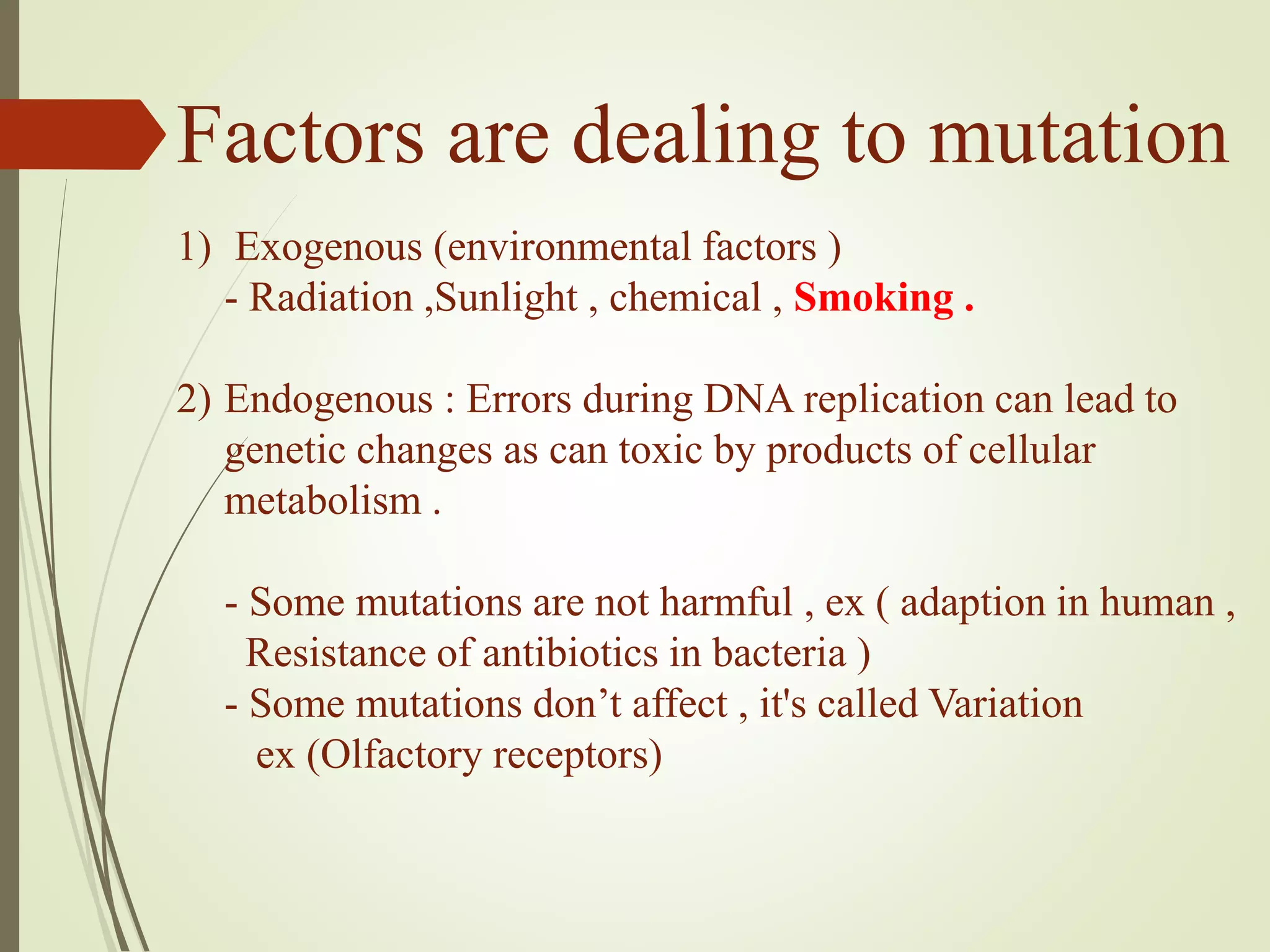
Factors are dealing to mutation
1) Exogenous (environmental factors )
- Radiation ,Sunlight , chemical , Smoking .
2) Endogenous : Errors during DNA replication can lead to
genetic changes as can toxic by products of cellular
metabolism .
- Some mutations are not harmful , ex ( adaption in human ,
Resistance of antibiotics in bacteria )
- Some mutations don’t affect , it's called Variation
ex (Olfactory receptors(
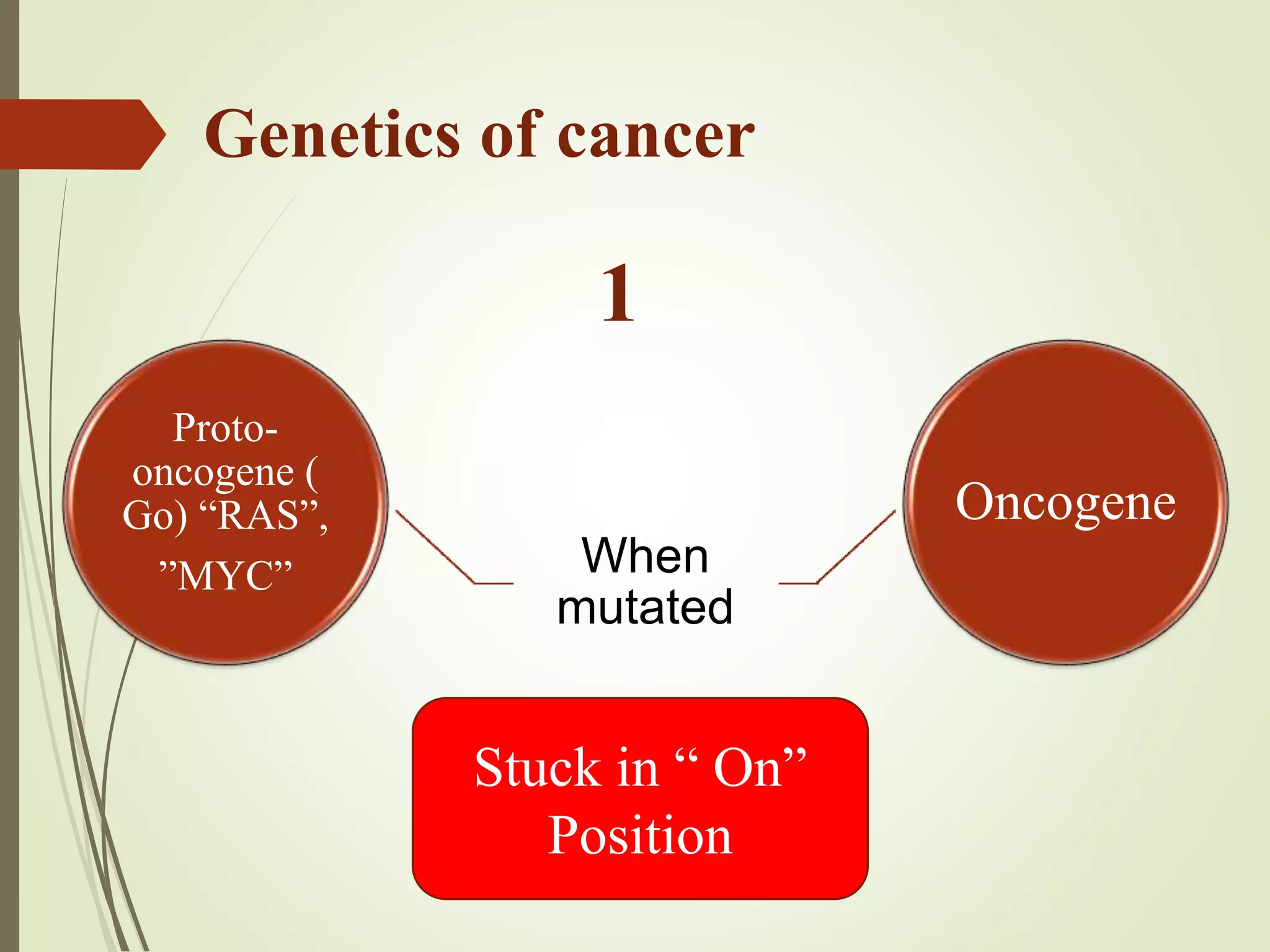
Genetics of cancer
Proto-
oncogene (
Go) “RAS”,
”MYC” When
mutated
Oncogene
1
Stuck in “ On”
Position
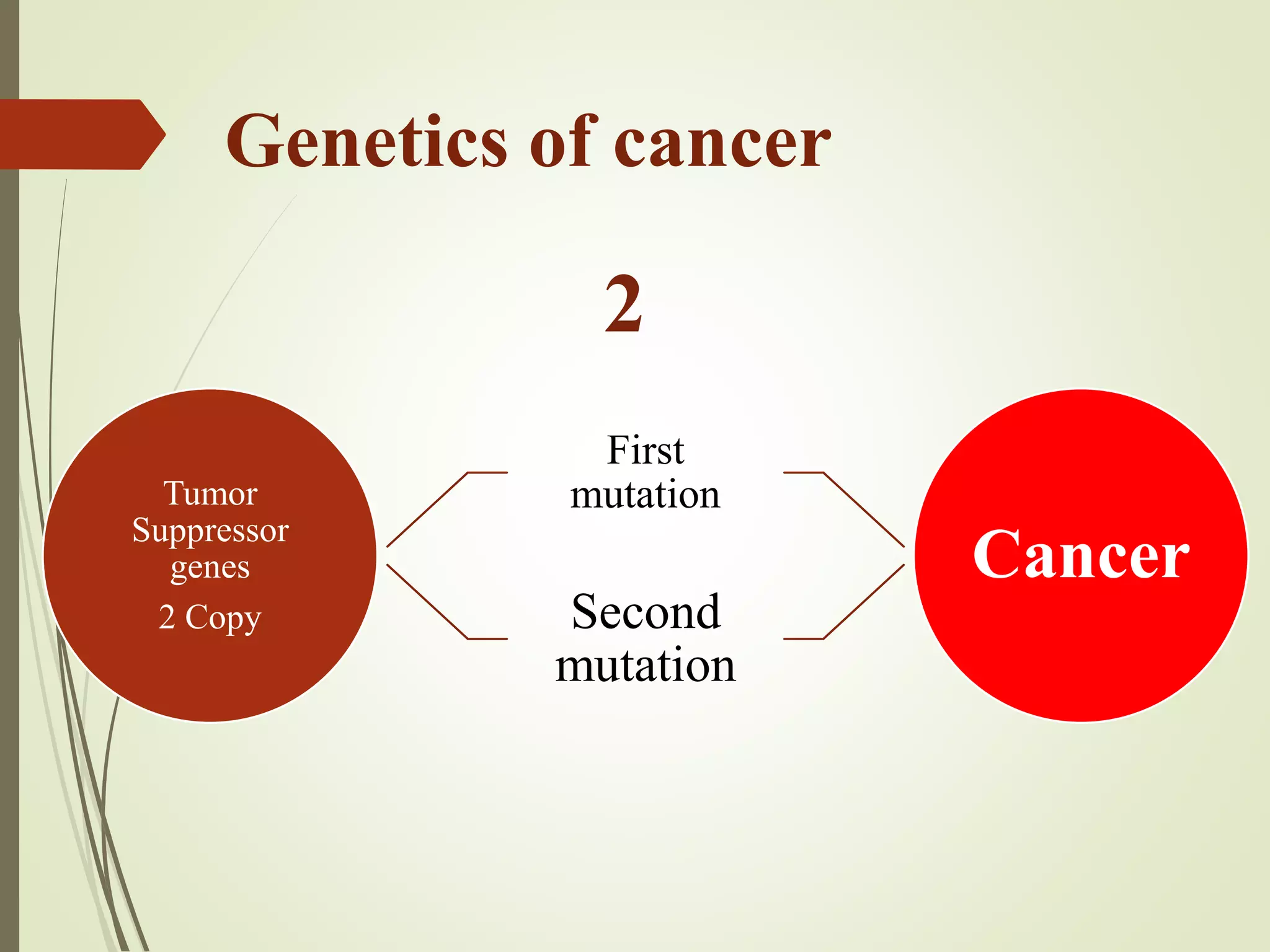
Genetics of cancer
Tumor
Suppressor
genes
2 Copy
First
mutation
Second
mutation
Cancer
2
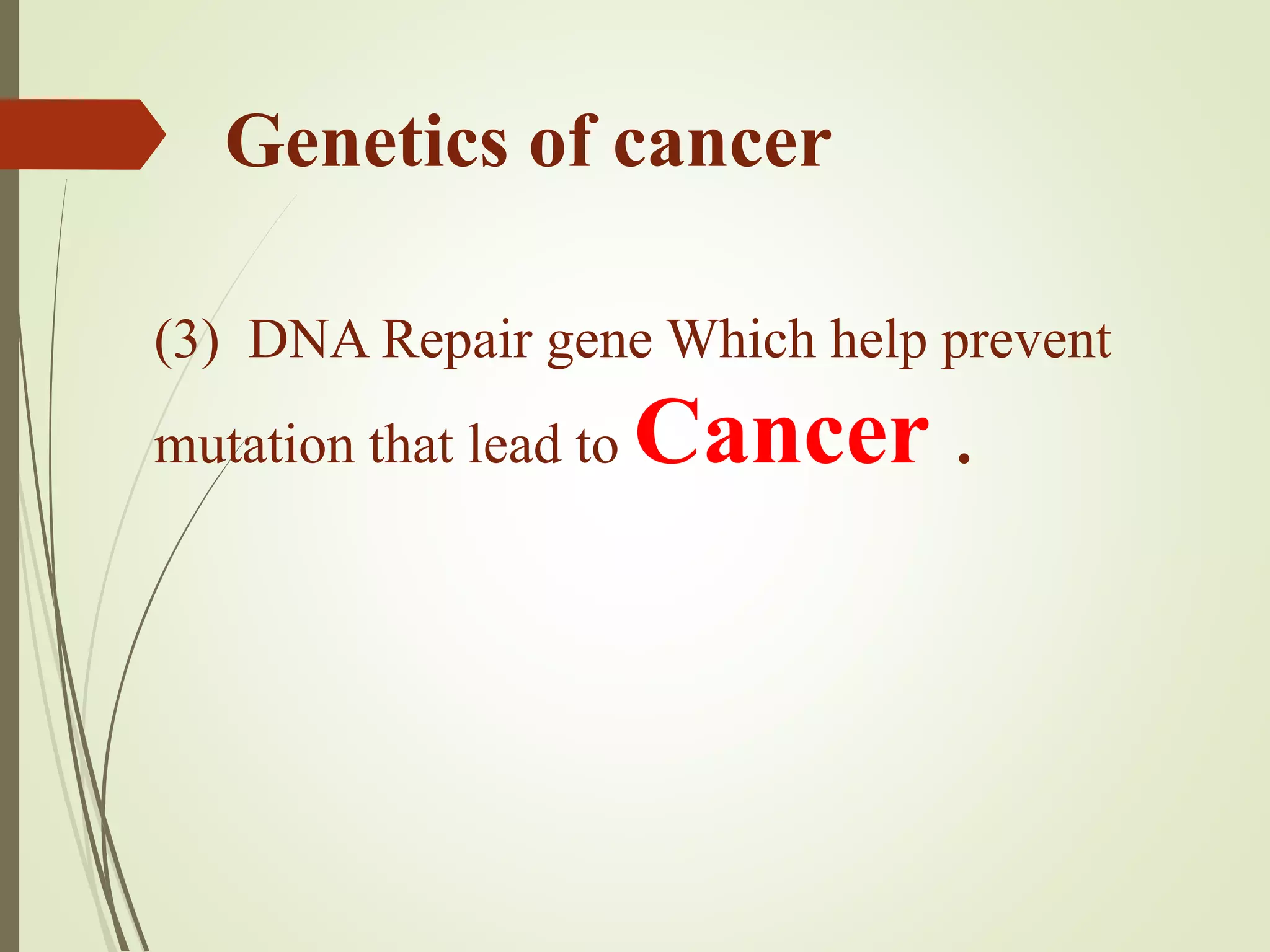
(3) DNA Repair gene Which help prevent
mutation that lead to Cancer .
Genetics of cancer
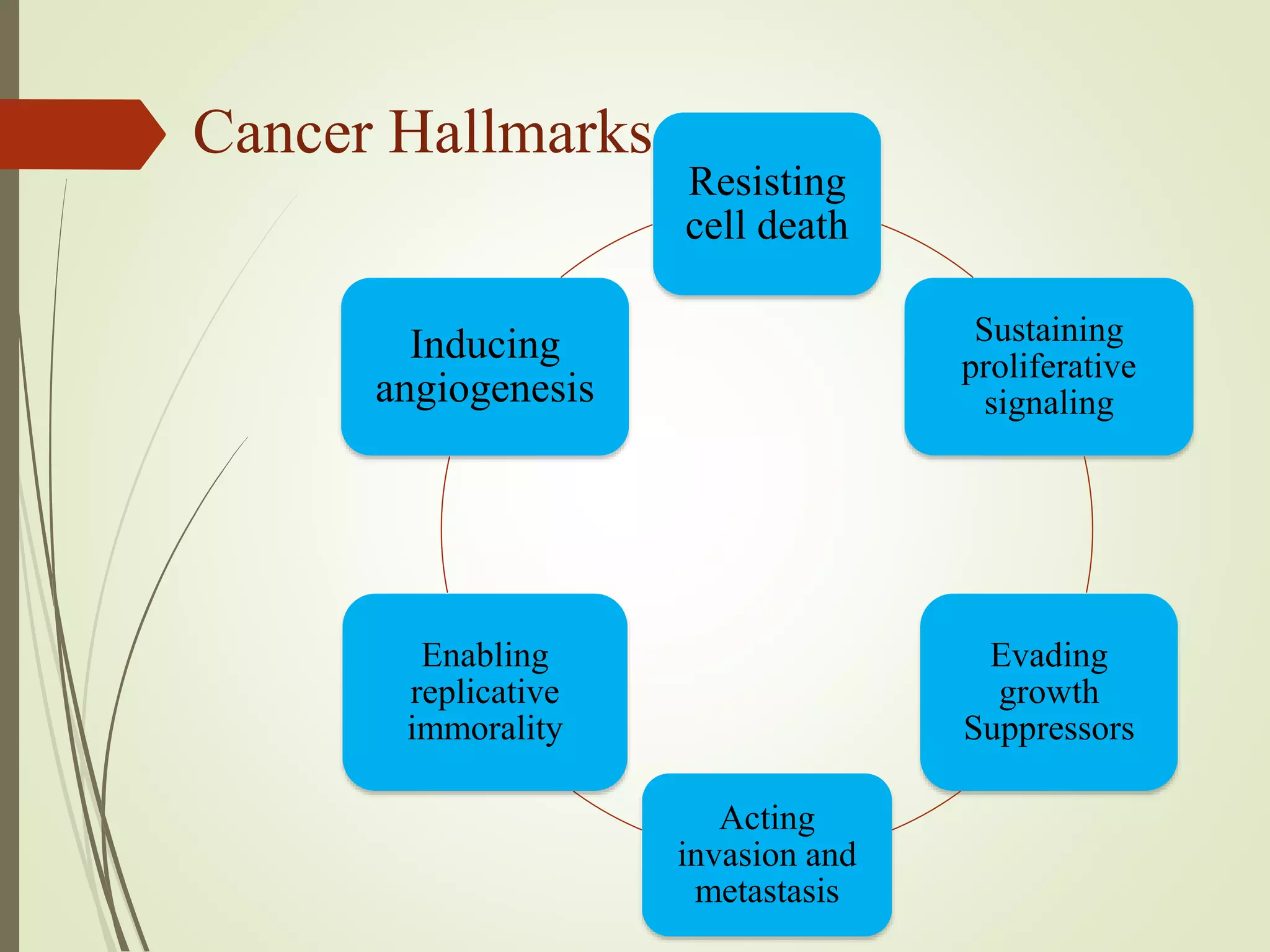
Resisting
cell death
Sustaining
proliferative
signaling
Evading
growth
Suppressors
Acting
invasion and
metastasis
Enabling
replicative
immorality
Inducing
angiogenesis
Cancer Hallmarks
Types of Cancer treatment .
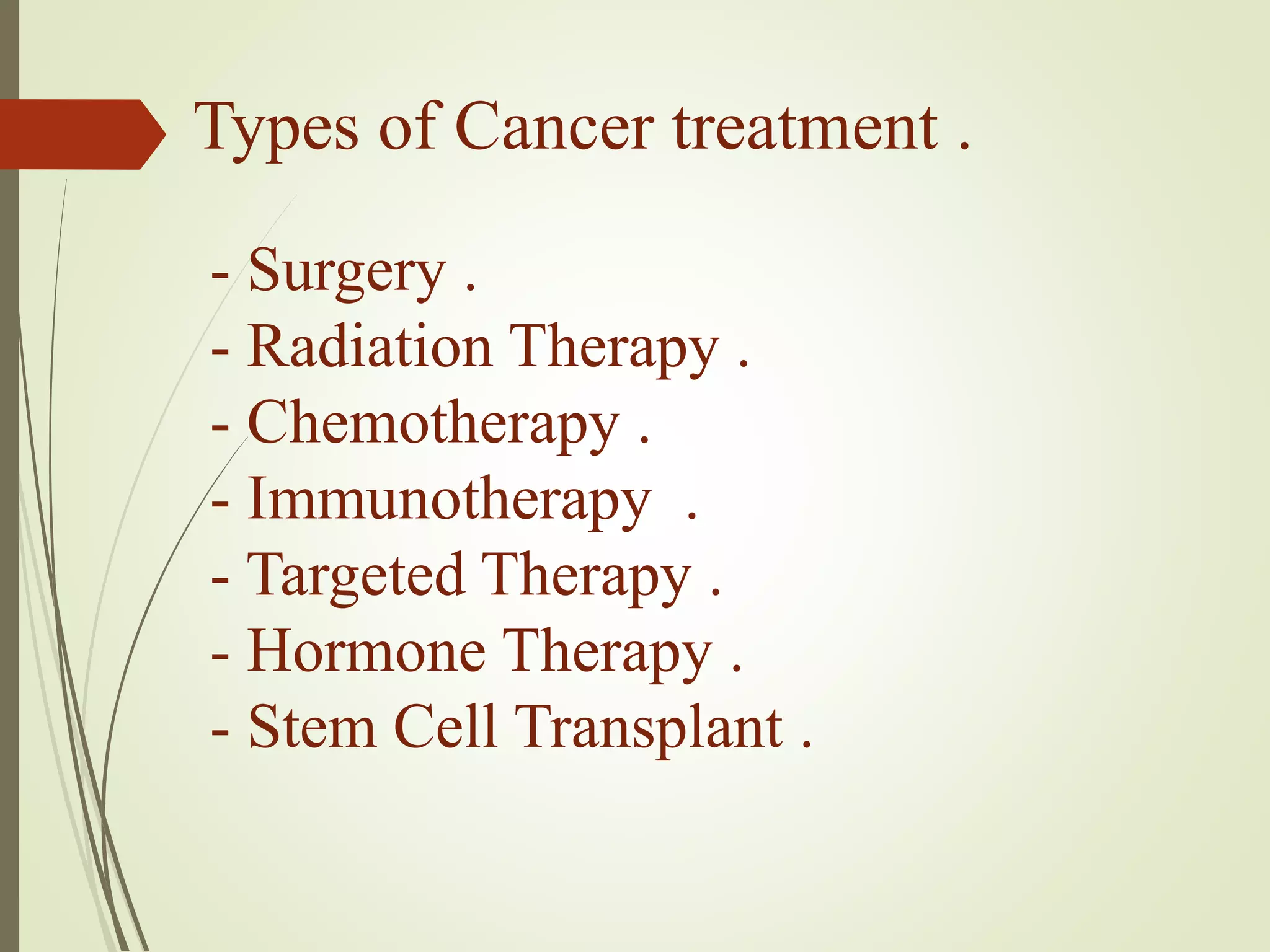
- Surgery .
- Radiation Therapy .
- Chemotherapy .
- Immunotherapy .
- Targeted Therapy .
- Hormone Therapy .
- Stem Cell Transplant .
Cancer prevention .
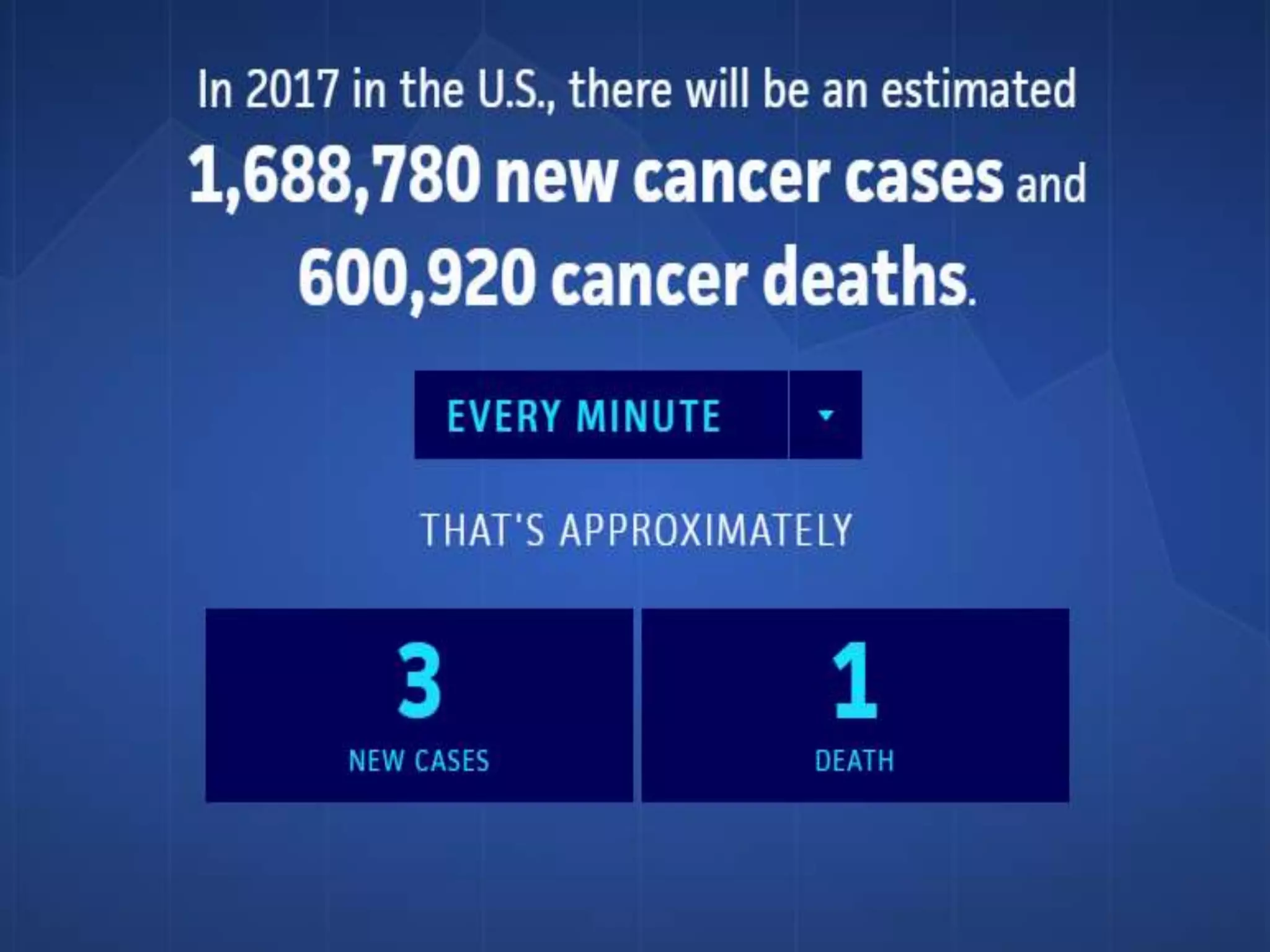
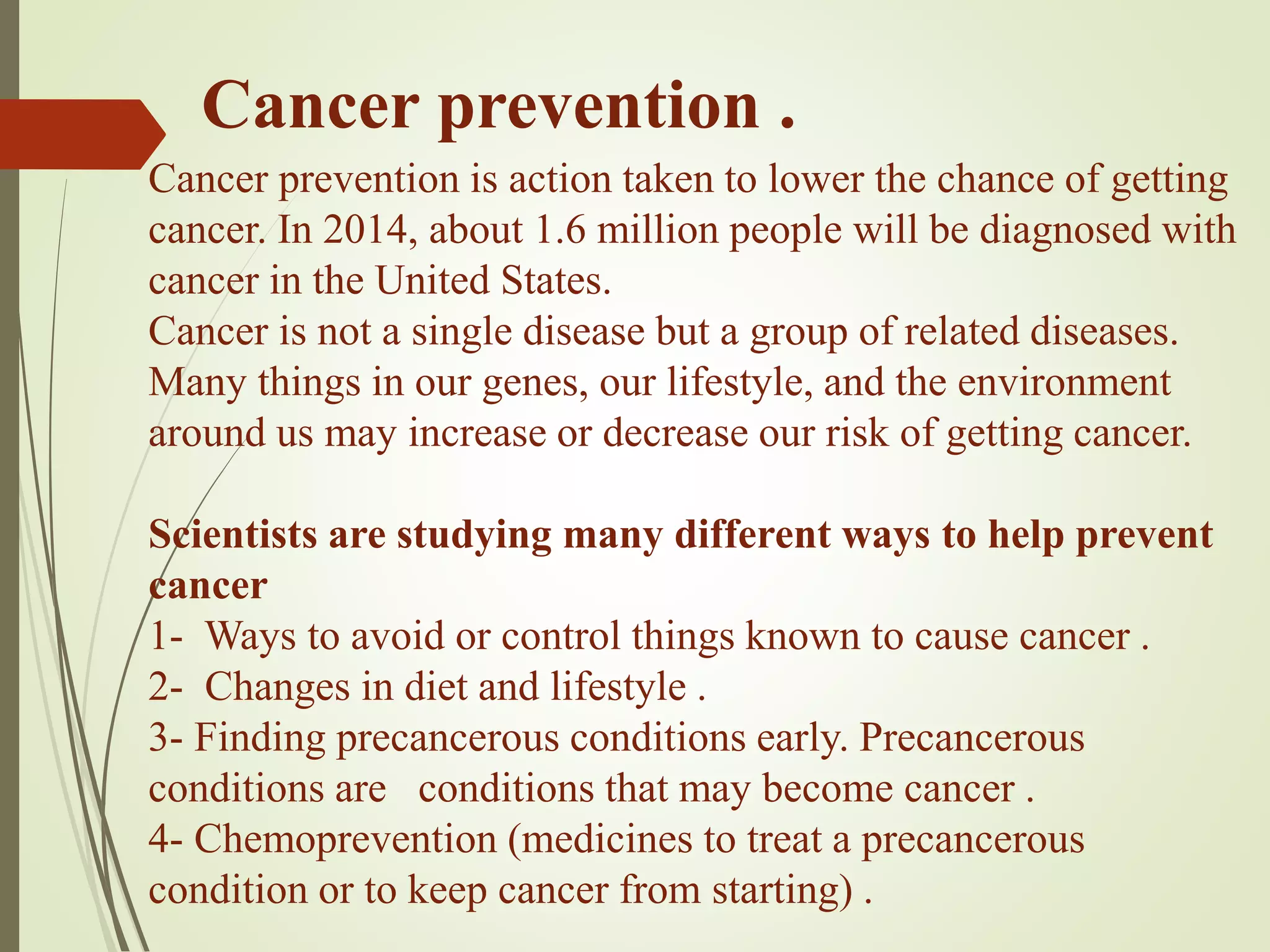
Cancer prevention is action taken to lower the chance of getting
cancer. In 2014, about 1.6 million people will be diagnosed with
cancer in the United States.
Cancer is not a single disease but a group of related diseases.
Many things in our genes, our lifestyle, and the environment
around us may increase or decrease our risk of getting cancer.
Scientists are studying many different ways to help prevent
cancer
1- Ways to avoid or control things known to cause cancer .
2- Changes in diet and lifestyle .
3- Finding precancerous conditions early. Precancerous
conditions are conditions that may become cancer .
4- Chemoprevention (medicines to treat a precancerous
condition or to keep cancer from starting) .
Sources
• (1) National Cancer Institute ) https://goo.gl/1mbVC5) .
• (2) National Cancer Institute ( http://goo.gl/9Qgn4d ) .
• (3) National Cancer Institute ( https://goo.gl/PmQo4S) .
• American Cancer Society ( https://goo.gl/nPuM4E) .
• World Health Organization ( https://goo.gl/6u1X4b ) .
• American Cancer Society ( http://goo.gl/wNoHbk ) .
• Livescience.com ( http://goo.gl/jhd97v ) .
• BBC News Services ( http://goo.gl/hBB4Ul ) .

Introduction to Cancer " part one "

  • 1.
    Cancer Mohammed Sami Abd_Elaziz CollegeScience , Al_AZHAR University Egypt Phone : 00201157017514 Email : mohammedsamy1196@gmail.com linked in : linkedin.com/in/mohammed-sami-2106a4125
  • 2.
    Objectives: • Introduction • Whatis Cancer ? • Benign & Malignant . • Types of Cancer . • Number of Cases, Deaths and Survivors . • Causes of Cancer (Factors are dealing to mutation) . • Genetics of cancer . • Cancer Hallmarks • Types of cancer treatment . • cancer prevention .
  • 3.
  • 5.
    What is Cancer? Cancer is the name given to a collection of related diseases. In all types of cancer, some of the body’s cells begin to divide without stopping and spread into surrounding tissues. Or it is an uncontrolled growth of abnormal cells
  • 6.
  • 7.
    Types of Cancer •Carcinoma (Carcinomas are the most common type of cancer. They are formed by epithelial cells . • Sarcoma (in bone and soft tissues, including muscle, fat, blood vessels, lymph vessels, and fibrous tissue). • Leukemia (in the blood-forming tissue of the bone marrow ) . • Lymphoma (in lymphocytes (T cells or B cells) ). • Multiple Myeloma (in plasma cells) . • Melanoma (in cells that become melanocytes). • Brain and Spinal Cord Tumors. • Other Types of Tumors (Germ Cell Tumors , Neuroendocrine Tumors , Carcinoid Tumors ) .
  • 9.
    Number of Cases,Deaths and Survivors . • Cancer is the second leading cause of death globally, and was responsible for 8.8 million deaths in 2015. Globally, nearly 1 in 6 deaths is due to cancer. • Worldwide in 2012 (the latest year for which information is available). - 14.1 million new cancer cases were diagnosed. - 8.2 million people died from cancer. - 32.6 million people were five-year cancer survivors (people who are alive five years after being diagnosed with cancer). • By 2025 , 19.3 million new cancer cases are expected to be diagnosed each year.
  • 11.
  • 12.
    Factors are dealingto mutation 1) Exogenous (environmental factors ) - Radiation ,Sunlight , chemical , Smoking . 2) Endogenous : Errors during DNA replication can lead to genetic changes as can toxic by products of cellular metabolism . - Some mutations are not harmful , ex ( adaption in human , Resistance of antibiotics in bacteria ) - Some mutations don’t affect , it's called Variation ex (Olfactory receptors(
  • 13.
    Genetics of cancer Proto- oncogene( Go) “RAS”, ”MYC” When mutated Oncogene 1 Stuck in “ On” Position
  • 14.
    Genetics of cancer Tumor Suppressor genes 2Copy First mutation Second mutation Cancer 2
  • 15.
    (3) DNA Repairgene Which help prevent mutation that lead to Cancer . Genetics of cancer
  • 16.
  • 17.
    Types of Cancertreatment . - Surgery . - Radiation Therapy . - Chemotherapy . - Immunotherapy . - Targeted Therapy . - Hormone Therapy . - Stem Cell Transplant .
  • 18.
    Cancer prevention . Cancerprevention is action taken to lower the chance of getting cancer. In 2014, about 1.6 million people will be diagnosed with cancer in the United States. Cancer is not a single disease but a group of related diseases. Many things in our genes, our lifestyle, and the environment around us may increase or decrease our risk of getting cancer. Scientists are studying many different ways to help prevent cancer 1- Ways to avoid or control things known to cause cancer . 2- Changes in diet and lifestyle . 3- Finding precancerous conditions early. Precancerous conditions are conditions that may become cancer . 4- Chemoprevention (medicines to treat a precancerous condition or to keep cancer from starting) .
  • 19.
    Sources • (1) NationalCancer Institute ) https://goo.gl/1mbVC5) . • (2) National Cancer Institute ( http://goo.gl/9Qgn4d ) . • (3) National Cancer Institute ( https://goo.gl/PmQo4S) . • American Cancer Society ( https://goo.gl/nPuM4E) . • World Health Organization ( https://goo.gl/6u1X4b ) . • American Cancer Society ( http://goo.gl/wNoHbk ) . • Livescience.com ( http://goo.gl/jhd97v ) . • BBC News Services ( http://goo.gl/hBB4Ul ) .