Chapter Sixteen Reducing Your Risk of Cancer
Defining Cancer Cancer is a group of diseases characterized by uncontrolled growth of  anaplastic cells  that often invade surrounding tissue and  metastasize  to distant body sites A woman’s prognosis depends upon a variety of factors e.g. location, nature of the tumor, and its stage The key to survival is early detection The higher incidence and mortality rates for cancer in women are: Breast Lungs Colon Rectum Tumors can be malignant or benign
Seven Warning Signs of Cancer C hange in bowel/bladder habits A  sore that does not heal U nusual bleeding or discharge T hickening or a lump in the breast or elsewhere I ndigestion or difficulty swallowing O bvious change in a wart/mole N agging cough or hoarseness In 2006 it was estimated that 679,510 women would be diagnosed with cancer and 273,560 would die
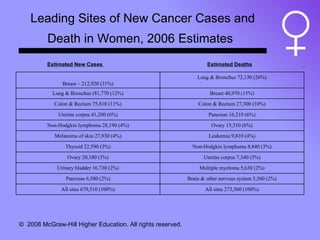
Leading Sites of New Cancer Cases and Death in Women, 2006 Estimates   Estimated New Cases  Estimated Deaths   All sites 273,560 (100%) All sites 679,510 (100%) Brain & other nervous system 5,560 (2%) Pancreas 6,580 (2%) Multiple myeloma 5,630 (2%) Urinary bladder 16,730 (2%) Uterine corpus 7,340 (3%) Ovary 20,180 (3%) Non-Hodgkin lymphoma 8,840 (3%) Thyroid 22,590 (3%) Leukemia 9,810 (4%) Melanoma of skin 27,930 (4%) Ovary 15,310 (6%) Non-Hodgkin lymphoma 28,190 (4%) Pancreas 16,210 (6%) Uterine corpus 41,200 (6%) Colon & Rectum 27,300 (10%) Colon & Rectum 75,810 (11%) Breast 40,970 (15%) Lung & Bronchus (81,770 (12%) Lung & Bronchus 72,130 (26%) Breast – 212,920 (31%)
Four Most Common Categories of Cancer Carcinomas – 85% of all cancers tend to be classified here (organs, skin, nerves, membranes) Sarcomas – bone, blood, connective tissue (2% of malignant cancers) Lymphomas – immune tissues/system (i.e., Hodgkin’s Disease and non-Hodgkin’s) Leukemia - blood and blood-forming tissues (bone marrow) See Table 16.2
Staging Cancer There has been an identification system known as the TNS staging system T = recognizes the extent of malignancy N = progressed or not to the lymph node M = presence or absence of metastasis A numerical system tracks the extent of the growth potential of cancer (I, II, III, or IV)
Causes of Cancer Cigarette Smoking Diet Growing older (age) Viruses Alcohol Consumption Close Relatives with certain types of Cancer Hormone Replacement Therapy (HRT) Diethylstillbestrol (DES) Lifestyle Factors Implicated in Cancer
Causes of Cancer (cont.) Exposure to Sun Ionizing Radiation Chemical and other substances Environmental Factors Implicated in Cancer
Current Research Regarding Causes and Treatment Molecular and Cellular Causes of Cancer Altered DNA may be responsible for abnormal growth Cell Cycle Research Defects in the synthesis or assembly of DNA during replication may cause genetic instability Gene Mutation Research Some individuals may be susceptible to mutation of suppressor genes Adjuvant Treatment Substances to enhance the action of drugs to treat cancer i.e. chemicals Immunotherapy Research Boosting the immune system to prevent tumor growth or attack cancer cells Stem Cell Transplantation Research Removal of cells in bone marrow before radiation or chemotherapy and later restored
Lung Cancer Two Types Non-small cell (most common) Small (oat) cell Risk Factors   Smoking Environmental pollutants Early detection symptoms Persistent cough, blood in the sputum, constant chest pain, recurring pneumonia, or bronchitis Treatment Surgery Radiation Chemotherapy Laser therapy (PDT) Leading cause of cancer death in women
Breast Cancer Identifiable protective factors Breast feeding and having children Exercise Early Detection Lumps Thickening in the breast or underarm area Additional warning signs: Change in the size or shape of the breast Discharge from the nipple Change in the color or texture of the skin of the breast or around the areola Second leading cancer killer of all women
Risk Factors for Breast Cancer Being a woman Age Early menstrual cycle for women Women with no children or having children later in life Hormone replacement therapy use Dense breast tissue Family History Previous breast biopsy Previous breast exposure to radiation Alcohol Obesity High fat diet Genetic alterations
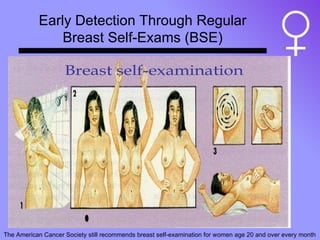
Early Detection Through Regular Breast Self-Exams (BSE) The American Cancer Society still recommends breast self-examination for women age 20 and over every month
Breast Cancer (cont.) Screening and Diagnosis Mammography Biopsies (excisional or incisional) Treatment (two categories) Local therapy (surgery or radiation) Surgery is the most common treatment Lumpectomy Mastectomy Modified radical mastectomy Systemic (chemotherapy, hormonal therapy, or biological therapy)
Uterine and Cervical Cancer Uterine cancer begins in the endometrium (lining of the uterus) Cervical cancer begins in the cervix and are considered squamous cell carcinomas Approximately 9,700 women develop cervical cancer each year   Cervical cancer is 100% curable and endometrial cancer is 94% curable when detected early Deaths related to ovarian and uterine cancer, which comprise only 13 percent of the cancers of women, are exceeded only by lung, breast, and colon cancers
Cervical Cancer Risk factors Early and continued sexual activity HPV and/or Herpes infection Smoking Prevention/Early Detection Sexual abstinence Pap tests Careful selection of sexual partners Treatment Surgery (minor or major) Radiation Chemotherapy
Uterine Cancer Risk Factors Early menarche, late menopause, lack of ovulation, never having given birth, ERT, use of tamoxifen, and also in diabetics, obese, and hypertensive women Prevention/Early Detection Minimize high levels of estrogen and regular physician care Treatment Surgery, radiation, chemotherapy, hormone treatment
Ovarian Cancer Ovarian cancer is a malignant tumor that begins in the ovaries  Prevention Similar to what is recommended for  breast cancer Prophylactic oophorectomy Early Detection Referred as the “silent cancer” Annual pelvic exams Genetic screenings (CA-125 radioimmunoassay) Treatment Surgery Chemotherapy Drug therapy Radiation In 2006, ACS estimates that there will be 20,180 new cases of ovarian cancer and 15,310 women will die from this cancer  Ovarian cancer is the seventh most common cancer in women
Skin Cancer Skin cancer is the most prevalent and most curable type of cancer found in women  Basal cell carcinomas are the most common type of malignancy in humans They are usually raised, hard, reddish lesions with a pearly surface and rarely metastasize These carcinomas are typically scaly and slightly elevated They are a relatively slow-growing malignancy
Skin Cancer (cont.) Malignant melanoma is the most dangerous but less common Risk factors Severe sunburn during childhood, chronic sun exposure during young adulthood Prevention Reduce exposure to sun’s rays, use sunscreens, Early Detection American Cancer Society guidelines (next slide) Treatment Radiation, Laser therapy, tissue destruction (heat or freezing) Skin Cancer is the most prevalent and curable type of cancer in women
American Cancer Society ABCD Method A symmetry B order irregularity C olor change D iameter greater than 6mm
Colon and Rectum Cancer In 2006, an estimated 75,810 new cases of colon and rectal cancer will be diagnosed in women and 27,300 women are estimated to die from the disease   Risk factors Personal and family history, polyps, or ulcerative colitis Preventive Screening Digital rectal exam yearly after age 40 for women, FOBT, and sigmoidoscopy or colonoscopy exam every 3-5 years after age 50 Early Detection Rectal exams, stool test, sigmoidoscopy, colonoscopy Treatment Surgery, radiation, chemotherapy
Steps to Take When Diagnosed with Cancer Once a woman knows the type of cancer, she can call the National Cancer Institute at 1-800-4-CANCER Get a second opinion before deciding on a particular treatment protocol Make sure you feel certain about your options Social support is a critical factor in recovery from cancer.  There are many avenues of social support to pursue during all stages of treatment
Complementary Treatment in Cancer Management Magnetic and Electronic Devices Radionic devices Galvanic devices Low-level output electrical devices Magnetic devices Color and light treatment devices Food remedies Vegetarian diets Herbal and vitamin therapy Spiritual and Meditation Practices Relaxation Acupuncture and Acupressure
Chapter Sixteen Reducing Your Risk of Cancer

Womens Health 16

  • 1.
    Chapter Sixteen ReducingYour Risk of Cancer
  • 2.
    Defining Cancer Canceris a group of diseases characterized by uncontrolled growth of anaplastic cells that often invade surrounding tissue and metastasize to distant body sites A woman’s prognosis depends upon a variety of factors e.g. location, nature of the tumor, and its stage The key to survival is early detection The higher incidence and mortality rates for cancer in women are: Breast Lungs Colon Rectum Tumors can be malignant or benign
  • 3.
    Seven Warning Signsof Cancer C hange in bowel/bladder habits A sore that does not heal U nusual bleeding or discharge T hickening or a lump in the breast or elsewhere I ndigestion or difficulty swallowing O bvious change in a wart/mole N agging cough or hoarseness In 2006 it was estimated that 679,510 women would be diagnosed with cancer and 273,560 would die
  • 4.
    Leading Sites ofNew Cancer Cases and Death in Women, 2006 Estimates Estimated New Cases Estimated Deaths All sites 273,560 (100%) All sites 679,510 (100%) Brain & other nervous system 5,560 (2%) Pancreas 6,580 (2%) Multiple myeloma 5,630 (2%) Urinary bladder 16,730 (2%) Uterine corpus 7,340 (3%) Ovary 20,180 (3%) Non-Hodgkin lymphoma 8,840 (3%) Thyroid 22,590 (3%) Leukemia 9,810 (4%) Melanoma of skin 27,930 (4%) Ovary 15,310 (6%) Non-Hodgkin lymphoma 28,190 (4%) Pancreas 16,210 (6%) Uterine corpus 41,200 (6%) Colon & Rectum 27,300 (10%) Colon & Rectum 75,810 (11%) Breast 40,970 (15%) Lung & Bronchus (81,770 (12%) Lung & Bronchus 72,130 (26%) Breast – 212,920 (31%)
  • 5.
    Four Most CommonCategories of Cancer Carcinomas – 85% of all cancers tend to be classified here (organs, skin, nerves, membranes) Sarcomas – bone, blood, connective tissue (2% of malignant cancers) Lymphomas – immune tissues/system (i.e., Hodgkin’s Disease and non-Hodgkin’s) Leukemia - blood and blood-forming tissues (bone marrow) See Table 16.2
  • 6.
    Staging Cancer Therehas been an identification system known as the TNS staging system T = recognizes the extent of malignancy N = progressed or not to the lymph node M = presence or absence of metastasis A numerical system tracks the extent of the growth potential of cancer (I, II, III, or IV)
  • 7.
    Causes of CancerCigarette Smoking Diet Growing older (age) Viruses Alcohol Consumption Close Relatives with certain types of Cancer Hormone Replacement Therapy (HRT) Diethylstillbestrol (DES) Lifestyle Factors Implicated in Cancer
  • 8.
    Causes of Cancer(cont.) Exposure to Sun Ionizing Radiation Chemical and other substances Environmental Factors Implicated in Cancer
  • 9.
    Current Research RegardingCauses and Treatment Molecular and Cellular Causes of Cancer Altered DNA may be responsible for abnormal growth Cell Cycle Research Defects in the synthesis or assembly of DNA during replication may cause genetic instability Gene Mutation Research Some individuals may be susceptible to mutation of suppressor genes Adjuvant Treatment Substances to enhance the action of drugs to treat cancer i.e. chemicals Immunotherapy Research Boosting the immune system to prevent tumor growth or attack cancer cells Stem Cell Transplantation Research Removal of cells in bone marrow before radiation or chemotherapy and later restored
  • 10.
    Lung Cancer TwoTypes Non-small cell (most common) Small (oat) cell Risk Factors Smoking Environmental pollutants Early detection symptoms Persistent cough, blood in the sputum, constant chest pain, recurring pneumonia, or bronchitis Treatment Surgery Radiation Chemotherapy Laser therapy (PDT) Leading cause of cancer death in women
  • 11.
    Breast Cancer Identifiableprotective factors Breast feeding and having children Exercise Early Detection Lumps Thickening in the breast or underarm area Additional warning signs: Change in the size or shape of the breast Discharge from the nipple Change in the color or texture of the skin of the breast or around the areola Second leading cancer killer of all women
  • 12.
    Risk Factors forBreast Cancer Being a woman Age Early menstrual cycle for women Women with no children or having children later in life Hormone replacement therapy use Dense breast tissue Family History Previous breast biopsy Previous breast exposure to radiation Alcohol Obesity High fat diet Genetic alterations
  • 13.
    Early Detection ThroughRegular Breast Self-Exams (BSE) The American Cancer Society still recommends breast self-examination for women age 20 and over every month
  • 14.
    Breast Cancer (cont.)Screening and Diagnosis Mammography Biopsies (excisional or incisional) Treatment (two categories) Local therapy (surgery or radiation) Surgery is the most common treatment Lumpectomy Mastectomy Modified radical mastectomy Systemic (chemotherapy, hormonal therapy, or biological therapy)
  • 15.
    Uterine and CervicalCancer Uterine cancer begins in the endometrium (lining of the uterus) Cervical cancer begins in the cervix and are considered squamous cell carcinomas Approximately 9,700 women develop cervical cancer each year Cervical cancer is 100% curable and endometrial cancer is 94% curable when detected early Deaths related to ovarian and uterine cancer, which comprise only 13 percent of the cancers of women, are exceeded only by lung, breast, and colon cancers
  • 16.
    Cervical Cancer Riskfactors Early and continued sexual activity HPV and/or Herpes infection Smoking Prevention/Early Detection Sexual abstinence Pap tests Careful selection of sexual partners Treatment Surgery (minor or major) Radiation Chemotherapy
  • 17.
    Uterine Cancer RiskFactors Early menarche, late menopause, lack of ovulation, never having given birth, ERT, use of tamoxifen, and also in diabetics, obese, and hypertensive women Prevention/Early Detection Minimize high levels of estrogen and regular physician care Treatment Surgery, radiation, chemotherapy, hormone treatment
  • 18.
    Ovarian Cancer Ovariancancer is a malignant tumor that begins in the ovaries Prevention Similar to what is recommended for breast cancer Prophylactic oophorectomy Early Detection Referred as the “silent cancer” Annual pelvic exams Genetic screenings (CA-125 radioimmunoassay) Treatment Surgery Chemotherapy Drug therapy Radiation In 2006, ACS estimates that there will be 20,180 new cases of ovarian cancer and 15,310 women will die from this cancer Ovarian cancer is the seventh most common cancer in women
  • 19.
    Skin Cancer Skincancer is the most prevalent and most curable type of cancer found in women Basal cell carcinomas are the most common type of malignancy in humans They are usually raised, hard, reddish lesions with a pearly surface and rarely metastasize These carcinomas are typically scaly and slightly elevated They are a relatively slow-growing malignancy
  • 20.
    Skin Cancer (cont.)Malignant melanoma is the most dangerous but less common Risk factors Severe sunburn during childhood, chronic sun exposure during young adulthood Prevention Reduce exposure to sun’s rays, use sunscreens, Early Detection American Cancer Society guidelines (next slide) Treatment Radiation, Laser therapy, tissue destruction (heat or freezing) Skin Cancer is the most prevalent and curable type of cancer in women
  • 21.
    American Cancer SocietyABCD Method A symmetry B order irregularity C olor change D iameter greater than 6mm
  • 22.
    Colon and RectumCancer In 2006, an estimated 75,810 new cases of colon and rectal cancer will be diagnosed in women and 27,300 women are estimated to die from the disease Risk factors Personal and family history, polyps, or ulcerative colitis Preventive Screening Digital rectal exam yearly after age 40 for women, FOBT, and sigmoidoscopy or colonoscopy exam every 3-5 years after age 50 Early Detection Rectal exams, stool test, sigmoidoscopy, colonoscopy Treatment Surgery, radiation, chemotherapy
  • 23.
    Steps to TakeWhen Diagnosed with Cancer Once a woman knows the type of cancer, she can call the National Cancer Institute at 1-800-4-CANCER Get a second opinion before deciding on a particular treatment protocol Make sure you feel certain about your options Social support is a critical factor in recovery from cancer. There are many avenues of social support to pursue during all stages of treatment
  • 24.
    Complementary Treatment inCancer Management Magnetic and Electronic Devices Radionic devices Galvanic devices Low-level output electrical devices Magnetic devices Color and light treatment devices Food remedies Vegetarian diets Herbal and vitamin therapy Spiritual and Meditation Practices Relaxation Acupuncture and Acupressure
  • 25.
    Chapter Sixteen ReducingYour Risk of Cancer