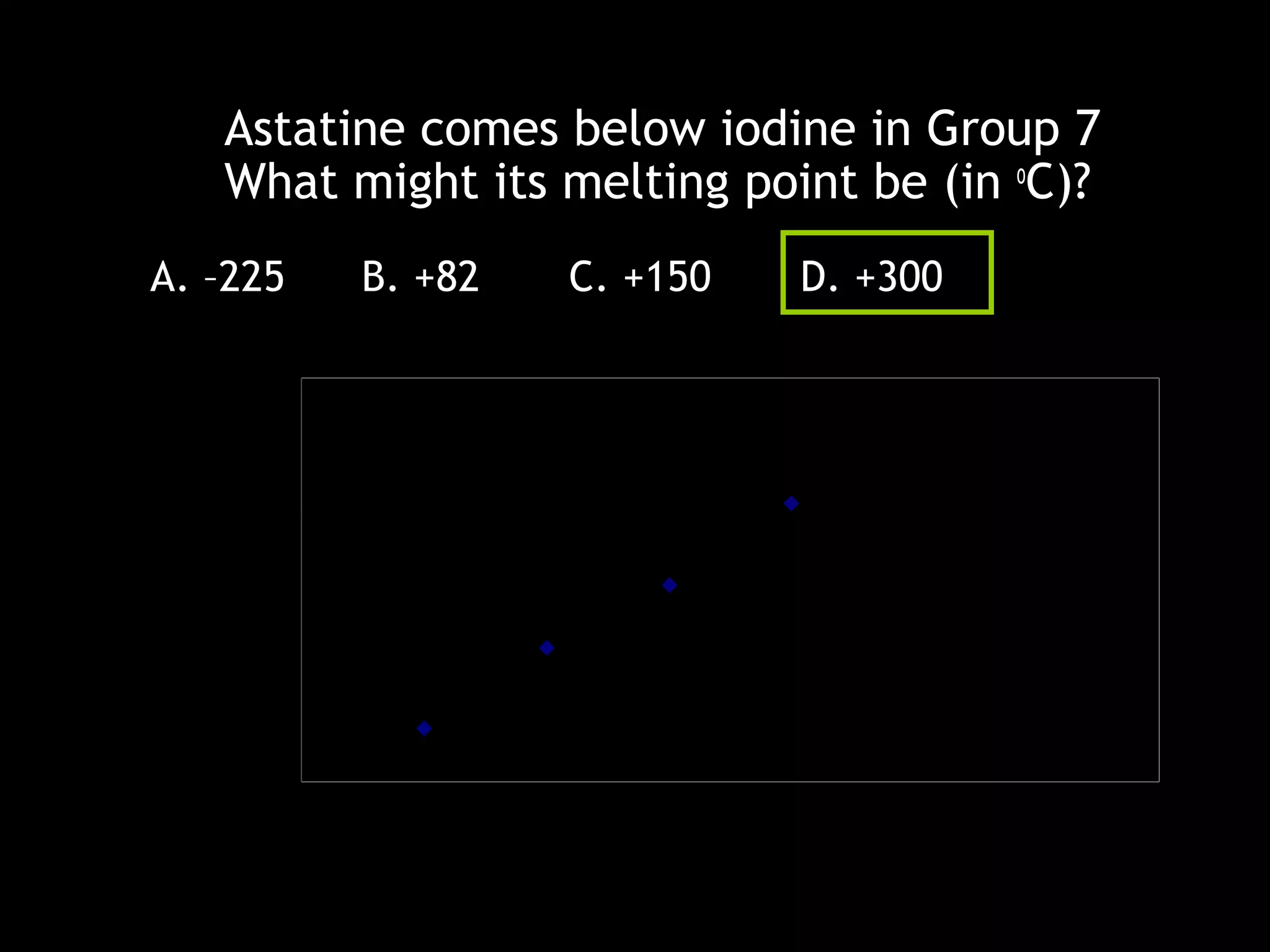
Based on the trend of increasing melting points down Group 7, astatine would be expected to have a melting point higher than iodine's 114°C. The closest answer is +150°C.
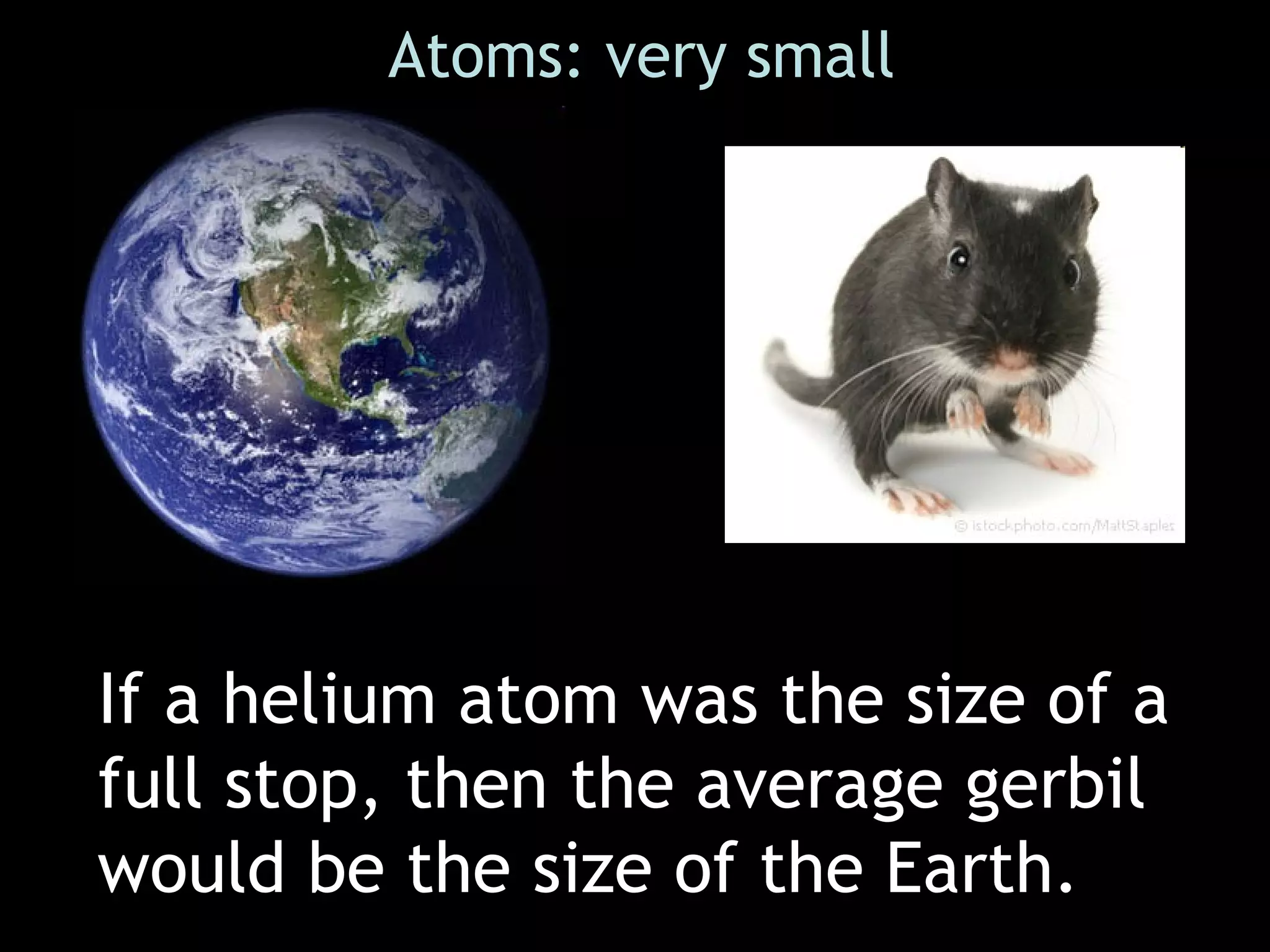
If a heliumatom was the size of a
full stop, then the average gerbil
would be the size of the Earth.
Atoms: very small
2.
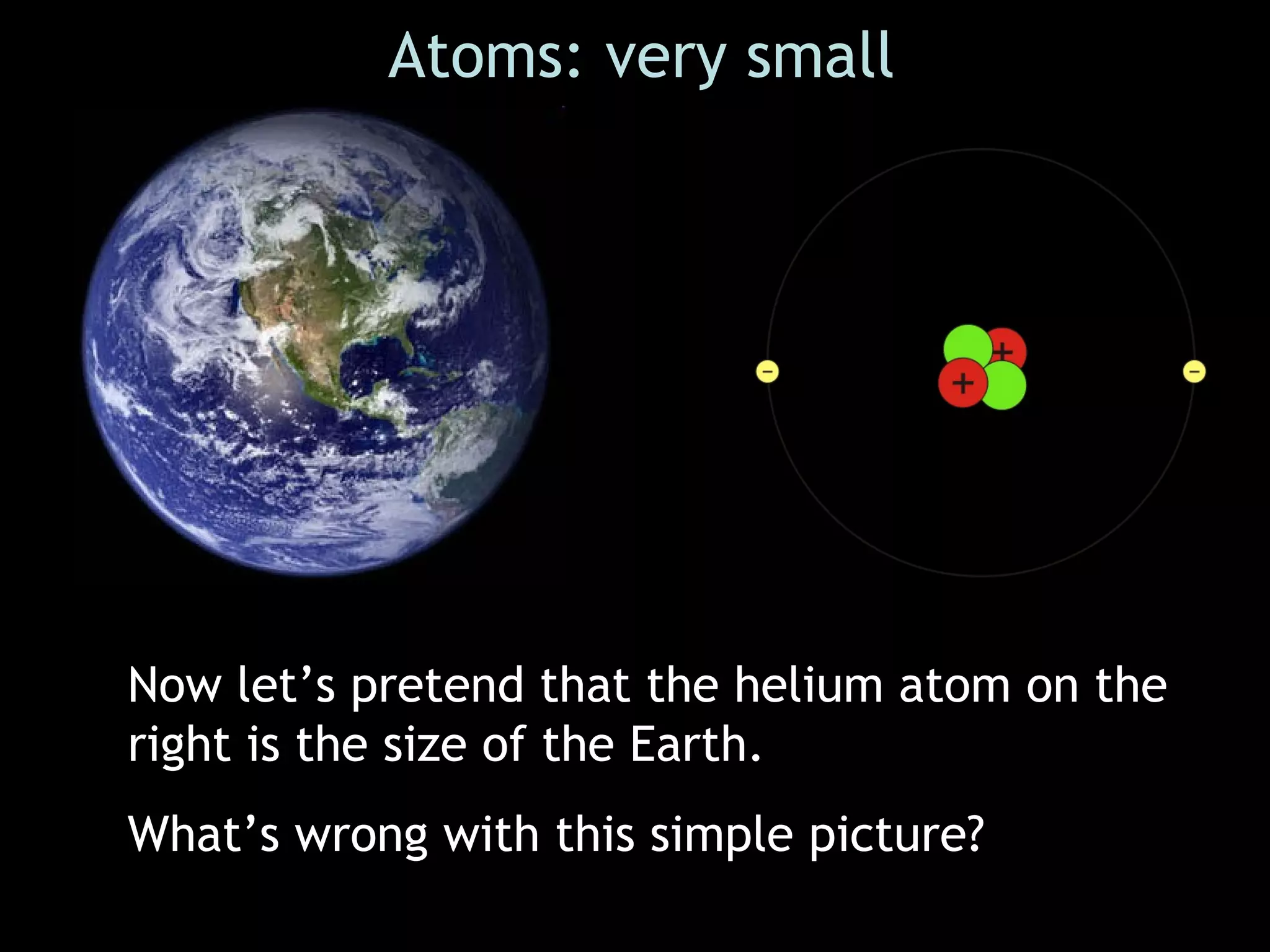
Now let’s pretendthat the helium atom on the
right is the size of the Earth.
What’s wrong with this simple picture?
Atoms: very small
3.
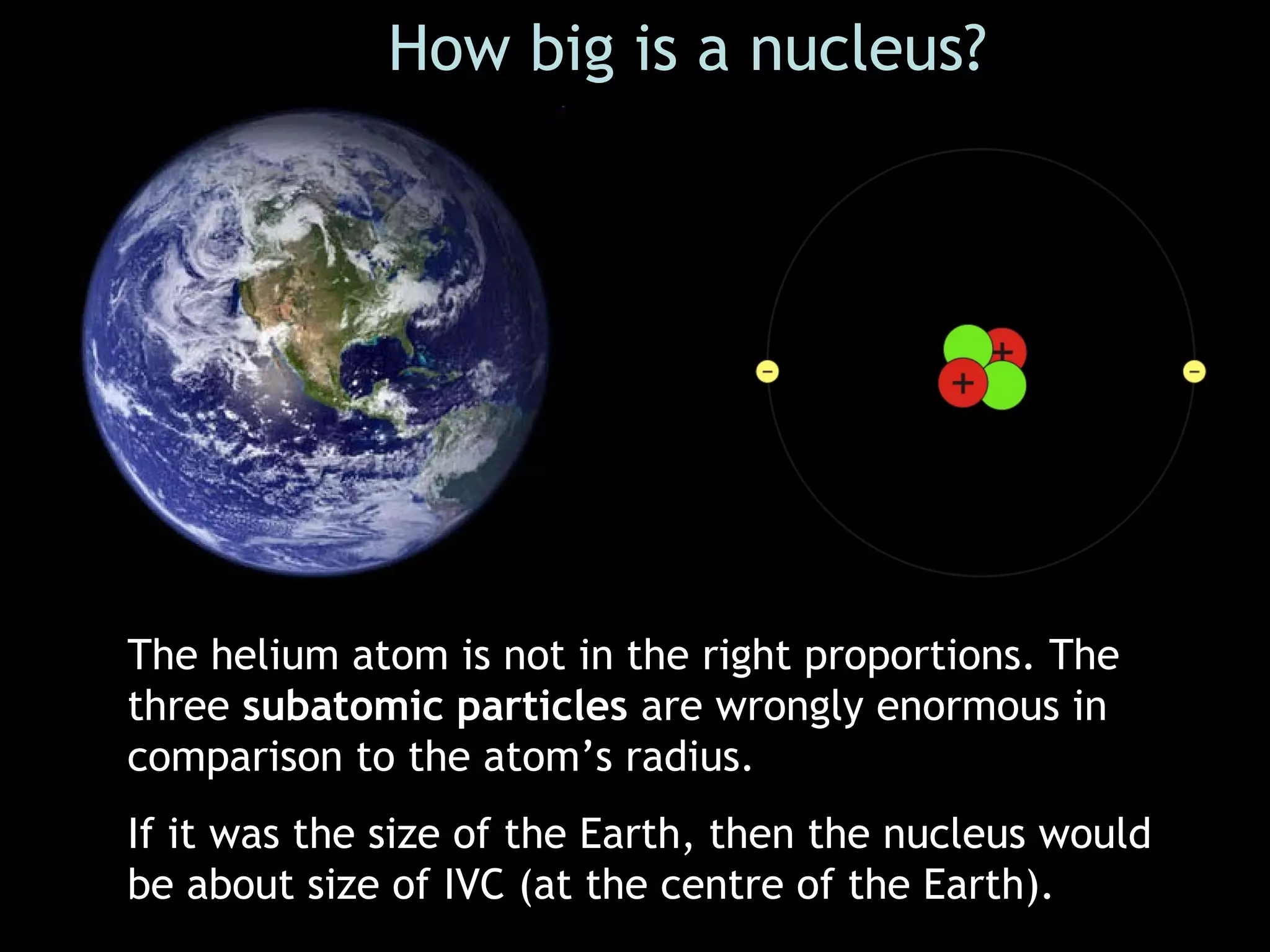
The helium atomis not in the right proportions. The
three subatomic particles are wrongly enormous in
comparison to the atom’s radius.
If it was the size of the Earth, then the nucleus would
be about size of IVC (at the centre of the Earth).
How big is a nucleus?
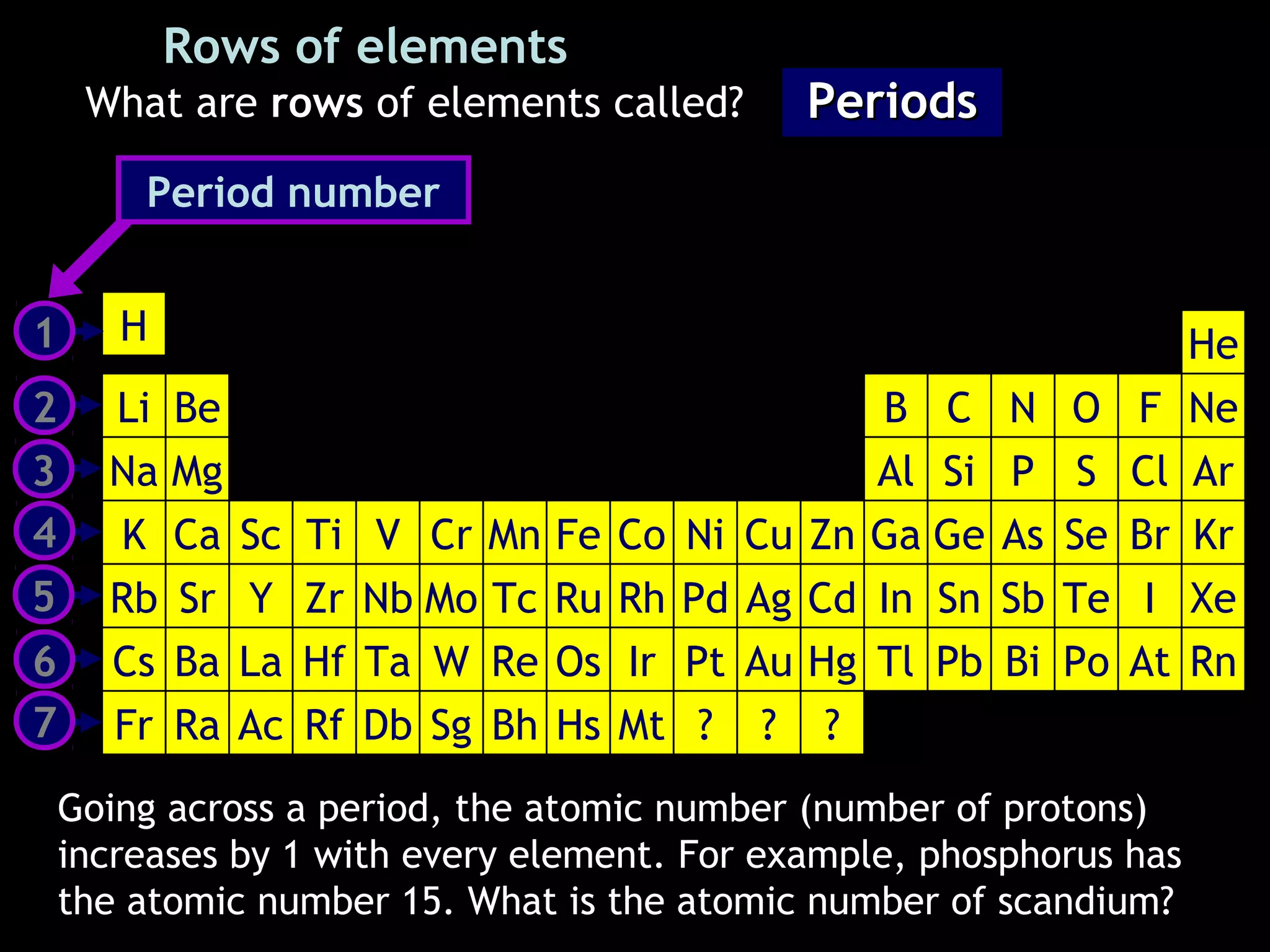
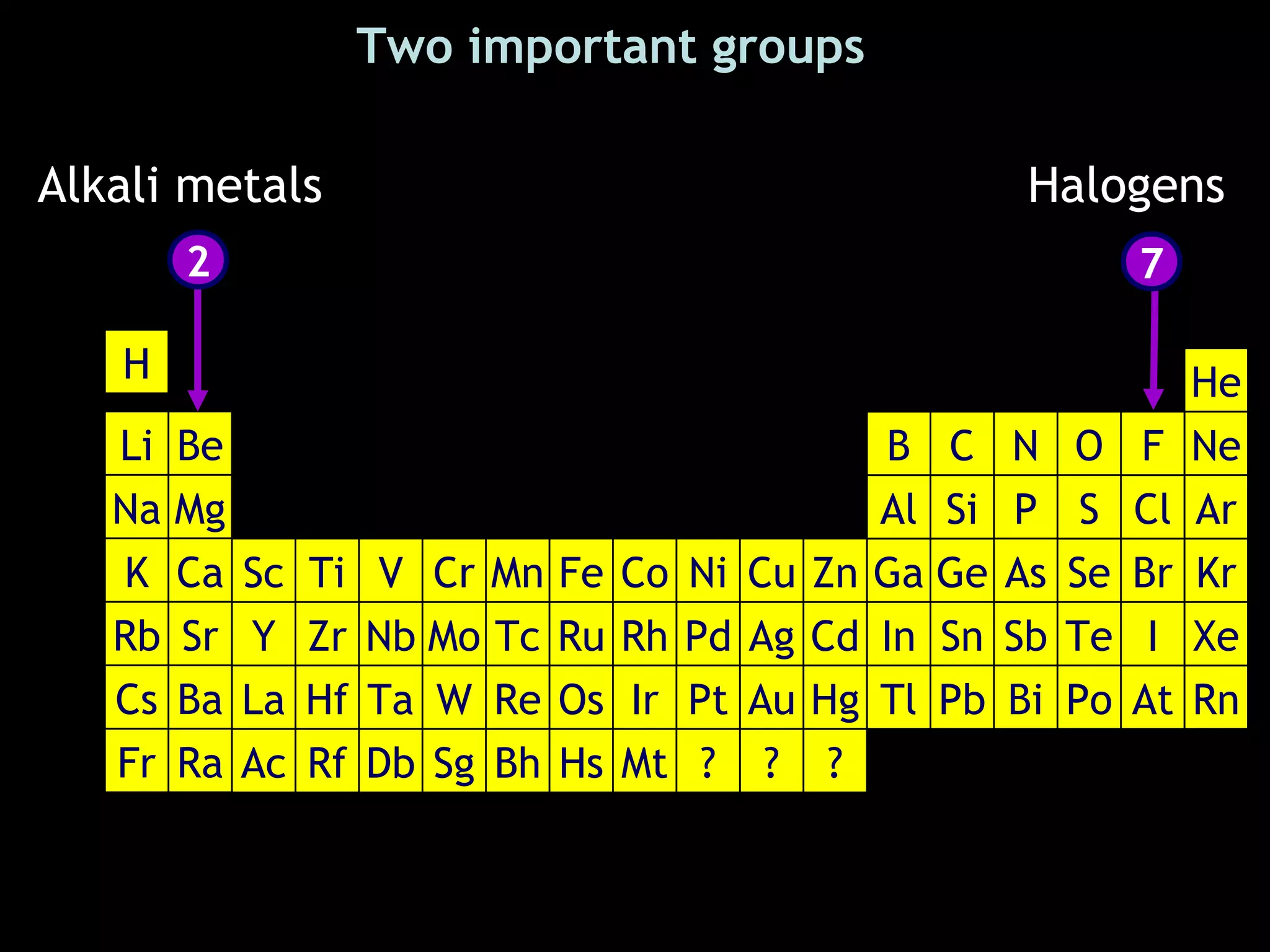
Rows of elements
HHe
Li Be N O F NeB C
Na Mg Al P S Cl ArSi
K Sc Ti V Cr Mn Fe Co Ni Cu Zn Ga Ge Se BrCa KrAs
Rb Y Zr Nb Mo Tc Ru Pd Ag Cd In Sn SbSr TeRh I Xe
Cs Ba Hf Ta W Re Os Ir Au Hg Tl Pb Bi PoLa AtPt Rn
Fr Ra Rf Db Sg Bh Hs Mt ? ?Ac ?
PeriodsPeriodsWhat are rows of elements called?
1
2
3
4
5
6
7
Period number
Going across a period, the atomic number (number of protons)
increases by 1 with every element. For example, phosphorus has
the atomic number 15. What is the atomic number of scandium?
8.
Li
7
3
(No. of protons)
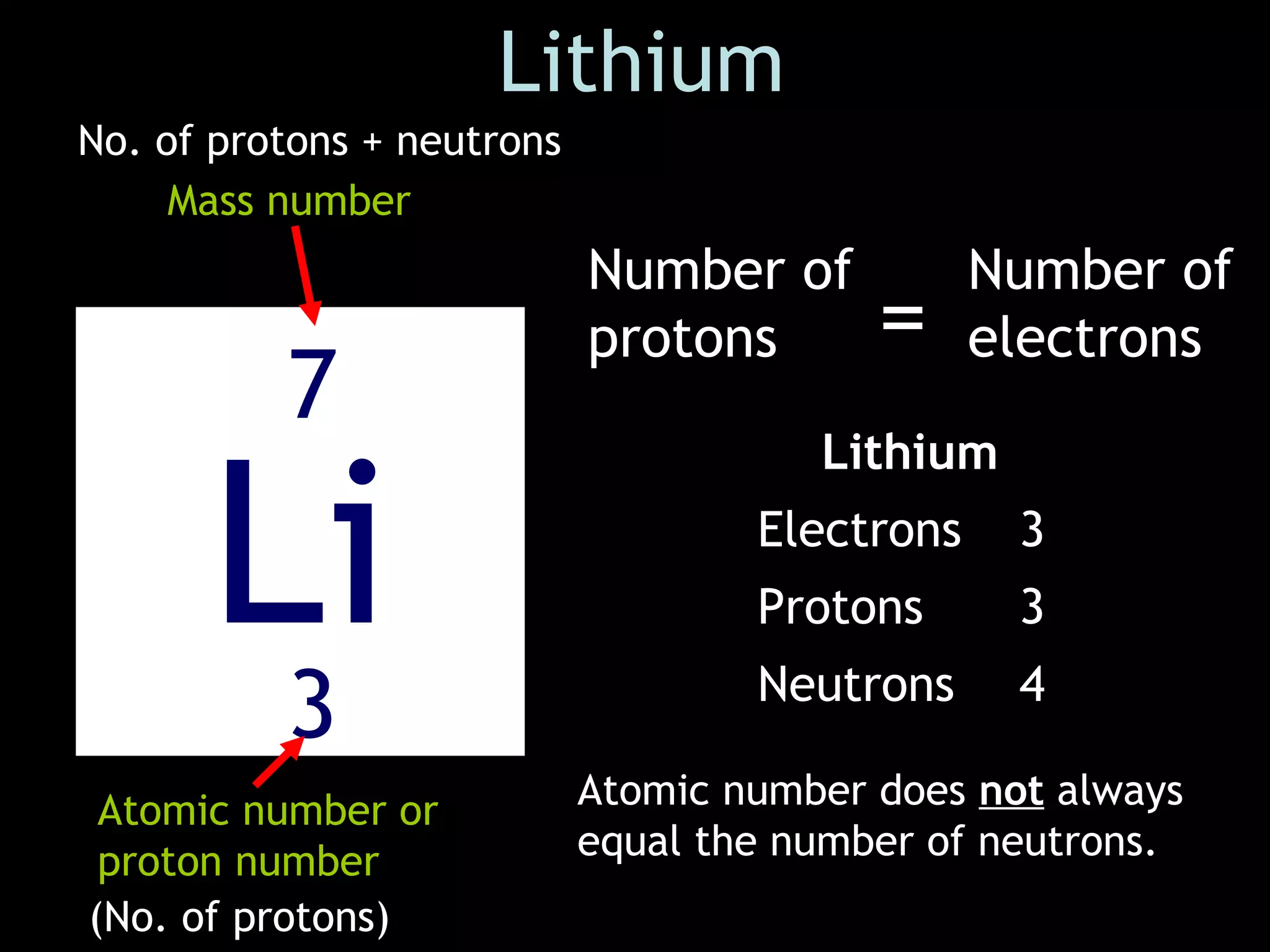
No.of protons + neutrons
Lithium
Number of
protons
Number of
electrons=
Atomic number does not always
equal the number of neutrons.
Lithium
Electrons 3
Protons 3
Neutrons 4
Mass number
Atomic number or
proton number
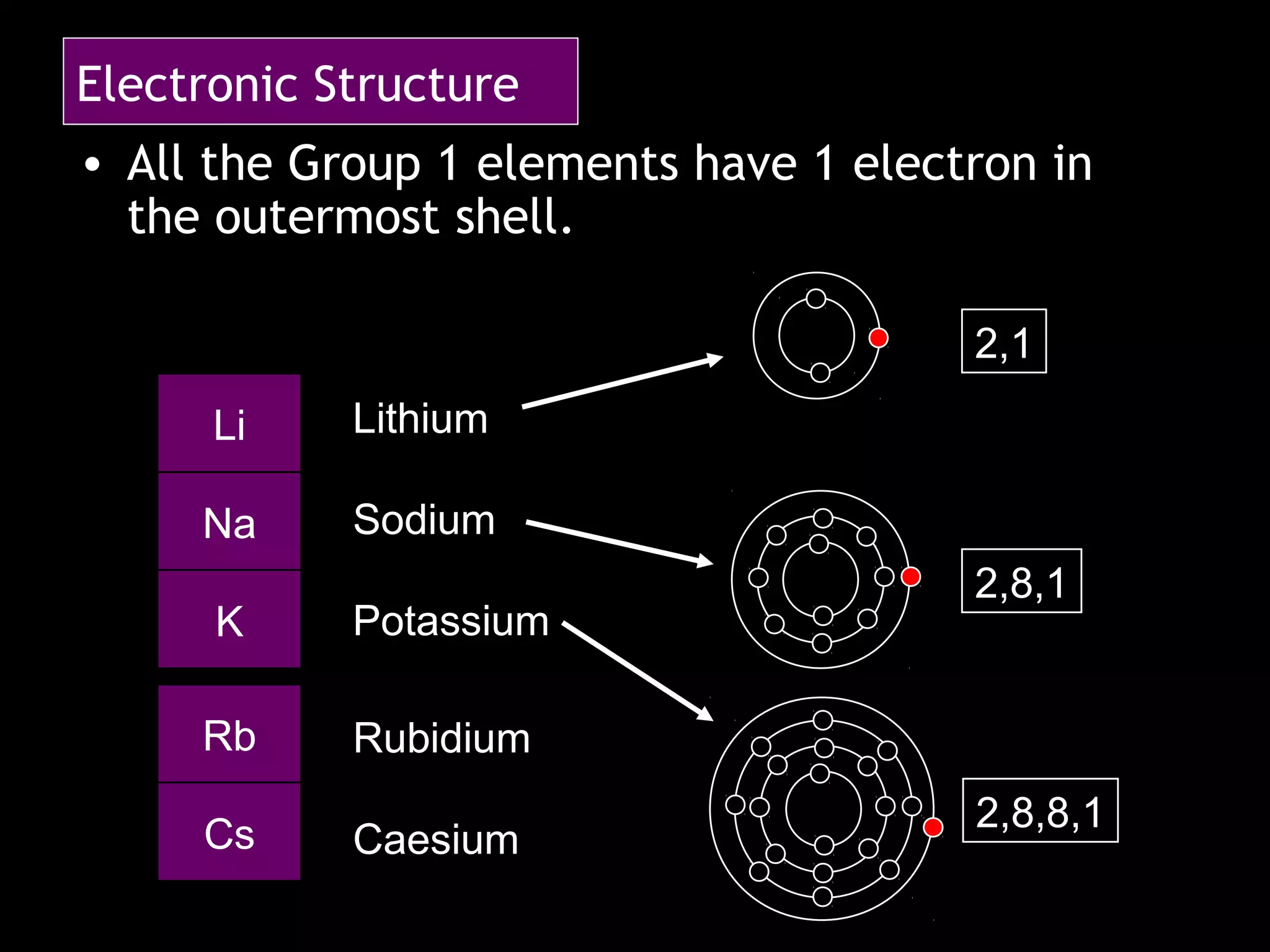
Electronic Structure
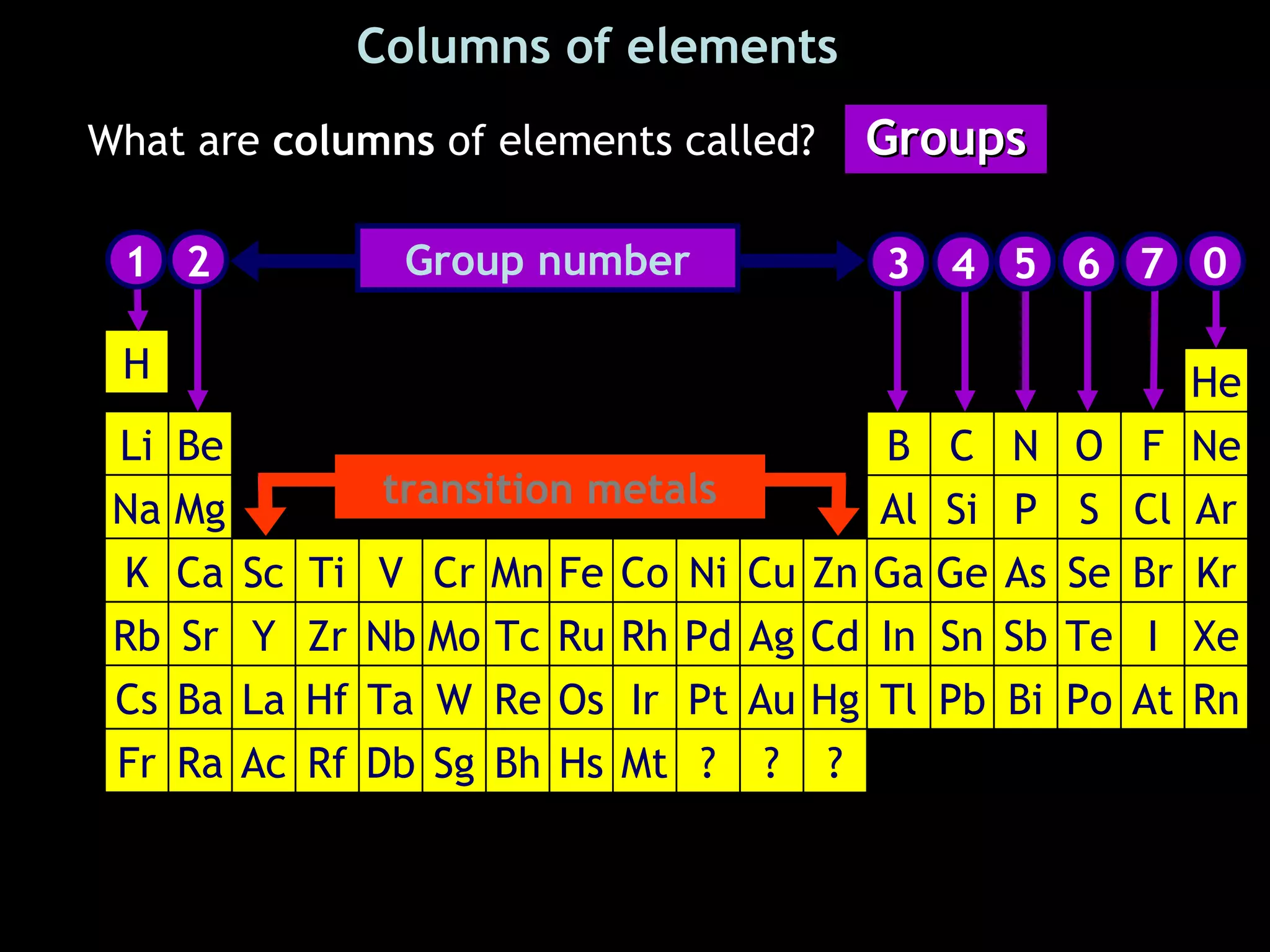
• Allthe Group 1 elements have 1 electron in
the outermost shell.
Li
Na
K
Rb
Cs
Lithium
Sodium
Potassium
Rubidium
Caesium
2,8,1
2,8,8,1
2,1
11.
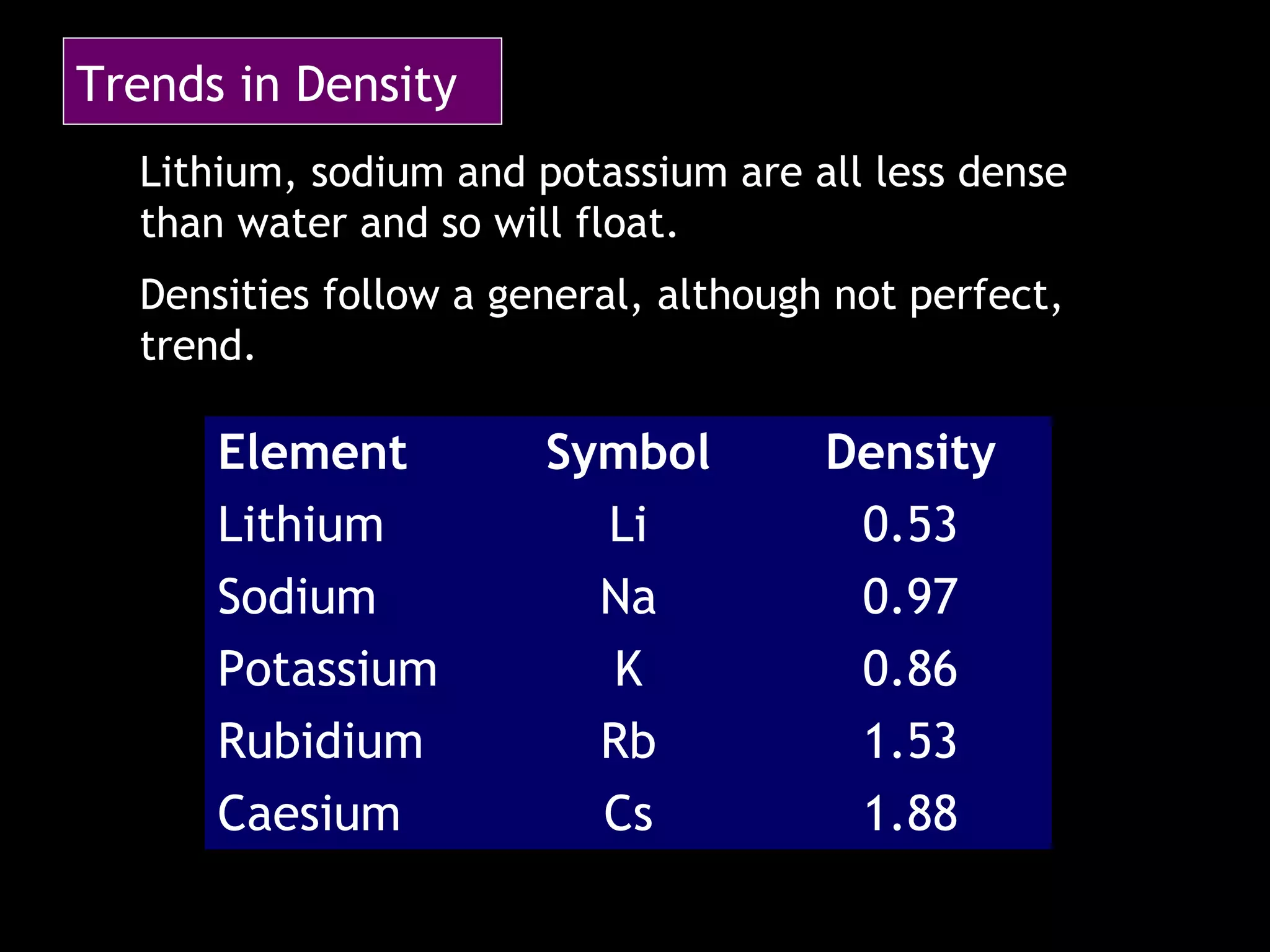
Trends in Density
Lithium,sodium and potassium are all less dense
than water and so will float.
Densities follow a general, although not perfect,
trend.
Element Symbol Density
Lithium Li 0.53
Sodium Na 0.97
Potassium K 0.86
Rubidium Rb 1.53
Caesium Cs 1.88
12.
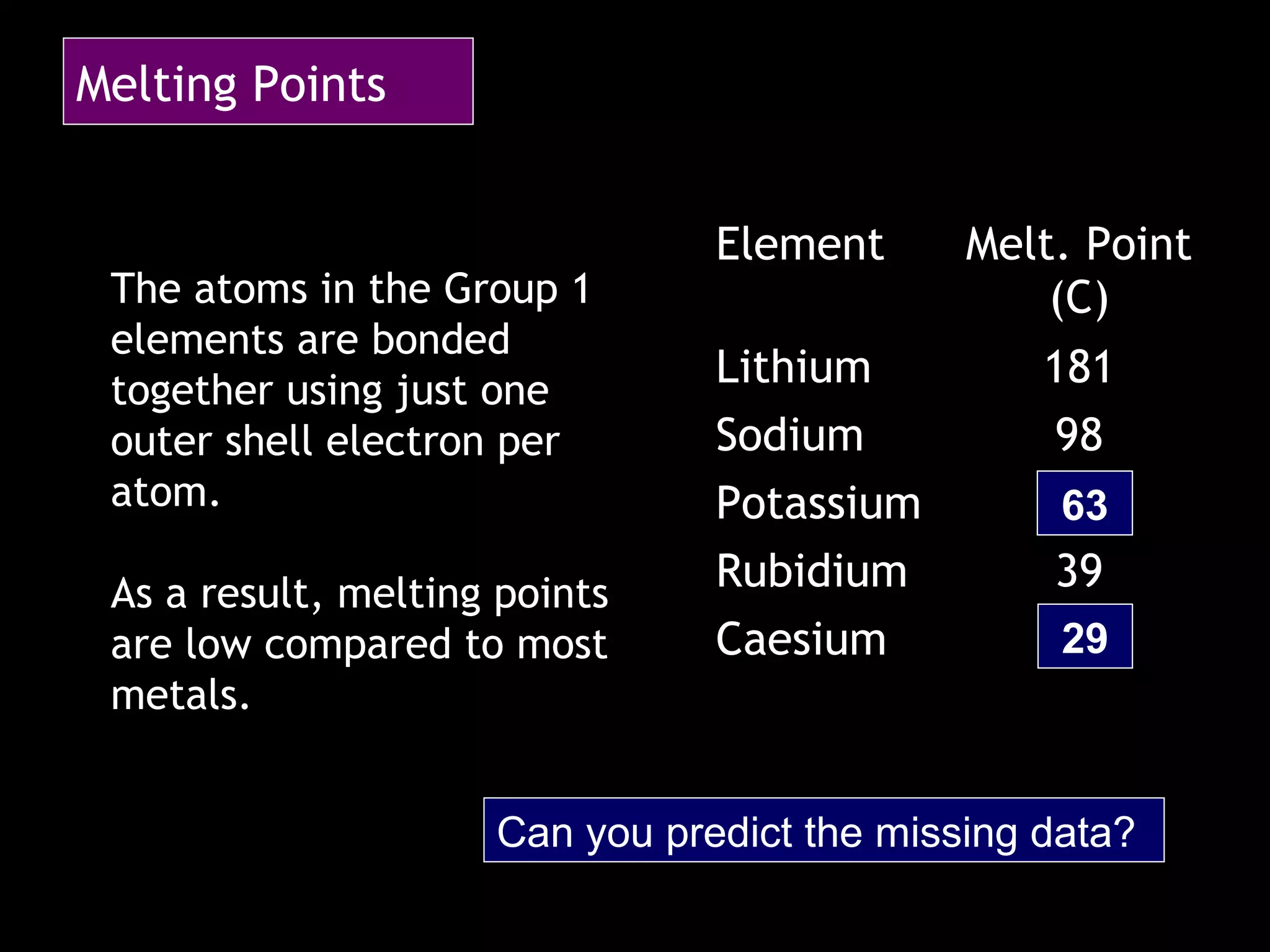
Melting Points
The atomsin the Group 1
elements are bonded
together using just one
outer shell electron per
atom.
As a result, melting points
are low compared to most
metals.
Element Melt. Point
(C)
Lithium 181
Sodium 98
Potassium
Rubidium 39
Caesium
Can you predict the missing data?
63
29
Electronic Structure
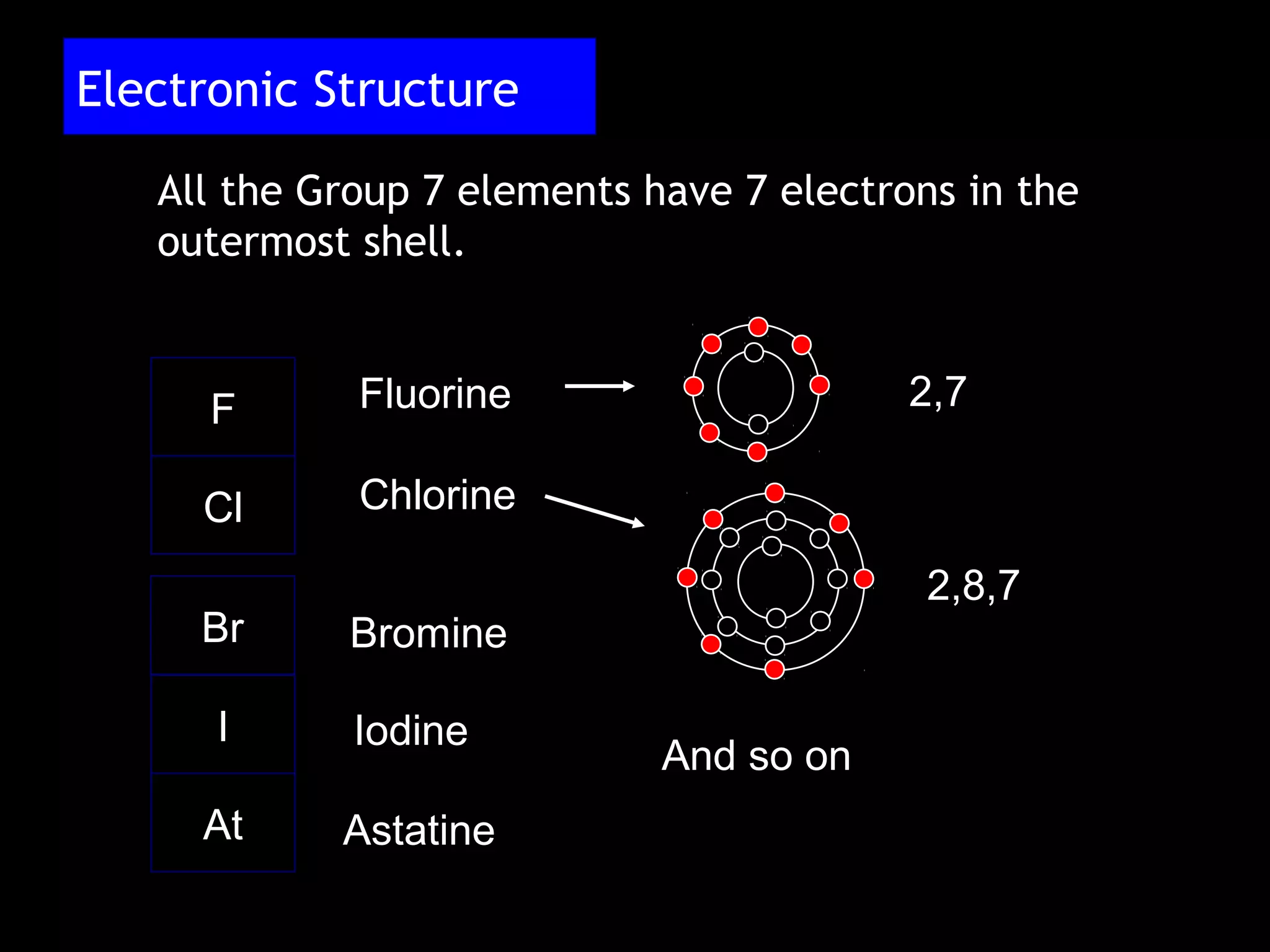
All theGroup 7 elements have 7 electrons in the
outermost shell.
F
Cl
Br
I
At
Bromine
Iodine
Astatine
Fluorine 2,7
Chlorine
2,8,7
And so on
15.
Halogen molecules
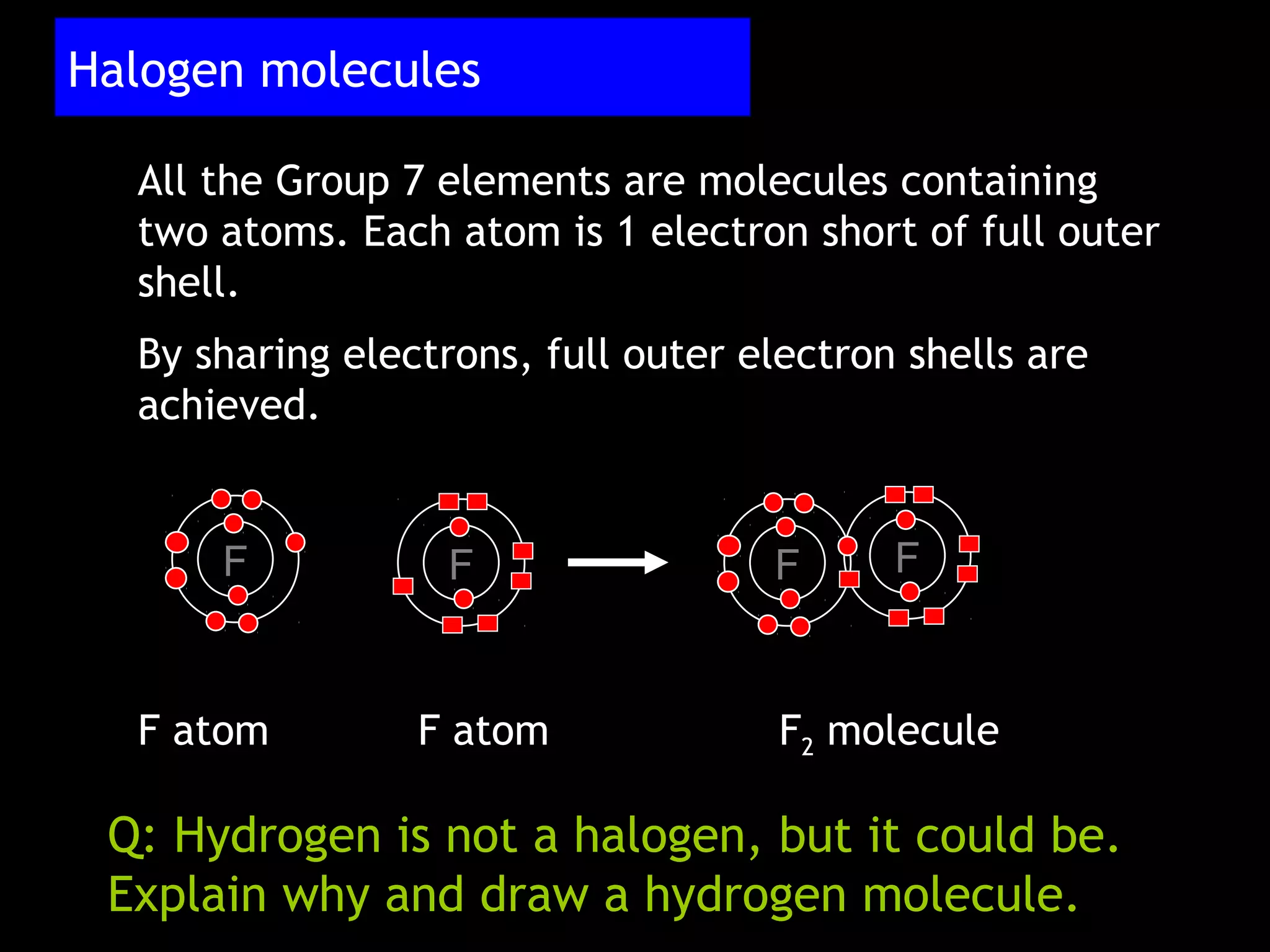
All theGroup 7 elements are molecules containing
two atoms. Each atom is 1 electron short of full outer
shell.
By sharing electrons, full outer electron shells are
achieved.
F FF F
F atom F atom F2 molecule
Q: Hydrogen is not a halogen, but it could be.
Explain why and draw a hydrogen molecule.
16.
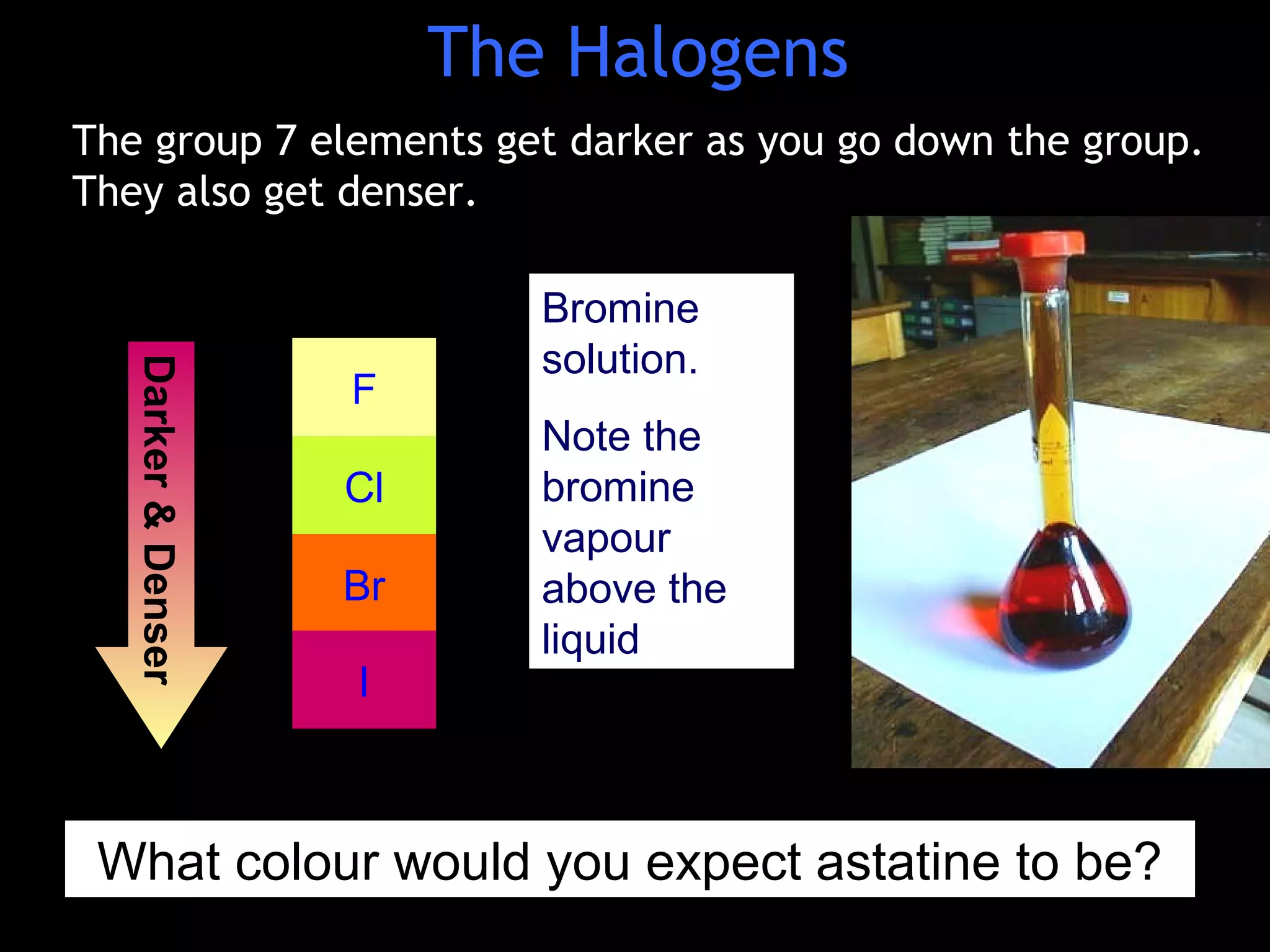
The group 7elements get darker as you go down the group.
They also get denser.
F
Cl
Br
I
Darker&Denser
Bromine
solution.
Note the
bromine
vapour
above the
liquid
What colour would you expect astatine to be?
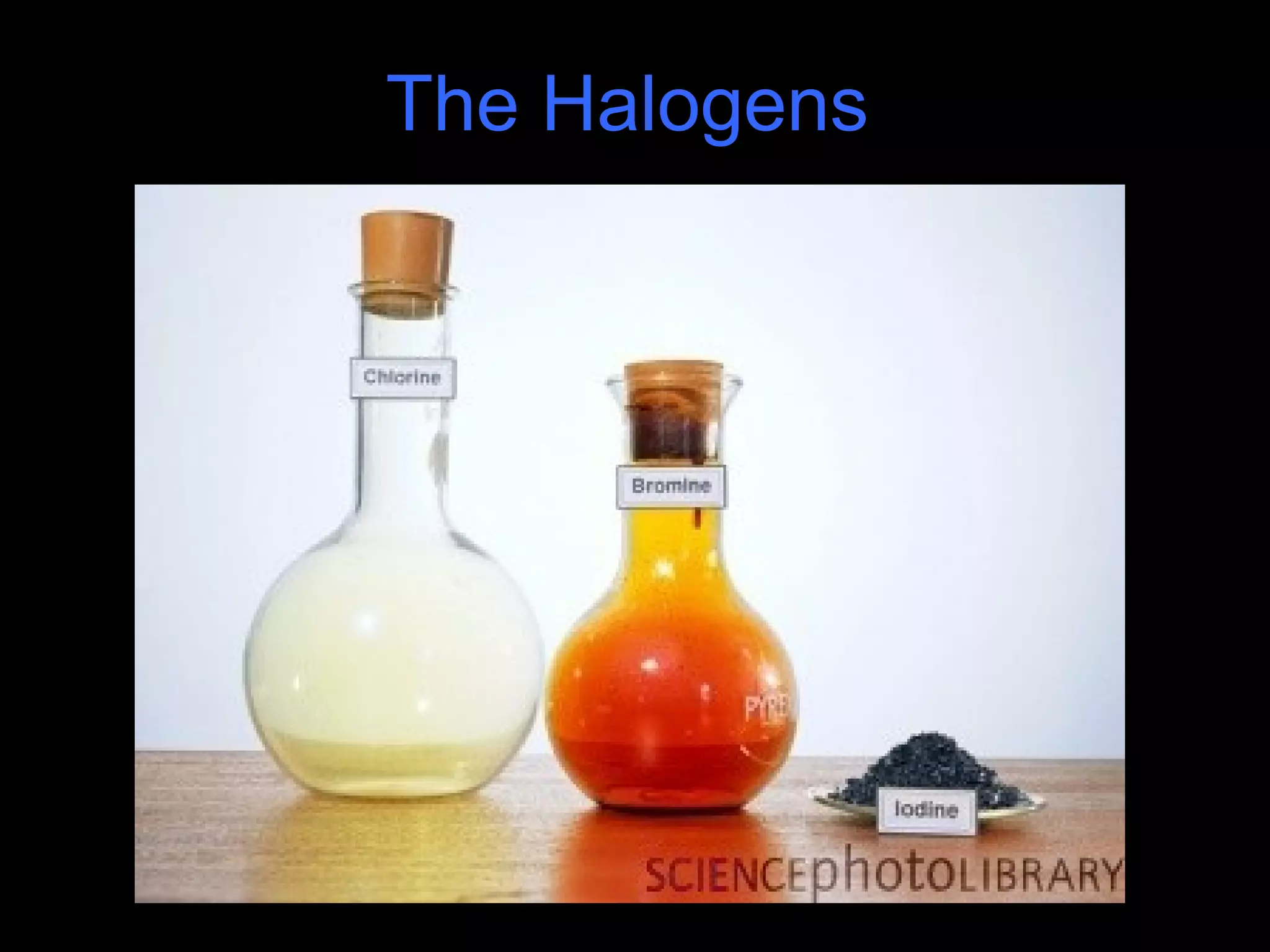
The Halogens
17.
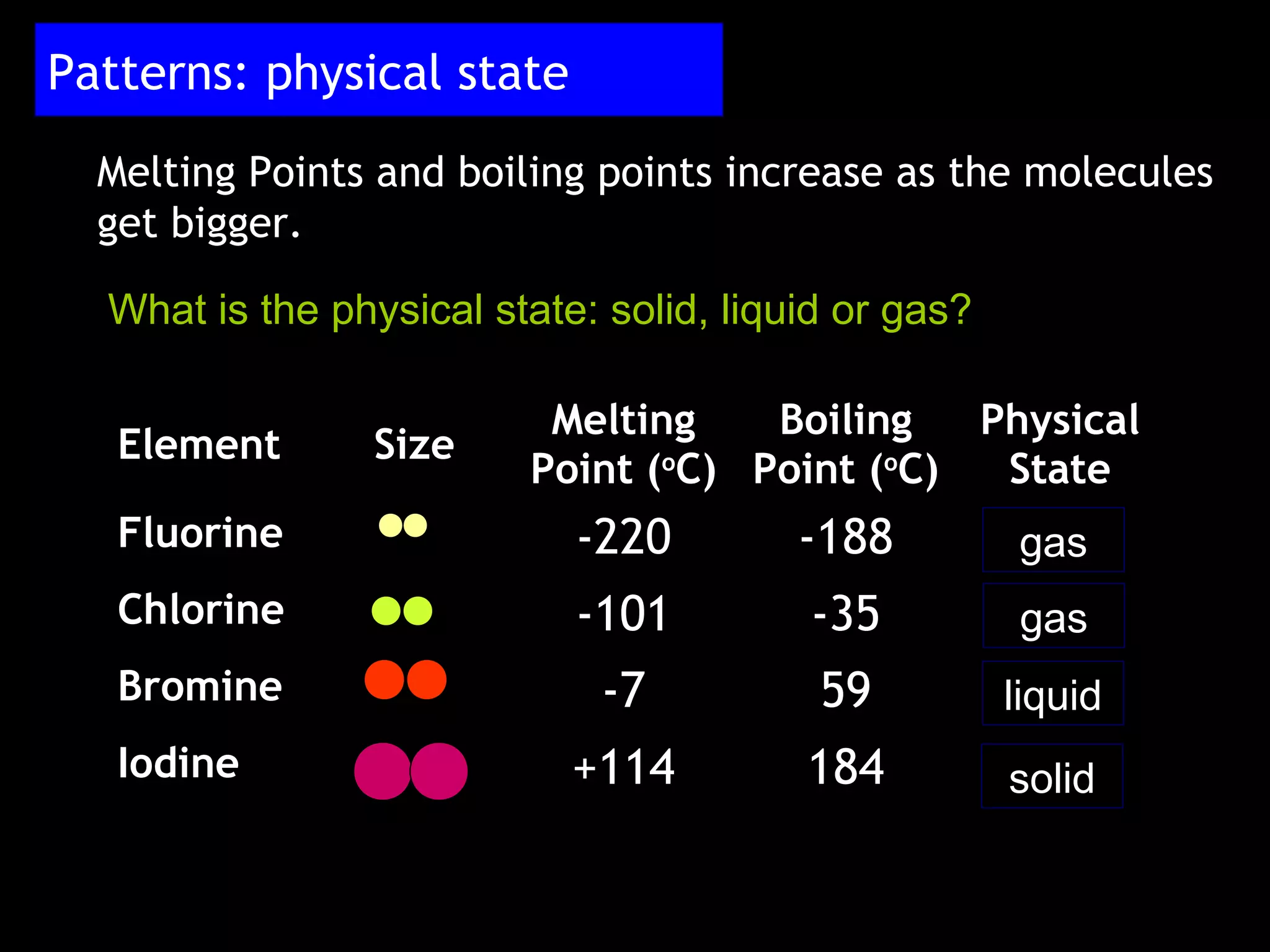
Patterns: physical state
MeltingPoints and boiling points increase as the molecules
get bigger.
What is the physical state: solid, liquid or gas?
Element Size
Melting
Point (o
C)
Boiling
Point (o
C)
Physical
State
Fluorine -220 -188
Chlorine -101 -35
Bromine -7 59
Iodine +114 184
gas
gas
liquid
solid
18.
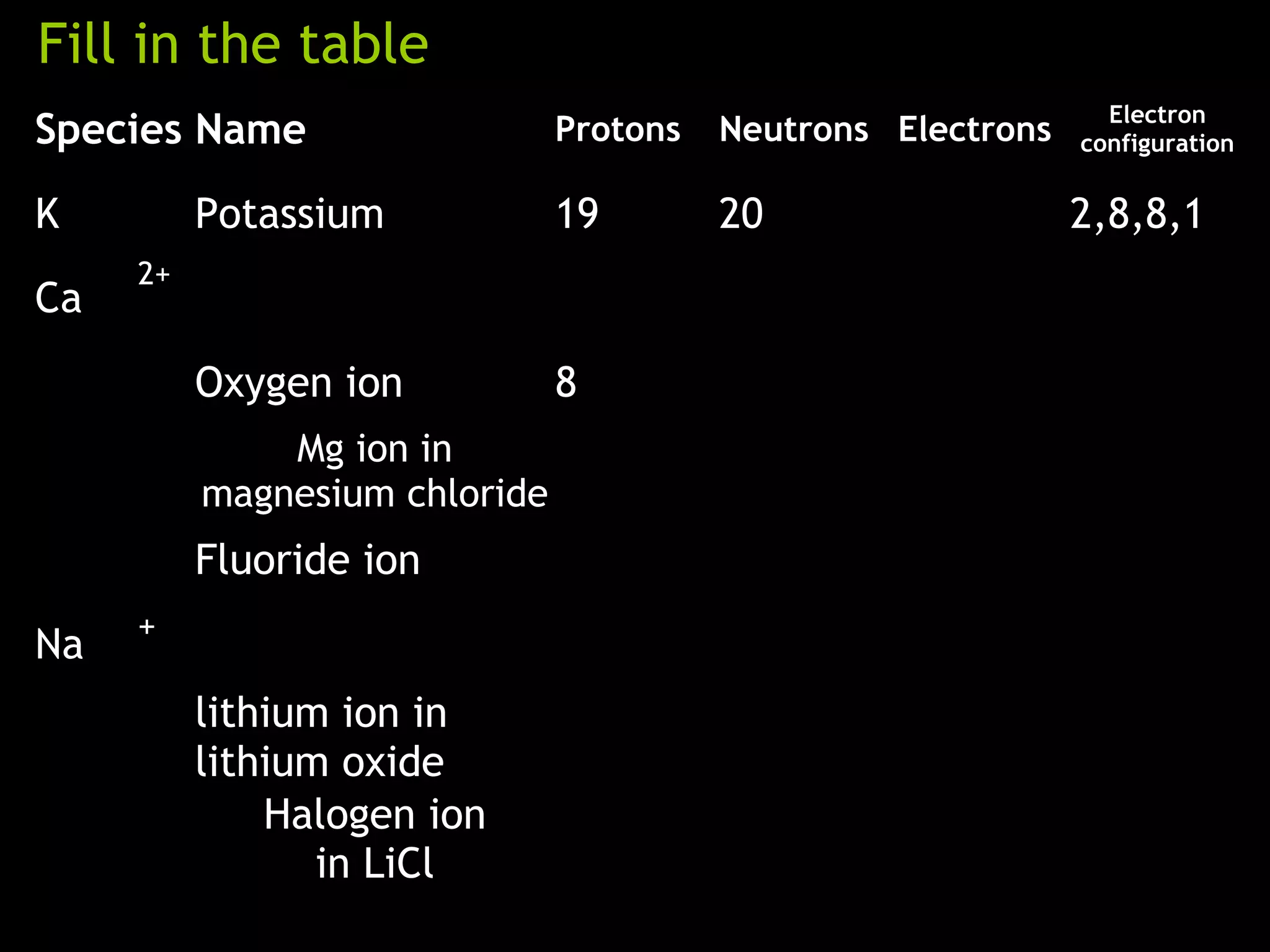
Fill in thetable
Species Name Protons Neutrons Electrons
Electron
configuration
K Potassium 19 20 2,8,8,1
Ca
Oxygen ion 8
Mg ion in
magnesium chloride
Fluoride ion
Na
lithium ion in
lithium oxide
Halogen ion
in LiCl
2+
+
19.
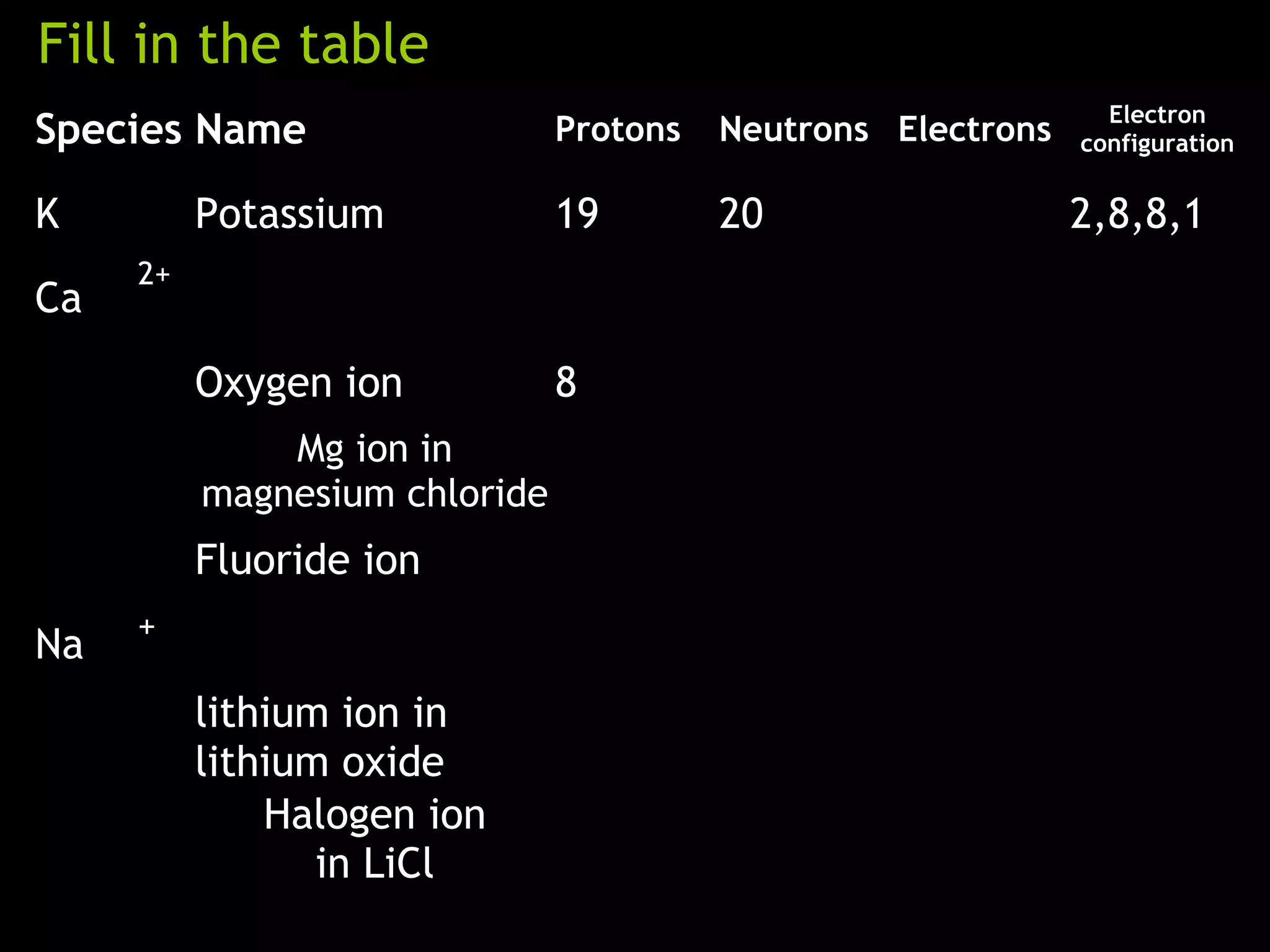
Fill in thetable
Species Name Protons Neutrons Electrons
Electron
configuration
K Potassium 19 20 2,8,8,1
Ca
Oxygen ion 8
Mg ion in
magnesium chloride
Fluoride ion
Na
lithium ion in
lithium oxide
Halogen ion
in LiCl
2+
+
20.
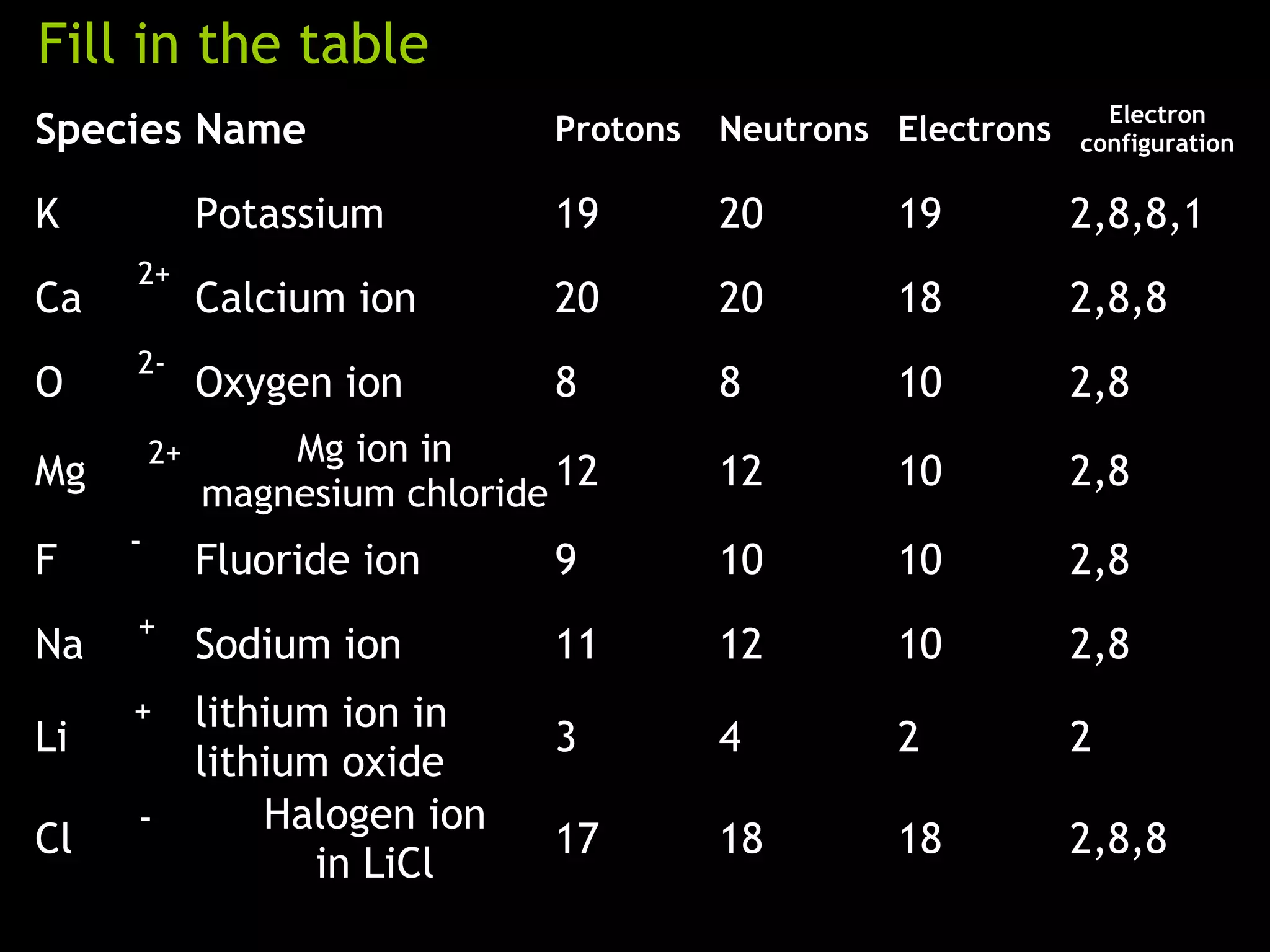
Fill in thetable
Species Name Protons Neutrons Electrons
Electron
configuration
K Potassium 19 20 19 2,8,8,1
Ca Calcium ion 20 20 18 2,8,8
O Oxygen ion 8 8 10 2,8
Mg
Mg ion in
magnesium chloride
12 12 10 2,8
F Fluoride ion 9 10 10 2,8
Na Sodium ion 11 12 10 2,8
Li
lithium ion in
lithium oxide
3 4 2 2
Cl
Halogen ion
in LiCl
17 18 18 2,8,8
2+
+
2-
-
+
-
2+
21.
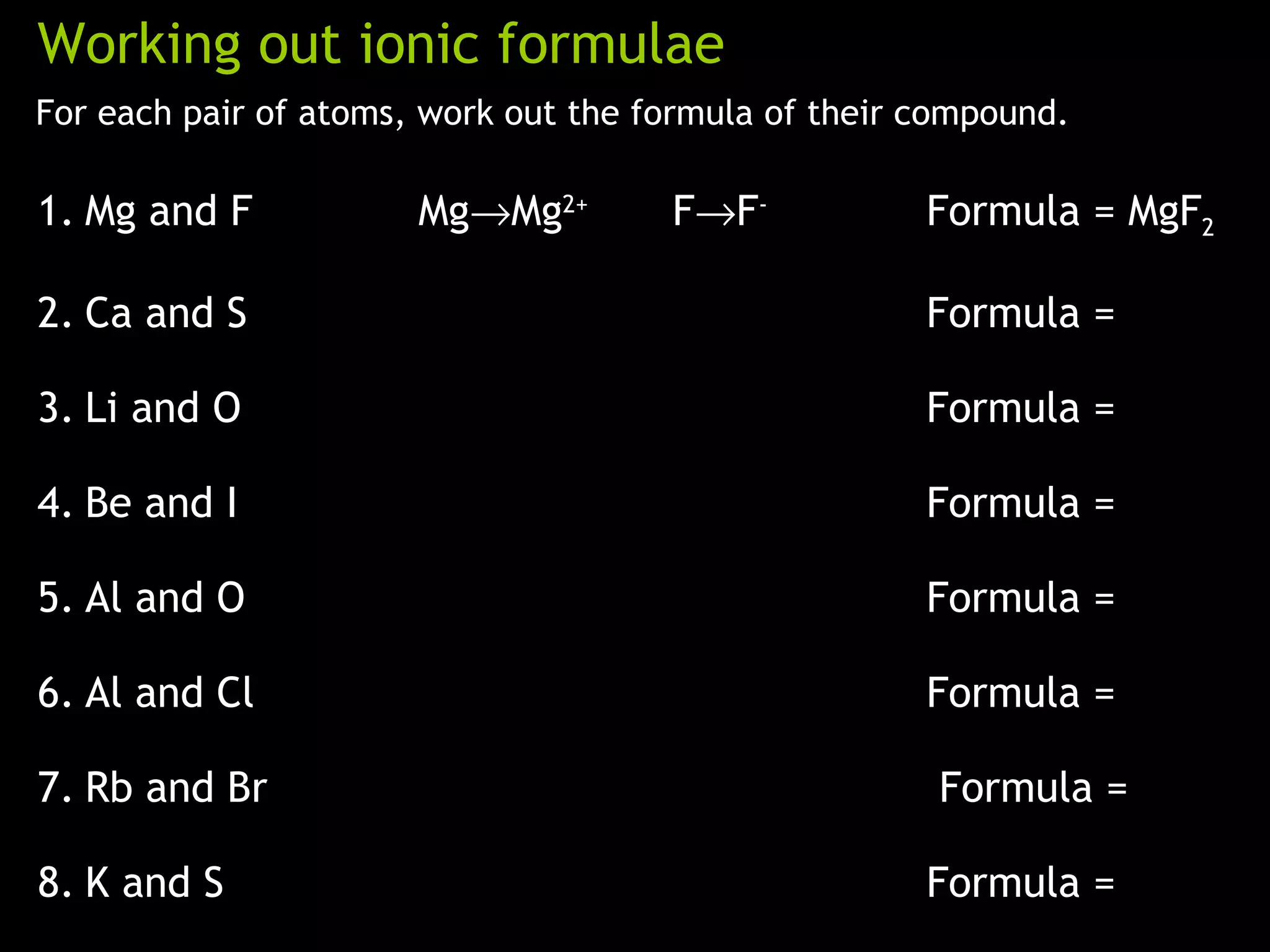
Working out ionicformulae
For each pair of atoms, work out the formula of their compound.
1. Mg and F Mg→Mg2+
F→F-
Formula = MgF2
2. Ca and S Formula =
3. Li and O Formula =
4. Be and I Formula =
5. Al and O Formula =
6. Al and Cl Formula =
7. Rb and Br Formula =
8. K and S Formula =
22.
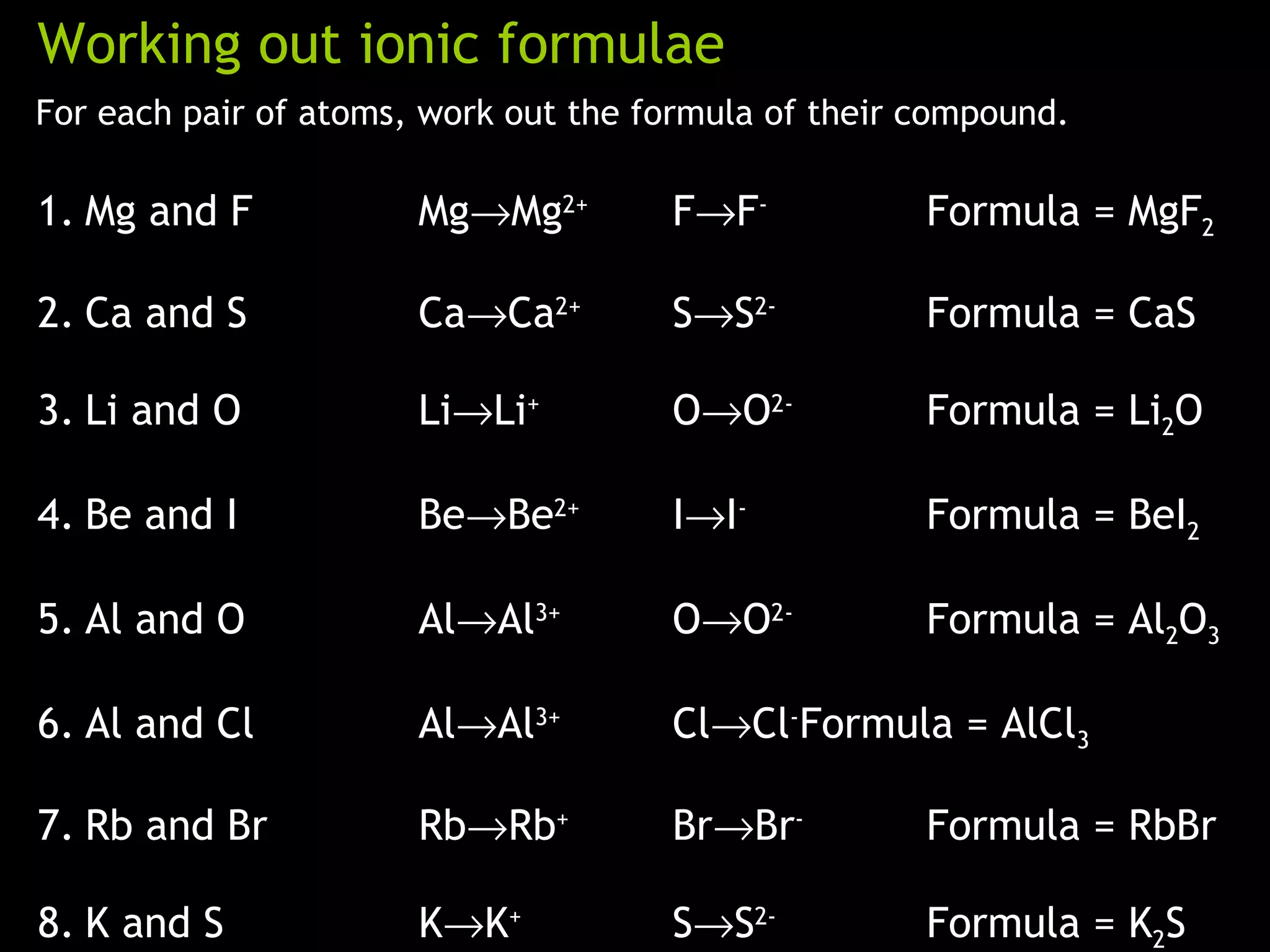
Working out ionicformulae
For each pair of atoms, work out the formula of their compound.
1. Mg and F Mg→Mg2+
F→F-
Formula = MgF2
2. Ca and S Ca→Ca2+
S→S2-
Formula = CaS
3. Li and O Li→Li+
O→O2-
Formula = Li2O
4. Be and I Be→Be2+
I→I-
Formula = BeI2
5. Al and O Al→Al3+
O→O2-
Formula = Al2O3
6. Al and Cl Al→Al3+
Cl→Cl-
Formula = AlCl3
7. Rb and Br Rb→Rb+
Br→Br-
Formula = RbBr
8. K and S K→K+
S→S2-
Formula = K2S
23.
Astatine comes belowiodine in Group 7
What might its melting point be (in o
C)?
A. –225 B. +82 C. +150 D. +300
-220
-101
-7
114
-300
-200
-100
0
100
200
300
Period
M.Pt(C)
F
Cl
Br
I



![GCSE Chemistry [C3]](https://cdn.slidesharecdn.com/ss_thumbnails/c3comp-090415025327-phpapp02-thumbnail.jpg?width=640&height=640&fit=bounds)


