C4 Revision Notes
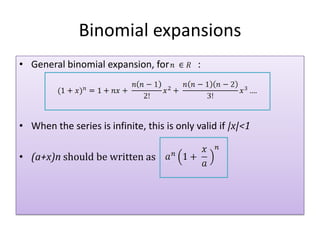
Binomial expansions
• General binomial expansion, for           :


• When the series is infinite, this is only valid if |x|<1

• (a+x)n should be written as
Partial fractions
• A proper algebraic fraction with a denominator which factorises can be
  decomposed into a sum of partial fractions. Following forms should be
  used:


• e.g.
• e.g.


• E.g
Trigonometry
Reciprocal trig functions:
•                  ;              ;


•                        ;

Compound-angle formulae
•
•
•
•

•

•
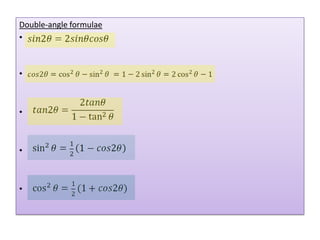
Double-angle formulae
•


•


•


•


•
The r, α formulae
•

•

•

•
Small-angle approximations

•

•

•


    Keep Θ in radians
Parametric Equations
• To draw a graph from parametric equations, plot the points on the curve
  given by different values of the parameter.
• Eliminate the parameter to give the cartesian equation of the curve.
• Parametric equations of circles:

    - Circle centre (0,0) and radius r


    - Circle centre (a,b) and radius r


•
Techniques for integration
Volumes of revolution
• About the x axis:


• About the y axis:


• Trapezium rule, with n strips of width h:


Note that this gives an overestimation of the area under the curve.
Vectors
• Magnitude-direction form:            (2 dimensions)
                                                          measured
                                                        anticlockwise
• Component form:                                           from
                                                         horizontal


• Position vector      is from origin to point P

• Vector

• ‘r’ denotes position vector of a general point
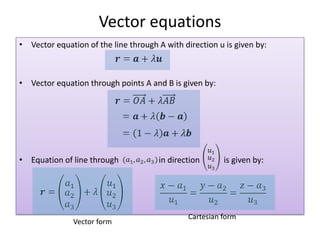
Vector equations
• Vector equation of the line through A with direction u is given by:


• Vector equation through points A and B is given by:


• Equation of line through            in direction       is given by:


                                               Cartesian form
               Vector form
Angle between two vectors
• The angle between a and b is given by


• Where

                              in two dimensions


                                      in three dimensions
• Cartesian equation of a plane perpendicular to             is:


• Equation of the plane through the point with position vector a, and
  perpendicular to n, is given by

                                 (r-a).n=0.
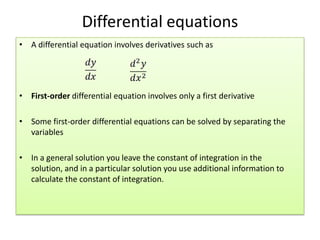
Differential equations
• A differential equation involves derivatives such as


• First-order differential equation involves only a first derivative

• Some first-order differential equations can be solved by separating the
  variables

• In a general solution you leave the constant of integration in the
  solution, and in a particular solution you use additional information to
  calculate the constant of integration.
Example

C4 EDEXCEL HELP

  • 1.
  • 2.
    Binomial expansions • Generalbinomial expansion, for : • When the series is infinite, this is only valid if |x|<1 • (a+x)n should be written as
  • 3.
    Partial fractions • Aproper algebraic fraction with a denominator which factorises can be decomposed into a sum of partial fractions. Following forms should be used: • e.g.
  • 4.
  • 5.
    Trigonometry Reciprocal trig functions: • ; ; • ; Compound-angle formulae • • • • • •
  • 6.
  • 7.
    The r, αformulae • • • •
  • 8.
  • 9.
    Parametric Equations • Todraw a graph from parametric equations, plot the points on the curve given by different values of the parameter. • Eliminate the parameter to give the cartesian equation of the curve. • Parametric equations of circles: - Circle centre (0,0) and radius r - Circle centre (a,b) and radius r •
  • 10.
    Techniques for integration Volumesof revolution • About the x axis: • About the y axis: • Trapezium rule, with n strips of width h: Note that this gives an overestimation of the area under the curve.
  • 11.
    Vectors • Magnitude-direction form: (2 dimensions) measured anticlockwise • Component form: from horizontal • Position vector is from origin to point P • Vector • ‘r’ denotes position vector of a general point
  • 12.
    Vector equations • Vectorequation of the line through A with direction u is given by: • Vector equation through points A and B is given by: • Equation of line through in direction is given by: Cartesian form Vector form
  • 13.
    Angle between twovectors • The angle between a and b is given by • Where in two dimensions in three dimensions
  • 14.
    • Cartesian equationof a plane perpendicular to is: • Equation of the plane through the point with position vector a, and perpendicular to n, is given by (r-a).n=0.
  • 15.
    Differential equations • Adifferential equation involves derivatives such as • First-order differential equation involves only a first derivative • Some first-order differential equations can be solved by separating the variables • In a general solution you leave the constant of integration in the solution, and in a particular solution you use additional information to calculate the constant of integration.
  • 16.