Elements and the Periodic Table
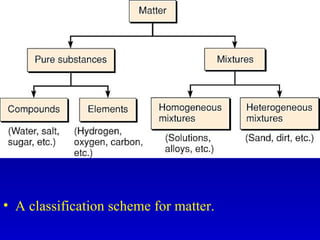
A classification scheme for matter.
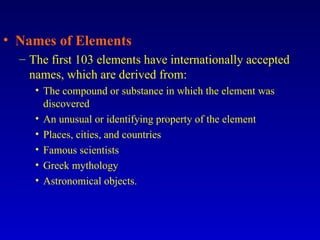
Names of Elements The first 103 elements have internationally accepted names, which are derived from: The compound or substance in which the element was discovered An unusual or identifying property of the element Places, cities, and countries Famous scientists Greek mythology Astronomical objects.
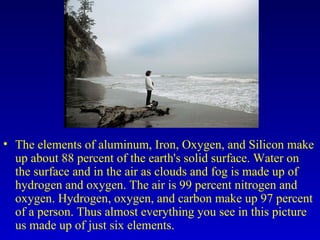
The elements of aluminum, Iron, Oxygen, and Silicon make up about 88 percent of the earth's solid surface. Water on the surface and in the air as clouds and fog is made up of hydrogen and oxygen. The air is 99 percent nitrogen and oxygen. Hydrogen, oxygen, and carbon make up 97 percent of a person. Thus almost everything you see in this picture us made up of just six elements.
Chemical Symbols There are about a dozen common elements that have a single capitalized letter for their symbol The rest, that have permanent names have two letters. the first is capitalized and the second is lower case. Some elements have symbols from their Latin names. Ten of the elements have symbols from their Latin or German names.
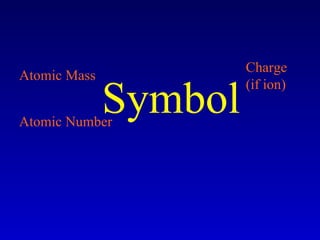
Symbol Atomic Mass Atomic Number Charge  (if ion)
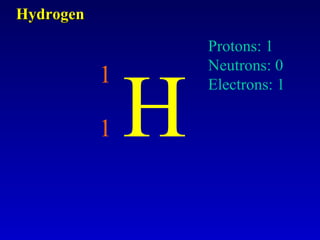
H Hydrogen 1 1 Protons: 1 Neutrons: 0 Electrons: 1
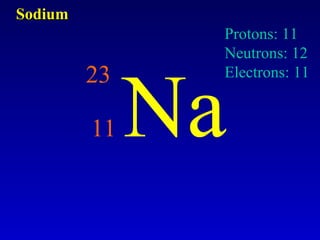
Na Sodium 23 11 Protons: 11 Neutrons: 12 Electrons: 11
The Modern Periodic Table
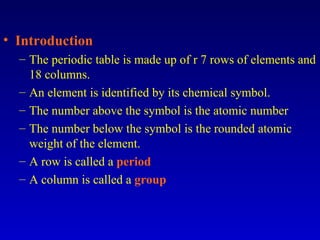
Introduction The periodic table is made up of r 7 rows of elements and 18 columns. An element is identified by its chemical symbol. The number above the symbol is the atomic number The number below the symbol is the rounded atomic weight of the element. A row is called a  period A column is called a  group
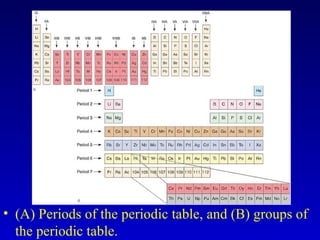
(A) Periods of the periodic table, and (B) groups of the periodic table.
Group A elements are called  representative elements Group B elements are called  transition elements .
Chemical “Families” IA are called  alkali metals  because the react with water to from an alkaline solution Group IIA are called the  alkali earth metals  because they are reactive, but not as reactive as Group IA. They are also soft metals like Earth. Group VIIA are the  halogens These need only one electron to fill their outer shell They are very reactive. Group VIIIA are the  noble gases  as they have completely filled outer shells They are almost non reactive.
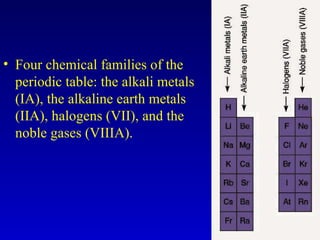
Four chemical families of the periodic table: the alkali metals (IA), the alkaline earth metals (IIA), halogens (VII), and the noble gases (VIIIA).
Metal:  Elements that are usually solids at room temperature.  Most elements are metals. Non-Metal:  Elements in the upper right corner of the periodic  Table.  Their chemical and physical properties are different from metals. Metalloid:  Elements that lie on a diagonal line between the  Metals and non-metals.  Their chemical and physical properties are intermediate between the two.
When an atom or molecule gain or loses an electron it becomes an ion. A  cation  has lost an electron and therefore has a positive charge An  anion  has gained an electron and therefore has a negative charge.
Elements with 1, 2, or 3 electrons in their outer shell tend to  lose  electrons to fill their outer shell and become cations. These are the  metals  which always tend to lose electrons. Elements with 5 to 7 electrons in their outer shell tend to  gain  electrons to fill their outer shell and become anions. These are the  nonmetals  which always tend to gain electrons. Semiconductors  (metalloids) occur at the dividing line between metals and nonmetals.
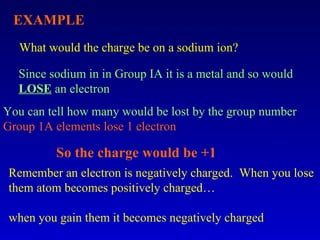
What would the charge be on a sodium ion? EXAMPLE Since sodium in in Group IA it is a metal and so would LOSE  an electron You can tell how many would be lost by the group number Group 1A elements lose 1 electron So the charge would be +1 Remember an electron is negatively charged.  When you lose  them atom becomes positively charged… when you gain them it becomes negatively charged
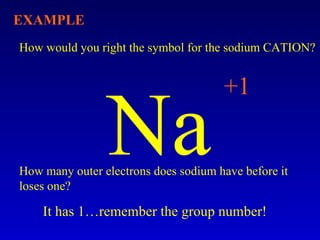
How would you right the symbol for the sodium CATION? EXAMPLE Na +1 How many outer electrons does sodium have before it  loses one? It has 1…remember the group number!

Elements and the pt

  • 1.
    Elements and thePeriodic Table
  • 2.
  • 3.
    Names of ElementsThe first 103 elements have internationally accepted names, which are derived from: The compound or substance in which the element was discovered An unusual or identifying property of the element Places, cities, and countries Famous scientists Greek mythology Astronomical objects.
  • 4.
    The elements ofaluminum, Iron, Oxygen, and Silicon make up about 88 percent of the earth's solid surface. Water on the surface and in the air as clouds and fog is made up of hydrogen and oxygen. The air is 99 percent nitrogen and oxygen. Hydrogen, oxygen, and carbon make up 97 percent of a person. Thus almost everything you see in this picture us made up of just six elements.
  • 5.
    Chemical Symbols Thereare about a dozen common elements that have a single capitalized letter for their symbol The rest, that have permanent names have two letters. the first is capitalized and the second is lower case. Some elements have symbols from their Latin names. Ten of the elements have symbols from their Latin or German names.
  • 6.
    Symbol Atomic MassAtomic Number Charge (if ion)
  • 7.
    H Hydrogen 11 Protons: 1 Neutrons: 0 Electrons: 1
  • 8.
    Na Sodium 2311 Protons: 11 Neutrons: 12 Electrons: 11
  • 9.
  • 10.
    Introduction The periodictable is made up of r 7 rows of elements and 18 columns. An element is identified by its chemical symbol. The number above the symbol is the atomic number The number below the symbol is the rounded atomic weight of the element. A row is called a period A column is called a group
  • 11.
    (A) Periods ofthe periodic table, and (B) groups of the periodic table.
  • 12.
    Group A elementsare called representative elements Group B elements are called transition elements .
  • 13.
    Chemical “Families” IAare called alkali metals because the react with water to from an alkaline solution Group IIA are called the alkali earth metals because they are reactive, but not as reactive as Group IA. They are also soft metals like Earth. Group VIIA are the halogens These need only one electron to fill their outer shell They are very reactive. Group VIIIA are the noble gases as they have completely filled outer shells They are almost non reactive.
  • 14.
    Four chemical familiesof the periodic table: the alkali metals (IA), the alkaline earth metals (IIA), halogens (VII), and the noble gases (VIIIA).
  • 15.
    Metal: Elementsthat are usually solids at room temperature. Most elements are metals. Non-Metal: Elements in the upper right corner of the periodic Table. Their chemical and physical properties are different from metals. Metalloid: Elements that lie on a diagonal line between the Metals and non-metals. Their chemical and physical properties are intermediate between the two.
  • 16.
    When an atomor molecule gain or loses an electron it becomes an ion. A cation has lost an electron and therefore has a positive charge An anion has gained an electron and therefore has a negative charge.
  • 17.
    Elements with 1,2, or 3 electrons in their outer shell tend to lose electrons to fill their outer shell and become cations. These are the metals which always tend to lose electrons. Elements with 5 to 7 electrons in their outer shell tend to gain electrons to fill their outer shell and become anions. These are the nonmetals which always tend to gain electrons. Semiconductors (metalloids) occur at the dividing line between metals and nonmetals.
  • 18.
    What would thecharge be on a sodium ion? EXAMPLE Since sodium in in Group IA it is a metal and so would LOSE an electron You can tell how many would be lost by the group number Group 1A elements lose 1 electron So the charge would be +1 Remember an electron is negatively charged. When you lose them atom becomes positively charged… when you gain them it becomes negatively charged
  • 19.
    How would youright the symbol for the sodium CATION? EXAMPLE Na +1 How many outer electrons does sodium have before it loses one? It has 1…remember the group number!