Consumer Markets and Consumer
              Buying Behavior


                            1
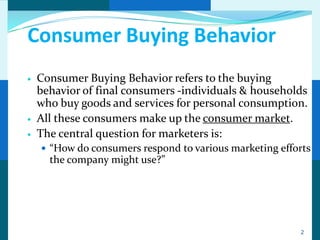
Consumer Buying Behavior
   Consumer Buying Behavior refers to the buying
    behavior of final consumers -individuals & households
    who buy goods and services for personal consumption.
   All these consumers make up the consumer market.
   The central question for marketers is:
     “How do consumers respond to various marketing efforts
      the company might use?”


                                                         2
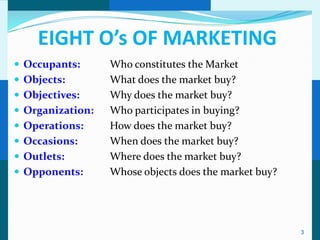
EIGHT O’s OF MARKETING
 Occupants:      Who constitutes the Market
 Objects:        What does the market buy?
 Objectives:     Why does the market buy?
 Organization:   Who participates in buying?
 Operations:     How does the market buy?
 Occasions:      When does the market buy?
 Outlets:        Where does the market buy?
 Opponents:      Whose objects does the market buy?


                                                       3
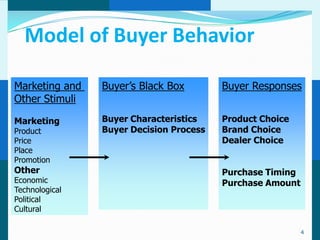
Model of Buyer Behavior

Marketing and   Buyer’s Black Box        Buyer Responses
Other Stimuli

Marketing       Buyer Characteristics    Product Choice
Product         Buyer Decision Process   Brand Choice
Price                                    Dealer Choice
Place
Promotion
Other                                    Purchase Timing
Economic                                 Purchase Amount
Technological
Political
Cultural

                                                           4
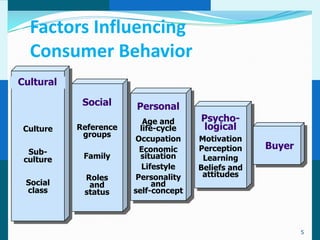
Factors Influencing
  Consumer Behavior
Cultural

            Social     Personal
                          Age and     Psycho-
 Culture   Reference     life-cycle    logical
            groups
                       Occupation     Motivation
                         Economic     Perception    Buyer
  Sub-
 culture    Family       situation     Learning
                         Lifestyle    Beliefs and
            Roles       Personality    attitudes
 Social      and             and
 class      status     self-concept


                                                            5
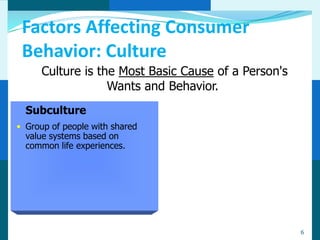
Factors Affecting Consumer
 Behavior: Culture
      Culture is the Most Basic Cause of a Person's
                   Wants and Behavior.
  Subculture
• Group of people with shared
  value systems based on
  common life experiences.


                                                      6
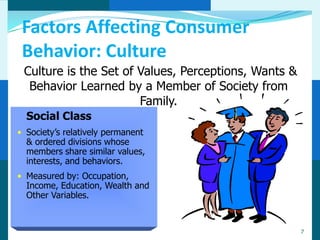
Factors Affecting Consumer
 Behavior: Culture
 Culture is the Set of Values, Perceptions, Wants &
  Behavior Learned by a Member of Society from
                       Family.
  Social Class
• Society’s relatively permanent
  & ordered divisions whose
  members share similar values,
  interests, and behaviors.
• Measured by: Occupation,
  Income, Education, Wealth and
  Other Variables.


                                                      7
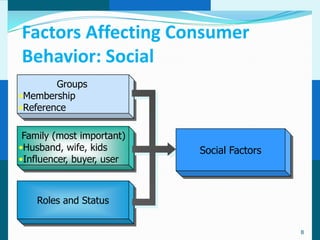
Factors Affecting Consumer
Behavior: Social
        Groups
•Membership
•Reference

 Family (most important)
•Husband, wife, kids       Social Factors
•Influencer, buyer, user


    Roles and Status


                                            8
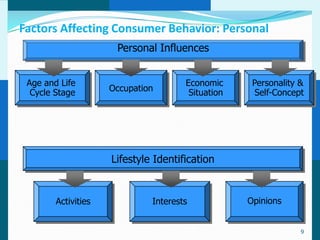
Factors Affecting Consumer Behavior: Personal
                     Personal Influences
                     Personal Influences


 Age and Life
 Age and Life                        Economic
                                     Economic      Personality &
                                                   Personality &
  Cycle Stage       Occupation
                    Occupation        Situation    Self-Concept
  Cycle Stage                         Situation     Self-Concept


                    Lifestyle Identification
                    Lifestyle Identification


       Activities
       Activities            Interests
                              Interests           Opinions
                                                  Opinions


                                                              9
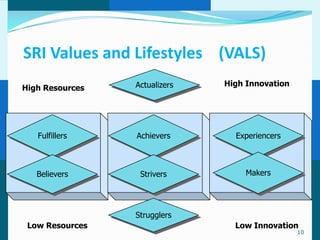
SRI Values and Lifestyles (VALS)
                 Actualizers   High Innovation
High Resources


   Fulfillers    Achievers       Experiencers


   Believers      Strivers         Makers


                 Strugglers
 Low Resources                   Low Innovation
                                                 10
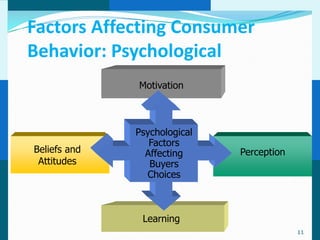
Factors Affecting Consumer
Behavior: Psychological
              Motivation


              Psychological
                 Factors
Beliefs and     Affecting     Perception
 Attitudes       Buyers
                Choices


               Learning
                                           11
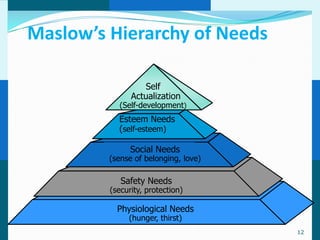
Maslow’s Hierarchy of Needs

                  Self
               Actualization
           (Self-development)
           Esteem Needs
           (self-esteem)

               Social Needs
         (sense of belonging, love)

            Safety Needs
         (security, protection)

           Physiological Needs
              (hunger, thirst)
                                      12
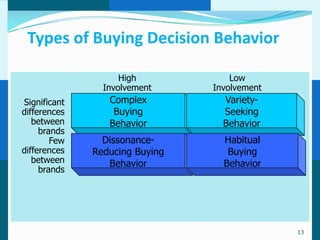
Types of Buying Decision Behavior

                    High            Low
                Involvement     Involvement
Significant      Complex          Variety-
differences       Buying          Seeking
   between       Behavior         Behavior
     brands
        Few     Dissonance-       Habitual
differences   Reducing Buying      Buying
   between       Behavior         Behavior
     brands


                                              13
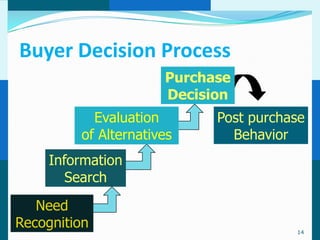
Buyer Decision Process
                      Purchase
                      Decision
           Evaluation       Post purchase
         of Alternatives      Behavior
     Information
        Search
   Need
Recognition                            14
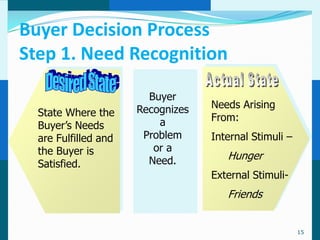
Buyer Decision Process
Step 1. Need Recognition

                        Buyer
                      Recognizes   Needs Arising
  State Where the                  From:
  Buyer’s Needs           a
  are Fulfilled and    Problem     Internal Stimuli –
  the Buyer is           or a
                        Need.         Hunger
  Satisfied.
                                   External Stimuli-
                                      Friends


                                                        15
The Buyer Decision Process
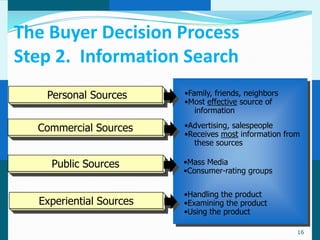
Step 2. Information Search
   Personal Sources      •Family, friends, neighbors
                         •Most effective source of
                            information

  Commercial Sources     •Advertising, salespeople
                         •Receives most information from
                           these sources

    Public Sources       •Mass Media
                         •Consumer-rating groups

                         •Handling the product
  Experiential Sources   •Examining the product
                         •Using the product

                                                       16
The Buyer Decision Process
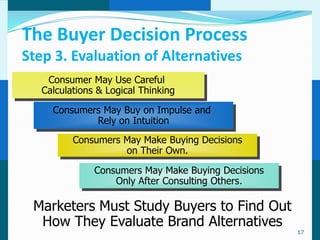
Step 3. Evaluation of Alternatives
    Consumer May Use Careful
   Calculations & Logical Thinking

     Consumers May Buy on Impulse and
             Rely on Intuition
          Consumers May Make Buying Decisions
                    on Their Own.

               Consumers May Make Buying Decisions
                   Only After Consulting Others.

 Marketers Must Study Buyers to Find Out
  How They Evaluate Brand Alternatives
                                                     17
The Buyer Decision Process
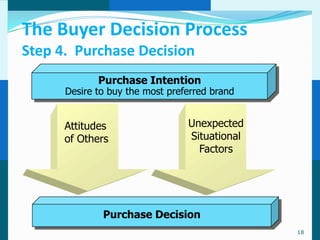
Step 4. Purchase Decision
             Purchase Intention
      Desire to buy the most preferred brand


      Attitudes                  Unexpected
      of Others                  Situational
                                   Factors


              Purchase Decision
                                               18
The Buyer Decision Process
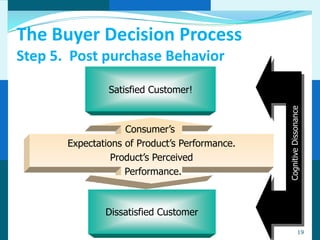
Step 5. Post purchase Behavior

                Satisfied Customer!


                                                Cognitive Dissonance
                    Consumer’s
       Expectations of Product’s Performance.
                 Product’s Perceived
                    Performance.


               Dissatisfied Customer
                                                               19
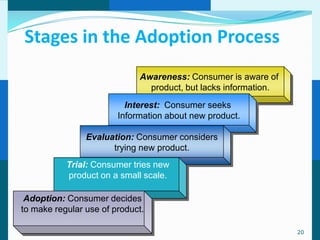
Stages in the Adoption Process
                             Awareness: Consumer is aware of
                               product, but lacks information.
                          Interest: Consumer seeks
                        Information about new product.

                Evaluation: Consumer considers
                      trying new product.
           Trial: Consumer tries new
           product on a small scale.

 Adoption: Consumer decides
to make regular use of product.

                                                                 20
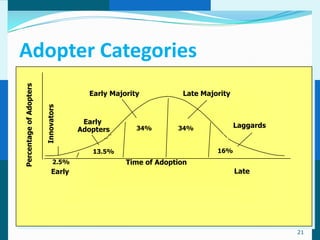
Adopter Categories
Percentage of Adopters


                                         Early Majority          Late Majority
                         Innovators


                                        Early
                                                      34%       34%              Laggards
                                       Adopters


                                          13.5%                           16%
                                2.5%               Time of Adoption
                              Early                                              Late


                                                                                            21
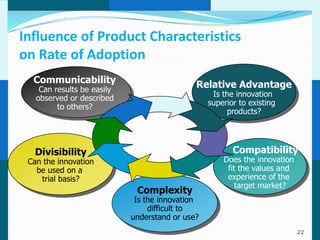
Influence of Product Characteristics
on Rate of Adoption
  Communicability                            Relative Advantage
    Can results be easily
                                                  Is the innovation
   observed or described
         to others?                              superior to existing
                                                      products?


  Divisibility                                          Compatibility
 Can the innovation                                  Does the innovation
   be used on a                                       fit the values and
    trial basis?                                      experience of the
                                                         target market?
                             Complexity
                             Is the innovation
                                 difficult to
                            understand or use?
                                                                           22
Business Buying Behavior
 Business market : organizations that buy goods and
 services for use in the production of other products
 and services that are sold rented, or supplied to others

 Business buying process: the decision making
 process by which business buyers establish the need
 for purchased products and services and identify,
 evaluate and choose among alternative brands and
 suppliers


                                                            23
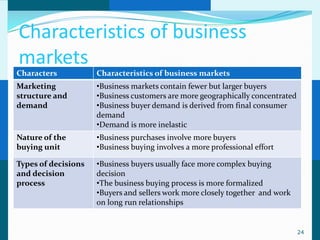
Characteristics of business
markets
Characters           Characteristics of business markets
Marketing            •Business markets contain fewer but larger buyers
structure and        •Business customers are more geographically concentrated
demand               •Business buyer demand is derived from final consumer
                     demand
                     •Demand is more inelastic
Nature of the        •Business purchases involve more buyers
buying unit          •Business buying involves a more professional effort

Types of decisions   •Business buyers usually face more complex buying
and decision         decision
process              •The business buying process is more formalized
                     •Buyers and sellers work more closely together and work
                     on long run relationships


                                                                                24
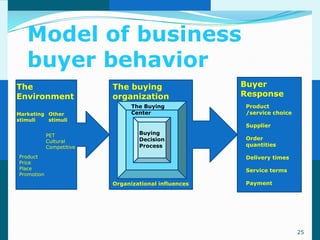
Model of business
   buyer behavior
The                       The buying                  Buyer
Environment               organization                Response
                                The Buying            Product
Marketing Other                 Center                /service choice
stimuli   stimuli
                                                      Supplier
            PET                   Buying
                                  Decision            Order
            Cultural
            Competitive           Process             quantities

Product                                               Delivery times
Price
Place                                                 Service terms
Promotion
                          Organizational influences   Payment


                                                                        25
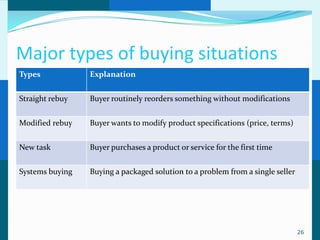
Major types of buying situations
Types            Explanation


Straight rebuy   Buyer routinely reorders something without modifications


Modified rebuy   Buyer wants to modify product specifications (price, terms)


New task         Buyer purchases a product or service for the first time


Systems buying   Buying a packaged solution to a problem from a single seller


                                                                                26
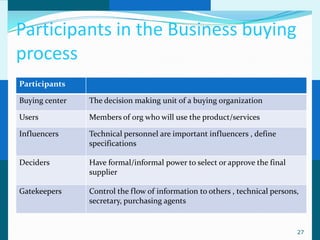
Participants in the Business buying
process
Participants

Buying center   The decision making unit of a buying organization

Users           Members of org who will use the product/services

Influencers     Technical personnel are important influencers , define
                specifications

Deciders        Have formal/informal power to select or approve the final
                supplier

Gatekeepers     Control the flow of information to others , technical persons,
                secretary, purchasing agents


                                                                             27
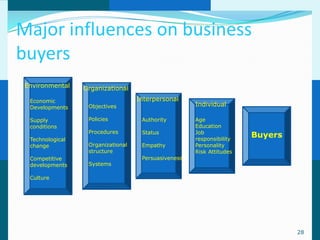
Major influences on business
buyers
 Environmental    Organizational
  Economic                          Interpersonal
  Developments     Objectives                         Individual

  Supply           Policies          Authority        Age
  conditions                                          Education
                   Procedures        Status           Job
  Technological                                       responsibility
                                                                       Buyers
  change           Organizational    Empathy          Personality
                   structure                          Risk Attitudes
  Competitive                        Persuasiveness
  developments     Systems

  Culture


                                                                                28
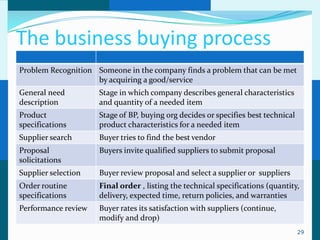
The business buying process
Problem Recognition Someone in the company finds a problem that can be met
                    by acquiring a good/service
General need         Stage in which company describes general characteristics
description          and quantity of a needed item
Product              Stage of BP, buying org decides or specifies best technical
specifications       product characteristics for a needed item
Supplier search      Buyer tries to find the best vendor
Proposal             Buyers invite qualified suppliers to submit proposal
solicitations
Supplier selection   Buyer review proposal and select a supplier or suppliers
Order routine        Final order , listing the technical specifications (quantity,
specifications       delivery, expected time, return policies, and warranties
Performance review   Buyer rates its satisfaction with suppliers (continue,
                     modify and drop)
                                                                                   29

Con behav-lecturesession3

  • 1.
    Consumer Markets andConsumer Buying Behavior 1
  • 2.
    Consumer Buying Behavior  Consumer Buying Behavior refers to the buying behavior of final consumers -individuals & households who buy goods and services for personal consumption.  All these consumers make up the consumer market.  The central question for marketers is:  “How do consumers respond to various marketing efforts the company might use?” 2
  • 3.
    EIGHT O’s OFMARKETING  Occupants: Who constitutes the Market  Objects: What does the market buy?  Objectives: Why does the market buy?  Organization: Who participates in buying?  Operations: How does the market buy?  Occasions: When does the market buy?  Outlets: Where does the market buy?  Opponents: Whose objects does the market buy? 3
  • 4.
    Model of BuyerBehavior Marketing and Buyer’s Black Box Buyer Responses Other Stimuli Marketing Buyer Characteristics Product Choice Product Buyer Decision Process Brand Choice Price Dealer Choice Place Promotion Other Purchase Timing Economic Purchase Amount Technological Political Cultural 4
  • 5.
    Factors Influencing Consumer Behavior Cultural Social Personal Age and Psycho- Culture Reference life-cycle logical groups Occupation Motivation Economic Perception Buyer Sub- culture Family situation Learning Lifestyle Beliefs and Roles Personality attitudes Social and and class status self-concept 5
  • 6.
    Factors Affecting Consumer Behavior: Culture Culture is the Most Basic Cause of a Person's Wants and Behavior. Subculture • Group of people with shared value systems based on common life experiences. 6
  • 7.
    Factors Affecting Consumer Behavior: Culture Culture is the Set of Values, Perceptions, Wants & Behavior Learned by a Member of Society from Family. Social Class • Society’s relatively permanent & ordered divisions whose members share similar values, interests, and behaviors. • Measured by: Occupation, Income, Education, Wealth and Other Variables. 7
  • 8.
    Factors Affecting Consumer Behavior:Social Groups •Membership •Reference Family (most important) •Husband, wife, kids Social Factors •Influencer, buyer, user Roles and Status 8
  • 9.
    Factors Affecting ConsumerBehavior: Personal Personal Influences Personal Influences Age and Life Age and Life Economic Economic Personality & Personality & Cycle Stage Occupation Occupation Situation Self-Concept Cycle Stage Situation Self-Concept Lifestyle Identification Lifestyle Identification Activities Activities Interests Interests Opinions Opinions 9
  • 10.
    SRI Values andLifestyles (VALS) Actualizers High Innovation High Resources Fulfillers Achievers Experiencers Believers Strivers Makers Strugglers Low Resources Low Innovation 10
  • 11.
    Factors Affecting Consumer Behavior:Psychological Motivation Psychological Factors Beliefs and Affecting Perception Attitudes Buyers Choices Learning 11
  • 12.
    Maslow’s Hierarchy ofNeeds Self Actualization (Self-development) Esteem Needs (self-esteem) Social Needs (sense of belonging, love) Safety Needs (security, protection) Physiological Needs (hunger, thirst) 12
  • 13.
    Types of BuyingDecision Behavior High Low Involvement Involvement Significant Complex Variety- differences Buying Seeking between Behavior Behavior brands Few Dissonance- Habitual differences Reducing Buying Buying between Behavior Behavior brands 13
  • 14.
    Buyer Decision Process Purchase Decision Evaluation Post purchase of Alternatives Behavior Information Search Need Recognition 14
  • 15.
    Buyer Decision Process Step1. Need Recognition Buyer Recognizes Needs Arising State Where the From: Buyer’s Needs a are Fulfilled and Problem Internal Stimuli – the Buyer is or a Need. Hunger Satisfied. External Stimuli- Friends 15
  • 16.
    The Buyer DecisionProcess Step 2. Information Search Personal Sources •Family, friends, neighbors •Most effective source of information Commercial Sources •Advertising, salespeople •Receives most information from these sources Public Sources •Mass Media •Consumer-rating groups •Handling the product Experiential Sources •Examining the product •Using the product 16
  • 17.
    The Buyer DecisionProcess Step 3. Evaluation of Alternatives Consumer May Use Careful Calculations & Logical Thinking Consumers May Buy on Impulse and Rely on Intuition Consumers May Make Buying Decisions on Their Own. Consumers May Make Buying Decisions Only After Consulting Others. Marketers Must Study Buyers to Find Out How They Evaluate Brand Alternatives 17
  • 18.
    The Buyer DecisionProcess Step 4. Purchase Decision Purchase Intention Desire to buy the most preferred brand Attitudes Unexpected of Others Situational Factors Purchase Decision 18
  • 19.
    The Buyer DecisionProcess Step 5. Post purchase Behavior Satisfied Customer! Cognitive Dissonance Consumer’s Expectations of Product’s Performance. Product’s Perceived Performance. Dissatisfied Customer 19
  • 20.
    Stages in theAdoption Process Awareness: Consumer is aware of product, but lacks information. Interest: Consumer seeks Information about new product. Evaluation: Consumer considers trying new product. Trial: Consumer tries new product on a small scale. Adoption: Consumer decides to make regular use of product. 20
  • 21.
    Adopter Categories Percentage ofAdopters Early Majority Late Majority Innovators Early 34% 34% Laggards Adopters 13.5% 16% 2.5% Time of Adoption Early Late 21
  • 22.
    Influence of ProductCharacteristics on Rate of Adoption Communicability Relative Advantage Can results be easily Is the innovation observed or described to others? superior to existing products? Divisibility Compatibility Can the innovation Does the innovation be used on a fit the values and trial basis? experience of the target market? Complexity Is the innovation difficult to understand or use? 22
  • 23.
    Business Buying Behavior Business market : organizations that buy goods and services for use in the production of other products and services that are sold rented, or supplied to others  Business buying process: the decision making process by which business buyers establish the need for purchased products and services and identify, evaluate and choose among alternative brands and suppliers 23
  • 24.
    Characteristics of business markets Characters Characteristics of business markets Marketing •Business markets contain fewer but larger buyers structure and •Business customers are more geographically concentrated demand •Business buyer demand is derived from final consumer demand •Demand is more inelastic Nature of the •Business purchases involve more buyers buying unit •Business buying involves a more professional effort Types of decisions •Business buyers usually face more complex buying and decision decision process •The business buying process is more formalized •Buyers and sellers work more closely together and work on long run relationships 24
  • 25.
    Model of business buyer behavior The The buying Buyer Environment organization Response The Buying Product Marketing Other Center /service choice stimuli stimuli Supplier PET Buying Decision Order Cultural Competitive Process quantities Product Delivery times Price Place Service terms Promotion Organizational influences Payment 25
  • 26.
    Major types ofbuying situations Types Explanation Straight rebuy Buyer routinely reorders something without modifications Modified rebuy Buyer wants to modify product specifications (price, terms) New task Buyer purchases a product or service for the first time Systems buying Buying a packaged solution to a problem from a single seller 26
  • 27.
    Participants in theBusiness buying process Participants Buying center The decision making unit of a buying organization Users Members of org who will use the product/services Influencers Technical personnel are important influencers , define specifications Deciders Have formal/informal power to select or approve the final supplier Gatekeepers Control the flow of information to others , technical persons, secretary, purchasing agents 27
  • 28.
    Major influences onbusiness buyers Environmental Organizational Economic Interpersonal Developments Objectives Individual Supply Policies Authority Age conditions Education Procedures Status Job Technological responsibility Buyers change Organizational Empathy Personality structure Risk Attitudes Competitive Persuasiveness developments Systems Culture 28
  • 29.
    The business buyingprocess Problem Recognition Someone in the company finds a problem that can be met by acquiring a good/service General need Stage in which company describes general characteristics description and quantity of a needed item Product Stage of BP, buying org decides or specifies best technical specifications product characteristics for a needed item Supplier search Buyer tries to find the best vendor Proposal Buyers invite qualified suppliers to submit proposal solicitations Supplier selection Buyer review proposal and select a supplier or suppliers Order routine Final order , listing the technical specifications (quantity, specifications delivery, expected time, return policies, and warranties Performance review Buyer rates its satisfaction with suppliers (continue, modify and drop) 29