Consumer and Business Buyer Behavior Chapter 5
Road Map: Previewing the Concepts Understand the consumer market and the major factors that influence consumer buyer behavior. Identify and discuss the stages in the buyer decision process. Describe the adoption and diffusion process for new products.
Define the business market and identify the major factors that influence business buyer behavior. List and define the steps in the business buying decision process. Road Map: Previewing the Concepts
Consumer Buying Behavior Refers to the buying behavior of people who buy goods and services for personal use. These people make up the  consumer market . The central question for marketers is: “ How do consumers respond to various marketing efforts the company might use?”
Culture Culture is the  Most Basic Cause  of a Person's Wants and Behavior. Culture is learned from family, church, school, peers, colleagues. Culture includes basic values, perceptions, wants, and behaviors.
Culture Subculture Groups of people with shared value systems based on  common life experiences. Major Groups Hispanic Consumers African-American Consumers Asian-American Consumers Mature Consumers
Social Class Society’s relatively permanent and ordered divisions whose members share similar values, interests, and behaviors. Measured by a combination of: occupation, income, education, wealth, and other variables. Culture
Social Factors Groups: Membership, Reference (Opinion Leaders) Aspirational Family: Most important consumer buying organization Roles & Status: Role = Expected activities Status = Esteem given to role by society
Personal Factors Age and Life-Cycle Stage Occupation Economic Situation
Personal Factors Lifestyle: Pattern of living as expressed in psychographics Activities Interests Opinions
Personality & Self-Concept Personality refers to the unique psychological characteristics that lead to relatively consistent and lasting responses to one’s own environment. Generally defined in terms of traits. Self-concept suggests that people’s possessions contribute to and reflect their identities.
Maslow’s Hierarchy of Needs Self-Actualization Esteem needs Social needs Safety needs Physiological needs
Perception Information Inputs Interpretation Selective Exposure Selective Distortion Selective Retention
Learning A relatively permanent change in behavior due to experience. Interplay of drives, stimuli, cues, responses, and reinforcement. Strongly influenced by the consequences of an individual’s behavior Behaviors with satisfying results tend to be repeated. Behaviors with unsatisfying results tend  not  to be repeated.
Beliefs & Attitudes A  belief  is a descriptive thought that a person holds about something. An  attitude  is a person’s consistently favorable or unfavorable evaluations, feelings, and tendencies toward an object or idea.
Buying Decision Process Need recognition Information search Evaluation of alternatives Purchase decision Postpurchase behavior
Sources of Information Personal Commercial Public Experiential
Buying Decision Process Factors that influence purchase decision: Attitudes of others Unexpected situational factors
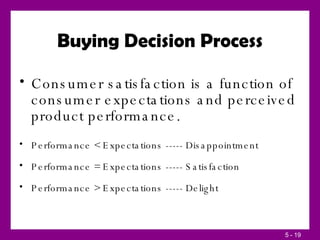
Buying Decision Process Consumer satisfaction is a function of consumer expectations and perceived product performance. Performance < Expectations ----- Disappointment Performance = Expectations ----- Satisfaction Performance > Expectations ----- Delight
Buying Decision Process Cognitive dissonance:  a buyer’s doubts shortly after a purchase about whether it was the right decision.
Stages in the Adoption Process Awareness :  Consumer becomes aware of the new product, but lacks information about it. Interest :  Consumer seeks information about new product. Evaluation :  Consumer considers whether trying the new product makes sense. Trial :  Consumer tries new product on a small scale to improve his or her estimate of its value. Adoption :  Consumer decides to make full and regular use of the new product.
Product Adopter Categories Innovators Early adopters Early majority Late majority Laggards
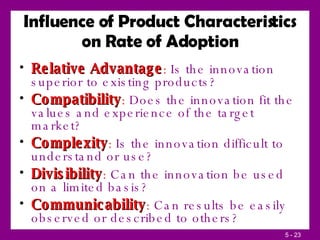
Influence of Product Characteristics on Rate of Adoption Relative Advantage :  Is the innovation superior to existing products? Compatibility :  Does the innovation fit the values and experience of the target market? Complexity :  Is the innovation difficult to understand or use? Divisibility :  Can the innovation be used on a limited basis? Communicability :  Can results be easily observed or described to others?
Business Markets & Business Buyer Behavior The  business market  is vast and involves far more dollars and items than do consumer markets. Business buyer behavior  refers to the buying behavior of the organizations that buy goods and services for use in the production of other products and services that are sold, rented, or supplied to others.
Business Markets Market Structure and Demand: Contains far fewer but larger buyers. Customers are more geographically concentrated. Business demand is derived from consumer demand. Nature of the Buying Unit: Business purchases involve more decision participants. Business buying involves a more professional purchasing effort.
Types of Decisions and the Decision Process Business buyers usually face more complex buying decisions. Business buying process tends to be more formalized. Buyers and sellers are much more dependent on each other.
Types of Buying Situations Straight rebuy Modified rebuy New Task
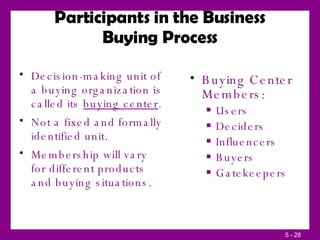
Participants in the Business Buying Process Decision-making unit of a buying organization is called its  buying center . Not a fixed and formally identified unit. Membership will vary for different products and buying situations. Buying Center Members: Users Deciders Influencers Buyers Gatekeepers
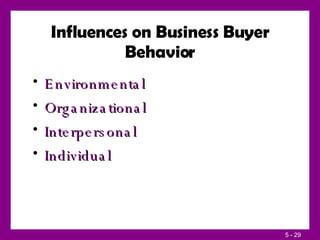
Influences on Business Buyer Behavior Environmental Organizational Interpersonal Individual
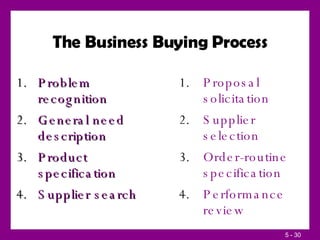
The Business Buying Process Problem recognition General need description Product specification Supplier search Proposal solicitation Supplier selection Order-routine specification Performance review
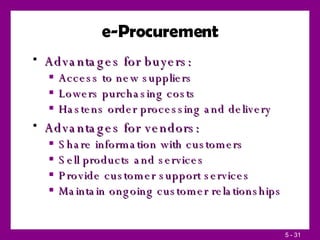
e-Procurement Advantages for buyers: Access to new suppliers Lowers purchasing costs Hastens order processing and delivery Advantages for vendors: Share information with customers Sell products and services Provide customer support services Maintain ongoing customer relationships
Rest Stop: Reviewing the Concepts Describe the consumer market and the major factors that influence consumer buyer behavior. Identify and discuss the stages in the buyer decision process. Describe the adoption and diffusion process for new products.
Rest Stop: Reviewing the Concepts Define the business market and identify the major factors that influence business buyer behavior. List and define the steps in the business buying decision process.
Managing Pofitable

  • 1.
    Consumer and BusinessBuyer Behavior Chapter 5
  • 2.
    Road Map: Previewingthe Concepts Understand the consumer market and the major factors that influence consumer buyer behavior. Identify and discuss the stages in the buyer decision process. Describe the adoption and diffusion process for new products.
  • 3.
    Define the businessmarket and identify the major factors that influence business buyer behavior. List and define the steps in the business buying decision process. Road Map: Previewing the Concepts
  • 4.
    Consumer Buying BehaviorRefers to the buying behavior of people who buy goods and services for personal use. These people make up the consumer market . The central question for marketers is: “ How do consumers respond to various marketing efforts the company might use?”
  • 5.
    Culture Culture isthe Most Basic Cause of a Person's Wants and Behavior. Culture is learned from family, church, school, peers, colleagues. Culture includes basic values, perceptions, wants, and behaviors.
  • 6.
    Culture Subculture Groupsof people with shared value systems based on common life experiences. Major Groups Hispanic Consumers African-American Consumers Asian-American Consumers Mature Consumers
  • 7.
    Social Class Society’srelatively permanent and ordered divisions whose members share similar values, interests, and behaviors. Measured by a combination of: occupation, income, education, wealth, and other variables. Culture
  • 8.
    Social Factors Groups:Membership, Reference (Opinion Leaders) Aspirational Family: Most important consumer buying organization Roles & Status: Role = Expected activities Status = Esteem given to role by society
  • 9.
    Personal Factors Ageand Life-Cycle Stage Occupation Economic Situation
  • 10.
    Personal Factors Lifestyle:Pattern of living as expressed in psychographics Activities Interests Opinions
  • 11.
    Personality & Self-ConceptPersonality refers to the unique psychological characteristics that lead to relatively consistent and lasting responses to one’s own environment. Generally defined in terms of traits. Self-concept suggests that people’s possessions contribute to and reflect their identities.
  • 12.
    Maslow’s Hierarchy ofNeeds Self-Actualization Esteem needs Social needs Safety needs Physiological needs
  • 13.
    Perception Information InputsInterpretation Selective Exposure Selective Distortion Selective Retention
  • 14.
    Learning A relativelypermanent change in behavior due to experience. Interplay of drives, stimuli, cues, responses, and reinforcement. Strongly influenced by the consequences of an individual’s behavior Behaviors with satisfying results tend to be repeated. Behaviors with unsatisfying results tend not to be repeated.
  • 15.
    Beliefs & AttitudesA belief is a descriptive thought that a person holds about something. An attitude is a person’s consistently favorable or unfavorable evaluations, feelings, and tendencies toward an object or idea.
  • 16.
    Buying Decision ProcessNeed recognition Information search Evaluation of alternatives Purchase decision Postpurchase behavior
  • 17.
    Sources of InformationPersonal Commercial Public Experiential
  • 18.
    Buying Decision ProcessFactors that influence purchase decision: Attitudes of others Unexpected situational factors
  • 19.
    Buying Decision ProcessConsumer satisfaction is a function of consumer expectations and perceived product performance. Performance < Expectations ----- Disappointment Performance = Expectations ----- Satisfaction Performance > Expectations ----- Delight
  • 20.
    Buying Decision ProcessCognitive dissonance: a buyer’s doubts shortly after a purchase about whether it was the right decision.
  • 21.
    Stages in theAdoption Process Awareness : Consumer becomes aware of the new product, but lacks information about it. Interest : Consumer seeks information about new product. Evaluation : Consumer considers whether trying the new product makes sense. Trial : Consumer tries new product on a small scale to improve his or her estimate of its value. Adoption : Consumer decides to make full and regular use of the new product.
  • 22.
    Product Adopter CategoriesInnovators Early adopters Early majority Late majority Laggards
  • 23.
    Influence of ProductCharacteristics on Rate of Adoption Relative Advantage : Is the innovation superior to existing products? Compatibility : Does the innovation fit the values and experience of the target market? Complexity : Is the innovation difficult to understand or use? Divisibility : Can the innovation be used on a limited basis? Communicability : Can results be easily observed or described to others?
  • 24.
    Business Markets &Business Buyer Behavior The business market is vast and involves far more dollars and items than do consumer markets. Business buyer behavior refers to the buying behavior of the organizations that buy goods and services for use in the production of other products and services that are sold, rented, or supplied to others.
  • 25.
    Business Markets MarketStructure and Demand: Contains far fewer but larger buyers. Customers are more geographically concentrated. Business demand is derived from consumer demand. Nature of the Buying Unit: Business purchases involve more decision participants. Business buying involves a more professional purchasing effort.
  • 26.
    Types of Decisionsand the Decision Process Business buyers usually face more complex buying decisions. Business buying process tends to be more formalized. Buyers and sellers are much more dependent on each other.
  • 27.
    Types of BuyingSituations Straight rebuy Modified rebuy New Task
  • 28.
    Participants in theBusiness Buying Process Decision-making unit of a buying organization is called its buying center . Not a fixed and formally identified unit. Membership will vary for different products and buying situations. Buying Center Members: Users Deciders Influencers Buyers Gatekeepers
  • 29.
    Influences on BusinessBuyer Behavior Environmental Organizational Interpersonal Individual
  • 30.
    The Business BuyingProcess Problem recognition General need description Product specification Supplier search Proposal solicitation Supplier selection Order-routine specification Performance review
  • 31.
    e-Procurement Advantages forbuyers: Access to new suppliers Lowers purchasing costs Hastens order processing and delivery Advantages for vendors: Share information with customers Sell products and services Provide customer support services Maintain ongoing customer relationships
  • 32.
    Rest Stop: Reviewingthe Concepts Describe the consumer market and the major factors that influence consumer buyer behavior. Identify and discuss the stages in the buyer decision process. Describe the adoption and diffusion process for new products.
  • 33.
    Rest Stop: Reviewingthe Concepts Define the business market and identify the major factors that influence business buyer behavior. List and define the steps in the business buying decision process.