Buyer Behaviour Models
The Economic Model
According to the economic model of buyer
behaviour, the buyer is a rational man and his
buying decisions are governed by the concept of
utility.
If he has a certain amount of purchasing power,
a set of needs to be met, and a set of products to
choose from, he will allocate this amount over the
set of products in a very rational manner with the
intention of maximising the utility / benefit / need
satisfaction.
The Learning Model
According to the learning model, which takes
its cue from the Pavlovian stimulus-response
theory on learning-buyer behaviour can be
influenced by manipulating the drives, stimuli
and responses of the buyer.
The model rests on the human ability of
learning, forgetting, and discriminating.
The Psychoanalytical Model
The psychoanalytical model draws mainly
from Freudian psychology. According to this
model, a consumer has a complex set of
deep-seated motives that drive him towards
certain behaviour. The buyer has a private
world with all his hidden fears, suppressed
desires and totally subjective longings.
Appealing to these desires and longings can
influence his buying action.
The Sociological Model
According to the sociological model, the
individual buyer is influenced in his buying
behaviour by society – by intimate groups as
well as social classes.
His buying decisions are not totally governed
by utility; he has a desire to emulate, follow,
and fit in with his environment. And, several
of his buying decisions may be governed by
the compulsions arising out of his being a
social creature.
The Systems Model
There have also been some efforts to build some
models on buyer behaviour using totally the
standpoint of the marketing man. They belong to
a category called the systems model, where the
human being is analysed as a system, with
stimuli as the input to the system and behaviour
as the output of the system.
Two important models in this category are:
1.The Nicosia Model
2.The Howerd and Sheth Model
The Nicosia Model
The model tries to establish the links between
a firm and its consumer – how the activities of
the firm influence the consumer and result in
his decision to buy.
The messages from the firm first influences
the predisposition of the consumer towards
the product. Depending on the situation, he
develops a certain attitude towards the
product.
The Nicosia Model …Contd.
It may lead to a search for the product or an
evaluation of the product. If these steps have
a positive impact on him, it may result in a
decision to buy. This is the sum and
substance of the ‘activity explanations’ in the
Nicosia model. The model groups these
activities into four basic fields as shown in
next two slides:
The Nicosia Model …Contd.
o Field One with two sub-fields – the firm’s
attributes and the consumer’s attributes.
An advertising message from the firm
reaches the consumer’s attributes.
Depending on the way the message is
received by the consumer, he develops a
certain attitude and this becomes the input
for Field Two.
The Nicosia Model …Contd.
o Field Two is the area of search and
evaluation of the advertised product and
other alternatives. If this process results in
a motivation to buy, it becomes the input for
Field Three.
o Field Three consists of the act of purchase.
o And Field Four consists of the use of the
purchased item. There is an output from
Field Four – feedback of sales results of the
firm.
The Howard-Sheth Model
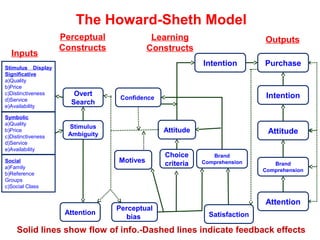
The logic of the model runs like this
- There are inputs in the form of stimuli
- There are outputs beginning with attention
to a given stimulus and ending with
purchase
- In between the inputs and the outputs,
there are variables affecting the
consumers’ perception and learning.
These variables are considered
‘hypothetical’ since they cannot be directly
measured at the time of occurrence.
The Howard-Sheth Model …Contd.
Model explains buyer decision process using
four major sets of variables, as applicable to
individual consumer:
1. Inputs
2. Perceptual and learning constructs
3. Outputs
4. Exogenous or external variables
The Howard-Sheth Model
Solid lines show flow of info.-Dashed lines indicate feedback effects
Purchase
Intention
Attitude
Brand
Comprehension
Attention
Intention
Brand
Comprehension
Satisfaction
Choice
criteria
OutputsLearning
Constructs
Perceptual
bias
Attention
Attitude
Motives
Confidence
Stimulus
Ambiguity
Overt
Search
Perceptual
Constructs
Inputs
Stimulus Display
Significative
a)Quality
b)Price
c)Distinctiveness
d)Service
e)Availability
Symbolic
a)Quality
b)Price
c)Distinctiveness
d)Service
e)Availability
Social
a)Family
b)Reference
Groups
c)Social Class
The Howard-Sheth Model …Contd.
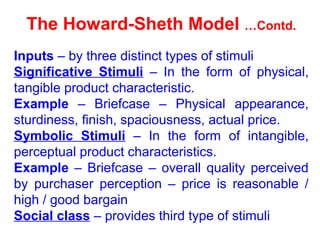
Inputs – by three distinct types of stimuli
Significative Stimuli – In the form of physical,
tangible product characteristic.
Example – Briefcase – Physical appearance,
sturdiness, finish, spaciousness, actual price.
Symbolic Stimuli – In the form of intangible,
perceptual product characteristics.
Example – Briefcase – overall quality perceived
by purchaser perception – price is reasonable /
high / good bargain
Social class – provides third type of stimuli
The Howard-Sheth Model …Contd.
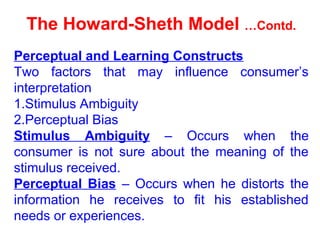
Perceptual and Learning Constructs
Two factors that may influence consumer’s
interpretation
1.Stimulus Ambiguity
2.Perceptual Bias
Stimulus Ambiguity – Occurs when the
consumer is not sure about the meaning of the
stimulus received.
Perceptual Bias – Occurs when he distorts the
information he receives to fit his established
needs or experiences.
The Howard-Sheth Model …Contd.
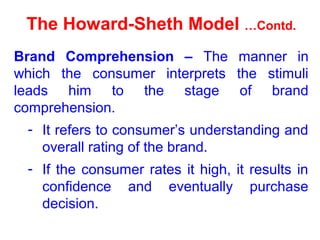
Brand Comprehension – The manner in
which the consumer interprets the stimuli
leads him to the stage of brand
comprehension.
- It refers to consumer’s understanding and
overall rating of the brand.
- If the consumer rates it high, it results in
confidence and eventually purchase
decision.
The Howard-Sheth Model …Contd.
Output – Purchase Decision is the Output
After product usage – if consumer is satisfied:
- It will reinforce his positive attitude and
purchase intention about the product and
brand.
- Positive attitude makes the consumer
more attentive to the product’s / brand’s
stimuli and further increases his brand
comprehension.
The Howard-Sheth Model …Contd.
If the Consumer is Dis-satisfied
It will trigger off reaction of negative attitude,
low attention to the product stimuli, poor brand
comprehension and negative intention to
purchase
The Howard-Sheth Model …Contd.
Exogenous or External Variables
These are not directly a part of decision
making process.
They are important as they influence the
consumer.
They vary from one consumer to another and
include:
o Consumer personality traits
o Social class
o Importance of the purchase
o Financial status etc.
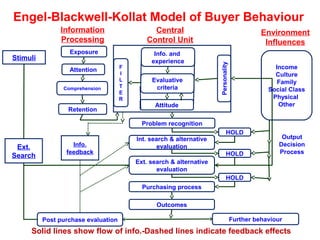
Engel-Blackwell-Kollat Model of
Buyer Behaviour
The Engel-Kollat-Blackwell Model consists of
four components
1. Information processing
2. Central control unit
3. Decision process
4. Environmental influences
Engel-Blackwell-Kollat Model of Buyer Behaviour
Solid lines show flow of info.-Dashed lines indicate feedback effects
Income
Culture
Family
Social Class
Physical
Other
Output
Decision
Process
Info. and
experience
Comprehension
Further behaviour
Environment
Influences
Central
Control Unit
Post purchase evaluation
Retention
Attitude
F
I
L
T
E
R
Attention
Exposure
Information
Processing
Stimuli
Ext.
Search
Evaluative
criteria
Problem recognition
Int. search & alternative
evaluationInfo.
feedback
Personality
Ext. search & alternative
evaluation
Purchasing process
Outcomes
HOLD
HOLD
HOLD
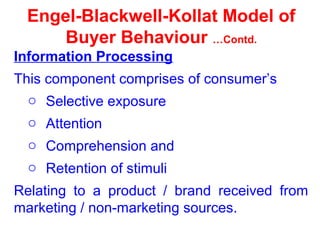
Engel-Blackwell-Kollat Model of
Buyer Behaviour …Contd.
Information Processing
This component comprises of consumer’s
o Selective exposure
o Attention
o Comprehension and
o Retention of stimuli
Relating to a product / brand received from
marketing / non-marketing sources.
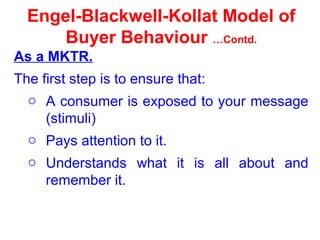
Engel-Blackwell-Kollat Model of
Buyer Behaviour …Contd.
As a MKTR.
The first step is to ensure that:
o A consumer is exposed to your message
(stimuli)
o Pays attention to it.
o Understands what it is all about and
remember it.
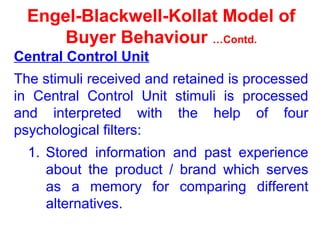
Engel-Blackwell-Kollat Model of
Buyer Behaviour …Contd.
Central Control Unit
The stimuli received and retained is processed
in Central Control Unit stimuli is processed
and interpreted with the help of four
psychological filters:
1. Stored information and past experience
about the product / brand which serves
as a memory for comparing different
alternatives.
Engel-Blackwell-Kollat Model of
Buyer Behaviour …Contd.
Central Control Unit …Contd.
2. Evaluating criteria which the consumer
uses in judging the alternatives.
3. General and specific attitudes which
influence the purchase decision.
4. Basic personality traits which influence
how the consumer is likely to respond to
various alternatives.
Engel-Blackwell-Kollat Model of
Buyer Behaviour …Contd.
Decision Process
The decision process component of the model
consists of:
a. Problem recognition
b. Internal search and evaluation
c. External search and evaluation
d. Purchase processes
e. Decision outcomes
Engel-Blackwell-Kollat Model of
Buyer Behaviour …Contd.
Decision Process …Contd.
If the purchase decision is such that it requires
EPS, the consumer would go through all the 5
stages.
In case of L.P.S. or R.R.B, some of the
intervening stages may be skipped and the
consumer may directly reach the purchase
decision.
Engel-Blackwell-Kollat Model of
Buyer Behaviour …Contd.
Environmental Influences
The factors that may influence the consumer’s
purchase decision are:
- Income
- Culture
- Family
- Social class and
- Physical situations
Engel-Blackwell-Kollat Model of
Buyer Behaviour …Contd.
Environmental Influences …Contd.
Depending on the specific product under
consideration, these factors may have a
favourable / un-favourable influence on the
purchase decision.

Buyer behaviour models (1)

  • 1.
  • 2.
    The Economic Model Accordingto the economic model of buyer behaviour, the buyer is a rational man and his buying decisions are governed by the concept of utility. If he has a certain amount of purchasing power, a set of needs to be met, and a set of products to choose from, he will allocate this amount over the set of products in a very rational manner with the intention of maximising the utility / benefit / need satisfaction.
  • 3.
    The Learning Model Accordingto the learning model, which takes its cue from the Pavlovian stimulus-response theory on learning-buyer behaviour can be influenced by manipulating the drives, stimuli and responses of the buyer. The model rests on the human ability of learning, forgetting, and discriminating.
  • 4.
    The Psychoanalytical Model Thepsychoanalytical model draws mainly from Freudian psychology. According to this model, a consumer has a complex set of deep-seated motives that drive him towards certain behaviour. The buyer has a private world with all his hidden fears, suppressed desires and totally subjective longings. Appealing to these desires and longings can influence his buying action.
  • 5.
    The Sociological Model Accordingto the sociological model, the individual buyer is influenced in his buying behaviour by society – by intimate groups as well as social classes. His buying decisions are not totally governed by utility; he has a desire to emulate, follow, and fit in with his environment. And, several of his buying decisions may be governed by the compulsions arising out of his being a social creature.
  • 6.
    The Systems Model Therehave also been some efforts to build some models on buyer behaviour using totally the standpoint of the marketing man. They belong to a category called the systems model, where the human being is analysed as a system, with stimuli as the input to the system and behaviour as the output of the system. Two important models in this category are: 1.The Nicosia Model 2.The Howerd and Sheth Model
  • 7.
    The Nicosia Model Themodel tries to establish the links between a firm and its consumer – how the activities of the firm influence the consumer and result in his decision to buy. The messages from the firm first influences the predisposition of the consumer towards the product. Depending on the situation, he develops a certain attitude towards the product.
  • 8.
    The Nicosia Model…Contd. It may lead to a search for the product or an evaluation of the product. If these steps have a positive impact on him, it may result in a decision to buy. This is the sum and substance of the ‘activity explanations’ in the Nicosia model. The model groups these activities into four basic fields as shown in next two slides:
  • 9.
    The Nicosia Model…Contd. o Field One with two sub-fields – the firm’s attributes and the consumer’s attributes. An advertising message from the firm reaches the consumer’s attributes. Depending on the way the message is received by the consumer, he develops a certain attitude and this becomes the input for Field Two.
  • 10.
    The Nicosia Model…Contd. o Field Two is the area of search and evaluation of the advertised product and other alternatives. If this process results in a motivation to buy, it becomes the input for Field Three. o Field Three consists of the act of purchase. o And Field Four consists of the use of the purchased item. There is an output from Field Four – feedback of sales results of the firm.
  • 11.
    The Howard-Sheth Model Thelogic of the model runs like this - There are inputs in the form of stimuli - There are outputs beginning with attention to a given stimulus and ending with purchase - In between the inputs and the outputs, there are variables affecting the consumers’ perception and learning. These variables are considered ‘hypothetical’ since they cannot be directly measured at the time of occurrence.
  • 12.
    The Howard-Sheth Model…Contd. Model explains buyer decision process using four major sets of variables, as applicable to individual consumer: 1. Inputs 2. Perceptual and learning constructs 3. Outputs 4. Exogenous or external variables
  • 13.
    The Howard-Sheth Model Solidlines show flow of info.-Dashed lines indicate feedback effects Purchase Intention Attitude Brand Comprehension Attention Intention Brand Comprehension Satisfaction Choice criteria OutputsLearning Constructs Perceptual bias Attention Attitude Motives Confidence Stimulus Ambiguity Overt Search Perceptual Constructs Inputs Stimulus Display Significative a)Quality b)Price c)Distinctiveness d)Service e)Availability Symbolic a)Quality b)Price c)Distinctiveness d)Service e)Availability Social a)Family b)Reference Groups c)Social Class
  • 14.
    The Howard-Sheth Model…Contd. Inputs – by three distinct types of stimuli Significative Stimuli – In the form of physical, tangible product characteristic. Example – Briefcase – Physical appearance, sturdiness, finish, spaciousness, actual price. Symbolic Stimuli – In the form of intangible, perceptual product characteristics. Example – Briefcase – overall quality perceived by purchaser perception – price is reasonable / high / good bargain Social class – provides third type of stimuli
  • 15.
    The Howard-Sheth Model…Contd. Perceptual and Learning Constructs Two factors that may influence consumer’s interpretation 1.Stimulus Ambiguity 2.Perceptual Bias Stimulus Ambiguity – Occurs when the consumer is not sure about the meaning of the stimulus received. Perceptual Bias – Occurs when he distorts the information he receives to fit his established needs or experiences.
  • 16.
    The Howard-Sheth Model…Contd. Brand Comprehension – The manner in which the consumer interprets the stimuli leads him to the stage of brand comprehension. - It refers to consumer’s understanding and overall rating of the brand. - If the consumer rates it high, it results in confidence and eventually purchase decision.
  • 17.
    The Howard-Sheth Model…Contd. Output – Purchase Decision is the Output After product usage – if consumer is satisfied: - It will reinforce his positive attitude and purchase intention about the product and brand. - Positive attitude makes the consumer more attentive to the product’s / brand’s stimuli and further increases his brand comprehension.
  • 18.
    The Howard-Sheth Model…Contd. If the Consumer is Dis-satisfied It will trigger off reaction of negative attitude, low attention to the product stimuli, poor brand comprehension and negative intention to purchase
  • 19.
    The Howard-Sheth Model…Contd. Exogenous or External Variables These are not directly a part of decision making process. They are important as they influence the consumer. They vary from one consumer to another and include: o Consumer personality traits o Social class o Importance of the purchase o Financial status etc.
  • 20.
    Engel-Blackwell-Kollat Model of BuyerBehaviour The Engel-Kollat-Blackwell Model consists of four components 1. Information processing 2. Central control unit 3. Decision process 4. Environmental influences
  • 21.
    Engel-Blackwell-Kollat Model ofBuyer Behaviour Solid lines show flow of info.-Dashed lines indicate feedback effects Income Culture Family Social Class Physical Other Output Decision Process Info. and experience Comprehension Further behaviour Environment Influences Central Control Unit Post purchase evaluation Retention Attitude F I L T E R Attention Exposure Information Processing Stimuli Ext. Search Evaluative criteria Problem recognition Int. search & alternative evaluationInfo. feedback Personality Ext. search & alternative evaluation Purchasing process Outcomes HOLD HOLD HOLD
  • 22.
    Engel-Blackwell-Kollat Model of BuyerBehaviour …Contd. Information Processing This component comprises of consumer’s o Selective exposure o Attention o Comprehension and o Retention of stimuli Relating to a product / brand received from marketing / non-marketing sources.
  • 23.
    Engel-Blackwell-Kollat Model of BuyerBehaviour …Contd. As a MKTR. The first step is to ensure that: o A consumer is exposed to your message (stimuli) o Pays attention to it. o Understands what it is all about and remember it.
  • 24.
    Engel-Blackwell-Kollat Model of BuyerBehaviour …Contd. Central Control Unit The stimuli received and retained is processed in Central Control Unit stimuli is processed and interpreted with the help of four psychological filters: 1. Stored information and past experience about the product / brand which serves as a memory for comparing different alternatives.
  • 25.
    Engel-Blackwell-Kollat Model of BuyerBehaviour …Contd. Central Control Unit …Contd. 2. Evaluating criteria which the consumer uses in judging the alternatives. 3. General and specific attitudes which influence the purchase decision. 4. Basic personality traits which influence how the consumer is likely to respond to various alternatives.
  • 26.
    Engel-Blackwell-Kollat Model of BuyerBehaviour …Contd. Decision Process The decision process component of the model consists of: a. Problem recognition b. Internal search and evaluation c. External search and evaluation d. Purchase processes e. Decision outcomes
  • 27.
    Engel-Blackwell-Kollat Model of BuyerBehaviour …Contd. Decision Process …Contd. If the purchase decision is such that it requires EPS, the consumer would go through all the 5 stages. In case of L.P.S. or R.R.B, some of the intervening stages may be skipped and the consumer may directly reach the purchase decision.
  • 28.
    Engel-Blackwell-Kollat Model of BuyerBehaviour …Contd. Environmental Influences The factors that may influence the consumer’s purchase decision are: - Income - Culture - Family - Social class and - Physical situations
  • 29.
    Engel-Blackwell-Kollat Model of BuyerBehaviour …Contd. Environmental Influences …Contd. Depending on the specific product under consideration, these factors may have a favourable / un-favourable influence on the purchase decision.