PERCEPTION
Today’s class
   Comparison of Marks
   Dynamics of Perception
   Elements of Perception
   Consumer Imagery
   Positioning of products
   Perceived risk
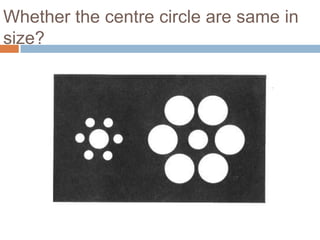
Whether the centre circle are same in
size?
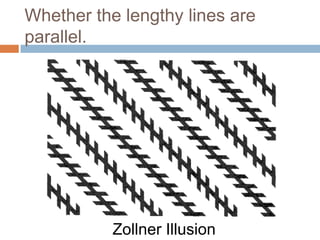
Whether the lengthy lines are
parallel.


           Zollner Illusion
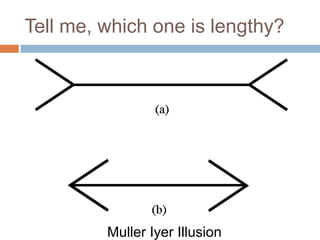
Tell me, which one is lengthy?


         Muller Iyer Illusion
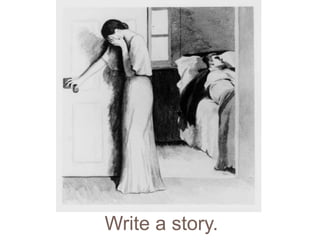
Write a story.
PERCEPTION
   The process by which an individual selects,
    organizes, and interprets stimuli into a
    meaningful and coherent picture of the world.
Dynamics of Perception
   Sensation – immediate and direct response of
    the sensory organs to stimuli.
   Stimulus – any unit of input to any of the
    senses.
   Sensory receptors – Eyes, Ears, Nose, Mouth
    and Skin
   THE ABSOLUTE THRESHOLD:-
     Thelowest level at which an individual can
     experience a sensation. [ Detecting difference
     between “something and nothing”]
   Sensory Adaptation:-
     Getting   used to senses.
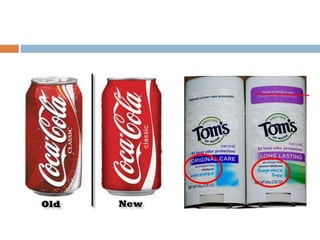
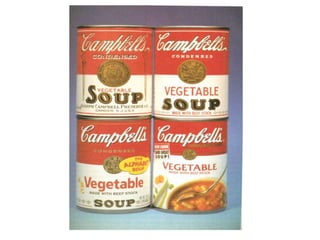
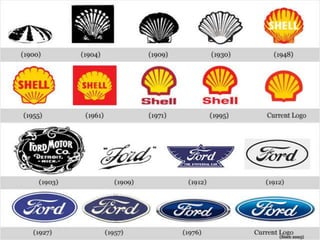
   The Differential Threshold:-
     Minimal   difference detected between two similar
      stimuli
     Ernest Weber 19th Century.

   Marketing Applications:-
     Negative  changes are not readily seen (price rise,
      reduce in quantity)
     Positive changes are clearly seen.
Subliminal Perception
   Message below the threshold level – below the
    conscious level.
     Takes place in movies – Motorola Mobile Phone
      with Kamalahassan in Vettaiyadu Velaiyadu.
     MRF Tiers in Indian Movie.
Elements of Perception
   Perceptual Selection
   Perceptual Organization
   Perceptual Interpretation
Perceptual Selection
   Stimuli get selected on two factors:-
     Consumers previous experience affects their
      expectation
     Motives at the time


   1) Nature of the stimulus
     Nature of the product, physical attributes, the package
      design, brand name and advertisements (includes
      copy, choice and sex of the model, positioning, size of
      ad)
     CONTRAST – Difference creates more attention
      towards the ad.
   2) Expectations:-
     People see what they want to see, based on previous
      experience, familiarity and preconditioned set of
      expectations.
     Marketers believed that high degree of sexuality
      creates more attention.

   3) Motives
     People perceive the things they need and want –
      Stronger the need – Greater tendency to ignore
      unrelated things.
     People who are obese see ads related to gyms and
      diet.
SELECTIVE PERCEPTION
Example: Airtel Super Singer.
 Selective exposure:-

     Peoplelook for pleasant and sympathetic
      messages and avoid painful or threatening ones.
   Selective attention:-
     People   look into ads which will satisfy their need.
   Perceptual Defense:-
     People avoid psychologically threatening ones.
      Hence constantly change the ad nature. [
      Smoking – warning with words, and now with
      images ]
   Perceptual Blocking:-
     People   block stimuli which is bombarded.
Perceptual Organization
   People see everything as a whole.
   Gestalt Psychology
     Figureand Ground
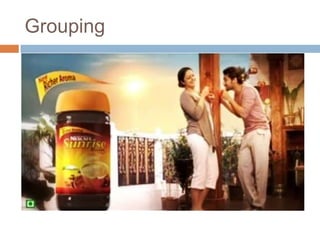
     Grouping

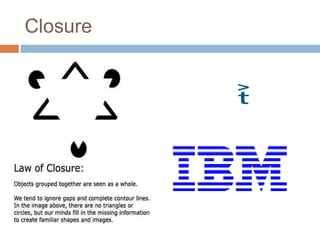
     Closure
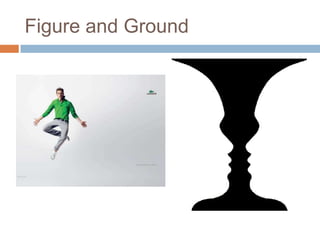
Figure and Ground
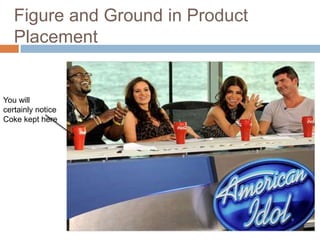
Figure and Ground in Product
   Placement


You will
certainly notice
Coke kept here
Figure and Ground
Grouping
Closure
PERCEPTUAL
INTERPRETATION
   Stimulus are often highly ambiguous or weak.
     Washing   Machine Story.
     Projective techniques


   Stereotypes
   Physical Appearances
   Descriptive terms
   First Impression
   Halo Effect
Stereotypes
  People  carrying biased pictures in their minds of
   the meanings of various stimuli.
  People hold meaning related to stimuli

  Stereotypes influence how stimuli are perceived

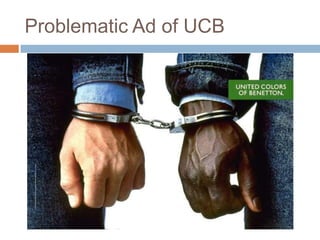
  Bias in United Colors of Benetton.
Problematic Ad of UCB
Physical Appearances
  People   associate quality with people in the ads.
  Attractive models have positive influence

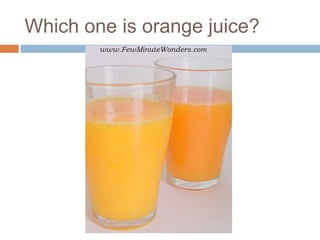
  Colors of juices.

  Shape of the package

  Average men are not considered as
   businessman.
    Ex:   Bill gates Vs Sarathbabu Elumalai
Which one is orange juice?
Descriptive Terms
   Stereotypes are reflected in Verbal messages.

     Accenture   – High Performance, Delivered.

     KFC   – Spicy Chicken

     McDonald  – Happy price (targeting Indians who
     are price conscious)
Which one is a courier
company?
First Impressions
   First impressions are lasting

   The perceiver is trying to determine which
    stimuli are relevant, important, or predictive
Halo Effect
   Consumers perceive and evaluate product or
    service or even product line based on just one
    dimension.

   Important with spokesperson choice.

   Tampering the halo effect is detrimental to the
    organization.

       Toyota – Quality.
       Ford – Safety.
       Sony - Music
The halo effect
  helps Adidas
 break into new
    product
   categories.
Consumer Imagery
   Consumers perceived images about product,
    services, prices, product quality, retail stores
    and manufacturers.

   People buy product to enhance their self
    image (relating themselves to the product).
POSITIONING
   Image of the product in the minds of the
    customer is called POSITIONING

   Image of your product gear up your sales, but
    the product should also deliver it performance.

   Product BENEFITS should be focused more
    than it’s physical attributes.
Umbrella Positioning
   Nicolo Pome, UK marketing director for
    Nivea’s parent company Beiersdorf, said: “We
    wanted to find a more relevant role for the
    Nivea brand in our target markets' minds”. The
    awareness of the Nivea brand is vast but we
    needed to find a way to engage with the
    audience to a greater degree.

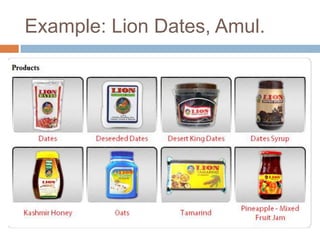
   An umbrella branding strategy, is
    marketing practice that involves selling many
    related products under a single brand name.
Example: Lion Dates, Amul.
Positioning Products and
  Services
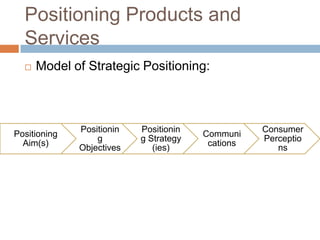
     Model of Strategic Positioning:


              Positionin   Positionin              Consumer
Positioning                             Communi
                  g        g Strategy              Perceptio
  Aim(s)                                 cations
              Objectives      (ies)                   ns
Typology of Strategic
Positioning
   Top of the range – Upper class – Rolls Royce

   Service – Impressive service – Pizza hut – 30
    mins

   Value for money – Affordability –
    Megamart,Europa

   Reliability – Durability – Lakshmi grinders-
    7yrs warranty
   Attractive – Cool, Elegant – Mercedes,
    Bournville

   Country of Origin – Patriotism- Amul- The
    Taste of India

   The Brand Name – Leaders in the market –
    Apple, Sony

   Selectivity – Discriminatory – Nano, Macbook
    Air
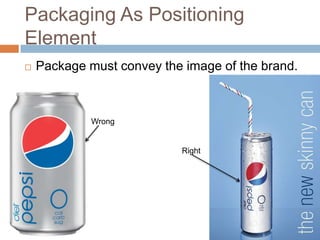
Packaging As Positioning
Element
   Package must convey the image of the brand.


             Wrong


                           Right
Product Repositioning


       Why repositioning is required?
   To face the competitors, who offer new
    products or service.
   Changing lifestyle of people, you need to suit
    the current trend. Eg) Evolution of Xerox and
    Apple.
   When brand need to change their target
    segment (happens rarely)
   Company want to advertise new offerings
   To motivate customers to buy a product.
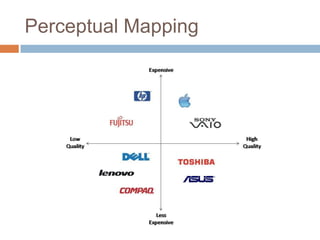
Perceptual Mapping
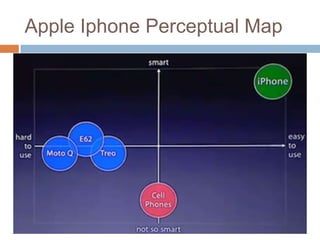
Apple Iphone Perceptual Map
Positioning of Services
   It’s difficult to position a service because it’s
    intangible.
   Only Image differentiation helps to position
    better among their competitors.

   Examples:
     Flipkart.com – Reliable
     Pizza Hut – Fast in Delivery
Perceived Price
   Perceived price should reflect the value that
    the customer receives from purchase.

   Perceived price reflect on Purchase intentions
    and Purchase Satisfaction.
   REFERENCE PRICE:-
     Internal– From customers memory
     External – From companies and environment.
Perceived Quality
   Intrinsic Cues – People actually experience the
    product here. Physical Attributes of the product.
       Eg) Shape, Size, and Color.


   Extrinsic Cues - Absence of actual experience
    with a product.
       Consumer often “evaluate” quality on the basis of
        factors quite external to the product itself, such as its
        price, the image of the store(s) that carries it, or the
        image (that is, the reputation) of the manufacturer that
        produces it.
Price/Quality Relationship
   Most consumers rely on price as an indicator
    of product quality.

   Consumers use price as a surrogate indicator
    of quality when they have less information of
    the product. Eg:-purchase of apparels of a new
    brand.

   When consumers are familiar with the product
    or have used it before price declines as a
    determining factor in evaluation.
Perceived Risk
“The uncertainty that consumers faces when
  they cannot foresee the consequences of their
  purchase decisions”
Types of Risk
1) Functional 2) Physical 3) Financial 4) Social
5) Psychological 6) Time
Handling Risk
   Consumers seeks information
   Consumers are brand loyal
   Consumers select by brand image
   Consumers rely on store image
   Consumers buy most expensive model
   Consumers seeks reassurance

Consumer Perception

  • 1.
  • 2.
    Today’s class  Comparison of Marks  Dynamics of Perception  Elements of Perception  Consumer Imagery  Positioning of products  Perceived risk
  • 3.
    Whether the centrecircle are same in size?
  • 4.
    Whether the lengthylines are parallel. Zollner Illusion
  • 5.
    Tell me, whichone is lengthy? Muller Iyer Illusion
  • 6.
  • 7.
    PERCEPTION  The process by which an individual selects, organizes, and interprets stimuli into a meaningful and coherent picture of the world.
  • 8.
    Dynamics of Perception  Sensation – immediate and direct response of the sensory organs to stimuli.  Stimulus – any unit of input to any of the senses.  Sensory receptors – Eyes, Ears, Nose, Mouth and Skin  THE ABSOLUTE THRESHOLD:-  Thelowest level at which an individual can experience a sensation. [ Detecting difference between “something and nothing”]
  • 9.
    Sensory Adaptation:-  Getting used to senses.  The Differential Threshold:-  Minimal difference detected between two similar stimuli  Ernest Weber 19th Century.  Marketing Applications:-  Negative changes are not readily seen (price rise, reduce in quantity)  Positive changes are clearly seen.
  • 13.
    Subliminal Perception  Message below the threshold level – below the conscious level.  Takes place in movies – Motorola Mobile Phone with Kamalahassan in Vettaiyadu Velaiyadu.  MRF Tiers in Indian Movie.
  • 14.
    Elements of Perception  Perceptual Selection  Perceptual Organization  Perceptual Interpretation
  • 15.
    Perceptual Selection  Stimuli get selected on two factors:-  Consumers previous experience affects their expectation  Motives at the time  1) Nature of the stimulus  Nature of the product, physical attributes, the package design, brand name and advertisements (includes copy, choice and sex of the model, positioning, size of ad)  CONTRAST – Difference creates more attention towards the ad.
  • 16.
    2) Expectations:-  People see what they want to see, based on previous experience, familiarity and preconditioned set of expectations.  Marketers believed that high degree of sexuality creates more attention.  3) Motives  People perceive the things they need and want – Stronger the need – Greater tendency to ignore unrelated things.  People who are obese see ads related to gyms and diet.
  • 17.
    SELECTIVE PERCEPTION Example: AirtelSuper Singer.  Selective exposure:-  Peoplelook for pleasant and sympathetic messages and avoid painful or threatening ones.  Selective attention:-  People look into ads which will satisfy their need.  Perceptual Defense:-  People avoid psychologically threatening ones. Hence constantly change the ad nature. [ Smoking – warning with words, and now with images ]
  • 18.
    Perceptual Blocking:-  People block stimuli which is bombarded.
  • 19.
    Perceptual Organization  People see everything as a whole.  Gestalt Psychology  Figureand Ground  Grouping  Closure
  • 20.
  • 21.
    Figure and Groundin Product Placement You will certainly notice Coke kept here
  • 22.
  • 23.
  • 24.
  • 25.
    PERCEPTUAL INTERPRETATION  Stimulus are often highly ambiguous or weak.  Washing Machine Story.  Projective techniques  Stereotypes  Physical Appearances  Descriptive terms  First Impression  Halo Effect
  • 26.
    Stereotypes  People carrying biased pictures in their minds of the meanings of various stimuli.  People hold meaning related to stimuli  Stereotypes influence how stimuli are perceived  Bias in United Colors of Benetton.
  • 27.
  • 28.
    Physical Appearances People associate quality with people in the ads.  Attractive models have positive influence  Colors of juices.  Shape of the package  Average men are not considered as businessman.  Ex: Bill gates Vs Sarathbabu Elumalai
  • 29.
    Which one isorange juice?
  • 30.
    Descriptive Terms  Stereotypes are reflected in Verbal messages.  Accenture – High Performance, Delivered.  KFC – Spicy Chicken  McDonald – Happy price (targeting Indians who are price conscious)
  • 31.
    Which one isa courier company?
  • 32.
    First Impressions  First impressions are lasting  The perceiver is trying to determine which stimuli are relevant, important, or predictive
  • 33.
    Halo Effect  Consumers perceive and evaluate product or service or even product line based on just one dimension.  Important with spokesperson choice.  Tampering the halo effect is detrimental to the organization.  Toyota – Quality.  Ford – Safety.  Sony - Music
  • 34.
    The halo effect helps Adidas break into new product categories.
  • 35.
    Consumer Imagery  Consumers perceived images about product, services, prices, product quality, retail stores and manufacturers.  People buy product to enhance their self image (relating themselves to the product).
  • 36.
    POSITIONING  Image of the product in the minds of the customer is called POSITIONING  Image of your product gear up your sales, but the product should also deliver it performance.  Product BENEFITS should be focused more than it’s physical attributes.
  • 37.
    Umbrella Positioning  Nicolo Pome, UK marketing director for Nivea’s parent company Beiersdorf, said: “We wanted to find a more relevant role for the Nivea brand in our target markets' minds”. The awareness of the Nivea brand is vast but we needed to find a way to engage with the audience to a greater degree.  An umbrella branding strategy, is marketing practice that involves selling many related products under a single brand name.
  • 38.
  • 39.
    Positioning Products and Services  Model of Strategic Positioning: Positionin Positionin Consumer Positioning Communi g g Strategy Perceptio Aim(s) cations Objectives (ies) ns
  • 40.
    Typology of Strategic Positioning  Top of the range – Upper class – Rolls Royce  Service – Impressive service – Pizza hut – 30 mins  Value for money – Affordability – Megamart,Europa  Reliability – Durability – Lakshmi grinders- 7yrs warranty
  • 41.
    Attractive – Cool, Elegant – Mercedes, Bournville  Country of Origin – Patriotism- Amul- The Taste of India  The Brand Name – Leaders in the market – Apple, Sony  Selectivity – Discriminatory – Nano, Macbook Air
  • 42.
    Packaging As Positioning Element  Package must convey the image of the brand. Wrong Right
  • 43.
    Product Repositioning Why repositioning is required?
  • 44.
    To face the competitors, who offer new products or service.  Changing lifestyle of people, you need to suit the current trend. Eg) Evolution of Xerox and Apple.  When brand need to change their target segment (happens rarely)  Company want to advertise new offerings  To motivate customers to buy a product.
  • 45.
  • 46.
  • 47.
    Positioning of Services  It’s difficult to position a service because it’s intangible.  Only Image differentiation helps to position better among their competitors.  Examples:  Flipkart.com – Reliable  Pizza Hut – Fast in Delivery
  • 48.
    Perceived Price  Perceived price should reflect the value that the customer receives from purchase.  Perceived price reflect on Purchase intentions and Purchase Satisfaction.  REFERENCE PRICE:-  Internal– From customers memory  External – From companies and environment.
  • 49.
    Perceived Quality  Intrinsic Cues – People actually experience the product here. Physical Attributes of the product.  Eg) Shape, Size, and Color.  Extrinsic Cues - Absence of actual experience with a product.  Consumer often “evaluate” quality on the basis of factors quite external to the product itself, such as its price, the image of the store(s) that carries it, or the image (that is, the reputation) of the manufacturer that produces it.
  • 50.
    Price/Quality Relationship  Most consumers rely on price as an indicator of product quality.  Consumers use price as a surrogate indicator of quality when they have less information of the product. Eg:-purchase of apparels of a new brand.  When consumers are familiar with the product or have used it before price declines as a determining factor in evaluation.
  • 51.
    Perceived Risk “The uncertaintythat consumers faces when they cannot foresee the consequences of their purchase decisions” Types of Risk 1) Functional 2) Physical 3) Financial 4) Social 5) Psychological 6) Time
  • 52.
    Handling Risk  Consumers seeks information  Consumers are brand loyal  Consumers select by brand image  Consumers rely on store image  Consumers buy most expensive model  Consumers seeks reassurance