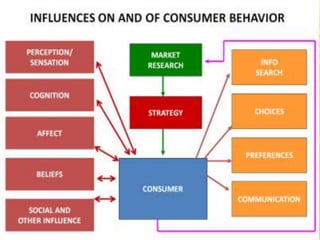
CONSUMER DECISION
MAKING PROCESS

 Submitted by-
 Neha
 Piyush
 Poonam
 Rajni
 Satvir kaur
CONSUMER BEHAVIOR??
 Consumer behaviour is the study of when,
  why, how, and where people do or do not buy
  a product.
 It blends elements from psychology, sociology,
  social anthropology and economics.
 It attempts to understand the buyer decision
  making process, both individually and in groups.
 It studies characteristics of individual consumers
  such as demographics and behavioural
  variables in an attempt to understand people's
  wants.
 Consumer behaviour in management is a
  very young discipline and form an
  important part in both formulation and
  implementation of all marketing strategies .
 It was during the 1950s, that marketing
  concept developed, and thus the need to
  study the behaviour of consumers was
  recognised.
 Marketing starts with the needs of the
  customer and ends with their satisfaction.
 When every thing revolves round the
  customer, then the study of consumer
  behaviour becomes a necessity.
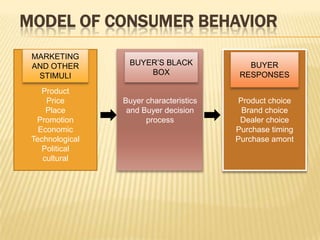
MODEL OF CONSUMER BEHAVIOR
 MARKETING
 AND OTHER        BUYER’S BLACK             BUYER
  STIMULI             BOX                 RESPONSES

    Product
     Price       Buyer characteristics    Product choice
     Place        and Buyer decision       Brand choice
  Promotion            process            Dealer choice
   Economic                              Purchase timing
 Technological                           Purchase amont
    Political
    cultural
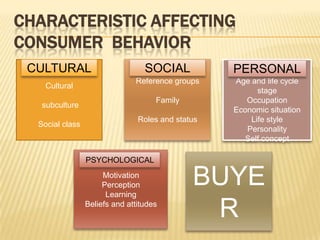
CHARACTERISTIC AFFECTING
CONSUMER BEHAVIOR
 CULTURAL                         SOCIAL           PERSONAL
                               Reference groups    Age and life cycle
    Cultural
                                                         stage
                                     Family           Occupation
   subculture
                                                   Economic situation
                                Roles and status       Life style
  Social class
                                                      Personality
                                                      Self concept

                 PSYCHOLOGICAL
                      Motivation
                      Perception
                       Learning
                                              BUYE
                 Beliefs and attitudes
                                               R
TYPES OF BUYING BEHAVIOR
                   High involvement   Low involvement


   Significant    Complex buying       Variety seeking
  differences       behavior           buying behavior
between brands


                    Dissonance         Habitual buying
Few differences   reducing buying        behavior
between brands       behavior
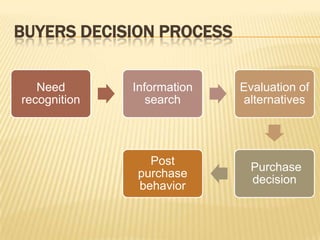
BUYERS DECISION PROCESS


   Need       Information   Evaluation of
recognition      search     alternatives


                Post
                              Purchase
              purchase
                              decision
              behavior
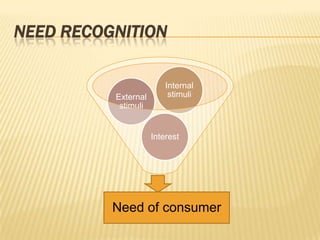
NEED RECOGNITION

                         Internal
          External        stimuli
           stimuli


                     Interest


          Need of consumer
INFORMATION SEARCH

    • FAMILY                               •   ADVERTISING
    • FRIEND                               •   WEBSITS
    • NIGHBORS                             •   SALESPERSON
                                           •   DEALERS


                   Personal   COMMERCI
                                 AL


                              EXPERIMENT
                   PUBLIC         AL

    • MASS MEDIA                           • HANDLING
                                           • EXAMINING
                                           • USING THE
                                             PRODUCT
EVALUATION OF ALTERNATIVES
 No single process is used by all consumers,
  or by one consumer in all buying situations.
 The most current model see the consumer
  forming judgments largely on a conscious
  and rational basis.
 This evaluation depends on the individual
  consumer and specific buying situations
BELEIF     PRICE


STYLING   WARRANTY


    ATTITUDES
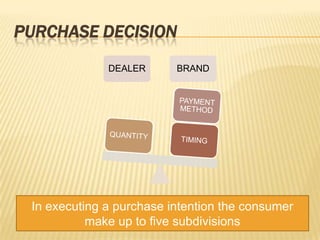
PURCHASE DECISION
              DEALER      BRAND


 In executing a purchase intention the consumer
           make up to five subdivisions
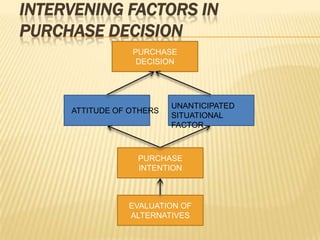
INTERVENING FACTORS IN
PURCHASE DECISION
                 PURCHASE
                  DECISION


                          UNANTICIPATED
     ATTITUDE OF OTHERS
                          SITUATIONAL
                          FACTOR


                  PURCHASE
                  INTENTION


                EVALUATION OF
                ALTERNATIVES
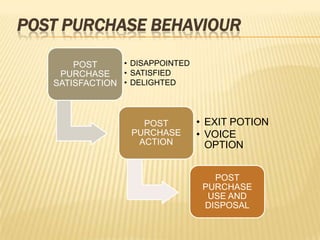
POST PURCHASE BEHAVIOUR

       POST     • DISAPPOINTED
    PURCHASE    • SATISFIED
   SATISFACTION • DELIGHTED


                    POST         • EXIT POTION
                  PURCHASE       • VOICE
                   ACTION          OPTION


                                    POST
                                  PURCHASE
                                   USE AND
                                  DISPOSAL
BUYER DECISION PROCESS FOR NEW
PRODUCTS
                        AWARNES
                           S


                 INTEREST    EVALUATION


                        ADOPTION
         TRAIL
Consumer decision making process

Consumer decision making process

  • 1.
    CONSUMER DECISION MAKING PROCESS Submitted by- Neha Piyush Poonam Rajni Satvir kaur
  • 2.
    CONSUMER BEHAVIOR??  Consumerbehaviour is the study of when, why, how, and where people do or do not buy a product.  It blends elements from psychology, sociology, social anthropology and economics.  It attempts to understand the buyer decision making process, both individually and in groups.  It studies characteristics of individual consumers such as demographics and behavioural variables in an attempt to understand people's wants.
  • 3.
     Consumer behaviourin management is a very young discipline and form an important part in both formulation and implementation of all marketing strategies .  It was during the 1950s, that marketing concept developed, and thus the need to study the behaviour of consumers was recognised.  Marketing starts with the needs of the customer and ends with their satisfaction.  When every thing revolves round the customer, then the study of consumer behaviour becomes a necessity.
  • 4.
    MODEL OF CONSUMERBEHAVIOR MARKETING AND OTHER BUYER’S BLACK BUYER STIMULI BOX RESPONSES Product Price Buyer characteristics Product choice Place and Buyer decision Brand choice Promotion process Dealer choice Economic Purchase timing Technological Purchase amont Political cultural
  • 5.
    CHARACTERISTIC AFFECTING CONSUMER BEHAVIOR CULTURAL SOCIAL PERSONAL Reference groups Age and life cycle Cultural stage Family Occupation subculture Economic situation Roles and status Life style Social class Personality Self concept PSYCHOLOGICAL Motivation Perception Learning BUYE Beliefs and attitudes R
  • 7.
    TYPES OF BUYINGBEHAVIOR High involvement Low involvement Significant Complex buying Variety seeking differences behavior buying behavior between brands Dissonance Habitual buying Few differences reducing buying behavior between brands behavior
  • 8.
    BUYERS DECISION PROCESS Need Information Evaluation of recognition search alternatives Post Purchase purchase decision behavior
  • 9.
    NEED RECOGNITION Internal External stimuli stimuli Interest Need of consumer
  • 10.
    INFORMATION SEARCH • FAMILY • ADVERTISING • FRIEND • WEBSITS • NIGHBORS • SALESPERSON • DEALERS Personal COMMERCI AL EXPERIMENT PUBLIC AL • MASS MEDIA • HANDLING • EXAMINING • USING THE PRODUCT
  • 11.
    EVALUATION OF ALTERNATIVES No single process is used by all consumers, or by one consumer in all buying situations.  The most current model see the consumer forming judgments largely on a conscious and rational basis.  This evaluation depends on the individual consumer and specific buying situations
  • 12.
    BELEIF PRICE STYLING WARRANTY ATTITUDES
  • 13.
    PURCHASE DECISION DEALER BRAND In executing a purchase intention the consumer make up to five subdivisions
  • 14.
    INTERVENING FACTORS IN PURCHASEDECISION PURCHASE DECISION UNANTICIPATED ATTITUDE OF OTHERS SITUATIONAL FACTOR PURCHASE INTENTION EVALUATION OF ALTERNATIVES
  • 15.
    POST PURCHASE BEHAVIOUR POST • DISAPPOINTED PURCHASE • SATISFIED SATISFACTION • DELIGHTED POST • EXIT POTION PURCHASE • VOICE ACTION OPTION POST PURCHASE USE AND DISPOSAL
  • 16.
    BUYER DECISION PROCESSFOR NEW PRODUCTS AWARNES S INTEREST EVALUATION ADOPTION TRAIL