Consumer Decision Making chapter 4
Learning Objectives chapter 4 1. Explain why marketing managers should understand consumer behavior. 2.  Analyze the components of the consumer decision-making process. 3.  Explain the  consumer’s postpurchase evaluation process.
Learning Objectives (continued) chapter 4 4.  Identify the types of consumer buying decisions and discuss the significance of consumer involvement. 5.  Identify and understand the cultural factors that affect consumer buying decisions.
Learning Objectives (continued) chapter 4 6.  Identify and understand the social factors that affect consumer buying decisions.  7. Identify and understand the individual factors that affect consumer buying decisions. 8.  Identify and understand the psychological factors that affect consumer buying decisions.
Learning Objective  1 Explain why marketing managers  should understand  consumer behavior.
Consumer Behavior Processes a consumer uses to make purchase decisions, as well as to use and dispose of purchased goods or services; also includes factors that influence purchase decisions and  the product use. 1
Learning Objective  2 Analyze the components  of the consumer  decision-making process.
Consumer Decision-Making Process A five-step process used  by consumers when buying goods or services. 2
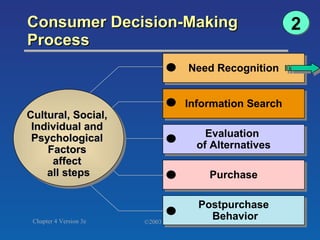
Consumer Decision-Making Process 2 Postpurchase Behavior Purchase Evaluation  of Alternatives Information Search Need Recognition Cultural, Social,  Individual and  Psychological  Factors  affect  all steps
Need Recognition Result of an imbalance between actual and  desired states. 2
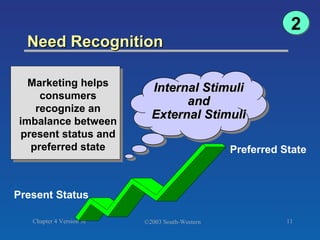
Need Recognition 2 Internal Stimuli and External Stimuli Present Status Preferred State Marketing helps consumers recognize an imbalance between present status and preferred state
Stimulus Any unit of input affecting one or more of the five senses: sight smell taste touch hearing 2
Want Recognition of an  unfulfilled need and  a product  (or attribute or feature)  that will satisfy it. 2
Recognition of Unfulfilled Wants When a current product isn’t performing properly When the consumer is running  out of an product When another product seems superior to the one currently used 2
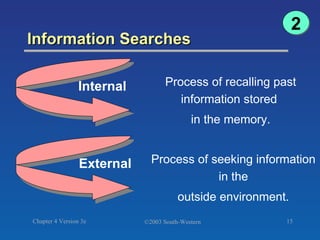
Information Searches Process of recalling past information stored  in the memory. Internal  Process of seeking information in the outside environment. External  2
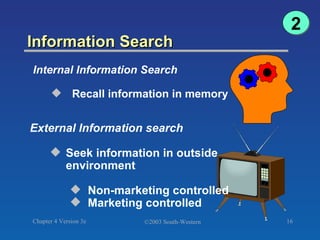
Information Search External Information search Seek information in outside environment Non-marketing controlled Marketing controlled 2 Internal Information Search   Recall information in memory
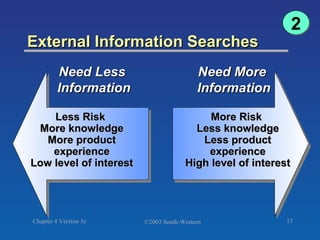
External Information Searches 2 Need More  Information More Risk  Less knowledge Less product experience High level of interest Less Risk  More knowledge More product experience Low level of interest Need Less  Information
Evoked Set Group of brands,  resulting from an information search,  from which a buyer  can choose. 2
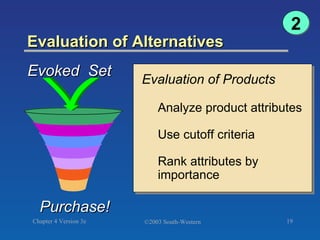
Evaluation of Alternatives 2 Evoked  Set Purchase! Evaluation of Products Analyze product attributes Use cutoff criteria Rank attributes by importance
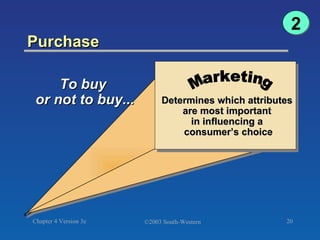
Purchase Determines which attributes  are most important  in influencing a  consumer’s choice To buy  or not to buy... Marketing 2
Learning Objective  Explain the  consumer’s  postpurchase evaluation process. 3
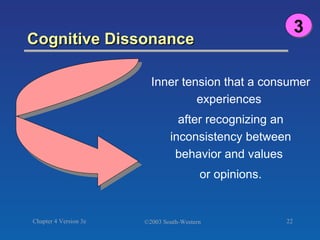
Cognitive Dissonance Inner tension that a consumer experiences  after recognizing an inconsistency between behavior and values  or opinions. 3
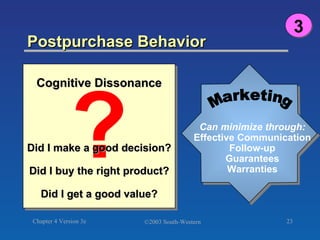
Postpurchase Behavior 3 Can minimize through: Effective Communication Follow-up Guarantees Warranties Marketing Cognitive Dissonance ? Did I make a good decision? Did I buy the right product? Did I get a good value?
Learning Objective  Identify the types of  consumer buying decisions  and discuss the significance  of consumer involvement. 4
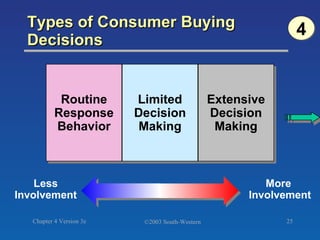
Types of Consumer Buying Decisions More Involvement Less Involvement Routine Response Behavior Limited Decision Making Extensive Decision Making 4
Involvement and Decision Making High Involvement Extended Problem Solving eg buying a car, computer Limited Problem Solving eg buying clothes Low Involvement Habitual Decision Making eg buying soft drinks
Five Factors influencing Decisions 1. Level of consumer involvement 2. Length of time to make decision 3.  Cost of good or service 4.  Degree of information search 5.  Number of alternatives considered 4
Routine Response Behavior Little involvement in selection process Frequently purchased low cost goods May stick with one brand Buy first/evaluate later Quick decision 4
Limited Decision Making Low levels of involvement Low to moderate cost goods Evaluation of a few alternative brands Short to moderate time to decide 4
Extensive Decision Making 4 High levels of involvement High cost goods Evaluation of many brands Long time to decide May experience cognitive dissonance
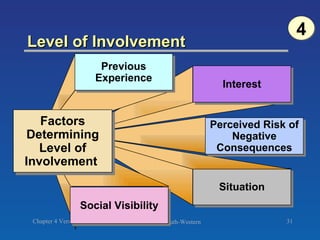
Level of Involvement 4 Situation Social Visibility Interest Perceived Risk of Negative Consequences Previous Experience Factors Determining Level of Involvement
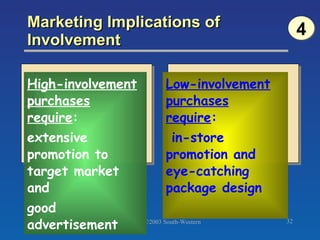
Marketing Implications of Involvement High-involvement purchases require : extensive promotion to target market and good advertisement Low-involvement purchases require : in-store promotion and eye-catching package design 4
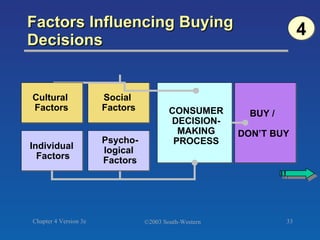
Factors Influencing Buying Decisions 4 Social  Factors Individual  Factors Psycho- logical  Factors Cultural  Factors CONSUMER DECISION- MAKING PROCESS BUY /  DON’T BUY
Learning Objective  Identify and understand the  cultural factors that affect  consumer buying decisions. 5
Culture Set of values norms, attitudes, and other meaningful symbols that shape human behavior and the artifacts, or products, of that behavior as they are transmitted from one generation to the next. 5
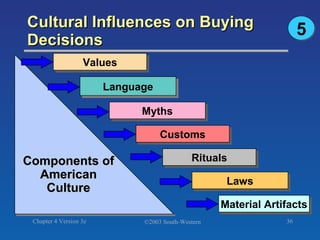
Cultural Influences on Buying Decisions 5 Values Language Myths Customs Rituals Laws Components of American Culture Material Artifacts
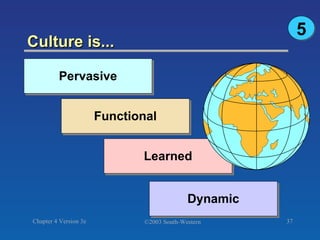
Culture is... Learned Functional Pervasive Dynamic 5
Value Enduring belief that a specific mode of conduct  is personally or socially preferable to another  mode of conduct. 5
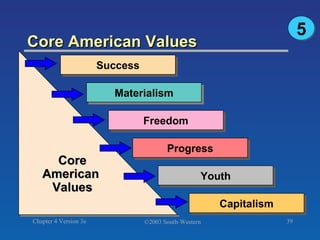
Core American Values 5 Success Materialism Freedom Progress Youth Capitalism Core American  Values
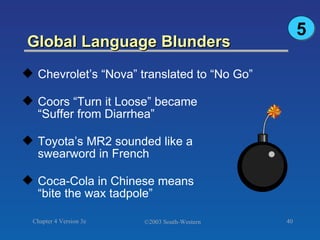
Global Language Blunders 5 Chevrolet’s “Nova” translated to “No Go”   Coors “Turn it Loose” became  “Suffer from Diarrhea” Toyota’s MR2 sounded like a  swearword in French Coca-Cola in Chinese means  “bite the wax tadpole”
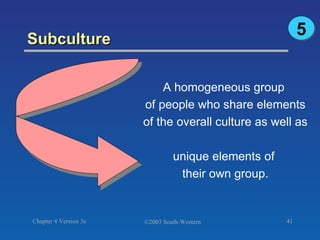
Subculture A homogeneous group  of people who share elements of the overall culture as well as  unique elements of  their own group. 5
Social Class A group of people in a society who are considered nearly equal in status or community esteem, who regularly socialize among themselves both formally and informally, and who share behavioral norms. 5
Learning Objective  6 Identify and understand the  social factors that affect  consumer buying decisions.
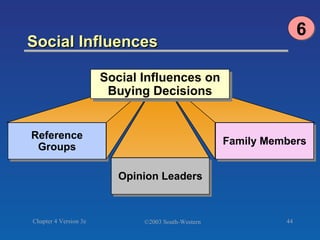
Social Influences  Reference Groups Opinion Leaders Family Members Social Influences on Buying Decisions 6
Reference Group A group in society that influences an individual’s purchasing behavior. 6
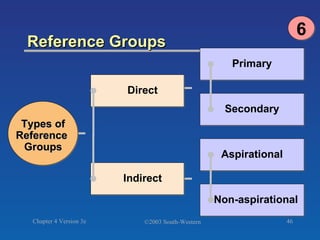
Reference Groups Direct Indirect 6 Types of Reference  Groups Primary Secondary Aspirational Non-aspirational
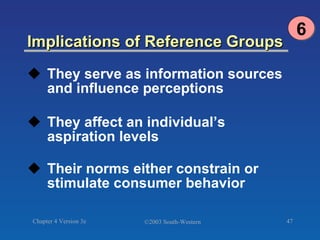
Implications of Reference Groups They serve as information sources and influence perceptions They affect an individual’s aspiration levels Their norms either constrain or stimulate consumer behavior 6
Opinion Leaders  An individual who  influences the opinion  of others. 6
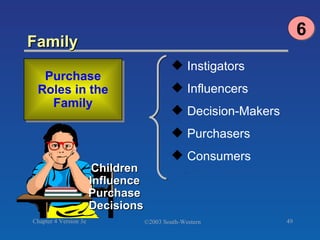
Family Purchase Roles in the Family Instigators Influencers Decision-Makers Purchasers Consumers Children  Influence  Purchase  Decisions 6
Learning Objective  Identify and understand the  individual factors that affect  consumer buying decisions. 7
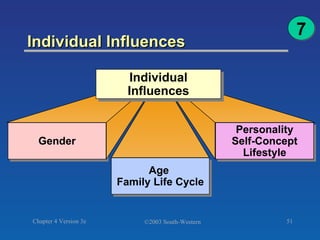
Individual Influences Gender Age  Family Life Cycle Personality Self-Concept Lifestyle Individual Influences 7
Psychographics  The analytical technique used to examine consumer lifestyles and to categorize consumers. 7
Learning Objective  Identify and understand the  psychological factors that affect  consumer buying decisions. 8
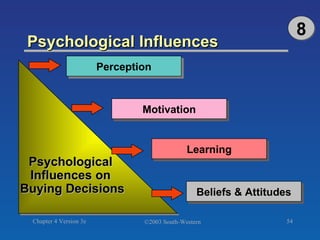
Psychological Influences 8 Psychological  Influences on  Buying Decisions Perception Motivation Learning Beliefs & Attitudes
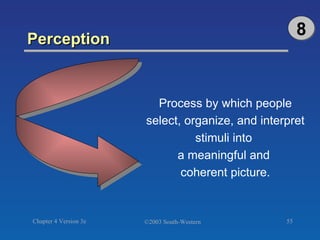
Perception  Process by which people select, organize, and interpret stimuli into  a meaningful and  coherent picture. 8
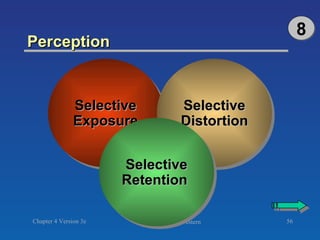
Perception Selective Exposure Selective Distortion Selective Retention   8
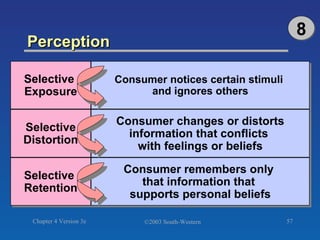
Perception 8 Selective  Exposure Selective Distortion Consumer notices certain stimuli  and ignores others Consumer changes or distorts information that conflicts  with feelings or beliefs Selective  Retention Consumer remembers only  that information that  supports personal beliefs
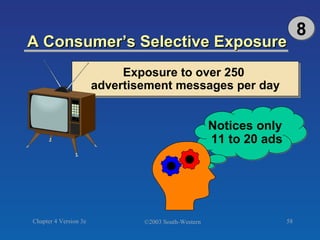
A Consumer’s Selective Exposure Notices only  11 to 20 ads Exposure to over 250  advertisement messages per day 8
Marketing Implications of Perception Important attributes Higher price Brand names  Quality and reliability Threshold level of perception Product changes 8
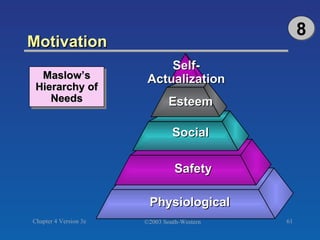
Maslow’s Hierarchy of Needs  A method of classifying human needs and motivations into five categories in ascending order of importance. 8
Motivation 8 Maslow’s Hierarchy of Needs Physiological  Safety Social Esteem Self- Actualization
Learning  A process that creates changes in behavior, immediate or expected, through experience  and practice. 8
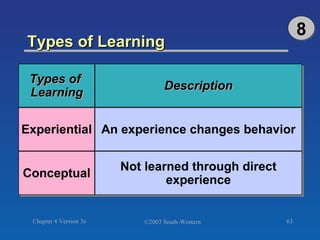
Types of Learning 8 Types of  Learning Description Experiential Conceptual An experience changes behavior Not learned through direct experience
Stimulus Generalization  A form of learning that occurs when one response is extended to a second stimulus similar to the first. 8
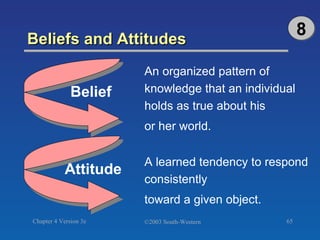
Beliefs and Attitudes  An organized pattern of knowledge that an individual holds as true about his  or her world. 8 Belief Attitude A learned tendency to respond consistently  toward a given object.

Consumer Decision Making

  • 1.
  • 2.
    Learning Objectives chapter4 1. Explain why marketing managers should understand consumer behavior. 2. Analyze the components of the consumer decision-making process. 3. Explain the consumer’s postpurchase evaluation process.
  • 3.
    Learning Objectives (continued)chapter 4 4. Identify the types of consumer buying decisions and discuss the significance of consumer involvement. 5. Identify and understand the cultural factors that affect consumer buying decisions.
  • 4.
    Learning Objectives (continued)chapter 4 6. Identify and understand the social factors that affect consumer buying decisions. 7. Identify and understand the individual factors that affect consumer buying decisions. 8. Identify and understand the psychological factors that affect consumer buying decisions.
  • 5.
    Learning Objective 1 Explain why marketing managers should understand consumer behavior.
  • 6.
    Consumer Behavior Processesa consumer uses to make purchase decisions, as well as to use and dispose of purchased goods or services; also includes factors that influence purchase decisions and the product use. 1
  • 7.
    Learning Objective 2 Analyze the components of the consumer decision-making process.
  • 8.
    Consumer Decision-Making ProcessA five-step process used by consumers when buying goods or services. 2
  • 9.
    Consumer Decision-Making Process2 Postpurchase Behavior Purchase Evaluation of Alternatives Information Search Need Recognition Cultural, Social, Individual and Psychological Factors affect all steps
  • 10.
    Need Recognition Resultof an imbalance between actual and desired states. 2
  • 11.
    Need Recognition 2Internal Stimuli and External Stimuli Present Status Preferred State Marketing helps consumers recognize an imbalance between present status and preferred state
  • 12.
    Stimulus Any unitof input affecting one or more of the five senses: sight smell taste touch hearing 2
  • 13.
    Want Recognition ofan unfulfilled need and a product (or attribute or feature) that will satisfy it. 2
  • 14.
    Recognition of UnfulfilledWants When a current product isn’t performing properly When the consumer is running out of an product When another product seems superior to the one currently used 2
  • 15.
    Information Searches Processof recalling past information stored in the memory. Internal Process of seeking information in the outside environment. External 2
  • 16.
    Information Search ExternalInformation search Seek information in outside environment Non-marketing controlled Marketing controlled 2 Internal Information Search Recall information in memory
  • 17.
    External Information Searches2 Need More Information More Risk Less knowledge Less product experience High level of interest Less Risk More knowledge More product experience Low level of interest Need Less Information
  • 18.
    Evoked Set Groupof brands, resulting from an information search, from which a buyer can choose. 2
  • 19.
    Evaluation of Alternatives2 Evoked Set Purchase! Evaluation of Products Analyze product attributes Use cutoff criteria Rank attributes by importance
  • 20.
    Purchase Determines whichattributes are most important in influencing a consumer’s choice To buy or not to buy... Marketing 2
  • 21.
    Learning Objective Explain the consumer’s postpurchase evaluation process. 3
  • 22.
    Cognitive Dissonance Innertension that a consumer experiences after recognizing an inconsistency between behavior and values or opinions. 3
  • 23.
    Postpurchase Behavior 3Can minimize through: Effective Communication Follow-up Guarantees Warranties Marketing Cognitive Dissonance ? Did I make a good decision? Did I buy the right product? Did I get a good value?
  • 24.
    Learning Objective Identify the types of consumer buying decisions and discuss the significance of consumer involvement. 4
  • 25.
    Types of ConsumerBuying Decisions More Involvement Less Involvement Routine Response Behavior Limited Decision Making Extensive Decision Making 4
  • 26.
    Involvement and DecisionMaking High Involvement Extended Problem Solving eg buying a car, computer Limited Problem Solving eg buying clothes Low Involvement Habitual Decision Making eg buying soft drinks
  • 27.
    Five Factors influencingDecisions 1. Level of consumer involvement 2. Length of time to make decision 3. Cost of good or service 4. Degree of information search 5. Number of alternatives considered 4
  • 28.
    Routine Response BehaviorLittle involvement in selection process Frequently purchased low cost goods May stick with one brand Buy first/evaluate later Quick decision 4
  • 29.
    Limited Decision MakingLow levels of involvement Low to moderate cost goods Evaluation of a few alternative brands Short to moderate time to decide 4
  • 30.
    Extensive Decision Making4 High levels of involvement High cost goods Evaluation of many brands Long time to decide May experience cognitive dissonance
  • 31.
    Level of Involvement4 Situation Social Visibility Interest Perceived Risk of Negative Consequences Previous Experience Factors Determining Level of Involvement
  • 32.
    Marketing Implications ofInvolvement High-involvement purchases require : extensive promotion to target market and good advertisement Low-involvement purchases require : in-store promotion and eye-catching package design 4
  • 33.
    Factors Influencing BuyingDecisions 4 Social Factors Individual Factors Psycho- logical Factors Cultural Factors CONSUMER DECISION- MAKING PROCESS BUY / DON’T BUY
  • 34.
    Learning Objective Identify and understand the cultural factors that affect consumer buying decisions. 5
  • 35.
    Culture Set ofvalues norms, attitudes, and other meaningful symbols that shape human behavior and the artifacts, or products, of that behavior as they are transmitted from one generation to the next. 5
  • 36.
    Cultural Influences onBuying Decisions 5 Values Language Myths Customs Rituals Laws Components of American Culture Material Artifacts
  • 37.
    Culture is... LearnedFunctional Pervasive Dynamic 5
  • 38.
    Value Enduring beliefthat a specific mode of conduct is personally or socially preferable to another mode of conduct. 5
  • 39.
    Core American Values5 Success Materialism Freedom Progress Youth Capitalism Core American Values
  • 40.
    Global Language Blunders5 Chevrolet’s “Nova” translated to “No Go” Coors “Turn it Loose” became “Suffer from Diarrhea” Toyota’s MR2 sounded like a swearword in French Coca-Cola in Chinese means “bite the wax tadpole”
  • 41.
    Subculture A homogeneousgroup of people who share elements of the overall culture as well as unique elements of their own group. 5
  • 42.
    Social Class Agroup of people in a society who are considered nearly equal in status or community esteem, who regularly socialize among themselves both formally and informally, and who share behavioral norms. 5
  • 43.
    Learning Objective 6 Identify and understand the social factors that affect consumer buying decisions.
  • 44.
    Social Influences Reference Groups Opinion Leaders Family Members Social Influences on Buying Decisions 6
  • 45.
    Reference Group Agroup in society that influences an individual’s purchasing behavior. 6
  • 46.
    Reference Groups DirectIndirect 6 Types of Reference Groups Primary Secondary Aspirational Non-aspirational
  • 47.
    Implications of ReferenceGroups They serve as information sources and influence perceptions They affect an individual’s aspiration levels Their norms either constrain or stimulate consumer behavior 6
  • 48.
    Opinion Leaders An individual who influences the opinion of others. 6
  • 49.
    Family Purchase Rolesin the Family Instigators Influencers Decision-Makers Purchasers Consumers Children Influence Purchase Decisions 6
  • 50.
    Learning Objective Identify and understand the individual factors that affect consumer buying decisions. 7
  • 51.
    Individual Influences GenderAge Family Life Cycle Personality Self-Concept Lifestyle Individual Influences 7
  • 52.
    Psychographics Theanalytical technique used to examine consumer lifestyles and to categorize consumers. 7
  • 53.
    Learning Objective Identify and understand the psychological factors that affect consumer buying decisions. 8
  • 54.
    Psychological Influences 8Psychological Influences on Buying Decisions Perception Motivation Learning Beliefs & Attitudes
  • 55.
    Perception Processby which people select, organize, and interpret stimuli into a meaningful and coherent picture. 8
  • 56.
    Perception Selective ExposureSelective Distortion Selective Retention 8
  • 57.
    Perception 8 Selective Exposure Selective Distortion Consumer notices certain stimuli and ignores others Consumer changes or distorts information that conflicts with feelings or beliefs Selective Retention Consumer remembers only that information that supports personal beliefs
  • 58.
    A Consumer’s SelectiveExposure Notices only 11 to 20 ads Exposure to over 250 advertisement messages per day 8
  • 59.
    Marketing Implications ofPerception Important attributes Higher price Brand names Quality and reliability Threshold level of perception Product changes 8
  • 60.
    Maslow’s Hierarchy ofNeeds A method of classifying human needs and motivations into five categories in ascending order of importance. 8
  • 61.
    Motivation 8 Maslow’sHierarchy of Needs Physiological Safety Social Esteem Self- Actualization
  • 62.
    Learning Aprocess that creates changes in behavior, immediate or expected, through experience and practice. 8
  • 63.
    Types of Learning8 Types of Learning Description Experiential Conceptual An experience changes behavior Not learned through direct experience
  • 64.
    Stimulus Generalization A form of learning that occurs when one response is extended to a second stimulus similar to the first. 8
  • 65.
    Beliefs and Attitudes An organized pattern of knowledge that an individual holds as true about his or her world. 8 Belief Attitude A learned tendency to respond consistently toward a given object.