Chapter One:
Consumer Behavior and
  Marketing Strategy


                        1-1
Welcome to Consumer Behaviour
• Why study consumer behaviour (CB)?
• What is consumer behaviour?
• How does it affect marketing strategy?


                                           1-2
The Text Required


                    1-3
For information:
• This
  Australian
  Edition is
  based on
  the main US
  Edition:


                              1-4
Subject objectives
• Knowledge and understanding
  – Theories               working model of CB
  – Implications for strategic marketing decisions
  – A focus on marketing decisions

• Communication skills
  – Increase your skills in developing and presenting
    ideas orally and in writing


                                                     1-5
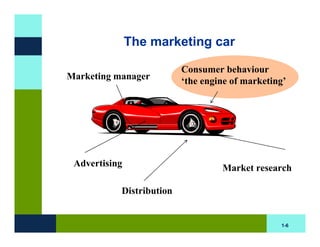
The marketing car

                          Consumer behaviour
Marketing manager         ‘the engine of marketing’


 Advertising                       Market research

           Distribution


                                                 1-6
Overview of the chapter:
1. Studying the consumer is important for marketers
2. Implications of consumer behavior for marketing
   strategy
3. Components of a consumer behavior audit
4. Relevance of consumer behavior for non-profit
   organizations, government agencies or consumer
   groups
5. A working model of consumer behavior


                                                      1-7
Introductory chapter
• Is usually the most important
• Provides an overview of what’s in store
• Bird’s-eye view of the subject
• Important to see the linkages between BB
  and Marketing Strategy
• (note all the past year examination questions
  require explanation of how the BB concept
  being tested is linked to marketing strategy)


                                             1-8
Definitions of consumer behaviour
• The dynamic interaction of cognition,
  behaviour and environmental events by which
  human beings conduct the exchange aspects
  of their lives
  (American Marketing Association)


• A discipline dealing with how and why
  consumers purchase (or don’t purchase)
  products and services.
  (Neal et al.)


                                           1-9
Definitions of consumer behaviour
                (cont.)
• Those behaviours performed by decision-
  making units in the purchase, usage and
  disposal of goods and services
  (Kotler & Levy)


                                            1-10
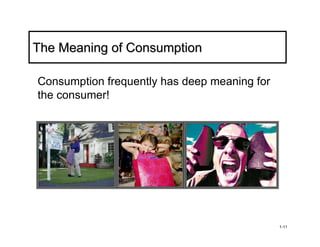
The Meaning of Consumption

Consumption frequently has deep meaning for
the consumer!


                                              1-11
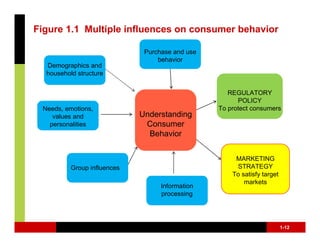
Figure 1.1 Multiple influences on consumer behavior

                              Purchase and use
                                  behavior
  Demographics and
  household structure


                                                    REGULATORY
                                                       POLICY
 Needs, emotions,                                To protect consumers
    values and               Understanding
   personalities              Consumer
                               Behavior


                                                      MARKETING
          Group influences                            STRATEGY
                                                     To satisfy target
                                                         markets
                                   Information
                                   processing


                                                                         1-12
Marketing decisions
  At each stage in this course you will be
  required to consider the importance of
  consumer behaviour knowledge in the
  development of marketing strategy.
  Marketing decisions are based on:
• Market segmentation
• Product positioning
• Marketing mix


                                             1-13
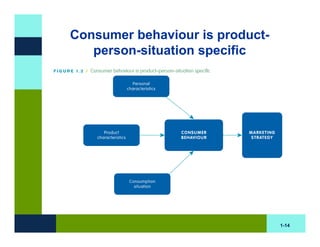
Consumer behaviour is product-
   person-situation specific


                                 1-14
Consumer behaviour is product-
      person-situation specific
• Product specific
  – Depends on the nature of the product


• Person-individual
  – Different customers behave differently due to
    needs, personalities and values


• Situation
  – Buying behaviour is dependent on the given
     situation
                                                    1-15
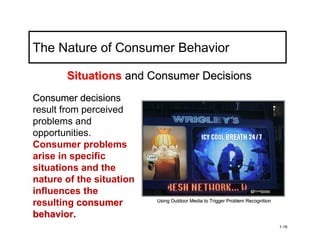
The Nature of Consumer Behavior

       Situations and Consumer Decisions
Consumer decisions
result from perceived
problems and
opportunities.
Consumer problems
arise in specific
situations and the
nature of the situation
influences the
resulting consumer        Using Outdoor Media to Trigger Problem Recognition


behavior.
                                                                               1-16
Consumer behaviour and marketing
            strategy
• Positioning strategy
• Market segmentation
• New products
• New market applications
• Global marketing          Read pages 10 to 13
                            from the text
• Marketing mix
• Consumerism
• Non-profit marketing


                                                  1-17
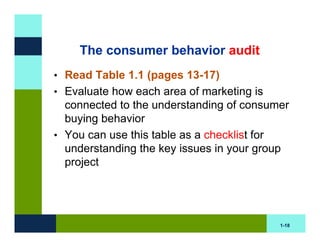
The consumer behavior audit
• Read Table 1.1 (pages 13-17)
• Evaluate how each area of marketing is
  connected to the understanding of consumer
  buying behavior
• You can use this table as a checklist for
  understanding the key issues in your group
  project


                                           1-18
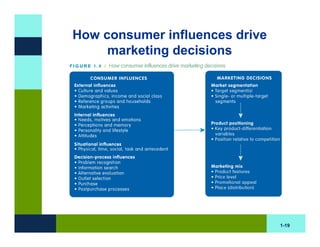
How consumer influences drive
     marketing decisions


                                1-19
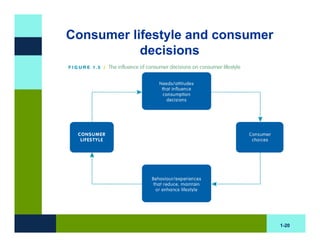
Consumer lifestyle and consumer
           decisions


                                  1-20
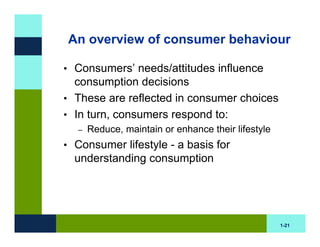
An overview of consumer behaviour

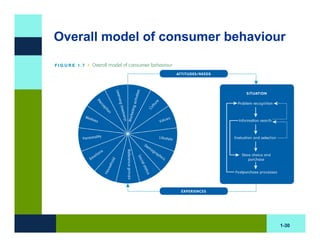
• Consumers’ needs/attitudes influence
  consumption decisions
• These are reflected in consumer choices
• In turn, consumers respond to:
  –   Reduce, maintain or enhance their lifestyle
• Consumer lifestyle - a basis for
  understanding consumption


                                                    1-21
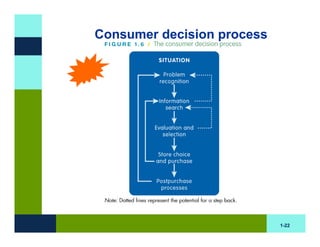
Consumer decision process


                            1-22
Consumer decision process
• Consumers are problem solvers


In a given situation the decision process
   involves:
1. Problem recognition
2. Information search
3. Evaluation and selection
4. Store choice and purchase
5. Post-purchase processes


                                            1-23
Decision vary according to situations
• See Table 1.2
• Consumer decision making for high versus
  low involvement purchases


                                             1-24
Read overview of internal and
        external influences
• Read pages 21- 25
• Provides an early overview of the chapters to
  come in later lectures


                                            1-25
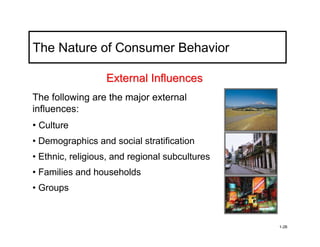
The Nature of Consumer Behavior

                  External Influences
The following are the major external
influences:
• Culture
• Demographics and social stratification
• Ethnic, religious, and regional subcultures
• Families and households
• Groups


                                                1-26
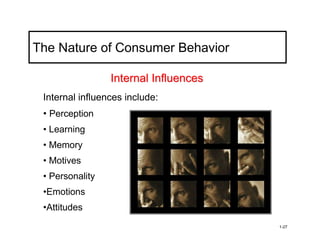
The Nature of Consumer Behavior

                 Internal Influences
 Internal influences include:
 • Perception
 • Learning
 • Memory
 • Motives
 • Personality
 •Emotions
 •Attitudes
                                       1-27
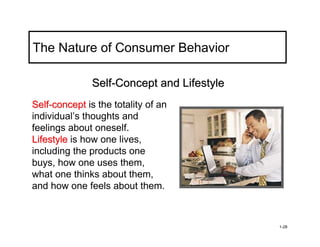
The Nature of Consumer Behavior

               Self-Concept and Lifestyle
Self-concept is the totality of an
individual’s thoughts and
feelings about oneself.
Lifestyle is how one lives,
including the products one
buys, how one uses them,
what one thinks about them,
and how one feels about them.


                                            1-28
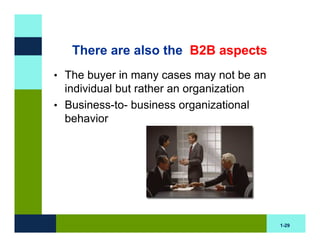
There are also the B2B aspects
• The buyer in many cases may not be an
  individual but rather an organization
• Business-to- business organizational
  behavior


                                          1-29
Overall model of consumer behaviour


                                  1-30
APPLICATION OF MARKETING
STRATEGY


The remaining slides outline the key issues in marketing
strategy. Understand how consumer behavior is linked to the
development of marketing strategies


                                                              1-31
Applications of Consumer Behavior


1. Marketing Strategy


2. Regulatory Policy


3. Social Marketing


4. Informed Individuals

                                    1-32
Applications of Consumer Behavior
Marketing Strategy


 Marketing strategies and tactics are based on explicit or
 implicit beliefs about consumer behavior.
                                 behavior

 Decisions based on explicit assumptions and sound theory
 and research are more likely to be successful than are
 decisions based solely on implicit intuition.

 Knowledge of consumer behavior can be an important
 competitive advantage and can greatly reduce the odds of
 bad decisions and market failures!
                                                             1-33
Applications of Consumer Behavior
Regulatory Policy


 Various regulatory bodies exist to develop, interpret, and/or
 implement policies designed to protect and aid consumer.

 Effective regulation of many marketing practices requires an
 extensive knowledge of consumer behavior.
                                   behavior


                                                                 1-34
Applications of Consumer Behavior
Social Marketing


 Social marketing is the application of marketing strategies
 and tactics to alter or create behaviors that have a positive
 effect on the targeted individuals or society as a whole.

 As is true for commercial marketing strategy, successful
 social marketing strategy requires a sound understanding of
 consumer behavior.
             behavior


                                                                 1-35
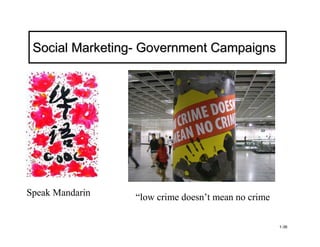
Social Marketing- Government Campaigns


Speak Mandarin   “low crime doesn’t mean no crime

                                                    1-36
Applications of Consumer Behavior
Informed Individuals

 Most economically developed societies are referred to as
 consumption societies. Most individuals in these societies
 spend more time engaged in consumption than any other
 activity, including work or sleep.

 Knowledge of consumer behavior can enhance our
 understanding of our environment and ourselves.

 Such an understanding is essential for sound citizenship,
 effective purchasing behavior, and reasoned business ethics.

                                                              1-37
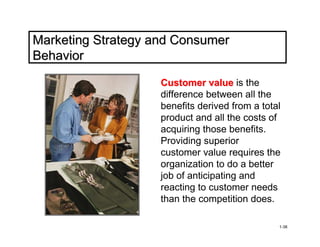
Marketing Strategy and Consumer
Behavior

                    Customer value is the
                    difference between all the
                    benefits derived from a total
                    product and all the costs of
                    acquiring those benefits.
                    Providing superior
                    customer value requires the
                    organization to do a better
                    job of anticipating and
                    reacting to customer needs
                    than the competition does.

                                                1-38
Marketing Strategy and Consumer Behavior


                                           1-39
Marketing Strategy and Consumer
Behavior
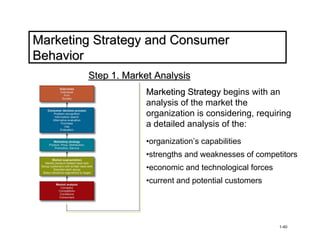
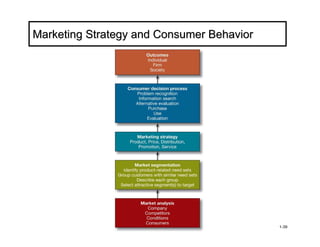
        Step 1. Market Analysis
                    Marketing Strategy begins with an
                    analysis of the market the
                    organization is considering, requiring
                    a detailed analysis of the:
                    •organization’s capabilities
                    •strengths and weaknesses of competitors
                    •economic and technological forces
                    •current and potential customers


                                                         1-40
Marketing Strategy and Consumer
Behavior
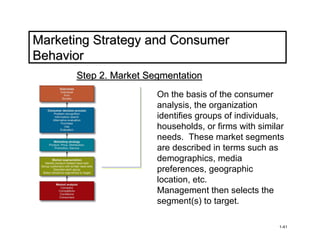
      Step 2. Market Segmentation
                       On the basis of the consumer
                       analysis, the organization
                       identifies groups of individuals,
                       households, or firms with similar
                       needs. These market segments
                       are described in terms such as
                       demographics, media
                       preferences, geographic
                       location, etc.
                       Management then selects the
                       segment(s) to target.

                                                      1-41
Marketing Strategy and Consumer
Behavior
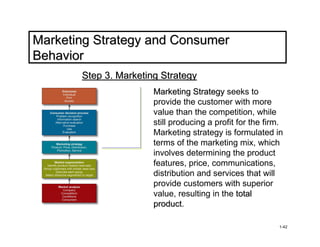
       Step 3. Marketing Strategy
                       Marketing Strategy seeks to
                       provide the customer with more
                       value than the competition, while
                       still producing a profit for the firm.
                       Marketing strategy is formulated in
                       terms of the marketing mix, which
                       involves determining the product
                       features, price, communications,
                       distribution and services that will
                       provide customers with superior
                       value, resulting in the total
                       product.
                       product

                                                           1-42
Marketing Strategy and Consumer
Behavior
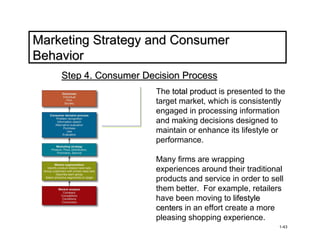
    Step 4. Consumer Decision Process
                       The total product is presented to the
                       target market, which is consistently
                       engaged in processing information
                       and making decisions designed to
                       maintain or enhance its lifestyle or
                       performance.

                       Many firms are wrapping
                       experiences around their traditional
                       products and service in order to sell
                       them better. For example, retailers
                       have been moving to lifestyle
                       centers in an effort create a more
                       pleasing shopping experience.
                                                          1-43
Marketing Strategy and Consumer
Behavior
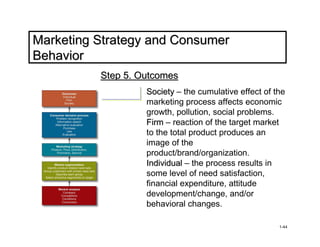
          Step 5. Outcomes
                   Society – the cumulative effect of the
                   marketing process affects economic
                   growth, pollution, social problems.
                   Firm – reaction of the target market
                   to the total product produces an
                   image of the
                   product/brand/organization.
                   Individual – the process results in
                   some level of need satisfaction,
                   financial expenditure, attitude
                   development/change, and/or
                   behavioral changes.

                                                       1-44
Market Analysis Components


1. The Consumers

2. The Company

3. The Competitors

4. The Conditions


                             1-45
Market Analysis Components

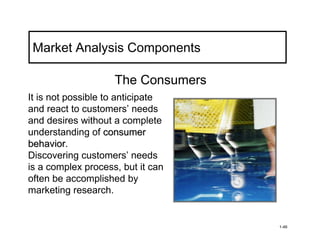
                    The Consumers
It is not possible to anticipate
and react to customers’ needs
and desires without a complete
understanding of consumer
behavior.
behavior
Discovering customers’ needs
is a complex process, but it can
often be accomplished by
marketing research.


                                    1-46
Market Analysis Components

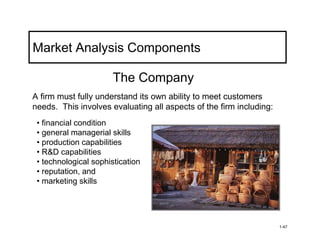
                       The Company
A firm must fully understand its own ability to meet customers
needs. This involves evaluating all aspects of the firm including:
 • financial condition
 • general managerial skills
 • production capabilities
 • R&D capabilities
 • technological sophistication
 • reputation, and
 • marketing skills


                                                                     1-47
Market Analysis Components

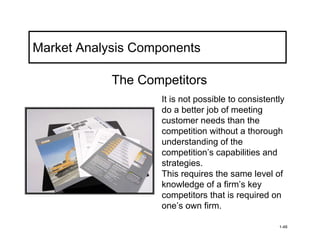
            The Competitors
                   It is not possible to consistently
                   do a better job of meeting
                   customer needs than the
                   competition without a thorough
                   understanding of the
                   competition’s capabilities and
                   strategies.
                   This requires the same level of
                   knowledge of a firm’s key
                   competitors that is required on
                   one’s own firm.

                                                   1-48
Market Analysis Components

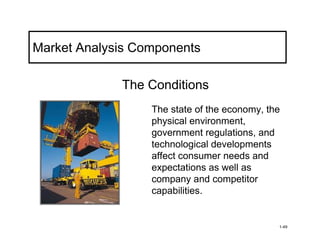
             The Conditions
                  The state of the economy, the
                  physical environment,
                  government regulations, and
                  technological developments
                  affect consumer needs and
                  expectations as well as
                  company and competitor
                  capabilities.


                                              1-49
Market Segmentation


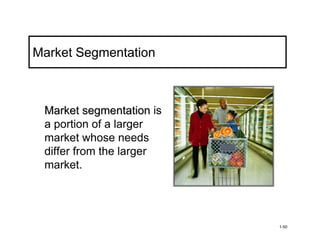
 Market segmentation is
 a portion of a larger
 market whose needs
 differ from the larger
 market.


                          1-50
Market Segmentation

Market Segmentation Involves Four Steps:

1. Identifying Product-Related Need Sets

2. Grouping Customers with Similar Need Sets

3. Describing Each Group

4. Selecting an Attractive Segment(s) to Serve


                                                 1-51
Market Segmentation
            Product-Related Need Sets
Organizations approach market segmentation with a set
of current and potential capabilities.
The term need set is used to reflect the fact that most
products in developed economies satisfy more than one
need.
Customer needs are not restricted to product features but
also include types and sources of product information,
outlets where the product is available, product price, the
image of the product or firm, and even where and how the
product is produced.

                                                         1-52
Market Segmentation

         Customers with Similar Need Sets
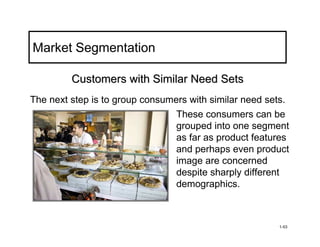
The next step is to group consumers with similar need sets.
                                 These consumers can be
                                 grouped into one segment
                                 as far as product features
                                 and perhaps even product
                                 image are concerned
                                 despite sharply different
                                 demographics.


                                                        1-53
Market Segmentation

          Description of Each Group
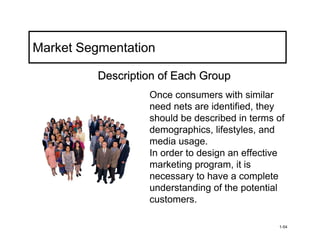
                   Once consumers with similar
                   need nets are identified, they
                   should be described in terms of
                   demographics, lifestyles, and
                   media usage.
                   In order to design an effective
                   marketing program, it is
                   necessary to have a complete
                   understanding of the potential
                   customers.

                                                1-54
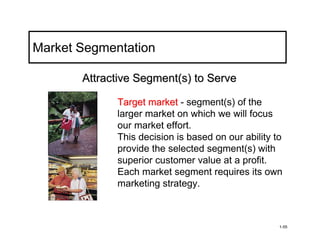
Market Segmentation

       Attractive Segment(s) to Serve

             Target market - segment(s) of the
             larger market on which we will focus
             our market effort.
             This decision is based on our ability to
             provide the selected segment(s) with
             superior customer value at a profit.
             Each market segment requires its own
             marketing strategy.


                                                    1-55
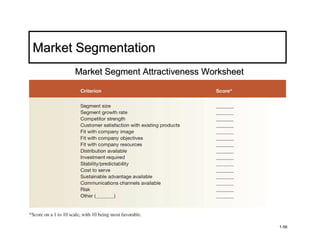
Market Segmentation
      Market Segment Attractiveness Worksheet


                                                1-56
Marketing Strategy
  Marketing Strategy is the answer to the question:
  How will we provide superior customer value to our
  target market?
  This requires the formulation of a consistent marketing
  mix, which includes the
  mix
  1. Product
  2. Price
  3. Communications
  4. Distribution, and
     Distribution
  5. Services


                                                        1-57
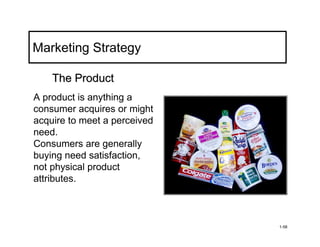
Marketing Strategy

    The Product
A product is anything a
consumer acquires or might
acquire to meet a perceived
need.
Consumers are generally
buying need satisfaction,
not physical product
attributes.


                              1-58
Marketing Strategy

                   Communications
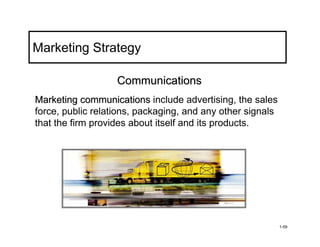
Marketing communications include advertising, the sales
force, public relations, packaging, and any other signals
that the firm provides about itself and its products.


                                                            1-59
Marketing Strategy

                       Price
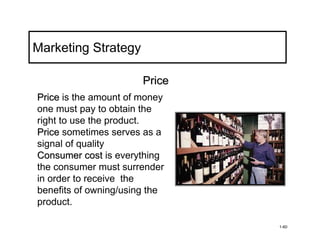
Price is the amount of money
one must pay to obtain the
right to use the product.
Price sometimes serves as a
signal of quality
Consumer cost is everything
the consumer must surrender
in order to receive the
benefits of owning/using the
product.

                               1-60
Marketing Strategy

                    Distribution

Distribution means having the
product available where target
customers can buy it. This is
essential to the product’s
success.
Good channel decisions require
a sound knowledge of where
target customers shop for the
product.

                                   1-61
Marketing Strategy

                        Service
Service refers to auxiliary or
peripheral activities that are
performed to enhance the
primary product or primary
service.
Auxiliary services cost money
to provide, so it is essential
that the firm furnish only those
services that provide value to
the target customers.

                                   1-62
Consumer Decisions

The consumer decision process intervenes between
the marketing strategy, as implemented in the
              strategy
marketing mix, and the outcomes.
          mix           outcomes
The firm can succeed only if consumers see a need
that its product can solve, become aware of the
product and its capabilities, decide that it is the best
available solution, proceed to buy it, and become
satisfied with the result of the purchase.


                                                           1-63
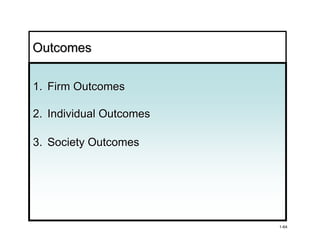
Outcomes

1. Firm Outcomes

2. Individual Outcomes

3. Society Outcomes


                         1-64
Outcomes

                   Firm Outcomes
The product position is the image of the product or brand
in the consumer’s mind relative to competing products
and brands.
Sales are a critical outcome, as they produce the revenue
necessary for the firm to continue in business.
Customer satisfaction remains a concern for marketers.
Retaining customers requires that they be satisfied with
their purchase and use of the product.


                                                        1-65
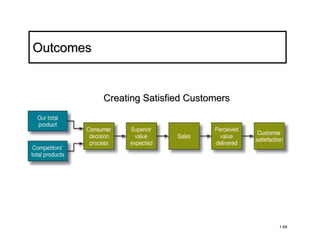
Outcomes


           Creating Satisfied Customers


                                          1-66
Outcomes

                Individual Outcomes
Need satisfaction
The most obvious outcome of the consumption process
for an individual, whether or not a purchase is made, is
some level of satisfaction of the need that initiated the
consumption process.
Injurious consumption, the dark side of consumer
behavior, occurs when individuals or groups make
consumption decisions that have negative consequences
for their long-run well-being.


                                                        1-67
Outcomes

                        Society Outcomes
Economic Outcomes
The cumulative impact of consumers’ purchase decisions, including the
decision to forgo consumption, is a major determinant of the state of a
given country’s economy.
Physical Environment Outcomes
Consumers make decisions that have a major impact on the physical
environments of both their own and other societies.
Social Welfare
Consumer decisions affect the general social welfare of a society,
including having a major impact on the overall quality of life in a society.


                                                                          1-68

BB Chapter One: Consumer Behavior and Marketing Strategy

  • 1.
    Chapter One: Consumer Behaviorand Marketing Strategy 1-1
  • 2.
    Welcome to ConsumerBehaviour • Why study consumer behaviour (CB)? • What is consumer behaviour? • How does it affect marketing strategy? 1-2
  • 3.
  • 4.
    For information: • This Australian Edition is based on the main US Edition: 1-4
  • 5.
    Subject objectives • Knowledgeand understanding – Theories working model of CB – Implications for strategic marketing decisions – A focus on marketing decisions • Communication skills – Increase your skills in developing and presenting ideas orally and in writing 1-5
  • 6.
    The marketing car Consumer behaviour Marketing manager ‘the engine of marketing’ Advertising Market research Distribution 1-6
  • 7.
    Overview of thechapter: 1. Studying the consumer is important for marketers 2. Implications of consumer behavior for marketing strategy 3. Components of a consumer behavior audit 4. Relevance of consumer behavior for non-profit organizations, government agencies or consumer groups 5. A working model of consumer behavior 1-7
  • 8.
    Introductory chapter • Isusually the most important • Provides an overview of what’s in store • Bird’s-eye view of the subject • Important to see the linkages between BB and Marketing Strategy • (note all the past year examination questions require explanation of how the BB concept being tested is linked to marketing strategy) 1-8
  • 9.
    Definitions of consumerbehaviour • The dynamic interaction of cognition, behaviour and environmental events by which human beings conduct the exchange aspects of their lives (American Marketing Association) • A discipline dealing with how and why consumers purchase (or don’t purchase) products and services. (Neal et al.) 1-9
  • 10.
    Definitions of consumerbehaviour (cont.) • Those behaviours performed by decision- making units in the purchase, usage and disposal of goods and services (Kotler & Levy) 1-10
  • 11.
    The Meaning ofConsumption Consumption frequently has deep meaning for the consumer! 1-11
  • 12.
    Figure 1.1 Multipleinfluences on consumer behavior Purchase and use behavior Demographics and household structure REGULATORY POLICY Needs, emotions, To protect consumers values and Understanding personalities Consumer Behavior MARKETING Group influences STRATEGY To satisfy target markets Information processing 1-12
  • 13.
    Marketing decisions At each stage in this course you will be required to consider the importance of consumer behaviour knowledge in the development of marketing strategy. Marketing decisions are based on: • Market segmentation • Product positioning • Marketing mix 1-13
  • 14.
    Consumer behaviour isproduct- person-situation specific 1-14
  • 15.
    Consumer behaviour isproduct- person-situation specific • Product specific – Depends on the nature of the product • Person-individual – Different customers behave differently due to needs, personalities and values • Situation – Buying behaviour is dependent on the given situation 1-15
  • 16.
    The Nature ofConsumer Behavior Situations and Consumer Decisions Consumer decisions result from perceived problems and opportunities. Consumer problems arise in specific situations and the nature of the situation influences the resulting consumer Using Outdoor Media to Trigger Problem Recognition behavior. 1-16
  • 17.
    Consumer behaviour andmarketing strategy • Positioning strategy • Market segmentation • New products • New market applications • Global marketing Read pages 10 to 13 from the text • Marketing mix • Consumerism • Non-profit marketing 1-17
  • 18.
    The consumer behavioraudit • Read Table 1.1 (pages 13-17) • Evaluate how each area of marketing is connected to the understanding of consumer buying behavior • You can use this table as a checklist for understanding the key issues in your group project 1-18
  • 19.
    How consumer influencesdrive marketing decisions 1-19
  • 20.
    Consumer lifestyle andconsumer decisions 1-20
  • 21.
    An overview ofconsumer behaviour • Consumers’ needs/attitudes influence consumption decisions • These are reflected in consumer choices • In turn, consumers respond to: – Reduce, maintain or enhance their lifestyle • Consumer lifestyle - a basis for understanding consumption 1-21
  • 22.
  • 23.
    Consumer decision process •Consumers are problem solvers In a given situation the decision process involves: 1. Problem recognition 2. Information search 3. Evaluation and selection 4. Store choice and purchase 5. Post-purchase processes 1-23
  • 24.
    Decision vary accordingto situations • See Table 1.2 • Consumer decision making for high versus low involvement purchases 1-24
  • 25.
    Read overview ofinternal and external influences • Read pages 21- 25 • Provides an early overview of the chapters to come in later lectures 1-25
  • 26.
    The Nature ofConsumer Behavior External Influences The following are the major external influences: • Culture • Demographics and social stratification • Ethnic, religious, and regional subcultures • Families and households • Groups 1-26
  • 27.
    The Nature ofConsumer Behavior Internal Influences Internal influences include: • Perception • Learning • Memory • Motives • Personality •Emotions •Attitudes 1-27
  • 28.
    The Nature ofConsumer Behavior Self-Concept and Lifestyle Self-concept is the totality of an individual’s thoughts and feelings about oneself. Lifestyle is how one lives, including the products one buys, how one uses them, what one thinks about them, and how one feels about them. 1-28
  • 29.
    There are alsothe B2B aspects • The buyer in many cases may not be an individual but rather an organization • Business-to- business organizational behavior 1-29
  • 30.
    Overall model ofconsumer behaviour 1-30
  • 31.
    APPLICATION OF MARKETING STRATEGY Theremaining slides outline the key issues in marketing strategy. Understand how consumer behavior is linked to the development of marketing strategies 1-31
  • 32.
    Applications of ConsumerBehavior 1. Marketing Strategy 2. Regulatory Policy 3. Social Marketing 4. Informed Individuals 1-32
  • 33.
    Applications of ConsumerBehavior Marketing Strategy Marketing strategies and tactics are based on explicit or implicit beliefs about consumer behavior. behavior Decisions based on explicit assumptions and sound theory and research are more likely to be successful than are decisions based solely on implicit intuition. Knowledge of consumer behavior can be an important competitive advantage and can greatly reduce the odds of bad decisions and market failures! 1-33
  • 34.
    Applications of ConsumerBehavior Regulatory Policy Various regulatory bodies exist to develop, interpret, and/or implement policies designed to protect and aid consumer. Effective regulation of many marketing practices requires an extensive knowledge of consumer behavior. behavior 1-34
  • 35.
    Applications of ConsumerBehavior Social Marketing Social marketing is the application of marketing strategies and tactics to alter or create behaviors that have a positive effect on the targeted individuals or society as a whole. As is true for commercial marketing strategy, successful social marketing strategy requires a sound understanding of consumer behavior. behavior 1-35
  • 36.
    Social Marketing- GovernmentCampaigns Speak Mandarin “low crime doesn’t mean no crime 1-36
  • 37.
    Applications of ConsumerBehavior Informed Individuals Most economically developed societies are referred to as consumption societies. Most individuals in these societies spend more time engaged in consumption than any other activity, including work or sleep. Knowledge of consumer behavior can enhance our understanding of our environment and ourselves. Such an understanding is essential for sound citizenship, effective purchasing behavior, and reasoned business ethics. 1-37
  • 38.
    Marketing Strategy andConsumer Behavior Customer value is the difference between all the benefits derived from a total product and all the costs of acquiring those benefits. Providing superior customer value requires the organization to do a better job of anticipating and reacting to customer needs than the competition does. 1-38
  • 39.
    Marketing Strategy andConsumer Behavior 1-39
  • 40.
    Marketing Strategy andConsumer Behavior Step 1. Market Analysis Marketing Strategy begins with an analysis of the market the organization is considering, requiring a detailed analysis of the: •organization’s capabilities •strengths and weaknesses of competitors •economic and technological forces •current and potential customers 1-40
  • 41.
    Marketing Strategy andConsumer Behavior Step 2. Market Segmentation On the basis of the consumer analysis, the organization identifies groups of individuals, households, or firms with similar needs. These market segments are described in terms such as demographics, media preferences, geographic location, etc. Management then selects the segment(s) to target. 1-41
  • 42.
    Marketing Strategy andConsumer Behavior Step 3. Marketing Strategy Marketing Strategy seeks to provide the customer with more value than the competition, while still producing a profit for the firm. Marketing strategy is formulated in terms of the marketing mix, which involves determining the product features, price, communications, distribution and services that will provide customers with superior value, resulting in the total product. product 1-42
  • 43.
    Marketing Strategy andConsumer Behavior Step 4. Consumer Decision Process The total product is presented to the target market, which is consistently engaged in processing information and making decisions designed to maintain or enhance its lifestyle or performance. Many firms are wrapping experiences around their traditional products and service in order to sell them better. For example, retailers have been moving to lifestyle centers in an effort create a more pleasing shopping experience. 1-43
  • 44.
    Marketing Strategy andConsumer Behavior Step 5. Outcomes Society – the cumulative effect of the marketing process affects economic growth, pollution, social problems. Firm – reaction of the target market to the total product produces an image of the product/brand/organization. Individual – the process results in some level of need satisfaction, financial expenditure, attitude development/change, and/or behavioral changes. 1-44
  • 45.
    Market Analysis Components 1.The Consumers 2. The Company 3. The Competitors 4. The Conditions 1-45
  • 46.
    Market Analysis Components The Consumers It is not possible to anticipate and react to customers’ needs and desires without a complete understanding of consumer behavior. behavior Discovering customers’ needs is a complex process, but it can often be accomplished by marketing research. 1-46
  • 47.
    Market Analysis Components The Company A firm must fully understand its own ability to meet customers needs. This involves evaluating all aspects of the firm including: • financial condition • general managerial skills • production capabilities • R&D capabilities • technological sophistication • reputation, and • marketing skills 1-47
  • 48.
    Market Analysis Components The Competitors It is not possible to consistently do a better job of meeting customer needs than the competition without a thorough understanding of the competition’s capabilities and strategies. This requires the same level of knowledge of a firm’s key competitors that is required on one’s own firm. 1-48
  • 49.
    Market Analysis Components The Conditions The state of the economy, the physical environment, government regulations, and technological developments affect consumer needs and expectations as well as company and competitor capabilities. 1-49
  • 50.
    Market Segmentation Marketsegmentation is a portion of a larger market whose needs differ from the larger market. 1-50
  • 51.
    Market Segmentation Market SegmentationInvolves Four Steps: 1. Identifying Product-Related Need Sets 2. Grouping Customers with Similar Need Sets 3. Describing Each Group 4. Selecting an Attractive Segment(s) to Serve 1-51
  • 52.
    Market Segmentation Product-Related Need Sets Organizations approach market segmentation with a set of current and potential capabilities. The term need set is used to reflect the fact that most products in developed economies satisfy more than one need. Customer needs are not restricted to product features but also include types and sources of product information, outlets where the product is available, product price, the image of the product or firm, and even where and how the product is produced. 1-52
  • 53.
    Market Segmentation Customers with Similar Need Sets The next step is to group consumers with similar need sets. These consumers can be grouped into one segment as far as product features and perhaps even product image are concerned despite sharply different demographics. 1-53
  • 54.
    Market Segmentation Description of Each Group Once consumers with similar need nets are identified, they should be described in terms of demographics, lifestyles, and media usage. In order to design an effective marketing program, it is necessary to have a complete understanding of the potential customers. 1-54
  • 55.
    Market Segmentation Attractive Segment(s) to Serve Target market - segment(s) of the larger market on which we will focus our market effort. This decision is based on our ability to provide the selected segment(s) with superior customer value at a profit. Each market segment requires its own marketing strategy. 1-55
  • 56.
    Market Segmentation Market Segment Attractiveness Worksheet 1-56
  • 57.
    Marketing Strategy Marketing Strategy is the answer to the question: How will we provide superior customer value to our target market? This requires the formulation of a consistent marketing mix, which includes the mix 1. Product 2. Price 3. Communications 4. Distribution, and Distribution 5. Services 1-57
  • 58.
    Marketing Strategy The Product A product is anything a consumer acquires or might acquire to meet a perceived need. Consumers are generally buying need satisfaction, not physical product attributes. 1-58
  • 59.
    Marketing Strategy Communications Marketing communications include advertising, the sales force, public relations, packaging, and any other signals that the firm provides about itself and its products. 1-59
  • 60.
    Marketing Strategy Price Price is the amount of money one must pay to obtain the right to use the product. Price sometimes serves as a signal of quality Consumer cost is everything the consumer must surrender in order to receive the benefits of owning/using the product. 1-60
  • 61.
    Marketing Strategy Distribution Distribution means having the product available where target customers can buy it. This is essential to the product’s success. Good channel decisions require a sound knowledge of where target customers shop for the product. 1-61
  • 62.
    Marketing Strategy Service Service refers to auxiliary or peripheral activities that are performed to enhance the primary product or primary service. Auxiliary services cost money to provide, so it is essential that the firm furnish only those services that provide value to the target customers. 1-62
  • 63.
    Consumer Decisions The consumerdecision process intervenes between the marketing strategy, as implemented in the strategy marketing mix, and the outcomes. mix outcomes The firm can succeed only if consumers see a need that its product can solve, become aware of the product and its capabilities, decide that it is the best available solution, proceed to buy it, and become satisfied with the result of the purchase. 1-63
  • 64.
    Outcomes 1. Firm Outcomes 2.Individual Outcomes 3. Society Outcomes 1-64
  • 65.
    Outcomes Firm Outcomes The product position is the image of the product or brand in the consumer’s mind relative to competing products and brands. Sales are a critical outcome, as they produce the revenue necessary for the firm to continue in business. Customer satisfaction remains a concern for marketers. Retaining customers requires that they be satisfied with their purchase and use of the product. 1-65
  • 66.
    Outcomes Creating Satisfied Customers 1-66
  • 67.
    Outcomes Individual Outcomes Need satisfaction The most obvious outcome of the consumption process for an individual, whether or not a purchase is made, is some level of satisfaction of the need that initiated the consumption process. Injurious consumption, the dark side of consumer behavior, occurs when individuals or groups make consumption decisions that have negative consequences for their long-run well-being. 1-67
  • 68.
    Outcomes Society Outcomes Economic Outcomes The cumulative impact of consumers’ purchase decisions, including the decision to forgo consumption, is a major determinant of the state of a given country’s economy. Physical Environment Outcomes Consumers make decisions that have a major impact on the physical environments of both their own and other societies. Social Welfare Consumer decisions affect the general social welfare of a society, including having a major impact on the overall quality of life in a society. 1-68