©2003 Prentice Hall, Inc. Copyright © 2004 by South-Western, a division of Thomson Learning, Inc. All rights reserved.Developed by Cool Pictures and MultiMedia Presentations
©2003 Prentice Hall, Inc. To accompany A Framework for Marketing Management, 2nd
Edition Slide 2 in Chapter 7
ObjectivesObjectives
 Understand the nature of the business market and how it
differs from the consumer market.
 Learn how institutions and government agencies buy.
 Identify the different buying situations faced by organizational
buyers.
 Identify the participants in the business buying process and
the various influences impacting business buying decisions.
 Understand how business buyers make their decisions.
©2003 Prentice Hall, Inc. To accompany A Framework for Marketing Management, 2nd
Edition Slide 3 in Chapter 7
Organizational BuyingOrganizational Buying
 Organizational buying is:
“the decision-making process by
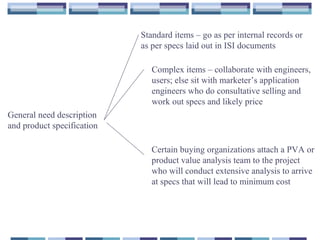
which formal organizations
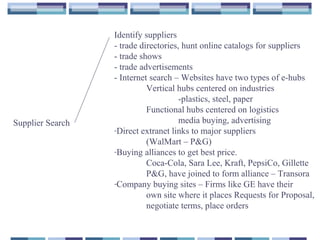
establish the need for purchased
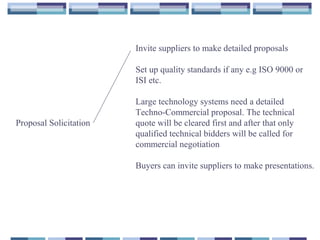
products and services and identify,
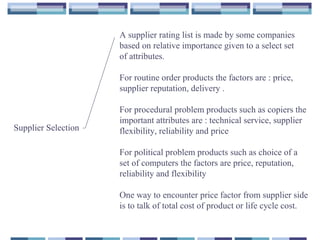
evaluate, and choose among
alternative brands and suppliers.”
©2003 Prentice Hall, Inc. To accompany A Framework for Marketing Management, 2nd
Edition Slide 4 in Chapter 7
Organizational BuyingOrganizational Buying
 Compared to Consumer Markets,
Business Markets have . . .
–Fewer buyers
–Larger buyers
–Geographically concentrated buyers
–Close relationships with their
supplier-customers
©2003 Prentice Hall, Inc. To accompany A Framework for Marketing Management, 2nd
Edition Slide 5 in Chapter 7
Organizational BuyingOrganizational Buying
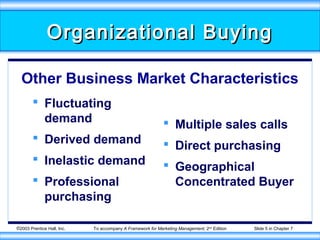
 Fluctuating
demand
 Derived demand
 Inelastic demand
 Professional
purchasing
 Multiple sales calls
 Direct purchasing
 Geographical
Concentrated Buyer
Other Business Market Characteristics
©2003 Prentice Hall, Inc. To accompany A Framework for Marketing Management, 2nd
Edition Slide 6 in Chapter 7
Organizational BuyingOrganizational Buying
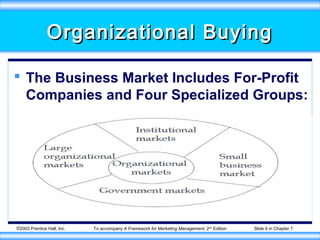
 The Business Market Includes For-Profit
Companies and Four Specialized Groups:
©2003 Prentice Hall, Inc. To accompany A Framework for Marketing Management, 2nd
Edition Slide 7 in Chapter 7
Organizational BuyingOrganizational Buying
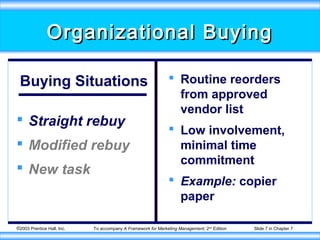
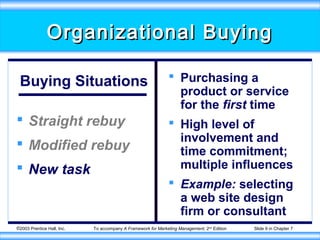
Buying Situations
 Straight rebuy
 Modified rebuy
 New task
 Routine reorders
from approved
vendor list
 Low involvement,
minimal time
commitment
 Example: copier
paper
©2003 Prentice Hall, Inc. To accompany A Framework for Marketing Management, 2nd
Edition Slide 8 in Chapter 7
Organizational BuyingOrganizational Buying
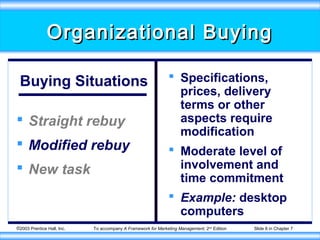
Buying Situations
 Straight rebuy
 Modified rebuy
 New task
 Specifications,
prices, delivery
terms or other
aspects require
modification
 Moderate level of
involvement and
time commitment
 Example: desktop
computers
©2003 Prentice Hall, Inc. To accompany A Framework for Marketing Management, 2nd
Edition Slide 9 in Chapter 7
Organizational BuyingOrganizational Buying
Buying Situations
 Straight rebuy
 Modified rebuy
 New task
 Purchasing a
product or service
for the first time
 High level of
involvement and
time commitment;
multiple influences
 Example: selecting
a web site design
firm or consultant
©2003 Prentice Hall, Inc. To accompany A Framework for Marketing Management, 2nd
Edition Slide 10 in Chapter 7
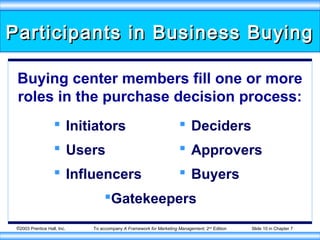
Participants in Business BuyingParticipants in Business Buying
 Initiators
 Users
 Influencers
 Deciders
 Approvers
 Buyers
Buying center members fill one or more
roles in the purchase decision process:
Gatekeepers
©2003 Prentice Hall, Inc. To accompany A Framework for Marketing Management, 2nd
Edition Slide 11 in Chapter 7
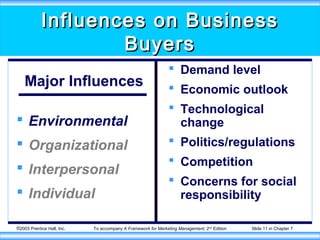
Influences on BusinessInfluences on Business
BuyersBuyers
Major Influences
 Environmental
 Organizational
 Interpersonal
 Individual
 Demand level
 Economic outlook
 Technological
change
 Politics/regulations
 Competition
 Concerns for social
responsibility
©2003 Prentice Hall, Inc. To accompany A Framework for Marketing Management, 2nd
Edition Slide 12 in Chapter 7
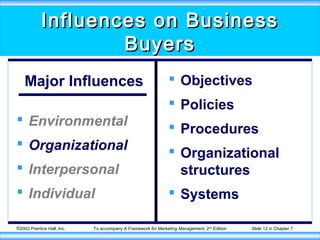
Influences on BusinessInfluences on Business
BuyersBuyers
Major Influences
 Environmental
 Organizational
 Interpersonal
 Individual
 Objectives
 Policies
 Procedures
 Organizational
structures
 Systems
©2003 Prentice Hall, Inc. To accompany A Framework for Marketing Management, 2nd
Edition Slide 13 in Chapter 7
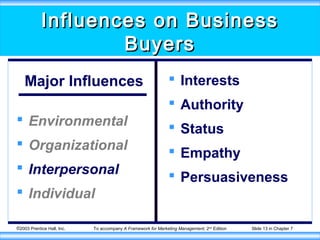
Influences on BusinessInfluences on Business
BuyersBuyers
Major Influences
 Environmental
 Organizational
 Interpersonal
 Individual
 Interests
 Authority
 Status
 Empathy
 Persuasiveness
©2003 Prentice Hall, Inc. To accompany A Framework for Marketing Management, 2nd
Edition Slide 14 in Chapter 7
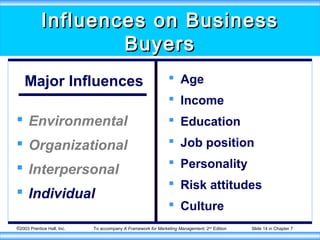
Influences on BusinessInfluences on Business
BuyersBuyers
Major Influences
 Environmental
 Organizational
 Interpersonal
 Individual
 Age
 Income
 Education
 Job position
 Personality
 Risk attitudes
 Culture
©2003 Prentice Hall, Inc. To accompany A Framework for Marketing Management, 2nd
Edition Slide 15 in Chapter 7
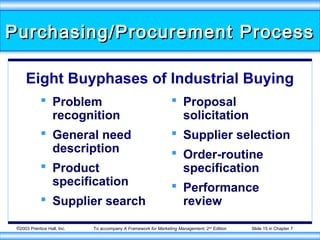
Purchasing/Procurement ProcessPurchasing/Procurement Process
 Problem
recognition
 General need
description
 Product
specification
 Supplier search
 Proposal
solicitation
 Supplier selection
 Order-routine
specification
 Performance
review
Eight Buyphases of Industrial Buying
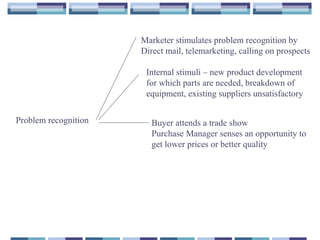
Problem recognition
Marketer stimulates problem recognition by
Direct mail, telemarketing, calling on prospects
Internal stimuli – new product development
for which parts are needed, breakdown of
equipment, existing suppliers unsatisfactory
Buyer attends a trade show
Purchase Manager senses an opportunity to
get lower prices or better quality
General need description
and product specification
Standard items – go as per internal records or
as per specs laid out in ISI documents
Complex items – collaborate with engineers,
users; else sit with marketer’s application
engineers who do consultative selling and
work out specs and likely price
Certain buying organizations attach a PVA or
product value analysis team to the project
who will conduct extensive analysis to arrive
at specs that will lead to minimum cost
Supplier Search
Identify suppliers
- trade directories, hunt online catalogs for suppliers
- trade shows
- trade advertisements
- Internet search – Websites have two types of e-hubs
Vertical hubs centered on industries
-plastics, steel, paper
Functional hubs centered on logistics
media buying, advertising
-Direct extranet links to major suppliers
(WalMart – P&G)
-Buying alliances to get best price.
Coca-Cola, Sara Lee, Kraft, PepsiCo, Gillette
P&G, have joined to form alliance – Transora
-Company buying sites – Firms like GE have their
own site where it places Requests for Proposal,
negotiate terms, place orders
Proposal Solicitation
Invite suppliers to make detailed proposals
Set up quality standards if any e.g ISO 9000 or
ISI etc.
Large technology systems need a detailed
Techno-Commercial proposal. The technical
quote will be cleared first and after that only
qualified technical bidders will be called for
commercial negotiation
Buyers can invite suppliers to make presentations.
Supplier Selection
A supplier rating list is made by some companies
based on relative importance given to a select set
of attributes.
For routine order products the factors are : price,
supplier reputation, delivery .
For procedural problem products such as copiers the
important attributes are : technical service, supplier
flexibility, reliability and price
For political problem products such as choice of a
set of computers the factors are price, reputation,
reliability and flexibility
One way to encounter price factor from supplier side
is to talk of total cost of product or life cycle cost.
Order routine
specification
Buyers negotiate the final order with the selected
suppliers, and details the tech. specs., the quantity
the delivery time, return policies, warranties etc.
For maintenance and repair items , firms are moving
towards a blanket contract that establishes a long run
relation. Such contracts are called stockless
purchase plans as the stock is held by the supplier
Long run contracts are also agreed upon in case of
shortage raw materials / inputs so that there is a
steady flow of material. In many cases the supplier
locates his factory near the buyer for bringing down
inventory and transport costs.
Vendor managed inventory is when the responsibility
rests with the vendor for maintaining inventory
Important parameters to see are OT – deliver on time
IF – in full, NE – No error
Performance Review
Three methods of review
1 Ask for evaluation from buyers
2 Buyer rates supplier on weighted score
method
3. Based on drawbacks of performance the
buyer may come up with adjusted cost
of purchase including price
4. Managers are rewarded for good buying
performance
Institutional and Government Markets
1. Institutional Markets are – schools, colleges, universities, hospitals,
nursing homes.
2. Institutions normally ask for lowest price given a minimum quality
3. In government organizations the normal process is bidding with the
order going to the lowest bidder(s)
4. Negotiated contracts are applicable where the project is complex and
risky.
5. Governments tend to favor domestic suppliers
6. Government decisions are subject to review, so there is lot of paperwork
in contracting
7. Director General of Supplies and Disposals is the central purchasing unit of
Indian Government.
©2003 Prentice Hall, Inc.
THANK YOU ,
To accompany A Framework for Marketing Management, 2nd
Edition Slide 24 in Chapter 7

organization buying behavior

  • 1.
    ©2003 Prentice Hall,Inc. Copyright © 2004 by South-Western, a division of Thomson Learning, Inc. All rights reserved.Developed by Cool Pictures and MultiMedia Presentations
  • 2.
    ©2003 Prentice Hall,Inc. To accompany A Framework for Marketing Management, 2nd Edition Slide 2 in Chapter 7 ObjectivesObjectives  Understand the nature of the business market and how it differs from the consumer market.  Learn how institutions and government agencies buy.  Identify the different buying situations faced by organizational buyers.  Identify the participants in the business buying process and the various influences impacting business buying decisions.  Understand how business buyers make their decisions.
  • 3.
    ©2003 Prentice Hall,Inc. To accompany A Framework for Marketing Management, 2nd Edition Slide 3 in Chapter 7 Organizational BuyingOrganizational Buying  Organizational buying is: “the decision-making process by which formal organizations establish the need for purchased products and services and identify, evaluate, and choose among alternative brands and suppliers.”
  • 4.
    ©2003 Prentice Hall,Inc. To accompany A Framework for Marketing Management, 2nd Edition Slide 4 in Chapter 7 Organizational BuyingOrganizational Buying  Compared to Consumer Markets, Business Markets have . . . –Fewer buyers –Larger buyers –Geographically concentrated buyers –Close relationships with their supplier-customers
  • 5.
    ©2003 Prentice Hall,Inc. To accompany A Framework for Marketing Management, 2nd Edition Slide 5 in Chapter 7 Organizational BuyingOrganizational Buying  Fluctuating demand  Derived demand  Inelastic demand  Professional purchasing  Multiple sales calls  Direct purchasing  Geographical Concentrated Buyer Other Business Market Characteristics
  • 6.
    ©2003 Prentice Hall,Inc. To accompany A Framework for Marketing Management, 2nd Edition Slide 6 in Chapter 7 Organizational BuyingOrganizational Buying  The Business Market Includes For-Profit Companies and Four Specialized Groups:
  • 7.
    ©2003 Prentice Hall,Inc. To accompany A Framework for Marketing Management, 2nd Edition Slide 7 in Chapter 7 Organizational BuyingOrganizational Buying Buying Situations  Straight rebuy  Modified rebuy  New task  Routine reorders from approved vendor list  Low involvement, minimal time commitment  Example: copier paper
  • 8.
    ©2003 Prentice Hall,Inc. To accompany A Framework for Marketing Management, 2nd Edition Slide 8 in Chapter 7 Organizational BuyingOrganizational Buying Buying Situations  Straight rebuy  Modified rebuy  New task  Specifications, prices, delivery terms or other aspects require modification  Moderate level of involvement and time commitment  Example: desktop computers
  • 9.
    ©2003 Prentice Hall,Inc. To accompany A Framework for Marketing Management, 2nd Edition Slide 9 in Chapter 7 Organizational BuyingOrganizational Buying Buying Situations  Straight rebuy  Modified rebuy  New task  Purchasing a product or service for the first time  High level of involvement and time commitment; multiple influences  Example: selecting a web site design firm or consultant
  • 10.
    ©2003 Prentice Hall,Inc. To accompany A Framework for Marketing Management, 2nd Edition Slide 10 in Chapter 7 Participants in Business BuyingParticipants in Business Buying  Initiators  Users  Influencers  Deciders  Approvers  Buyers Buying center members fill one or more roles in the purchase decision process: Gatekeepers
  • 11.
    ©2003 Prentice Hall,Inc. To accompany A Framework for Marketing Management, 2nd Edition Slide 11 in Chapter 7 Influences on BusinessInfluences on Business BuyersBuyers Major Influences  Environmental  Organizational  Interpersonal  Individual  Demand level  Economic outlook  Technological change  Politics/regulations  Competition  Concerns for social responsibility
  • 12.
    ©2003 Prentice Hall,Inc. To accompany A Framework for Marketing Management, 2nd Edition Slide 12 in Chapter 7 Influences on BusinessInfluences on Business BuyersBuyers Major Influences  Environmental  Organizational  Interpersonal  Individual  Objectives  Policies  Procedures  Organizational structures  Systems
  • 13.
    ©2003 Prentice Hall,Inc. To accompany A Framework for Marketing Management, 2nd Edition Slide 13 in Chapter 7 Influences on BusinessInfluences on Business BuyersBuyers Major Influences  Environmental  Organizational  Interpersonal  Individual  Interests  Authority  Status  Empathy  Persuasiveness
  • 14.
    ©2003 Prentice Hall,Inc. To accompany A Framework for Marketing Management, 2nd Edition Slide 14 in Chapter 7 Influences on BusinessInfluences on Business BuyersBuyers Major Influences  Environmental  Organizational  Interpersonal  Individual  Age  Income  Education  Job position  Personality  Risk attitudes  Culture
  • 15.
    ©2003 Prentice Hall,Inc. To accompany A Framework for Marketing Management, 2nd Edition Slide 15 in Chapter 7 Purchasing/Procurement ProcessPurchasing/Procurement Process  Problem recognition  General need description  Product specification  Supplier search  Proposal solicitation  Supplier selection  Order-routine specification  Performance review Eight Buyphases of Industrial Buying
  • 16.
    Problem recognition Marketer stimulatesproblem recognition by Direct mail, telemarketing, calling on prospects Internal stimuli – new product development for which parts are needed, breakdown of equipment, existing suppliers unsatisfactory Buyer attends a trade show Purchase Manager senses an opportunity to get lower prices or better quality
  • 17.
    General need description andproduct specification Standard items – go as per internal records or as per specs laid out in ISI documents Complex items – collaborate with engineers, users; else sit with marketer’s application engineers who do consultative selling and work out specs and likely price Certain buying organizations attach a PVA or product value analysis team to the project who will conduct extensive analysis to arrive at specs that will lead to minimum cost
  • 18.
    Supplier Search Identify suppliers -trade directories, hunt online catalogs for suppliers - trade shows - trade advertisements - Internet search – Websites have two types of e-hubs Vertical hubs centered on industries -plastics, steel, paper Functional hubs centered on logistics media buying, advertising -Direct extranet links to major suppliers (WalMart – P&G) -Buying alliances to get best price. Coca-Cola, Sara Lee, Kraft, PepsiCo, Gillette P&G, have joined to form alliance – Transora -Company buying sites – Firms like GE have their own site where it places Requests for Proposal, negotiate terms, place orders
  • 19.
    Proposal Solicitation Invite suppliersto make detailed proposals Set up quality standards if any e.g ISO 9000 or ISI etc. Large technology systems need a detailed Techno-Commercial proposal. The technical quote will be cleared first and after that only qualified technical bidders will be called for commercial negotiation Buyers can invite suppliers to make presentations.
  • 20.
    Supplier Selection A supplierrating list is made by some companies based on relative importance given to a select set of attributes. For routine order products the factors are : price, supplier reputation, delivery . For procedural problem products such as copiers the important attributes are : technical service, supplier flexibility, reliability and price For political problem products such as choice of a set of computers the factors are price, reputation, reliability and flexibility One way to encounter price factor from supplier side is to talk of total cost of product or life cycle cost.
  • 21.
    Order routine specification Buyers negotiatethe final order with the selected suppliers, and details the tech. specs., the quantity the delivery time, return policies, warranties etc. For maintenance and repair items , firms are moving towards a blanket contract that establishes a long run relation. Such contracts are called stockless purchase plans as the stock is held by the supplier Long run contracts are also agreed upon in case of shortage raw materials / inputs so that there is a steady flow of material. In many cases the supplier locates his factory near the buyer for bringing down inventory and transport costs. Vendor managed inventory is when the responsibility rests with the vendor for maintaining inventory Important parameters to see are OT – deliver on time IF – in full, NE – No error
  • 22.
    Performance Review Three methodsof review 1 Ask for evaluation from buyers 2 Buyer rates supplier on weighted score method 3. Based on drawbacks of performance the buyer may come up with adjusted cost of purchase including price 4. Managers are rewarded for good buying performance
  • 23.
    Institutional and GovernmentMarkets 1. Institutional Markets are – schools, colleges, universities, hospitals, nursing homes. 2. Institutions normally ask for lowest price given a minimum quality 3. In government organizations the normal process is bidding with the order going to the lowest bidder(s) 4. Negotiated contracts are applicable where the project is complex and risky. 5. Governments tend to favor domestic suppliers 6. Government decisions are subject to review, so there is lot of paperwork in contracting 7. Director General of Supplies and Disposals is the central purchasing unit of Indian Government.
  • 24.
    ©2003 Prentice Hall,Inc. THANK YOU , To accompany A Framework for Marketing Management, 2nd Edition Slide 24 in Chapter 7