R e - E n g i n e e r i n g
A. Y. Dadabhai Technical Institute
Department of
MECHANICAL ENGINEERING
Industrial Engineering (3351904)
Guide By:
Mr S. H. Patel
Prepared By:
Satish Patel
116010319119
This is to certify that Patel Satish M. of mechanical engineering
department Enrollment no.: 116010319119 studies in 5th semester from
A.Y. Dadabhai Technical Institute, Kosamba has finished the topic “RE-
ENGINEERING satisfactorily in subject INDUSTRIAL ENGINEERING.
___________________
Guide
DEFINITION OF RE-ENGINEERING
Reengineering is the fundamental rethinking and radical
redesign of business processes to achieve dramatic
improvements in critical, contemporary measures of
performance such as cost, quality, service, and speed.”
RE-ENGINEERING
 ALL Industries Now -a-days re –examining the production activists .Because, they
are interested to speed up their production activities .Now business process RE-
ENGINEERIG technique is developed, with which industries are preparing new
design for production work.
 It is their attempt to speed up the productions Activates with the help of new
designs. RE-ENGINEERING provides, themes success in their attempts ,Now-a-days
from normal producer to the industries having high technology Are implementing the
need of speed up their activates.
RE-ENGINEERING
RE-ENGINEERING
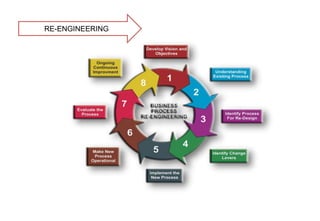
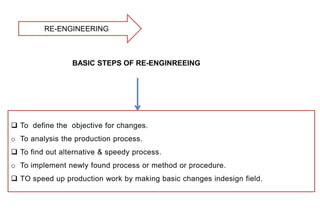
BASIC STEPS OF RE-ENGINREEING
Why BPR Is Necessary
– Change becomes constant.
• reduced product cycles
• reduced time to develop new products
• more environment scanning
• Technology
• Customer Preferences
– “Companies created to thrive on mass production, stability, and growth
can’t be fixed to succeed in [such] a world.”
• Integrate people, technology, & organizational culture to Respond to rapidly
changing technical & business environment and customer’s needs to
achieve Big performance gains
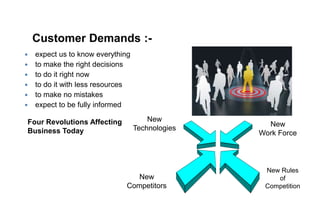
 expect us to know everything
 to make the right decisions
 to do it right now
 to do it with less resources
 to make no mistakes
 expect to be fully informed
Customer Demands :-
Four Revolutions Affecting
Business Today
New
Competitors
New
Technologies
New
Work Force
New Rules
of
Competition
The C’s related to Organization Re-engineering
Projects:-
The 3C’s of organization Re-
engineering:
• Customers
• Competition
• Change
The 4C’s of effective teams:
• Commitment
• Cooperation
• Communication
• Contribution
Some of the BPR Objectives:-
• Improve Efficiency e.g. reduce time to market, provide quicker
response to customers
• Increase Effectiveness e.g. deliver higher quality
• Achieve Cost Saving in the longer run
• Provide more Meaningful work for employees
• Increase Flexibility and Adaptability to change
• Enable new business Growth.
Skills Required:-
 Capacity to view the organization as a whole
 Ability to focus on end-customers
 Ability to challenge fundamental assumptions
 Courage to deliver and venture into unknown areas
 Ability to assume individual and collective responsibility
Use of Consultants
• Used to generate internal capacity
• Appropriate when a implementation is needed quickly
• Ensure that adequate consultation is sought from staff so that the initiative is organization-led
and not consultant-driven
• Control should never be handed over to the consultant
How to Avoid BPR Failure
• To avoid failure of the BPR process it is recommended that:
• BPR must be accompanied by strategic planning, which addresses
leveraging Information technology as a competitive tool.
• Place the customer at the centre of the reengineering effort, concentrate
on reengineering fragmented processes that lead to delays or other
negative impacts on customer service.
• BPR must be "owned" throughout the organization, not driven by a group
of outside consultants.
• Case teams must be comprised of both managers as well as those who
will actually do the work.
Common Problems with BPR
• Process Simplification is Common - True BPR is Not
• Desire to Change Not Strong Enough
• Start Point the Existing Process Not a Blank Slate
• Commitment to Existing Processes Too Strong
– REMEMBER - “If it isn’t broke …”
• Process under review too big or too small
• Reliance on existing process too strong
• The Costs of the Change Seem Too Large
• BPR Isolated Activity not Aligned to the Business Objectives
• Allocation of Resources
• Poor Timing and Planning
• Keeping the Team and Organization on Target
WHY DOES REENGINEERING FAIL?
 Trying to fix a process instead of changing it
 Ignoring everything except the process design
 Quitting too early
 Reengineering from the bottom up
 Neglecting people’s values and beliefs
 Being willing to settle for minor results
 Assigning someone who does not understand reengineering to lead
the effort.
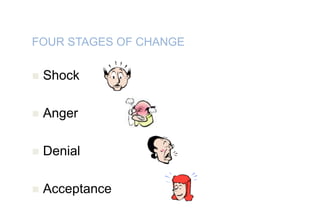
FOUR STAGES OF CHANGE
 Shock
 Anger
 Denial
 Acceptance
• Think about the transition from shock to acceptance and how an
organization may overcome them.
• Shock- usually the first reaction once a change has been announced. "
Where in the world did this come from?" "Why?"
• Anger- if change is viewed in a negative way, people may react in anger.
They blame other persons and begin to not accept or support the change.
"It wont work and I will not accept this." This can be very damaging to a
process and needs to confronted.
• Denial- this person begins to make excuses as to why he or she should not
be held accountable for anything that may go wrong. " Don't blame me if
this doesn't work, it wasn't my idea."
• Acceptance- this is the goal an organization needs to get all employees to.
This person has accepted the change and begins to invision his or her role
in the new situation. "How can I help my organization in this process."
HOW TO IMPLEMENT
3 steps to transition of change
 1. Discontinuation of the old way of doing business
 2. Migration
 3. Starting the new way of doing business
Conclusion:
 BPR is a multi-discipline approach for strategic change
 Methodology provides missing “how to” that must follow the “why”
 BPR must be managed as a project
 BPR must be owned by the organization, not driven by consultants
 BPR requires constant communication and feedback

Re-engineering - i.e. 116010319119

  • 1.
    R e -E n g i n e e r i n g A. Y. Dadabhai Technical Institute Department of MECHANICAL ENGINEERING Industrial Engineering (3351904) Guide By: Mr S. H. Patel Prepared By: Satish Patel 116010319119
  • 2.
    This is tocertify that Patel Satish M. of mechanical engineering department Enrollment no.: 116010319119 studies in 5th semester from A.Y. Dadabhai Technical Institute, Kosamba has finished the topic “RE- ENGINEERING satisfactorily in subject INDUSTRIAL ENGINEERING. ___________________ Guide
  • 3.
    DEFINITION OF RE-ENGINEERING Reengineeringis the fundamental rethinking and radical redesign of business processes to achieve dramatic improvements in critical, contemporary measures of performance such as cost, quality, service, and speed.”
  • 4.
    RE-ENGINEERING  ALL IndustriesNow -a-days re –examining the production activists .Because, they are interested to speed up their production activities .Now business process RE- ENGINEERIG technique is developed, with which industries are preparing new design for production work.  It is their attempt to speed up the productions Activates with the help of new designs. RE-ENGINEERING provides, themes success in their attempts ,Now-a-days from normal producer to the industries having high technology Are implementing the need of speed up their activates.
  • 5.
  • 6.
  • 7.
    Why BPR IsNecessary – Change becomes constant. • reduced product cycles • reduced time to develop new products • more environment scanning • Technology • Customer Preferences – “Companies created to thrive on mass production, stability, and growth can’t be fixed to succeed in [such] a world.” • Integrate people, technology, & organizational culture to Respond to rapidly changing technical & business environment and customer’s needs to achieve Big performance gains
  • 8.
     expect usto know everything  to make the right decisions  to do it right now  to do it with less resources  to make no mistakes  expect to be fully informed Customer Demands :- Four Revolutions Affecting Business Today New Competitors New Technologies New Work Force New Rules of Competition
  • 9.
    The C’s relatedto Organization Re-engineering Projects:- The 3C’s of organization Re- engineering: • Customers • Competition • Change The 4C’s of effective teams: • Commitment • Cooperation • Communication • Contribution
  • 10.
    Some of theBPR Objectives:- • Improve Efficiency e.g. reduce time to market, provide quicker response to customers • Increase Effectiveness e.g. deliver higher quality • Achieve Cost Saving in the longer run • Provide more Meaningful work for employees • Increase Flexibility and Adaptability to change • Enable new business Growth.
  • 12.
    Skills Required:-  Capacityto view the organization as a whole  Ability to focus on end-customers  Ability to challenge fundamental assumptions  Courage to deliver and venture into unknown areas  Ability to assume individual and collective responsibility Use of Consultants • Used to generate internal capacity • Appropriate when a implementation is needed quickly • Ensure that adequate consultation is sought from staff so that the initiative is organization-led and not consultant-driven • Control should never be handed over to the consultant
  • 13.
    How to AvoidBPR Failure • To avoid failure of the BPR process it is recommended that: • BPR must be accompanied by strategic planning, which addresses leveraging Information technology as a competitive tool. • Place the customer at the centre of the reengineering effort, concentrate on reengineering fragmented processes that lead to delays or other negative impacts on customer service. • BPR must be "owned" throughout the organization, not driven by a group of outside consultants. • Case teams must be comprised of both managers as well as those who will actually do the work.
  • 14.
    Common Problems withBPR • Process Simplification is Common - True BPR is Not • Desire to Change Not Strong Enough • Start Point the Existing Process Not a Blank Slate • Commitment to Existing Processes Too Strong – REMEMBER - “If it isn’t broke …” • Process under review too big or too small • Reliance on existing process too strong • The Costs of the Change Seem Too Large • BPR Isolated Activity not Aligned to the Business Objectives • Allocation of Resources • Poor Timing and Planning • Keeping the Team and Organization on Target
  • 15.
    WHY DOES REENGINEERINGFAIL?  Trying to fix a process instead of changing it  Ignoring everything except the process design  Quitting too early  Reengineering from the bottom up  Neglecting people’s values and beliefs  Being willing to settle for minor results  Assigning someone who does not understand reengineering to lead the effort.
  • 16.
    FOUR STAGES OFCHANGE  Shock  Anger  Denial  Acceptance
  • 17.
    • Think aboutthe transition from shock to acceptance and how an organization may overcome them. • Shock- usually the first reaction once a change has been announced. " Where in the world did this come from?" "Why?" • Anger- if change is viewed in a negative way, people may react in anger. They blame other persons and begin to not accept or support the change. "It wont work and I will not accept this." This can be very damaging to a process and needs to confronted. • Denial- this person begins to make excuses as to why he or she should not be held accountable for anything that may go wrong. " Don't blame me if this doesn't work, it wasn't my idea." • Acceptance- this is the goal an organization needs to get all employees to. This person has accepted the change and begins to invision his or her role in the new situation. "How can I help my organization in this process."
  • 18.
    HOW TO IMPLEMENT 3steps to transition of change  1. Discontinuation of the old way of doing business  2. Migration  3. Starting the new way of doing business
  • 19.
    Conclusion:  BPR isa multi-discipline approach for strategic change  Methodology provides missing “how to” that must follow the “why”  BPR must be managed as a project  BPR must be owned by the organization, not driven by consultants  BPR requires constant communication and feedback